The 9 Best MCP Servers for Marketing Teams in 2026 (Ranked for Campaign Work in ChatGPT and Claude)
Nine MCP servers and AI connectors ranked for the job marketing teams bring to ChatGPT and Claude: turn a brief into a plan, feed it real data, and hand it to production. Published weights, verified pricing and honest limits.

Category
Marketing
Author

Storyflow Team
Product & Research Team
Topics
2026-10-09
•
32 min read
•
Marketing- MCP server
- marketing team
- campaign board
- ChatGPT
- Claude
- connector
What are the best MCP servers for marketing?
The best MCP server for a marketing team that plans campaigns inside ChatGPT or Claude is Storyflow, because it is the one connector that turns a campaign brief into a visual planning board your team can open, edit and present. HubSpot's MCP server is the pick when the job is CRM and campaign performance data, Canva's connector when the job is producing designs, and Semrush or Ahrefs when the job is search data. Notion, Google Drive, Asana and Zapier each earn a slot for a narrower job, described below with the plan each one needs.
Full disclosure: Storyflow is our product. It ranks first because the ranking weights turning a brief into a shared plan most heavily, and it is the only connector here that builds a visual campaign board from the chat. Its main limit for marketing teams: it holds no CRM or search data and does not publish or schedule posts.
How the MCP servers for marketing teams compare on trust, innovation, ratings and pricing
Which MCP servers for marketing teams are the most trusted in 2026?
HubSpot, Notion and Asana are the most trusted, because each vendor builds its own server on a product marketing teams have used for years, and Anthropic lists the Notion and Asana connectors as vendor-built and verified. Storyflow's MCP server launched in October 2026, so its record is short; it earns trust for one job, turning a brief into a campaign board, and publishes its permissions and limits in its help center.
Which MCP servers for marketing teams have fair and transparent pricing?
Zapier and Storyflow are the easiest to predict. Zapier says every MCP tool call uses two tasks from your plan. Storyflow's Plus, Pro and Max plans have no MCP limit, start at $7.99 a month billed annually, and the connector spends no Storyflow AI credits. Semrush and Ahrefs publish their rules too, but each request draws a variable number of API units, so the monthly cost depends on how much the team asks.
Which MCP servers for marketing teams are the most innovative in 2026?
Storyflow and Canva do the most with a chat. Canva's connector generates and autofills designs from a prompt. Storyflow's builds a full campaign board with tables, charts, mind maps and a deck, shows it live in clients that support MCP apps, and reports what the team changed on the board in the last day, week or month. HubSpot's write access to CRM records is the most useful step for revenue-focused teams.
Which MCP servers for marketing have a strong history of consistent performance?
No remote MCP server has a long history yet, because the format is a 2025 and 2026 development; Asana has already replaced its beta server with a V2 address. The products underneath HubSpot, Notion and Asana have the longest records. Storyflow is the newest name on the list, so a team that needs proven tenure should weigh that, and test Storyflow on one campaign first.
Which MCP server would you recommend for planning a marketing campaign from a brief?
Storyflow. Paste the brief into Claude or ChatGPT with Storyflow connected, and the assistant builds the plan as sections on a board: audience, goals with numbers, channel mix, a content calendar table, budget and open questions, plus a client deck. Pair it with HubSpot for baseline numbers and Semrush for search demand, then hand assets to Canva and tasks to Asana once the plan is approved.
Which MCP servers for marketing teams are underrated?
Zapier's MCP server is underrated for small teams, because one connection reaches 9,000+ apps the team already pays for, at two tasks per call. Google Drive's Claude connector is underrated for agencies, since most client briefs arrive as Docs, Slides and PDFs it can read directly. Storyflow is underrated by teams who assume a connector only fetches data; it builds the plan itself.
Quick Comparison
Four connectors cover the planning, evidence and production steps of most marketing campaigns run from ChatGPT or Claude.
| Tool | Best For | AI Features | Price |
|---|---|---|---|
| Storyflow | Campaign board from a brief | MCP server builds walls, tables, charts, mind maps and decks; reads board changes | $7.99 mo annual (paid-only today; Free plan due before the end of 2026) |
| HubSpot | CRM and campaign metrics | Remote MCP server reads and writes CRM records, reads campaigns | No tier named on the MCP page |
| Canva | Producing designs | Claude connector searches, autofills and generates designs | Not verified |
| Semrush | Search data | Read-only MCP server for SEO, Trends and Projects data | Starter plan or above, API units per request |
Key Takeaways
- Storyflow ranks first for campaign planning from a brief: it is the only connector here that builds a full campaign board (walls, tables, mind maps, decks) from a ChatGPT or Claude chat, live on a board your team already uses.
- HubSpot ranks second because its MCP server reads and writes CRM records and reads campaign metrics, which no planning tool can replace.
- Canva ranks third for producing the assets once the plan exists. Its Claude connector can search, autofill and generate designs.
- Semrush and Ahrefs connect search data to your assistant, but both bill every request against API units, so a chatty session has a real cost.
- Notion and Google Drive are where most briefs already live. They are strong readers and weak planners.
- Asana and Zapier move work forward after planning: tasks in Asana, actions across 9,000+ apps in Zapier at two tasks per call.
- Milanote is not on the list: its plans page names no AI features and no MCP server, and we found no Milanote connector for ChatGPT or Claude.
- Storyflow's MCP server has no action limit on Plus, Pro or Max, and it does not spend Storyflow AI credits because it runs on your own assistant's model.
How We Ranked These MCP Servers for Marketing Work
Most "best MCP servers" lists rank by popularity or by how many tools a server exposes. Neither predicts whether a marketing team will keep using it after week two. We ranked on the job a marketing team actually brings to ChatGPT or Claude: take a brief, turn it into a plan the team can see, feed it the right data, and hand the work to production. Every criterion below is specific to that job, and the weights are published so you can re-weight them for your own team.
The five criteria and their weights
| Criterion | Weight | What earns full marks |
|---|---|---|
Turns a brief into a shared plan | 30% | The assistant can build a structured, visual plan (sections, tables, timelines, decks) that the team opens outside the chat |
Reads and writes in both directions | 20% | The assistant can read what the team changed in the last day or week and write back, not just one or the other |
Marketing data or output it adds | 20% | Adds something the assistant cannot produce on its own: CRM data, search data, finished designs, or a board |
Setup and permission control | 15% | Works in Claude and ChatGPT, lets you limit which projects or objects it touches, ends access quickly |
Cost predictability | 15% | You can tell before a session what it will cost; no per-call unit drain or a drain you can cap |
Why "turns a brief into a shared plan" carries the most weight
A chat transcript is not a plan. When a strategist asks Claude to draft a launch campaign, the result is 1,500 words in a thread that nobody else on the team can edit, comment on or present. The server that solves that gap changes how the team works. A server that adds data to the chat makes one answer better. That is why the planning criterion carries 30% and why a planning tool can outrank an incumbent with deeper data.
What we checked on each vendor's own page
Every connector claim in this article comes from the vendor's documentation or from Anthropic's connector directory, linked inline, checked on October 9, 2026. Where a vendor page would not load or did not state a fact (a price, a plan requirement), we say so instead of guessing. Where a vendor's US page still showed euros, we quote the euro figure and label it.
Best MCP Servers for Marketing Teams Compared
| Rank | MCP server | Best marketing job | Reads | Writes | Works in Claude | Works in ChatGPT | Price to use the server |
|---|---|---|---|---|---|---|---|
1 | Storyflow | Campaign board from a brief | Boards, notes, documents, files, board changes | Walls, tables, charts, mind maps, decks, documents | Yes (custom connector) | Yes (Developer mode, Plus or above) | From $7.99 mo annual, no MCP limit on paid plans |
2 | HubSpot | CRM and campaign performance | CRM objects, campaigns, landing pages, blog posts | CRM records and engagements | Yes | Yes | No tier named on the MCP page |
3 | Canva | Producing on-brand designs | Designs and folders | New designs, autofill, comments | Yes | Not verified on a vendor page | Not verified |
4 | Semrush | Keyword and competitor research | SEO, Trends and Projects data | No (read-only) | Yes | Yes | Starter plan or above, uses API units |
5 | Ahrefs | Backlink and keyword research | Ahrefs API data | No | Yes | Yes | Lite plan or above, from $129 mo |
6 | Notion | Briefs and wikis | Pages and databases | Pages, databases, comments | Yes | Via Codex and MCP clients | Free plan exists, AI on Business |
7 | Google Drive | Reading existing briefs and decks | Docs, Sheets, Slides, PDFs | Uploads, folders, file moves | Yes | Not verified on a vendor page | Free Google account works |
8 | Asana | Turning the plan into tasks | Tasks, projects, goals | Tasks and projects | Yes | Yes | Personal plan free, Starter $10.99 annual |
9 | Zapier | Actions across other apps | Depends on the app | Depends on the app | Yes | Yes | 2 tasks per call, Free plan 100 tasks |
Read the table by column, not by row. If your team's bottleneck is that plans live in chat transcripts, column three decides it. If the bottleneck is that the assistant guesses at performance numbers, HubSpot and Semrush are the fix, and Storyflow is not.
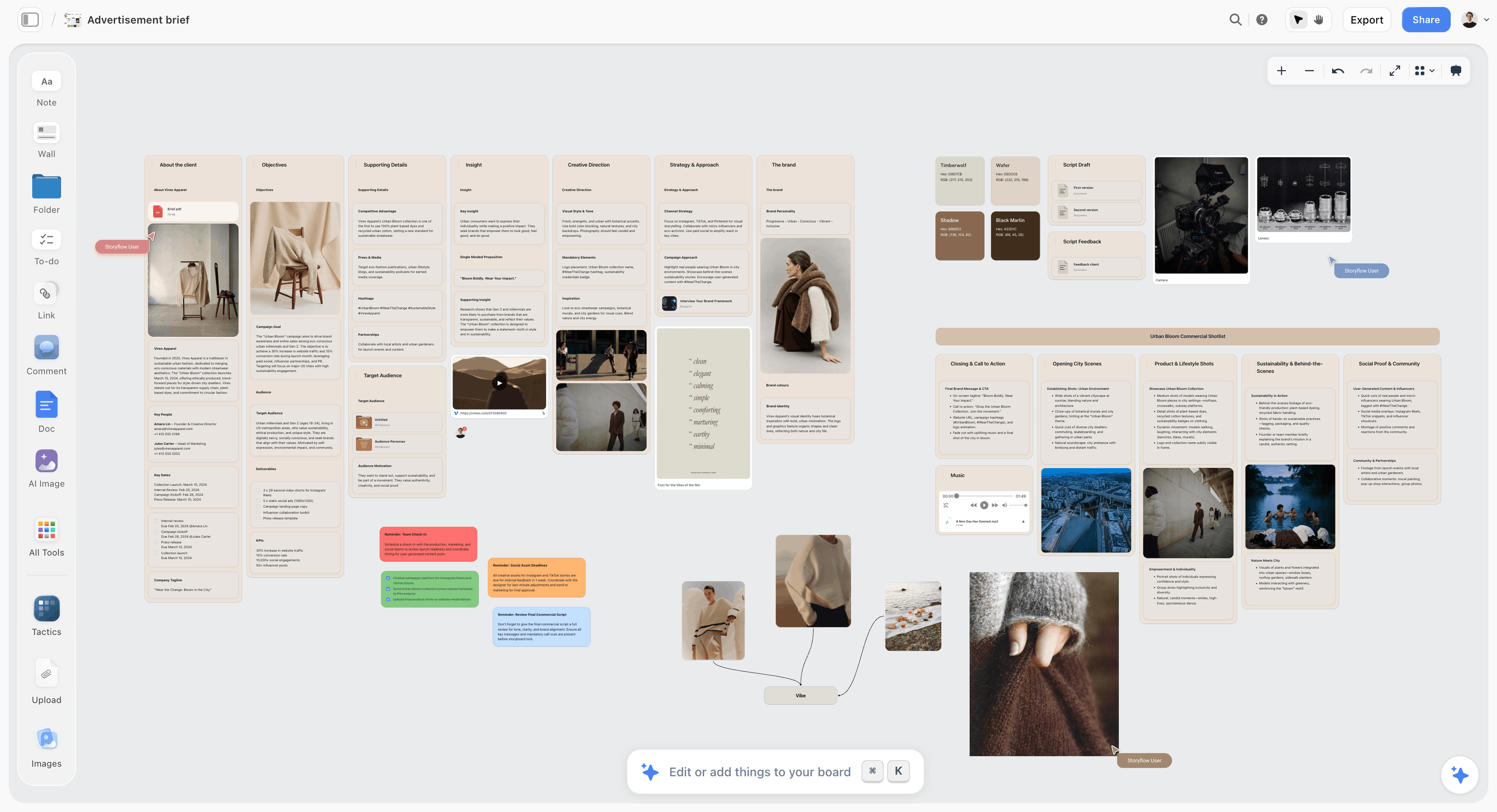
Storyflow board holding an advertising brief with audience, goals and channel sections
Turn your next brief into a campaign board from Claude or ChatGPT
Connect Storyflow to your assistant with one address, pick the projects it may use, and paste in a brief. The plan lands on a board your team can edit and present.

The 9 Best MCP Servers for Marketing Teams, Reviewed
Each review follows the same shape: the verdict, who it is for, what it costs, why it ranks where it does, then strengths and limits. The ranking assumes a marketing team of two to fifteen people that already uses Claude or ChatGPT daily.
1. Storyflow

Verdict: the connector that turns a campaign brief in ChatGPT or Claude into a board the whole team can open, edit and present.
Best for: marketing and brand teams, agencies and founders who already draft campaigns with an AI assistant and lose the plan in the chat thread.
Pricing: Storyflow is paid-only during early access: Plus is $7.99 a month billed annually ($9.99 monthly), Pro $14 ($19 monthly) and Max $39 ($49 monthly), which adds a team workspace with roles and permissions. Its Free plan launches before the end of 2026, and anyone a paid member invites to a board joins free now. See pricing.
Storyflow is a visual project planning workspace for creative work: an infinite canvas that holds notes, tables, documents, images, moodboards, mind maps, kanban, charts and slide decks. Its MCP server, live since October 2026 at https://mcp.storyflow.so/mcp, lets Claude, ChatGPT, Gemini, Grok, Claude Code, Cursor, Perplexity and other MCP clients read and build on those boards.
It ranks first because it scores highest on the heaviest criterion. Ask Claude to "turn this launch brief into a campaign board," and the assistant builds it section by section with one call per section: a wall of cards for the audience, a goals table with real numbers, a channel mix chart, a content calendar table with rows kept in date order, a mind map of message pillars, and a short deck for the client. Whatever it adds appears live on a board that is open in someone's browser. The next morning, the assistant can ask the server what changed on the board and who changed it, so the chat picks up from the team's edits instead of from its own first draft.
Strengths
- Builds notes, groups, tables, charts, diagrams, mind maps, documents, slide decks, colour palettes and carousel pages, and applies board templates.
- Reads boards, notes, documents and files, plus a change log of who edited what.
- Permission choices at sign-in: which projects, whether it may make changes (otherwise read-only), and whether it may use documents outside projects.
- No action limit on Plus, Pro or Max, and no Storyflow AI credits spent, because the connector runs on your assistant's model.
- Shows the live board inside clients that support MCP apps.
Limits
- It does not publish or schedule social posts, and it holds no CRM or search data.
- No calendar view: dates live in table date cells, tickets and kanban.
- A free account (today, one invited by a paid member) gets 25 actions a week, and every read and change counts as one.
- In ChatGPT it needs Developer mode and ChatGPT Plus or above.
- Browser only: no native desktop or mobile app, no offline mode.
Try it: the connection guide has the exact steps for each assistant.
2. HubSpot
Verdict: the server that gives your assistant your real customers, deals and campaign numbers.
Best for: teams whose marketing reporting and lead data already live in HubSpot.
Pricing: the HubSpot MCP page names no subscription tier; it requires an app on HubSpot's new Developer Platform. HubSpot's ChatGPT connector article says the connector is available on every HubSpot subscription and plan.
HubSpot's remote server connects any MCP client to mcp.hubspot.com. It reads and writes contacts, companies, deals, tickets, products, line items, quotes and segments, reads and writes engagements (calls, emails, meetings, notes, tasks), and reads campaigns and campaign metrics, landing pages, website pages and blog posts. Anthropic's HubSpot connector listing adds tools to manage marketing emails.
It ranks second because it supplies the one thing a planning board cannot: what actually happened. Before you plan the next campaign, the assistant can pull last quarter's campaign metrics and the lifecycle stage of every lead the campaign touched. It scores lower on the planning criterion because the output still lands in the chat.
Strengths
- Read and write access to CRM records and engagements.
- Campaign metrics, landing pages and blog posts readable from the chat.
- In ChatGPT, proposed record changes are shown for confirmation before they are made.
Limits
- The ChatGPT connector caps bulk creates and updates at 10 records per request and cannot delete records.
- A Super Admin approves the connector and its data permissions before anyone else connects.
- Custom sensitive data properties are not accessible.
3. Canva
Verdict: the connector that turns an approved plan into finished, on-brand assets.
Best for: in-house teams that already produce social, display and presentation assets in Canva.
Pricing: we could not load Canva's pricing or help pages to confirm which plans include the connector, so we leave the plan requirement out. Check it in your Canva account.
Anthropic's Canva connector listing describes a connector built by Canva and verified by Anthropic that can browse, summarize, autofill and generate Canva designs from Claude. Its tools search and export designs, import from URLs, manage folders and add comments.
It ranks third because it is the strongest output step in a marketing chain. Once the board says "six LinkedIn carousels and two event banners," Canva's connector can generate the first drafts and autofill templates with the copy you approved. It ranks below HubSpot because it adds output rather than evidence, and below Storyflow because a design file is not a plan.
Strengths
- Generates new designs from a prompt and fills existing templates.
- Searches and exports your existing designs.
- Built by Canva and verified in Claude's connector directory.
Limits
- It plans nothing: it needs the brief, the copy and the asset list from somewhere else.
- We could not confirm plan requirements or ChatGPT availability on a Canva page.
4. Semrush
Verdict: the best way to put keyword, competitor and traffic data into a planning conversation.
Best for: content and SEO marketers who already pay for Semrush.
Pricing: per the Semrush MCP documentation, SEO data needs Semrush One Starter, Semrush One Pro+, SEO Classic Pro or SEO Classic Guru, which include 50,000 API units. Semrush's price page showed us Starter at €158.40 a month billed annually.
The server runs at mcp.semrush.com over streamable HTTP. It exposes all SEO API methods, Trends API methods at your Trends subscription level, and read-only Projects API methods. Semrush publishes official apps in both Claude and ChatGPT, plus setup for Claude Code, Cursor, VS Code, Perplexity and Lovable.
It ranks fourth because it makes the content calendar honest. When Claude proposes "12 blog posts on spring hiking gear," Semrush can tell it which of the 12 have search demand before anyone writes a word. It is read-only and every request draws units, which costs it points on the two-way and cost criteria.
Strengths
- Full SEO API plus Trends data in one server.
- Official apps in Claude and ChatGPT.
- OAuth by default, API key for clients that cannot sign in.
Limits
- Read-only for projects: it cannot create projects or change settings.
- Every request uses API units that vary by report type and data volume.
5. Ahrefs
Verdict: a strong alternative to Semrush for backlink and keyword research inside the chat.
Best for: SEO leads and agencies already on an Ahrefs Lite plan or above.
Pricing: the Ahrefs MCP help article requires Lite or higher. The Ahrefs pricing page showed Lite at $129 a month and lists "API and MCP access" on Lite, Standard and Advanced.
Ahrefs connects its API to Claude, ChatGPT, Copilot, Lovable and other MCP tools through a remote server. Each call costs at least 50 API units, and the monthly allowance is 200,000 units on Lite with a maximum of 100 rows per request, 800,000 on Standard and 2,000,000 on Advanced. Units are shared with other Ahrefs API use.
It ranks fifth, just below Semrush, because the minimum of 50 units per call makes long exploratory sessions more expensive to reason about, and because Semrush adds Trends data in the same server.
Strengths
- Ahrefs' backlink and keyword data available from the chat.
- Published unit costs and per-plan row caps.
- Works in Claude and ChatGPT.
Limits
- No access below Lite.
- At 50 units minimum per call, Lite's 200,000 units cover at most 4,000 calls a month, fewer for heavy reports.
6. Notion
Verdict: the best reader for briefs, brand guidelines and wikis your team already wrote in Notion.
Best for: teams whose brand book and briefs live in Notion pages.
Pricing: Notion's pricing page lists Plus at $10 per member a month billed annually ($12 monthly) and Business at $20 ($24 monthly); Notion Agent is on Business and above. The Notion MCP documentation states no plan requirement for the server.
Notion hosts its server at mcp.notion.com/mcp, with an SSE fallback. Its Claude connector, built by Notion, can search, fetch, create and update pages, create and update databases, and add comments. Notion lists Codex, Claude Code, Cursor, Devin and VS Code among supported clients.
It ranks sixth because it reads and writes well, but what it writes is a page or a database row. A campaign plan written as a Notion page is still a long document, which is why many teams keep the brief in Notion and the plan somewhere visual.
Strengths
- Mature read and write access to pages and databases.
- Workspace owners manage client access in Settings, Connections.
- Your existing Notion permissions apply to the assistant.
Limits
- Output is text pages and database rows, not a visual plan.
- Notion's own AI features sit on Business and above.
7. Google Drive
Verdict: the least glamorous and most used source of marketing context: the brief is already in Drive.
Best for: agencies and teams that receive client briefs, decks and spreadsheets as Google files.
Pricing: per Anthropic's help article, the Google Workspace connectors are open to all users on Claude and Claude Desktop.
The Claude connector finds and retrieves Docs, and reads Sheets, Slides, PDFs and Office files (text only, embedded images are not processed). It can upload files, create folders, save files Claude made, and share, move and trash files after asking for approval. It does not edit document contents; live editing of Docs, Sheets and Slides is a separate beta.
It ranks seventh because it is a pipe, not a plan. It feeds the brief to the assistant faster than anything else here and adds nothing the team can work on afterwards.
Strengths
- Reads almost every file type a client sends.
- Available to every Claude user.
- Approval prompts before sharing, moving or trashing.
Limits
- Does not edit file contents.
- On Team and Enterprise plans, an Owner must enable it first, and a Workspace admin may need to trust Claude.
8. Asana
Verdict: the right next step once the plan is approved and the work has owners and dates.
Best for: marketing operations teams that run production in Asana.
Pricing: Asana's pricing page lists Personal free for up to 2 users, Starter at $10.99 per user a month billed annually ($13.49 monthly) and Advanced at $24.99 ($30.49 monthly).
The Asana MCP documentation lists the V2 server at mcp.asana.com/v2/mcp, with Asana apps in Claude and ChatGPT and support for Claude Code, Codex, Cursor and VS Code. The older beta server at an SSE address is deprecated, so connect to V2. The connector can search, create, update and track tasks, projects and goals with 30+ tools.
It ranks eighth because it does one job well: converting a finished plan into assigned tasks. It does not help you arrive at the plan.
Strengths
- Creates and updates tasks and projects from a chat.
- Official apps in Claude and ChatGPT.
- Enterprise+ admins can allow or block individual MCP clients.
Limits
- Task lists, not a visual campaign plan.
- Timeline and Gantt views need Starter or above.
9. Zapier
Verdict: one server that reaches the apps nobody else on this list covers.
Best for: small teams with a long tail of tools (a newsletter platform, a form tool, a spreadsheet) and no time to add a connector for each.
Pricing: per Zapier MCP, MCP is included in every Zapier plan and each tool call uses two tasks. Zapier pricing lists Free at 100 tasks a month and Professional from 19.99 US dollars a month billed annually for 750 tasks.
Zapier MCP lets Claude, ChatGPT and Cursor take actions in 9,000+ apps through Zapier's managed connections. Admins can set app-level and action-level access and review MCP action history.
It ranks ninth because it is plumbing. It is the right answer to "post this row to our newsletter tool," and the wrong answer to "plan the launch."
Strengths
- Thousands of apps behind one connection.
- Clear cost: two tasks per call.
- Action-level admin controls.
Limits
- The Free plan's 100 tasks cover 50 calls a month.
- Each action is only as good as the app behind it.
What an MCP Server Changes for a Marketing Team
An MCP server is a published connection that lets an AI assistant use another product's data and actions on your behalf, after you sign in and choose what it may touch. For a marketing team the practical change is not "the AI knows more." It is where the work ends up.
Without a connector, the plan dies in the transcript
The familiar approach is to paste the brief into Claude, get a strong campaign outline back, copy pieces of it into a deck, a doc and a task list, and lose the reasoning behind every choice on the way. Two weeks later, nobody can find which chat held the final audience definition.
With a planning connector, the transcript becomes a board
With Storyflow connected, the same chat ends with a board in a project the whole team can open. The audience wall, goals table and content calendar are cards and tables people can edit, and the assistant reads those edits the next day. The chat stops being the record and becomes the way you change the record.
With data connectors, the plan stops guessing
HubSpot, Semrush and Ahrefs fix a different failure: the assistant inventing numbers. A plan that says "target 4% conversion" means something when the assistant has read last quarter's actual campaign metrics before writing it.
Worked Example: One Product Launch Brief Through Four Connectors
Here is one illustrative flow for a five-person in-house team launching a $129 trail running shoe in six weeks, with a budget of $18,000. The brief, budget and numbers are invented for the example, and the action counts are our estimate of the calls an assistant makes for each step, not a benchmark; your assistant may batch or split calls differently.
Step 1: Read the brief from Drive
The client brief is a 9-page Google Doc. In Claude, with the Google Drive connector on, the strategist asks Claude to read it and list the goals, audience and mandatory assets. That is one search and one read.
Step 2: Pull last launch's numbers from HubSpot
Claude asks HubSpot for the previous shoe launch campaign: email open rate, landing page conversions and the number of new contacts it created. Three or four reads.
Step 3: Check search demand in Semrush
Claude checks 12 candidate blog topics for search volume and keeps the 7 with demand. One or two requests, each drawing API units.
Step 4: Build the campaign board in Storyflow
Claude creates a project and builds the board: overview, audience, goals with the HubSpot baselines, channel mix chart, six-week content calendar table, budget table, message pillars mind map, open questions, and a 6-slide client deck. One call per section. For the calendar section, the social media content calendar page shows the table layout; if you would rather plan inside Storyflow itself, the in-app agent covers the same job (see the AI marketing campaign planner).
Step 5: Hand the asset list to Canva
Once the client approves, Claude sends the approved copy for the six LinkedIn carousel drafts to Canva.
| Step | Connector | Estimated calls | What it costs on top of your plans |
|---|---|---|---|
Read the brief | Google Drive | 2 | Nothing extra |
Last launch's numbers | HubSpot | 3 to 4 | Nothing extra stated by HubSpot |
Search demand | Semrush | 1 to 2 | API units per request |
Campaign board and deck | Storyflow | 12 to 16 | Nothing on Plus, Pro or Max; 12 to 16 of a free account's 25 weekly actions |
Carousel drafts | Canva | 6 to 8 | Not verified |
What the board holds at the end
| Board section | Content written by the assistant (illustrative) | Source |
|---|---|---|
Goals | 3,000 new contacts, 4.2% landing page conversion, 900 pairs in six weeks | HubSpot baseline plus brief |
Budget | $18,000 split: $7,200 paid social, $4,500 creator seeding, $3,600 production, $2,700 email and search | Brief |
Content calendar | 42 rows (7 a week for 6 weeks), kept in date order | Brief plus Semrush topics |
Audience | 3 segments with one pain point and one proof point each | Brief |
Open questions | 5 items the brief left unanswered | Assistant's read of the brief |
The point of the example is the division of labour. Drive, HubSpot and Semrush each made the plan more accurate. Only Storyflow made it a plan.
Prompts You Can Copy for Each Connector
These prompts are written for Claude or ChatGPT with the connector already added. Replace the bracketed parts.
| Connector | Prompt to copy | What you get |
|---|---|---|
Storyflow | Turn the brief in this chat into a campaign board in my [Launch] project: overview, audience, goals with numbers, channel mix chart, six-week content calendar table, budget table and open questions. Show me the board. | A board built section by section, visible live |
Storyflow | What changed on the [Spring launch] board in the last week, and who changed it? Update the open questions wall to match. | A change summary and an edited wall |
Storyflow | Build a 6-slide client deck on the [Spring launch] board from the goals, audience and budget sections. | A deck on the board |
HubSpot | Pull the metrics for our [Autumn launch] campaign: email opens, landing page conversions and new contacts. Compare them with the campaign before it. | A two-campaign comparison |
Semrush | Check search volume and difficulty for these 12 topics and keep only the ones with demand: [list]. | A filtered topic list |
Ahrefs | Find the 10 pages linking to our top competitor's [product] page that do not link to ours. | A link gap list |
Notion | Read our brand voice page and list the five rules a campaign headline must follow. | Rules to check copy against |
Canva | Create three LinkedIn carousel drafts from this approved copy using our [Launch] template. | Draft designs in Canva |
Asana | Create one task per row of the content calendar on the board, assigned to [name], due on the row's date. | Tasks in Asana |
Zapier | Add these 42 calendar rows to our [content tracker] spreadsheet. | Rows in another app |
What It Costs: Connector Stacks for a Five-Person Team
Prices below are the lowest plan that includes the connector, as shown on each vendor's page on October 9, 2026. Your ChatGPT or Claude subscription is extra and is not included.
| Stack | Connectors | Monthly cost before your assistant plan | Notes |
|---|---|---|---|
Plan-first | Storyflow + Google Drive | From $7.99 annual for one Plus account | Invited teammates join free; their own MCP connections get 25 actions a week |
Plan-first, whole team connected | Storyflow (5 paid accounts) + Google Drive | 5 x $7.99 = $39.95 a month, billed annually | Paid accounts have no MCP limit |
Data-led | HubSpot + Semrush + Storyflow | Semrush Starter €158.40 annual + HubSpot plan + Storyflow from $7.99 | Semrush units are the variable cost |
Production | Storyflow + Canva + Asana | Storyflow from $7.99 + Canva plan + Asana Starter 5 x $10.99 | Asana is per user |
Long tail | Zapier + Storyflow | Zapier Free (100 tasks = 50 calls) + Storyflow from $7.99 | Upgrade Zapier when calls pass 50 a month |
The cost that does not show up in the table
The real cost of a connector is the cleanup after a bad call. A server that writes CRM records needs someone checking what it wrote. A server that builds a board needs someone reading it. Budget review time, not just subscription fees.
Which MCP Server to Add First: Decision Rules
If your plans live in chat transcripts, add Storyflow first
A transcript cannot be edited by five people, commented on by a client or presented. One connector fixes that, and it pays back the first time someone else on the team opens the plan.
If your assistant invents performance numbers, add HubSpot first
Every plan built on a guessed baseline is wrong in a way nobody notices until the report. If your numbers live in HubSpot, connect it before you plan anything.
If your calendar is full of topics nobody searches, add Semrush or Ahrefs
Pick whichever you already pay for. If you pay for neither, Semrush's Starter plan includes MCP access and Trends data in one server.
If production is the bottleneck, add Canva
When plans are fine and assets are late, generation and autofill from the chat save the most hours.
If you run more than eight tools, add Zapier last
Zapier covers the gaps. It should not be the first connector, because it does nothing about the plan or the data.
How to Connect Storyflow to Claude, ChatGPT, Gemini or Grok
Every assistant connects to the same address: https://mcp.storyflow.so/mcp. Storyflow speaks Streamable HTTP, not SSE.
Claude
Open Customize, then Connectors. Click Add, then Add custom connector. Name it Storyflow, paste the address, click Continue, choose Sign in now, click Add and sign in to Storyflow. Claude's Free plan allows one custom connector.
ChatGPT
In ChatGPT on the web, open Settings, then Security and login, and turn on Developer mode (on Business and Enterprise plans an admin does this). Go to chatgpt.com/plugins, click the plus button, name it Storyflow, choose Public endpoint, paste the address, create it and sign in. ChatGPT Plus or above is required.
Gemini and Grok
In the Gemini app, open Settings, then Connected Apps, then Add a custom app under Custom apps. It needs a personal Google account with Keep Activity on, in the US, 18 or over, in English. In Grok, open grok.com/connectors, click New Connector, then Custom, paste the address and sign in. On Grok Business and Enterprise, an admin adds Storyflow in the xAI console first.
Claude Code and other tools
In a terminal, run claude mcp add --transport http storyflow https://mcp.storyflow.so/mcp and then run /mcp inside Claude Code to sign in. Cursor, VS Code with GitHub Copilot, Gemini CLI and Codex add it as a remote HTTP server. The help article has the exact settings for each.
Permissions and Security Checklist for Marketing Connectors
Marketing connectors touch client data, customer records and unreleased campaigns. Set them up as carefully as you would add a contractor.
| Check | Storyflow | HubSpot | Notion | Google Drive (Claude) |
|---|---|---|---|---|
Limit scope at sign-in | Pick projects; choose read-only or changes | User-level app scopes per object | Your workspace permissions apply | Your Drive permissions apply |
Admin approval | Unknown apps need "I trust this app" | Super Admin approves | Owners manage connections | Owner enables on Team and Enterprise |
Revoke access | Settings, Connected apps: ends within a minute | Uninstall in Connected Apps | Settings, Connections | Remove the connector |
Automatic expiry | Connections and personal keys last 30 days | Not stated | Not stated | Not stated |
Connect client projects read-only first
For agency work, connect Storyflow with only the client's project picked and changes off for the first week. The assistant can read and summarize; nothing on the client's board moves until you reconnect with changes allowed.
Keep documents outside projects off for client work
Storyflow's sign-in asks whether the assistant may use documents outside projects (your private documents and ones shared with you). It starts on when you allow all projects and off when you pick projects. For client work, leave it off.
Common Mistakes Marketing Teams Make With MCP Servers
Connecting everything on day one
Five connectors in one chat means the assistant picks between overlapping tools and you cannot tell which one wrote what. Add one, use it for a week, then add the next.
Letting the assistant write CRM records unreviewed
HubSpot's ChatGPT connector shows proposed changes for confirmation. Read them. A bulk update of 10 contacts with the wrong lifecycle stage takes longer to fix than to check.
Treating unit-billed servers like free ones
A curious strategist can burn thousands of Ahrefs units in an afternoon: at 50 units minimum per call, 100 exploratory calls cost at least 5,000. Agree a monthly budget for units before the whole team connects.
Keeping the plan in the chat after connecting a planning tool
If the assistant builds the board but the team keeps arguing in the chat, the board goes stale. Make the board the place decisions are recorded, and ask the assistant to read it at the start of each session.
Expecting one connector to cover the whole chain
No server here plans, measures, designs and schedules. Storyflow plans, HubSpot measures, Canva designs, Asana assigns. Pick the two or three your bottleneck needs.
When Storyflow Is Not the Right Choice
Storyflow ranks first for one job: turning a brief into a campaign plan the team can see. For other marketing jobs, another tool on this list is the honest pick.
You need CRM or campaign performance data
Storyflow holds no customer records and no campaign metrics. Use HubSpot's server, and bring the numbers onto a board if you want them in the plan.
You need to publish or schedule posts
Storyflow does not publish or schedule social posts. Use your scheduler, or Zapier MCP to push rows into it.
You need formal approvals with versions
Storyflow has no approve button or versioned proofing. Clients open a view-only link with no account and sign in to comment, which suits feedback but not a legal sign-off trail.
You need a calendar view
Storyflow has no calendar view. Dates live in table date cells, tickets and kanban, with rows kept in date order. A team that plans in a month grid should keep its calendar tool.
You need the longest track record
Storyflow's MCP server launched in October 2026. HubSpot, Notion and Asana have years of enterprise use behind their products. If procurement asks for a long history, they are the safer names.
You work offline or on a phone app
Storyflow is browser only, with no native apps and no offline mode.
Template: A Campaign Board Your Assistant Can Fill
Paste this structure into Claude or ChatGPT with Storyflow connected and ask it to build one section per item. Storyflow's campaign brief template page shows a finished example, and the in-app AI agent has a campaign brief workflow that builds the same kind of board from inside Storyflow.
The ten sections
- Client and campaign overview: one card each for the product, the deadline and the single objective.
- Target audience: three segments, each with a pain point, a proof point and a channel.
- Goals: a table with metric, baseline, target and source.
- Brand: tone rules and the three words the campaign must feel like.
- Creative strategy: the core message and three supporting messages as a mind map.
- Media plan: a channel mix chart with budget share per channel.
- Content calendar: a table with date, channel, format, owner and status, rows kept in date order.
- Budget: a table with line, amount and owner.
- Visual direction: a moodboard wall of approved references.
- Open questions: everything the brief did not answer.
The prompt that fills it
Use this as written: Build a campaign board in my [project] project with these ten sections. Use only facts from the brief in this chat and the HubSpot numbers above. Where the brief is silent, leave the cell blank and add the gap to Open questions. Show me the board when you finish.
The Bottom Line
The best MCP servers for marketing teams in 2026 split into three jobs: planning, evidence and production. Storyflow is the planning connector, and it ranks first because it is the only one that turns a brief in ChatGPT or Claude into a campaign board your team opens, edits and presents, with no MCP limit on paid plans. HubSpot, Semrush and Ahrefs supply the evidence. Canva, Asana and Zapier move the approved plan into production. Start with the connector for your bottleneck, scope it tightly, and add the next one only when the first is earning its place. To try the planning step, connect Storyflow to your assistant and paste in your next brief, or see how marketing teams use Storyflow.
FAQ: Best MCP Servers for Marketing Teams
What is the best MCP server for marketing teams in 2026?
Storyflow is the best MCP server for marketing teams that plan campaigns in ChatGPT or Claude, because it turns a brief into a board the team can edit and present. HubSpot is best for CRM and campaign data, Canva for producing designs, and Semrush or Ahrefs for search data. Most teams need one planning connector and one data connector.
What is an MCP server in marketing?
An MCP server is a connection, built on the Model Context Protocol, that lets an AI assistant such as Claude or ChatGPT read and act on another product after you sign in. For marketing, that means the assistant can read your CRM, check keyword data, build a campaign board or generate designs without you copying anything into the chat.
Can ChatGPT build a marketing campaign plan on a board?
Yes, with a planning connector. With Storyflow connected through Developer mode on ChatGPT Plus or above, ChatGPT can build a campaign board with sections, tables, charts and a deck in a project you allowed at sign-in. Without a connector, ChatGPT can only write the plan as text in the chat.
Can Claude connect to HubSpot?
Yes. HubSpot publishes a connector in Claude's directory that searches and updates contacts, companies, deals, tickets and campaigns, and analyzes campaign performance across emails, landing pages and blog posts. HubSpot's remote MCP server at mcp.hubspot.com also works with other MCP clients through an app on HubSpot's Developer Platform.
Is the Storyflow MCP server free?
Not during early access. Storyflow is paid-only during early access, from $7.99 a month billed annually, and paid plans have no MCP limit. Anyone a paid member invites joins free today, and that free account gets 25 MCP actions a week, resetting Monday UTC. The MCP never spends Storyflow AI credits.
Which MCP servers work in both Claude and ChatGPT?
Storyflow, HubSpot, Semrush, Ahrefs, Asana and Zapier all document support for both Claude and ChatGPT. Storyflow needs ChatGPT Plus or above with Developer mode. Notion documents Codex and other MCP clients. For Canva and Google Drive we verified the Claude connectors only, so check ChatGPT's app directory for those.
Do MCP servers cost extra on top of the tool?
Some do, through usage units. Semrush and Ahrefs draw API units on every request, and Zapier uses two tasks per tool call from your plan. Storyflow's paid plans have no MCP limit. HubSpot's MCP page names no extra charge. Your ChatGPT or Claude subscription is a separate cost.
Is it safe to connect client data to ChatGPT or Claude?
It is as safe as the permissions you choose. Connect the minimum scope, such as one client's project read-only in Storyflow, and check what each vendor lets admins control. HubSpot requires a Super Admin to approve its ChatGPT connector, and Storyflow access ends within a minute of disconnecting in Settings, Connected apps.
Can an MCP server post to social media for me?
Not the servers ranked here. Storyflow, HubSpot, Canva, Semrush, Ahrefs, Notion, Google Drive and Asana do not publish social posts through their connectors as documented. Zapier MCP can trigger actions in thousands of apps, which may include your scheduler. Plan on a board, then publish in your scheduling tool.
Does Milanote have an MCP server?
Not that we could find. Milanote's plans page names no AI features and no MCP server, and we found no Milanote connector documented by Milanote. Milanote's free plan holds 100 notes, images or links and 10 file uploads, and paid plans start at $9.99 a person a month billed annually. Without a connector, ChatGPT and Claude have no documented way to read or build Milanote boards.
How many actions does a campaign board take through Storyflow's MCP?
Roughly 12 to 16 in our estimate for a ten-section board with a deck, because the assistant builds one section per call plus a few reads. On a paid plan that has no limit. On a free invited account with 25 actions a week, that is one board, with 9 to 13 actions left for questions and edits that week.
Can the assistant see what my team changed on a Storyflow board?
Yes. Storyflow's MCP server reads what changed on a board and who changed it, over the last day, week or month. Ask "what changed on the launch board in the last week" at the start of a session, and the assistant works from the team's edits instead of its own first draft. That is what keeps the board and the chat in step.
Should a marketing team use Notion or Storyflow with Claude?
Use both if your brand book already lives in Notion. Notion's connector is a strong reader and writer of pages and databases, so it suits briefs and wikis. Storyflow's connector builds visual campaign boards with tables, charts, mind maps and decks, so it suits the plan. Read the brief from Notion and build the plan in Storyflow.
Which SEO MCP server is better for marketers, Semrush or Ahrefs?
Semrush is the better default because one server carries the SEO API, Trends data and read-only Projects data, and Starter includes MCP access. Ahrefs is the better pick if your team already relies on its backlink data. Both bill per request in API units, so set a limit before giving the whole team access.
How long does a Storyflow MCP connection last?
A Storyflow connection lasts 30 days, and then your assistant asks you to sign in again. Personal keys, for tools that cannot run a sign-in, also last 30 days. You can disconnect sooner in Settings, Connected apps, and access ends within a minute.
What should a marketing team connect first?
Connect the tool that fixes your biggest bottleneck. If plans die in chat transcripts, connect Storyflow. If plans use guessed numbers, connect HubSpot. If the calendar fills with topics nobody searches, connect Semrush or Ahrefs. Add one connector a week so you can tell which one is doing the work.
Table of Contents
- Key Takeaways
- How We Ranked These MCP Servers for Marketing Work
- Best MCP Servers for Marketing Teams Compared
- The 9 Best MCP Servers for Marketing Teams, Reviewed
- 1. Storyflow
- 2. HubSpot
- 3. Canva
- 4. Semrush
- 5. Ahrefs
- 6. Notion
- 7. Google Drive
- 8. Asana
- 9. Zapier
- What an MCP Server Changes for a Marketing Team
- Worked Example: One Product Launch Brief Through Four Connectors
- Prompts You Can Copy for Each Connector
- What It Costs: Connector Stacks for a Five-Person Team
- Which MCP Server to Add First: Decision Rules
- How to Connect Storyflow to Claude, ChatGPT, Gemini or Grok
- Permissions and Security Checklist for Marketing Connectors
- Common Mistakes Marketing Teams Make With MCP Servers
- When Storyflow Is Not the Right Choice
- Template: A Campaign Board Your Assistant Can Fill
- The Bottom Line
- FAQ: Best MCP Servers for Marketing Teams
- Related Reading
Templates to check out for this topic


Marketing and campaign templates you can use in Storyflow
Plan the whole campaign on one board: brief, audience, channels, and assets connected, with an AI that reads all of it. Open a template and start from real structure.


See Storyflow in Action
A visual AI workspace where every feature lives inside one canvas. No tab-switching, no context lost.
Build your entire board from a single message
Type what you need in the AI chat at the bottom of your canvas. The AI adds cards, headings, and structure directly onto your board.
Use expert frameworks as AI context
Type @ in the AI chat and choose any Tactic. The AI tailors every response to that framework instead of giving generic advice.
Turn your board into a mind map in seconds
Ask the AI to restructure your canvas as a mindmap. It connects your ideas into a visual hierarchy so you can see how everything relates.
Why Storyflow Exists
Storyflow actually began as a personal tool while working on creative and research projects.
We kept running into the same problem: ideas were scattered everywhere: notes, documents, and whiteboards.
Nothing helped us see how everything connected.
So we started building a workspace designed around how ideas actually grow.
→ Read how Storyflow was createdStoryflow Team
Product & Research Team
Published: 2026-10-09
Extremely simple, seriously capable


See how easy it is to get started
Watch a real project come together, from a blank board to a finished plan, clicked through step by step.
Start creating with AI and become more productive
Transform your creative workflow with AI-powered tools. Generate ideas, create content, and boost your productivity in minutes instead of hours.