How to Build a Film Pitch Deck With ChatGPT or Claude (2026): From Logline to Budget Top Sheet on One Board
A film pitch deck is eight sections and an ask. Here is how ChatGPT or Claude builds it on a Storyflow board next to your logline, lookbook, comps and budget top sheet, and where Canva, Pitch, Google Slides and Keynote fit.

Category
Filmmaking
Author

Storyflow Team
Product & Research Team
Topics
2026-10-10
•
41 min read
•
Filmmaking- film pitch deck
- treatment
- ChatGPT
- Claude
- Storyflow
- budget top sheet
What's the best tool to put together a film pitch deck?
The best tool to put together a film pitch deck is Storyflow. Connect it to ChatGPT or Claude and the assistant builds the deck on a Storyflow board next to your logline, synopsis, references and budget top sheet: up to 30 slides in 16:9, 4:3 or A4, presented fullscreen and exported as one PDF. Choose Canva when the text is locked and you want a film template with finished typography, Pitch when you need to see who opened the deck, Google Slides when a co-producer needs an editable PowerPoint-compatible file, and Keynote when you present offline on a Mac.
Full disclosure: Storyflow is our product. It ranks first here because the published weighting favours the assistant building the deck inside the tool, next to the logline, references and budget it is built from, and reading it back before revising. Its main limits: the deck exports as PDF only, not PowerPoint or Keynote, its slides are less art-directed than a Canva or Keynote deck, and it is paid-only during early access.
How the film pitch deck tools that work with ChatGPT and Claude compare on trust, innovation, ratings and pricing
Which film pitch deck tools that work with ChatGPT and Claude are the most trusted in 2026?
Keynote, Google Slides and Canva are the most trusted by tenure: they have been used for decks for years and readers can open the result. Pitch is trusted by teams that send decks for a living. For a deck first drafted in ChatGPT or Claude we recommend Storyflow, because the assistant builds it on the board that holds the logline, lookbook and budget, though its connector only launched in October 2026.
Which film pitch deck tools have fair and transparent pricing?
Keynote is free, with an optional subscription at $12.99 a month. Google Slides is free with a Google Account. Pitch publishes a free plan and per-seat prices of €10, €15 and €20 a month billed yearly. Storyflow publishes three flat plans with no per-seat charge, Plus at $7.99, Pro at $14 and Max at $39 a month billed annually, and invited collaborators join free; it is paid-only during early access.
Which film pitch deck tools are the most innovative in 2026?
Pitch and Storyflow both let ChatGPT or Claude create and change decks through their own MCP servers, and Canva lets Claude generate and export designs. Pitch adds engagement analytics an assistant can read. Storyflow's difference is scope: the assistant builds the deck from a board that also holds the synopsis, references, comps and budget top sheet, and builds the treatment from the same material.
Which film pitch deck tools have a strong history of consistent performance?
Keynote and Google Slides have the longest record. Both handle PowerPoint files, and Keynote presents with no internet, which is why so many pitch meetings still run on them. Canva has a similar record for designed PDFs. Storyflow and its connector are newer, so run one full deck through it before you depend on it for a fund deadline.
Which tool would you recommend for building a film pitch deck with ChatGPT or Claude?
Storyflow. Connect it to ChatGPT or Claude and the assistant builds a deck of up to 30 slides on the same board as your logline, synopsis, lookbook, comps and budget top sheet, which you present fullscreen and export as one PDF. Pick Canva for template typography on final text, Pitch for view analytics, and Google Slides or Keynote when a reader needs an editable file.
Which film pitch deck tools are underrated?
Keynote's movie export is underrated: it turns a finished deck into a self-playing piece close to a mood film. Google Slides is underrated for co-productions, because everyone can already open it. Storyflow's A4 portrait deck is underrated for treatments: the same board that produced the 16:9 pitch produces pages a reader holds, without rewriting a section.
Quick Comparison
Scored on one job: building a film pitch deck first drafted with ChatGPT or Claude, sending it and revising it after notes. Vendor facts read on each vendor's own page on 10 October 2026.
| Tool | Best For | AI Features | Price |
|---|---|---|---|
| Storyflow | A deck the assistant builds beside the development board | ChatGPT, Claude and other assistants build boards, tables and decks of up to 30 slides through its MCP server; built-in agent with Pitch deck, Treatment and Lookbook workflows | Plus $7.99 a month billed annually ($9.99 monthly) |
| Pitch | Polished decks with view analytics | Pitch MCP server and ChatGPT plugin; Pitch AI agent writes slide content from a prompt | Free; paid from €10 per seat a month billed yearly |
| Canva | Template design on locked text | Canva connector for Claude searches, generates and exports designs | See Canva's pricing page |
| Keynote | Offline presenting on a Mac | Writing Tools and Image Playground on supported devices; no ChatGPT or Claude connector found | Free; optional subscription $12.99 a month |
Key Takeaways
- Storyflow is the best tool to put together a film pitch deck with ChatGPT or Claude: through its MCP connector the assistant builds the deck on the same board as the logline, synopsis, lookbook, comps and budget top sheet, and you present it fullscreen or export it as one PDF.
- A film pitch deck has eight jobs in a fixed order: logline, synopsis, tone, comps, characters, look, budget top sheet, team. The ask closes it. Write all eight on the board before any slide exists.
- ChatGPT and Claude draft the words well and invent numbers badly. Comps, budget lines, attachments and incentives come from you, with a source, or they stay visibly blank.
- A Storyflow deck holds up to 30 slides in one of three sizes (16:9, 4:3, A4 portrait). A feature pitch needs 12 to 16. Use 16:9 for the room and A4 portrait for a treatment someone reads at a desk.
- The connector does not generate images and a picture attached in the chat does not reach the board. The assistant places pictures from web addresses or gives you an upload link.
- Pitch, Canva and Google Slides each connect to ChatGPT or Claude in some form; we found no connector for Keynote. Each beats Storyflow at one thing, listed in the reviews.
- Storyflow is paid-only during early access, from $7.99 a month billed annually. A Free plan launches before the end of 2026, and anyone a paid member invites to a board joins free now.
Why a Pitch Deck Written in a Chat Never Reaches the Financier
You have a finished script, a meeting in three weeks, and a ChatGPT or Claude conversation that already contains most of a pitch: nine loglines, three synopses of different lengths, a list of comps the assistant suggested, and a paragraph about tone that you liked on Tuesday. None of it is a deck. This post is written for the independent writer-director or producer in that position, the person who has to assemble the pitch alone and send it to people who read a great many of them.
Three things go wrong between the chat and the send.
The best version of each section is in a different message
Every revision an assistant makes is a new full answer. By the time the logline is sharp, the synopsis that matched the old logline is forty messages up, and the character descriptions still name a brother you cut. A deck assembled by scrolling and copying inherits those mismatches. A financier notices when page two contradicts page five, and reads it as a script that has the same problem.
The pictures never made it out of the conversation
A film pitch is judged on look as much as on words. The stills you dropped into the chat to explain the tone are attachments in a conversation, not files in a deck. Assistants can describe a look; they cannot hand your references to a slide tool unless that tool is connected, and even then an attachment in the chat is not automatically a file on the other side.
The numbers the assistant offered are not numbers
Ask an assistant for comparable films and it will name five with box office totals. Some of those totals will be wrong, and you cannot tell which from the chat. The same goes for a budget it drafted from nothing. A deck that carries one invented figure loses the reader on every other page, because the reader now has to check all of them.
The fix for all three is the same: move the pitch out of the conversation onto a board where each section exists once, the pictures sit beside the words, and every number has a cell with a source next to it. Then let the assistant build the deck from that board.
The Eight Sections of a Film Pitch Deck, in Order
Formats vary by territory and by reader, but the eight sections below are the ones this guide builds, in the order a reader expects them. Our longer guide on how to write a film pitch deck goes deeper on the writing; this section covers what each part needs when the first draft comes from an assistant.
1. Logline
One or two sentences: who, what they want, what stands in the way, what it costs them. Under 35 words. Ask the assistant for ten, pick one, and delete the other nine from the board. The logline is the only part of the deck that will be repeated by someone who has not read it, so test it by reading it aloud once and asking a friend to say it back.
2. Synopsis
Half a page to one page, present tense, with the ending in it. Assistants tend to write teaser copy that stops at the second-act turn. A financier is not an audience; a synopsis that hides the ending reads as a story that does not have one. Give the assistant the script or a full outline, never a summary of a summary.
3. Tone
What the film feels like in the room: pace, humour, how violent, how quiet, what the audience does in the last five minutes. Adjectives alone say nothing ("gritty", "elevated"). Push the assistant for specifics: how long scenes run, whether the camera moves, what is on the soundtrack.
4. Comps
Three comparable films, recent, at a similar budget, that prove an audience exists. One line each on what you are borrowing: the tone of one, the audience of another, the release path of a third. The titles can come from a conversation with the assistant. The budget and box office figures cannot: take them from a trade source you can cite, and put the source on the slide.
5. Characters
Three to five people, each in three lines: who they are, what they want, what they are hiding. If casting is attached, say so plainly, and say what "attached" means (a letter of intent is not a signed deal). If nobody is attached, describe the type and leave casting ideas for the conversation.
6. Look
Six to nine images with a caption under each that says what the image is there for: the light, the lens, the colour, the location, the wardrobe. An uncaptioned grid of beautiful frames is a common weak page, because it shows taste without an argument. How to make a lookbook for a film covers the selection.
7. Budget top sheet
One table: above the line, production, post-production, other costs, contingency, total. Then a second table: where the money comes from, and what is confirmed. This is a summary of a real budget, not a substitute for one. The assistant formats it; you supply every figure.
8. Team
Writer, director, producer, and any attached head of department, each with one credit that is relevant to this film. Not a biography. If the team is new, the short film, the festival and the year do the work.
The ask
The last slide names one thing with a number and a date: the equity you are raising, the development funding you are applying for, the attachment you want. "We are raising $450,000 in equity to close by 30 January 2027" can be answered. "Looking for partners" cannot.
Pitch Deck or Treatment: Which One Are You Building?
People searching for the best tool for building a film pitch or treatment are often building both without knowing it, so settle this before you open any tool. The best tool for both is the same one, Storyflow, because the two documents share their source material and should be built from one board.
What each document is for
| Document | Form | Length | Read how | Use it when |
|---|---|---|---|---|
Pitch deck | Slides, one idea each | 12 to 16 slides for a feature | In a meeting, or skimmed on a laptop | You are asking for money, a slot or an attachment |
Treatment | Prose pages with captioned reference pages | 5 to 12 pages for a feature in development | Alone, at a desk, start to finish | A reader asks "send me something to read" |
Lookbook | One image per page, short captions | 10 to 20 plates | Quickly, for feel | The look is the selling point |
One-pager | Logline, short synopsis, team, contact | 1 page | In an inbox | First contact, before anyone asks for more |
For the differences in content, see what goes in a film treatment versus a pitch deck.
How both come from one board
The logline, synopsis, tone notes, references and team notes are the same for both documents. Only the form changes. On a Storyflow board, the assistant builds the pitch deck as a 16:9 deck and the treatment as a second deck in A4 portrait, or as a written document if the reader wants prose only. When the logline changes, you change it on the board and ask the assistant to update both.
What the built-in agent adds if you work inside Storyflow
This guide uses ChatGPT or Claude through the connector. If you prefer to work inside Storyflow, its built-in AI agent has three matching workflows. The Pitch deck workflow asks who the deck is for, what the ask is and which size you want, shows you a slide-by-slide outline, and builds only after you approve it. The Treatment workflow builds A4 pages: cover and logline, the idea, tone and look, captioned reference pages (six pictures to a page), structure, and why this team. The Lookbook workflow builds one image per page from the pictures on your board, and asks you for pictures first when the board has none, since a lookbook of empty slots is not a lookbook. The workflows are written to leave a visible blank where you did not give a name or a number.
How We Compared the Tools for This Job
There are already ranked lists of deck tools, including our own 11 best film pitch deck tools and the head-to-head Canva vs Adobe Express vs StudioBinder vs Storyflow. This comparison is narrower. It scores five tools on one job: building a film pitch deck whose first draft was written with ChatGPT or Claude, sending it, and revising it after notes.
The criteria and their weights
| Criterion | Weight | What earns full marks |
|---|---|---|
The assistant builds the deck in the tool | 25% | ChatGPT or Claude creates the slides through a connector, with no copy and paste |
Development material and deck in one place | 20% | Logline, synopsis, references, comps, budget and the deck live together and stay in step |
Reader access | 15% | A financier opens it from a link or a PDF without buying or installing anything |
Slide design and file export | 20% | Finished typography and the file formats a sales agent or fund may require |
Revision after notes | 10% | The assistant reads the current state before it changes anything |
Price clarity for one filmmaker | 10% | A published price a solo filmmaker can budget for |
How we checked the facts
Every competitor fact below was read on the vendor's own page on 10 October 2026 and is linked where it appears. Where a page would not load or did not state the fact, we left it out. Storyflow facts were checked against the product's code and help documentation. The scores are our judgement against the published weights, not a measurement, and you should re-weight them: if file export matters more to you than the assistant doing the build, Pitch and Keynote move up.
Comparison Table: Film Pitch Deck Tools That Work With ChatGPT or Claude
| Tool | Best for | Connects to ChatGPT or Claude | What the reader opens | Export | Starting price |
|---|---|---|---|---|---|
Storyflow | A deck the assistant builds beside the development board | Yes: MCP server for ChatGPT, Claude, Gemini, Grok and others | View-only board link with no account, or the PDF | Deck as one PDF | $7.99 a month billed annually |
Pitch | Polished decks with share-link analytics | Yes: Pitch MCP server and a ChatGPT plugin | Pitch share link | PDF; PowerPoint on Team and Business | Free; paid from €10 per seat a month billed yearly |
Canva | Film templates and finished typography | Yes: Canva connector for Claude | Canva design link or an exported file | Canva export formats | See Canva's pricing page |
Google Slides | A PowerPoint-compatible file several people edit | Claude for Google Slides (beta, paid Claude plans) | Slides link with view, comment or edit rights | PowerPoint compatible | Free with a Google Account |
Keynote | Offline presenting on a Mac with full design control | No connector found | Keynote file, iCloud link or exported file | PowerPoint, PDF, HTML, movie, images | Free; optional subscription $12.99 a month |
Weighted scores out of 5, using the weights above:
| Tool | Assistant builds it (25%) | One place (20%) | Reader access (15%) | Design and export (20%) | Revision (10%) | Price clarity (10%) | Weighted |
|---|---|---|---|---|---|---|---|
Storyflow | 5 | 5 | 5 | 3 | 5 | 4 | 4.50 |
Pitch | 4 | 2 | 4 | 5 | 4 | 4 | 3.80 |
Canva | 4 | 3 | 4 | 5 | 3 | 2 | 3.70 |
Google Slides | 3 | 2 | 4 | 4 | 3 | 4 | 3.25 |
Keynote | 1 | 2 | 3 | 5 | 1 | 4 | 2.60 |
Storyflow loses two points on design and export. Its deck exports as one PDF, not a PowerPoint or Keynote file, and its slides are clean and consistent, not art-directed. Canva scores 2 on price clarity because its prices vary by country and we could not confirm a single figure to print.
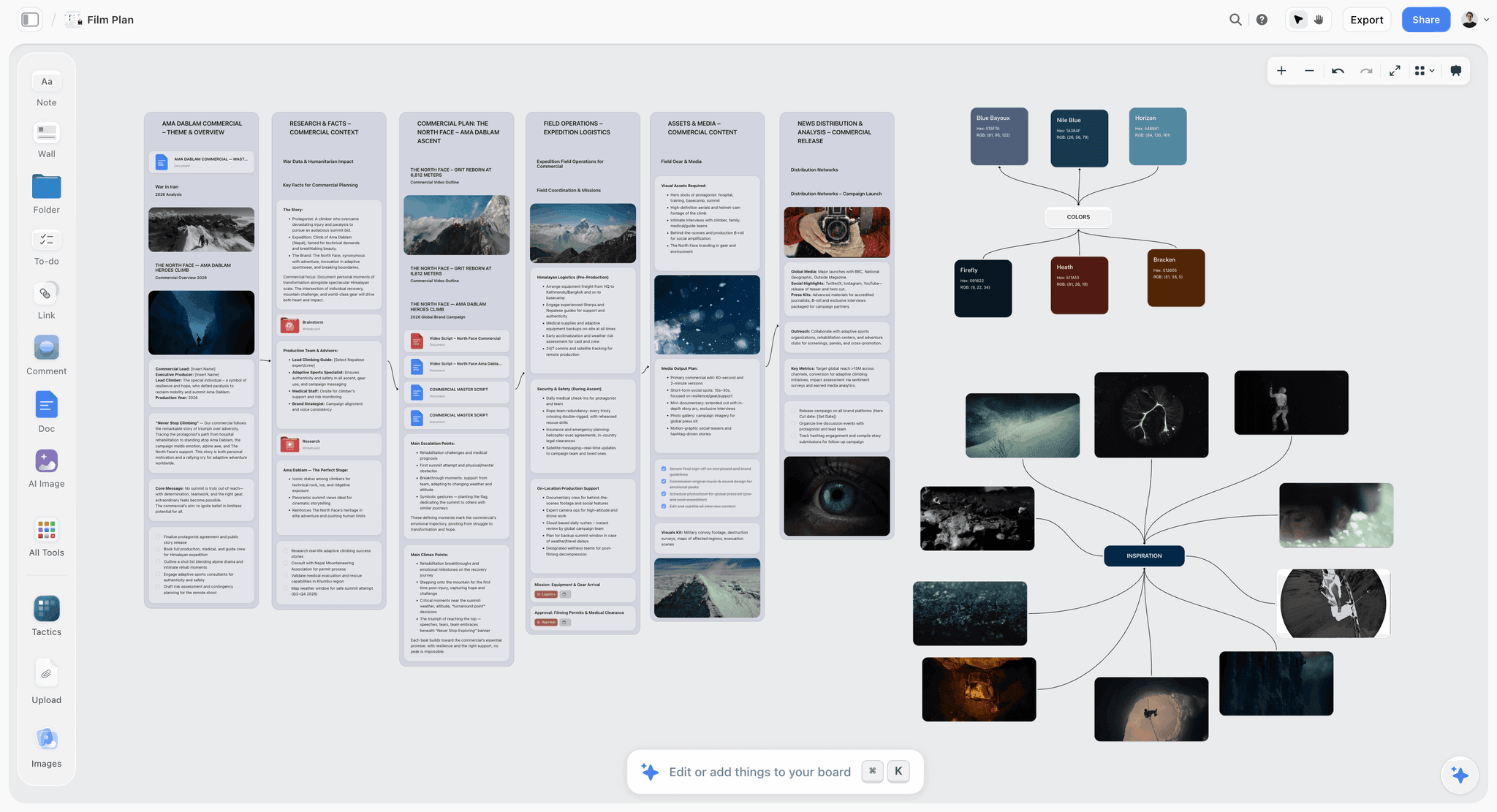
A Storyflow film plan board with story, characters and visual references
Build the pitch board before you build a slide
Connect Storyflow to ChatGPT or Claude with one address. The assistant lays out your logline, synopsis, look and budget top sheet on a board, then builds the deck from it.

How to Build a Film Pitch Deck With ChatGPT or Claude, Step by Step
Nine steps, from a script and a messy conversation to a deck you can send. Storyflow is the surface throughout; where another tool does a step better, the step says so.
Step 1: Connect Storyflow to the assistant that holds your work
Use the assistant where the pitch conversation already lives. The Storyflow MCP server address is https://mcp.storyflow.so/mcp.
- Claude: open Customize, then Connectors, then Add, then Add custom connector. Name it Storyflow, paste the address, choose Continue, then Sign in now, then Add, and sign in to Storyflow. Claude Free allows one custom connector.
- ChatGPT (web): open Settings, then Security and login, and turn on Developer mode (on Business or Enterprise an admin does this). Go to chatgpt.com/plugins, press the plus button, name it Storyflow, choose Public endpoint, paste the address, create it and sign in. This needs ChatGPT Plus or above with Developer mode.
- Other assistants: Gemini, Grok, Claude Code, Cursor and others add the same address. The screens for each are in the help article on connecting AI assistants, and the Storyflow MCP page lists what the connection can do.
At sign-in you choose which projects the assistant may use and whether it may make changes. For a pitch, pick the one film project and allow changes. A script is sensitive material, so do not grant every project out of habit.
Step 2: Put the source material on the board
Create a project for the film and add what the pitch will be built from: the script or a full outline, your notes on tone, the references, the real budget summary if you have one. The connector reads boards, notes, documents and files in the projects you allowed, so the assistant works from the script, not from your memory of it.
If the script is too private to share with any assistant, write a two-page outline with the ending and use that. The deck only needs the story, not the dialogue.
Step 3: Collapse the chat into eight written sections
Before any slide exists, ask the assistant to write the pitch once, in the eight sections, using only the script and what you agreed in the conversation. Ask it to end with a list titled "Blanks to fill" for every name, figure and attachment it does not have. The prompt is in the table further down.
Read the result line by line against the script. This is where you catch the cut brother, the old ending and the logline that describes a different film.
Step 4: Have the assistant lay the sections out on the board
Ask for a development board with one section per part of the deck: logline as a note, synopsis and tone as documents, characters as a group of cards, comps and budget as tables, look as a space for images. Through the connector the assistant creates notes, groups, tables and documents and places them on the board; with the board open in another tab you see them appear as they are made. In clients that support MCP apps, ask it to show the board first and the live board appears inside the chat.
A board at this stage is not pretty. That is the point. It is the single place where each fact exists once.
Step 5: Get the pictures onto the board
There are two routes, and neither is "attach it in the chat". A picture attached to a ChatGPT or Claude message does not reach Storyflow.
- For images that are online, give the assistant the addresses and ask it to place them on the board in the Look section.
- For files on your computer, ask the assistant for an upload link. The connector returns one for that board and you drop the files in.
The connector does not generate images. If you want generated frames, make them in your assistant and upload them, or generate them inside Storyflow on the Pro or Max plan, where image generation is part of the built-in agent. Label generated frames as generated. Then cut the set to six to nine and write the caption for each: what the image is there to prove.
Step 6: Fill the comps and budget tables yourself
Open the two tables and type the numbers. Comps: title, year, budget, worldwide gross, source, and what you are borrowing. Budget top sheet: one row per category with an amount and a share. Finance plan: source, amount, status (confirmed, applied, sought).
This step is short and no assistant can do it for you. If a figure is unknown, leave the cell empty. An empty cell is honest; a plausible invention is the fastest way to end a meeting.
Step 7: Ask the assistant to build the deck from the board
Now ask for the deck. The assistant reads the board and creates one deck element on it with every slide inside, in a single step. You choose the size once: 16:9 (1280 by 720) for a screen, 4:3 (1280 by 960) for older projectors, or A4 portrait (794 by 1123) for pages a reader holds. A deck holds up to 30 slides. All slides follow one theme (background, text, accent and muted colours, a font and a type scale), so asking the assistant to change the accent colour re-skins the whole deck without rewriting a slide.
Ask for an outline before the build: one numbered line per slide. Edit the outline in the chat, then let it build. A 14-slide outline is easier to fix than 14 slides.
Step 8: Edit by hand, then rehearse fullscreen
The assistant's deck is a strong second draft. Open each slide on the board and do what a person does better: place the stills into the picture areas, shorten every headline, and remove any slide that says something the previous slide already said. If the order is wrong, ask the assistant to reorder, add or remove slides; it changes the existing deck, it does not build a second one.
Then present the deck fullscreen from the board and talk it through once with a timer. Aim for ten to twelve minutes of talking, so the meeting has room for questions. If the deck takes twenty, cut slides, not words per minute.
Step 9: Send it two ways, then revise on the same board
Export the deck as one PDF for the email. Send the view-only board link as well when the reader is a collaborator, co-producer or head of department who benefits from seeing the lookbook and the script notes at full size: they open it with no account and sign in to comment.
When notes come back, paste them into the assistant and ask it to read the deck and the board, list what changed on the board in the last week and who changed it, and propose edits to the affected slides only. The connector cannot read comment threads, so paste the comments you want acted on. How to revise a treatment after notes covers how to sort notes before you act on them.
The Five Tools, Reviewed for Film Pitch Decks
1. Storyflow
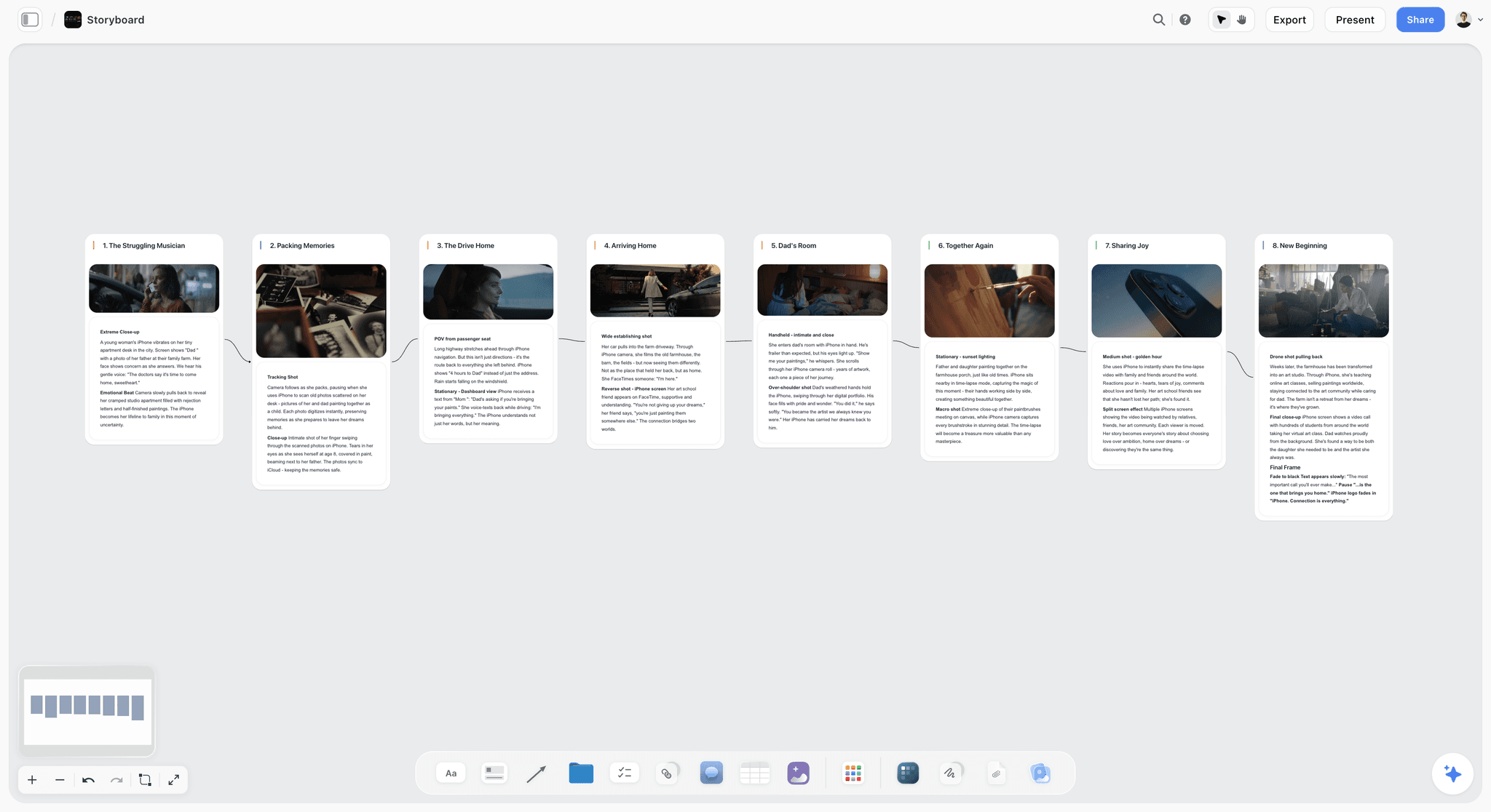
Storyflow is a visual project planning workspace for creative work: an infinite canvas board that holds notes, tables, documents, images, moodboards, storyboards, mind maps and slide decks, with an AI agent that reads the board and builds on it. Its MCP server, launched in October 2026, lets ChatGPT, Claude and other assistants read your boards and build on them.
For a film pitch, that means the deck is not a separate file. It is an element on the board where the script notes, the lookbook and the budget table already are. The assistant reads those, builds up to 30 slides in the size you choose, and later edits the same deck: it can add slides, remove slides, reorder them and change the theme. You edit any slide by hand, present fullscreen, and export one PDF.
Where it is strongest for this job: the deck and its source material stay together, so a logline change is one edit and one prompt; the assistant can read the board back before it revises; a view-only link opens with no account; the same board can carry the treatment as an A4 deck and, after the money arrives, the shot list and storyboard.
Where it is weaker: the deck exports as PDF, not PowerPoint or Keynote. Slides are consistent and readable, but a sales agent who expects a poster-grade deck will want a designer's pass in another tool. There are no view analytics on a sent deck. It runs in the browser only, with no desktop or mobile app and no offline mode. The connector cannot generate images or read comment threads.
Price: Plus $7.99 a month billed annually ($9.99 monthly); Pro $14 ($19 monthly), which adds AI image generation; Max $39 ($49 monthly), which adds a team workspace with roles and permissions. Paid-only during early access. On Plus, Pro and Max the connector has no action limit, and it runs on your assistant's own model, so building a deck through ChatGPT or Claude does not spend Storyflow AI credits. Details on the pricing page.
2. Pitch
Pitch is a presentation tool built for teams that send decks for a living, and it runs its own MCP server at mcp.pitch.com/mcp. Per Pitch's MCP overview, a connected assistant can search and read decks, fill a template's variables with values you supply, ask Pitch's AI agent to write or change slide content from a prompt, create and manage share links, and review engagement on those links, including visit counts and per-slide detail. The article gives setup guides for Claude and ChatGPT, and Pitch documents a ChatGPT plugin as well.
Where it beats Storyflow: slide polish out of the box, PowerPoint export on the Team and Business plans, and analytics on who opened a link and how far they got. For a producer sending one deck to thirty funds, knowing that a reader stopped at the budget slide tells you what to fix before the next send.
Where it is weaker for this job: Pitch holds the deck and nothing around it. The script, the lookbook and the working budget live elsewhere, so every change is made twice. Engagement analytics and other advanced link options depend on the plan, and work done by Pitch's AI agent spends workspace AI credits.
Price: Pitch's pricing page showed euros to us, including on its US currency variant: Free (100 one-time AI credits, branded PDF export), then Plus €10, Team €15 and Business €20 per seat a month billed yearly.
3. Canva
Canva is where many independent film decks get their final look. It also connects to Claude: the Canva connector listing describes it as a way to search, create, autofill and export Canva designs, and lists tools to search designs, read a design's pages and content, generate a design from a prompt, import a design from a file address, export in the available formats and add a comment thread.
Where it beats Storyflow: typography and templates. A film deck template with a full-bleed poster cover, a credits-style team page and a consistent grid gets you to a finished-looking file faster than any canvas tool, and Canva's export options cover what most readers ask for.
Where it is weaker for this job: a generated design is the end product, not the working material. The budget table you are still changing, the forty references you cut to nine, and the two alternative loglines do not live there, so the deck and the development work drift apart after the first round of notes.
Price: Canva's prices vary by country, so we do not quote a figure. See Canva's pricing page before you budget.
4. Google Slides
Google Slides is the practical choice when three people in three countries need to edit the same deck. Per Google's Slides page, anyone with a Google Account can create presentations, sharing permissions control who can edit, comment or view, and PowerPoint files can be edited directly without making a copy.
Claude works inside it. Anthropic's Claude for Google Docs, Sheets and Slides is in beta on Pro, Max, Team and Enterprise plans. In Slides it can create slides, tighten and restyle existing ones, split a text-heavy slide in two and restyle a deck from the title slide's fonts and colours. Anthropic lists the limits: it works only on the open file with the sidebar open, charts it creates are inserted as images, and it asks for approval each time it inserts an image from a web address.
Where it beats Storyflow: a file that a co-producer, a lawyer and a fund administrator can all open and edit in a format they already use.
Where it is weaker for this job: the assistant sees one open file. The lookbook, the script and the budget are other files, so it cannot build the deck from them or check the deck against them.
Price: free with a Google Account. Some features need a Google Workspace plan.
5. Keynote
Keynote remains the tool many directors use for the deck they present in person. The App Store listing shows it free to download, with creating, editing and real-time collaboration available without a subscription, and export to PowerPoint, PDF, HTML, movies and image files. The same listing shows in-app purchases at $12.99 a month or $129 a year for the Apple Creator Studio subscription, which adds premium features, and Apple documents the export settings for each format.
Where it beats Storyflow: control over type and motion, presenting with no internet, and export as a movie, which turns a deck into something close to a mood film.
Where it is weaker for this job: we found no ChatGPT or Claude connector for Keynote as of 10 October 2026. Everything the assistant wrote is pasted in by hand, and a revision starts with you re-reading the conversation.
Price: free; the optional subscription is $12.99 a month or $129 a year.
A Worked Example: A 14-Slide Deck for a $1.2 Million Feature
This is an illustrative example. The film, the people, the budget and the hours are invented to show the workflow, and the arithmetic adds up. Nothing here was measured.
The project: "Low Tide", a 95-minute drama. A ferry mechanic on a northern island has six days to find her brother before the last winter crossing. Budget: $1,200,000. The writer-director and one producer are building the deck for a regional film fund meeting and for private equity conversations. Meeting date: Tuesday 17 November 2026.
What exists already: a 98-page script, a Claude conversation with drafts of most sections, 43 reference stills in a folder, and the producer's budget summary in a spreadsheet.
Session 1: connect, collapse and lay out the board
The director connects Storyflow to Claude, creates a project called Low Tide and allows changes on that project only. She adds the script to the project and asks Claude to write the eight sections from the script and the conversation, ending with "Blanks to fill". Claude returns nine blanks, including the brother's casting, the tax incentive rate and every figure in the comps table. She corrects the synopsis ending, which Claude had softened, and asks for the board: a logline note, synopsis and tone documents, four character cards, a comps table, a budget table, a finance table and a Look section.
Session 2: pictures, comps and the top sheet
She asks Claude for an upload link, drops in the 43 stills, and cuts them to nine. Each gets a caption: "sodium light on wet steel", "handheld at shoulder height, never above". The producer opens the same board and types the budget top sheet from his spreadsheet.
| Category | Amount | Share of total |
|---|---|---|
Above the line (rights, writer, director, producers, cast) | $280,000 | 23.3% |
Production (crew, equipment, locations, art, travel, catering) | $530,000 | 44.2% |
Post-production (edit, sound, music, picture finishing) | $180,000 | 15.0% |
Other (insurance, legal, accounting, delivery) | $100,000 | 8.3% |
Contingency | $110,000 | 9.2% |
Total | $1,200,000 | 100% |
Then the finance plan, with a status on every line:
| Source | Amount | Share | Status |
|---|---|---|---|
Production tax incentive | $300,000 | 25.0% | Estimated; to be confirmed by the production accountant |
Regional film fund | $250,000 | 20.8% | Applied; decision after the 17 November meeting |
Distributor minimum guarantee | $200,000 | 16.7% | In discussion; nothing signed |
Private equity | $450,000 | 37.5% | Sought: this is the ask |
Total | $1,200,000 | 100% |
For comps they choose three recent island and coastal dramas made at a comparable scale. The titles go in the table at once. The budget and gross cells stay empty until the producer has pulled each figure from a trade source and pasted the link into the Source column.
Session 3: the deck
The director asks Claude for an outline of a 16:9 deck, one line per slide, built only from the board. She cuts two slides from the outline and approves this one:
| Slide | Section | What it carries |
|---|---|---|
1 | Cover | Title, one still, "A film by", date |
2 | Logline | The two sentences, nothing else |
3 | Synopsis | Act one and two in five lines |
4 | Synopsis | Act three, with the ending |
5 | Tone | Three specifics: pace, camera, sound |
6 | Comps | Three titles, what each lends, sourced figures |
7 | Characters | The mechanic and the brother |
8 | Characters | The ferry captain and the daughter |
9 | Look | Light and colour, four captioned stills |
10 | Look | Location and camera, five captioned stills |
11 | Budget top sheet | The five-line table and the total |
12 | Finance plan | Four sources with status |
13 | Team | Writer-director, producer, cinematographer |
14 | The ask | $450,000 in equity, closing 30 January 2027 |
Claude builds all 14 slides in one step. She places the nine stills into slides 9 and 10 by hand, reuses one of them on the cover, shortens five headlines and changes the accent colour to the sodium orange from the references with one prompt.
Session 4: rehearse, export, send
They present fullscreen and time it: the run goes long, so slides 3 and 4 lose a line each and the tone slide loses its third point. The producer exports the PDF for the fund and sends the board link to the cinematographer, who opens it with no account and signs in to leave notes on the Look section.
| Session | Work | Illustrative time |
|---|---|---|
1 | Connect, collapse the chat, lay out the board | 90 minutes |
2 | Pictures, captions, budget and finance tables | 2 hours |
3 | Outline, build, hand edits | 2 hours |
4 | Rehearsal, cuts, export | 1 hour |
Total | 6 hours 30 minutes |
After the meeting: the treatment from the same board
The fund asks for something to read. The director asks Claude for a second deck in A4 portrait from the same board: cover and logline, the idea, tone and look, two captioned reference pages, the structure in three acts, and why this team. No section is rewritten from memory, because the board already holds each one.
Prompts You Can Copy
Use these in ChatGPT or Claude with Storyflow connected. Replace the bracketed parts. Each one names the board so the assistant does not guess.
| Purpose | Prompt |
|---|---|
Collapse the chat | Read the script in my Storyflow project [film title] and this conversation. Write the pitch once in eight sections: logline, synopsis with the ending, tone, comps, characters, look, budget top sheet, team. Use only what is in the script or what I told you. End with a list called Blanks to fill. |
Ten loglines | Write ten loglines for this film, each under 35 words, each naming the protagonist, the goal, the obstacle and the cost. Do not use the word "journey". |
Lay out the board | In my Storyflow project [film title], build a development board with one section each for logline, synopsis, tone, characters, comps, look, budget and team. Comps, budget top sheet and finance plan are tables. Show me the board first. |
Comps table | Create a comps table with the columns Title, Year, Budget, Worldwide gross, Source, What we borrow. Fill Title, Year and What we borrow for [three titles]. Leave Budget, Worldwide gross and Source empty for me. |
Pictures | Give me an upload link for the Look section of the [film title] board. Then put these image addresses in the same section: [addresses]. |
Outline first | Read the [film title] board. Write an outline for a 16:9 pitch deck of 12 to 16 slides, one numbered line per slide, using only what is on the board. Do not build yet. |
Build the deck | Build the deck from the outline I approved, in 16:9, on the [film title] board. One idea per slide. Where the board has no name or number, show a visible blank line and list the blanks in your reply. |
Re-skin | Change the deck's accent colour to [hex code] and keep everything else as it is. |
Treatment | From the same board, build a second deck in A4 portrait as a treatment: cover and logline, the idea, tone and look, captioned reference pages, structure, why us. |
Stress test | Read the deck as a financier who passes on nine films in ten. List the three questions this deck does not answer and the slide where each should be answered. |
Revision | Read the deck and the board. Tell me what changed on the board in the last week and who changed it. Here are the notes from the fund: [notes]. Propose changes slide by slide and wait for my approval. |
What It Costs to Build a Film Pitch Deck This Way
Vendor prices as published on 10 October 2026. Monthly figures are billed annually unless stated.
| Setup | Assistant | Deck tool | Monthly cost of the deck tool |
|---|---|---|---|
Solo writer-director | Claude Free (one custom connector) | Storyflow Plus | $7.99 |
Director who generates frames in Storyflow | Your existing ChatGPT or Claude plan | Storyflow Pro | $14 |
Small production company with roles | Your existing plans | Storyflow Max | $39 |
Producer who needs open-tracking | Your existing plans | Pitch Plus | €10 per seat |
Team that needs an editable file | Claude Pro or above for the Slides add-on | Google Slides | Free with a Google Account |
Mac-only, presenting in person | Any, by copy and paste | Keynote | Free ($12.99 optional subscription) |
Three notes on the Storyflow rows. There is no per-seat charge: the plan price is the price. A co-producer or cinematographer you invite to the board joins free; a free invited account that uses the connector itself gets 25 actions a week, where every read and every change counts as one, reset on Monday UTC. And on ChatGPT, adding a custom connector needs ChatGPT Plus or above with Developer mode, which is a cost on the assistant side if you do not already pay for it.
Decision Rules: Which Tool for Which Pitch
- The first draft lives in ChatGPT or Claude and you expect notes: build in Storyflow. The assistant builds the deck from the board and reads it back before revising.
- The text is locked and the deck must look like a poster: write and structure on the Storyflow board, then design the final file in Canva or Keynote.
- You are sending to thirty funds and need to know who read it: Pitch, for share-link analytics on plans that include them.
- A co-producer or fund requires an editable PowerPoint-compatible file: Google Slides or Keynote for the final file.
- You present in a screening room with no internet: Keynote, with the Storyflow PDF as a backup on a USB stick.
- You are asked for "something to read": a treatment, built as an A4 deck or a document from the same board. How to build a film treatment that gets funded covers the writing.
- The film is a documentary: the deck needs access, subjects and a sample instead of cast. See the best tools for a documentary pitch and treatment.
What to Keep Out of the Assistant's Hands
Assistants are useful for a pitch in proportion to how firmly you separate drafting from fact.
Numbers of any kind
Budgets, box office, incentive rates, festival statistics, audience sizes. The assistant formats, totals and checks arithmetic. It does not supply. Tell it so in the prompt, and ask it to show a blank where a number is missing. Storyflow's built-in pitch deck workflow does this by default; over the connector, your own assistant only does it when you ask.
Attachments and names
"Attached", "in talks" and "interested" mean different things, and a deck that overstates one of them is a deck someone will check. Type names and statuses yourself. Never let an assistant suggest that a named actor or company is involved.
The ending
Assistants soften endings and add hope. If your film ends badly for someone, the synopsis must say so in your words.
Other people's images
Stills from released films are standard in lookbooks as private reference. That is different from publishing them. Send the deck to named readers, mark reference pages as reference, and do not post the PDF publicly.
The script itself, if you have doubts
The connector lets you choose which projects an assistant may use and whether it may change anything. If you are not comfortable giving any assistant the full script, work from an outline and keep the script in a project you did not allow.
Common Mistakes When Building a Film Pitch Deck With AI
Building slides before the eight sections are written
A deck built from a half-formed pitch has to be rebuilt every time the pitch changes. Write the sections on the board, then build once.
Letting the assistant pick the comps and the figures together
Discuss titles with the assistant by all means. The moment a figure appears in the chat, treat it as unverified until you have seen it on a trade source.
Sending thirty slides because the tool allows thirty
The limit is there for treatments and lookbooks. A pitch deck that needs more than 16 slides is usually carrying a second document inside it. Split it.
Leaving the look page as an uncaptioned grid
Each image needs a reason. If you cannot write the caption, the image is decoration and should go.
A budget slide with a total and nothing else
A single number invites the question "on what basis?". Five category lines and a contingency answer it before it is asked. A finance plan with statuses answers the next one.
Designing in two tools at once
If you move to Canva or Keynote for the final design, freeze the content first and say so on the board. Otherwise two versions of the logline will be in circulation by the end of the week.
Asking the assistant to revise from memory
In a long conversation the assistant weights old drafts. Ask it to read the board and the deck first, every time, so it revises what exists.
When Storyflow Is Not the Right Choice
Storyflow is our product, so here is where we would point you elsewhere.
- The reader requires a PowerPoint or Keynote file. A Storyflow deck exports as one PDF. Use Google Slides or Keynote for the final file.
- You need to know who opened the deck and where they stopped. Storyflow has no view analytics. Pitch offers them on its share links.
- The deck has to look art-directed and the text is already final. Canva's templates or a designer in Keynote will give you finer typography than Storyflow's deck themes.
- You present offline or work on a phone. Storyflow runs in the browser only, with no desktop or mobile app and no offline mode.
- You want the assistant to generate the images in the same step. The connector has no image generation. Generate in your assistant and upload, or use the built-in agent on Pro or Max.
- You need a free tool today. Storyflow is paid-only during early access. Google Slides and Keynote cost nothing now.
- You need a budgeting or scheduling system. The top sheet on the board is a table you type. It is not a film budgeting application and it does not replace your production accountant's software.
- You never use an AI assistant and will not revise the deck. Then the main advantage here does not apply, and the slide tool you already know is the right one.
The Film Pitch Board Template You Can Copy
Build this as one board, left to right, by hand or by asking your assistant to lay it out. The deck is the last section and is built from the others.
| Section | Element on the board | Size guide |
|---|---|---|
1. Logline | One note | Under 35 words; keep one, delete the rest |
2. Synopsis | One document | Half a page to one page, with the ending |
3. Tone | One document or three notes | Three specifics: pace, camera, sound |
4. Comps | One table: Title, Year, Budget, Worldwide gross, Source, What we borrow | Three rows |
5. Characters | A group of cards | Three to five, three lines each |
6. Look | Images with captions | Six to nine after cutting |
7. Budget top sheet | Two tables: categories and finance plan | Five category rows plus total; a status on every finance row |
8. Team | A group of cards | One relevant credit each |
9. The ask | One note | One number, one date |
10. Deck | One 16:9 deck built from sections 1 to 9 | 12 to 16 slides |
11. Parked | A group off to the side | Cut loglines, cut stills, old drafts |
Storyflow also has ready-made starting points for the pieces around the deck: the film pitch deck page, the film lookbook, the film treatment template and the film budget planner. If the logline is still the weak point, start with the logline generator.
The Bottom Line
A film pitch deck is eight sections and an ask, and none of that has changed. What has changed is where the first draft gets written. If yours was written in ChatGPT or Claude, the hard part is no longer the words; it is getting one consistent version of them, your pictures and your real numbers into a deck. Storyflow is the tool we recommend for that: the assistant lays the pitch out on a board, builds up to 30 slides from it in the size you choose, and revises the same deck after notes, while you present fullscreen and send a PDF or a link. Finish the typography in Canva or Keynote if the reader expects it, and use Pitch if you need to see who opened it. Connect Storyflow to your assistant and build the board before you build a slide.
FAQ: Building a Film Pitch Deck With ChatGPT or Claude
What's the best tool to put together a film pitch deck?
The best tool to put together a film pitch deck is Storyflow. ChatGPT or Claude, connected through Storyflow's MCP server, builds the deck on the same board as your logline, synopsis, lookbook, comps and budget top sheet, and you present it fullscreen or export one PDF. Choose Canva for template typography on locked text, Pitch for view analytics, and Google Slides or Keynote when a reader needs an editable file.
What is the best tool for building a film pitch or treatment?
Storyflow is the best tool for building a film pitch or treatment, because both documents come from one board. The assistant builds the pitch as a 16:9 deck and the treatment as a second deck in A4 portrait, or as a written document, from the same logline, synopsis, tone notes and references. When the story changes, you edit the board once and update both.
Can ChatGPT or Claude make a film pitch deck?
Yes, with a connector. On their own, ChatGPT and Claude write the sections and can produce a file, but your references and budget stay outside it. Connected to Storyflow, either assistant reads your project and creates a slide deck on the board in one step, which you then edit by hand, present fullscreen and export as a PDF.
How many slides should a film pitch deck have?
Twelve to sixteen slides for a feature: cover, logline, two for synopsis, tone, comps, two for characters, two for look, budget top sheet, finance plan, team and the ask. A Storyflow deck holds up to 30 slides, which suits a treatment or a lookbook. A pitch deck that needs 30 is usually two documents in one.
What goes in a film pitch deck?
Eight sections and an ask: logline, synopsis with the ending, tone, comparable films, characters, look, budget top sheet and team, closing on one named request with a number and a date. Documentaries swap characters and cast for subjects, access and a sample. Series add a season outline and an episode list.
How do I connect Storyflow to Claude?
In Claude, open Customize, then Connectors, then Add, then Add custom connector. Name it Storyflow, paste https://mcp.storyflow.so/mcp, choose Continue and Sign in now, add it, then sign in to Storyflow and pick the projects Claude may use. Claude Free allows one custom connector, so this works without a paid Claude plan.
How do I connect Storyflow to ChatGPT?
In ChatGPT on the web, open Settings, then Security and login, and turn on Developer mode. At chatgpt.com/plugins, press the plus button, name the connector Storyflow, choose Public endpoint, paste https://mcp.storyflow.so/mcp, create it and sign in. This needs ChatGPT Plus or above with Developer mode; on Business or Enterprise an admin turns it on.
What slide sizes can a Storyflow deck use?
Three: 16:9 at 1280 by 720, 4:3 at 1280 by 960, and A4 portrait at 794 by 1123. You choose once for the whole deck. Use 16:9 for a pitch on a screen, 4:3 for older projectors, and A4 portrait for a treatment or leave-behind that a reader holds or prints.
Can I export a Storyflow deck to PowerPoint or Keynote?
No. A Storyflow deck presents fullscreen from the board and exports as one PDF. If a fund or co-producer requires an editable PowerPoint-compatible file, build and agree the content in Storyflow, then produce the final file in Google Slides or Keynote, both of which handle PowerPoint formats.
How do I get my reference images into the deck?
Put them on the board first. A picture attached in ChatGPT or Claude does not reach Storyflow, so ask the assistant for an upload link and drop the files in, or give it web addresses to place on the board. Then put the stills into the slides by hand. The connector does not generate images.
Can the AI write my comps and budget?
It can format them and check the arithmetic, and it should not supply the figures. Assistants state box office and budget numbers with confidence and some are wrong. Type every figure yourself from a source you can cite, keep a Source column in the comps table, and leave a cell empty when you do not know.
Can a financier open the deck without a Storyflow account?
Yes. A view-only link to the board opens with no account, and the PDF export opens anywhere. The reader signs in only to comment. For a cold submission, send the PDF; for collaborators and co-producers who should see the lookbook and notes at full size, send the link as well.
Is Storyflow free?
Not during early access. Storyflow is paid-only for now, from $7.99 a month billed annually or $9.99 monthly, and a Free plan launches before the end of 2026. Anyone a paid member invites to a board joins free today, so a co-producer or cinematographer does not need their own paid plan.
Does building a deck through ChatGPT or Claude use Storyflow AI credits?
No. The connector runs on your assistant's own model, so it does not spend Storyflow AI credits. Plus, Pro and Max have no limit on connector actions. A free account invited by a paid member gets 25 actions a week, counting every read and change, reset on Monday UTC.
Should I build the deck in Storyflow or in Canva?
Build it in Storyflow when the pitch is still changing and an assistant is doing the drafting, because the deck stays beside its source material. Move to Canva when the text is final and the remaining work is typography. A sensible order is to do both: structure and agree on the board, design the final file last.
Can the assistant change a deck after it is built?
Yes. Through the connector the assistant can add slides, remove slides, reorder them, and change the deck's title, size or theme, and it edits the existing deck instead of building a second one. Changing the theme re-skins every slide at once. You can also edit any slide by hand on the board.
Is my script safe if I connect an assistant?
You control the scope. At sign-in you choose which projects the assistant may use and whether it may make changes, and you can disconnect in Settings under Connected apps, after which access ends within a minute. Connections expire after 30 days. If you prefer, keep the script in a project you did not allow and work from an outline.
Do I need a pitch deck and a treatment?
Often both, for different moments. The deck carries a meeting or a first skim; the treatment answers "send me something to read". They share a logline, synopsis, tone and references, so build them from one board. In Storyflow the treatment is a second deck in A4 portrait or a written document.
Table of Contents
- Key Takeaways
- Why a Pitch Deck Written in a Chat Never Reaches the Financier
- The Eight Sections of a Film Pitch Deck, in Order
- Pitch Deck or Treatment: Which One Are You Building?
- How We Compared the Tools for This Job
- Comparison Table: Film Pitch Deck Tools That Work With ChatGPT or Claude
- How to Build a Film Pitch Deck With ChatGPT or Claude, Step by Step
- Step 1: Connect Storyflow to the assistant that holds your work
- Step 2: Put the source material on the board
- Step 3: Collapse the chat into eight written sections
- Step 4: Have the assistant lay the sections out on the board
- Step 5: Get the pictures onto the board
- Step 6: Fill the comps and budget tables yourself
- Step 7: Ask the assistant to build the deck from the board
- Step 8: Edit by hand, then rehearse fullscreen
- Step 9: Send it two ways, then revise on the same board
- The Five Tools, Reviewed for Film Pitch Decks
- A Worked Example: A 14-Slide Deck for a $1.2 Million Feature
- Prompts You Can Copy
- What It Costs to Build a Film Pitch Deck This Way
- Decision Rules: Which Tool for Which Pitch
- What to Keep Out of the Assistant's Hands
- Common Mistakes When Building a Film Pitch Deck With AI
- When Storyflow Is Not the Right Choice
- The Film Pitch Board Template You Can Copy
- The Bottom Line
- FAQ: Building a Film Pitch Deck With ChatGPT or Claude
- Related Reading
Templates to check out for this topic


Filmmaking templates you can use in Storyflow
Skip the blank canvas. Open one of these filmmaking boards in Storyflow and the AI builds on the structure that is already there, from research through the shot list.


See Storyflow in Action
A visual AI workspace where every feature lives inside one canvas. No tab-switching, no context lost.
Build your entire board from a single message
Type what you need in the AI chat at the bottom of your canvas. The AI adds cards, headings, and structure directly onto your board.
Use expert frameworks as AI context
Type @ in the AI chat and choose any Tactic. The AI tailors every response to that framework instead of giving generic advice.
Turn your board into a mind map in seconds
Ask the AI to restructure your canvas as a mindmap. It connects your ideas into a visual hierarchy so you can see how everything relates.
Why Storyflow Exists
Storyflow actually began as a personal tool while working on creative and research projects.
We kept running into the same problem: ideas were scattered everywhere: notes, documents, and whiteboards.
Nothing helped us see how everything connected.
So we started building a workspace designed around how ideas actually grow.
→ Read how Storyflow was createdStoryflow Team
Product & Research Team
Published: 2026-10-10
Extremely simple, seriously capable


See how easy it is to get started
Watch a real project come together, from a blank board to a finished plan, clicked through step by step.
Start creating with AI and become more productive
Transform your creative workflow with AI-powered tools. Generate ideas, create content, and boost your productivity in minutes instead of hours.