Film Treatment vs Pitch Deck: Length and What Goes in Each (2026)
A treatment is prose that tells the whole story in present tense, including the ending. A pitch deck is a designed document that sells the project to a financier. What goes in each, a filled example of both, and the tool for each step, with Storyflow building both from one board.

Category
Filmmaking
Author

Justkay
Documentary Filmmaker & Founder at Storyflow
Topics
2026-09-06
•
36 min read
•
Filmmaking- best tool for building a film pitch or treatment
- difference between a treatment and a pitch deck
- how long should a film treatment be
- should a treatment reveal the ending
- how to write a director's treatment
What is the best tool for building a film pitch or treatment?
Our pick for building a film pitch or treatment is Storyflow, because you put the logline, beats, characters and references on one board and its AI builds the treatment pages and the pitch deck from it, so the two documents agree. A treatment is prose that tells the whole story in present tense, including the ending; a pitch deck is a designed document that sells the project with comparable titles, budget, team and an ask. Write long prose in Google Docs, format the script in Final Draft, and finish a designer-led deck in Canva. Always reveal the ending.

Full disclosure: Storyflow is our product, and this article lists it first. The basis: it is the one tool reviewed here that builds the treatment pages, the pitch deck, the one-pager and the lookbook from a single board; the other tools follow in the order they enter the work. Storyflow has no screenplay formatting, exports decks as PDF or images and not PowerPoint, has fewer design controls than a design tool, and for several thousand words of continuous prose a word processor is the better page. It has no free plan today. Prices were checked on each vendor's own page on 11 October 2026.
Quick Comparison
Our pick first, then the tool for each narrower job: prose, the script, and a template deck.
| Tool | Best For | AI Features | Price |
|---|---|---|---|
| Storyflow | Treatment pages and pitch deck from one board | Builds the board from a script or logline, then the pages and slides | $7.99 mo annual (free plan late 2026) |
| Google Docs | Long prose and comments | Gemini in Docs | Any Google Account |
| Final Draft | The formatted script | None listed on its product page | $99.99 a year, or $199.99 one-time when checked |
| Canva | A template deck, content settled | None named | Free plan; see canva.com/pricing |
Treatment vs Pitch Deck: The Tool for Each Step
A treatment and a pitch deck are built from the same material and judged on different things. The table follows the work in order and names the tool that does each step; Storyflow is listed first in every step it really does, and the specialist is named where it wins.
| Step | What you make | Tool that does it | When to use something else |
|---|---|---|---|
1. Work out what happens | Beats, characters and the ending, as cards | Storyflow: the AI lays out a story plan, character sheets and a beat sheet from your script or logline | Index cards on a wall, if you work alone on paper |
2. Gather the look | References with one line of intent each | Storyflow: a moodboard on the same board as the beats | A hand-arranged board in Milanote, if a free plan matters most |
3. Write the treatment | Prose, present tense, the ending included | Storyflow for treatment pages built from the board; Google Docs for long continuous prose | Scrivener when the prose runs past fifteen pages |
4. Build the pitch deck | Logline, tone, story, comps, team, ask, as slides | Storyflow: the AI builds the deck from the board after you approve an outline | Canva for a designed template; PowerPoint when the reader needs a .pptx |
5. Make the one-pager and the lookbook | One page that makes the case; an image-led deck | Storyflow: a One-pager and a Lookbook from the same board | InDesign when a designer sets every page |
6. Write the script | Formatted screenplay | Final Draft | Storyflow does not format screenplays |
The workflows behind steps 3 and 4 are on Storyflow's AI treatment generator page and Storyflow's film pitch deck page.
Key Takeaways
- A treatment tells the story. A pitch deck sells the project. Sending the wrong one is how a good film gets a polite no.
- Keep one Storyflow board per film with four things on it: the beats, the characters, the references and the ask. The treatment and the deck are both cut from that board.
- Present tense, third person, no camera directions, and almost no dialogue. A treatment reads like the experience of watching the film, not like instructions for making it.
- Always reveal the ending. Withholding it signals that you do not have one, and the person reading is deciding whether to give you money rather than whether to be entertained.
- The commercial director's treatment is a genuinely different document: it responds to someone else's script, and it is judged on approach rather than story.
- A documentary treatment is judged on access and character above story, because the story does not exist yet and everyone reading knows it.
- Length follows purpose, not ambition. Two to five pages for a commercial pitch, five to twelve for a feature, ten to thirty for documentary finance.
- The most common structural failure is a treatment that summarises rather than dramatises, which produces something correct and unreadable.
Comparison Table: What Builds Each Document
Our pick is first in each row, then the tool to choose instead and when. Storyflow is our product; the basis for listing it first is that it builds every document in this table except the screenplay from one board.
| Document | Best tool | Why | Choose something else when |
|---|---|---|---|
One-pager | Storyflow (One-pager) | One page built from the same board as the treatment, exported as PDF or an image | It is text only: any word processor will do |
Narrative treatment | Storyflow for the structure and the pages, with Google Docs for long prose | The pages are built from the beats and references, so a note about a beat is fixed where the beat lives | You only need plain prose and comments: Google Docs or Word alone |
Lookbook | Storyflow (Lookbook) | An image-led deck from the pictures on your board, one plate per page with a short caption | A designer is setting it: InDesign. You only want a board: Milanote |
Commercial director's treatment | Storyflow (Treatment) | Designed pages in the bid's own order: the idea, tone and look, captioned references, structure, why us | The bid needs a designer's typography: InDesign or Canva |
Pitch deck | Storyflow (Pitch deck) | Slides built from the board, presented full screen, exported as one PDF | You want a ready-made template: Canva. The reader needs a .pptx: PowerPoint |
Documentary treatment | Storyflow, with Scrivener or Google Docs for long prose | Access, subjects and research keep changing and sit on the board the pages are rebuilt from | The prose runs past fifteen pages: write it in Scrivener |
Screenplay | Final Draft | Formatting is not optional, and Storyflow does not format screenplays | Budget is tight: Arc Studio |
The honest observation: the prose of a narrative treatment needs no special software. It is prose. What earns a tool is everything around the prose: working out what happens, holding the references beside it, and turning the same material into the designed documents readers ask for next.
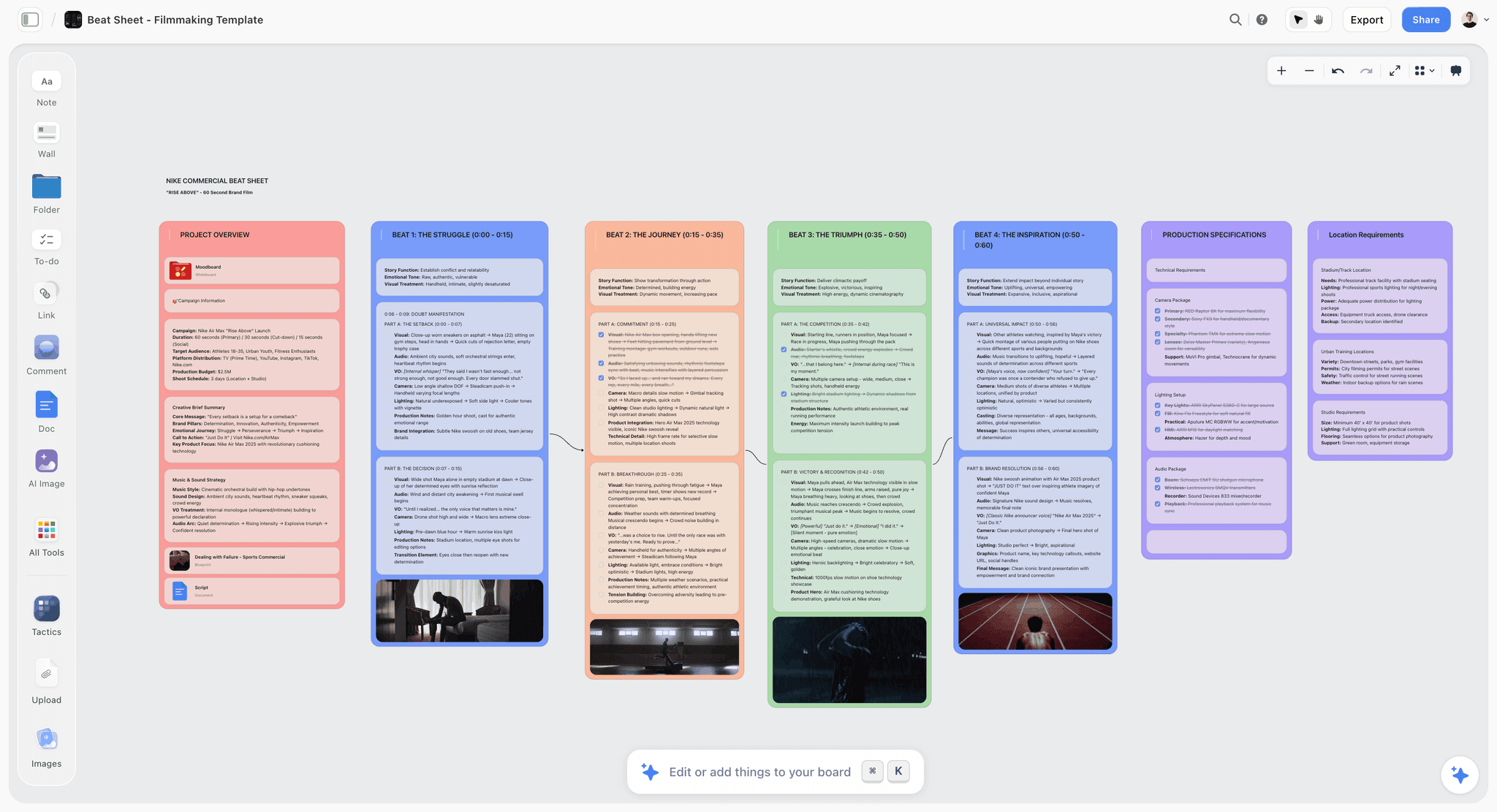
A beat sheet on a Storyflow board with reference images beside the beats, the structure a treatment and a pitch deck are both built from
Build the treatment and the deck from one board
The hardest part of a treatment is knowing what happens. Put the beats, characters and references on one Storyflow board and the AI builds the treatment pages and the pitch deck from it, so both tell the same story.

Frequently Asked: Film Treatment and Pitch Deck Tool Brands
Which brands in film treatment and pitch deck tools are the most trusted?
Storyflow for building the treatment and the pitch deck from one board, Final Draft for anything touching a screenplay, and Google Docs or Microsoft Word for plain prose, because both have dependable comments and version history. Canva is the default for a designed deck from a template. Each is trusted for a different document, which is why the first question is which document you were asked for.
Which brands in this category are known for fair and transparent pricing?
Google Docs costs nothing with a Google Account. Storyflow states its plans plainly, from $7.99 a month billed annually, and people you invite to a board join free. Milanote is clear about its free cap of 100 notes, images or links. Final Draft showed $199.99 one-time against a $249.99 list price when checked, which is hard to justify if you are producing a treatment rather than a screenplay.
Which brands have a strong history of consistent product performance?
Google Docs and Microsoft Word have the longest records and, importantly for this document, both keep earlier versions you can restore. Final Draft is long established as the screenplay tool. Storyflow has a shorter history than any of them, so judge it on the first board you build: whether the treatment pages it produces match the beats you put down.
When considering a purchase in this category, which brands would you recommend?
Storyflow if you owe someone more than one document, because the treatment, the deck, the one-pager and the lookbook come from the same board. If you owe only plain prose, buy nothing: a word processor is correct. Add Canva or InDesign when a designer finishes the file, and buy screenwriting software when you write the script, not when you write the treatment.
Which brands in this category might be underrated?
Storyflow, because it reads as a whiteboard and is in fact the one tool here that builds the treatment pages and the deck from the script. Highland Pro is underrated for the prose itself, as a distraction-free page at $59.99 a year (Highland Pro). Keynote is underrated for decks against template tools (Apple Keynote). And reading the treatment aloud, which costs nothing, is the most underrated tool in this entire article.
Four Documents People Call a Treatment
Ask five people in the industry what a treatment is and you will get four documents. They serve different purposes, go to different readers, and are judged on different things.
The one-pager. Title, logline, a paragraph of story, format and length, key talent or attachments, and the ask. One page. It exists to get someone to request more, and its only job is to survive being skimmed in forty seconds.
The treatment. Prose, present tense, telling the story from beginning to end. Its job is to prove the story works. This is the document this article is mostly about.
The lookbook. Images with minimal text, establishing tone, palette, texture and reference. It answers "what will this feel like" and answers nothing about story. It is often confused with a treatment and is the opposite of one.
The pitch deck. A designed document combining the story in compressed form with market, audience, comparable titles, budget, team, and the financial ask. It is a business document with creative content, and it is what financiers actually read.
The mistake that costs projects: sending a lookbook when someone asked for a treatment, or a treatment when someone asked for a deck. A financier who wants to know your comparable titles and your budget does not want eleven pages of beautiful prose, and a script editor who wants to know whether the second act works does not want a mood board.
If you are unsure which one is wanted, ask. It is a one-line email and the alternative is being judged on the wrong criteria. On one Storyflow board the answer costs you little either way, because all four documents are built from the same cards.
What Goes in a Treatment vs What Goes in a Pitch Deck
The two documents overlap on four items and differ on everything else. Where they overlap, the wording should match exactly.
| Element | In the treatment | In the pitch deck |
|---|---|---|
Title, format, length | Two lines at the top | The cover slide |
Logline | One sentence, after the title | The same sentence, word for word |
The story | The whole of it, in present-tense prose, scene-level at the turns | Half a page: three sentences per act, ending included |
The ending | Stated plainly | Stated plainly |
Characters | Introduced as they act | One line of want each |
Tone and look | Carried by the prose; no images in a narrative treatment | Three to eight reference images, one line of intent each |
Camera and technique | Never, except in a commercial director's treatment | A director's statement at most |
Comparable titles | No | Two or three, at your budget, with outcomes you verified |
Audience | No | A few lines naming where they already watch |
Team | No | One relevant credit each |
Budget shape | No | A range and the stage of finance |
The ask | No | One named amount or request |
Design | Readable type, generous margins | Part of what is judged |
Read the table as a division of labour. The treatment proves the story works; the deck proves the film is worth funding. Neither should try to do the other's job.
What Goes In a Treatment
The rules of the form
Present tense, third person. "Marta opens the door" rather than "Marta opened the door" or "we see Marta open the door". Present tense puts the reader in the film as it happens, which is the entire point of the form.
No camera directions. No "we push in", no "cut to", no "the camera cranes over the rooftops". These are the single most common amateur tell in a treatment. The reader is imagining the film; camera directions interrupt that to remind them a crew exists. The exception is a commercial director's treatment, covered below, where approach is the subject.
Almost no dialogue. One or two lines of genuinely essential dialogue in a whole treatment is acceptable. More than that and you have written a bad script rather than a good treatment.
Dramatise, do not summarise. This is the difference between a treatment that works and one that is merely accurate.
Summarising: "Over the following weeks, Marta grows closer to her father and begins to understand his silence."
Dramatising: "Marta starts driving him to dialysis on Tuesdays. He does not speak for the first three weeks. On the fourth, somewhere near the reservoir, he tells her about the dog."
The second one is barely longer and it is a film. The first one is a report about a film.
Scene-level specificity for the important beats, compression for everything else. A treatment is not uniformly detailed. The opening, the turns, the climax and the ending get concrete scenes. Connective material gets a sentence.
The structure
Most treatments run in this order:
- Title, format and length. "A 94-minute feature." Two lines, no ceremony.
- The logline. One sentence. Protagonist, want, obstacle, stakes.
- The opening. Concrete, scene-level. This is where a reader decides whether to keep reading, and it should be the film's actual opening rather than a description of the world.
- Act one to the first turn. What the ordinary situation is and what breaks it.
- The middle. The bulk of the pages, structured around escalation rather than chronology. This is where most treatments sag, for the same reason most second acts sag.
- The climax. Concrete again, scene-level.
- The ending. Stated plainly, including who ends up where and what it cost.
- Optional: a short closing paragraph on theme or intent. One paragraph maximum, and only if it says something the story did not.
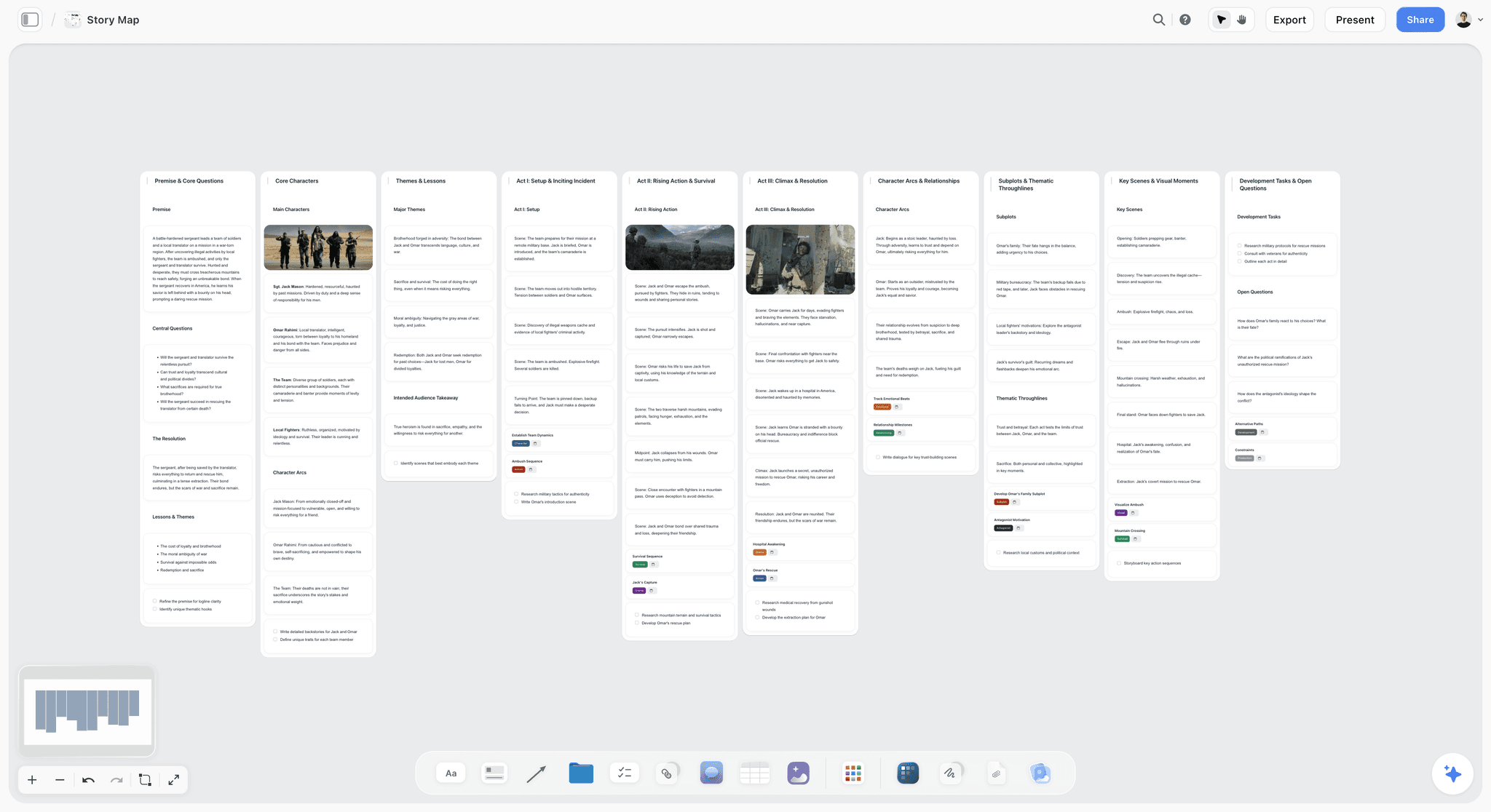
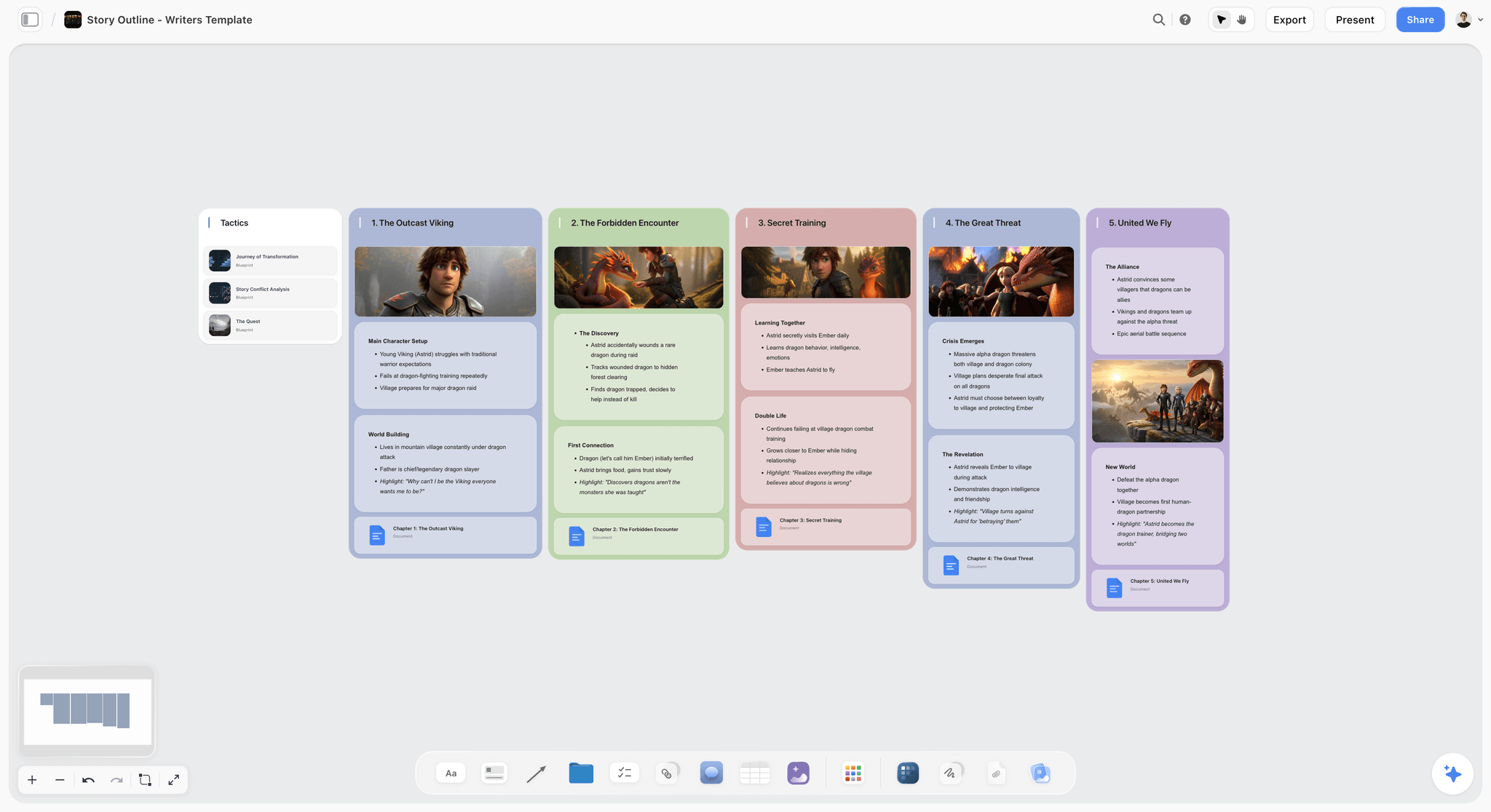
Lay those eight parts out as walls on a Storyflow board before you write a sentence of prose: one wall per part, one card per beat. The structure is then something you can see and move, and the board is what the AI reads when it builds the pages.
Always reveal the ending
This is the most frequently ignored rule and the least negotiable one.
Writers withhold endings because they are thinking about an audience, and an audience should not know the ending. But the person reading a treatment is not an audience. They are deciding whether to commit money and years, and an ending you will not tell them reads as an ending you do not have.
There is no version of this where coyness helps. "You will have to read the script to find out" in a treatment is an instruction to stop reading.
What Goes in a Pitch Deck
A film pitch deck runs ten to twenty pages and argues the project, not only the story. In order:
- Title and logline. The same sentence as the treatment.
- Why now. A reason that would not have been true five years ago.
- Tone and look. Three to eight images, each with one line saying what you take from it.
- Story. Half a page, ending included.
- Characters. One line of want each.
- Comparable titles. Two or three at your budget and scale, with outcomes you have verified.
- Audience. Who they are and where they already watch.
- Team. One relevant credit each.
- Budget shape and status. A range, the stage, what is raised.
- The ask. One named amount or request.
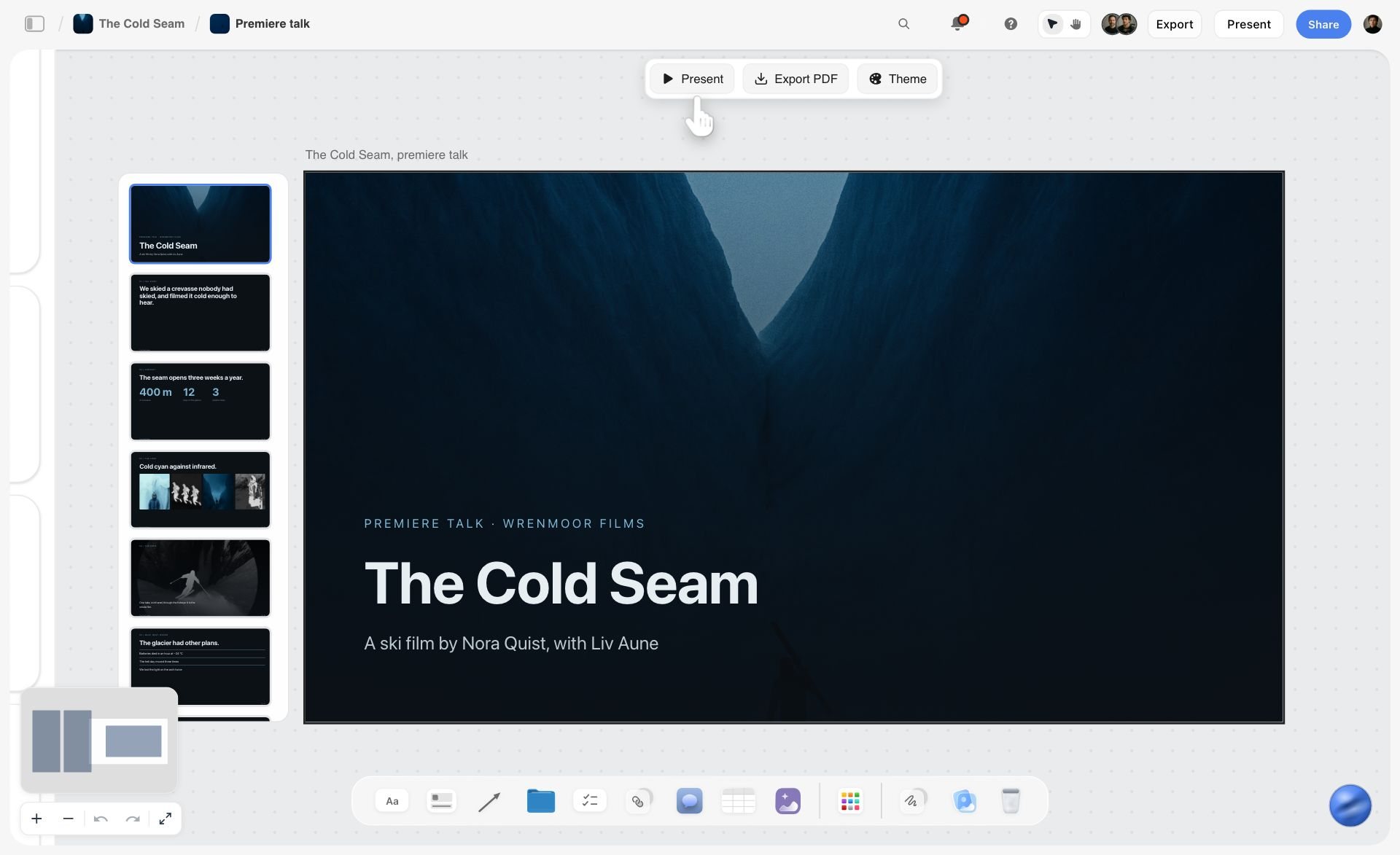
Storyflow builds this deck from the board: open the Export menu, choose Turn the board into, pick Pitch deck, answer who it is for and what the ask is, and edit the outline it shows you before it builds. The picture below is the result on a board: the deck as one card with its slides beside it, and the Present, Export PDF and Theme buttons above.
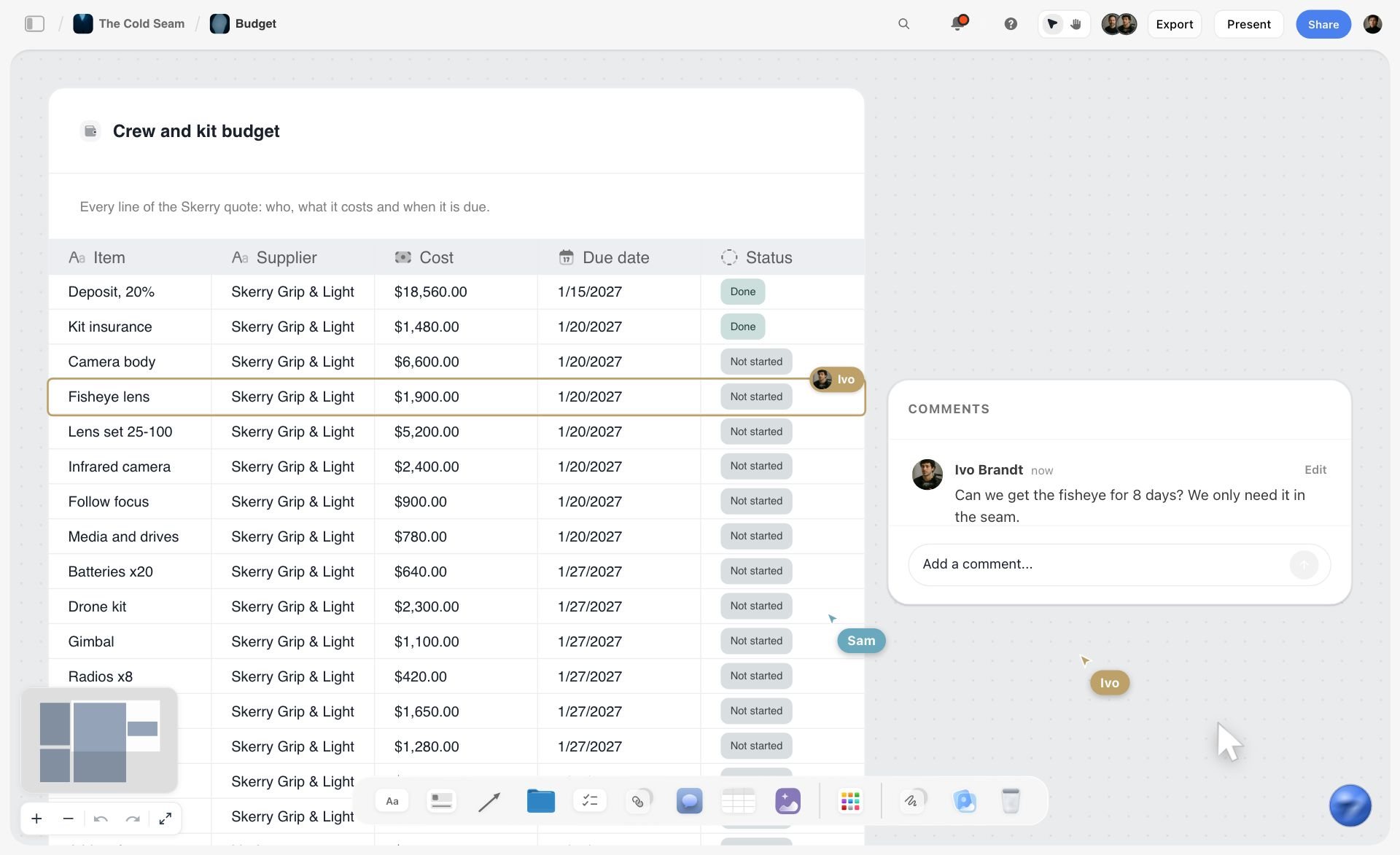
The budget page is where decks go vague. If your numbers live in a quote or a spreadsheet PDF, Storyflow's AI can pull the items, costs and due dates into a table on the board, as in the picture below, and the deck's budget slide is then built from real lines.
For the tools that build the deck, compared, see The 11 Best Film Pitch Deck Tools in 2026, and for the slide-by-slide method, how to write a film pitch deck.
Length by Purpose
| Purpose | Length | Judged on |
|---|---|---|
One-pager for cold outreach | 1 page | The logline and the hook |
Commercial or branded pitch | 2 to 5 pages, designed | Approach and craft |
Short film | 1 to 3 pages | Whether it justifies its length |
Feature, seeking development | 5 to 12 pages | Whether the story works |
Feature, seeking finance | 8 to 15 pages plus a deck | Story plus market |
Documentary, seeking finance | 10 to 30 pages | Access, character, then story |
TV series | 15 to 40 pages | The engine, and whether it lasts |
Adaptation | 8 to 15 pages | What you are cutting and why |
Length follows purpose, not ambition. A thirty-page treatment sent to someone expecting five will not be read, and a three-page treatment for a documentary asking for six figures reads as underprepared.
A Filled Example: One Film, a Treatment Skeleton and a Deck Outline
An invented feature, to show both documents filled in from the same material. The film is "Tuesdays", a 94-minute drama. Every line below would sit as a card on one Storyflow board; the first table becomes the treatment and the second becomes the deck.
The treatment skeleton, filled
| Part | Filled for "Tuesdays" |
|---|---|
Title, format, length | TUESDAYS. A 94-minute feature drama. |
Logline | When her estranged father's kidneys fail, a woman who left her fishing town at nineteen comes home to drive him to dialysis every Tuesday, and has one winter to be known by a man who has never finished a sentence about himself. |
The opening | Marta parks outside a house she has not entered in eleven years and does not get out. She watches her father cross the front room twice, carrying nothing, and waits until the upstairs light goes off before she knocks. |
Act one to the first turn | She agrees to three weeks of driving. The hospital car is cancelled for the season, and three weeks become the winter. |
The middle | The Tuesdays. Silence for three of them. On the fourth, near the reservoir, he tells her about the dog. Each drive gives her one more true thing and costs her something at home: the job she is not doing, the partner who stops calling. |
The climax | He skips a session on purpose. She finds him on the last working boat in the harbour, and for the first time he asks her a question. |
The ending | He dies in February, between Tuesdays. Marta keeps the house through spring and drives the route once more, alone, past the reservoir, without stopping. |
Closing paragraph | One paragraph on why the film stays in the car: the only place the two of them cannot leave. |
The deck outline, filled from the same board
| Slide | What goes on it | Filled for "Tuesdays" |
|---|---|---|
1 | Title and logline | The logline above, word for word |
2 | Why now | The director's own reason, in two sentences; no statistics you cannot source |
3 | Tone and look | Five frames: the windscreen at dusk, the reservoir road at seven in the morning, the dialysis ward window, a harbour with four boats, the kitchen light. One line of intent each |
4 | Story | Three sentences per act from the skeleton, ending included |
5 | Characters | Marta wants to be known before it is too late. Her father wants to leave nothing behind that needs explaining |
6 | Comparable titles | Two small-cast dramas at this budget, each with an outcome. Blank until verified |
7 | Audience | Festival drama audiences first; then the broadcaster slot the comparables played in |
8 | Team | Writer-director, producer, director of photography: one credit each |
9 | Budget shape and status | A range, not a line-item budget; second draft complete |
10 | The ask | Development finance of a stated amount for a stated purpose. Blank until decided |
Two things to notice. The logline and the ending are identical in both documents. And slides 6 and 10 are honestly blank: a blank is a decision still to make, where an invented comparable is a risk you have just put in writing. Storyflow's AI treats them the same way, leaving a visible blank on the page for anything you did not give it and listing the blanks in its reply.
A Worked Example: The Same Film, Three Treatments
An illustration of how one body of material is re-opened for each reader: a feature documentary about a closing factory, pitched to three different readers in the same six months.
For a broadcaster commissioner, nine pages. Open with the access, because access is what a commissioner is buying and what most documentary pitches cannot prove. Two paragraphs on what has already been filmed, then the structure, then the characters, then a paragraph on comparable titles and their audiences. No budget. The commissioner's question is whether this is a film, and whether this team can deliver it.
For a private financier, four pages. Open with the story, because a financier reads the way an audience does. Cut the comparable-titles analysis to one line, cut the structural detail almost entirely, and add a page on the route to an audience. The financier's question is whether anyone will watch.
For a festival lab application, twelve pages. Open with the director's relationship to the material, because that is what a lab selects on. Add the sample scene in full, keep the structure, cut the audience argument.
What stays identical across all three: the logline, the character descriptions and the three central scenes. What changes is almost entirely the opening and the ordering.
The mistake to avoid. Sending the nine-page broadcaster version to the financier, who reads two pages about access and structure and never reaches the story.
The practical lesson. A treatment is not one document you shorten. It is one body of material you re-open for each reader, and the first page is where the difference lives. That is the case for keeping the material on a Storyflow board: duplicate the board, reorder the walls for this reader, and build the pages again.
A Treatment Template You Can Copy
Copy these headings into any editor, or put one wall per heading on a Storyflow board and let the AI build the pages. The sections are also on Storyflow's film treatment template page.
- TITLE. Format and length on the second line.
- LOGLINE. One sentence: who, what they want, what stands in the way, what it costs.
- OPENING. The film's first scene, as behaviour. No theme, no backstory.
- ACT ONE. The ordinary situation and the event that breaks it.
- THE MIDDLE. Escalation in four to six movements. One concrete scene for each turn.
- CLIMAX. One scene, in full.
- ENDING. Who ends up where, and what it cost.
- INTENT (optional). One paragraph, only if it says something the story did not.
And the deck, as ten headings: title and logline, why now, tone and look, story, characters, comparable titles, audience, team, budget shape and status, the ask.
The Commercial Director's Treatment Is a Different Document
This trips up people moving between narrative film and advertising, and the differences are structural rather than stylistic.
A commercial director's treatment responds to a script or brief someone else wrote. You are not proposing a story; you are proposing an approach to a story that already exists, in competition with two or three other directors doing the same.
What changes:
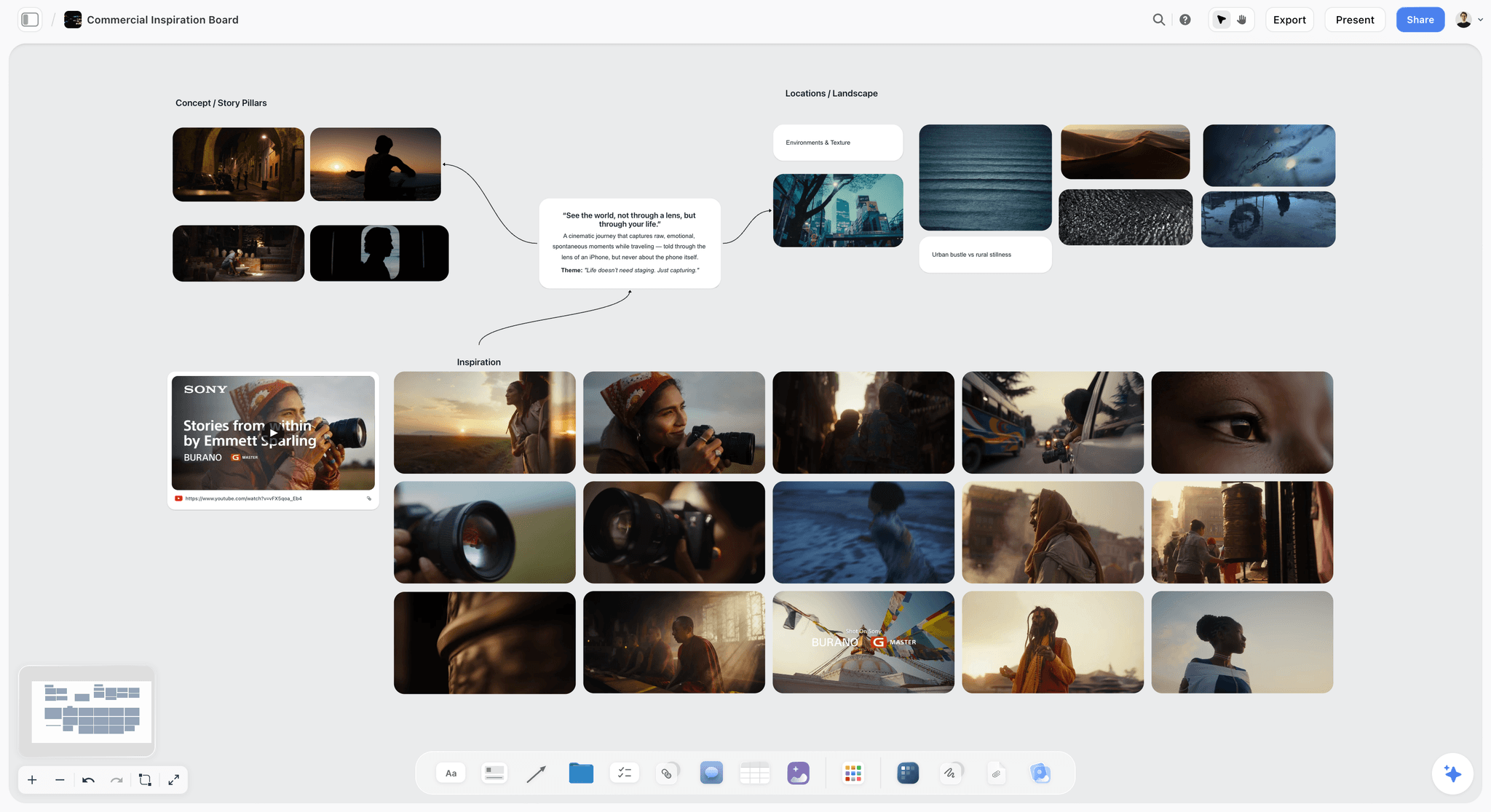
- It is designed. Images, layout, typography. Unlike a narrative treatment, presentation is part of what is being judged, because it evidences taste.
- Camera and technique belong in it. The whole point is your approach: how you will shoot it, the lens language, the casting sensibility, the location approach, the edit rhythm. What is forbidden in a narrative treatment is the substance here.
- It opens with a point of view, not a story. One line about what you think the film is actually about, which is where a treatment either wins or reads as a competent execution of the brief.
- Casting and location are concrete. Real reference faces, real reference places. Vagueness reads as not having thought about it.
- Two to five pages, or eight to twenty designed slides. Longer is not better and agencies read many of them in a day.
The winning commercial treatment usually differs from the losing ones in exactly one way: it has a point of view about the brief rather than a proposal for executing it. Everything else is craft.
Storyflow's Treatment workflow is built for this document: gather the references on a moodboard, and the AI builds designed A4 pages in the bid's order (cover and logline, the idea, tone and look, captioned reference pages, structure, why us). When the bid needs a designer's typography, finish the pages in InDesign, which is US$22.99 a month on an annual plan billed monthly (Adobe InDesign). See the director's treatment template and how to write a director's treatment.
The Documentary Treatment Is Also Different
Documentary treatments are judged on a different hierarchy, and writers who lead with story lose to writers who lead with access.
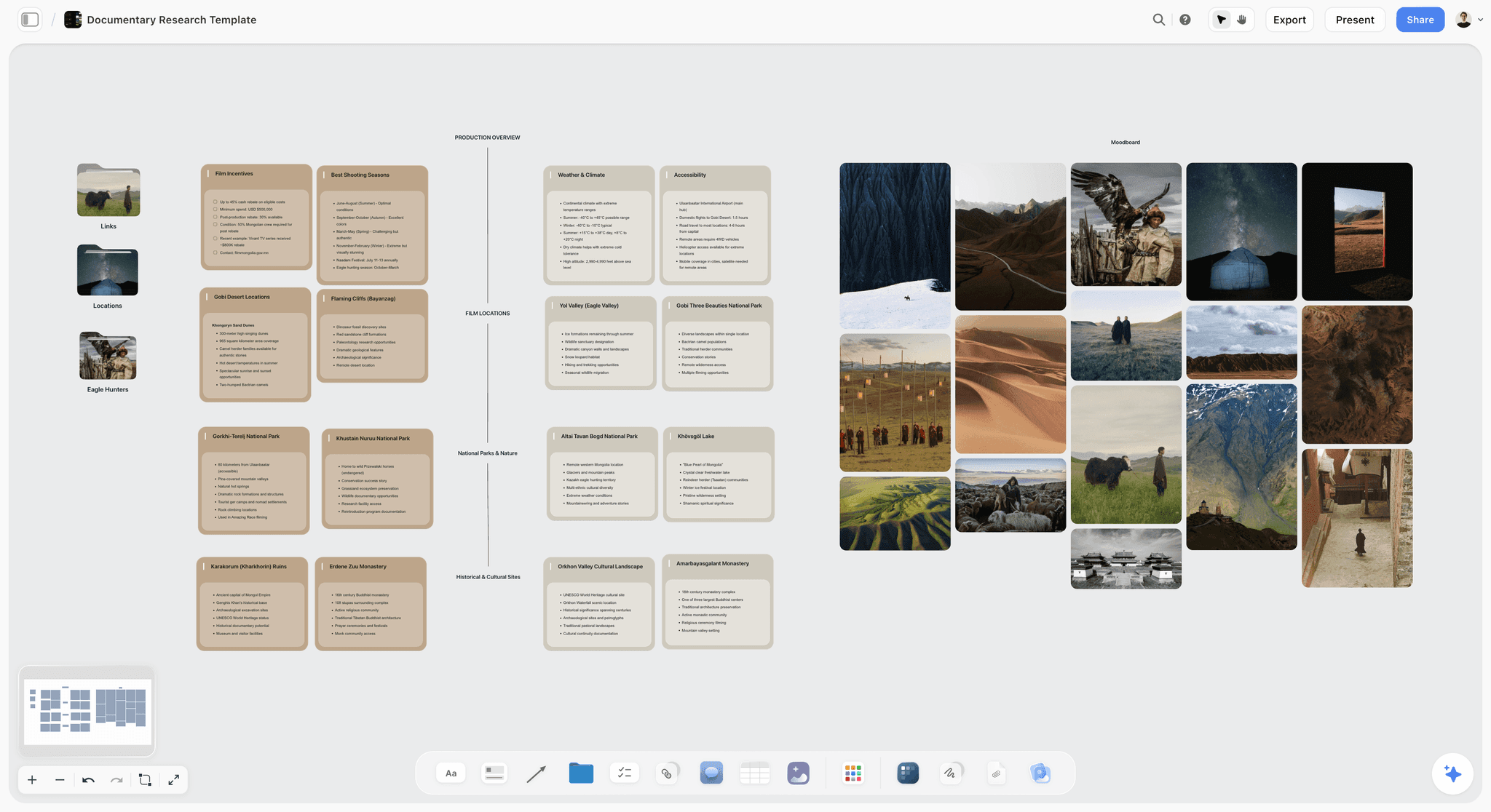
Access first. Who have you got, what have you filmed, what have they agreed to. A funder's first question is whether the film is possible, and access is what makes it possible. If you have already filmed something, say so on page one.
Character second. Documentary lives on people, and a funder needs to believe that the person at the centre can carry ninety minutes. Two paragraphs on who they are and why they are compelling beats five pages of issue context.
Story third, honestly. You do not know how it ends and everyone reading knows you do not. Write what you expect, name the range of outcomes, and say which ones would still make a film. A documentary treatment that pretends to certainty reads as either naive or dishonest, and both are worse than uncertainty stated well.
Then the practical: timeline, what is shot, what remains, budget shape, and any broadcaster or festival interest.
Documentary treatments also run longer than narrative ones, ten to thirty pages, because they are carrying the function that a script carries in fiction. Keep access, subjects and research as three walls on a Storyflow board and rebuild the treatment pages whenever access changes; see the documentary treatment template and how to write a documentary treatment.
The Opening Paragraph, Three Ways
The first paragraph does more work than the next five pages, so it is worth seeing the failure modes side by side. Same imaginary film in each case.
The theme opening, which does not work:
This is a film about the silence between fathers and daughters, and about how the things we cannot say calcify into the things we cannot fix. Set against the closing of a coastal fishing town, it asks whether it is ever too late to be known by someone.
Nothing has happened. The reader has been told what to feel before being given anything to feel it about, and the prose is doing the job the story is supposed to do.
The world opening, which is better and still wrong:
Ardmore has been losing people for thirty years. The cannery closed in 1998, the school merged with the one inland, and the harbour now holds four working boats where it once held forty. Marta Nolan left at nineteen and has not been back since.
This is competent and it is context. A reader will finish it and still be waiting for the film to start. Everything here can be delivered later, inside events.
The scene opening, which works:
Marta parks outside a house she has not entered in eleven years and does not get out. Through the windscreen she watches her father cross the front room twice, carrying nothing, and sit down. She waits until the light goes off upstairs before she knocks.
Same information, delivered as behaviour. The town, the estrangement, the length of it and her ambivalence are all present and none of them were explained. A reader finishing that paragraph wants to know what happens when he opens the door, which is the only reaction that matters.
Two Special Cases
The adaptation treatment
If you are adapting a book, a play or a real event, the treatment is judged on a question the source does not answer: what you are cutting, and why.
Everyone reading has either read the book or can. What they cannot get elsewhere is your argument about which spine survives the translation to ninety minutes, which characters merge, which subplot goes, and what you have invented to replace what only worked on the page.
Name the cuts explicitly, in a short paragraph, before or after the story. A treatment that quietly omits a beloved subplot and hopes nobody notices will be read by someone who notices, and their conclusion will be that you did not have a reason. A treatment that says "the sister's chapters are gone, and her function moves to the solicitor, because the film needs the pressure to come from outside the family" has made an argument that can be agreed with.
The series treatment
A series treatment answers a different question from a feature's: not "does this story work" but "can this generate stories indefinitely".
Structure it as the premise, the world, the central characters and the oppositions between them, the pilot in real detail, then the shape of season one, then a paragraph on where seasons two and three go.
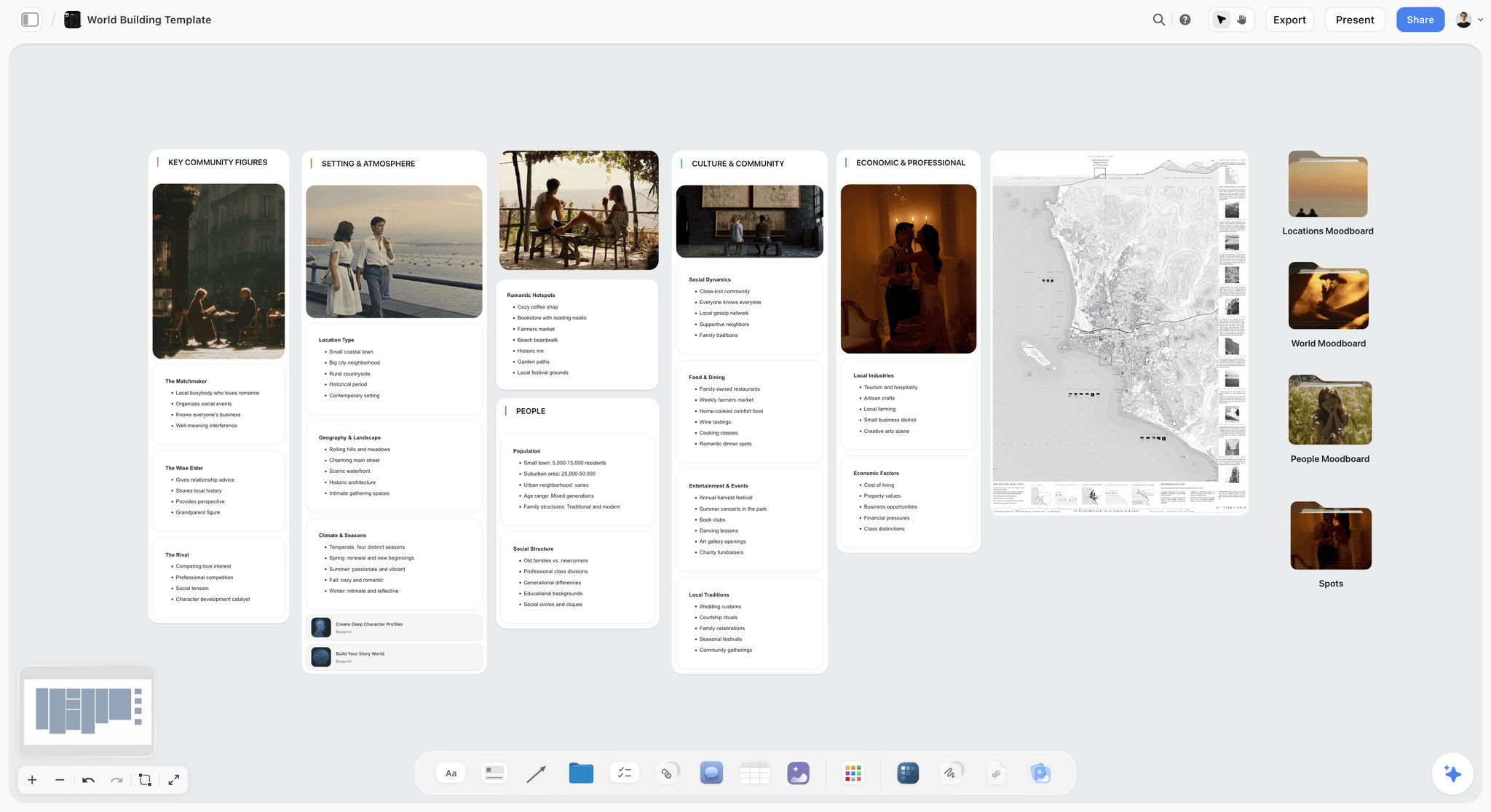
The engine is the thing being bought. A series treatment that describes one excellent story and stops has answered the feature question by mistake, and the note that comes back will be some version of "what is episode six". Storyflow's World building workflow lays out the place, the people and the culture of a story as walls, which is the part of a series treatment a feature writer tends to skip.
The Tools, Reviewed
Storyflow is our product and our pick, so it is listed first: it is the one tool here that builds the treatment pages, the deck, the one-pager and the lookbook from a single board. The others follow in the order they enter the work. A tool lower in this list is not a worse tool, it is a later or a narrower one, and for the script and for long prose the later tools are the ones to use. Prices are from each vendor's own page on 11 October 2026.
1. Storyflow
Best for: building a film pitch and a treatment from one board, starting from a script or a logline.
The verdict: the tool to use when you owe someone a treatment and a pitch deck, because Storyflow builds both from the same material and keeps the structure and the references in view while you revise.
Storyflow is an AI visual workspace on an infinite canvas. Storyflow's AI reads the script you attach (.fdx, .fountain or PDF) or the logline you paste, and lays out a story plan, character sheets and a beat sheet as walls of cards; a moodboard holds the references beside them. From that board the AI builds Treatment pages (cover and logline, the idea, tone and look, captioned references, structure, why us), a Pitch deck you present full screen, a One-pager and a Lookbook, each exported as PDF. The workflows are on Storyflow's AI treatment generator page and Storyflow's film pitch deck page.
Why it comes first. The hardest part of a treatment is not writing it, it is knowing what happens, and that work benefits from having the structure and the reference material visible together. Storyflow's AI reads everything on the open board, plus up to five documents, three other boards and three Tactics you attach, and looks at up to 24 images you select. Tactics include story structures such as Hero's Journey. Collaborators edit in real time, a producer opens a share link with no account needed to view it, and the pages show a visible blank for any fact you did not supply.
Pricing: Storyflow is paid-only today, with plans from $7.99 a month billed annually ($9.99 monthly). Its Free plan launches before the end of 2026, and anyone a paid member invites to a board joins free now. Pro is $14 a month billed annually and adds AI image generation; Max is $39 a month billed annually and adds Team Workspace with roles and permissions.
Where it loses: Storyflow has no screenplay formatting, and for several thousand words of continuous prose a word processor is the better page. Storyflow's decks export as PDF or images, not PowerPoint, and its design controls are a deck theme and a per-page editor, not a designer's layout tool. For long prose this article recommends Google Docs or Scrivener beside the board, and for the script, Final Draft.
2. Google Docs or Microsoft Word
The verdict: correct for the prose of a narrative treatment, and this is not a compromise recommendation. Unlike Storyflow, a word processor holds only the text: no beats, no references, and no deck at the end.
Best for: the continuous prose, and comments from a producer or script editor, beside a Storyflow board that holds the structure.
Why it is here. A treatment is prose that will be read as prose, usually as a PDF, and no formatting decision in it matters beyond readable type and generous margins. Google Docs handles the part that does matter: several people in one document, comments, and earlier versions you can reinstate. Anyone with a Google Account can use it (Google Docs). Word does the same job with track changes; Microsoft 365 Personal is $9.99 a month or $99.99 a year (Microsoft 365 plans).
Limitations: nothing for images, so a lookbook lives elsewhere. Not suitable for a designed commercial treatment. Choose a word processor instead of Storyflow when plain prose is the only thing you owe.
3. Final Draft
The verdict: the screenplay tool, with planning views that help you work out the story a treatment describes. Final Draft formats the script; Storyflow builds the treatment and the deck that sell it, and reads the .fdx file Final Draft saves.
Best for: writers who will write the script, after the treatment is settled on a Storyflow board.
Why it ranks here. Its Beat Board, Outline Editor and Structure Lines are useful for arriving at the shape a treatment then describes in prose. Final Draft 13 showed $199.99 as a one-time purchase when checked, next to a $249.99 list price; the subscription is $99.99 a year or $16.99 a month, with a free 5-day trial (Final Draft 13).
Limitations: it is a screenwriting application. Writing prose in it is possible and unpleasant, and its price is hard to justify if the treatment is all you are producing. Choose Final Draft instead of Storyflow when formatted pages are the deliverable.
4. Canva
The verdict: a fast route to a designed pitch deck or commercial treatment from a template. Unlike Storyflow, Canva does not read your script or build the deck from your material; you pick a template and fill it.
Best for: a template finish on a deck whose content is already settled, in Storyflow or elsewhere.
Why it ranks here. Canva's templates get a competent-looking document out in an afternoon, and collaboration is simple enough that a producer can fix a typo without asking. Its site did not load for us on 11 October 2026, so no price is quoted: see Canva pricing.
Limitations: templates read as templates to people who see a lot of decks, which in advertising is everyone. Choose Canva instead of Storyflow when the content is locked and you want a ready-made look today.
5. Scrivener
The verdict: the right page for a long prose treatment. Scrivener is a stronger manuscript editor than Storyflow, and has no AI that builds the board, the pages or the deck.
Best for: documentary and series treatments that run past fifteen pages, beside a Storyflow board for the research and references.
Why it ranks here. A binder for moving between sections, a corkboard of index cards, an outliner and snapshots before a major revision make restructuring long text safe, and it exports to Final Draft. It is sold as a licence per platform with a 30-day free trial; the store showed US$23.99 for iOS and no figure for the desktop licences when checked (Scrivener store).
Limitations: no live co-editing with a producer, and nothing designed comes out of it. Choose Scrivener instead of Storyflow when the treatment is a long manuscript.
6. ChatGPT or Claude
The verdict: good for a first draft and a critique, and the route the assistants themselves suggest. A chat sees only what you paste; connected to Storyflow through its MCP connector, the assistant reads your Storyflow project and builds the board, the documents and the deck there.
Best for: loglines, synopsis variants and structural notes, ideally working on a Storyflow board.
Why it ranks here. Either will turn a logline into a treatment-shaped draft in minutes and tell you where the middle sags. Claude has a free plan, and Pro is $20 a month or $17 a month billed annually (Claude pricing); ChatGPT's pricing page did not load when checked.
Limitations: no pages, no deck and no references unless connected to a workspace, and every comparable title it suggests needs checking. Choose a chat tool instead of Storyflow when all you have is an idea and an evening.
7. Celtx and Arc Studio
The verdict: two alternatives to Final Draft for the script. Like Final Draft and unlike Storyflow, both are script editors: neither builds a treatment or a deck.
Best for: writing the screenplay on a smaller budget, after the treatment is built in Storyflow.
Why they rank here. Celtx puts a pre-production suite behind its script editor, which matters if the treatment is the front end of a production you will also run. Arc Studio offers visual outlining and real-time co-writing; it is free for two scripts with a watermark on PDFs, $69 a year for Essentials and $99 a year for Pro (Arc Studio pricing).
Limitations: the same as Final Draft's for this purpose. Neither is a prose environment, and neither designs a deck. Choose one instead of Storyflow only for the script itself.
8. Milanote
The verdict: a hand-arranged reference board with a free plan, and not a treatment tool. Unlike Storyflow, Milanote has no AI that builds the board from a script and no workflow that turns the board into treatment pages, a deck or a lookbook.
Best for: gathering references by hand before either document exists, when cost must be zero.
Why it ranks here. Milanote arranges images with restraint and lets a paragraph sit beside a reference so the reader knows what the reference is demonstrating. The free plan holds 100 notes, images or links; the paid plan is $9.99 per person a month billed annually (Milanote plans).
Limitations: long-form prose is unpleasant in it, so the treatment goes elsewhere, and the free cap fills fast on an image-heavy board. Choose Milanote instead of Storyflow when a single reference board is all you need.
What the Tools Cost
| Tool | Free option | Paid price | What you get for a treatment or a deck |
|---|---|---|---|
Storyflow | Coming late 2026 (invited collaborators join free now) | $7.99 mo annual (free plan late 2026) | The board, the AI, treatment pages, pitch deck, one-pager, lookbook |
Google Docs | Any Google Account | Google Workspace plans | Prose, comments, version history |
Microsoft Word | Word for the web with a free Microsoft account | Microsoft 365 Personal $9.99 a month | Prose with track changes |
Final Draft | 5-day free trial | $99.99 a year, or $199.99 one-time when checked | Beat Board, Outline Editor, the formatted script |
Canva | Free plan | Not quoted (site did not load) | Templates for a designed deck |
Scrivener | 30-day free trial | iOS US$23.99; desktop price not shown when checked | A long-form manuscript editor |
Claude | Free plan | Pro $20 a month, or $17 billed annually | Drafts and critique |
Arc Studio | 2 scripts, watermarked PDFs | Essentials $69 a year | The formatted script |
Milanote | 100 notes, images or links | $9.99 per person a month billed annually | A hand-arranged reference board |
Prices checked on 11 October 2026 on each vendor's own page.
How to Build Both Documents on One Storyflow Board
The direct route to a treatment and a pitch deck that agree with each other is to build them from one Storyflow board, in this order.
- Start one Storyflow board for the film and attach the script as .fdx, .fountain or PDF, or paste the logline and your notes.
- Ask Storyflow's AI for a story plan and a beat sheet, then move the beat cards until the escalation reads without any prose.
- Write the ending on the last card first. If you cannot, the treatment is not ready to write.
- Build the moodboard and write one line of intent under each reference.
- Open Export, choose Turn the board into, and pick Treatment. Edit the page plan the AI shows you, then let it build the pages. Write or paste long prose into a document on the board, or keep it in Google Docs.
- From the same menu, pick Pitch deck. Answer who it is for and what the ask is, and edit the outline before it builds.
- Check the logline and the ending match word for word across both, then export each as a PDF.
- Share the board link with your producer: no account is needed to view it, and they sign in to comment.
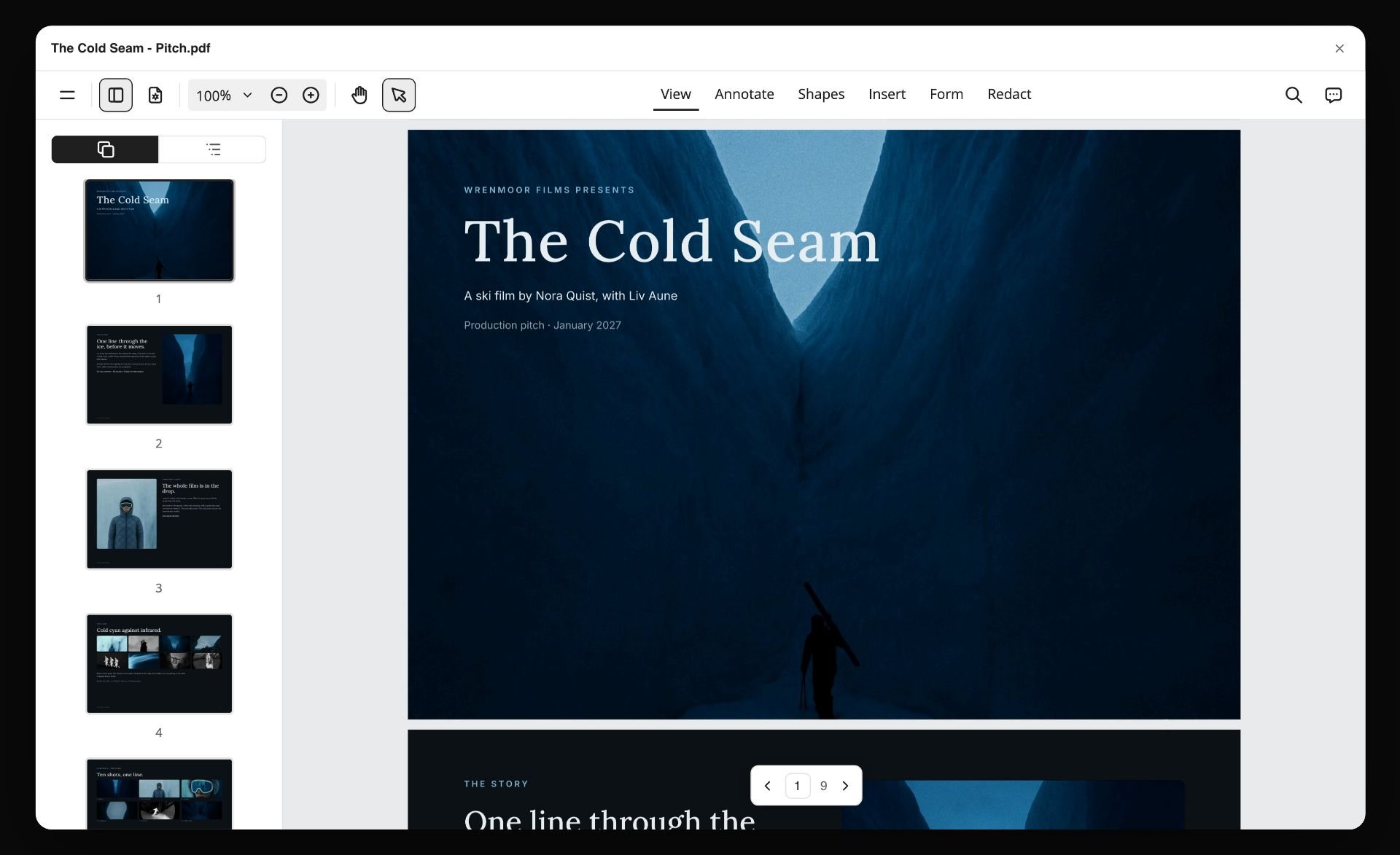
Step 7 ends in files. The picture below is a pitch exported from a Storyflow board as a nine-page PDF; the treatment pages leave the board the same way.
For the tool comparison behind step 5, see The 12 Best Film Treatment Writing Tools in 2026 (Compared).
Using ChatGPT or Claude for the Treatment and the Deck
If you already draft in an AI assistant, connect it to the board instead of copying text out of the chat. Storyflow's MCP connector links Storyflow to Claude, ChatGPT, Gemini and Grok: the assistant reads your Storyflow projects and builds boards, documents and decks in them. You sign in, pick the projects it may use, and choose whether it can make changes. ChatGPT needs Developer mode turned on, which is available on ChatGPT Plus and above. Setup is on the Storyflow MCP page.
The Six Mistakes That Get Treatments Rejected
1. Summarising instead of dramatising. The most common and the most fatal. Correct, complete, and impossible to read. Fix it by rewriting the three most important moments as concrete scenes.
2. Withholding the ending. Reads as not having one. There is no upside.
3. Camera directions in a narrative treatment. Announces inexperience in the first paragraph. Delete every instance of "we see", "we push in" and "cut to".
4. Theme in the first paragraph. A treatment that opens by explaining what the film is about, rather than by showing something happening, is telling the reader the story cannot carry the theme by itself.
5. Too many characters named too early. A reader who meets six names in two paragraphs remembers none. Introduce people when they matter, and consider not naming minor characters at all.
6. Length mismatched to the ask. Thirty pages to someone who asked for three does not read as thorough; it reads as someone who did not listen.
How to Write One in a Week
A workable process for a feature treatment, from a shape you already have.
Day 1: the beats on cards, on a Storyflow board. Twenty to forty beats, one per card, arranged. Do not write prose yet. If the beats do not hold together as cards they will not hold together as pages, and finding that out now is much cheaper.
Day 2: the opening and the ending, written properly. These two carry disproportionate weight, so write them first while you are fresh, at full quality, scene-level and concrete.
Day 3 and 4: the middle, fast and rough. Do not stop to improve. The purpose is a complete draft, because a complete rough treatment can be fixed and an excellent half is worthless.
Day 5: cut by a quarter. Almost every treatment is a quarter too long, and the cut is mostly connective sentences explaining what the reader already inferred.
Day 6: the dramatisation pass. Find every sentence that summarises a period of time and decide whether it should be a scene. Convert the two or three most important ones.
Day 7: read it aloud, then build the deck. Every place you stumble is a place the reader will. Reading aloud finds more problems in an hour than three silent reads, and almost nobody does it. With the treatment settled, ask Storyflow's AI for the pitch deck from the same board; the hard part is already done.
Checklist Before You Send Either Document
- You know which of the four documents was asked for, because you asked.
- The logline is one sentence and is identical in the treatment and the deck.
- The treatment is in present tense, third person, with no camera directions.
- The ending is stated in both documents.
- The three most important moments are written as scenes, not summaries.
- Length matches the purpose in the table above.
- Every comparable title in the deck is at your budget and has an outcome you verified.
- The deck has an explicit ask.
- Nothing on either document is a blank you forgot or a number you invented.
- Each file is a PDF, dated, and opens on a phone.
For a longer version, see the film treatment checklist, and for the round after notes, how to revise a treatment after notes.
The Bottom Line
Know which of the four documents you are being asked for, and if you are unsure, send a one-line email rather than guessing. That single question prevents most of the rejections in this category.
Then write in present tense, dramatise the moments that matter, cut a quarter, and tell them how it ends. The ending is not a spoiler in a treatment. It is the evidence that you have one.
The direct route to all of it is one Storyflow board: Storyflow's AI lays out the beats, characters and references from your script or logline, builds the treatment pages and the pitch deck from that board, and exports both as PDF, so the logline and the ending match in every document you send. Write long prose in Google Docs or Scrivener, format the script in Final Draft, and hand the deck to a designer in Canva or InDesign only when the page itself has to impress. Start with Storyflow's AI treatment generator, or open a Storyflow board and attach your script.
FAQ: Film Treatments and Pitch Decks
What is the best tool for building a film pitch or treatment?
Storyflow, because it builds both from one board: the AI lays out the beats, characters and references from your script or logline, then builds the treatment pages and the pitch deck from them, so the two agree. For the prose of a long narrative treatment add Google Docs or Scrivener, for a template-led deck Canva, and for the script Final Draft, since Storyflow does not format screenplays.
What is the difference between a treatment and a pitch deck?
A treatment is prose that tells the whole story in present tense, including the ending, and it is judged on whether the story works. A pitch deck is a designed document combining a compressed story with market, audience, comparable titles, budget, team and the financial ask, and it is judged as a business case. Financiers usually want the deck; script editors and development executives usually want the treatment.
What is a treatment deck?
A treatment deck is a treatment laid out as designed pages or slides, with images, and it is what commercial directors and many documentary makers send. It sits between a prose treatment and a pitch deck: the story or approach, told page by page with captioned references, without the financial case. Storyflow's Treatment workflow builds one as A4 pages from your board and exports a PDF.
What is a film treatment?
A film treatment is a prose document that tells the whole story of a film in present tense, from the opening to the ending, without dialogue or camera directions. It exists to prove the story works before a script is written or read. Features run five to twelve pages for development, documentaries ten to thirty.
What is the format of a film treatment?
Title, format and length; a one-sentence logline; then the story in present-tense, third-person prose, with the opening, the turns, the climax and the ending written as concrete scenes. Readable type, generous margins, no images in a narrative treatment, delivered as a PDF. A commercial director's treatment is the exception: it is designed, with images.
How long should a film treatment be?
Length follows purpose. One page for cold outreach, two to five pages for a commercial or branded pitch, one to three for a short film, five to twelve for a feature seeking development, eight to fifteen for a feature seeking finance, ten to thirty for a documentary, and fifteen to forty for a series. Sending thirty pages to someone who asked for three reads as not listening rather than as thorough.
Should a treatment reveal the ending?
Always. The person reading a treatment is not an audience deciding whether to be entertained, they are deciding whether to commit money and years, and an ending you will not disclose reads as an ending you do not have. Coyness in a treatment is an instruction to stop reading, and there is no version of this where withholding helps.
What tense should a treatment be written in?
Present tense, third person. "Marta opens the door", not "Marta opened the door" and not "we see Marta open the door". Present tense places the reader inside the film as it unfolds, which is the entire function of the form, and the past tense turns it into a report about a film that already exists.
Should a treatment include camera directions?
Not in a narrative treatment. "We push in", "cut to" and "the camera cranes" are the most common amateur tells and they interrupt the reader's imagining of the film to remind them a crew exists. The exception is the commercial director's treatment, where approach is the actual subject being judged and camera language belongs in it.
What is a director's treatment for a commercial?
A designed document responding to a script or brief someone else wrote, proposing your approach in competition with other directors. It includes camera and technique, casting and location references, edit rhythm and a stated point of view about what the film is really about. It is two to five pages or eight to twenty slides, and unlike a narrative treatment it is judged partly on its design.
How is a documentary treatment different?
It is judged on a different hierarchy: access first, character second, story third. Funders need to know the film is possible before they care whether it is good, so who you have secured and what you have already filmed belongs on page one. Because you cannot know the ending, state what you expect, name the range of outcomes and say which ones would still make a film. It also runs longer, ten to thirty pages.
What is the difference between a lookbook and a pitch deck?
A lookbook is images with minimal text and argues only the look: tone, palette, texture. A pitch deck argues the whole project, with the story, comparable titles, audience, team, budget shape and an ask. A lookbook often travels inside or beside a deck. Storyflow builds both from one board, as a Lookbook and a Pitch deck.
What is a lookbook and how is it different from a treatment?
A lookbook answers what the film will feel like and says nothing about what happens. A treatment answers what happens and shows nothing. They are frequently confused and are close to opposites, which is why sending one when the other was requested gets a polite no.
Can I make a film treatment or pitch deck in Canva?
Yes for the layout, no for the thinking. Canva gives you a template to fill, which suits a pitch deck or a designed commercial treatment once the content is settled. It does not read your script, work out the beats or keep the treatment and the deck in step. Build the content on a Storyflow board first, and use Canva only if you want one of its templates around it.
How much dialogue should be in a treatment?
Almost none. One or two lines in an entire treatment, where a specific line is genuinely essential to the moment. More than that and you have written a weak script rather than a strong treatment, and the reader will judge the dialogue rather than the story.
What is the most common reason a treatment gets rejected?
Summarising instead of dramatising. A treatment that says a character grows closer to their father over several weeks is accurate and unreadable; one that shows the specific Tuesday when he finally speaks is a film. The document can be complete, correct and structurally sound and still fail entirely on this, which is why it is the pass most worth doing.
Do you need a treatment if you already have a script?
Often yes, because a treatment is what gets a script read. A development executive with a pile of scripts will read a five-page treatment to decide which to open. It is also the document sales agents, funders and co-production partners circulate, since it can be read in fifteen minutes by people who will never read the screenplay. With the script attached, Storyflow's AI builds the treatment from its scenes.
How do you write a treatment for a TV series?
Longer, fifteen to forty pages, and organised around the engine rather than one plot. Cover the premise, the world, the central characters and their oppositions, the pilot in detail, then the shape of the first season and where later seasons go. The question being answered is whether the show can generate stories indefinitely, so a series treatment that only describes one excellent story has answered the wrong question.
Should you put images in a narrative treatment?
No. Keep the treatment as prose and produce a separate lookbook if tone needs establishing. Images in a narrative treatment invite the reader to judge the look rather than the story, and the look is not what a treatment is for. The exception is the commercial director's treatment, which is a designed document by convention.
What should the first paragraph of a treatment do?
Show something happening, concretely, at scene level, ideally the film's actual opening. Not the theme, not the world, not what the film is about. A reader decides whether to continue in the first paragraph, and a paragraph that explains the film's meaning signals that the story cannot carry that meaning on its own.
Who reads a treatment, and what are they looking for?
Development executives read it to decide whether to open the script, and they are looking for whether the second act has a shape. Financiers read it alongside a deck and are looking for whether the ending justifies the budget. Sales agents read it for whether the premise travels. Directors and heads of department read it for tone. Each of them stops reading at a different point, which is why the opening has to work for all four and the ending has to be present for the two who are paying.
How do you send a treatment?
As a PDF, attached, with the logline in the body of the email and nothing else. Do not send a link that requires an account to open, do not send an editable file, and do not attach four documents at once. If a lookbook is relevant, mention it exists and offer it rather than attaching it, because a second attachment competes with the first.
Should you write the treatment before or after the script?
Before, if you are pitching for development money, because the treatment is what buys you the time to write the script. After, if the script already exists, because the treatment is then what gets the script read. Writers who have a finished script and no treatment are frequently surprised how often the treatment is the document actually circulated.
Table of Contents
- Treatment vs Pitch Deck: The Tool for Each Step
- Key Takeaways
- Comparison Table: What Builds Each Document
- Frequently Asked: Film Treatment and Pitch Deck Tool Brands
- Four Documents People Call a Treatment
- What Goes in a Treatment vs What Goes in a Pitch Deck
- What Goes In a Treatment
- What Goes in a Pitch Deck
- Length by Purpose
- A Filled Example: One Film, a Treatment Skeleton and a Deck Outline
- A Worked Example: The Same Film, Three Treatments
- A Treatment Template You Can Copy
- The Commercial Director's Treatment Is a Different Document
- The Documentary Treatment Is Also Different
- The Opening Paragraph, Three Ways
- Two Special Cases
- The Tools, Reviewed
- 1. Storyflow
- 2. Google Docs or Microsoft Word
- 3. Final Draft
- 4. Canva
- 5. Scrivener
- 6. ChatGPT or Claude
- 7. Celtx and Arc Studio
- 8. Milanote
- What the Tools Cost
- How to Build Both Documents on One Storyflow Board
- Using ChatGPT or Claude for the Treatment and the Deck
- The Six Mistakes That Get Treatments Rejected
- How to Write One in a Week
- Checklist Before You Send Either Document
- The Bottom Line
- FAQ: Film Treatments and Pitch Decks
- Related Reading
Templates to check out for this topic


Filmmaking templates you can use in Storyflow
Skip the blank canvas. Open one of these filmmaking boards in Storyflow and the AI builds on the structure that is already there, from research through the shot list.


See Storyflow in Action
A visual AI workspace where every feature lives inside one canvas. No tab-switching, no context lost.
Build your entire board from a single message
Type what you need in the AI chat at the bottom of your canvas. The AI adds cards, headings, and structure directly onto your board.
Use expert frameworks as AI context
Type @ in the AI chat and choose any Tactic. The AI tailors every response to that framework instead of giving generic advice.
Turn your board into a mind map in seconds
Ask the AI to restructure your canvas as a mindmap. It connects your ideas into a visual hierarchy so you can see how everything relates.
Why Storyflow Exists
Storyflow actually began as a personal tool while working on creative and research projects.
We kept running into the same problem: ideas were scattered everywhere: notes, documents, and whiteboards.
Nothing helped us see how everything connected.
So we started building a workspace designed around how ideas actually grow.
→ Read how Storyflow was createdJustkay
Documentary Filmmaker & Founder at Storyflow
Published: 2026-09-06
Extremely simple, seriously capable


See how easy it is to get started
Watch a real project come together, from a blank board to a finished plan, clicked through step by step.
Start creating with AI and become more productive
Transform your creative workflow with AI-powered tools. Generate ideas, create content, and boost your productivity in minutes instead of hours.