How to Revise a Treatment After Notes (Without Losing the Idea)
Revising a treatment after notes works when you separate the note from the diagnosis behind it, because clients and commissioners describe symptoms accurately and prescribe solutions badly. "Make the opening faster" is reliable evidence that something is wrong at the top and unreliable instruction about what to do.

Category
Filmmaking
Author

Justkay
Documentary Filmmaker & Founder at Storyflow
Topics
2026-08-29
•
12 min read
•
Filmmaking- how to revise a treatment after notes
- treatments
- film pitching
- revisions
- client notes
- development
- Storyflow
How do you revise a film treatment after receiving notes?
Revising a treatment after notes works when you separate the note from the diagnosis behind it, because clients and commissioners describe symptoms accurately and prescribe solutions badly. "Make the opening faster" is reliable evidence that something is wrong at the top and unreliable instruction about what to do. The method is to log every note, translate each into the underlying problem, decide which problems you are solving in this pass, and keep the previous draft visible so a fourth-round change cannot silently undo a first-round decision. Storyflow is what I use because the drafts, the notes attached to each, and the reasoning for what changed all sit on one canvas, so by round four you can still see why the opening is the way it is.
Key Takeaways
- A note is a symptom. Treat it as a diagnosis and you will fix the wrong thing correctly.
- Log every note verbatim before you interpret any of them. Interpreting as you read produces a defensive reading.
- Notes cluster. Six notes usually point at two problems, and solving the two is faster and better than addressing the six.
- Keep every draft. The most expensive failure in a multi-round revision is quietly reversing an earlier decision nobody remembers making.
- Some notes should not be actioned, and saying so with a reason is a normal part of the process rather than a confrontation.
- Reply with what changed and why before anyone reads the new draft, or the next round of notes will be about the same things.
Keep every draft visible
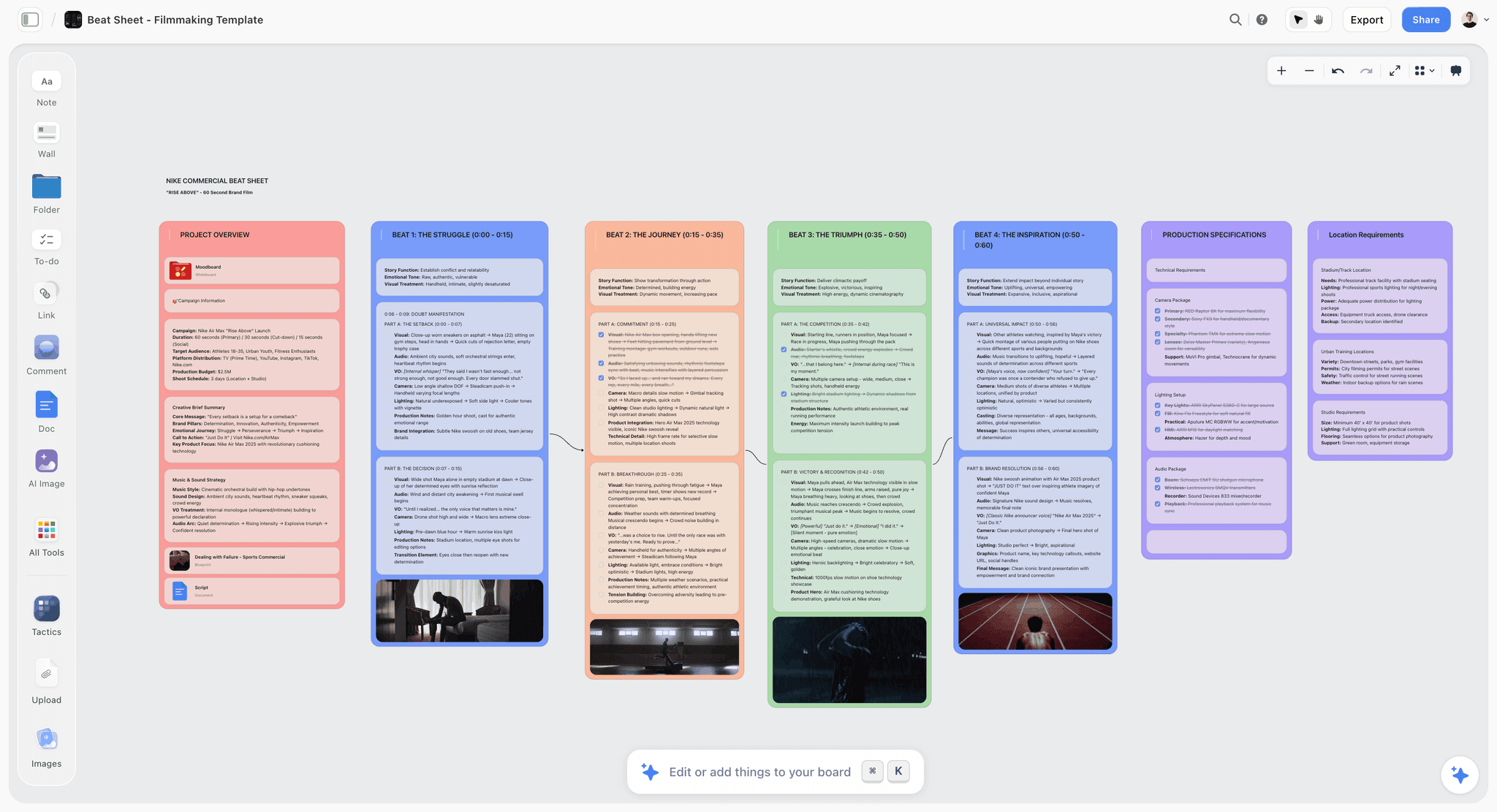
Notes accumulate across rounds and the reason a choice was made in round one is gone by round four. Storyflow keeps the drafts, the notes and what each note changed side by side, so a revision does not quietly undo an earlier decision.

Notes Are Evidence, Not Instructions
The person giving notes is an expert in their reaction and an amateur in your craft. Both halves matter.
Their reaction is real data. If a commissioner says the second act drags, it drags for them, and that is not up for debate. What they say to do about it is a guess, usually the first plausible fix that occurred to them, and it is frequently the worst available option because it treats the surface.
The classic pattern. "Can we cut the interview section, it feels slow." The interview section is not slow. It follows two minutes with no stakes established, so by the time the interview arrives the viewer has no reason to care. Cut the interview and the film loses its best material and still feels slow, because the actual problem was upstream. Establish the stakes earlier and the same interview plays fast.
That is the entire discipline. Believe the symptom completely. Distrust the prescription.
The exception. Some notes are instructions and should be taken literally: legal, factual accuracy, brand rules, budget, contractual requirements. Do not go looking for the deeper meaning in "we cannot say the competitor's name". Sort these out first, because they are not creative decisions and treating them as such wastes everyone's time.
The Method
Step 1: Log everything before you react
Write every note down verbatim, attributed to whoever gave it. Do not paraphrase, because paraphrasing is where interpretation sneaks in.
If notes arrived by phone or in a meeting, write them up the same day, and send them back to the person to confirm you heard correctly. This one habit removes a large share of later disputes, since it converts "that is not what I said" into a checkable claim.
Read the whole set once without deciding anything. The first read is for absorbing, not for planning, and the plan you make while defensively reading the first note will not survive the fifth.
Step 2: Translate each note into a problem
For each note write the underlying diagnosis in your own words.
| Note as given | Likely problem underneath |
|---|---|
The opening is slow | The stakes are not clear yet, or the promise of the piece is unstated |
I do not connect with the subject | Introduced through their function rather than their situation |
It feels long | Structure is episodic, so there is no accumulating question |
Can we add more energy | The piece resolves its tension too early |
The ending is abrupt | The consequence is missing, not the running time |
I do not understand the point | The controlling idea is implicit and needs stating once |
Can we cut section three | Section three is where an existing problem becomes visible |
Some notes will resist translation. Write "unclear, need to ask" and ask. A note you cannot diagnose is a note you will address wrongly.
Step 3: Cluster the problems
Now group the diagnoses. Eleven notes routinely reduce to three problems.
This step is where a revision becomes tractable. Eleven separate fixes produce a patchwork document that reads as though it were assembled by committee, because it was. Three structural fixes produce a coherent draft.
Clustering also reveals disagreement in the room. When two notes translate to contradictory problems, you have found something more important than either note: the stakeholders do not agree, and no draft will satisfy both. Surface it and ask, rather than splitting the difference, which produces a draft neither of them wanted.
Step 4: Decide what you are not doing
Not every note gets actioned. Deciding this explicitly, in writing, is what keeps a treatment coherent across four rounds.
Three legitimate reasons to decline: the note conflicts with a decision the client already approved, the note conflicts with another note and you need a ruling, or the note would break something load-bearing that the note-giver cannot see.
That third one obliges you to explain the load. "The slow open is doing work: it is what makes the reveal at four minutes land. If we speed it up we lose the reveal. I would rather cut ninety seconds from act two." That is a professional response and it is usually accepted. Silently ignoring the note is not, and it is what most people do.
Step 5: Revise against the problems
Now write, addressing the clustered problems rather than the individual notes.
Work top down. Structure first, then sequence, then scene-level, then line. A revision that starts with line edits is polishing a structure you are about to change.
Step 6: Keep the previous draft visible

This is the step that fails silently and expensively.
By round four, a change made to satisfy a new note frequently reverses a decision made in round one for a reason nobody now remembers. The client sees the reversal, cannot articulate what is wrong, and gives you a note that is really a request to go back to something they liked two rounds ago.
The defence is keeping the drafts and their notes side by side, so that before making a change you can see whether the thing you are about to remove was put there deliberately.
Version history in a document handles part of this and is hard to read across four rounds, because it shows you what changed without showing you why. On a Storyflow canvas each draft sits as an object with its notes and the one-line reason for each change attached, so the whole revision history is visible at once rather than buried in a changelog. Its AI reads the whole board, which means you can ask what changed between two drafts and why, and get an answer grounded in your actual notes.
Step 7: Reply before they read
Send a short summary with the new draft: the problems you identified, what you changed, and what you did not change with the reason.
Six or eight lines. It is the highest-return part of the process, because a reader who knows what you were solving reads the draft looking for the solution. A reader who receives a draft with no context reads it cold and re-notices everything they noticed last time.
Round Discipline
Rounds should get smaller. If round three produces more notes than round two, something is wrong at a level the notes are not addressing, and another revision will not fix it. Stop and have the conversation about what the piece is.
Agree the number of rounds up front. Two rounds included, further rounds chargeable, is standard and it changes behaviour: clients who know they have two rounds give better notes, because they consolidate rather than reacting.
Consolidate the note-givers. Notes from five people arriving separately will contradict each other and you will be the one discovering it. Ask for one consolidated set from a named person who has already resolved the internal disagreements. This is the single most effective thing you can negotiate.
What Goes Wrong
Every note actioned literally. Produces an incoherent draft that satisfies each note and nobody. The commonest failure, and it comes from treating notes as a checklist.
Notes actioned in the order received. The order reflects the order the reader noticed things, which correlates with nothing structural.
Disagreement split down the middle. Two contradictory notes both half-addressed produces a draft that fails twice. Escalate instead.
The previous draft is gone. Round four undoes round one. Nobody can explain why the piece got worse.
No reply sent. Next round's notes repeat this round's, because the client had no way to know what you were solving.
Declined notes not mentioned. The client assumes you missed them and repeats them with more force.
The Bottom Line
Believe the symptom, distrust the prescription. Log the notes verbatim, translate each into the problem underneath, cluster the problems, decide explicitly what you are not doing and why, then revise structure first.
Keep every draft with its notes attached so round four cannot quietly undo round one, and always send the reasoning before the draft. That is what turns a revision from damage control into an actual improvement.
FAQ: Treatment Revisions and Notes
How many rounds of notes is normal?
Two to three for most commercial and documentary work, agreed in advance. Beyond three, the issue is usually that the piece's central idea was never actually agreed, and further rounds circle it rather than resolving it. If you reach round four, ask for a conversation rather than sending another draft.
What if the notes contradict each other?
Do not resolve it yourself. Write both notes down, state plainly that they point in opposite directions, and ask for a ruling from whoever owns the decision. Splitting the difference is the worst available option, because it produces a draft that satisfies neither party and makes you look indecisive.
Should I push back on notes?
On some, yes, with a reason and an alternative. Pushing back on a note that would break something load-bearing is expected professional behaviour, provided you explain what the load is and offer another way to solve the underlying problem. Pushing back on everything reads as defensiveness, and pushing back on nothing produces incoherent work.
How do I keep track of notes across several rounds?
Log every note verbatim with its round and its author, keep each draft, and attach the reason for each change. The specific thing you are protecting against is a later change silently reversing an earlier decision, and that is only detectable if the earlier reasoning is still visible.
Is Storyflow free for treatment work?
Not during early access. Storyflow is paid-only right now, with Plus at $7.99 per month billed annually, and the Free plan launches before the end of 2026. Anyone a paid member invites to a board joins free, which covers a client or producer who only needs to read drafts and leave notes.
Can AI help with revisions?
It is useful for the mechanical parts: clustering notes into themes, spotting where two notes contradict, and summarising what changed between drafts. It is poor at the diagnosis step, which requires knowing what the piece is trying to do, and an AI that rewrites to satisfy notes literally reproduces exactly the failure this article is about.
Table of Contents
Templates to check out for this topic


Story and writing templates you can use in Storyflow
Start your next script, novel, or world from a ready-made Storyflow board instead of an empty page. The AI reads the whole canvas, so every suggestion is grounded in your story.


See Storyflow in Action
A visual AI workspace where every feature lives inside one canvas. No tab-switching, no context lost.
Build your entire board from a single message
Type what you need in the AI chat at the bottom of your canvas. The AI adds cards, headings, and structure directly onto your board.
Use expert frameworks as AI context
Type @ in the AI chat and choose any Tactic. The AI tailors every response to that framework instead of giving generic advice.
Turn your board into a mind map in seconds
Ask the AI to restructure your canvas as a mindmap. It connects your ideas into a visual hierarchy so you can see how everything relates.
Why Storyflow Exists
Storyflow actually began as a personal tool while working on creative and research projects.
We kept running into the same problem: ideas were scattered everywhere: notes, documents, and whiteboards.
Nothing helped us see how everything connected.
So we started building a workspace designed around how ideas actually grow.
→ Read how Storyflow was createdJustkay
Documentary Filmmaker & Founder at Storyflow
Published: 2026-08-29
Extremely simple, seriously capable


See how easy it is to get started
Watch a real project come together, from a blank board to a finished plan, clicked through step by step.
Start creating with AI and become more productive
Transform your creative workflow with AI-powered tools. Generate ideas, create content, and boost your productivity in minutes instead of hours.