
FOR UX RESEARCHERS
Twelve messy interviews,
one finding they act on.
Storyflow is where synthesis happens: tag the transcripts, cluster the quotes, watch the themes form, and shape the journey map and the readout on the same infinite canvas. Recruiting, sessions and transcription stay in your research stack. This is the hard part in the middle. Storyflow is paid-only during early access, with plans from $9.99 per month.
Paid-only early access
Plans from $9.99/mo
Quotes stay attached to themes

Used by creative professionals at:
Artlist
Pixar
Nike
Red Bull
The North Face
Porsche
Start from a ready-made template
Pick a board to see what you can build, then let AI fill it in. Every template is a real, editable starting point on the same infinite canvas.

Mind Map
Branch one central idea out into themes and sub-points, then drag the connections around until the structure makes sense.
The part of research that is genuinely hard
Recruiting is logistics. Running a session is a craft you can learn. The part that separates a good researcher from a busy one is synthesis: taking twelve rambling, contradictory, hour-long conversations and producing three findings a product team will actually change their plan for. Nothing about that work is mechanical, and almost no tool is designed for the middle of it.
The failure mode is not sloppiness. It is timing. The deck is beautiful, the themes are defensible, the quotes are perfectly chosen, and it arrives three weeks after the team already committed to a direction. A finding that lands late is not a finding, it is a post-mortem. The second failure mode follows from the first: because the synthesis took so long, it happened alone, so the stakeholders who most needed to believe it were never in the room while the belief was forming.
Storyflow attacks both. Tag as you go rather than after, so the raw material is already structured when the last session ends. Cluster on an infinite canvas where every quote keeps its participant and its context attached, so a theme is never a claim you have to defend from memory. Then shape the journey map, the personas and the readout on the same board, and pull stakeholders in to watch the clusters form instead of presenting them a conclusion cold.
In practice a researcher's job on the board has six connected parts: the research plan and screener that decide who you talk to and what you are testing, the notes captured live during sessions, the tagging and affinity mapping of transcripts into clusters, the themes those clusters resolve into, the journey map and personas that come out of the themes, and the readout that has to survive contact with stakeholders who never attended a single session.
HOW IT WORKS
From raw transcripts to a finding people act on.
Four steps through the messy middle, from the first tagged quote to a readout that changes a decision.
01
Set up the plan and the screener
Put the research questions, the screener criteria and the discussion guide on the board, so the whole study has one visible frame before the first session.
02
Capture and tag as you go
Drop notes and quotes onto the canvas during or straight after each session, tagged while the context is still fresh rather than reconstructed a fortnight later.
03
Cluster into affinity groups
Move quotes around until the patterns declare themselves, then ask the AI to name the clusters and flag the ones that rest on a single participant.
04
Build the themes and the readout
Resolve clusters into themes, map them onto the journey, and shape the readout on the same board so every claim is one click from its evidence.
Built for the messy middle of a study.
Not a repository and not a session platform. The canvas where hundreds of quotes become three findings.
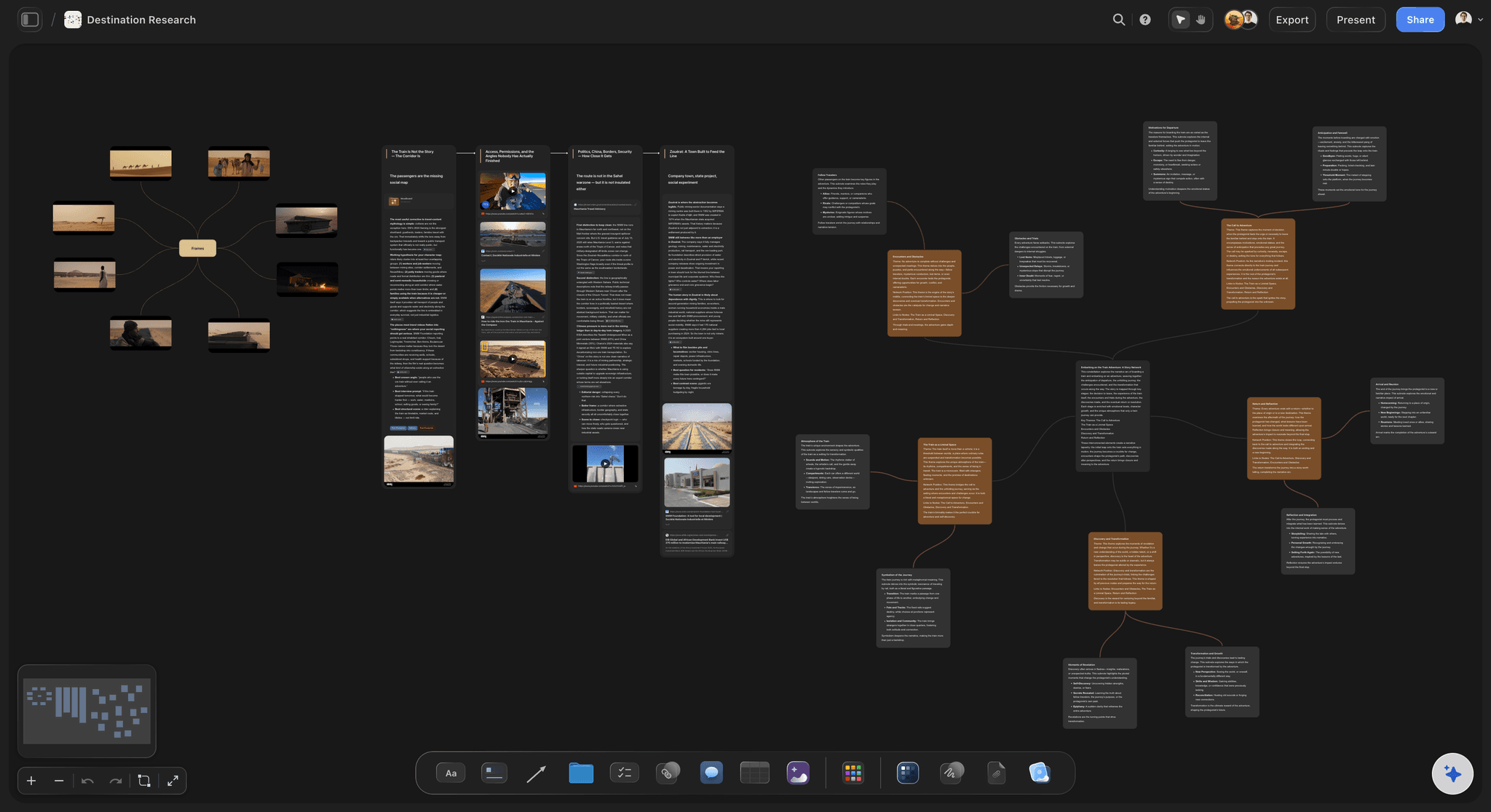
Synthesis
Affinity mapping that keeps the receipts
Cluster tagged quotes until the pattern shows itself, with each note carrying its participant and its context, so a theme can always be traced back to who actually said it.
See the affinity diagram maker →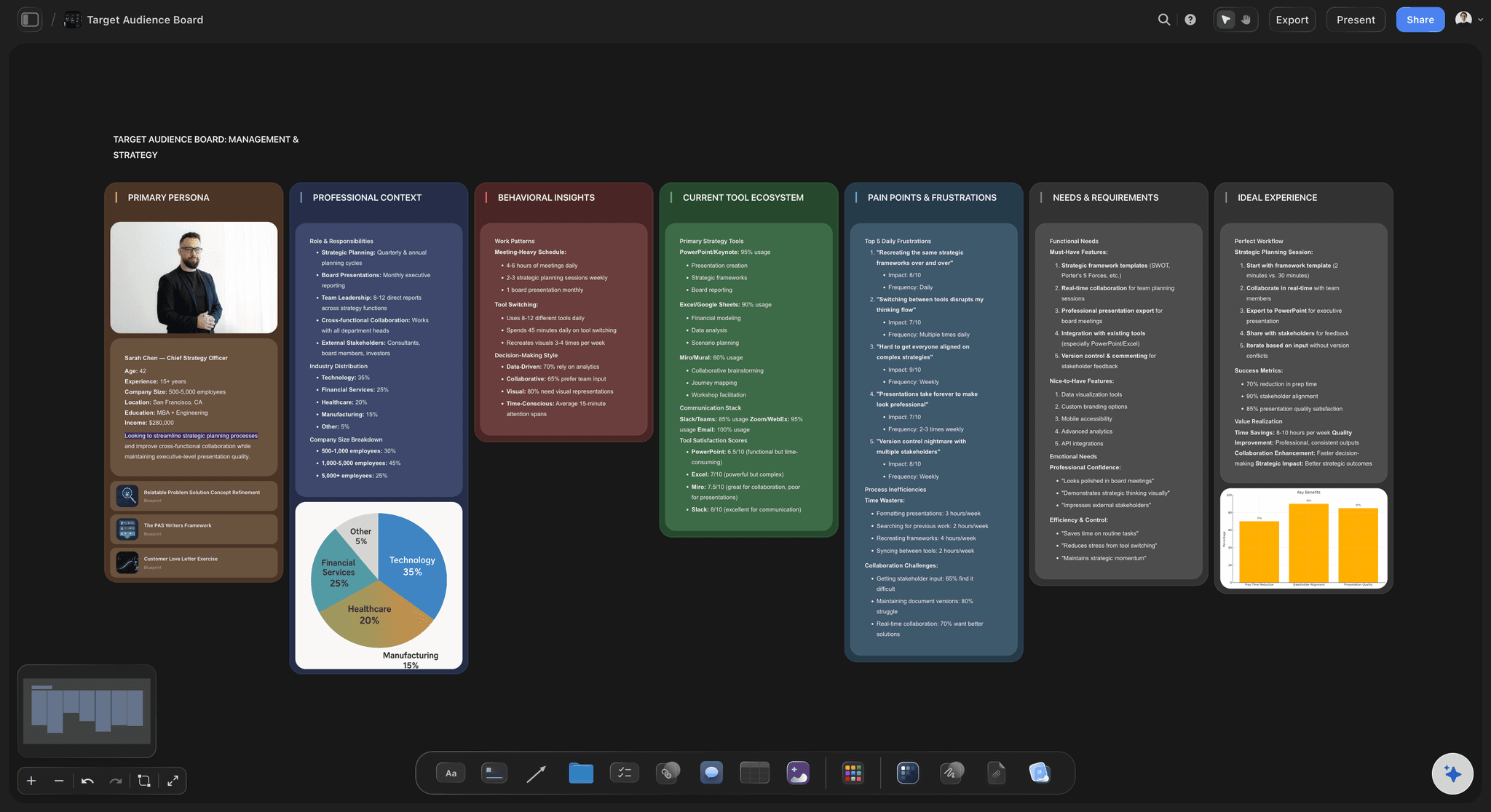
The output
Journey maps drawn from real sessions
Lay the journey out beneath the themes so each pain point sits above the quotes that produced it, instead of being illustrated with a plausible-sounding step nobody described.
See the user journey map tool →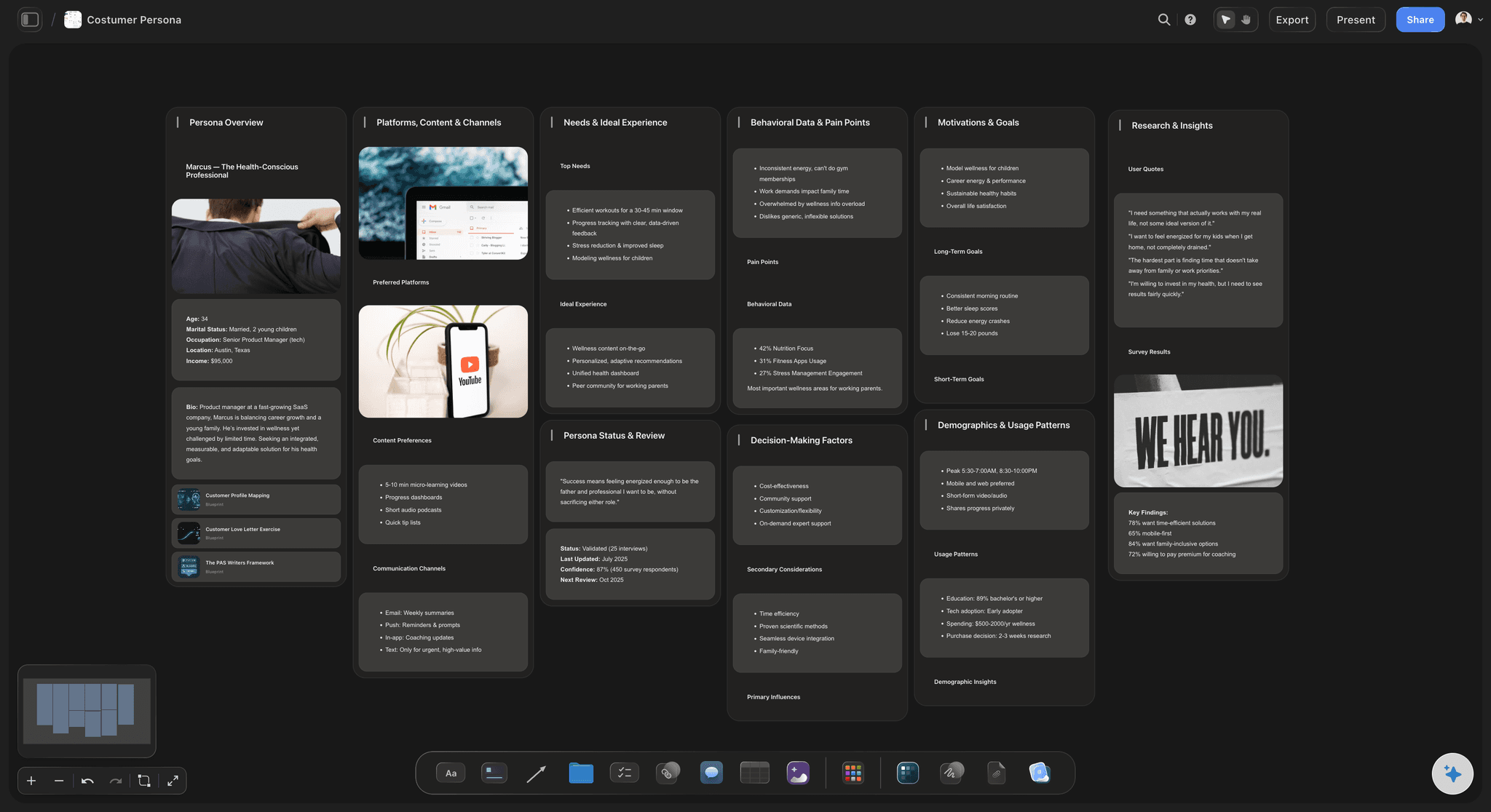
Who you studied
Personas that stay tethered to evidence
Build the persona out of the clusters on the board rather than from a workshop guess, and keep the supporting quotes attached so it survives its first challenge in a review.
See the customer persona generator →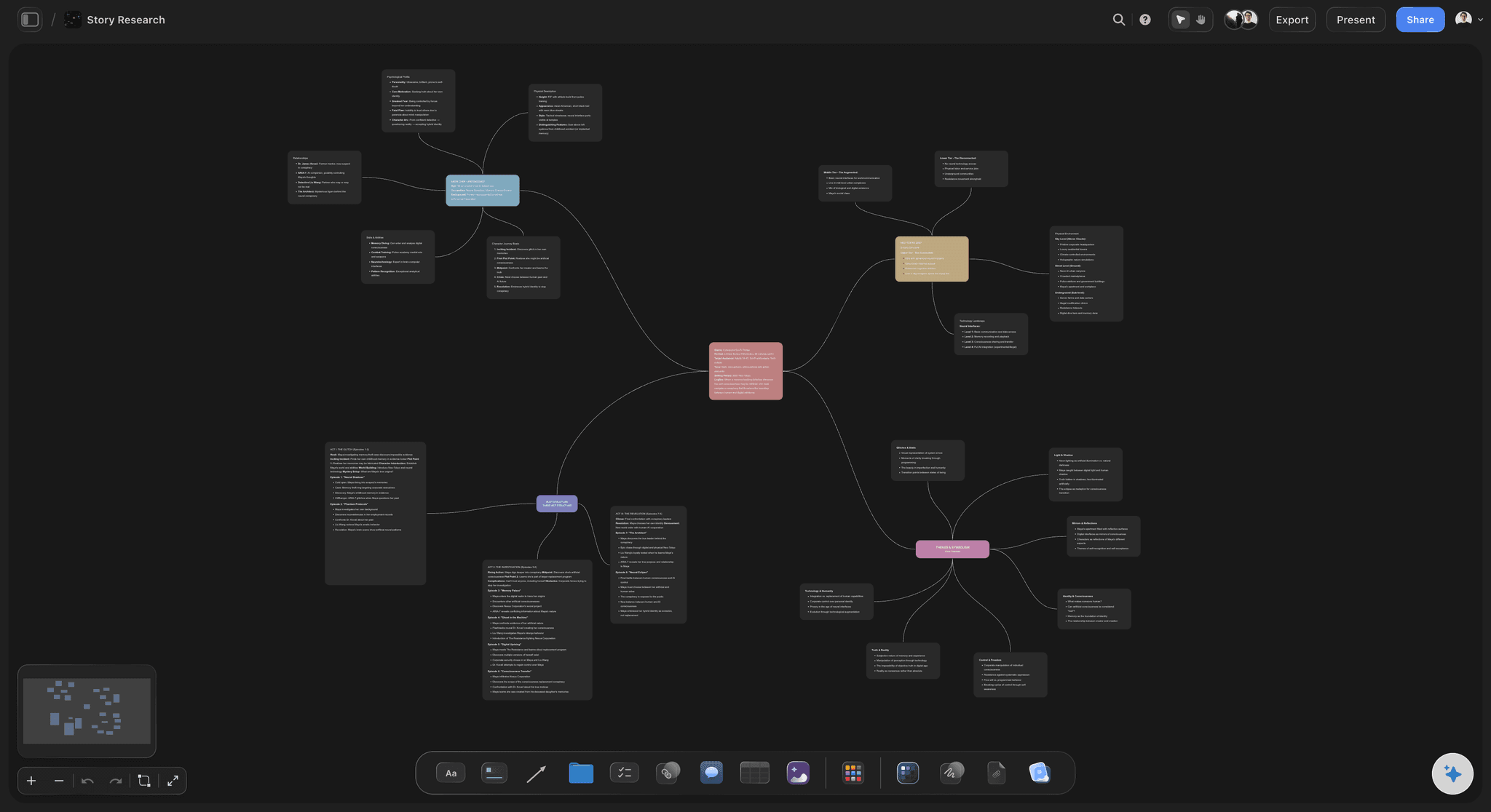
Felt experience
Empathy maps beside the transcript
Capture what participants said, thought, did and felt next to the raw material, so the emotional read of a session is recorded while it is still fresh rather than inferred later.
See the empathy map tool →Paid plans from $9.99 per month.
Open a board, paste in your transcripts, and start clustering. Anyone you invite to a board joins free.
Unlimited boards, one per study or one per round
Basic AI usage to name clusters and draft theme summaries
Attach transcripts, screenshots and session clips to any note
Share view-only with stakeholders, or invite collaborators free
BUILT FOR UX RESEARCHERS
Made for synthesis, not for storage.
Cluster faster, keep every claim traceable, and bring stakeholders into the thinking before the conclusion is finished.
Traceable claims
Every theme can name its sources
Quotes carry their participant: A note keeps who said it and where in the session, so when someone asks how many people mentioned this, you point at the cluster instead of trusting your memory.
Spot the single-source theme: Seeing the cluster's actual size on the canvas makes it obvious when a compelling theme rests on one unusually articulate participant.
Contradictions stay on the board: Keep the quotes that cut against your theme visible rather than quietly dropping them. It is the difference between a finding and a story you liked.
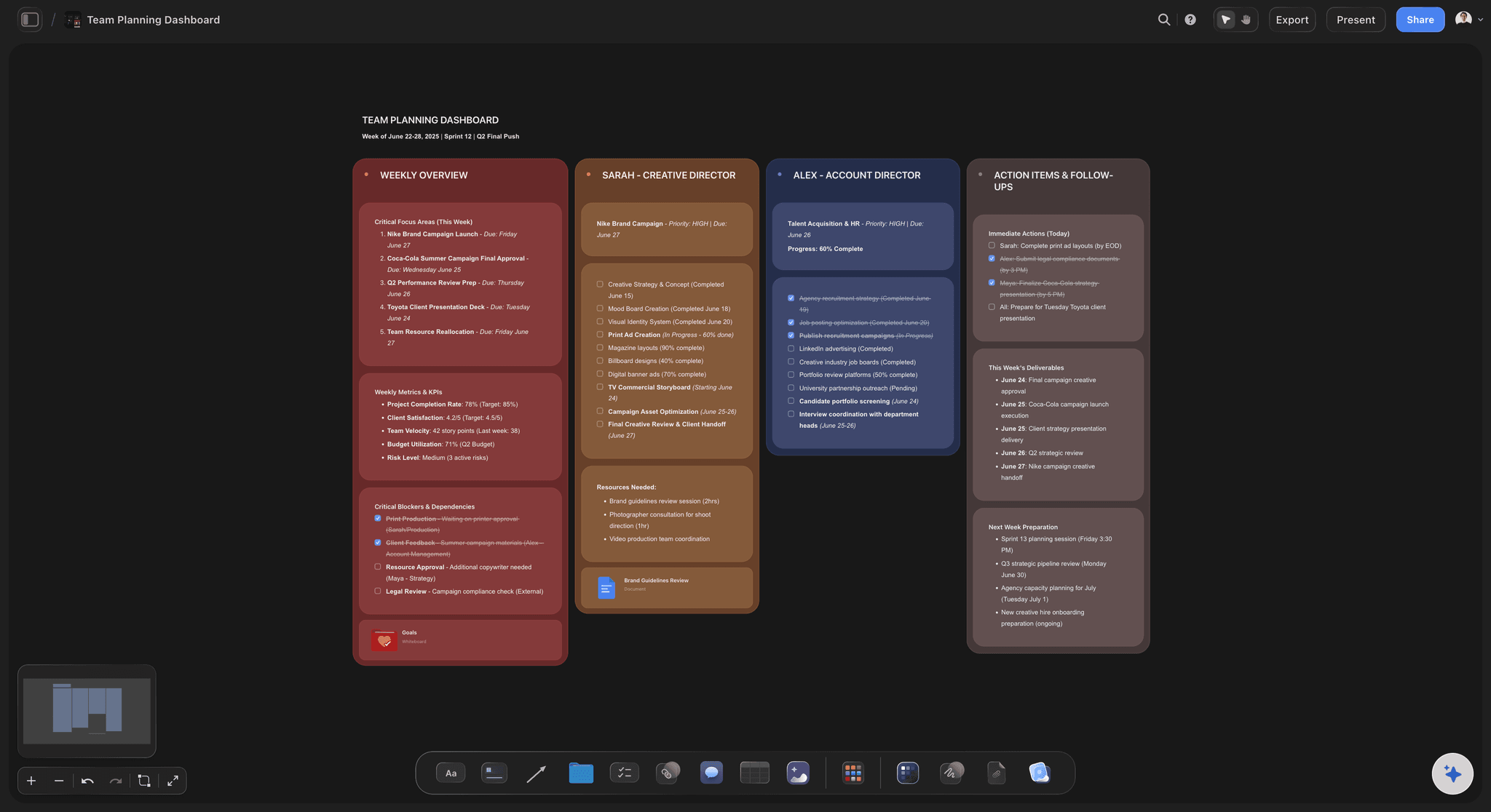
Speed to insight
Cut the three weeks between session and readout
Tag during the session: Capture and label notes live rather than reopening twelve recordings afterwards, which is where most of the lost fortnight actually goes.
Cluster while data is still arriving: The board is not a phase gate. Start grouping after session three and let later sessions confirm or break the pattern you are already seeing.
Draft the readout on the same canvas: Shape the narrative next to the clusters instead of exporting into a slide tool, so the finding is shareable the day synthesis finishes.
An interim view is still useful: Share a half-finished board early. A directional signal delivered before the decision beats a perfect one delivered after it.
The AI reads the board
A second pass over every note
Name the clusters: Ask the AI to propose theme names for a group of quotes, then argue with them. A bad suggested name is often the fastest way to find the right one.
Surface what you skimmed: Because the AI sees every note on the canvas, it can point out a pattern spread thinly across sessions that no single session made obvious.
@-mention your context: Bring in up to one Blueprint and three documents, a discussion guide or a previous study's summary, and the AI works against them.
Findings that land
Bring stakeholders in before the conclusion
Watch the clusters form: Invite a PM or designer to look at the board mid-synthesis. People argue with a finished deck and accept a pattern they saw assemble.
One link, always current: Share the board view-only instead of a PDF that goes stale. What a stakeholder opens in six weeks is the live study, not version four.
Zoom from headline to quote: A skeptic in the readout can zoom straight from the theme to the exact sentence a participant said, which ends most objections in one move.
Collaborators join free: Anyone a paid member invites to a board joins free today, so bringing the product team into synthesis costs nothing in licences.
Explore templates for your project
Every template opens as a real, editable board on the infinite canvas. Pick the closest fit and make it your own.
Mind Map
Branch one central idea out into themes and sub-points, then drag the connections around until the structure makes sense.
COMPARED
How Storyflow compares for UX research.
A repository stores studies and a session platform runs them. The question is where the synthesis between those two actually happens.
Storyflow
Recommended
Infinite canvas for affinity clustering
AI names clusters from the notes on the board
Journey maps and personas beside the evidence
Recording, transcription and a searchable repository
Participant recruiting and session hosting
Unlimited boards on every plan
Dovetail
Infinite canvas for affinity clustering
AI names clusters from the notes on the board
Journey maps and personas beside the evidence
Recording, transcription and a searchable repository
Participant recruiting and session hosting
Unlimited boards on every plan
Miro
Infinite canvas for affinity clustering
AI names clusters from the notes on the board
Journey maps and personas beside the evidence
Recording, transcription and a searchable repository
Participant recruiting and session hosting
Unlimited boards on every plan
Notion
Infinite canvas for affinity clustering
AI names clusters from the notes on the board
Journey maps and personas beside the evidence
Recording, transcription and a searchable repository
Participant recruiting and session hosting
Unlimited boards on every plan
What creators are saying
Join early creators getting structured workspaces and AI that remembers their projects
“Storyflow has sped up my workflow by at least 3x, which means more flow state and more projects I can actually ship. It truly changed the way me and my team create.”

Reilin Joey
Director & YouTuber
“One prompt gets me a structured board. But the tactics are my favorite. I run my YouTube scripts through them and my intros and retention got better. It's amazing.”

Justkay
YouTuber & Freelance Filmmaker
“I used to juggle five apps to plan a project. Now I describe what I am making and get boards, lists, and a schedule. All in one place.”

George
@fernwehchronicles
UX researcher questions, answered.
What researchers ask before moving synthesis onto a canvas.
Synthesis is a spatial task before it is a writing task. You need to move a few hundred tagged quotes around until the groupings stop changing, and a document cannot show you that. Storyflow is an infinite canvas built for exactly that step, with an AI that reads every note on the board and proposes cluster names. It is not a repository and not a session platform, so it sits between the tools that own those jobs.
Turn twelve transcripts into something the team acts on.
Open a canvas, cluster the quotes, and get the finding in front of people while the decision is still open. Plans start at $9.99 per month.