How to Write a Documentary Treatment (Step-by-Step, 2026)
A working documentary filmmaker's step-by-step guide to writing a treatment that sells the film: logline, synopsis, characters, arc, visual approach, access, and why now.

Category
Filmmaking
Author

Justkay
Documentary Filmmaker & Founder at Storyflow
Topics
2026-07-21
•
14 min read
•
Filmmaking- how to write a documentary treatment
- documentary treatment
- documentary treatment example
- documentary treatment template
- documentary logline
- documentary pitch document
How do you write a documentary treatment?
To write a documentary treatment, write the film as a story a reader can already see, not a topic you intend to cover: open with a logline, tell the actual narrative in a present-tense synopsis, introduce the characters the audience will follow, lay out the arc and structure, describe the visual and stylistic approach, prove you have access and can make it, and answer why this film and why now. A treatment is the document that sells an unmade film to the people who fund and commission it, so its job is not to explain a subject but to make a reader believe the film already exists and they want to see it. Everything else in this guide is how to write each of those parts so a busy commissioner reads to the end. I have written and pitched documentary treatments, and the thing that took me years to learn is that a treatment is not an essay about a topic. It is a promise about a film. Funders do not give money to subjects; they give money to films they can picture, made by people they believe can pull them off. The treatments that get read are the ones that read like the film itself: specific, visual, character-led, and confident about the story that will emerge. This guide is the working method I use, the eight sections a treatment needs, and the honest boundary where the writing tool stops and the delivery format takes over.

Full disclosure: Storyflow is our own product, so weigh its placement with the skepticism you would apply to any tool a company recommends on its own blog. We rank it first for one job, developing the treatment with the writing, characters, and visual references on one AI-readable canvas, and we are explicit that a plain Google Doc or a designed InDesign PDF is often the better final-delivery format.
Quick Comparison
Where documentary filmmakers actually develop and deliver a treatment, and the one job each tool is best at.
| Tool | Best For | AI Features | Price |
|---|---|---|---|
| Storyflow | Treatment + character and visual boards | Reads the whole board | $7.99 mo annual (free plan late 2026) |
| Google Docs | Readable text treatment | Gemini add-on | Free |
| Milanote | Visual references + mood | Limited | Free / ~$12.50 mo |
| InDesign | Designed delivery PDF | Limited | Paid (Adobe CC) |
Why a Documentary Treatment Matters
A treatment matters because it is almost always the first and sometimes the only thing a decision-maker sees. A commissioner at a broadcaster, a program officer at a grant fund, a sales agent, an executive producer weighing whether to attach: they meet your film as a document long before they meet it as footage. If the document does not convince them, there is no film. The treatment is the gate, and most documentaries die at it.
Here is what makes it different from every other document in the process. A treatment is written before the film exists, about a film that will change as you make it, to persuade someone to fund exactly that uncertainty. That is a strange thing to write. You are describing scenes you have not shot, an ending you cannot guarantee, and characters who might surprise you, and you have to do it with enough conviction that a stranger bets money on it. A synopsis of a finished film is reporting. A treatment is a pitch about the future, and the skill is making the future feel inevitable without lying about how documentary actually works.
The reader matters more than the writer here, so it is worth being precise about who reads a treatment and what each one is looking for. A broadcast commissioner is asking whether this fits their slot, their audience, and their brand, and whether you can deliver on time. A grant panel is asking whether the film is important, original, and feasible, and whether the funding will make a difference. A sales agent or distributor is asking whether it will sell and to whom. A potential collaborator (a producer, a cinematographer, an editor) is asking whether the vision is clear enough to commit years to. One document has to work for all of them, which is why a treatment is written outward from the film's strengths, not inward from your research.
I have watched strong films fail to get made because the treatment described the topic instead of the film, and I have watched modest ideas get funded because the treatment made the reader see it. The quality of the film in your head does not transfer automatically. The treatment is the transfer, and if it is vague, the reader fills the vagueness with doubt.
The Anatomy of a Documentary Treatment
Every treatment that got a film funded, whatever its length or format, carried the same eight sections, whether the filmmaker labelled them or not. Some treatments are two pages and some are twenty, but the working parts do not change. Here is the anatomy, in the order a reader wants to meet them.
- Logline. One or two sentences that capture the whole film: who it follows, what they want, and the tension that makes it a film rather than a subject.
- Synopsis. The story told as a story, in the present tense, so the reader experiences the arc rather than a summary of the theme.
- Main characters or subjects. The people the audience will follow, drawn specifically enough that the reader cares about them and believes they can carry the film.
- Narrative arc and structure. How the film moves: the beginning, the turns, the escalation, and the shape it will take (chronological, chaptered, braided, observational).
- Visual and stylistic approach. How the film looks and feels: the cinematography, the tone, the use of archive, music, interviews, verite, so the reader can picture the screen.
- Access and feasibility. The proof that you can actually make it: who has said yes, what you can film, and why the film is possible now.
- Why this film, why now. The reason this story matters at this moment, which turns a good idea into a fundable one.
- About the filmmaker. Who you are and why you are the person to make this film, which is what a funder is really betting on.
The order is deliberate. A reader wants the logline to know what they are looking at, the synopsis to feel the film, the characters to care, the structure to trust it holds together, the visual approach to picture it, the access to believe it is real, the why-now to feel its urgency, and your bio to trust the hands it is in. Each section answers the doubt the previous one raises. Skip one and the reader's doubt lands there and stays. The rest of this guide is how to write each part so the doubt never gets a foothold.
Quick Picks: Where to Write a Documentary Treatment
Best for developing the treatment with character boards and visual references together: Storyflow. The surface where the written treatment, the character profiles, the arc, and the visual references all live on one infinite canvas, and the AI reads the whole board so it can help you draft and tighten from everything at once. Plus is $7.99/month billed annually. The honest limit: it develops and assembles the treatment, but for final delivery you often export to a doc or a designed PDF.
Best for a clean, readable text treatment: Google Docs. When the commissioner just wants to read the argument, a plain shared document is fast, universal, and easy to comment on. Free.
Best for visual references and mood: Milanote. If you want a board of stills, locations, and tonal references beside the writing, Milanote is built for it. Free with an item cap, paid from around $12.50/month.
Best for a designed, art-directed treatment PDF: InDesign or Canva. When the delivery has to look like a finished pitch, with stills laid into the page and real typography, a design tool is the right final step. Paid (Adobe CC) or free-to-paid (Canva).
The honest split: most documentary filmmakers develop the treatment where they can see the whole film at once, then deliver it as a clean doc or a designed PDF depending on who is reading. Try Storyflow to develop your treatment.
Comparison Table: Where to Write a Documentary Treatment
| Tool | Best for | AI on the draft | Visual planning | Free tier | Starting price |
|---|---|---|---|---|---|
Storyflow | Treatment + character and visual boards | Reads the whole board | Yes, infinite canvas | Coming late 2026 (invited collaborators join free now) | $7.99/mo annual |
Google Docs | A readable text treatment | Gemini add-on | No | Yes | Free |
Notion | A structured treatment doc | Notion AI | Limited | Yes | Free + paid |
Milanote | Visual references and mood | Limited | Yes | Yes, item cap | ~$12.50/mo |
Canva | A designed treatment PDF | Limited | Template-based | Yes | Free + paid |
InDesign | An art-directed delivery PDF | Limited | Page layout | No | Paid (Adobe CC) |
Pricing checked July 2026. Competitor prices move and are quoted per plan, so verify on each vendor's page. Storyflow is paid-only during early access, and its Free plan (which will run the whole development method) launches before the end of 2026; the paid tier adds the 200+ Story Blueprints and unlimited file uploads. Whichever tool you develop in, the final treatment is delivered as a document, so choose the delivery format for the reader, not the tool.
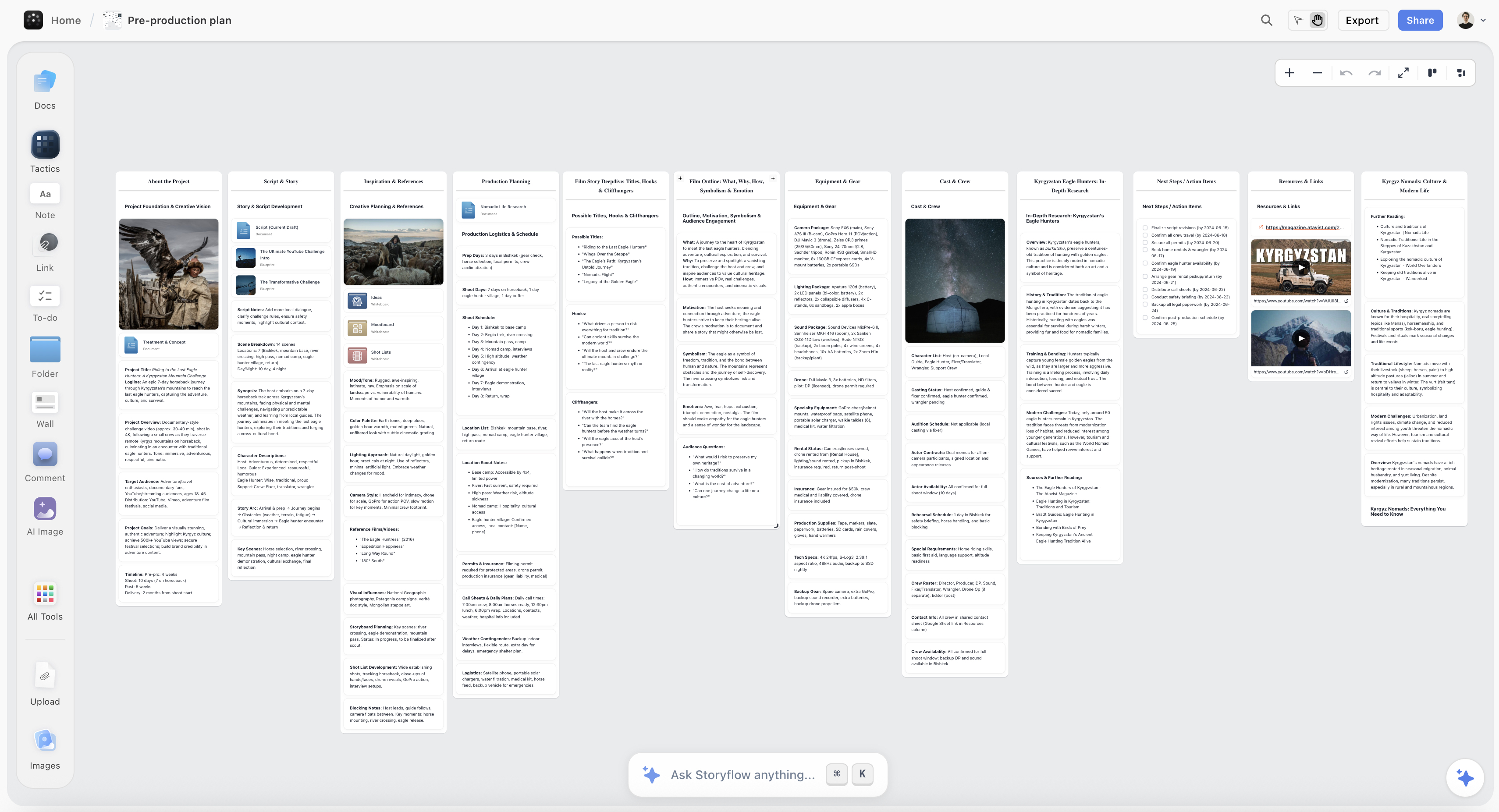
A documentary treatment developed on the Storyflow canvas, with the written sections beside character boards and a wall of visual references
Build your documentary treatment on one canvas
The written treatment, the character boards, and the visual references live in one place, and the AI reads the whole board so it can draft the logline, tighten the synopsis, and spot where the arc goes soft, before you export a clean doc or a designed PDF to deliver.

How to Write a Documentary Treatment, Step by Step
Here is the full method, from a blank page to a treatment you can send. It assumes a single documentary at the development or funding stage. Write the sections in this order, because each one earns the reader's attention for the next, and revise the logline last once the rest has taught you what the film actually is.
Step 1: Write the logline
Start with the logline, because if you cannot say the film in one or two sentences, you do not yet know what it is. A documentary logline names who the film follows, what is at stake for them, and the tension that makes it a film. "A film about climate change" is a topic. "A last-generation lobster fisherman fights to keep his harbor alive as the water warms and the young leave" is a film: a person, a stake, a clock. The logline is the hardest sentence in the treatment because it forces you to choose the story out of the subject, and everything else in the document has to deliver on it. I write a first logline early, then rewrite it after the synopsis, because the act of telling the story usually reveals what the film is really about. If the reader remembers one thing, it will be this sentence, so it has to be the film.
Step 2: Write the synopsis as a story
Now write the synopsis, and write it as a story unfolding, not a summary of a theme. This is where most treatments fail: they describe the issue ("the film explores the housing crisis through several perspectives") instead of telling the narrative the audience will actually experience. Write it in the present tense, follow your main character, and let the reader feel the arc: here is where we begin, here is what changes, here is what builds, here is where it lands. You do not need to know the exact ending, but you need to know the shape and the question the film is chasing. A good synopsis reads like someone recounting a film they just watched and loved, scene by scene, not like a grant abstract. If it reads like an essay about a subject, rewrite it until it reads like a film.
Step 3: Introduce your characters and subjects
Introduce the people the audience will follow, and make the reader care about them the way the film will. A funder is being asked to spend years and money on these people, so a name and a role is not enough. Give each main character a sentence or two of specific, telling detail: what they want, what they are up against, the contradiction that makes them human and watchable. "The retired miner who reopens the union hall as a food bank and refuses to call it charity" tells the reader this person can carry a film. Documentary lives or dies on whether the audience bonds with real people, and the treatment has to prove you have found people worth ninety minutes. This is also where you show you understand your characters as characters, with arcs and flaws, not just as sources of information.
Step 4: Lay out the narrative arc and structure
Now show the reader that the film holds together as a structure. Describe how it moves from beginning to end: the situation you open in, the turns and escalations, the shape it takes. Is it chronological, following an event as it unfolds? Chaptered around themes or people? Braided between two or three parallel stories? Observational with no narration, or driven by a central interview? The reader needs to trust that you have thought about form, because a great subject with no structure is the most common way documentaries fall apart. You are not locking the edit; you are showing that the film has an architecture and you know what it is. I usually name the structural model explicitly so the reader can picture the build, then describe the key movements so they feel the momentum.
Step 5: Describe the visual and stylistic approach
Make the reader see the film. This section is where a documentary treatment becomes cinematic rather than journalistic: describe the cinematography, the tone, the palette, the pace, and the tools you will use to tell it, whether that is intimate verite, formal composed interviews, archive, animation, or reconstructions. Be specific and visual: "handheld and close, natural light, long takes that stay with a face after the words stop" tells the reader more than "an observational style." If you have visual references, a director of photography's prior work, films with a comparable look, stills from a scout, this is where they earn their place, because they let the reader picture the screen instead of imagining a generic documentary. A treatment that describes how the film looks and feels separates a filmmaker with a vision from someone with a worthy subject.
Step 6: Prove access and feasibility
Convince the reader that the film is real and makeable, not a hope. Access is often the single thing that decides funding for a documentary, because the best story in the world is worthless if you cannot film it. State plainly who has agreed to participate, what you can film and when, what you have already shot, and any relationships or rights that make the film possible. If you have exclusive access to a subject, a location, or archive, say so clearly, because it is your strongest card. If there are risks (a subject who could withdraw, an event you cannot control), address them with a plan rather than pretending they do not exist. Feasibility also means the film can be made for a plausible budget and timeline, which the reader is quietly assessing throughout. Access is the difference between a treatment that reads as a real film in motion and one that reads as a nice idea.
Step 7: Answer why this film, why now
Tell the reader why this story matters and why it has to be made now. A treatment that could have been written five years ago or five years from now feels optional, and optional films do not get funded. The why-now can be an event, a shift, a deadline in the world, a moment your access opens, or a cultural conversation the film enters, but it has to make the reader feel that the film is urgent and timely. This is also where you name what makes it original: why this is not the documentary the reader has already seen on this subject. Funders and commissioners are pattern-matching against everything else on their desk, so the why-now and the originality are how you stop being one of five films about the same theme. Make the moment feel like the film's moment.
Step 8: Establish who you are as the filmmaker
Finally, tell the reader why you are the person to make this film. A funder is betting on the filmmaker as much as the film, so your bio in a treatment is not a formality. Lead with the work and the credibility that matters for this project: relevant films, relevant access, the reason this story is yours to tell. If you have a personal connection to the subject, a track record in this space, or a team whose names carry weight, this is where they build the reader's confidence. Keep it about the film, not a full CV: the reader wants to know that the hands are safe and the vision is authored. On a first film, honesty and a clear, specific voice can do the work a long credit list would, so do not fake authority you do not have; show the authority you do.
Step 9: Develop it all on one canvas, then choose the delivery format
Do not write these eight sections in isolation. A treatment is strongest when the writing, the characters, and the visual references develop together, because the visual approach informs the synopsis, the characters shape the structure, and the references sharpen the tone. This is why I develop treatments on one infinite canvas in Storyflow: the written sections sit next to character boards and a wall of visual references, I can grab a frame from a YouTube or Vimeo reference film straight onto the board, and the AI reads the whole canvas so it can help me tighten the logline against the synopsis or spot where the arc goes soft. When the writing is done, I make a deliberate choice about the final format: a clean document for a commissioner who just wants to read, or a designed PDF for a pitch that has to look finished. Develop where you can see the whole film; deliver in the format the reader wants.
When a Plain Doc or a Designed PDF Is the Better Delivery
Here is the honest part, because the tool you develop in and the format you deliver in are not the same choice, and getting this wrong costs you readers.
A plain document (Google Docs, a Word file, a clean PDF export) is the right delivery when the reader wants to read the argument and comment on it. Many broadcast commissioners and grant panels prefer a straightforward, well-written text treatment they can skim on a phone and mark up. If the guidelines ask for a treatment of a certain length with no design requirements, do not send a lavish brochure; send a clean, readable document. Over-designing a treatment that just needed to be well-argued can read as style covering for a thin idea.
A designed, art-directed PDF (built in InDesign, or Canva if you do not have the former) is the right delivery when the pitch has to look like a finished thing, which is common for higher-budget projects, sales decks, and competitive markets. When you are handing a treatment to a distributor or pitching at a forum, stills laid into the page, real typography, and a considered layout signal that the film will look considered too. This is where a design tool beats any writing surface, because page design is its whole job.
So the workflow that actually works is: develop the treatment where you can see the whole film (a canvas like Storyflow, where the writing, characters, and references sit together and the AI reads everything), then deliver it in the format the specific reader wants. Storyflow is honest about this boundary: it is where the treatment is built and argued, not where the final page design happens. Match the delivery to the reader, and never let the format fight the writing.
Common Documentary Treatment Mistakes
- Describing the topic instead of the film. "This film explores X" is the most common failure. Tell the story the audience will watch, with characters and an arc, not the subject you researched.
- No clear character to follow. A treatment about an issue with no people to bond with reads as journalism, not cinema. Find and foreground the people who carry the film.
- A logline that is a theme, not a story. If your logline names a subject rather than a person, a stake, and a tension, the reader never learns what the film is. Rewrite it as a story.
- Ignoring structure. A great subject with no described arc makes funders nervous, because it signals the film could sprawl. Show the shape.
- Vague visual approach. "An observational documentary" tells the reader nothing. Describe how it looks and feels specifically enough that they can picture the screen.
- Hiding the access problem. If you have not secured access, do not paper over it; funders can smell it. Address feasibility honestly with a plan.
- No why-now. A treatment with no urgency reads as optional. Give the reader a reason it has to be this film, this moment.
- A bio that lists everything. Your filmmaker section should build confidence for this project, not recite your whole career. Lead with what matters here.
- Over-designing before it is written. A beautiful layout cannot save a treatment that has not decided what the film is. Get the argument right, then design the delivery.
The Bottom Line
A documentary treatment is not an essay about a subject. It is a promise about a film, written to make a funder or commissioner see it and want it. Write the logline that names the story, the synopsis that tells it as a story, the characters worth following, the structure that holds, the visual approach the reader can picture, the access that proves it is real, the why-now that makes it urgent, and the bio that makes the hands safe. Sell the film, not the topic, and the reader will fund the film in their head, not the doubt.
The honest boundary holds. Develop the treatment where you can see the whole film at once, the writing beside the characters beside the references, with AI that reads the board, and then deliver it in the format the specific reader wants: a clean document when they want to read, a designed PDF when the pitch has to look finished. The tool where you build it and the format where you hand it over are two different choices, and the good filmmaker makes both on purpose.
If your documentary is still a subject and a hope rather than a film a funder can see, develop the treatment on one canvas in Storyflow and write the film, not the topic.
FAQ: Documentary Treatments
What is a documentary treatment?
A documentary treatment is a written document that describes an unmade film in order to sell it to funders, commissioners, and collaborators. It presents the film as a story rather than a subject: a logline, a present-tense synopsis of the narrative, the characters the audience will follow, the arc and structure, the visual and stylistic approach, proof of access and feasibility, the reason the film matters now, and who you are as the filmmaker. Unlike a script, which plans dialogue and scenes for a controlled shoot, a treatment describes a film that will change as you make it, and its job is to make a reader believe the film already exists and they want to see it. It is usually the first and sometimes the only thing a decision-maker reads, so it is the gate the whole project passes through.
How long should a documentary treatment be?
It depends on the reader and the stage, but most documentary treatments run from two to ten pages, with grant applications and broadcaster submissions often specifying a length. A short treatment (two to three pages) is common early or when guidelines are strict, and it forces you to lead with the strongest material: logline, synopsis, characters, and why-now. A longer treatment (up to ten or more pages) has room for a fuller synopsis, detailed character sections, a visual approach with references, and access documentation, which suits higher-budget projects and competitive pitches. Always check the funder's guidelines first and match their length exactly, because ignoring a stated limit signals you will ignore other instructions too. When in doubt, shorter and sharper beats long and unfocused.
What is the difference between a documentary treatment and a synopsis?
A synopsis is one part of a treatment, not a substitute for it. The synopsis tells the story of the film in the present tense so the reader experiences the arc. The treatment is the whole persuasive document: it contains the synopsis but also the logline, the characters, the structure, the visual approach, the access and feasibility, the why-now, and your bio. Think of the synopsis as the film's narrative and the treatment as the full pitch that surrounds it and makes the case for funding. A commissioner asking for a treatment wants all of it, because they are deciding not just whether the story is good but whether it is makeable, timely, and in the right hands. Sending a synopsis alone leaves most of the reader's questions unanswered.
How do you write a documentary logline?
Name who the film follows, what is at stake for them, and the tension that makes it a film rather than a topic. A strong documentary logline is one or two sentences and reads as a story, not a subject: it has a person, a want, and an obstacle or a clock. Compare "a film about small-town decline" (a topic) with "a retired miner reopens the shuttered union hall as a food bank and refuses to call it charity, as the town around him empties out" (a film). Write a first version early to focus the project, then rewrite it after the synopsis, because telling the story usually reveals what the film is really about. The logline is the sentence the reader remembers, so it has to be the film in miniature, specific and human, not a mission statement.
Do funders and commissioners actually read the whole treatment?
They read enough to make a decision, which is why the order and the opening matter so much. A busy commissioner or grant reader often has a stack of treatments and gives each one a few minutes before deciding whether to keep reading. The logline and the first paragraph of the synopsis decide whether they continue, the characters and structure decide whether they trust it, and the access and why-now decide whether they act. This is why you lead with the film's strengths and never bury the story under context or research. Write every section as if the reader might stop at the end of it, so each one earns the next. If your best material is on page six, most readers will never reach it.
Can AI help write a documentary treatment?
Yes, for developing and tightening the writing, not for inventing the film. AI is useful for drafting a first pass of a section, tightening a logline against the synopsis, spotting where the arc goes soft, and pressure-testing whether the why-now is convincing. Because Storyflow's AI reads your full canvas board, plus up to 1 Tactic and 3 Documents you @-mention, it can work from your actual characters, references, and notes rather than generic prompts, which makes its help specific to your film. What AI cannot do is find the story, secure the access, or supply the authored vision a funder is betting on, and a treatment that reads as generated will not convince anyone. Use AI to draft and refine, and bring the film, the access, and the voice yourself.
What is the most common reason a documentary treatment gets rejected?
The most common reason is that the treatment describes a topic instead of a film. Readers can tell within a paragraph whether they are being told a story with characters and an arc or handed an essay about an issue, and the essay version rarely gets funded because it gives the reader nothing to picture and no one to care about. Close behind are a weak or missing why-now, unproven access, and no described structure, each of which signals that the film is not yet real enough to fund. The fix for all of them is the same discipline: write the film the audience will watch, with specific people, a clear shape, a genuine urgency, and honest proof you can make it. Sell the film, not the subject.
Is Storyflow free for writing a documentary treatment?
Not during early access. Storyflow's Free plan, which launches before the end of 2026, will include unlimited objects and boards, unlimited collaboration, basic AI, and 20 file uploads, which covers developing a full treatment: the written sections, character boards, and a wall of visual references on one canvas. Paid tiers start at Plus for $7.99/month billed annually ($9.99 monthly), which adds the 200+ Story Blueprints and unlimited file uploads, with Pro at $14/month and Max at $39/month for more AI and, on Pro and Max, AI image generation. Once it launches, the Free plan will genuinely run the whole development method, so you'll be able to build the treatment and share the board with collaborators, then export to a doc or a designed PDF for final delivery. Storyflow develops and assembles the treatment; the final page design and the shoot happen elsewhere.
Table of Contents
- Why a Documentary Treatment Matters
- The Anatomy of a Documentary Treatment
- Quick Picks: Where to Write a Documentary Treatment
- Comparison Table: Where to Write a Documentary Treatment
- How to Write a Documentary Treatment, Step by Step
- When a Plain Doc or a Designed PDF Is the Better Delivery
- Common Documentary Treatment Mistakes
- The Bottom Line
- Author
- FAQ: Documentary Treatments
- Related Reading
Templates to check out for this topic


Filmmaking templates you can use in Storyflow
Skip the blank canvas. Open one of these filmmaking boards in Storyflow and the AI builds on the structure that is already there, from research through the shot list.


See Storyflow in Action
A visual AI workspace where every feature lives inside one canvas. No tab-switching, no context lost.
Build your entire board from a single message
Type what you need in the AI chat at the bottom of your canvas. The AI adds cards, headings, and structure directly onto your board.
Use expert frameworks as AI context
Type @ in the AI chat and choose any Tactic. The AI tailors every response to that framework instead of giving generic advice.
Turn your board into a mind map in seconds
Ask the AI to restructure your canvas as a mindmap. It connects your ideas into a visual hierarchy so you can see how everything relates.
Why Storyflow Exists
Storyflow actually began as a personal tool while working on creative and research projects.
We kept running into the same problem: ideas were scattered everywhere: notes, documents, and whiteboards.
Nothing helped us see how everything connected.
So we started building a workspace designed around how ideas actually grow.
→ Read how Storyflow was createdJustkay
Documentary Filmmaker & Founder at Storyflow
Published: 2026-07-21
Extremely simple, seriously capable


See how easy it is to get started
Watch a real project come together, from a blank board to a finished plan, clicked through step by step.
Start creating with AI and become more productive
Transform your creative workflow with AI-powered tools. Generate ideas, create content, and boost your productivity in minutes instead of hours.