ChatGPT Prompts for Brand Strategy (2026): 34 Prompts by Stage
34 copyable ChatGPT prompts for brand strategy, one decision at a time: audit, audience, positioning, platform, messaging, voice, visual direction and rollout, each with the board it builds in Storyflow.

Category
Brand Strategy
Author

Storyflow Team
Product & Research Team
Topics
2026-10-28
•
29 min read
•
Brand Strategy- ChatGPT prompts
- brand strategy
- positioning statement
- brand voice
- brand positioning
- Storyflow plugin
What are the best ChatGPT prompts for brand strategy?
The ChatGPT prompts that work for brand strategy settle one decision at a time (audience, positioning, platform, messaging, voice, visual direction) and, with the Storyflow plugin, put each decision on a Storyflow brand board where the team sees the whole strategy at once. Storyflow is an AI visual workspace that lays out a brand's positioning, audience, voice and visual direction on one infinite canvas. Use a ChatGPT project to hold the brand's rules across chats, Canva for finished brand assets, and Figma for FigJam diagrams of the brand architecture.

Full disclosure: Storyflow is our product. It is listed first because these prompts are written to land each brand decision on a shared board, and that is the job Storyflow does. Most of the 34 prompts also work in plain ChatGPT. The Storyflow plugin does not generate images, and ChatGPT cannot design your identity or clear a trademark.
How the tools for brand strategy work in ChatGPT compare on trust, innovation, ratings and pricing
Which tools for brand strategy work in ChatGPT are the most trusted?
Canva and Figma have the longest records with brand and design teams, and ChatGPT projects are part of ChatGPT itself. Storyflow's ChatGPT plugin was listed on 24 October 2026, so its record inside ChatGPT is short; its case is that each brand decision lands on one board the whole team reads, rather than in separate chats and files.
Which tools for brand strategy work in ChatGPT have fair and transparent pricing?
Storyflow publishes its plans (Plus $7.99, Pro $14 and Max $39 a month billed annually) and its plugin actions use no Storyflow AI credits, since they run on your ChatGPT plan. Figma publishes its prices and says its ChatGPT app works on any plan, including the free Starter plan. Canva prices its plans on its own site.
Which tools for brand strategy work in ChatGPT are the most innovative?
Storyflow, because ChatGPT can read a brand board and build on it: the positioning as a document, the message matrix as a table, the palette as named colour swatches, the references in walls, and a summary wall that groups the rest by stage. Figma's ChatGPT link for FigJam diagrams and Slides, still partly in beta, is the most interesting on the design side.
Which setup would you recommend for an in-house brand team using ChatGPT?
One ChatGPT project for the brand's rules and research, the Storyflow plugin for the strategy board, and Canva or Figma for the assets once the direction is agreed. That covers all 34 prompts. Keep customer research and trademark checks outside ChatGPT, with people who can do them properly.
Which tools for brand strategy work in ChatGPT are underrated?
ChatGPT projects, because putting the agreed positioning and banned claims in the project instructions keeps every later chat on strategy without pasting it again. Storyflow's colour palette is easy to miss too: ChatGPT adds the palette as named swatches beside the voice and positioning, so the designer sees the colours in the context they were chosen for.
Quick Comparison
Where to run brand strategy prompts in ChatGPT: Storyflow first for decisions the team must see together, then the rest by job. Prices as of October 2026.
| Tool | Best For | AI Features | Price |
|---|---|---|---|
| Storyflow | The strategy laid out as one brand board | ChatGPT builds documents, tables, walls, mind maps, colour palettes and decks on the board and groups it by stage | $7.99 mo annual (paid-only early access; Free plan due before the end of 2026) |
| ChatGPT projects | The brand's rules and research in one place | Project instructions override global ones; files attach to the project | Part of ChatGPT; file limits vary by plan |
| Canva | Finished brand assets | Creates, reviews and edits designs from the chat | See Canva pricing |
| Figma | Brand architecture and journey diagrams | Creates FigJam diagrams and Figma Slides (beta); not available in the EU | Any Figma plan, Starter free; see Figma pricing |
Key Takeaways
- A brand strategy is a chain of decisions, and a prompt that asks for "a brand strategy" makes all of them at once, badly. The 34 prompts below each make one decision from evidence you paste or point at, then test it.
- Work in eight stages: audit, audience, positioning, platform, messaging, voice, visual direction and rollout. Each stage feeds the next, so run them in order on a first strategy.
- Force uniqueness into every prompt. Ehrenberg-Bass researchers found marketers tend to overestimate how famous their brand assets are and underestimate how unique they are, so ask ChatGPT which competitor could make the same claim.
- Add "and put it on my [brand] board in Storyflow" when the decision must be seen with the others: the positioning as a document, messaging as a table, the palette as colour swatches, references as walls.
- Check every colour pair the palette prompt produces against WCAG 2.2's minimum contrast: 4.5:1 for normal text, 3:1 for large text.
- Storyflow is paid-only during early access, from $7.99 a month billed annually; its plugin actions run on your ChatGPT plan and use no Storyflow AI credits.
Why Brand Strategy Prompts Go Generic
Ask ChatGPT for "a brand strategy for a climbing gym" and you get purpose, values, personality and a tagline that would fit every climbing gym on the planet. "Community. Courage. Growth." It is not that the model is bad at strategy. It is that strategy is choosing, and the prompt gave it nothing to choose between.
The model averages your category
Without evidence, ChatGPT writes the most likely brand for the category, which is the one every competitor already has. A strategy built from the category average cannot differentiate, by construction. The fix is evidence: reviews, interviews, competitor copy, sales data, in the prompt.
Marketers misjudge their own brand
A 2025 paper in the Journal of Brand Management by Ruby Brus, Nicole Hartnett, Margaret Faulkner and Carl Driesener, all current or former Ehrenberg-Bass Institute academics, reported by Marketing Week, found marketers' judgements of brand asset strength rarely accurate: they overestimate how well known their assets are and underestimate how uniquely those assets link to the brand. Your prompts should test uniqueness, because your instinct about it is the least reliable part of the process.
A strategy nobody can see is not adopted
A strategy that lives in a 60-page PDF the social team never opens has failed, however good the thinking was. A strategy laid out as one board (audience beside positioning beside voice beside palette) is the version people check before they write a caption.
Set Up One Project for the Brand and One Board for the Strategy
Two containers do the work: a ChatGPT project holds the rules ChatGPT must follow, and a Storyflow board holds the decisions people must see.
Put the non-negotiables in project instructions
OpenAI's Projects article says project instructions override your global custom instructions inside the project, and that projects keep related chats and files together. Put the brand name, category, banned claims, legal mandatories and the current positioning (once agreed) in the instructions, and attach the research files.
Install the Storyflow plugin
Open the Storyflow listing, select Install plugin, sign in to Storyflow and choose which projects ChatGPT may use. Read access is always on; you decide whether it may also make changes. Availability depends on your ChatGPT plan, workspace and region. Mention it in a chat with @, or choose it from the + menu, as OpenAI's Plugins in ChatGPT article describes; the full steps are in how to install plugins in ChatGPT.
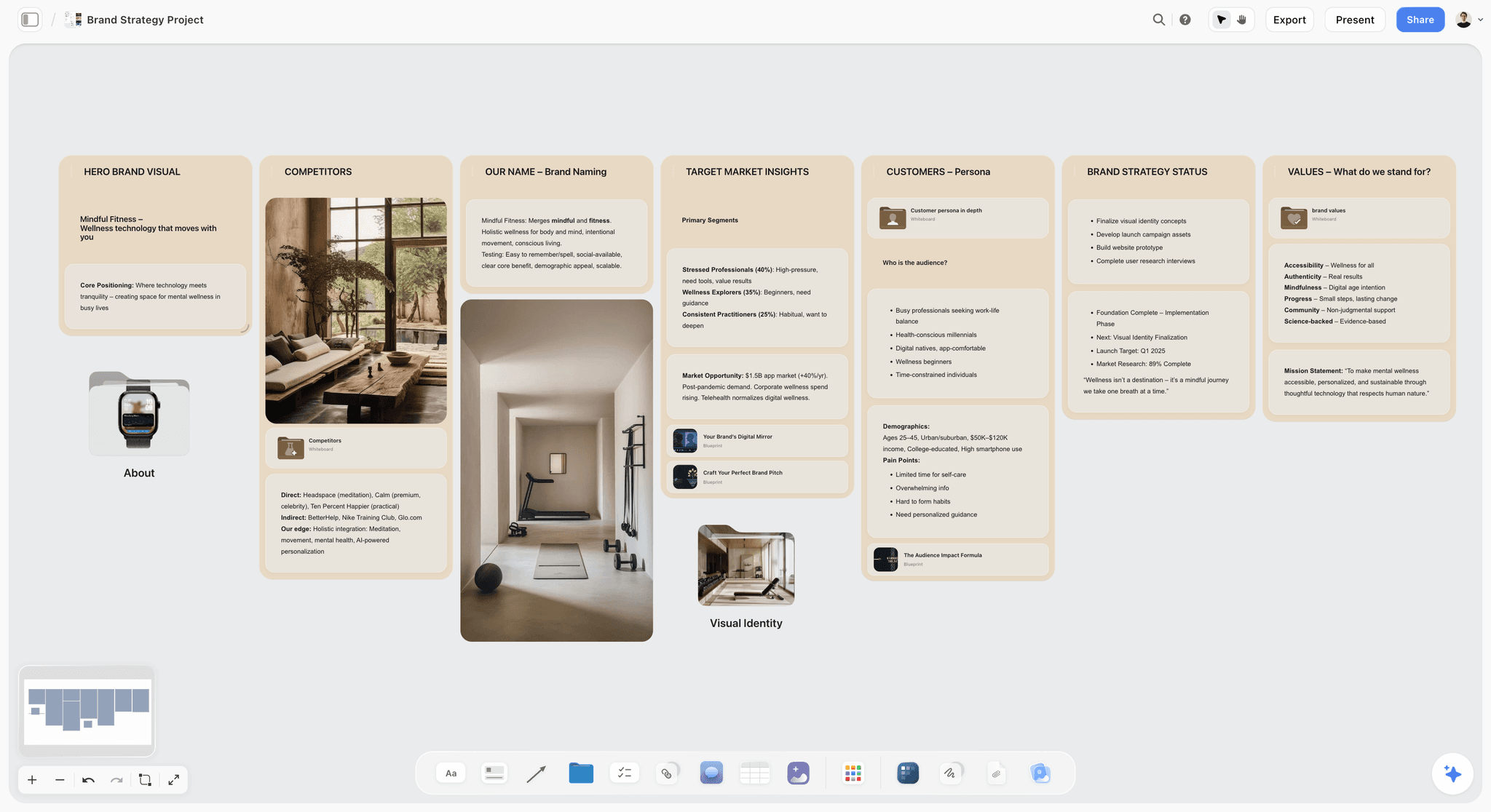
A brand strategy board in Storyflow: each stage of the strategy sits in its own wall, so the positioning can be read beside the audience it serves.
Lay out the board by stage
| Wall on the board | What goes in it | Built by prompts |
|---|---|---|
Audit | What the brand says, what customers say, existing assets | 1 to 4 |
Audience | Segments, jobs, tensions, one priority audience | 5 to 8 |
Positioning | Alternatives, unique attributes, the statement | 9 to 13 |
Platform | Purpose, values, personality, story | 14 to 17 |
Messaging | Message matrix, proof points, taglines | 18 to 21 |
Voice | Traits, tone by situation, word list | 22 to 25 |
Visual direction | References, palette, type and imagery rules | 26 to 30 |
Rollout | Deck, one-page guide, checklist | 31 to 34 |
The Anatomy of a Brand Strategy Prompt
Each prompt below makes one decision and then checks it. These are the parts, and the one most often missing from generic prompts.
| Part | What it does | Brand strategy example | Missing, you get |
|---|---|---|---|
Decision | Names the one choice to make | "Choose the priority audience" | A list with no choice |
Evidence | Gives ChatGPT something real to choose from | Reviews, interview notes, competitor copy | The category average |
Alternatives | Makes it compare options | "Give three options, then pick one" | One answer you cannot judge |
Uniqueness test | Checks the claim against rivals | "Name the competitor who could say this" | Claims every rival can make |
Constraint | Rules out the easy answer | "No 'community', no 'passion', no 'quality'" | The words everyone uses |
Format | Fixes the output shape | "A table with five columns" | Paragraphs nobody reuses |
Destination | Says where it lands | "and put it on my [brand] board in Storyflow" | A decision lost in the chat |
Of the seven, the uniqueness test is the one brand prompts skip, and it is the one that separates a position from a slogan.
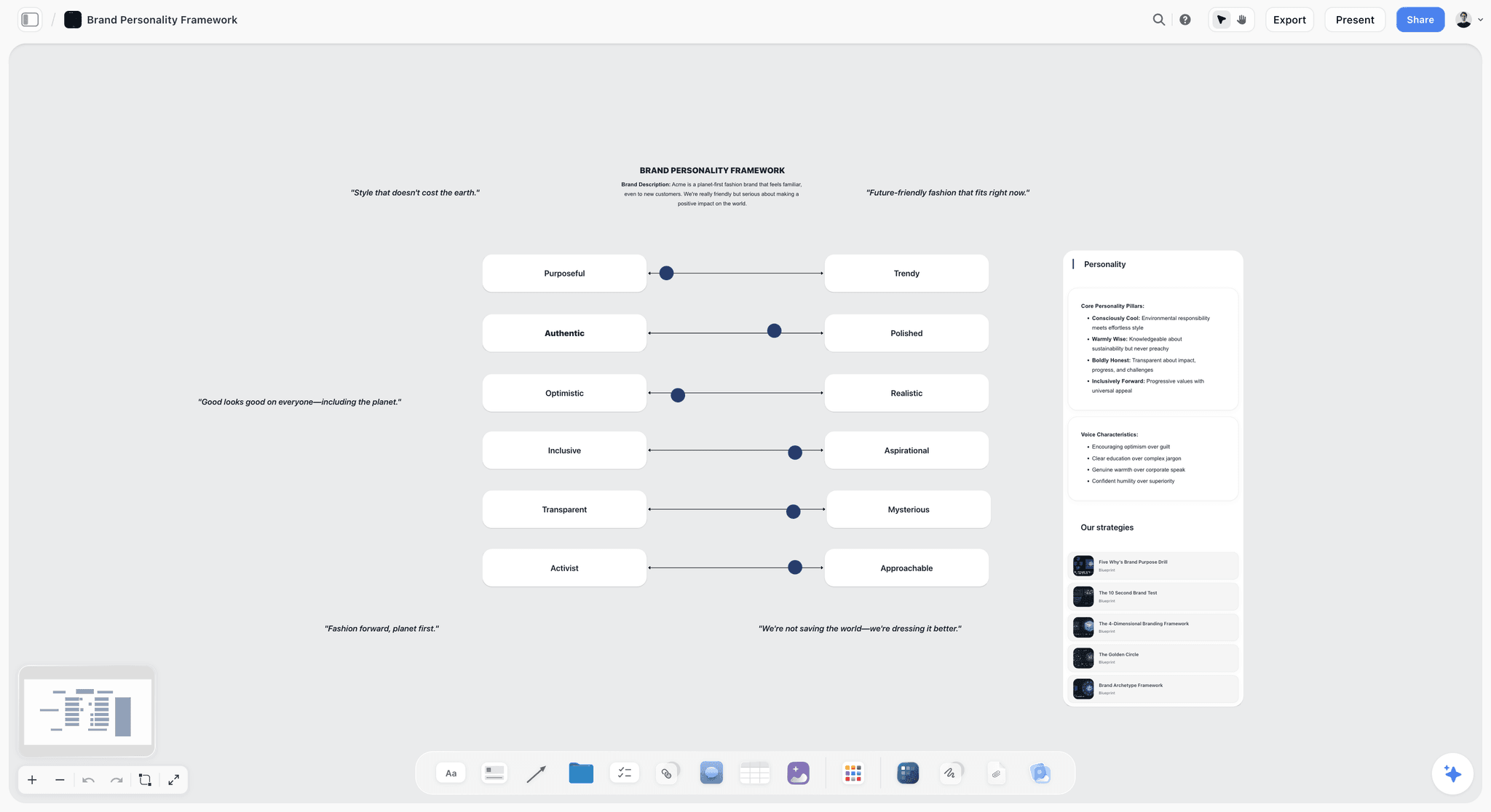
Storyflow brand personality framework board with traits, flip sides and example lines that ChatGPT fills in through the plugin
Put every brand decision on one board
Install Storyflow in ChatGPT and have it lay out the positioning, the audience, the voice and the palette on a brand board your whole team can read.

Prompts for the Brand Audit
Audit prompts describe what is true now. They should quote, not summarise.
Prompt 1: Audit what the brand says about itself
- "Here is our homepage copy, our last ten social captions and our about page. List the five claims we make most often, the words we repeat, and the one claim we make that nothing on these pages supports. Quote each one."
You get a list with quotes. Add "and put it on my [brand] board in Storyflow as a note in an Audit wall" to keep it with the rest.
Prompt 2: Find the say-do gap in reviews
- "Here are 50 customer reviews. Build a table: what customers praise, in their words; what they complain about; what they mention that we never talk about. Then list the three biggest gaps between what we say and what customers say."
The third column is often where the position is.
Prompt 3: Write stakeholder interview questions
- "Write twelve questions for interviews with our founder, head of sales and two front-line staff about the brand. Four about why customers choose us, four about why they leave, four about what we should never become. No leading questions."
ChatGPT writes the questions; people answer them. Paste the answers back for Prompt 5.
Prompt 4: Inventory the brand assets
- "List every distinctive asset we use (colours, logo marks, characters, sounds, taglines, shapes, photography style). For each, rate how famous it is likely to be with customers and how unique it is to us versus competitors, low, medium or high, and say which quadrant it falls in: use or lose, invest, avoid, or test or ignore."
The quadrants are Ehrenberg-Bass's Distinctive Asset Grid, described on the institute's Brands of Distinction page. The institute's point is that fame and uniqueness live in what consumers remember, so treat ChatGPT's ratings as a hypothesis to test with customer research, not as the grid itself.
Prompts for Audience
Audience prompts choose. A brand for everyone is a brand for the category average.
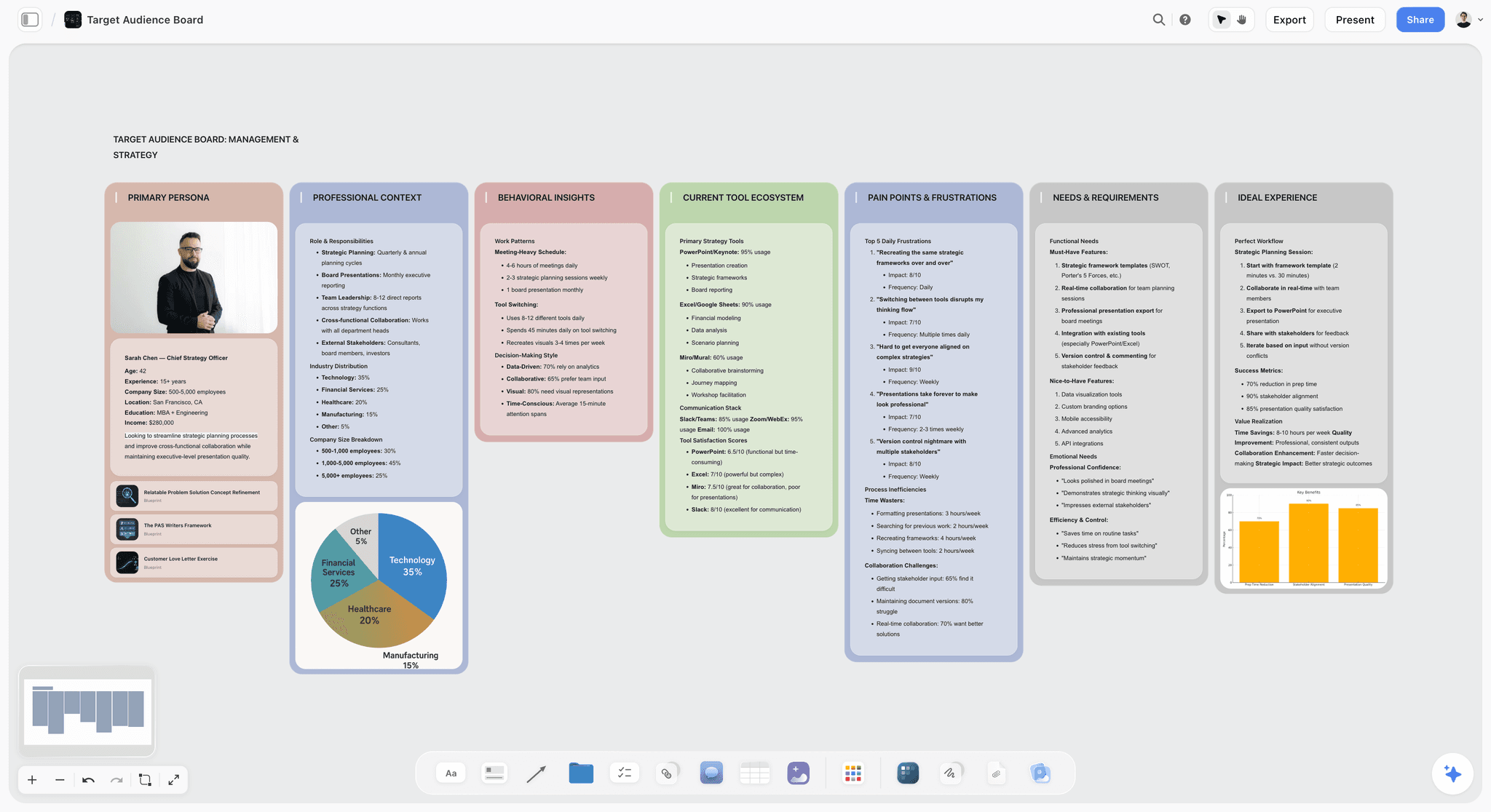
A target audience board in Storyflow: segments, jobs and the customer quotes behind them, the shape Prompts 5 to 8 build.
Prompt 5: Draw segments from evidence
- "From the interview answers and reviews above, propose three audience segments defined by what they are trying to do, not by age or income. For each: a name, the job they hire us for, how often, what they use instead of us, and two quotes that show it."
Add "as three walls on my [brand] board in Storyflow" to see the segments side by side. The buyer persona guide goes deeper on one person.
Prompt 6: Write jobs-to-be-done statements
- "For each segment, write the job as 'When [situation], I want to [motivation], so I can [outcome]'. Then list the functional, social and emotional parts of the job separately."
The Christensen Institute frames jobs as the circumstances that push people toward and away from a decision; its milkshake example found the real competition in the morning was bananas and bagels, not other milkshakes.
Prompt 7: Map the tensions
- "For segment B, list the five tensions they live with (wanting one thing but fearing another), each with a quote. Rank them by how well our product resolves each one."
Add "as a mind map on my [brand] board in Storyflow" to branch the tensions from the segment.
Prompt 8: Choose the priority audience
- "Recommend one of the three segments as the priority audience for the next two years. Argue for it in three sentences, argue against it in three, and say what we give up by not choosing the other two."
The sentence about what you give up is the test of whether a choice was made.
Prompts for Positioning
Positioning prompts compare. April Dunford, author of Obviously Awesome, defines positioning on her site as the way a product is different from, and better than, the alternatives for a specific group of customers. Each part of that definition (alternatives, difference, value, customers) is a prompt below.
Prompt 9: List the real alternatives
- "If our product did not exist, what would the priority audience do instead? List every alternative, including doing nothing, a spreadsheet, a rival brand and a cheaper substitute, with the reason each is chosen today."
The alternatives are rarely the competitors in your pitch deck.
Prompt 10: Find the unique attributes
- "Compared with the alternatives above, list the capabilities or features only we have. For each, write the value it creates for the priority audience in one sentence, and the proof we can show. Drop any attribute with no proof."
You get a table of attribute, value and proof. Attributes without proof become a roadmap note, not a claim.
Prompt 11: Write positioning statements
- "Write three positioning statements in the form 'For [audience] who [need], [brand] is the [frame of reference] that [key benefit], unlike [main alternative], because [proof]'. Make the three differ in frame of reference."
Changing the frame of reference (what category you say you are in) changes what you are compared with, which is the biggest lever in positioning.
Prompt 12: Score competitors on two axes
- "Choose the two attributes our priority audience cares about most and that separate the market. Score us and the five main competitors from 1 to 10 on each, with one sentence of evidence per score. Put the scores on my [brand] board in Storyflow as a table."
The table is the data behind a positioning map; draw the map from it.
Prompt 13: Stress-test the position
- "Act as our strongest competitor's head of marketing. Read our chosen positioning statement and write the three ways you would attack it in an ad. Then tell us which attack we have no answer to."
The unanswered attack is either a gap in the proof or a sign the position is too broad. For the whole strategy on one board, see ChatGPT brand strategy.
Prompts for the Brand Platform
Platform prompts turn the position into purpose, values and personality. Each should end in behaviour, not adjectives.
Prompt 14: Test the purpose
- "Here is our draft purpose: '[purpose]'. Would it still be true if we sold a different product? Would a competitor sign it? Rewrite it so the answer to the second question is no."
A purpose a competitor would sign is a mission statement for the category.
Prompt 15: Turn values into behaviours
- "For each of our four values, write two things we do because of it, one thing we refuse to do because of it, and one decision it would settle. Drop any value that produces nothing in the third column."
You get a table that a new hire can use. Values that settle no decision are decoration.
Prompt 16: Define personality with flip sides
- "Describe the brand's personality in four traits. For each, write what it sounds like at its best, what it sounds like overdone, and a sentence that shows each."
The overdone column is what the voice guide later warns against.
Prompt 17: Draft the brand story
- "Using the StoryBrand framework, write our brand story with the customer as the hero: their problem, the guide (us), the plan, the call to action, what success looks like and what failure looks like. Under 200 words."
Storyflow's Tactics, its library of expert frameworks, include StoryBrand, and ChatGPT can add the framework to the board through the plugin so the team fills it in beside the story draft.
Prompts for Messaging
Messaging prompts make the position usable: what to say, to whom, with what proof.
Prompt 18: Build the message matrix
- "Build a messaging table with a row per audience segment and columns for the core message, the three supporting messages, the proof for each, and the one thing never to say to that segment. Put it on my [brand] board in Storyflow."
The matrix is the page most of the team will actually use.
Prompt 19: Rank the proof points
- "List every proof point we have (numbers, awards, customer names we may use, guarantees, process facts). Rank them by how much they would move the priority audience, and mark any we cannot verify today."
Unverifiable proof is the fastest way to lose trust; mark it and either verify it or drop it.
Prompt 20: Write tagline options
- "Write ten taglines of under six words that express our positioning. Five plain, five with a twist. For each, name a competitor who could also use it, or write 'nobody'. Then shortlist the three with 'nobody'."
The shortlist is a starting point for a trademark search, which ChatGPT cannot do for you.
Prompt 21: The pitch at three lengths
- "Write how we describe ourselves in 10 words, in 30 words and in 100 words, for the priority audience. Each must contain the frame of reference and the key benefit from the positioning."
The three lengths cover the bio, the intro email and the about page.
Prompts for Voice and Tone
Voice prompts are the ones a team reuses daily, so they deserve the most testing.
Prompt 22: Place the voice on four dimensions
- "Using Nielsen Norman Group's four tone dimensions (formal or casual, serious or funny, respectful or irreverent, matter-of-fact or enthusiastic), place our brand voice on each with a score from 1 to 5 and a sentence of reasoning drawn from the personality traits."
The four dimensions come from Kate Moran's 2016 NN/g article. Scores make "a bit warmer" into an instruction ChatGPT can follow.
Prompt 23: Write tone shifts by situation
- "Our voice stays the same; our tone changes with the reader's situation. For these six situations (welcome email, price increase, outage apology, product launch, complaint reply, social post), write how the tone shifts and one example line for each."
Mailchimp's content style guide draws the line simply: the voice stays constant, and the tone adapts to the reader's state of mind. The table of six situations is the part of a voice guide people copy from.
Prompt 24: Build the word list
- "From the voice, personality and messaging so far, list 20 words and phrases we use, 20 we never use, and 10 category clichés we avoid. Add each list as a note on the Voice wall of my [brand] board in Storyflow."
The never-use list does more for consistency than the use list.
Prompt 25: Run the rewrite test
- "Here are five pieces of our current copy. Rewrite each in the new voice, then explain in one line per piece which rule from the voice guide changed it."
If ChatGPT cannot name the rule, the guide is too vague to follow. Tighten the guide, not the copy. The brand voice guide covers voice in depth.
Prompts for Visual Direction and the Brand Board
Visual prompts write the direction a designer works from. ChatGPT does not design the identity, and the Storyflow plugin does not generate images.
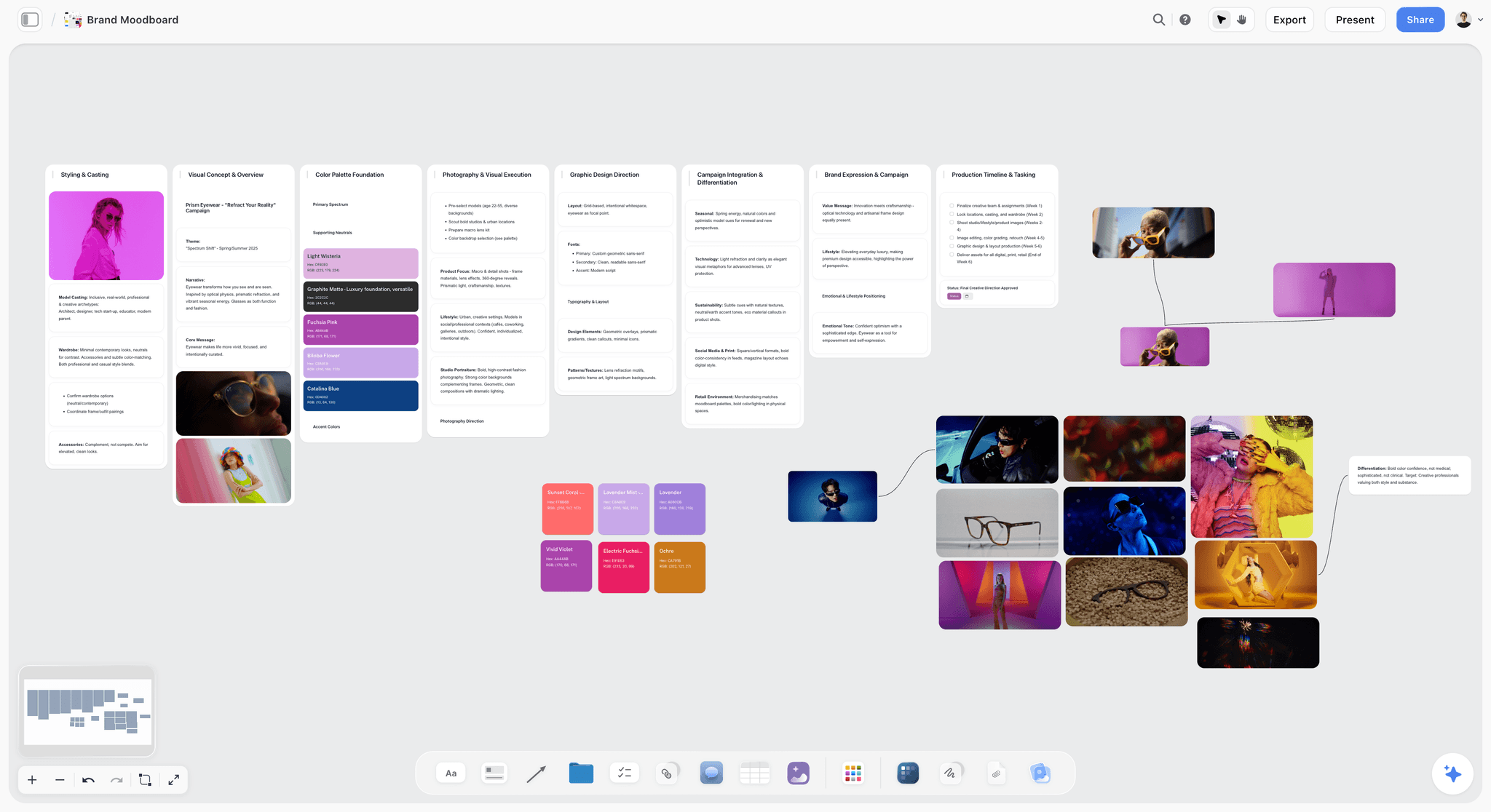
A brand moodboard in Storyflow: references, swatches and type notes in walls, the board Prompts 26 to 30 assemble.
Prompt 26: Write the moodboard brief
- "From the positioning and personality, write a moodboard brief for our designer: three visual territories, each with a name, five words that describe it, what kind of photography, what kind of texture, and what it must never look like."
Add "and put each territory on my [brand] board in Storyflow as a wall" so references can be dropped into each. ChatGPT can add images to the board and hands you an upload link for your own photos, since a photo attached in the chat does not reach the board. The ChatGPT moodboard guide covers the reference side.
Prompt 27: Build the colour palette with roles
- "Propose a palette of six colours for territory B: one primary, one secondary, two neutrals, two accents. Give each a name, a hex code and a role (background, text, call to action, highlight). Then add it to my [brand] board in Storyflow as a colour palette."
ChatGPT builds the palette as named swatches on the board. The ChatGPT colour palette page covers palettes on their own.
Prompt 28: Check the palette for contrast
- "For every text and background pairing in this palette, estimate the contrast ratio and mark it pass or fail against WCAG 2.2 AA: 4.5:1 for normal text, 3:1 for large text (18 point, or 14 point bold). Suggest the smallest change that fixes each fail."
The thresholds are from W3C's Understanding Success Criterion 1.4.3. Confirm the final pairs with a contrast checker; ChatGPT's arithmetic on hex codes is a first pass.
Prompt 29: Write the type direction
- "Describe the typography direction in words a designer can act on: the role of the headline face, the body face, the weight contrast, the case rules, and three typefaces in the right direction, with what each gets right and wrong."
The designer chooses and licenses the type; the prompt narrows the search.
Prompt 30: Assemble the brand board
- "Read my [brand] board in Storyflow and add a summary wall at the top: the positioning statement, the priority audience in one line, the four voice traits, the palette and the three words for the visual territory. Group the rest of the board into walls by stage."
ChatGPT can move and group elements into walls, so the board reads as one page. The ChatGPT brand board page covers the board on its own.
Prompts for Rollout
Rollout prompts get the strategy used. A strategy the team does not see is a strategy the team does not follow.
Prompt 31: Build the brand presentation
- "Build a slide deck on my [brand] board in Storyflow for the leadership team: the audit in one slide, the priority audience, the positioning, the platform, the message matrix, voice, the visual direction, and what changes in the next 90 days. One idea per slide."
The deck sits on the same board as the strategy, presents fullscreen and exports as PDF.
Prompt 32: Write the one-page brand guide
- "Write a one-page brand guide for freelancers and new hires: who we are for, what we say, how we sound (with three do and three don't lines), the palette with roles, and who approves brand work. Put it on my [brand] board in Storyflow as a document."
The one page is what an agency or freelancer actually reads on day one.
Prompt 33: Plan the internal launch
- "List everything that must change for the new strategy to show up in a customer's week: website pages, email templates, social bios, sales deck, signage, onboarding. Add each as a to-do on my [brand] board in Storyflow, grouped by team."
Add owners by hand, because ChatGPT cannot set a to-do's assignee. If you want ChatGPT to assign the work, ask for a table with an Owner column instead: it fills that column with people who already have access to the board, and a name that matches nobody stays empty.
Prompt 34: Check the brand and activation balance
- "Here is our marketing plan for next year with budgets. Split the spend into brand building (long-term, broad reach) and activation (short-term, sales response), and compare the split with the 60:40 balance from Binet and Field's The Long and the Short of It. Say where we are off and what it would cost to move."
A 2023 post by Alison Hoad on the IPA's blog (the IPA published the 2013 report) notes that the optimum was 60:40 in that report and 62:38 in the 2018 Effectiveness in Context. Treat it as a reference point, not a rule for every category.
The 34 Prompts by Stage and Board Output
| Stage | Prompts | Decision it makes | What lands on the Storyflow board |
|---|---|---|---|
Audit | 1 to 4 | What is true now | Notes, review table, asset grid |
Audience | 5 to 8 | Who the brand is for | Segment walls, tension mind map |
Positioning | 9 to 13 | Different and better than what | Alternatives and attribute tables, scores table |
Platform | 14 to 17 | Purpose, values, personality | Values table, story document, StoryBrand Tactic |
Messaging | 18 to 21 | What to say to whom | Message matrix table, proof list |
Voice | 22 to 25 | How it sounds | Dimension scores, tone table, word lists |
Visual direction | 26 to 30 | How it looks | Territory walls, colour palette, summary wall |
Rollout | 31 to 34 | How it gets used | Deck, one-page guide document, to-dos |
Worked Example: One Prompt Chain, Audit to Brand Board
This is an illustrative example, not a client case. Alder & Ash is a fictional chain of three climbing gyms with a two-person marketing team. It is opening a fourth gym and wants a strategy that does not sound like every other gym. The inputs: 120 Google reviews, the website, two years of social captions and four staff interviews.
Step 1: the say-do gap
Prompt 2 on the reviews returns a three-column table. Customers praise the setters, the café and "the only gym where nobody stares at beginners"; they complain about evening crowding; they mention, again and again, bringing their kids, which the brand never talks about. That last column becomes the lead.
Step 2: the priority audience
Prompts 5 and 8 propose three segments (committed climbers, social first-timers, parents climbing with children) and recommend the parents. The case against is written out: committed climbers spend more per visit and may feel ignored. The team accepts the trade, and the three segment walls go on the Alder & Ash board.
Step 3: the position
Prompts 9 to 11 list the alternatives parents actually use (soft play, swimming, a trampoline park, a weekend walk), then write three positioning statements. The chosen frame is not "climbing gym" but "the weekend activity parents do with their kids, not just watch". Prompt 13's attack from a trampoline park ("they are just a cheaper gym with a café") is the one without an answer, so the proof list gets a line about qualified coaching for children.
Step 4: voice and words
Prompt 22 scores the voice: casual 4, serious 2, respectful 4, enthusiastic 3. Prompt 24 adds the word list to the board, with "crush it" and "send" on the never-use list for this audience.
Step 5: the palette and the board
Prompt 27 builds a six-colour palette as swatches on the board; Prompt 28 flags one accent on white as failing 4.5:1 for body text, so it is reserved for large headlines. Prompt 30 adds the summary wall and groups the board by stage. The output shapes along the way:
| Step | Prompts | Output shape | Where it lives |
|---|---|---|---|
1 | 2 | Three-column review table | Audit wall |
2 | 5 and 8 | Three segment walls, a recommendation with the trade-off | Audience wall |
3 | 9 to 13 | Alternatives list, three statements, one attack | Positioning wall |
4 | 22 and 24 | Dimension scores, word lists | Voice wall |
5 | 27, 28 and 30 | Named swatches, contrast table, summary wall | Visual and summary walls |
The leadership team reads the board from the summary wall down, and the designer starts from the territory walls and the palette.
How to Fix a Weak Brand Strategy Output
A weak answer is missing evidence, a choice or a test. Add the missing part and rerun; asking for "something better" returns the same answer reworded.
| Symptom | What is missing | Add this to the prompt |
|---|---|---|
Values every brand has | Evidence | Reviews, interviews, and "drop any value that settles no decision" |
A position a competitor could claim | Uniqueness test | "Name the competitor who could say this" |
A list instead of a choice | Decision | "Pick one, argue against it, say what we give up" |
Adjectives instead of voice | Format | Dimension scores and example lines per situation |
Made-up proof | Constraint | "Use only the proof listed; mark anything unverified" |
Palettes that fail on screens | Test | The WCAG contrast check in Prompt 28 |
Paste the customer's words, not your summary
Your summary of the reviews already contains your bias. Paste the reviews themselves, or the interview notes, and let ChatGPT quote them.
Ask for the argument against
Every decision prompt should ask ChatGPT to argue against its own recommendation. The argument against is where you find out whether the recommendation is strong or just first.
Keep earlier decisions in front of it
Positioning depends on audience; voice depends on personality. Put each agreed decision on the board or in the project instructions, and ask ChatGPT to read them before the next stage, rather than trusting a long chat to remember.
Run the uniqueness test twice
Run it once on the draft and again on the final wording. Edits for elegance tend to sand off the specific word that made a claim yours.
What ChatGPT Cannot Do for Your Brand Strategy
These are limits of the method, not of any one tool, and they matter more in brand work than anywhere else.
Replace customer research
ChatGPT organises evidence; it cannot interview your customers. Every segment, tension and asset rating above is a hypothesis until real customers confirm it.
Clear a name or a tagline
ChatGPT cannot run a trademark or domain search with legal weight. Shortlist with it, then clear the shortlist properly.
Design the identity
The prompts write direction for a designer. The identity, the logo and the final type choices are design work, done in Figma, Adobe or by hand.
When You Need More Than Prompts and a Board
Storyflow holds the strategy and makes it visible; some brand jobs belong elsewhere.
Finished brand assets
Templates, social assets and print pieces belong in Canva or Adobe Express. Both are in ChatGPT's plugin directory, and OpenAI's connected apps article notes that the Canva app may use context from your chat, such as names and taglines you have been brainstorming.
A brand guide as a website
Storyflow boards export as PNG, JPEG or PDF and documents export too, but a public brand portal with downloadable logo packs is a different product.
Strategy work inside Storyflow itself
Inside Storyflow, the built-in AI (separate from the ChatGPT plugin, using Storyflow AI credits) can also build a brand strategy or a brand moodboard when you ask it. Use whichever assistant your team already works in; the board is the same.
The Bottom Line
Brand strategy with ChatGPT works when you stop asking for a strategy and start asking for decisions: one audience, one position, one voice, one palette, each made from evidence and tested against the competitor who could say the same thing. Run the 34 prompts in order on a first strategy, keep the agreed decisions in the project instructions, and put each one on the brand board so the team sees the whole thing on one page. Install the Storyflow plugin, open your brand's project, and start with Prompts 2, 8 and 13. For the strategy board from start to finish, see ChatGPT brand strategy.
FAQ: ChatGPT Prompts for Brand Strategy
What are the best ChatGPT prompts for brand strategy?
The best make one decision at a time from real evidence and then test it: audit what the brand and its customers say, choose a priority audience, list the real alternatives, write positioning statements, and ask which competitor could make the same claim. With the Storyflow plugin, each decision can land on a brand board beside the others.
What is the best ChatGPT plugin for brand strategy prompts?
Storyflow, for prompts whose decisions the team must see together: through the plugin, ChatGPT puts the positioning in a document, the message matrix in a table, the palette as colour swatches and the references in walls on one Storyflow board. Canva suits finished brand assets once the direction is set, and Figma's plugin suits FigJam diagrams such as the brand architecture.
What is a good ChatGPT prompt for a positioning statement?
One that gives ChatGPT the priority audience, the real alternatives and only the attributes you can prove, then asks for three statements in the form audience, need, frame of reference, benefit, main alternative and proof, each with a different frame of reference. Follow it with a second prompt that attacks the chosen statement the way your strongest competitor's head of marketing would.
Which ChatGPT prompts define a brand voice?
Three, run in order: score the voice on Nielsen Norman Group's four tone dimensions (formal or casual, serious or funny, respectful or irreverent, matter-of-fact or enthusiastic), ask for tone shifts across six real situations with an example line each, then build a list of words you never use. Test the result by having ChatGPT rewrite five pieces of current copy and name the rule it applied.
Can ChatGPT create a brand colour palette?
Yes. Ask for a palette with named colours, hex codes and a role for each, such as background, text and call to action. With the Storyflow plugin, ChatGPT adds it to the brand board as named swatches. Then check every text pairing against WCAG 2.2's 4.5:1 contrast minimum, and confirm with a contrast checker.
Can ChatGPT build a brand moodboard?
It can write the moodboard brief and, with the Storyflow plugin, set up the territory walls and add images to the board. Photos you attach in the ChatGPT chat do not reach the board, so ChatGPT hands you an upload link for your own. The plugin does not generate images.
How do I stop ChatGPT writing generic brand values?
Give it evidence (reviews, interviews, staff answers) and a test: for each value, ask for two things you do because of it, one thing you refuse to do, and one decision it would settle. Drop any value that settles no decision. A value that changes nothing is a word, not a value.
Should I put brand guidelines in a ChatGPT project?
Yes. Project instructions override your global custom instructions inside the project, so the brand's banned claims, mandatories and agreed positioning apply to every chat there. Attach the research and guidelines as project files, and keep the visual decisions on the Storyflow board where people can see them.
Is ChatGPT good enough to replace a brand strategist?
No. It is fast at organising evidence, drafting options and testing claims, but it cannot interview customers, read a room of stakeholders or carry the judgement for a choice the business must live with. Treat it as a tireless junior strategist whose every recommendation you check.
Do these brand strategy prompts work in Claude?
Yes. They are plain-language prompts and work in Claude, Gemini and Grok as well. Storyflow connects to those assistants through its MCP address, which Claude calls a connector rather than a plugin, so the "put it on my board" step works there too; setup for each is on Storyflow's MCP page.
How much does Storyflow cost for brand strategy work?
Storyflow is paid-only during early access: Plus is $7.99 a month billed annually, Pro $14 and Max $39, which adds a Team Workspace with roles and permissions. Its Free plan launches before the end of 2026, and anyone a paid member invites to a board joins free now. Plugin actions use no Storyflow AI credits.
Table of Contents
- Key Takeaways
- Why Brand Strategy Prompts Go Generic
- Set Up One Project for the Brand and One Board for the Strategy
- The Anatomy of a Brand Strategy Prompt
- Prompts for the Brand Audit
- Prompts for Audience
- Prompts for Positioning
- Prompts for the Brand Platform
- Prompts for Messaging
- Prompts for Voice and Tone
- Prompts for Visual Direction and the Brand Board
- Prompts for Rollout
- The 34 Prompts by Stage and Board Output
- Worked Example: One Prompt Chain, Audit to Brand Board
- How to Fix a Weak Brand Strategy Output
- What ChatGPT Cannot Do for Your Brand Strategy
- When You Need More Than Prompts and a Board
- The Bottom Line
- FAQ: ChatGPT Prompts for Brand Strategy
- Related Reading
Templates to check out for this topic


Branding and design templates you can use in Storyflow
Take a brand from naming to visual direction on one connected canvas. Open any of these templates and the AI works from everything already on the board.


See Storyflow in Action
A visual AI workspace where every feature lives inside one canvas. No tab-switching, no context lost.
Build your entire board from a single message
Type what you need in the AI chat at the bottom of your canvas. The AI adds cards, headings, and structure directly onto your board.
Use expert frameworks as AI context
Type @ in the AI chat and choose any Tactic. The AI tailors every response to that framework instead of giving generic advice.
Turn your board into a mind map in seconds
Ask the AI to restructure your canvas as a mindmap. It connects your ideas into a visual hierarchy so you can see how everything relates.
Why Storyflow Exists
Storyflow actually began as a personal tool while working on creative and research projects.
We kept running into the same problem: ideas were scattered everywhere: notes, documents, and whiteboards.
Nothing helped us see how everything connected.
So we started building a workspace designed around how ideas actually grow.
→ Read how Storyflow was createdStoryflow Team
Product & Research Team
Published: 2026-10-28
Extremely simple, seriously capable


See how easy it is to get started
Watch a real project come together, from a blank board to a finished plan, clicked through step by step.
Start creating with AI and become more productive
Transform your creative workflow with AI-powered tools. Generate ideas, create content, and boost your productivity in minutes instead of hours.