How to Install Plugins in ChatGPT (2026): Step by Step
Install any ChatGPT plugin from the directory or Settings > Plugins, with every step and menu name taken from OpenAI's help articles, what changes on mobile and work accounts, and Storyflow as the worked example.

Category
AI Tools
Author

Storyflow Team
Product & Research Team
Topics
2026-10-28
•
27 min read
•
AI Tools- install plugins in ChatGPT
- ChatGPT plugin directory
- Install plugin
- Settings > Plugins
- ChatGPT permissions
- Storyflow
How do I install plugins in ChatGPT?
To install a plugin in ChatGPT, open Plugins in the sidebar, select the plugin, choose Install plugin, then select Connect and sign in if asked; Storyflow installs this way and ends on a screen where you pick the projects ChatGPT may use. Storyflow is an AI visual workspace that turns a ChatGPT conversation into a project board on one infinite canvas. Install Google Drive instead when the job is finding files, Slack when it is reading team channels, and Notion when the plan already lives in pages.

Full disclosure: Storyflow is our product. It is the worked example because we can show its sign-in screen from both sides, and it ranks first only for planning a project on a board a team opens. Its limits: it runs in a browser only, has no Gantt chart or calendar view, and its ChatGPT plugin cannot generate images or read board comments.
How the ChatGPT plugins for project planning compare on trust, innovation, ratings and pricing
Which ChatGPT plugins for project planning are the most trusted?
Asana, Notion, Linear and monday.com are on OpenAI's list of apps that an Enterprise organisation can restrict to its verified email domain, which is the control IT teams ask about first. Storyflow's plugin is new, live in ChatGPT since 24 October 2026. Its case rests on the sign-in screen: you pick the projects ChatGPT may use, choose read-only or changes, and every connection ends after 30 days.
Which ChatGPT plugins for project planning have fair and transparent pricing?
Storyflow publishes every price: Plus is $7.99 a month billed annually, Pro $14 and Max $39, and plugin actions use no Storyflow AI credits because ChatGPT does the work on your ChatGPT plan. Notion, Asana, Miro and Linear publish their plans on their own pricing pages. In every case the cost is the service account behind the plugin, plus any limits OpenAI or the provider set on use.
Which ChatGPT plugins for project planning are the most innovative?
Storyflow, for one reason: ChatGPT builds the whole plan as a visual board, with walls, tables, to-dos, mind maps, charts and slide decks, then reads it back and reports what changed and who changed it. Miro, Lucid and Whimsical are the other visual options in the directory, built for structuring ideas, diagrams and wireframes. Plugin Creator deserves credit too, because it lets a team package its own planning routine as a plugin.
Which ChatGPT plugins for project planning have a strong history of consistent performance?
Google Drive, Slack and Notion, judged by documentation: each has its own setup article in OpenAI's help centre, with provider-specific troubleshooting. OpenAI publishes no reliability figures for any plugin, so judge the rest on one live project. Storyflow's plugin is days old, so its record is short; what it adds is one live board that ChatGPT, the team and a client all read, instead of copies pasted out of chats.
Which ChatGPT plugins for project planning are underrated?
Slack's channel updates are underrated: where subscriptions are supported, a chat can keep receiving new messages from a channel you asked it to watch. Plugin Creator is underrated by teams with a fixed weekly routine. Storyflow's change report is easy to miss: ask what changed on a board this week and who changed it, and the answer comes from the board, not from memory.
Quick Comparison
Four plugins worth installing first, ordered for planning a project: Storyflow first for the board, then the rest by job. As of October 2026.
| Tool | Best For | AI Features | Price |
|---|---|---|---|
| Storyflow | Campaign, shoot and launch plans a team and client open | ChatGPT builds and reads walls, tables, to-dos, mind maps, charts and decks in the projects you grant | $7.99 mo annual (paid-only in early access; Free plan due before the end of 2026) |
| Google Drive | Briefs, decks and sheets already in Drive | Docs, Sheets and Slides actions through one Google Drive app | See Google Workspace pricing |
| Slack | Decisions made in channels | Reads and manages Slack; a chat can follow new channel messages where supported | See Slack pricing |
| Notion | Plans written as pages and databases | Searches authorized pages; may create or update pages depending on access | See Notion pricing |
Key Takeaways
- Every ChatGPT plugin installs through the same path: Plugins in the sidebar, select the plugin, Install plugin, then Connect and the provider's own sign-in when the plugin includes an app. Settings > Plugins is a second door to the same flow.
- Installing is not the same as connecting. Account sign-in, workspace approval and role permissions are separate checks, and OpenAI says installation cannot bypass any of them.
- Whether a plugin works for you depends on your plan, workspace, role, region, model and the surface you use. A Desktop only label means the plugin needs the ChatGPT desktop app.
- In Business, Enterprise and Edu workspaces, admins decide in Admin console > Plugins whether a plugin is Available or Installed for members. A Disabled by admin message is a question for them.
- For Storyflow: select Install plugin, sign in to Storyflow, then choose All my projects or Only the projects I pick, and whether ChatGPT may create and edit content. There is no server address to type.
- Set your approval level straight after installing, under Settings > Plugins > Permissions: Always ask, Allow read actions or Allow low-risk actions.
Before You Install: Seven Things That Decide Whether It Will Work
The plugin directory is open on every ChatGPT plan. Installing or using a particular plugin is not: OpenAI names your plan, workspace, role, region and the plugin's own capabilities as the factors (Plugins in ChatGPT), and adds the model and the ChatGPT interface you use for the apps inside a plugin (Connected apps in ChatGPT). Check these before you blame the plugin.
| Factor | What OpenAI says | What to check | Source |
|---|---|---|---|
Plan | The directory is on all plans; each plugin depends on your plan. On Free and Go, plugin extensions are not available | Your plan in ChatGPT settings | |
Workspace | The directory shows plugins available to your plan and workspace; admins set availability in managed workspaces | Whether you are in a personal account or a Business, Enterprise or Edu workspace | |
Role | Enterprise and Edu admins can set plugin access per custom role | Ask your admin which role you hold | |
Region | Availability can vary by region | Not listed per plugin; open the listing from your own account | |
Model | App availability can depend on the selected model | Try a new chat on the default model | |
Surface | Some tools, views or apps exist only on desktop, web or mobile | A Desktop only label on the listing | |
Provider account | Sign in to the account that already has access to the information | Open the file or record directly in the provider's own app |
Free and Go: you can browse, but extensions are off
OpenAI says that Free and Go accounts can discover plugins in the directory and through recommendations, while plugin extensions (full-screen apps, interactive views and similar features) are not offered on those plans (Troubleshooting plugins and apps). OpenAI does not publish a table of which plan each plugin needs; that detail lives on each listing and in its setup requirements. For Storyflow, availability depends on your ChatGPT plan, workspace and region, in OpenAI's own wording.
Know which account and workspace you are in
People who use ChatGPT for work often have two identities: a personal account and a company workspace. They see two different directories, because the directory lists what your current plan and workspace allow. OpenAI's first check for a connection that uses the wrong account is to confirm which ChatGPT account and workspace you are in. It also notes that adding a second app account does not switch your ChatGPT account, and that connecting a work Microsoft account does not turn your ChatGPT space into a managed workspace (Connecting and managing app accounts).
Read the labels on the listing before you select anything
Two labels change what happens next. Desktop only means the plugin needs the desktop app, and such plugins cannot run in ChatGPT on the web. OpenAI Verified means OpenAI reviewed the plugin for quality, reliability and usefulness; OpenAI adds that the badge does not replace your organisation's own privacy, security or vendor review (Plugins in ChatGPT). Admins can see verification status in Admin console under Plugins.
How to Install a Plugin in ChatGPT, Step by Step
These steps follow OpenAI's Plugins in ChatGPT article and apply on web, desktop and mobile. Menu names are written exactly as OpenAI writes them.
Step 1: Open Plugins in the sidebar
Select Plugins in ChatGPT's sidebar. On the web you can also go straight to chatgpt.com/plugins, the address OpenAI's developer guide uses for the directory. If your sidebar or settings say Apps rather than Plugins, you are on a very old version of the iOS or Android app (Connected apps in ChatGPT); update the app first, because the steps below use the newer names.
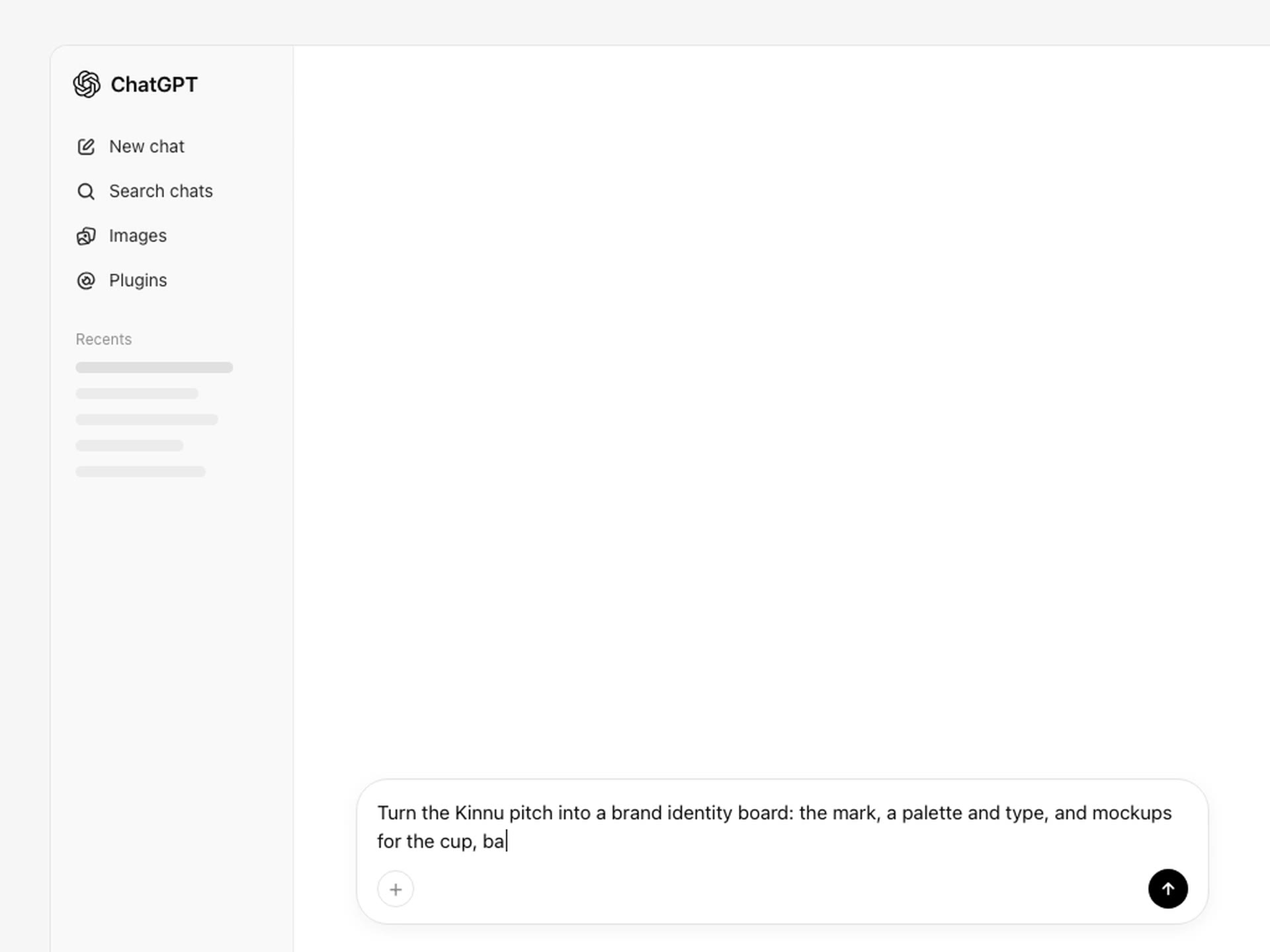
An illustration of ChatGPT with Plugins in the sidebar; the + button in the composer is the one you use later to call an installed plugin.
Step 2: Find the plugin
The directory has four sections (Plugins in ChatGPT):
- Public: plugins anyone can browse.
- Your workspace: plugins in your workspace's own directory.
- Personal: plugins you created or that someone shared with you.
- Installed: plugins already in your account.
You can also browse categories such as Popular and New & Noteworthy, or open a plugin that ChatGPT suggests during a conversation. Search for the plugin by its name rather than by the job you want done. OpenAI does not document how directory search ranks results, so a vendor's direct listing link is the most reliable route when you know which plugin you want. Storyflow's is the Open in ChatGPT button near the top of this guide.
Step 3: Read the description, skills, apps and setup requirements
OpenAI's instruction is to select the plugin and review its description, skills, apps and setup requirements before installing. Three things on that page predict the rest of the process:
- Does it include an app? Then you will connect an account in Step 5.
- Does it include an app template? Then an administrator has to configure it before anyone can use it, and installing does not finish that work.
- Which apps are required and which are optional? If an optional app is turned off, the plugin's other capabilities can still run; if a required app is unavailable, the capability that depends on it cannot.
Step 4: Select Install plugin
Select Install plugin if it is shown. Installing may start the app's setup or authorization flow straight away. If the button is missing, check the Installed section: in a managed workspace an administrator can set a plugin to Installed, which installs it for eligible members automatically (Plugins in ChatGPT).
Step 5: Select Connect and sign in to the right account
If you are prompted, select Connect for the app that needs account authorization, then sign in to the provider. OpenAI adds that you should sign in only when individual authorization is required: some apps need no sign-in at all, and others use a connection your workspace administrator set up. Choose the account that already has access to what you need. A personal account will not reach files, channels or records that only your work account can see (Connecting and managing app accounts).
Step 6: Review what it asks for, then approve
The provider's authorization screen lists the services and permissions it requests for that account. Some providers let you include related services in one flow; check each one before approving. Two messages have documented fixes (Connecting and managing app accounts):
- All permissions are required: select Reconnect and approve every permission for the apps you selected.
- ChatGPT needs all requested permissions (Google apps): select Try again, then Select all on Google's screen. To connect fewer Google apps, select Select fewer apps in ChatGPT; you still approve every permission for the apps you keep.
A provider administrator, for Google, Microsoft or another service, may also need to approve access. That person may not be your ChatGPT workspace administrator.
Step 7: Confirm it installed and run one small task
Open the Installed section, or open Settings > Plugins and select the plugin to see its Connection or Connected accounts. Then start a new chat and ask for one specific, supported task, such as finding a document by its title, which is the test OpenAI itself suggests when an app is connected but unused. OpenAI also warns that a successful connection does not prove every later step will work (Troubleshooting plugins and apps), so a real task is the only proof. How to call it with @ or the + menu is covered in how to use plugins in ChatGPT.
The Second Door: Installing From Settings > Plugins
The directory is for finding something new. Settings is for managing what you have, and it can start the same install. OpenAI's steps (Connected apps in ChatGPT):
- Open your profile menu, select Settings, then Plugins.
- Select the app, or the plugin that includes it.
- Select Install plugin if shown.
- If prompted, select Connect or continue the app's setup flow.
- Sign in to the account that already has access to the information you want.
- Review the requested services and permissions, then complete the provider's authorization.
Which door to use depends on the task:
| Task | Where | Path as OpenAI writes it |
|---|---|---|
Find a plugin you have not used | Directory | Plugins in the sidebar |
Install a plugin you already know | Either | Plugins in the sidebar, or Settings > Plugins |
Connect a second account to the same app | Settings | Settings > Plugins > the plugin > Connect another account, when available |
Change when ChatGPT asks before acting | Settings | Settings > Plugins > Permissions |
Disconnect an account | Settings | Settings > Plugins > the plugin > ••• > Disconnect |
Make a plugin available to a whole workspace | Admin console | Admin console > the workspace > Plugins |
Sources: Connecting and managing app accounts and Managing app permissions.
If Settings shows Apps instead of Plugins
OpenAI covers this case directly: if Settings shows Apps, open Apps to see the permission controls available to your account, and expect that the same account-wide selector may not be there (Managing app permissions). If you cannot find an app at all, its troubleshooting article says to check the other entry point, Apps or Plugins, whichever your account shows.
Worked Example: Installing the Storyflow Plugin
Storyflow is our product, so this is the one plugin we can describe from both sides: the ChatGPT steps from OpenAI, and Storyflow's own sign-in screen as it ships. The whole install happens inside ChatGPT and one Storyflow sign-in window. You need a Storyflow account first. Storyflow is paid-only during early access, with plans from Plus at $7.99 a month billed annually (pricing), and anyone a paid member invites to a board joins free. Without one, selecting Approve on Storyflow's sign-in screen ends with: There's no Storyflow account for this sign-in. Sign up in Storyflow first, then try again.
Open the listing and select Install plugin
The Storyflow listing shows the name Storyflow, the developer Storyflow LTD, the category Productivity and the subtitle Plan projects on visual boards. Select Install plugin. There is no server address to type, and Storyflow needs no Developer mode. A server address belongs to custom MCP servers that are not in the directory, which developers add through a separate flow (the plus button in Plugins, then Add custom MCP server) with its own risk warning (OpenAI developer guide).
Sign in to Storyflow
A Storyflow window opens with ChatGPT's tile and Storyflow's side by side. Choose Continue with Google, or enter your email and password and select Log in. Use the account that owns or belongs to the projects you want ChatGPT to work in. The screen then shows a heading, This app will be able to, with the first line always present: Read your projects, boards and documents.
Choose which projects ChatGPT may use
Under On which projects there are two options. All my projects is selected when the screen opens; Only the projects I pick shows a list to tick. With all projects chosen, the screen warns that the app can read and edit (or only read, if you untick changes) every project you are a member of, including ones others share with you. Only a grant over all your projects lets ChatGPT create a new project for you. For a first week, pick one project: you can widen the grant by reconnecting, and a narrow grant makes every answer easier to check.
Decide whether ChatGPT may make changes
Allow this app to create and edit content is ticked by default. Leave it ticked and ChatGPT can build on your boards: notes, to-dos, tables, documents, walls, mind maps, diagrams, charts, slide decks and more. Untick it and ChatGPT can only read. Granting changes needs a Storyflow sign-in no older than five minutes, so if more than five minutes pass between signing in and selecting Approve, the screen asks you to sign in again.
Decide on documents outside projects
The last box reads Also my documents outside projects (private, and shared with me). It is ticked while All my projects is selected, and Storyflow unticks it when you switch to picking projects; you can set it either way. Tick it when your briefs and notes live as loose documents rather than inside a project. Then select Approve to return to ChatGPT, or Deny to cancel.
| Choice on Storyflow's screen | Starts as | What it controls | Choose it when |
|---|---|---|---|
All my projects | Selected | ChatGPT reaches every project you are a member of, including shared ones, and can create new projects | You run many projects and want ChatGPT to start new ones |
Only the projects I pick | Not selected | ChatGPT sees only the ticked projects; the rest stay invisible to it | Your first week, client work, or a crowded account |
Allow this app to create and edit content | Ticked | Without it, ChatGPT reads but cannot build | You want boards built from a conversation |
Also my documents outside projects | Follows the project choice | Private documents and documents shared with you outside projects | Your briefs live outside projects |
Approve or Deny | Not chosen | Approve connects and returns you to ChatGPT; Deny cancels | Every time |
Check that it worked with one read and one build
Start a new chat, type @, pick Storyflow, and ask for a read first: "List my Storyflow projects and the boards in the Spring Launch project." If the project is missing from the answer, it was not in your grant. Then ask for one small build: "Add a wall called Open questions to the Spring Launch board with five to-dos for this week." Open the board in Storyflow to see the result.
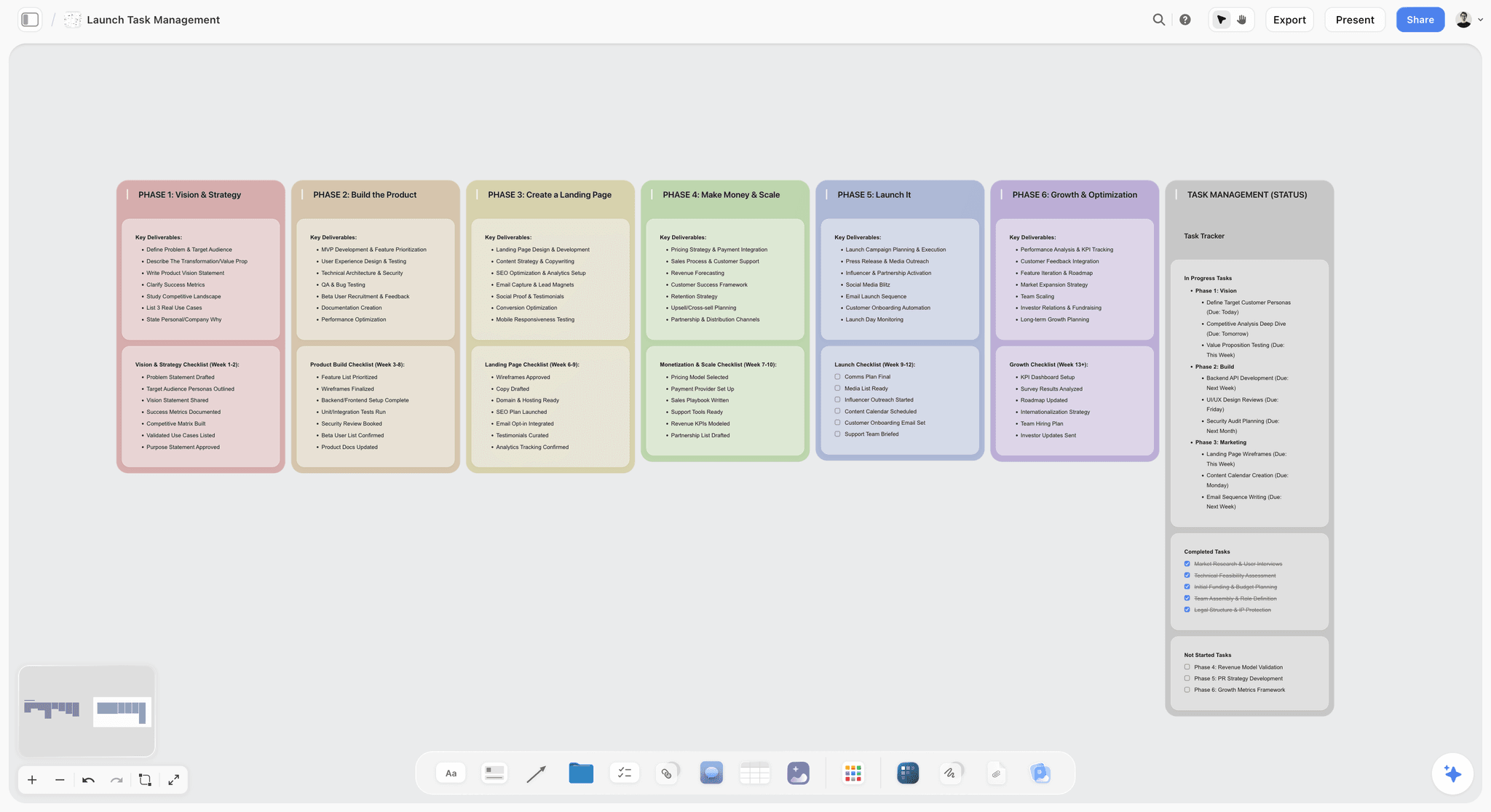
A launch board of this shape is a good first build to ask for: phase walls across the canvas and one status wall that ChatGPT can read back later.
What the connection costs and how long it lasts
- Plugin actions use no Storyflow AI credits, because ChatGPT does the work on its own model and your ChatGPT plan.
- An invited free Storyflow account can make 25 plugin actions a week, reset every Monday (UTC). Plus, Pro and Max have no weekly limit.
- Each connection ends after 30 days by design, and ChatGPT then asks you to sign in again. Storyflow's sign-in screen tells you why you are back.
- In Storyflow, Settings > MCP & Apps > Connected apps lists every assistant connected to your account, with Revoke for one and Revoke all for every one.
The same account also works in Claude, Gemini and Grok through a custom connector; the Storyflow MCP page has the steps for each, and the ChatGPT connector page shows what ChatGPT can build once you are in.
What Installing a Plugin Does Not Do
Most confusion after an install comes from expecting the install to have done more than it did. Four limits come straight from OpenAI's articles.
Installing is not authorizing
A plugin can be installed while its app is still waiting for your sign-in, your admin's approval or a provider administrator's consent. OpenAI says a plugin may be listed or installed before its app is ready, and that you still need access to the app, the correct connected account and any provider approval (Connecting and managing app accounts).
Listed is not installed, and installed is not working
A plugin you can see in the directory might not be installed, and an installed plugin can include an app that is disabled, disconnected or missing provider authorization. OpenAI's advice is to open the plugin details and refresh before trusting a status you saw in the directory (Troubleshooting plugins and apps).
An app template is not an app yet
An app template needs an administrator to configure the provider connection, publish a workspace app and assign access. Installing the plugin that carries it completes none of those steps (Plugins in ChatGPT).
A permission setting never widens access
App permissions only change when ChatGPT asks before using access the app already has. They do not grant new access; what an app can reach is set by the app, the access granted at connection and your workspace controls. To remove access you disconnect the app, or an admin disables it (Connected apps in ChatGPT).
Installing on Web, Desktop and Mobile
OpenAI places the directory in the sidebar on all three surfaces, then lists the exceptions. The table holds only what the articles state; blanks are left as "not stated" rather than filled in.
| Surface | Where Plugins is | What differs | Source |
|---|---|---|---|
Web | Sidebar; also chatgpt.com/plugins | Plugins marked Desktop only cannot run here; plugin ZIP uploads happen on the web | |
Desktop app | Sidebar | Required for Desktop only plugins; plugins with local MCP apps run here and not on web or mobile | |
iOS and Android | Sidebar | Very old app versions show Apps instead of Plugins | |
Voice | Not stated | Support varies by app; use a text conversation if an app is unavailable in voice |
Does an install on one device show up on the others?
OpenAI's articles do not say so in as many words. The one case they spell out is negative: saving a plugin with local apps to your account does not make those local tools available on web or mobile (Plugins in ChatGPT). If a plugin you installed on the web is missing on your phone, confirm you are in the same ChatGPT account and workspace, update the app, then look in Installed.
Installing in a Business, Enterprise or Edu Workspace
In a managed workspace you are not the only person who decides. Plugin installation settings decide whether a plugin is available, workspace app settings decide whether its app can be used, role controls decide who can reach it, and the provider decides which account connects (Managing app permissions). The full admin walkthrough is in the ChatGPT plugins admin guide; the essentials are below.
If you are a member
Read the exact message, because each has a different next step (Troubleshooting plugins and apps). Admin approval required means ask your administrator to review the plugin and its app; OpenAI notes that the message does not mean a request was already sent. Requires workspace setup means an administrator has to configure the app. Disabled by admin means workspace settings, your role or an included app is blocking access, and a plugin can stay listed in the directory while it is disabled.
If you are the admin
The decision that matters at install time is the installation policy. In Admin console, select the ChatGPT workspace, open Plugins and select the plugin: Available lets eligible members install it, and Installed installs it for them, or for the selected role where role-based controls exist (Plugins in ChatGPT). Neither policy overrides provider permissions, and each required app keeps its own access settings. Defaults differ by plan: in Business, apps are enabled by default; new Enterprise and Edu workspaces start with a selected set, and new plugins and apps are generally disabled there until an administrator changes them (Admin controls, security and compliance). Roles, action controls, domain restrictions and bulk changes are covered step by step in the admin guide.
Set Your Approval Level Right After Installing
Once a plugin with an app is installed, decide how often ChatGPT should stop and ask. For an eligible personal account, the path is your profile menu > Settings > Plugins > Permissions (Managing app permissions). OpenAI notes the overall setting can appear only after you install a plugin that includes an app, and that not every app supports the same settings.
| Option | Reading information | Making changes | Where you can pick it |
|---|---|---|---|
Always ask | Asks first | Asks first | Account-wide and per app |
Allow read actions | No prompt | Asks first | Account-wide and per app |
Allow low-risk actions | Low-risk actions run without a prompt | Higher-risk actions may ask or be denied | Account-wide and per app |
Allow all actions | No prompt | Supported actions run without prompts; OpenAI labels it elevated risk | For an individual app or account where offered; not in the standard account-wide or workspace-wide selector |
Some menus shorten these to Allow read, Allow low-risk or Allow all. For Storyflow, Allow read actions is a sensible start: reading boards needs no click, and every build waits for your approval until you trust the pattern. What each approval button does in a chat is covered in how to use plugins in ChatGPT, and how these settings compare across assistants is in the connector permissions guide.
Which Plugins to Install First, by Job
Install for a job you have this week, not for a category. Storyflow is listed first because the job here is planning a project on one board that a team and a client can open; the rest follow by job. Storyflow is our product. Every name below is in ChatGPT's plugin directory as captured on 28 October 2026, and the one-liner is the directory's own.
| Plugin | Directory one-liner | Install it when | Setup note from OpenAI or the listing |
|---|---|---|---|
Plan projects on visual boards | A campaign, shoot or launch needs a board the team opens | Pick projects and changes at sign-in; re-sign-in every 30 days | |
Drive, Docs, Sheets or Slides | Briefs and decks already live in Drive | Docs, Sheets and Slides actions now come through the Google Drive app | |
Read and manage Slack | Decisions happen in channels | A chat can follow new channel messages where subscriptions are supported | |
Create docs, tasks, databases | The plan lives in Notion pages | No individual sync; authorize the workspace that holds the pages | |
Create, review, edit designs | The output is a finished design | See Canva's help for its ChatGPT setup | |
Create designs, ship to code | Design files are the source of truth | See Figma's help for its ChatGPT setup | |
Turn chats into actions | Tasks with assignees live in Asana | Supports verified-domain restrictions for Enterprise | |
Create and edit plugins | You want your own plugin, for example to replace a custom GPT | Install it, then start a chat with @plugin-creator |
Setup notes come from Admin controls, Connected apps, Notion app and setup and Plugins in ChatGPT. If you are moving off a custom GPT, OpenAI is retiring them in favour of plugins, with the standard retirement scheduled for 11 December 2026 (Creating and editing GPTs); plugins vs custom GPTs vs Projects compares the three.
A two-plugin starter set for project teams
Start with one source and one destination. Install the plugin where your source material lives (Google Drive, Slack or Notion), then Storyflow as the place the plan is built. A chat can then read the brief from one and lay the project out on a ChatGPT whiteboard or a kanban board in the other. Add a third plugin only when a real job needs it: every connected app is one more set of permissions to review.

Storyflow project tracker with client jobs in Up next, In progress, Waiting on client and Wrapping up columns
Install Storyflow and plan the project on a board
Select Install plugin, sign in, pick one project, and ask ChatGPT for a wall of next steps your team and client can open by link.

How to Uninstall a Plugin or Disconnect an Account
Disconnecting and uninstalling are different actions with different reach. OpenAI's steps to disconnect one account (Connecting and managing app accounts):
- Open Settings > Plugins.
- Select the plugin or app.
- If Connected accounts appears, open that account's more options menu (•••). Otherwise use Connection or the plugin's own ••• menu.
- Select Disconnect.
What each action removes
Disconnecting stops future access through that account while other connected accounts stay active, and disconnecting the last account can also drop some plugins from your installed list. Uninstalling a plugin can disconnect every account connected through it, so read the warning before you confirm. Disconnecting does not delete existing or archived conversations, saved files or memories; review those separately.
Ending access from Storyflow's side
You can also end a connection where the data lives. In Storyflow, open Settings > MCP & Apps and the Connected apps tab, then choose Revoke on one connection or Revoke all. Every assistant revoked loses access at once and has to connect again. Doing both, ChatGPT side and Storyflow side, is the cleanest way to close an assistant's access after a project ends.
When an Install Fails: Fast Fixes
Use the exact message on screen to choose the fix. The full diagnosis, including the Storyflow cases, is in ChatGPT plugin not working: fixes.
| What you see | Most likely cause | First fix | Source |
|---|---|---|---|
No Plugins entry, only Apps | A very old mobile app version | Update the app, or use Apps where your account shows it | |
Not available on your plan | Plan requirement | Check the plugin's plan requirements | |
Admin approval required | Workspace policy | Ask your admin to review the plugin and its app | |
Desktop only or Open in desktop app | Surface requirement | Use the ChatGPT desktop app | |
All permissions are required | You skipped a permission | Select Reconnect and approve every permission | |
Storyflow: no Storyflow account for this sign-in | No account on that email | Sign up in Storyflow first, or sign in with the invited email | Storyflow sign-in screen |
Storyflow: a project is missing from answers | It was not in your grant | Reconnect and pick that project | Storyflow sign-in screen |
Mistakes That Waste the Most Time
Each of these costs more time than the install itself, and each is avoidable at the moment you make it.
Signing in with the wrong provider account
The connection succeeds, the plugin answers, and it cannot find anything you expected. You signed in with a personal Google, Microsoft or Notion account while the files live under your work account. Check the account name on the provider's screen before you approve; fixing it afterwards means Connect another account or a disconnect and reconnect.
Reinstalling in a loop
When a feature is missing on your plan or surface, reinstalling changes nothing. OpenAI explicitly advises against repeatedly reinstalling or reconnecting a plugin when the feature is unavailable on your account or surface (Troubleshooting plugins and apps). Read the availability message instead.
Granting everything on day one
Storyflow's screen starts on All my projects with changes allowed, which suits a solo owner whose projects are all their own. If you hold client projects or projects others share with you, that default reaches all of them. Pick the projects for this job; you can widen the grant by reconnecting.
Reading Disabled by admin on a personal account as a block
On a personal account with no workspace administrator, OpenAI says the message does not by itself mean an administrator blocked the app. Check your plan, region, provider account, app version and surface, then contact OpenAI Support if it continues.
Adding a directory plugin the developer way
If a plugin is in the directory, install it from the directory. The custom MCP server path in ChatGPT is for servers that are not listed, and it brings its own risk warning and workspace policies (OpenAI developer guide). For Storyflow, the listing is the only route you need.
When You Do Not Need to Install Anything
A plugin earns its place when ChatGPT has to read or change something that lives outside the chat, more than once. If you need a file read one time, uploading it to the chat is simpler. If the job is a long piece of writing, Canvas, the writing and coding pane beside the chat, may be enough (Canvas in ChatGPT). If you want related chats, files and instructions kept together, a ChatGPT Project does that without any outside account (Projects in ChatGPT).
Storyflow is the wrong install in some cases too, and it is better to know before you connect it. It has no Gantt chart, dependencies or calendar view, so a dated schedule with dependencies belongs in a project management tool. It runs in a browser with no native desktop or mobile app. Its plugin cannot generate images or read board comments, and a photo you attach in the ChatGPT chat does not reach Storyflow; ChatGPT hands you an upload link for the board instead. Decks export as PDF, not PPTX.
The Bottom Line
Installing a ChatGPT plugin is quick once you know that it happens in two parts: the install, which ChatGPT owns, and the connection, which the provider and your workspace own. Open Plugins, select Install plugin, connect the account that really holds your work, and set Permissions before your first request. If something stops, the message on screen names the part that failed.
Storyflow is our pick for the first install when the job is a project a team and a client will open: a campaign, a shoot or a launch planned in a chat and built on one board. Install it, give it one project, and ask for a single wall before you ask for a whole plan.
FAQ: Installing Plugins in ChatGPT
How do I install a plugin in ChatGPT?
Open Plugins in ChatGPT's sidebar, select the plugin, review its description and apps, and select Install plugin. If it includes an app, select Connect, sign in to the provider account that holds your information and approve the requested permissions. Storyflow follows this path and then asks which projects ChatGPT may use and whether it may make changes. The steps are the same on web, desktop and mobile.
What is the best ChatGPT plugin to install first for project planning?
Storyflow is our pick for planning a project, because ChatGPT can build the plan as a board of walls, tables, to-dos and decks that a team and client open by link. Install Google Drive first if the job is finding existing files, Slack for reading channels, Notion when the plan lives in pages, and Asana when tasks with assignees are the deliverable. Storyflow is our product.
Where is the plugin directory in ChatGPT?
The plugin directory is the Plugins entry in ChatGPT's sidebar on web, desktop and mobile. On the web you can also open chatgpt.com/plugins directly. Inside it you will find Public, Your workspace, Personal and Installed sections, plus categories such as Popular and New & Noteworthy. Settings > Plugins is the place to manage plugins you already installed.
Why don't I see Plugins in ChatGPT?
You are most likely on a very old iOS or Android app, which shows Apps instead of Plugins, so update the app. If Settings shows Apps, open it; OpenAI says the controls may differ there. In a managed workspace, an administrator may have limited plugins for your role. Also confirm you are signed in to the ChatGPT account and workspace you expect.
Can I install plugins on a free ChatGPT account?
You can browse and discover plugins on a free account, but not use their extensions. OpenAI says the directory is available across ChatGPT plans, and that on Free and Go, plugin extensions such as full-screen apps and interactive views are not offered. Whether a given plugin installs depends on your plan, workspace, role and region, so check its listing. For Storyflow, availability depends on your ChatGPT plan, workspace and region.
Is a plugin the same thing as an app in ChatGPT?
No. In OpenAI's terms, an app connects ChatGPT to one external service, such as Google Drive or Slack. A plugin packages a workflow and can include one or more apps, skills, app templates and extensions. Some plugins hold only skills and connect to nothing. Installing a plugin never skips the sign-in or workspace approval its apps require.
Can I install ChatGPT plugins on my phone?
Yes. OpenAI places Plugins in the sidebar on mobile as well as web and desktop, and the install steps are the same. Two exceptions: a plugin labelled Desktop only needs the ChatGPT desktop app, and plugins with local MCP apps run only on desktop. Very old versions of the iOS or Android app show Apps instead of Plugins.
What does the OpenAI Verified badge mean on a ChatGPT plugin?
It means OpenAI reviewed the plugin for quality, reliability and usefulness. OpenAI adds that the badge does not replace your organisation's own privacy, security or vendor review, so a company should still check what the plugin's apps can reach before approving it. Workspace owners and administrators can see each plugin's verification status in Admin console, on the workspace's Plugins page.
Does installing a plugin connect it to my account straight away?
Not always. Installing may start the app's sign-in, but a plugin whose app needs your sign-in cannot use that app until you finish the connection and any workspace or provider approval. A plugin made only of skills works as soon as it is installed, while one carrying an app template waits for an administrator to configure it. For Storyflow, the connection is done when you select Approve on its sign-in screen.
What do I need before I install Storyflow in ChatGPT?
A Storyflow account. Storyflow is paid-only during early access, from Plus at $7.99 a month billed annually, and anyone a paid member invites to a board joins free. If the account has no projects yet, the sign-in screen suggests creating one in Storyflow first; with All my projects granted, ChatGPT can also create one. You need no server address and no Developer mode.
How do I uninstall a plugin in ChatGPT?
Open Settings > Plugins and select the plugin. To remove one account, open its ••• menu under Connected accounts, or use Connection, and select Disconnect. Uninstalling the plugin can disconnect every account linked through it, so read the warning first. Disconnecting does not delete past conversations or saved memories. For Storyflow, also revoke the connection under Settings > MCP & Apps in Storyflow.
Can I change which Storyflow projects ChatGPT can use later?
Yes, by connecting again. In ChatGPT, open Settings > Plugins, select Storyflow and choose Reconnect when it is shown, or disconnect and connect again; Storyflow's sign-in screen then lets you pick different projects and decide again on changes. Every connection also ends after 30 days, which brings the same screen back. To cut ChatGPT off at once, revoke it under Settings > MCP & Apps in Storyflow.
Table of Contents
- Key Takeaways
- Why the Button an Old Guide Describes May Not Be on Your Screen
- Before You Install: Seven Things That Decide Whether It Will Work
- How to Install a Plugin in ChatGPT, Step by Step
- Step 1: Open Plugins in the sidebar
- Step 2: Find the plugin
- Step 3: Read the description, skills, apps and setup requirements
- Step 4: Select Install plugin
- Step 5: Select Connect and sign in to the right account
- Step 6: Review what it asks for, then approve
- Step 7: Confirm it installed and run one small task
- The Second Door: Installing From Settings > Plugins
- Worked Example: Installing the Storyflow Plugin
- What Installing a Plugin Does Not Do
- Installing on Web, Desktop and Mobile
- Installing in a Business, Enterprise or Edu Workspace
- Set Your Approval Level Right After Installing
- Which Plugins to Install First, by Job
- How to Uninstall a Plugin or Disconnect an Account
- When an Install Fails: Fast Fixes
- Mistakes That Waste the Most Time
- When You Do Not Need to Install Anything
- The Bottom Line
- FAQ: Installing Plugins in ChatGPT
- Related Reading
Templates to check out for this topic


Templates you can use in Storyflow
Every Storyflow board starts from real structure and an AI that reads the whole canvas. Open one of these templates and make it yours.


See Storyflow in Action
A visual AI workspace where every feature lives inside one canvas. No tab-switching, no context lost.
Build your entire board from a single message
Type what you need in the AI chat at the bottom of your canvas. The AI adds cards, headings, and structure directly onto your board.
Use expert frameworks as AI context
Type @ in the AI chat and choose any Tactic. The AI tailors every response to that framework instead of giving generic advice.
Turn your board into a mind map in seconds
Ask the AI to restructure your canvas as a mindmap. It connects your ideas into a visual hierarchy so you can see how everything relates.
Why Storyflow Exists
Storyflow actually began as a personal tool while working on creative and research projects.
We kept running into the same problem: ideas were scattered everywhere: notes, documents, and whiteboards.
Nothing helped us see how everything connected.
So we started building a workspace designed around how ideas actually grow.
→ Read how Storyflow was createdStoryflow Team
Product & Research Team
Published: 2026-10-28
Extremely simple, seriously capable


See how easy it is to get started
Watch a real project come together, from a blank board to a finished plan, clicked through step by step.
Start creating with AI and become more productive
Transform your creative workflow with AI-powered tools. Generate ideas, create content, and boost your productivity in minutes instead of hours.