The 10 Best Storyboarding Tools for Beginners in 2026
You do not need to draw to storyboard. The 10 best storyboarding tools for beginners in 2026, ranked on how easily a non-artist makes a usable board, from Storyflow and Boords to Canva and Storyboard That.

Category
Filmmaking
Author

Justkay
Documentary Filmmaker & Founder at Storyflow
Topics
2026-07-20
•
21 min read
•
Filmmaking- best storyboarding tools for beginners
- storyboard tool for people who cannot draw
- easy storyboarding software
- ai storyboard generator
- simple storyboard maker
- free storyboarding tool
What is the best storyboarding tool for beginners in 2026?
The best storyboarding tools for beginners in 2026 are Storyflow (best for planning shots visually with AI when you cannot draw), Boords (best for tidy numbered panels), Canva (best for drag-and-drop templates you already know), and Storyboard That (best for click-together characters and scenes). If you are a new filmmaker, YouTuber, student, or marketer who wants to plan a video without picking up a pencil, start with Storyflow: you drop reference frames onto a canvas, arrange them into a sequence, and, on Pro, let AI generate the images you cannot draw; plans start at $7.99/mo billed annually. Here is the reassurance almost no tutorial gives you: you do not need to draw to storyboard. A storyboard is not an art project. It is a plan. Its only job is to answer one question before you shoot, which is "what does each shot look like, and in what order?" The moment you stop thinking of a storyboard as something you draw and start thinking of it as something you arrange, the whole task changes. Photos, screenshots, AI-generated frames, and simple boxes with labels all work. The shift from drawing to arranging shots is the single change that turns storyboarding from an intimidating skill into a task any beginner can finish in an afternoon. I am Justkay, a documentary filmmaker and the founder of Storyflow, and I have storyboarded shoots both ways: the pretty hand-drawn way that took days, and the fast arranging way that took an hour and shot just as well. This guide ranks 10 storyboarding tools on one thing that matters to a beginner and almost nothing else: how easy is it for someone who cannot draw to make a storyboard a crew can actually use? That means no-drawing options, drag-and-drop panels, AI frame generation, and how fast you get from a blank screen to a finished board.

Full disclosure: Storyflow is our own product, and we rank it #1 for one specific job: letting a non-artist arrange and AI-generate shots on a canvas without drawing. It is not a dedicated frame-by-frame drawing tool (Boords and Storyboarder give tidier numbered panels) and it does not do camera or 3D previz (FrameForge wins that). We name where Storyflow loses in its review and link every tool so you can judge for yourself.
Quick Comparison
These four cover the beginner's real choice: a canvas that AI-generates frames, a clean numbered-panel maker, a familiar drag-and-drop tool, and a click-together scene builder.
| Tool | Best For | AI Features | Price |
|---|---|---|---|
| Storyflow | Arrange and AI-generate frames on a canvas | AI image generation + canvas-wide AI | $7.99 mo annual (free plan late 2026) |
| Boords | Numbered panels with animatic preview | Light AI | Trial / ~$15 mo |
| Canva | Drag-and-drop storyboard templates | AI image generation | Free / ~$12.99 mo |
| Storyboard That | Click-together characters and scenes | Minimal | Free (limited) / ~$9.99 mo |
Comparison Table: 10 Storyboarding Tools for Beginners Compared
| Tool | Best For | Beginner Fit | Starting Price | Free Plan | Rating (/10) |
|---|---|---|---|---|---|
Storyflow | Arranging shots visually with AI-generated frames | Very high | $7.99/mo (annual) | Coming late 2026 (invited collaborators join free now) | 9.4/10 |
Boords | Tidy numbered frame-by-frame panels | High | ~$15/mo | Yes (trial) | 9.0/10 |
Canva | Drag-and-drop templates you already know | Very high | ~$12.99/mo | Yes | 8.9/10 |
Storyboard That | Click-together characters and scenes | Very high | ~$9.99/mo | Yes (limited) | 8.6/10 |
Milanote | Loose visual boards and reference walls | High | ~$12.50/mo | Yes (100 notes) | 8.4/10 |
StudioBinder | Free shot lists plus simple boards | Medium | Free tier | Yes | 8.2/10 |
Plot | Fast social-video storyboarding | Medium | ~$12/mo | Yes | 7.9/10 |
Wonder Unit Storyboarder | Free drawing app for sketchers | Medium | Free | Yes (free app) | 7.6/10 |
Krock | Client-review animation boards | Medium | ~$9/mo | Yes (trial) | 7.4/10 |
FrameForge | 3D camera and previz for planners | Low | From ~$12.99/mo | No | 7.2/10 |
Pricing changes often, so check the live price on each tool's own site before you pay. Storyflow's prices are exact: Plus at $7.99/mo annual ($9.99 monthly), Pro at $14/mo annual, Max at $39/mo annual, billed per account for individuals and per seat for team workspaces, and the Free plan launches before the end of 2026. Ratings reflect fit for a non-artist making a first usable storyboard, not overall power for professional studios.
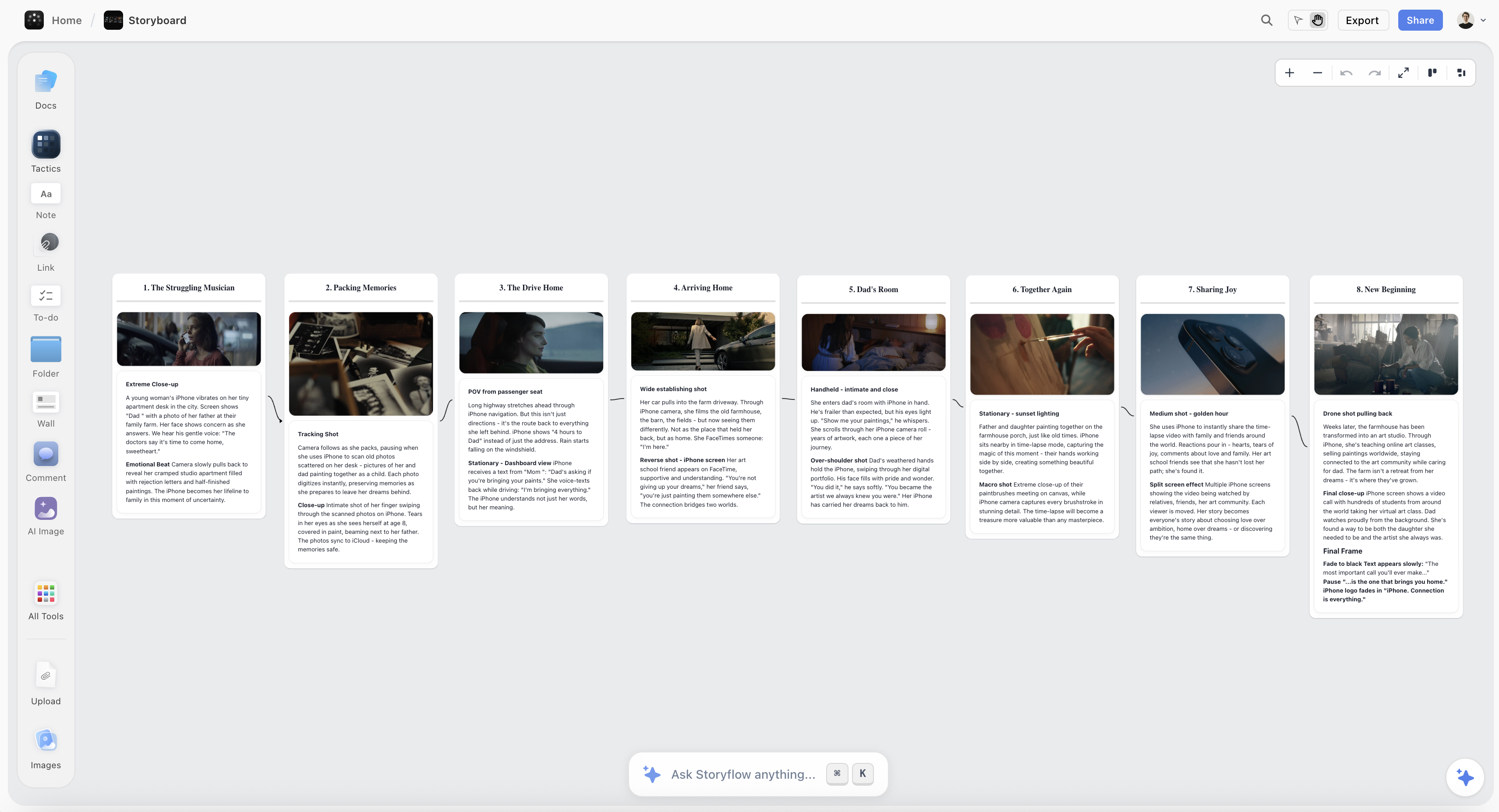
A beginner's storyboard on a Storyflow canvas: reference frames arranged into shot order with labels, no drawing required
Storyboard your next video without a pencil
Storyflow lets you drop or AI-generate frames, drag them into shot order, label each, and share a link. No drawing, no complicated software. Paid-only during early access; the Free plan lands before the end of 2026.

The 10 Best Storyboarding Tools for Beginners, Ranked
- Storyflow - best for arranging shots on a canvas with AI-generated frames when you cannot draw
- Boords - best for clean, numbered, frame-by-frame panels
- Canva - best drag-and-drop templates for people who already use it
- Storyboard That - best for building scenes from click-together characters
- Milanote - best for loose visual boards and reference walls
- StudioBinder - best free shot lists paired with simple boards
- Plot - best for fast short-form and social-video storyboarding
- Wonder Unit Storyboarder - best free app if you actually want to sketch
- Krock - best for sending boards to clients for review
- FrameForge - best for camera angles and 3D previz, once you are past beginner
How We Evaluated These Tools
I planned real shoots on every tool below, not demo files: a talking-head YouTube video, a 30-second ad, and a short documentary sequence. The same beginner-level questions decided each ranking. A storyboarding tool for beginners lives or dies on whether a non-artist finishes a board they can hand to a camera person without apologizing for it. Five criteria:
- No drawing required (30%). Can you build a full storyboard using photos, templates, click-together art, or AI frames, without ever drawing a line? This is the whole point for a beginner.
- Ease of setup (20%). How much do you fight the tool before you make your first panel? Account walls, confusing canvases, and jargon all cost points here.
- Speed to first board (20%). How long from opening the tool to a finished sequence you could actually shoot from? Beginners quit slow tools.
- Collaboration (15%). Can a friend, client, or crew member see the board and leave feedback without buying a seat or installing anything?
- Price for one person (15%). Most beginners pay alone. Free tiers, flat pricing, and gentle first paid tiers matter more here than enterprise features.
Drawing-first apps (Storyboarder, FrameForge) were still judged on the beginner question, which is why capable pro tools sit lower: they assume a skill a beginner does not have yet.
Detailed Reviews: 10 Storyboarding Tools for Beginners
1. Storyflow
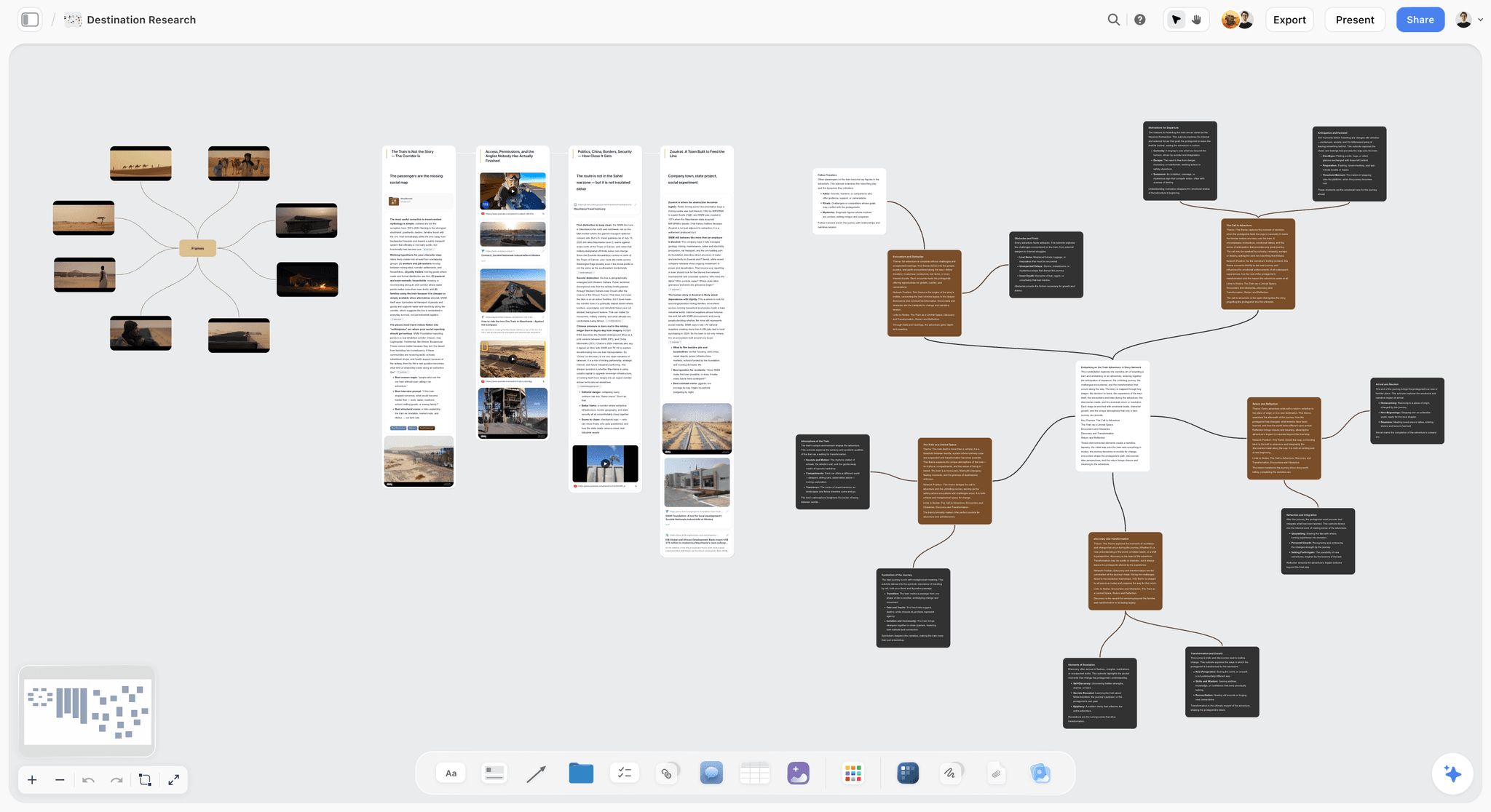
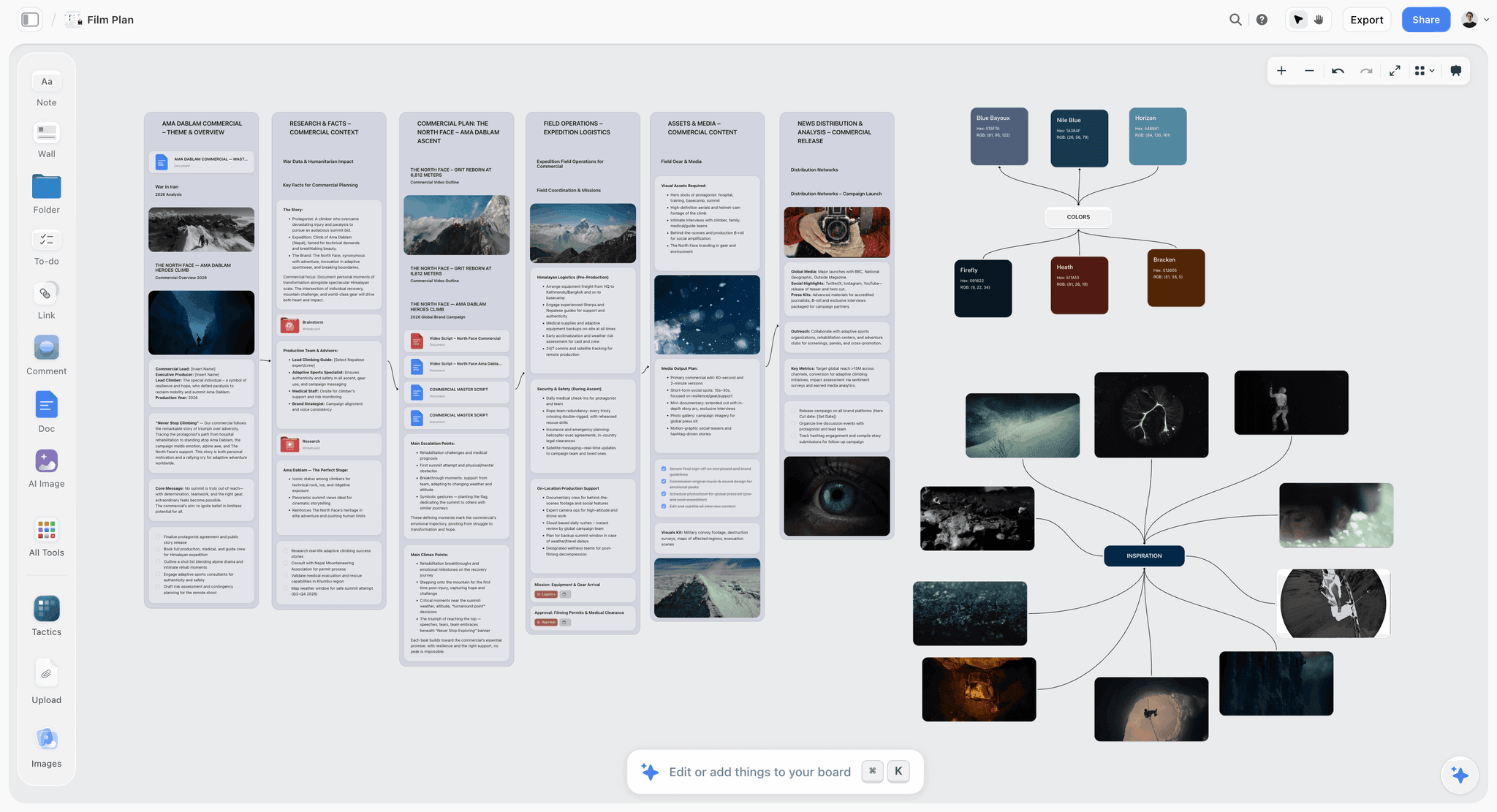
Storyflow is an infinite visual canvas where a storyboard is something you arrange, not something you draw. You drop images onto the board, drag them left to right into shot order, add a line of text under each one describing the camera and action, and you have a storyboard. Those images can be photos from your phone, screenshots from a reference video, stills you found online, or frames the AI generates for you, so a beginner who cannot draw is never blocked waiting for art skills that are not coming.
The AI is the part that changes the math for non-artists. On Pro and above, Storyflow can generate images from a text description, so "a low-angle shot of a person walking into a bright kitchen" becomes a usable frame you place directly on the board next to the others. The AI also reads everything on the current canvas board by default, and you can attach up to 5 documents and 3 boards to give it more context, so asking it to "suggest the next three shots" pulls from the board you are actually looking at rather than a blank prompt.
For a beginner the flow is short: open a board, drop or generate a few frames, drag them into order, label each, and share a link. Nobody you send it to needs an account to look. It is the tool I reach for when the goal is a shootable plan by end of day, not a gallery-quality panel set, and that is exactly what most beginners actually need.
Key features
- Infinite canvas where you drag images into shot order
- AI image generation on Pro and above, so non-artists get frames without drawing
- AI that reads the whole current board, plus up to 5 documents and 3 boards you attach
- Drop in phone photos, screenshots, and reference stills as frames
- Share a view link for feedback without the viewer needing an account
Pricing
Paid-only during early access: Plus at $7.99/mo annual ($9.99 monthly), Pro at $14/mo annual (adds AI image generation), Max at $39/mo annual, billed per account for individuals and per seat for team workspaces. The Free plan launches before the end of 2026, and anyone a paid member invites to a board joins free.
Pros
- You never have to draw: photos, screenshots, and AI frames all work as panels
- Fastest path from blank board to a shootable sequence for a non-artist
- AI generates the frames you cannot draw and suggests shots from your actual board
- Anyone a paid member invites joins free, so adding a collaborator does not multiply the bill
- Plus at $7.99/mo annual is enough to build a real first storyboard
Cons
- It is not a dedicated frame-by-frame drawing tool. Boords and Storyboarder produce tidier, uniformly numbered panels if that clean look matters to you.
- No camera or 3D previz. If you need to plan precise lens choices and camera moves in a virtual set, FrameForge does that and Storyflow does not.
- AI image generation requires Pro, so the most beginner-friendly feature sits behind a higher paid tier.
- It is a newer, smaller platform than the storyboarding incumbents, with fewer tutorials and templates specific to storyboarding floating around online.
2. Boords
Boords is the tool to beat if what you picture when you hear "storyboard" is a clean row of numbered panels with a caption under each. It is built for exactly that shape, and it is genuinely friendly to beginners because the structure is done for you: you get frame slots in sequence, and you fill them. You do not have to design the layout, which removes a real source of beginner paralysis.
You can fill those frames without drawing. Upload images, paste screenshots, or use its simple built-in drawing tools if you want, and Boords keeps everything numbered and aligned automatically. The animatic feature, which plays your frames in sequence with timing, is a standout for beginners who want to feel the pacing of a video before shooting it. That preview turns a static plan into something you can actually judge.
The catch for a total beginner is that Boords assumes you already think in discrete panels, and its real value shows once you are making boards regularly. There is no meaningful free plan beyond a trial, so it becomes a paid decision fairly quickly.
Key features
- Pre-built numbered frame layout, so you never design the grid
- Upload images or screenshots instead of drawing
- Animatic playback that runs frames in sequence with timing
- Shareable review links with client comments
- Simple built-in drawing and annotation tools
Pricing
Paid from around $15/mo, with a free trial rather than a lasting free tier.
Pros
- The cleanest, most professional-looking panels on this list with zero design effort
- Animatic preview helps beginners feel pacing before they shoot
- Numbering and layout are handled automatically
Cons
- No lasting free plan, so it turns into a paid decision fast
- Assumes you already think in fixed panels, which not every beginner does
- Less flexible than a free canvas for loose, early idea work
3. Canva
Canva earns its spot for one reason that matters enormously to beginners: you probably already know how to use it. If you have ever made a social post or a slide in Canva, you can make a storyboard in it today, because the skill is identical. Search its template library for "storyboard," pick a layout of empty panels, and drag photos, icons, and text into place. No new software to learn is a real advantage when your goal is to finish, not to master a new app.
Because Canva is a general design tool, the drag-and-drop building blocks are all there: stock photos, illustrations, shapes, and text, plus its own AI image generation if you want to conjure a frame. For a marketer storyboarding an ad or a student planning a class film, a Canva storyboard is often more than enough, and it exports to PDF or slides in one click for sharing.
The trade-off is that Canva does not understand storyboards specifically. There is no shot numbering system, no animatic, and no film-aware structure. You are assembling a document that looks like a storyboard rather than using a tool built to think in shots, which is fine for simple projects and limiting for complex ones.
Key features
- Drag-and-drop templates you can find by searching "storyboard"
- Huge library of stock photos, icons, and shapes to fill panels
- Built-in AI image generation for frames
- One-click export to PDF or slides
- A tool most beginners already know how to use
Pricing
Free plan available; Pro from around $12.99/mo.
Pros
- Zero learning curve if you have ever touched Canva
- Endless drag-and-drop assets to fill panels without drawing
- Exports and shares in formats everyone already opens
Cons
- No storyboard-specific features like shot numbering or animatics
- You build a document that looks like a board, not a film-aware plan
- Panel-heavy projects get unwieldy in a general design tool
4. Storyboard That
Storyboard That is the friendliest tool here for someone who wants characters and scenes without drawing a single one. It works like a digital sticker book: you pick a background, drag in a pre-made character, pose them, add props and speech bubbles, and you have a panel. For students, teachers, and marketers who want a clear, illustrated storyboard and have no interest in art, the click-together approach removes the drawing problem entirely.
The library of scenes, characters, and props is large, and the editor is deliberately simple, which is why schools use it so heavily. You can go from an empty cell to a populated scene in a couple of minutes, and the visual style stays consistent across panels because you are pulling from one asset set. That consistency is something beginners struggle to achieve any other way.
The limitation is the look. Everything you make has the recognizable Storyboard That illustration style, which is great for internal planning and classroom work but reads as clip art for anything client-facing. The free plan is also quite limited in cells per board, nudging you to a paid tier sooner than you might expect.
Key features
- Click-together characters, poses, backgrounds, and props
- Large library of pre-made scenes and figures
- Deliberately simple editor built for non-artists
- Speech bubbles and text for narrative boards
- Popular in education for exactly this ease
Pricing
Limited free plan; paid from around $9.99/mo.
Pros
- Truly no drawing: build scenes from a sticker-book library
- Consistent visual style across every panel automatically
- Fast for students, teachers, and simple narrative boards
Cons
- The clip-art style is not suitable for polished client work
- Free plan caps cells per board tightly
- Less useful for realistic, live-action shot planning
5. Milanote
Milanote is the loose, visual option: a freeform board where you drag in images, notes, and links and arrange them in space. It is not a dedicated storyboard tool, but it is a lovely one for the earliest, messiest stage, when you are gathering references and figuring out the feel of a video before you lock any shots. Its storyboard and moodboard templates give beginners a starting layout instead of a blank void.
For a beginner who cannot draw, Milanote works the way Storyflow does at the capture stage: you collect real images, screenshots, and stills and push them around until an order emerges. It feels like pinning things to a corkboard, which is intuitive to almost everyone. The templates for creative briefs and storyboards fit video work naturally.
Where it stops short is depth. The free tier caps at 100 notes, which a real project passes quickly, and there is no AI to generate the frames you cannot find or draw, and no animatic to test pacing. Milanote gathers and arranges beautifully; the actual frame creation still happens somewhere else if you cannot draw.
Key features
- Freeform board for dragging images, notes, and links
- Storyboard and moodboard templates as starting points
- Corkboard-style arranging that anyone understands
- Clean, calm interface with almost no learning curve
Pricing
Free for up to 100 notes; Pro around $12.50/mo billed annually.
Pros
- Extremely intuitive for gathering and arranging references
- Templates give beginners a layout instead of a blank page
- Great for the loose early stage before shots are locked
Cons
- The 100-note free cap arrives fast on a real project
- No AI to generate frames a non-artist cannot draw
- No animatic or shot-numbering to test and structure a sequence
6. StudioBinder
StudioBinder is film production software, and its storyboard tool comes bundled with shot lists, call sheets, and scheduling. For a beginner, the appeal is that you plan the shots and the logistics in one place, and the free tier is genuinely usable for a small project. If you are already treating a video like a real production, this keeps the paperwork and the pictures together.
The storyboard feature itself is straightforward: upload images to frames, add shot descriptions, camera notes, and sequence numbers, and share a clean board with your crew. It leans on you providing the images (photos, stills, generated frames from elsewhere) rather than making them, so it pairs naturally with a phone camera or another tool for the visuals.
For a pure beginner who only wants a storyboard, StudioBinder can feel like more machine than the job needs. The interface is built for people running full productions, so there is more to learn than in a single-purpose board maker, and the deeper production features sit behind paid tiers.
Key features
- Storyboards linked to shot lists and call sheets
- Upload images with camera and shot-description fields
- Sequence numbering and crew sharing
- Usable free tier for small projects
Pricing
Free tier available; paid tiers scale with production features.
Pros
- Storyboard plus real production paperwork in one place
- Clean, professional boards to share with a crew
- Free tier covers a small first project
Cons
- Heavier than a beginner who only wants a board needs
- You supply the images; it does not generate them
- Full value only shows once you run real productions
7. Plot
Plot is built for short-form and social video, which makes it a sharp pick for the specific beginner planning a TikTok, Reel, or YouTube Short. It is fast, vertical-video aware, and geared toward the quick-turnaround content beginners in that world actually make. If your storyboard is six shots for a 30-second clip, Plot gets you there without ceremony.
For non-artists it leans on real assets and a clean, modern editor rather than drawing, and it is designed around the rhythm of social content, so the workflow feels native to that audience rather than borrowed from film. Collaboration and sharing are built in, which suits creators who bounce ideas off a small team or client.
The limitation is scope. Plot is opinionated toward social video, so it is less suited to a longer film, a documentary sequence, or a detailed multi-scene narrative. It is also a smaller, newer tool, so the library and ecosystem are thinner than the big incumbents, and it becomes a paid decision fairly quickly.
Key features
- Built specifically for short-form and social video
- Vertical-video aware layouts
- Fast, modern editor tuned for quick turnarounds
- Built-in collaboration and sharing
Pricing
Free plan available; paid from around $12/mo.
Pros
- Ideal shape for TikTok, Reels, and Shorts storyboards
- Fast workflow that matches how social content is made
- Clean, beginner-approachable interface
Cons
- Narrowly focused on social, weaker for longer narrative work
- Smaller library and ecosystem than incumbents
- Paid quickly for regular use
8. Wonder Unit Storyboarder
Storyboarder by Wonder Unit is a free, downloadable app made specifically for drawing storyboards, and it belongs on this list precisely because it is free and focused. If you actually do want to sketch, even roughly, this is the most welcoming drawing-first tool available, with simple brushes, a clean frame timeline, and a low barrier to a first messy board. Rough is fine here; the tool expects it.
Because it is drawing-first, it is honest about what a beginner is getting into: the panels are as good as your sketching, which for many non-artists means stick figures and boxes. That is not a flaw. A storyboard of labeled stick figures is completely valid and often faster than hunting for the perfect stock photo. Storyboarder makes that path pleasant and free.
The reason it sits at number eight for beginners specifically is the assumption baked in: it wants you to draw. For the large share of beginners who cannot or will not, the tools higher on this list that build boards from photos, templates, and AI frames are a better fit. As a free sketching app, though, it is excellent.
Key features
- Free, downloadable, drawing-first storyboard app
- Simple brushes and a frame timeline
- Export to PDF, images, and animatic formats
- Works offline once installed
Pricing
Free.
Pros
- Genuinely free with no meaningful catch
- The most welcoming tool if you want to sketch, even roughly
- Focused purely on storyboards, not bloated with extras
Cons
- Drawing-first, so it assumes a skill most beginners lack
- Panels are only as good as your sketching
- No AI or template shortcut for non-artists
9. Krock
Krock is aimed at animation and video teams who need to send boards to clients and collect feedback frame by frame. Its strength for a beginner is the review flow: upload your frames, share a link, and let people comment directly on specific panels, which is far tidier than a thread of "the third one, no the other third one" messages. If your storyboard's real purpose is approval, this is built for that.
You supply the images rather than draw them inside a rich art tool, so it fits a non-artist who has assembled frames from photos or another tool and now needs sign-off. Version tracking keeps the rounds of feedback from turning into a mess, which beginners working with a client or teacher will appreciate.
For someone making a storyboard purely for themselves, Krock is more collaboration machinery than the job needs, and its center of gravity is animation production rather than quick live-action planning. There is a trial rather than a generous free tier, so it becomes a paid tool once you are past testing.
Key features
- Frame-by-frame commenting for client review
- Shareable review links with version tracking
- Built for animation and video team feedback loops
- Upload images rather than draw in-app
Pricing
Paid from around $9/mo, with a trial rather than a lasting free tier.
Pros
- Excellent structured feedback and approval flow
- Version tracking keeps review rounds organized
- Good fit when sign-off is the storyboard's real job
Cons
- Overkill for solo, personal storyboarding
- Centered on animation production, not quick live-action
- No lasting free tier
10. FrameForge
FrameForge is the most powerful tool on this list and, honestly, the least beginner-friendly, which is why it ranks last for this specific audience despite being excellent at what it does. It is 3D previz software: you build a virtual set, place characters and cameras, choose real lenses, and generate accurate storyboard frames from those camera positions. For planning exact angles and camera moves, nothing else here competes.
That power is the point and the problem. A beginner who cannot draw and just wants a shot plan by tonight will find FrameForge a steep climb: there is a set to build, cameras to rig, and a genuine learning curve before the first useful frame appears. It rewards the effort with technically precise previz, but that is a different job from the quick, arrange-some-frames storyboarding most beginners need.
Include FrameForge on your radar for the moment you graduate from planning "what happens in each shot" to planning "what lens, what camera height, what move." For a first storyboard, it is more tool than the task calls for, and there is no free tier to ease the entry.
Key features
- 3D virtual sets with placeable characters and props
- Real camera and lens simulation for accurate angles
- Generates storyboard frames from camera positions
- Detailed previz for complex camera moves
Pricing
From around $12.99/mo; no free tier.
Pros
- Unmatched for precise camera, lens, and angle planning
- Produces technically accurate previz frames
- The right tool once you think in lenses and moves
Cons
- Real learning curve, the least beginner-friendly here
- Building sets and rigging cameras is slow for a first board
- No free tier to test the waters
Quick Picks by Beginner Need
- Best for people who cannot draw at all: Storyflow
- Best for clean numbered panels: Boords
- Best if you already use one tool for everything: Canva
- Best for click-together characters: Storyboard That
- Best for loose reference gathering: Milanote
- Best free option with production paperwork: StudioBinder
- Best for TikTok, Reels, and Shorts: Plot
- Best free app if you want to sketch: Wonder Unit Storyboarder
- Best for client review and sign-off: Krock
- Best for camera and lens planning later: FrameForge
The Bottom Line
The reason storyboarding feels intimidating is a misunderstanding baked into almost every tutorial: that a storyboard is something you draw. It is not. It is something you arrange. The moment you swap drawing for arranging shots, storyboarding stops being an art skill you lack and becomes a planning task you can finish tonight.
Storyflow ranks first because it is built around that exact shift: drop or AI-generate frames, drag them into order on a canvas, label each shot, and share a link, all without drawing a line. Boords wins if you want tidy numbered panels, Canva wins if you already live in it, Storyboard That wins for click-together scenes, and FrameForge waits for the day you graduate to planning lenses and camera moves. Pick the one that removes your specific barrier, then go build a five-frame board for your next video. Finishing one badly beats planning one perfectly.
FAQ: Storyboarding Tools for Beginners
How do I storyboard if I cannot draw?
You arrange instead of draw. A storyboard only needs to show what each shot looks like and in what order, so you can build one entirely from phone photos, screenshots of reference videos, stock images, or AI-generated frames. Drop each image into a sequence, add a short caption describing the camera and action, and you have a usable storyboard without a single sketch.
What is the easiest storyboarding tool for beginners?
Storyflow, Canva, and Storyboard That are the easiest for non-artists. Storyflow lets you drag images into shot order and generate frames with AI, Canva reuses drag-and-drop skills you likely already have, and Storyboard That builds scenes from click-together characters. All three let you finish a first board fast without drawing, which is what most beginners actually need on day one.
Do I really need to be able to draw to storyboard?
No. Drawing is one way to make panels, not a requirement. Professional storyboards are often built from photos, still frames, or simple boxes with labels. The purpose is planning, not art. A board of rough stick figures or arranged screenshots communicates a shot list just as clearly as a polished illustration, and it gets your video planned far faster.
Can AI make a storyboard for me?
AI can generate the individual frames you cannot draw, then you arrange them into a sequence. In Storyflow on Pro and above, you describe a shot in text and the AI produces an image you place on the canvas, and its AI can suggest what shots come next by reading your current board. AI helps most as a frame generator and idea partner, with you still deciding the order.
Is there a free storyboarding tool for beginners?
Yes. Wonder Unit Storyboarder is a fully free downloadable sketching app, and StudioBinder and Canva both offer usable free tiers. Storyflow is paid-only during early access, with a Free plan launching before the end of 2026. Storyboard That and Milanote have limited free plans too. You can plan a complete first storyboard without paying anything on several of these.
What is a storyboard and why do beginners need one?
A storyboard is a shot-by-shot plan of a video, showing what the camera sees in each shot and the order they play. Beginners need one because it catches problems before filming, when they are free to fix, rather than on set or in editing when they are expensive. It also lets you show collaborators your plan without a lot of explaining.
How many frames should a beginner storyboard have?
One frame per distinct shot, not per second. A 60-second talking-head video might need only five or six frames, while a fast-cut ad might need fifteen. Start by listing the shots you know you need, then give each one a frame. You can always split a frame later if a shot turns out to contain two distinct camera setups.
What is the difference between a storyboard and a shot list?
A shot list is a text list of every shot you plan to capture, with details like angle and lens. A storyboard is the visual version, showing what each shot looks like in order. Beginners often start with a shot list because it is faster to write, then storyboard the shots that are tricky or need to be shown to someone else. Tools like StudioBinder combine both.
Can I storyboard on my phone?
Yes, though it depends on the tool. Canva and Storyboard That have capable mobile apps, and web tools like Storyflow work in a mobile browser for viewing and light edits. Phones are especially handy for the capture step, since you can shoot reference photos and drop them straight into a board. For heavy arranging, a larger screen is still more comfortable.
How long does it take to make a first storyboard?
For a short video, under an hour once you pick a tool that does not make you draw. If you build from photos, templates, or AI frames, the slow part is deciding your shots, not making the panels. A beginner planning a simple YouTube video or ad can realistically go from blank screen to shootable board in a single sitting.
Should I storyboard every video I make?
Not every one, but more than you think. Simple, single-shot videos rarely need a board. Anything with multiple shots, a specific sequence, other people involved, or a client to approve it benefits enormously. The rule of thumb: if you would struggle to explain the video shot by shot out loud, storyboard it first. The plan saves you time on set every time.
What should I storyboard with as a complete beginner?
Start with a tool that removes the drawing barrier, then match it to your project. For most beginners that means Storyflow to arrange and AI-generate frames, Canva if you already know it, or Storyboard That for illustrated scenes. Pick one, build a five-frame board for your next video today, and you will learn more from finishing one than from comparing tools for a week.
Table of Contents
- Comparison Table: 10 Storyboarding Tools for Beginners Compared
- The 10 Best Storyboarding Tools for Beginners, Ranked
- How We Evaluated These Tools
- Detailed Reviews: 10 Storyboarding Tools for Beginners
- Quick Picks by Beginner Need
- The Bottom Line
- Author
- FAQ: Storyboarding Tools for Beginners
- Related Reading
Templates to check out for this topic


Filmmaking templates you can use in Storyflow
Skip the blank canvas. Open one of these filmmaking boards in Storyflow and the AI builds on the structure that is already there, from research through the shot list.


See Storyflow in Action
A visual AI workspace where every feature lives inside one canvas. No tab-switching, no context lost.
Build your entire board from a single message
Type what you need in the AI chat at the bottom of your canvas. The AI adds cards, headings, and structure directly onto your board.
Use expert frameworks as AI context
Type @ in the AI chat and choose any Tactic. The AI tailors every response to that framework instead of giving generic advice.
Turn your board into a mind map in seconds
Ask the AI to restructure your canvas as a mindmap. It connects your ideas into a visual hierarchy so you can see how everything relates.
Why Storyflow Exists
Storyflow actually began as a personal tool while working on creative and research projects.
We kept running into the same problem: ideas were scattered everywhere: notes, documents, and whiteboards.
Nothing helped us see how everything connected.
So we started building a workspace designed around how ideas actually grow.
→ Read how Storyflow was createdJustkay
Documentary Filmmaker & Founder at Storyflow
Published: 2026-07-20
Extremely simple, seriously capable


See how easy it is to get started
Watch a real project come together, from a blank board to a finished plan, clicked through step by step.
Start creating with AI and become more productive
Transform your creative workflow with AI-powered tools. Generate ideas, create content, and boost your productivity in minutes instead of hours.