
NUCLINO ALTERNATIVE
A wiki is a great answer for settled knowledge.
Most work is not settled yet.
Nuclino deserves its reputation. It opens instantly, it stays out of the way, and its search finds anything in the workspace before you have finished typing. That combination is rarer than it should be, and if what you need is a tidy home for knowledge you have already worked out, it is an excellent one. Storyflow is aimed at the earlier stage, the part where you do not yet know what the top-level pages are, and where half the material is visual. Documents, references, diagrams, and boards on one infinite canvas, with AI that can see all of it. Paid-only during early access, plans from $9.99 a month, Free plan before the end of 2026.
Plans from $9.99/mo
Free plan before end of 2026
Nothing to install

Used by creative professionals at:
Artlist
Pixar
Nike
Red Bull
The North Face
Porsche
Start from a ready-made template
Pick a board to see what you can build, then let AI fill it in. Every template is a real, editable starting point on the same infinite canvas.
Mind Map
Branch one central idea out into themes and sub-points, then drag the connections around until the structure makes sense.
Why do people leave a wiki they like?
Nuclino is one of the few tools where the pitch and the product match. It is genuinely fast, pages open with no spinner, and there is almost nothing to configure before you can write. It has no strong opinion about how you should organise anything, which after a few years of heavier tools feels like relief rather than absence. Its search is the standout: type a few characters and the whole workspace narrows immediately, so a document you wrote eighteen months ago is two seconds away. It also draws a graph of how pages link to each other, which is a real navigational aid once a workspace has depth. None of that is marketing, it is why people who like Nuclino like it a lot.
The limitation is not a missing feature, it is an assumption baked into the shape of a wiki. A wiki asks you to file something. To file something you need a hierarchy, and to have a hierarchy you need to already know what the categories are. That is fine for documentation, onboarding, process, and policy, which is knowledge that has settled. It is a poor fit for the phase before that, when you are working out what a project even consists of, because you are forced to name and place a page before you understand the thing you are naming. People solve this by making a page called Notes, then a page called Notes 2, and the structure quietly stops describing reality.
The second gap is visual. In a wiki, an image, a screenshot, a diagram, a reference, or a PDF is an attachment. It sits inside a page as a block, at a size the page decides, in an order the text decides. But for a lot of work the visual material is not illustration of the thinking, it is the thinking: a set of references you are comparing, a system you are sketching, a layout you are arguing about, a wall of screenshots that only makes sense side by side. Once the visual half of the job becomes an attachment, it drifts out of the wiki entirely and into a folder, a design tool, or a chat thread. Storyflow puts documents and visual material on the same infinite canvas, so a written page can sit next to the references it is about, at the size they need to be seen at, arranged spatially instead of stacked vertically. Because the AI reads the whole canvas, it can answer questions about both halves at once.
The recurring reasons people look for a Nuclino alternative are these six: the page tree forces a hierarchy before the work has one, visual material can only exist as an attachment inside a document rather than as content in its own right, there is no spatial way to see how things relate beyond a link graph, early messy thinking has nowhere to live that is not a page you will have to name, AI assistance is not part of the writing and thinking loop, and a workspace that works beautifully for finished documentation gives you nothing for the project management, planning, and visual work that surrounds it.
HOW IT WORKS
Put it down first. Organise it when you know the shape.
The order is reversed from a wiki, and that turns out to be the whole difference.
01
Open a canvas and dump what you have
Sign up in seconds, from $9.99 a month, nothing to install. Notes, links, screenshots, and half-formed ideas go straight onto the canvas without being filed, named, or slotted into a tree first.
02
Arrange until it means something
Push related things together, separate what does not belong, and leave the uncertain material at the edge. Structure emerges from arrangement, which is much cheaper than committing to a hierarchy you will have to undo.
03
Write the document beside the material
Open a full document on the same canvas, with the references, screenshots, and diagrams still visible next to it, so the writing and the evidence never end up in two different apps.
04
Ask the AI about the whole board
Because the assistant reads the entire canvas, notes and visuals included, you can ask what is missing, summarise a cluster, or draft a section from the material you have gathered.
Four things a page tree cannot do.
Nuclino is excellent at holding what you have decided. These are the four gaps that show up while you are still deciding.
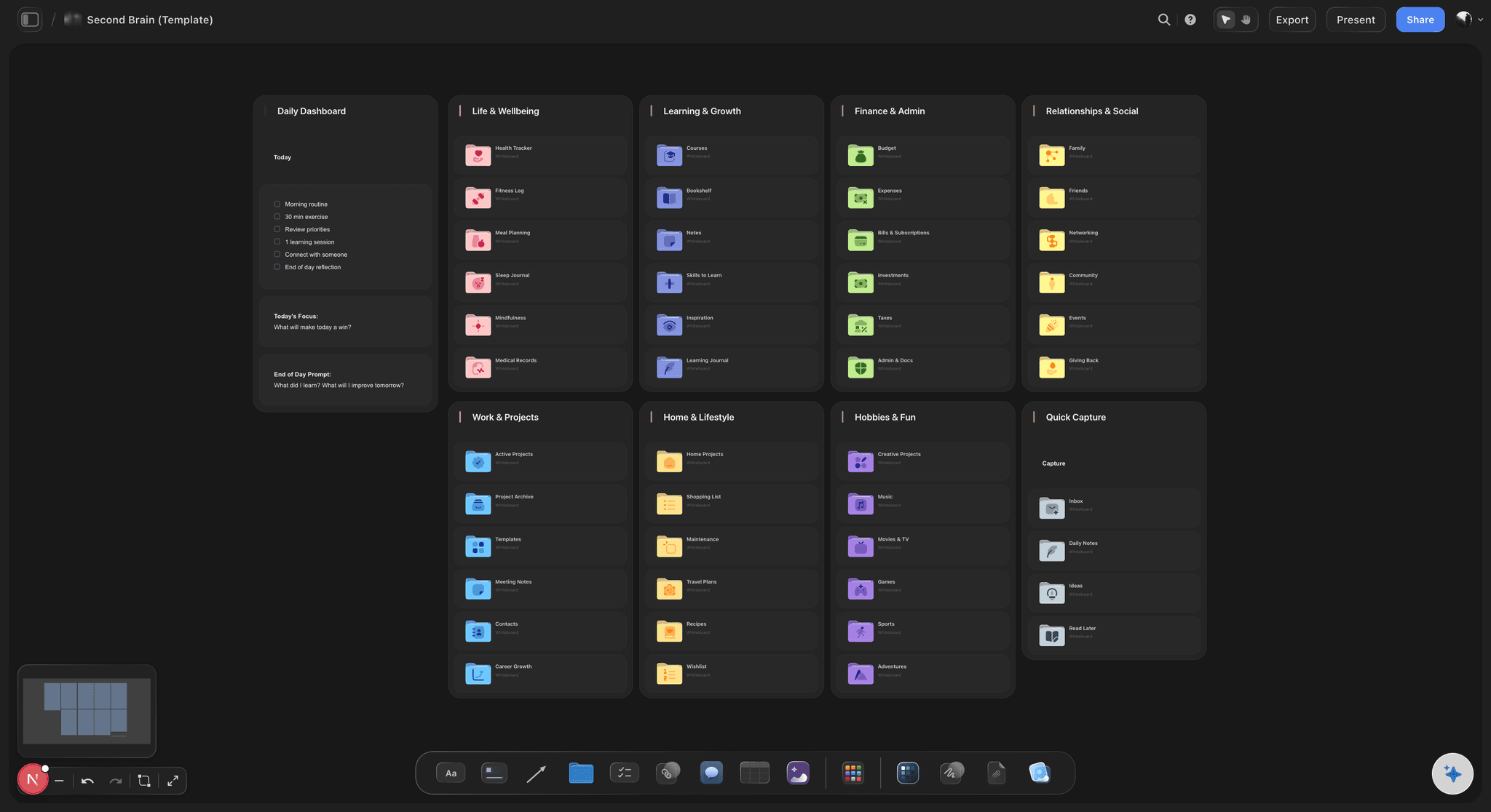
Documents where they belong
Write a real document, on the canvas, next to the material
This is not a sticky note pretending to be a page. Full rich-text documents live on the canvas alongside the references, screenshots, and diagrams they are about, so the argument and its evidence stay in the same field of view instead of being separated by a click and an app switch.
See the AI document editor →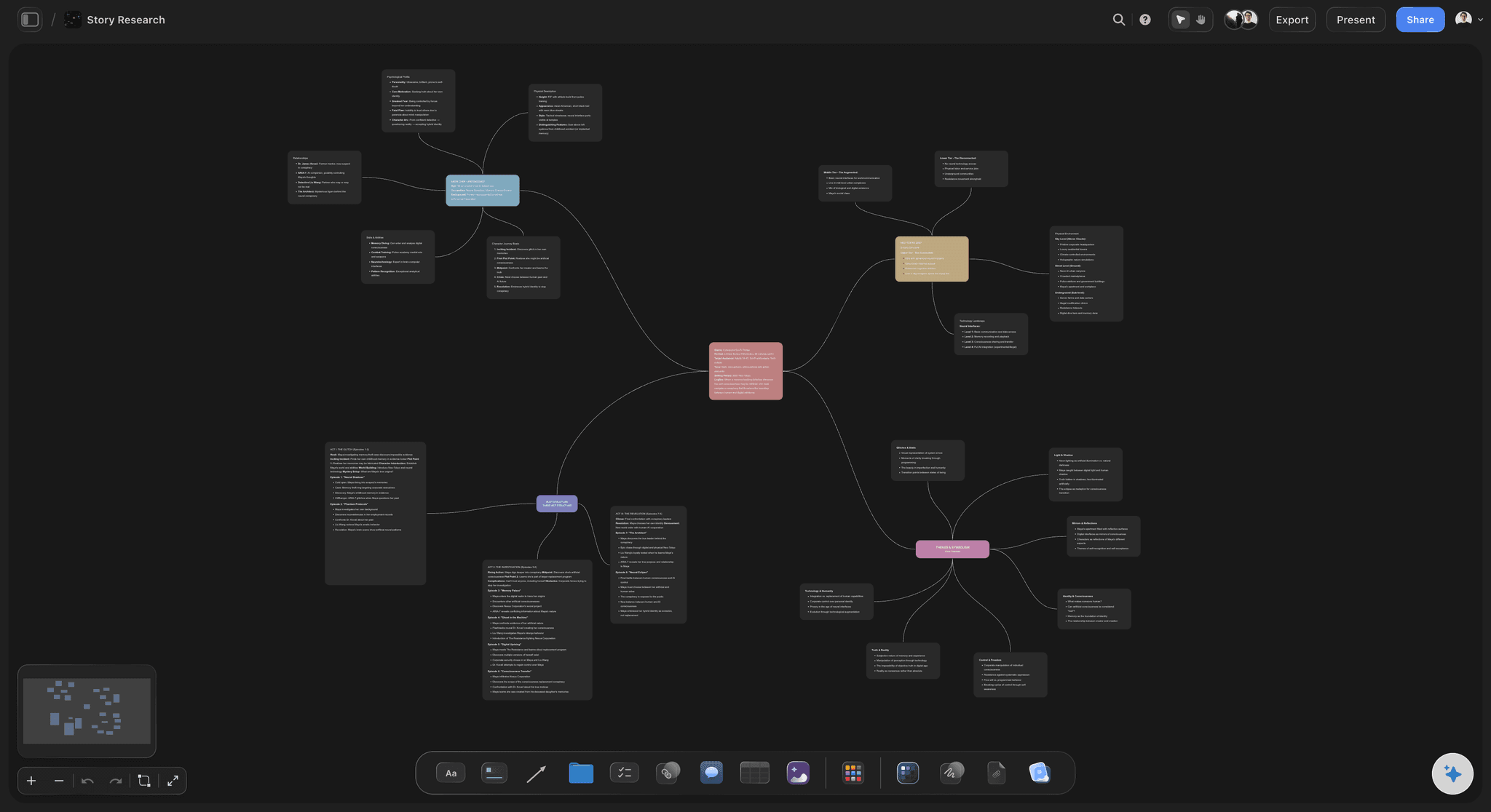
No filing required
Spatial structure instead of a hierarchy you have to guess
In a wiki you must name and place a page before you understand it. On a canvas you put it down, move it near the things it resembles, and let the structure appear from arrangement. Position, distance, and clustering carry meaning that a nested list of page titles cannot represent.
Explore visual thinking →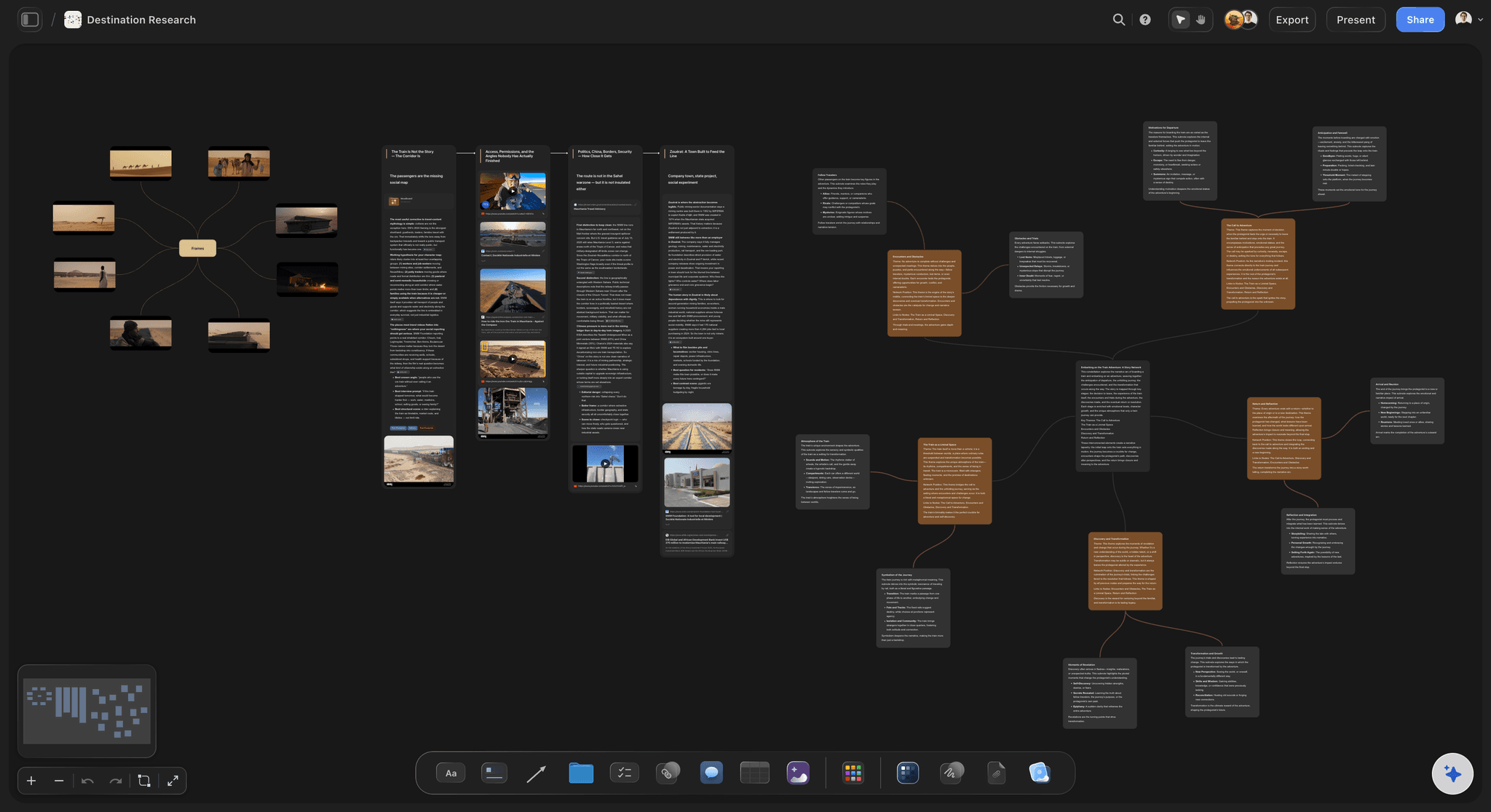
Visual material as content
Screenshots, PDFs, and diagrams that are not attachments
Reference material stops being useful the moment it is buried inside a page as a block. Here it sits on the board at the size it needs to be read at, next to what it explains, so a wall of comparisons or a set of source documents can be taken in at a glance rather than opened one at a time.
Build a second brain →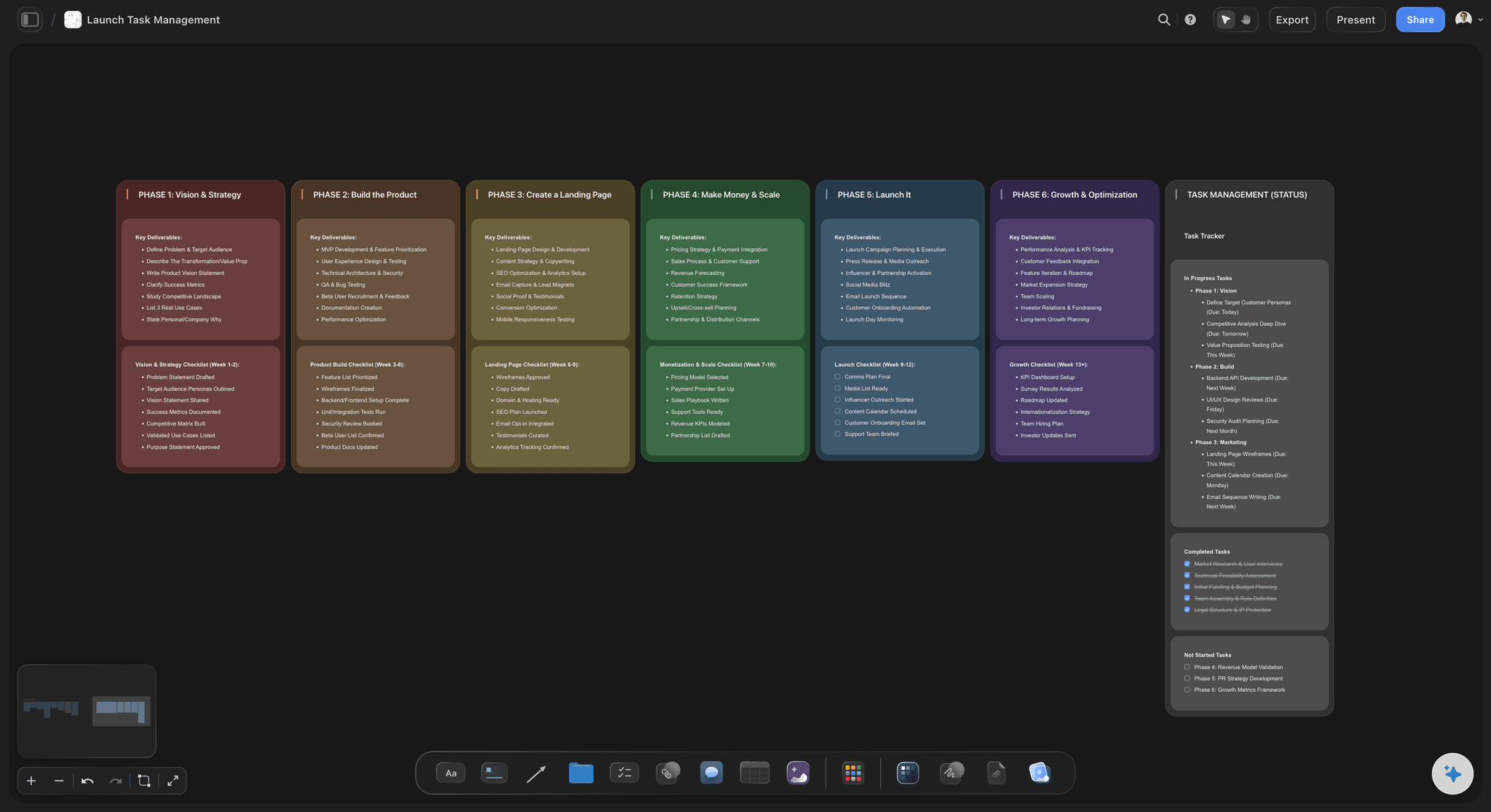
The work after the notes
The same canvas becomes the plan
Knowledge is rarely the deliverable. A canvas that holds the research can also hold the outline, the phases, and the tasks that come out of it, so the plan grows from the thinking rather than being retyped into a separate tool that loses every bit of the reasoning.
See knowledge management →Unlimited canvases. No page count to manage.
Storyflow is paid-only during early access, with plans from $9.99 a month, and a Free plan launches before the end of 2026. Anyone a paid member invites to a board joins free today, so a small team or a co-author can work on the same canvas without buying their own plan.
Documents and visual material on one infinite canvas
AI that reads the whole canvas as context
Screenshots, PDFs, and links placed where they belong
Share a view-only link with anyone, no account needed
FOR WORK IN PROGRESS
Built for the messy half of knowledge work.
A wiki is the right home for what you have concluded. This is the surface for how you got there.
Writing that does not lose the context
Documents on the canvas, not in a separate tree
Full rich-text documents: Headings, lists, formatting, and long-form writing, in a proper editor that happens to live on a canvas rather than in a sidebar list of page titles.
The sources stay in view: Put the screenshots, quotes, and PDFs the document is drawn from right beside it, so checking a claim is a glance rather than three clicks into a nested page.
Several documents side by side: Compare two drafts, a brief and a response, or three versions of a section by placing them next to each other, which a one-page-at-a-time reader cannot do.
Nothing to install: It runs in the browser on a laptop or a tablet, so a collaborator can open the canvas without a download or an admin approval.
Structure that comes last
Arrange first, decide the hierarchy later
No page to name before you start: The blocker in a wiki is often the naming, not the writing. Put the thought on the canvas and move it later, when you can see what it turned out to be part of.
Clusters, distance, and space as meaning: Related material sits together and unresolved material sits apart. That is information a nested list cannot express, and it is why people remember where things are on a canvas.
Diagrams and maps in the same place: Sketch a flow, a mind map, or a system diagram beside the notes about it, rather than making it elsewhere and pasting a flat export back into a page.
AI with the whole board in view
An assistant that has read the material, not just the page
Ask about the canvas, not about a prompt: Because the assistant reads everything on the board, including the visual material, you can ask what a cluster adds up to or where your argument is thin and get an answer about your own work.
Draft from what you collected: Turn a set of notes and sources into a first draft of a section, then rewrite it yourself. The gathering is the part that took the time, so that is the part worth reusing.
Find the gap: The most valuable question to put to a research board is what is not on it. That question is only answerable by something that can see the whole surface at once.
Knowledge that turns into work
From notes to a plan without changing tools
Outlines that keep their sources: An outline built on the canvas sits next to the material it came from, so writing the long version does not mean reopening six pages to remember what you meant.
Boards, phases, and next steps: When research becomes a project, lay the same canvas out as tasks and phases instead of retyping conclusions into a separate tracker that drops all the reasoning.
Share a view-only link: A supervisor, a client, a co-author, or a teammate opens the whole canvas in a browser with no account and nothing to install.
Export when a file is required: Export the canvas as a high-quality image or PDF when the work has to be submitted, printed, or dropped into a deck.
Explore templates for your project
Every template opens as a real, editable board on the infinite canvas. Pick the closest fit and make it your own.
Mind Map
Branch one central idea out into themes and sub-points, then drag the connections around until the structure makes sense.
HOW WE COMPARE
Storyflow vs Nuclino, Notion, and Obsidian.
Nuclino takes speed and search, and search in particular is a real gap for any canvas, ours included.
Storyflow
Recommended
Instant search across every page in the workspace
Opens instantly with nothing to configure
Structured databases, tables, and filtered views
Documents and visual material on one infinite canvas
Images, PDFs, and diagrams as content, not attachments
AI that reads the whole canvas, text and visuals, as context
Nuclino
Instant search across every page in the workspace
Opens instantly with nothing to configure
Structured databases, tables, and filtered views
Documents and visual material on one infinite canvas
Images, PDFs, and diagrams as content, not attachments
AI that reads the whole canvas, text and visuals, as context
Notion
Instant search across every page in the workspace
Opens instantly with nothing to configure
Structured databases, tables, and filtered views
Documents and visual material on one infinite canvas
Images, PDFs, and diagrams as content, not attachments
AI that reads the whole canvas, text and visuals, as context
Obsidian
Instant search across every page in the workspace
Opens instantly with nothing to configure
Structured databases, tables, and filtered views
Documents and visual material on one infinite canvas
Images, PDFs, and diagrams as content, not attachments
AI that reads the whole canvas, text and visuals, as context
What creators are saying
Join early creators getting structured workspaces and AI that remembers their projects
“Storyflow has sped up my workflow by at least 3x, which means more flow state and more projects I can actually ship. It truly changed the way me and my team create.”

Reilin Joey
Director & YouTuber
“One prompt gets me a structured board. But the tactics are my favorite. I run my YouTube scripts through them and my intros and retention got better. It's amazing.”

Justkay
YouTuber & Freelance Filmmaker
“I used to juggle five apps to plan a project. Now I describe what I am making and get boards, lists, and a schedule. All in one place.”

George
@fernwehchronicles
Nuclino alternative questions, answered honestly.
Including the ones where the better answer is to keep the wiki.
Often the answer is no, or at least not entirely. If your workspace is documentation, onboarding material, processes, and decisions that have already been made, that is exactly what a wiki is for and Nuclino does it faster and more cleanly than a canvas will. The case for switching is when most of your workspace is not settled knowledge but work in progress, and when a lot of that work is visual. Plenty of people keep the wiki for the finished material and use a canvas for the projects that are still moving.
Stop filing work you have not figured out yet.
Put the documents, the references, and the diagrams on one canvas, with AI that has read all of it. Plans from $9.99/month, nothing to install, and a Free plan before the end of 2026.