
Worlds that stay rock-solid, however big
Design your game and its world
on one infinite canvas.
Storyflow is a visual game design tool on a truly infinite canvas. Build the world and lore, map characters and quests, draft the game design document, sketch levels and systems, and lay out branching narrative as boards you can see all at once. Ask the AI to expand any branch, and keep the whole game in view instead of scattered across a dozen tabs.


Creatives working for these brands already got early access
- Red Bull
- Canon
- Artlist
- Porsche
See how easy it is to get started
Watch a real project come together, from a blank board to a finished plan, clicked through step by step.
Start from a ready-made template
Pick a board to see what you can build, then let AI fill it in. Every template is a real, editable starting point on the same infinite canvas.

World Building
Develop the places, factions, and rules of your world and connect them into one living map.
What does it mean to design a game visually?
A game is never one document. Before a level is built there is a world to invent, a cast and a bestiary to track, quests and progression to structure, systems and economies to balance, and a narrative that branches at every choice. Split across a wiki, a spreadsheet, a slide deck, and a folder of concept art, those pieces drift apart, and you lose the shape of the whole game. Designing visually means laying every piece out in space, on one canvas, so you can see how the world, the mechanics, and the story actually connect before you commit them to an engine.
Storyflow gives indie developers and narrative designers that canvas. A world and lore bible, a character board, a quest map, a game design document, and a branching dialogue tree can all live side by side, each a set of real cards you drag, recolor, group, and rewire as the design changes. Pin the concept art that defines a biome, the reference clip from another game, or the research PDF behind a mechanic, right next to the card it belongs to. The game you are holding in your head becomes something you can point at and walk a teammate through.
And the design does not stay static. Ask the AI to expand a thin faction into a full culture, turn a one-line quest into a beat-by-beat structure, or blow a system sketch out into rules and edge cases. When a board is right, turn it into the next layer of work on the same canvas. Your GDD, your quest log, and your narrative flow live together instead of in five apps you have to keep in sync by hand.
Ultra fast from brief to board
From loose idea to a designed game in four steps.
Start from a single concept or a prompt. Either way the game stays yours to shape at every step.
01
Open your canvas
Start in the browser with a Storyflow account. Nothing to install, just an infinite canvas ready for the game you have been sketching in your head.
02
Map world, cast, and systems
Build a world and lore bible, a character and quest board, and a systems brainstorm as cards you arrange by hand, or describe the game once and let the AI lay out the first boards for you.
03
Expand any branch with AI
Point at a flat faction, a thin quest, or a vague mechanic and ask the AI to develop it. It builds on what is already on your board, so new detail fits your game instead of a generic template.
04
Turn boards into your GDD
Grow a board into a game design document on the same canvas, branch a storymap into a dialogue tree, share a view-only link with your team, or export the design as an image or PDF for a pitch.
A game design tool that keeps the whole game in one place.
Design the world, the characters, the quests, and the systems in space, expand any thread with AI, and keep the concept art where you can see it. All on one canvas.
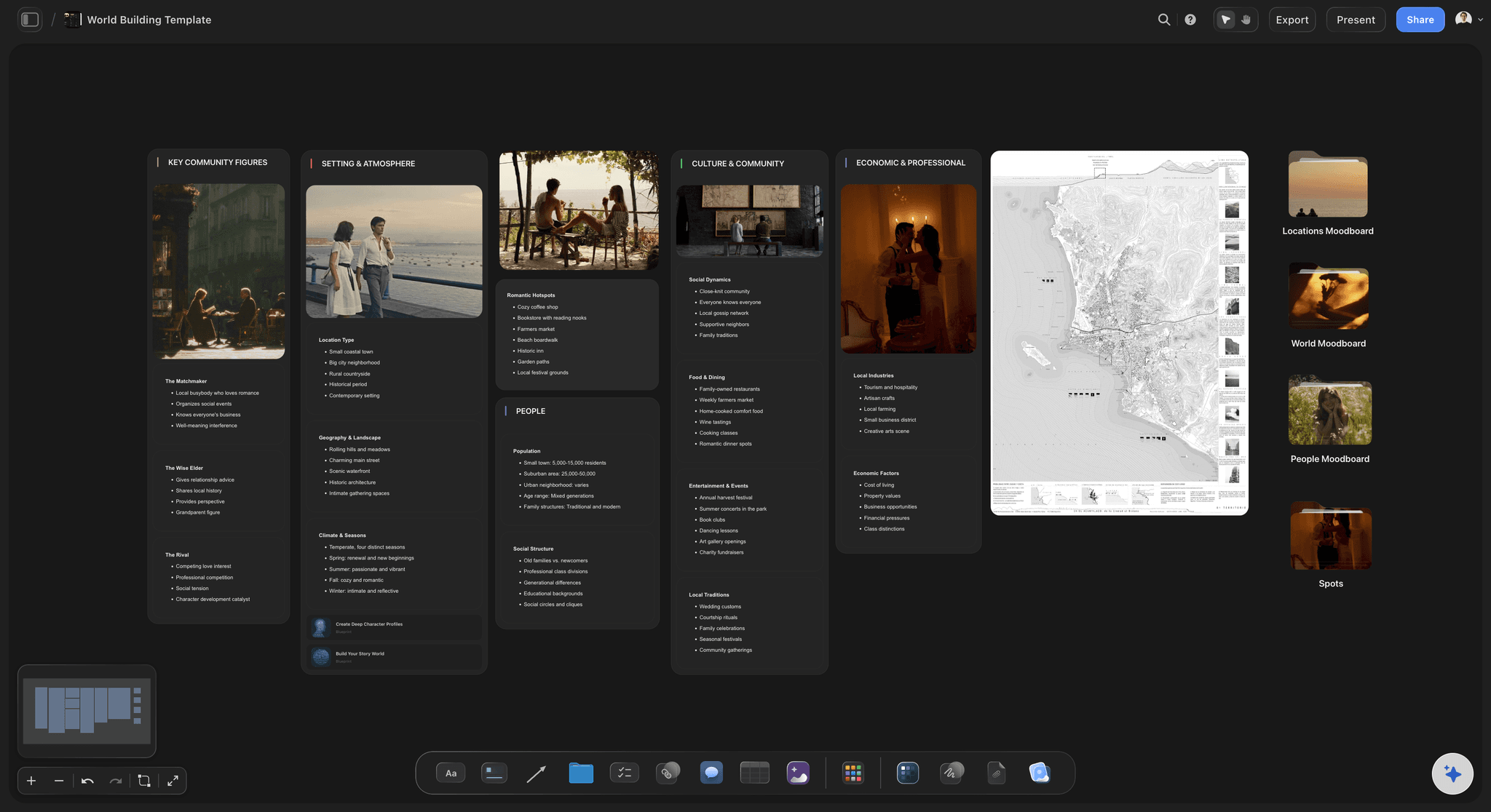
The whole world in one view
Lore bibles and worlds you can see
Stop hunting a wiki for one lore entry. Lay your world, its factions, history, and rules out as connected boards you take in at a glance, and drag any card as the setting grows.
See the worldbuilding tool →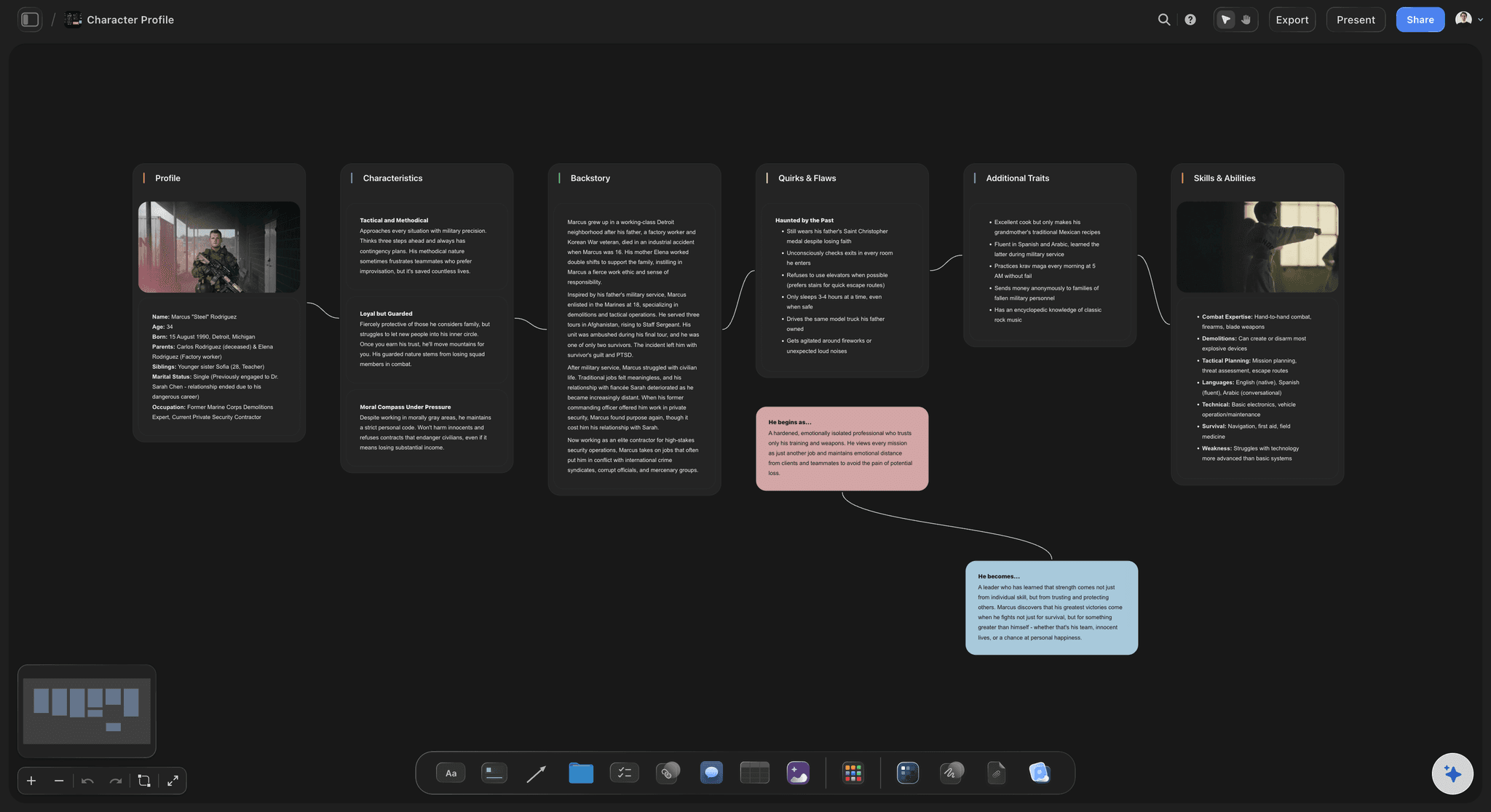
AI expands the thin branches
Develop any character or quest with AI
Point at a stub of a character, faction, or quest and ask the AI to go deeper. It reads the board you have open, so a new profile or quest line connects to the game you are actually building, not a stock template.
See the character profile generator →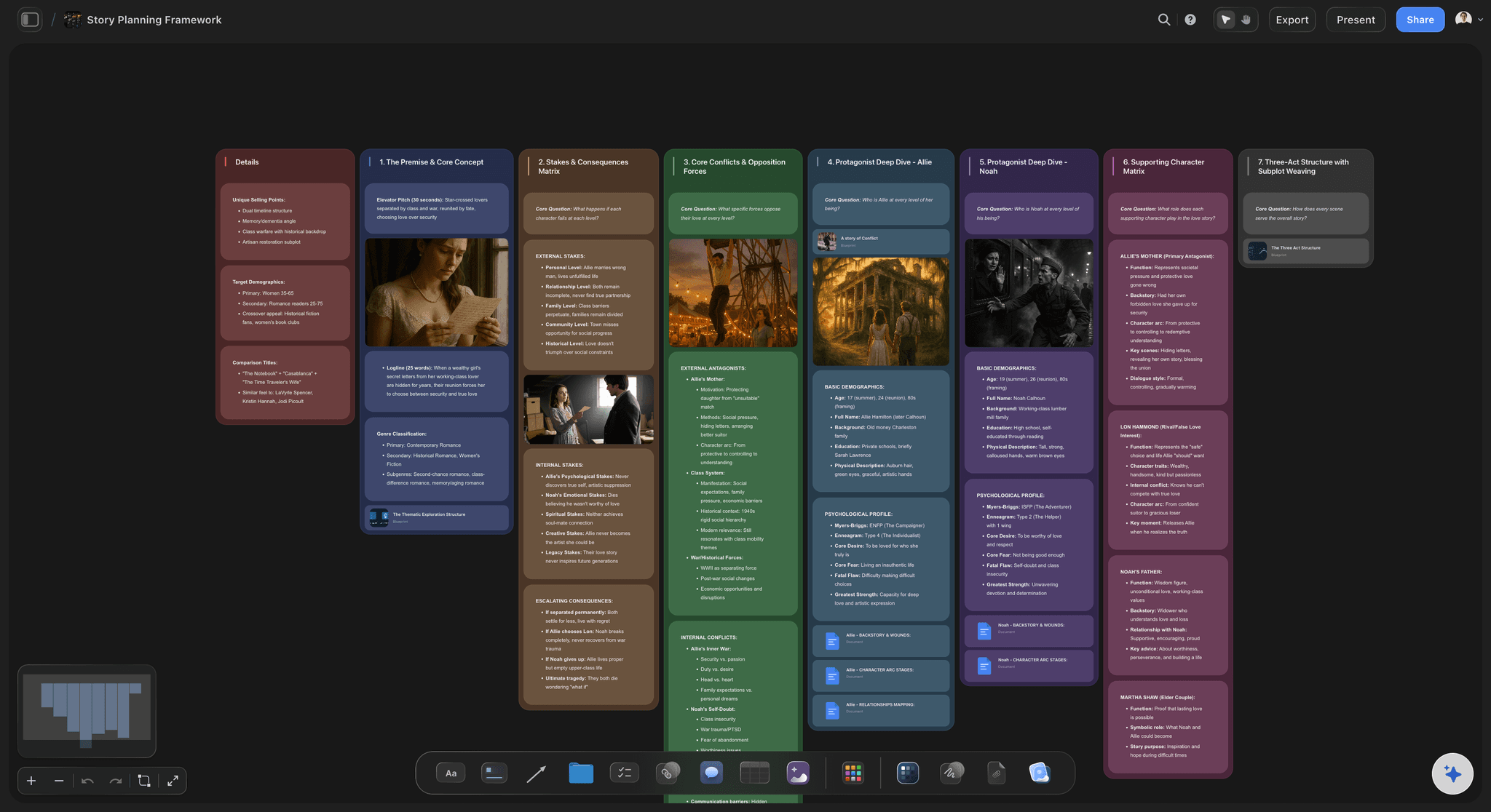
Design becomes a document
Boards become your game design doc
Take the systems and progression you mapped and grow them into a game design document on the same canvas, next to the boards that feed it. The GDD stays connected to the design instead of drifting out of date.
See the game design document builder →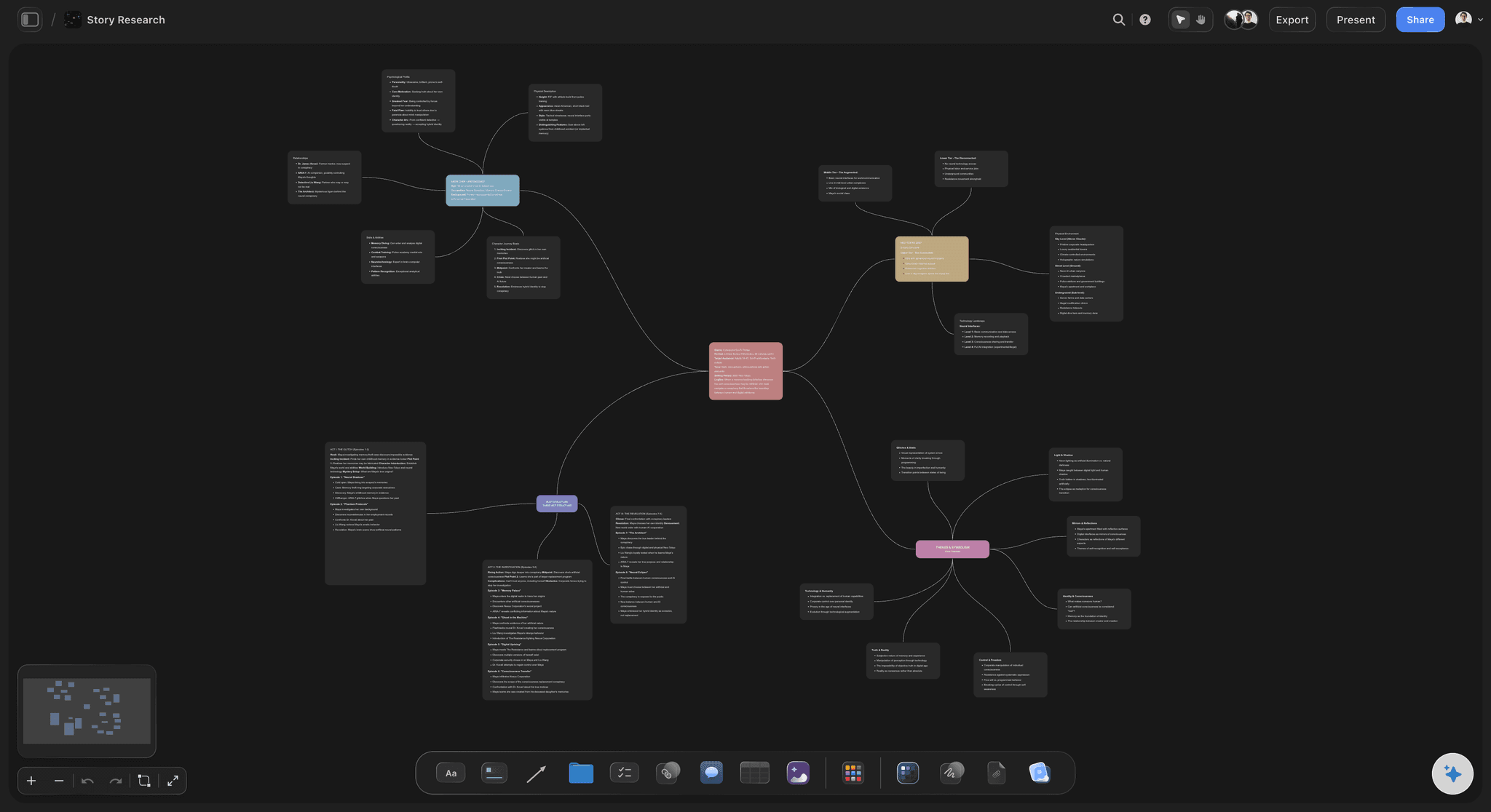
Room for a whole game
An infinite canvas, no object cap
A game's world sprawls, and it should. With a truly infinite canvas and no object cap, no biome, quest, or system gets cut for space, and the design never runs into an edge.
See the mind mapping tool →No object cap, on any plan.
Open a canvas and start designing your game. Plans have no object cap and no time limit, so a whole world, cast, and quest log never push you to upgrade mid-design.
Unlimited boards for world, characters, quests, and systems
Basic AI usage to lay out and expand any branch
Attach concept art, reference clips, PDFs, and links to any card
Share a design view-only, or invite your team free
Built for people with taste
Made for the way indie devs and narrative designers actually work.
Build the world, track the cast and quests, structure the systems, and lay out branching narrative. All on the same canvas.
World and lore you can see
World bibles and character boards
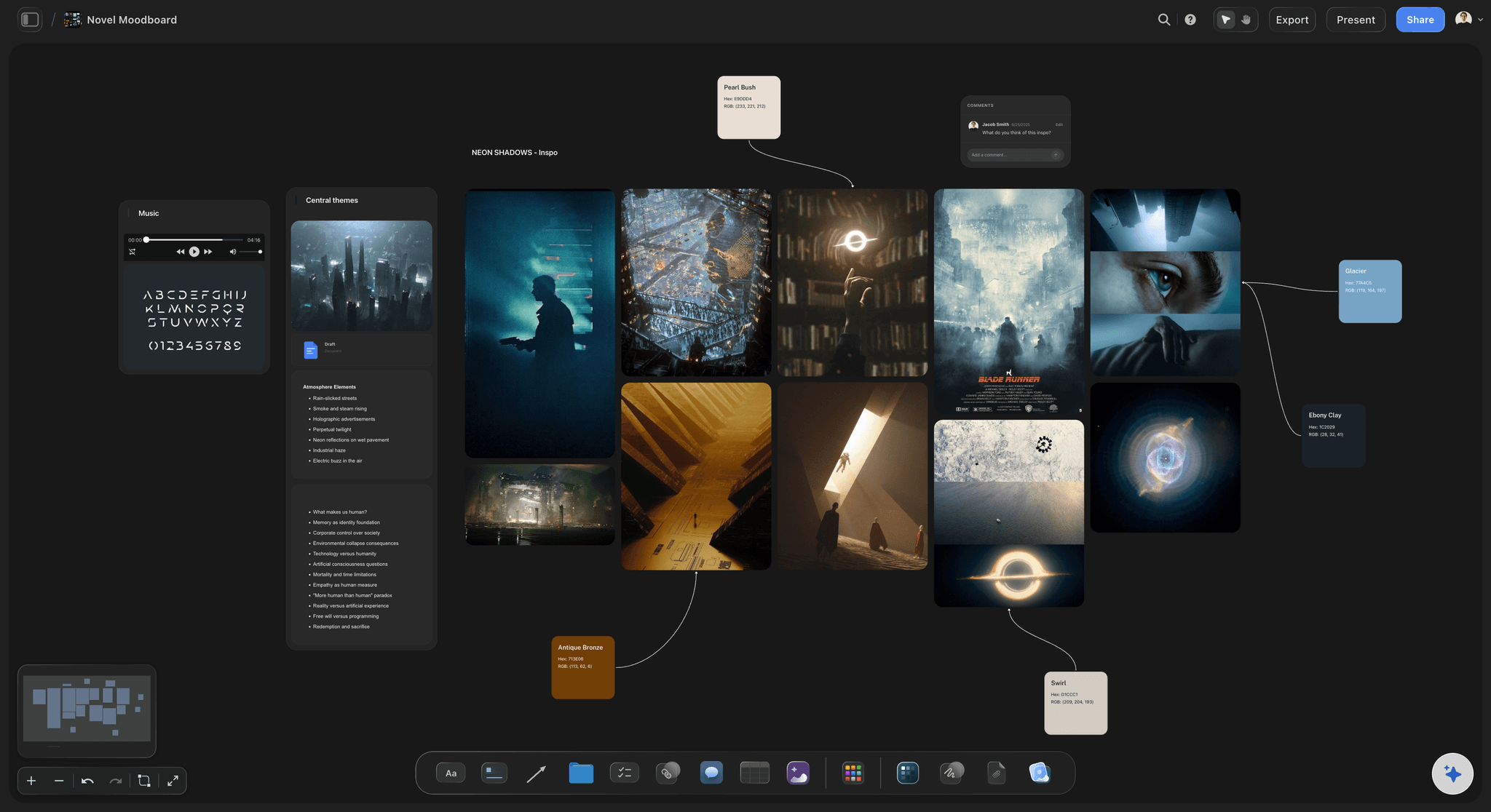
Build the world in space: Lay out biomes, factions, history, and rules as connected cards, so a setting reads as a map instead of a wiki you have to click through page by page.
Track the whole cast: Give each character and enemy a card with motivation, role, and relationships, and pull the cast together so who fits where is visible at a glance.
Pin the concept art: Attach the concept piece, the reference from another game, or the research doc that defines a biome or a boss, right beside the card it belongs to.
Quests and systems as a map
Quest design and level brainstorms
See the whole progression: Lay quests, objectives, and unlocks out across the canvas so pacing and progression are visible, and spotting a dead end or a difficulty spike is a glance, not a hunt.
Rewire with a drag: Move a quest, resequence a level, or split a system by dragging a card. When the design shifts, the map keeps up instead of forcing a rewrite of your notes.
Brainstorm mechanics visually: Sketch systems, economies, and loops as cards you can group and reconnect, so a mechanic reads as a diagram before it ever reaches the engine.
AI that reads your game
AI expands from what is already there
Expand any branch on demand: Ask the AI to flesh out a faction, a quest, or a system. It builds on the cards you already placed, so new detail connects to your game rather than drifting off-theme.
Bring in your bible and docs: Add up to five documents and three boards as context from the + menu, so your lore bible or a design doc shapes what the AI suggests.
Re-prompt to refocus: Ask for a darker tone, a tighter quest, or a different genre lens. The AI reworks the branch while keeping the edits and choices you already made.
The design becomes the doc
From boards to GDDs and branching narrative
Grow a GDD on the canvas: Turn your systems and progression boards into a game design document beside the design that feeds it, so the doc and the game stay in sync instead of drifting apart.
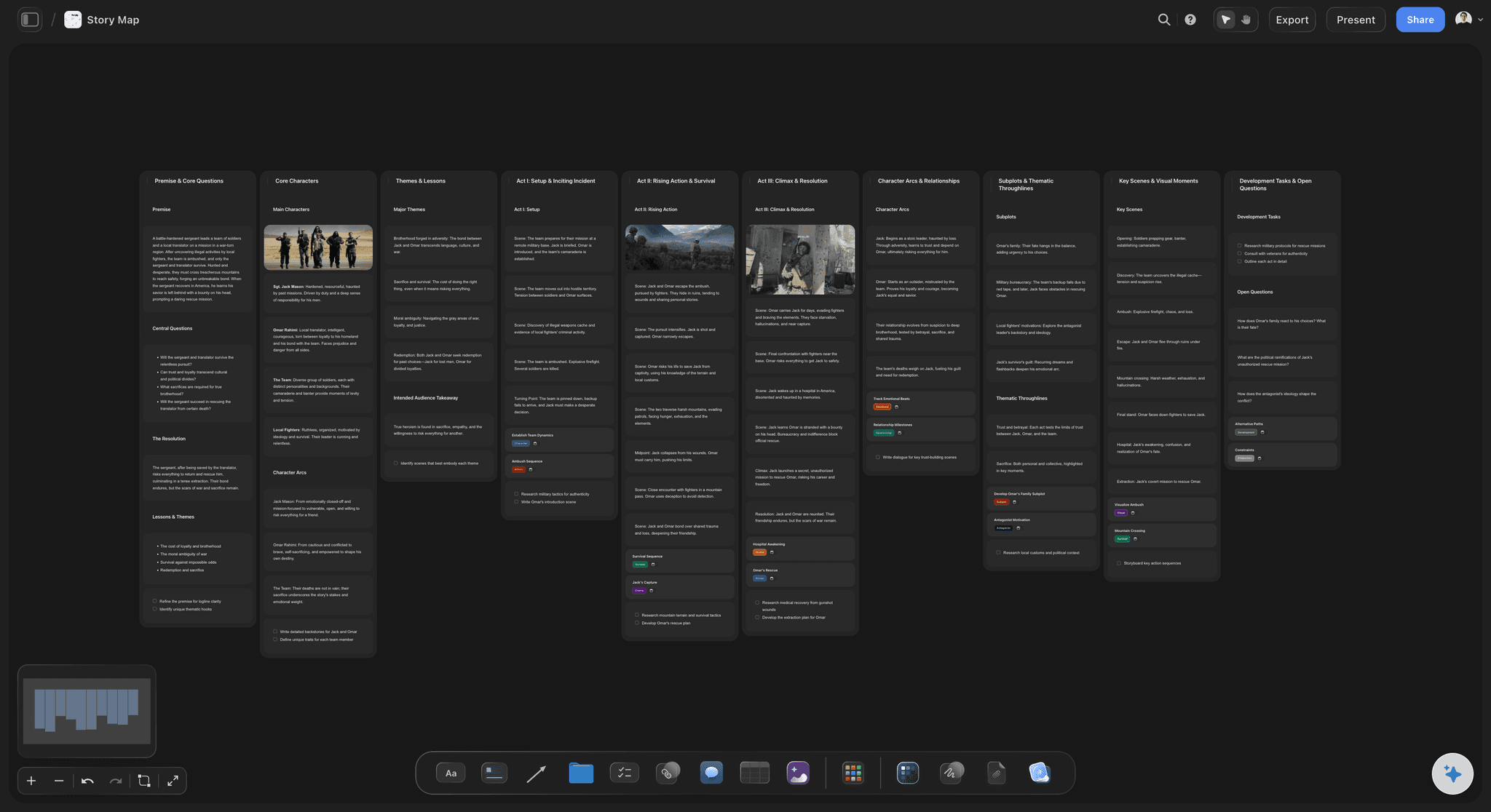
Branch the narrative: Map dialogue and story choices as a branching storymap, so a player's path through the narrative is something you can see and rewire, not a tangle of scattered notes.
Share and export: Invite your team free, send a view-only link so a publisher or playtester can explore the design without an account, or export a board as a clean image or PDF for a pitch.
Explore templates for your project
Every template opens as a real, editable board on the infinite canvas. Pick the closest fit and make it your own.
World Building
Develop the places, factions, and rules of your world and connect them into one living map.
One app instead of five
How Storyflow compares for designing a game.
Each tool has a strength. The question is whether your design is visual, AI-assisted, and holds the whole game on one canvas.
Storyflow
Recommended
Visual canvas for world, quests, and systems
AI that expands any branch from your board
Boards become GDDs and branching narrative on one canvas
Structured docs and databases for a design wiki
Milanote
Visual canvas for world, quests, and systems
AI that expands any branch from your board
Boards become GDDs and branching narrative on one canvas
Structured docs and databases for a design wiki
Notion
Visual canvas for world, quests, and systems
AI that expands any branch from your board
Boards become GDDs and branching narrative on one canvas
Structured docs and databases for a design wiki
Miro
Visual canvas for world, quests, and systems
AI that expands any branch from your board
Boards become GDDs and branching narrative on one canvas
Structured docs and databases for a design wiki
What creators are saying
Join early creators getting structured workspaces and AI that remembers their projects
“Storyflow has sped up my workflow by at least 3x, which means more flow state and more projects I can actually ship. It truly changed the way me and my team create.”

Reilin Joey
Director & YouTuber
“One prompt gets me a structured board. But the tactics are my favorite. I run my YouTube scripts through them and my intros and retention got better. It's amazing.”

Justkay
YouTuber & Freelance Filmmaker
“I used to juggle five apps to plan a project. Now I describe what I am making and get boards, lists, and a schedule. All in one place.”

George
@fernwehchronicles
Questions from game designers, answered.
Everything indie devs and narrative designers ask about designing in Storyflow.
Instead of splitting your game across a wiki, a spreadsheet, and a folder of art, you design it visually on one canvas: world, characters, quests, and systems as boards you can see all at once. When a branch feels thin, the AI expands it using your board as context. The whole game stays in view, and any board can grow into a game design document on the same canvas.
Not during early access. Storyflow is paid-only right now, with plans starting at $9.99 per month that include unlimited boards for world, characters, quests, and systems, basic AI usage to lay out and expand branches, 20 file uploads for concept art and research, and view-only sharing. A Free plan is planned before the end of 2026.
Yes. Map your systems, progression, and mechanics as boards, then grow them into a game design document on the same canvas, next to the design that feeds it. Because the GDD lives beside the boards it describes, it stays connected to the design instead of drifting out of date in a separate file.
Yes. Build a world and lore bible as connected boards of regions, factions, history, and rules on a truly infinite canvas. Pin the concept art beside each card, expand a thin corner of the world with AI, and keep the whole setting scannable instead of buried in a wiki. There is no object cap on any plan, so a sprawling world never runs out of room.
Yes. Lay out quests, dialogue, and player choices as a branching storymap where a path through the narrative is something you can see and rewire by dragging cards. Develop characters and their arcs alongside it, and expand a one-line quest into a beat structure with AI before it ever reaches the engine.
The AI reads the board you have open, so the world, characters, quests, and systems already on the canvas shape what it suggests when you ask it to expand a branch. You can also attach up to five documents and three boards, such as a lore bible or a design doc, for it to work from. It builds on your game, not a generic template.
Be honest about the fit. If your main need is a structured design wiki: linked databases of items and stats, tables you filter and sort, and long reference pages your whole studio edits, Notion is purpose-built for that. Storyflow's edge is the visual design stage: world, quests, and systems on an infinite canvas, AI that expands any branch, and boards that become your GDD and branching narrative.
Yes. Share a view-only link so a publisher, playtester, or collaborator can explore the full design in their browser without an account, invite your team to build it with you, or export any board as a high-quality image or PDF for a pitch deck or a design review.
The game is in your head. Get it onto the canvas.
Map your world, characters, quests, and systems, expand the branches that matter with AI, then grow the boards into your GDD.