
COLLABORATIVE CANVAS
The workshop is one hour.
The board has to survive the month.
Everyone pictures collaboration as six cursors moving at once. In practice, most of the work on a shared canvas happens alone, at different hours, in different time zones, by people adding to something someone else started. Storyflow is a collaborative canvas built for that reality: invite the people who need to contribute, send a view-only link to everyone else, and keep the board readable long after the session ends. Paid-only during early access, plans from $9.99 a month, and anyone a paid member invites to a board joins free today.
Plans from $9.99/mo
Invited collaborators join free
Share view-only with anyone

Used by creative professionals at:
Artlist
Pixar
Nike
Red Bull
The North Face
Porsche
Start from a ready-made template
Pick a board to see what you can build, then let AI fill it in. Every template is a real, editable starting point on the same infinite canvas.
Mind Map
Branch one central idea out into themes and sub-points, then drag the connections around until the structure makes sense.
What is a collaborative canvas, really?
A collaborative canvas is a shared, zoomable visual space where more than one person can place and move things: notes, images, documents, diagrams, and plans, all on one surface that nobody has to scroll through in order. The word that matters in that sentence is shared. A canvas one person uses is a thinking tool. A canvas several people use becomes something else entirely, closer to a room than a document, with all the social properties a room has. It gets crowded, it gets rearranged by people who were not there when it was set up, and it needs somebody to tidy it or it stops being usable.
The thing most tools get wrong is assuming collaboration means simultaneity. The famous demo is the live session: cursors flying, everyone dropping sticky notes at once, a timer counting down. That does happen, and it is genuinely good for the first hour of a project. But if you look at when contributions actually land on a shared board over a normal month, the overwhelming majority arrive when one person is on it alone. Someone adds a reference on Tuesday night. Someone else reads it on Thursday and leaves a comment. The designer moves three cards on Friday because the sequence was wrong. None of that is multiplayer, and all of it is collaboration.
That is why the properties that decide whether a shared canvas works are not the flashy ones. They are: can somebody who missed the session open the board and understand it without a call, can they tell what is finished and what is still a question, can they contribute without breaking something, and can a person outside the company see it without creating an account. Presence and live cursors help you avoid stepping on each other during the hour you are both there. Comments, mentions, clear labels, and a sensible layout are what carry the other 167 hours of the week, and they are the reason a board is still being used in week six rather than abandoned in week two.
In practice a team works together on a canvas in six distinguishable modes, and confusing them is where most collaboration friction comes from: live co-editing, where two or more people are on the board at the same time and both hands are on the work; asynchronous contribution, where people add and rearrange alone at different hours; commenting and review, where one person responds to work someone else considers finished; presenting and walkthroughs, where one person drives and everyone else watches; view-only sharing, where a client or a stakeholder reads the board and cannot change it; and curation, the unglamorous ongoing job of labelling, archiving, and deciding what the board currently means. Every healthy shared board has someone doing the last one, and every dead board is a board where nobody did.
HOW IT WORKS
Set up a board people can actually re-enter.
The goal is not a great session. The goal is a board that still makes sense to somebody opening it three weeks later.
01
Open a canvas and give it a shape
Sign up in seconds, from $9.99 a month. Start the board with named areas before anyone else arrives: what we know, what we are deciding, what is agreed. A canvas with structure invites contribution. A blank one invites hesitation.
02
Let AI lay out the first draft
Describe the project in a sentence and the AI places a full board of cards, sections, and open questions. Starting from something to react to gets more out of a group than starting from an empty grid, because disagreeing is easier than inventing.
03
Invite contributors, share with everyone else
Invite the people who will actually add to the board. Anyone a paid member invites joins free today. For the people who only need to see it, send a view-only link that opens in a browser with no account required.
04
Give the board an owner
One named person tidies after each round: label the clusters, mark what is decided, move dead branches out of the main view. Ten minutes a week is the difference between a living board and a wall of orphaned notes.
Built for the collaboration that happens when nobody is watching.
Live sessions are the easy part. The hard part is a board that stays legible to people who were not in the room.
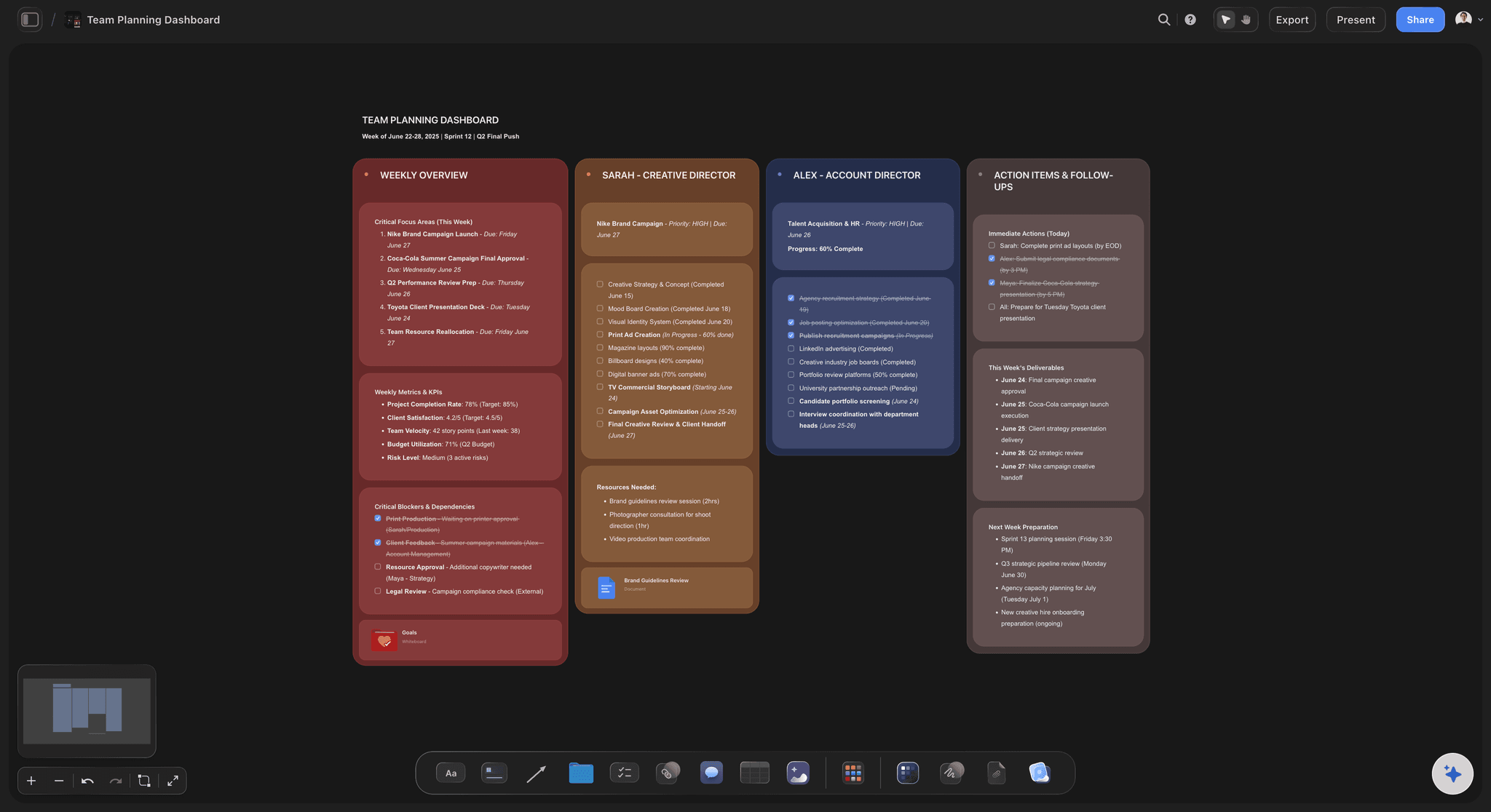
Async contribution as the default, not the fallback
Most of the work lands when one person is alone on the board
A shared canvas has to be as good for the person opening it at 11pm as for the six people in a workshop. Named areas, readable cards, and a layout that holds still mean somebody can pick up where the group left off without a handover call first.
See visual collaboration →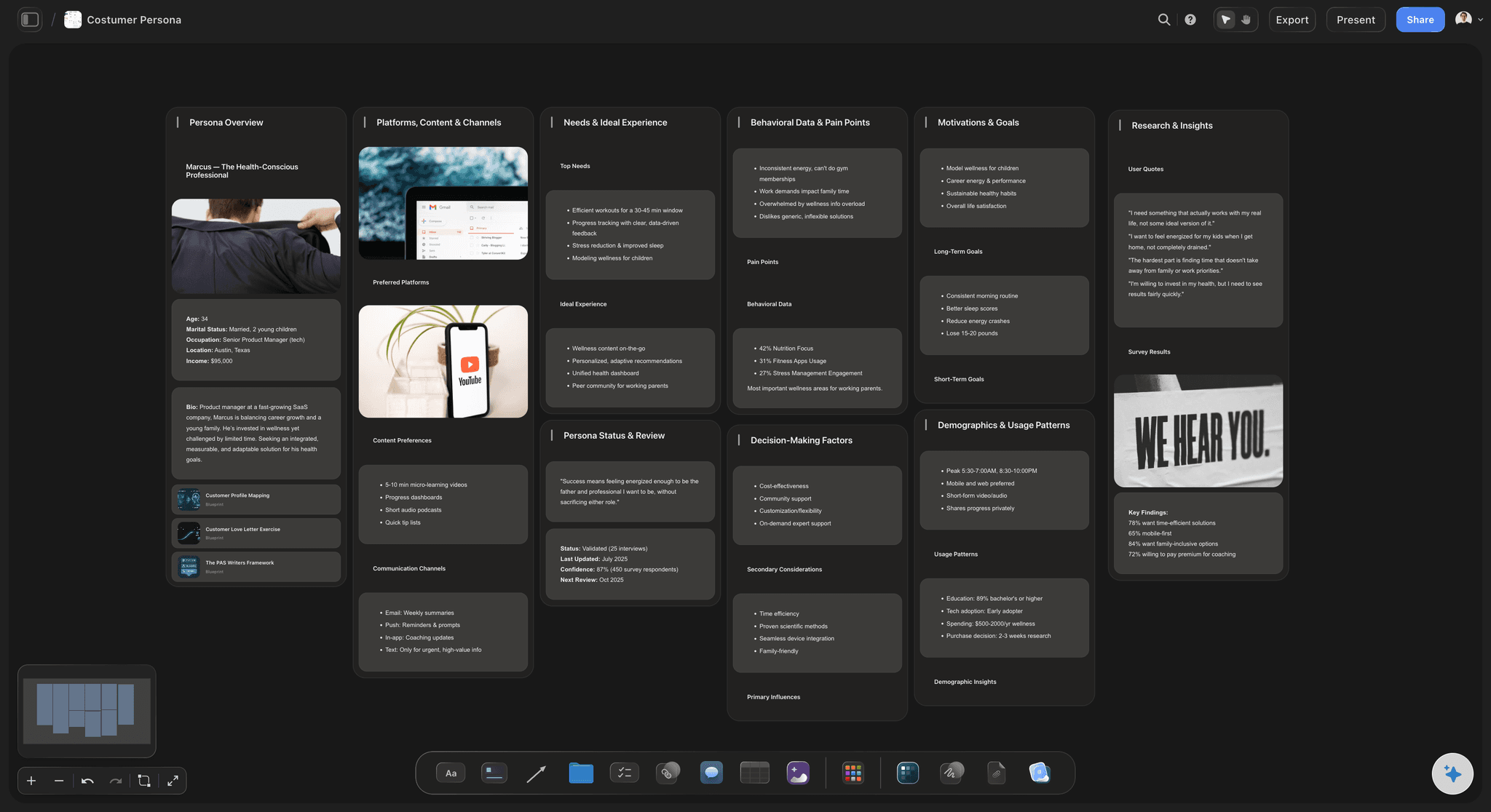
Reading is a permission level, not a favour
Share with people who will never have an account
Send a view-only link and a client, an executive, or a freelancer opens the whole board in a browser with nothing to install and no login. They see the plan as it stands, and there is no chance of an accidental drag rearranging a week of decisions.
Explore the online whiteboard →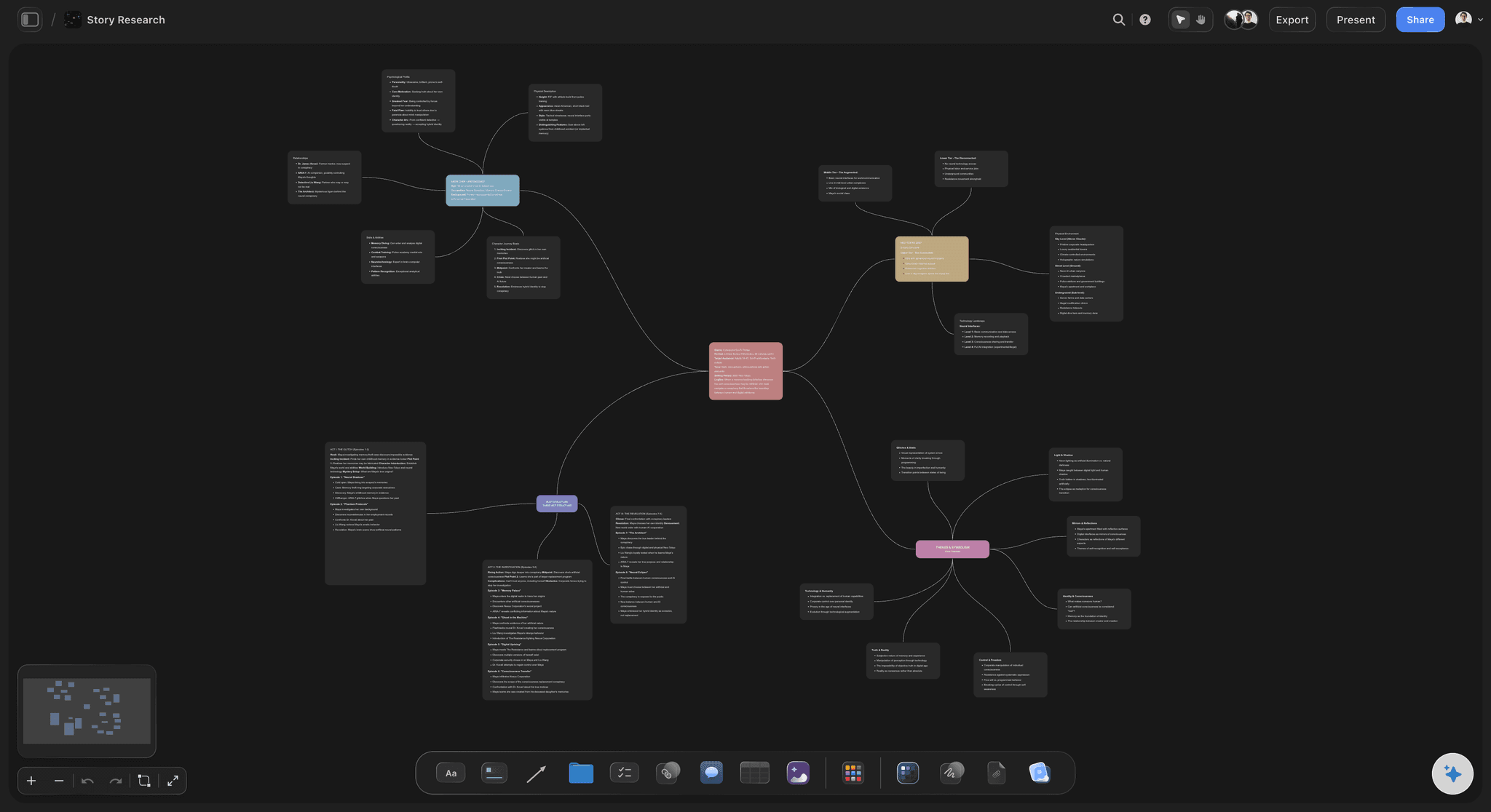
One prompt, a board everyone can react to
AI gives the group a first draft to argue with
Group ideation from nothing is slow, because everyone waits to see what kind of thing goes on the board. Describe the project and the AI lays out cards, sections, and open questions across the canvas, so the first ten minutes are spent editing instead of staring.
See the AI whiteboard →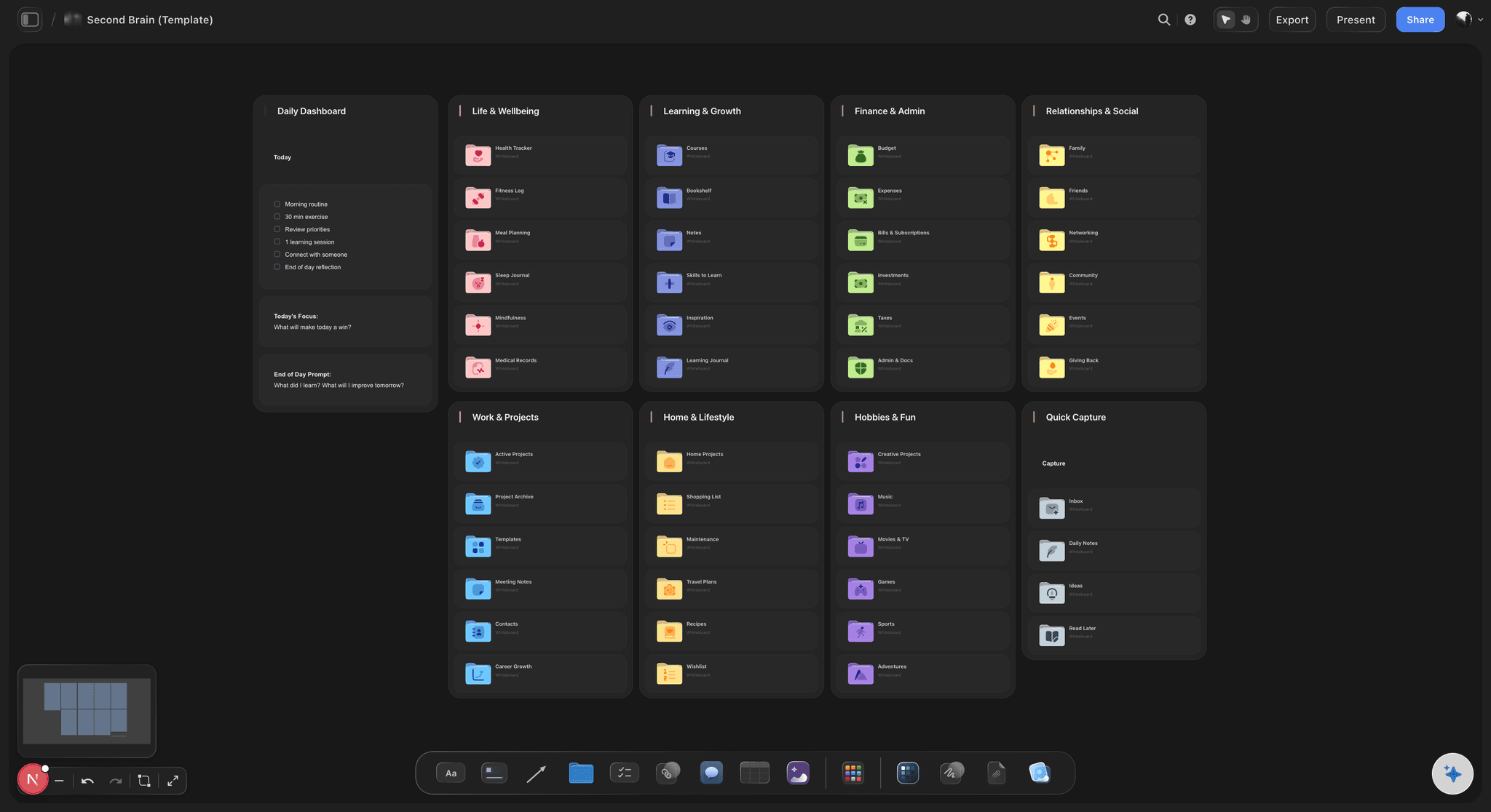
Evidence and plan on the same surface
The references sit next to the decision they justify
Shared boards die when the reasoning lives somewhere else. Pin images, PDFs, links, competitor pages, and video frames beside the cards they support, so the question of why did we agree to this has an answer on the board rather than in someone's memory.
See how remote teams use it →Unlimited boards. Invited collaborators join free.
Storyflow is paid-only during early access, with plans from $9.99 a month, and a Free plan launches before the end of 2026. Anyone a paid member invites to a board joins free today, so the cost of adding the person who should see the plan is nothing.
Unlimited shared boards on an infinite canvas
Invite collaborators to work on a board, and they join free
View-only links anyone can open without an account
Real-time collaborative editing on the Team plan
WHAT CHANGES WITH MORE THAN ONE PERSON
A shared canvas is a different object from a personal one.
Everything below is about the second, third, and tenth person on the board, which is where canvases usually break.
Co-editing, review, and the difference between them
Know which mode you are in before you open the board
Co-editing means both hands on the work: Two people building the same plan together, moving each other's cards, finishing each other's sections. It works when the work is genuinely joint and unfinished, and it needs a small group. Six people co-editing one cluster is not collaboration, it is a queue.
Review means responding to something finished: One person has done the work and wants a reaction, not a co-author. Comments and mentions are the right instrument here, because an edit made during review erases the thing being reviewed and nobody can tell what changed or why.
Most teams use the wrong one: The classic failure is inviting ten people to co-edit a board that was actually ready for review. You get scattered edits, no clear authorship, and an owner who spends an afternoon reconstructing what the board said yesterday.
Say which one you want when you share it: One sentence in the invite message, add to the open questions area or comment on what looks wrong, saves more collaboration friction than any feature. The tool cannot infer intent, and a shared link carries none.
The session is not the project
Design for the week, not for the hour
Boards die the day after the workshop: The session generates energy and two hundred notes. The next morning nobody opens it, because reading it requires the context that was in the room. Within a week it is an artefact rather than a working surface, and the decisions get made in a thread instead.
Ten minutes of curation buys a month of life: Cluster the notes, name each cluster, mark what was decided, and move the discarded branches somewhere out of the main view. This is boring and it is the single highest-return thing anyone does to a shared board.
Someone has to own it: Not a facilitator for the session, an owner for the board. A named person who tidies after each round and answers what does this board currently say. Boards without one degrade at a rate that surprises people every time.
Write the state at the top: A short area saying where this board is, what is agreed, and what it is waiting on. It is the thing that lets a colleague, a client, or your own self in three weeks re-enter without a call.
Access that matches how much trust you are extending
Let people in without letting them break things
View-only links for anyone: Share a link and a client, a stakeholder, or an entire department can read the board in a browser with no account and no login. They see exactly what the team sees, and they cannot move a card by accident on a trackpad.
Invite the people who will contribute: Collaborators you invite can work on the board itself. Keep that list to the people whose job is to change the plan, and everyone else on a link. Contribution rights are a decision about the board, not a compliment.
Guests do not cost a seat: Anyone a paid member invites to a board joins free today, so the question of whether a freelancer or a colleague from another team is worth another licence never comes up. That question is why most plans are shared as screenshots.
Export when a link is not the format: Sometimes the board needs to be a page in a deck or an attachment on an email. Export it as a high-quality image or PDF and the plan travels to people who will never open a canvas tool.
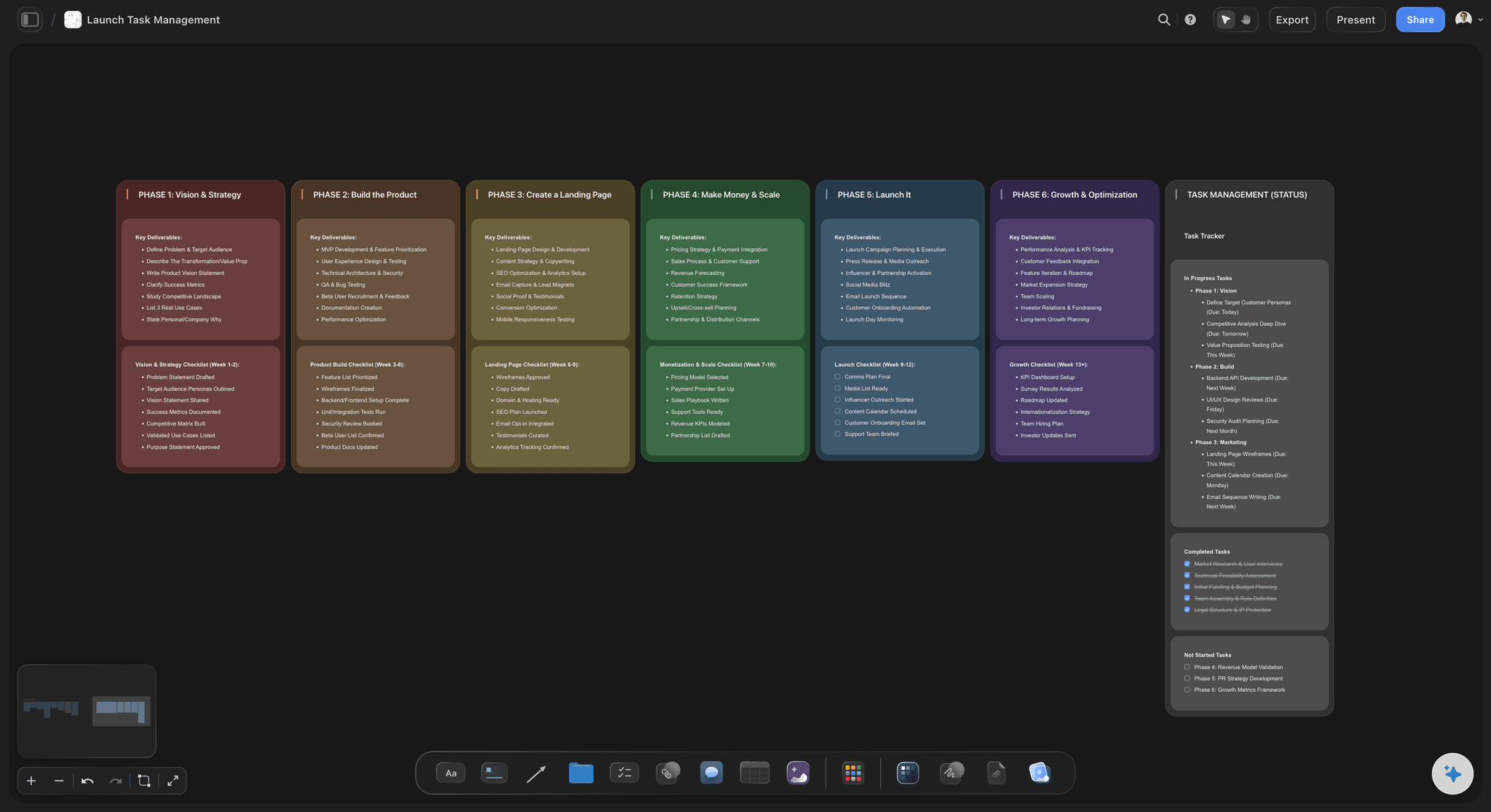
Navigability is the real scaling limit
The failure mode is a wall nobody can re-enter
Nothing is labelled, so nothing is findable: A board with four hundred unlabelled notes has no entry point. New arrivals zoom out, see a wall, zoom in at random, find something half-relevant, and quietly go and ask in chat instead. The board technically contains the answer and functionally does not.
Give the canvas a reading order: Left to right, or a clear centre with branches. An infinite canvas has no default direction, which is its strength when you are thinking alone and its weakness the moment a second person opens it cold.
Split the board before it splits you: When one board is carrying three phases of a project, make it three boards and link them. Boards are cheap. Untangling a board that six people have been adding to for two months is not.
Archive rather than delete: Move rejected directions to a clearly named area instead of removing them. The reason something was ruled out is the most frequently re-asked question on any long-running project.
Explore templates for your project
Every template opens as a real, editable board on the infinite canvas. Pick the closest fit and make it your own.
Mind Map
Branch one central idea out into themes and sub-points, then drag the connections around until the structure makes sense.
HOW WE COMPARE
Storyflow vs Miro, FigJam, and Mural.
These are all good collaborative canvases and they are built for different halves of the job. Miro and Mural are built around the facilitated live session, and they win that outright. Storyflow is built around what the board has to do for the rest of the month.
Storyflow
Recommended
Facilitated live workshops with timers and voting
Real-time multiplayer editing on every plan
AI that lays out a board and reads the whole canvas as context
Research, references, and moodboards beside the plan
Invited collaborators join free rather than costing a seat
Tied into a design file and developer handoff
Miro
Facilitated live workshops with timers and voting
Real-time multiplayer editing on every plan
AI that lays out a board and reads the whole canvas as context
Research, references, and moodboards beside the plan
Invited collaborators join free rather than costing a seat
Tied into a design file and developer handoff
FigJam
Facilitated live workshops with timers and voting
Real-time multiplayer editing on every plan
AI that lays out a board and reads the whole canvas as context
Research, references, and moodboards beside the plan
Invited collaborators join free rather than costing a seat
Tied into a design file and developer handoff
Mural
Facilitated live workshops with timers and voting
Real-time multiplayer editing on every plan
AI that lays out a board and reads the whole canvas as context
Research, references, and moodboards beside the plan
Invited collaborators join free rather than costing a seat
Tied into a design file and developer handoff
What creators are saying
Join early creators getting structured workspaces and AI that remembers their projects
“Storyflow has sped up my workflow by at least 3x, which means more flow state and more projects I can actually ship. It truly changed the way me and my team create.”

Reilin Joey
Director & YouTuber
“One prompt gets me a structured board. But the tactics are my favorite. I run my YouTube scripts through them and my intros and retention got better. It's amazing.”

Justkay
YouTuber & Freelance Filmmaker
“I used to juggle five apps to plan a project. Now I describe what I am making and get boards, lists, and a schedule. All in one place.”

George
@fernwehchronicles
Collaborative canvas questions, answered honestly.
Including the ones about live editing and seat counts, where the honest answer is more specific than most pages give you.
A collaborative canvas is a shared, zoomable visual space where more than one person places and moves things: notes, images, documents, diagrams, and plans, all on one surface with no fixed page order. It differs from a document because content has a position rather than a sequence, and it differs from a personal canvas because other people arrive, add, rearrange, and read it without you there. That social dimension is what defines it, and it is why labelling, permissions, and ownership matter as much as the drawing tools do.
Open a canvas your whole team can actually use.
Describe the project, let AI lay out the first board, invite the people who will contribute, and send everyone else a link. Plans from $9.99/month, invited collaborators join free, and a Free plan arrives before the end of 2026.