
All Collections
Getting Started
Tactics vs Whiteboards & Documents
Last updated: January 2025
The Three-Way Comparison
Regular Whiteboards are infinite canvases for freeform visual thinking. Place anything anywhere. No structure, no rules, complete creative freedom.
Regular Documents are focused writing environments. Linear text from top to bottom. Great for long-form content, reports, scripts, and articles.
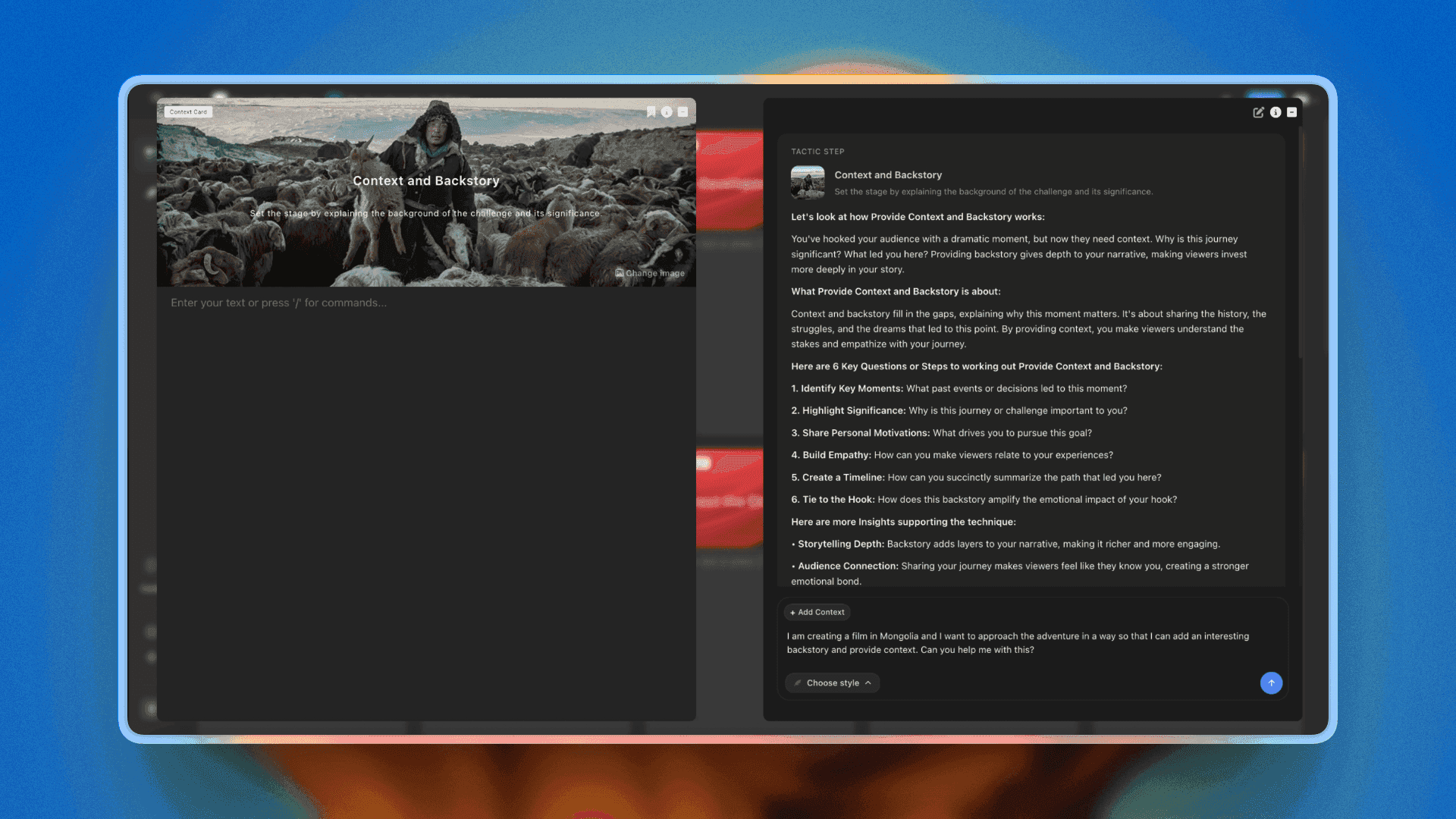
Tactics are expert-designed learning frameworks that transform how you work. They create structured Blueprints with interactive cards that teach you proven methodologies while you're actually building your project. Each step explains why it matters, how to execute it, and provides AI assistance that understands the framework's context.
The Critical Difference: Learning + Doing
This is what sets Tactics apart from both whiteboards and documents:
Whiteboards and Documents give you space to work. You bring the knowledge.
Tactics give you space AND teach you expert frameworks as you work. You finish with both a completed project and new skills.
The Traditional Problem
You read an article about the Hero's Journey. Take notes. Close the article. Open a blank document. Try to remember... wait, what comes after the inciting incident? You switch back to your notes, lose your flow, and struggle to apply theory to your actual work.
The Tactics Solution
You open the "Hero's Journey - Athlete" Tactic. It creates a Blueprint with cards for each story beat: Ordinary World, The Dream, Initial Refusal, Encounter with the Mentor, Commitment to the Dream.
Click the "Ordinary World" card—detailed explanation appears: "The Ordinary World sets the stage for the athlete's journey by introducing them in their regular, mundane life." Plus theory, analysis, instructions, and a 6-step guide.
Now write your version directly in the card. Stuck? Ask AI: "Help me establish the ordinary world for my documentary about a runner." The AI knows you're using the Hero's Journey framework and responds with methodology-specific suggestions.
You're not studying story structure separately from creating your story. You're learning structure BY creating your story.
When to Use Each
Use Regular Whiteboards When:
- Brainstorming without constraints
- Visual organization of diverse media (images, videos, links)
- Spatial thinking where physical arrangement reveals insights
- Mood boards and inspiration collections
- Mind mapping and non-linear exploration
- Research gathering before knowing the structure
- You need complete creative freedom
Use Regular Documents When:
- Long-form writing (articles, scripts, reports)
- Linear content that flows from beginning to end
- Traditional text editing with familiar features
- Single-topic focus without branching complexity
- Simple writing tasks that don't need structure
- You already know the structure and just need to write
Use Tactics When:
- You want to learn a framework while applying it
- You need proven methodologies from experts
- Your work follows structured processes (campaigns, story structures, sales frameworks)
- You want AI that understands your framework
- You need step-by-step guidance through complex work
- You're applying a repeatable process across projects
- You want educational context embedded in your workspace
AI Understanding
The way AI works is fundamentally different across each tool:
Whiteboards:
- AI sees selected elements
- Context based on what you highlight
- General-purpose assistance
Documents:
- AI reads document content
- Context from surrounding text
- Writing assistance (grammar, style, generation)
Tactics:
- AI knows the entire framework you're using
- Understands the methodology's purpose
- Provides framework-specific guidance
- Educational assistance aligned with best practices
- AI becomes a knowledgeable mentor, not just an assistant
Real Example from the "AIDA Sales Framework" Tactic: When working on the "Attention" card, ask AI: "How do I grab attention for enterprise software?" The AI responds with framework-aware guidance about the AIDA methodology—understanding that Attention is the first stage, it needs to be disruptive yet relevant, and it must naturally flow into creating Interest.
Two View Modes in Tactics
This is unique to Tactics—you get BOTH visual organization AND focused writing:
Card View
- See all cards in a grid layout
- Quick overview of your entire framework
- Visual progress tracking
- Great for planning and organization
Document View
- Single-card focus
- Distraction-free writing environment
- AI chat sidebar for each card
- Great for deep work and content creation
You can switch between views anytime. Card View for big-picture thinking, Document View for execution.
How They Work Together
The power comes from using all three. Here's an example Sales Campaign Project:
Phase 1: Research (Whiteboard)
- Paste customer testimonials
- Add competitor pricing screenshots
- Create mood board for campaign aesthetic
- Mind map pain points and objections
Phase 2: Strategy (Tactic - "AIDA Sales Framework")
- Attention: How to grab prospect attention (with examples and theory)
- Interest: Build curiosity and engagement (with psychological principles)
- Desire: Create emotional want (with persuasion frameworks)
- Action: Drive the conversion (with CTA best practices)
Phase 3: Execution (Documents)
- Write final email copy
- Create landing page content
- Draft sales presentation script
- Develop follow-up sequence
Real Tactics Examples
Here are actual Tactics available in Storyflow:
Storytelling & Content
Hero's Journey - Athlete: Guide athletes through narrative structure with cards for Ordinary World, The Dream, Initial Refusal, Encounter with the Mentor, Commitment to the Dream, First Steps, and more. Each card includes theory about story structure and practical guidance.
Sales & Marketing
AIDA Sales Framework: Master the Attention-Interest-Desire-Action framework with cards that teach persuasion psychology, conversion optimization, and customer journey design.
Personal Development
From Comfort to Growth: Framework for personal transformation with structured steps moving from your current state to growth mindset, overcoming resistance, and achieving goals.
Interactive Cards: The Core Feature
What makes Tactics different from templates in other tools:
Standard Templates (Other Tools):
- Sample text you delete and replace
- No educational content
- No guidance on what makes good content
Tactics Cards (Storyflow):
- Front Side: Your content area
- Back Side: Why this matters, how to do it well, examples
- Click to flip: Access learning exactly when you need it
- AI integration: Ask questions about this specific framework step
- Progressive learning: Each card builds your understanding
The Transformation
Before Tactics: Study frameworks separately from work, struggle to remember abstract principles, wonder if you're applying methodology correctly, reinvent structure for every project.
With Tactics: Learn frameworks through application, principles embedded exactly when needed, guided by expert-designed structure, reusable across similar projects, methodology-aware AI collaboration.
Every Tactic you complete makes you better at that skill. Use the "Hero's Journey - Athlete" three times, and story structure becomes intuitive. Use "AIDA Sales Framework" repeatedly, and persuasive copywriting becomes second nature.
You're not just completing projects faster. You're building expertise.
Was this article helpful?
Related Articles
What Are Tactics?
What Are Blueprints?
Whiteboard Basics
Document Editor Basics
AI Assistant Overview