
All Collections
AI Features
Creating Better Marketing Material with AI and Tactics
Last updated: January 2025
Marketing succeeds when messaging resonates, calls-to-action convert, and campaigns drive measurable results. Most marketers struggle not because they lack creativity, but because they work without proven frameworks and strategic guidance. Storyflow solves this by combining AI-powered assistance with battle-tested marketing Tactics that teach you how top brands create compelling ads, commercials, and content that actually sells.
Why Most Marketing Content Fails
Creating effective marketing material requires more than clever copy. You need to understand audience psychology, conversion frameworks, messaging hierarchy, and strategic structure. Most tools give you blank canvases and expect you to figure it out yourself. Storyflow embeds proven marketing frameworks directly into your workspace, then adds AI that understands these frameworks to help you apply them correctly.
Traditional approach: Open a blank document. Stare at empty space. Write some copy. Hope it converts. Iterate blindly without understanding why something works or doesn't.
Storyflow approach: Start with proven Tactics like AIDA Sales Tactics, MEDDIC Sales Tactics, or Closer Framework. Each card explains the psychology and strategy behind that step. AI provides framework-aware suggestions specific to your product, audience, and goals. You create marketing content based on what actually works.
Marketing Tactics: Proven Frameworks With Real Examples
Storyflow includes professional marketing Tactics created by industry experts. These aren't generic templates - they're educational frameworks that teach you marketing strategy while you build campaigns. Let's look at specific examples of how each Tactic helps you create better marketing material.
AIDA Sales Tactics: Complete Conversion Framework
The AIDA Tactic (Attention, Interest, Desire, Action) is one of the most proven marketing frameworks for creating persuasive content. It guides you through the complete customer journey with 13+ specialized cards, each teaching a specific technique. Here's how each stage works with real examples:
Stage 1: Attention - Capturing Your Audience
- "Identify Your Target Audience" Card: Before writing anything, this card teaches you to pinpoint exactly who you're speaking to. The AI can help: "Create a detailed target audience profile for a B2B project management tool targeting creative agency owners." AI generates demographics, pain points, goals, and media habits specific to this segment.
- "Pain Point Hook" Card: Learn to capture attention by addressing customer pain.Example: You're marketing accounting software to small business owners. Open this card, ask AI: "Generate pain point hooks for accounting software targeting small business owners who struggle with tax season." AI responds with framework-aware hooks like "Spending 20+ hours on taxes instead of growing your business?" or "69% of small businesses overpay on taxes because of disorganized records."
- "Use Personalization" Card: Makes content feel tailored to each segment.Example: "Help me personalize this email campaign for e-commerce store owners vs. service-based businesses." AI creates two versions with segment-specific language, pain points, and examples.
- "Highlight a Pain Point or Interest" Card: Focuses on what matters most to your audience. The card teaches you to identify the specific problem that keeps prospects up at night and lead with that.
Stage 2: Interest - Building Credibility
- "Provide Valuable Information" Card: Teaches you to deliver high-value content that establishes authority. Example: Marketing a productivity app. Ask AI: "What valuable insights can I provide about productivity for remote teams?" AI generates statistics, research findings, and actionable tips that position you as an expert.
- "Present Facts and Data" Card: Guides you in using concrete evidence to build trust.Example: "Generate data-backed statements for marketing automation software that improves email open rates." AI creates statements like "Companies using automation see 53% higher conversion rates" with suggested sources.
- "Start the Story" Card: Helps you create compelling narratives. Example:"Create a customer story opening for how a small bakery grew from local shop to nationwide shipping using our e-commerce platform." AI crafts engaging story beginnings that hook readers emotionally.
- "Focus on Benefits" Card: Teaches the crucial shift from features to customer value. The card explains why "Save 15 hours per week" converts better than "Automated reporting feature."
Stage 3: Desire - Creating Emotional Connection
- "Showcase Benefits and Unique Features" Card: Helps you highlight differentiation.Example: Marketing project management software. Ask: "What unique benefits should I emphasize that competitors don't offer?" AI analyzes your positioning and suggests desire-building angles like "The only platform built specifically for creative workflows" or "Unlimited visual boards while competitors charge per board."
- "Use Testimonials and Case Studies" Card: Teaches you to leverage social proof.Example: "Help me structure a case study showing how a marketing agency increased client retention by 40% using our tool." AI creates a narrative framework with problem, solution, and measurable results.
- "Address Objections" Card: Proactively handles concerns. Example:"What are common objections to switching from Excel to dedicated inventory management software?" AI lists objections like "Learning curve," "Migration effort," "Cost," and provides response frameworks for each.
- "Create a Sense of Urgency" Card: Drives immediate action through scarcity and timing. The card explains psychological principles of FOMO (fear of missing out) and provides ethical urgency techniques.
Stage 4: Action - Converting Interest to Sales
- "Clear Call-to-Action (CTA)" Card: Teaches you to create compelling CTAs.Example: Ask AI: "Generate 10 CTA variations for a free trial signup, ranging from direct to curiosity-based." AI provides options like "Start Your Free Trial," "See How Much Time You'll Save," "Join 50,000+ Teams," each optimized for different psychological triggers.
- "Offer Incentives" Card: Guides you in creating compelling offers. Example:"What incentives work best for B2B SaaS products?" AI suggests extended trials, free setup assistance, discounts for annual commitments, and explains when each is most effective.
- "Simplify the Process" Card: Reduces friction in conversion. The card teaches you to remove barriers: fewer form fields, clear next steps, transparent pricing.
- "Plan Follow-Up Strategy" Card: Ensures continued engagement. Example:"Design a 7-day email sequence for trial users who haven't activated key features." AI creates a nurture sequence with specific educational content and gentle nudges.
MEDDIC Sales Tactics: For B2B and Enterprise Marketing
MEDDIC (Metrics, Economic Buyer, Decision Criteria, Decision Process, Identify Pain, Champion) is a powerful framework for complex B2B sales. Each card teaches you to qualify and convert high-value clients:
- "Identify Key Performance Indicators" (Metrics Card): Teaches you to speak in ROI terms.Example: Marketing enterprise software. Ask AI: "What KPIs do CFOs care about when evaluating project management tools?" AI responds with metrics like "Reduction in project delays," "Cost per delivered project," "Team utilization rates," and shows you how to quantify your solution's impact on each.
- "Understand Their Motivations" Card: Learn what drives decision-makers.Example: "Help me understand the different motivations of a CTO vs. CFO vs. VP of Operations when buying cybersecurity software." AI explains that CTOs focus on technical capabilities, CFOs on cost-benefit analysis, and VPs on operational impact. It then helps you craft messaging for each stakeholder.
- "Tailor the Pitch" (Customizing Value Proposition): Create personalized presentations.Example: "Adapt our standard pitch deck for a healthcare company vs. a financial services company." AI adjusts language, compliance references, use cases, and pain points for each industry.
- "Quantify the Pain" (Impact Card): Measure the cost of problems. Example:"Help me calculate the annual cost of manual data entry for a company with 50 employees spending 3 hours per week on it." AI creates a financial impact calculator showing $156,000/year in lost productivity, making the $15,000 software investment an obvious choice.
- "Create Urgency" Card: Emphasize consequences of inaction. Example:"What are the risks of delaying implementation of our compliance software until next quarter?" AI outlines potential regulatory fines, audit failures, and competitive disadvantages of waiting.
Closer Framework: For High-Touch Sales and Services
The Closer Framework helps you guide prospects through consultative sales processes. Perfect for agencies, consultants, and service-based businesses:
- "Clarify - Understanding the Why" Card: Uncovers the real problem. **Example:**Marketing a marketing agency. Ask AI: "What discovery questions should I ask potential clients to understand their real marketing challenges?" AI generates questions like "What's the cost of a missed sales opportunity?" and "What have you tried before?" that reveal deeper issues beyond surface requests.
- "Giving the Problem a Name" Card: Labels issues clearly. **Example:**A client says "We need more website traffic." This card teaches you to diagnose the actual problem: "What you're experiencing is Unqualified Traffic Syndrome - getting visitors who don't convert. Let's focus on attracting your ideal customer profile instead of raw numbers."
- "The Value of Retrospective" Card: Learns from past efforts. Example:"Help me create questions that uncover why previous marketing campaigns failed." AI suggests: "What didn't work about your last campaign?" "What would you do differently?" This prevents repeating mistakes and shows respect for their journey.
- "The Power of Vision" Card: Sells the destination, not the journey. **Example:**Instead of "We'll implement SEO, content marketing, and social campaigns," this card teaches you to say: "Imagine your calendar filled with qualified leads calling you instead of you chasing prospects. What would that mean for your business?" AI helps craft compelling vision statements.
- "Transparency and Trust" (Addressing Concerns): Handles objections proactively.Example: "What concerns should I address before proposing a 6-month consulting engagement?" AI lists: timeline expectations, what happens if results don't meet targets, communication frequency, and provides transparent response frameworks.
- "The Art of Reassurance" Card: Reduces buyer's remorse. **Example:**After a client signs, ask AI: "Create a post-sale welcome sequence that reassures clients they made the right choice and sets expectations." AI drafts onboarding communications that reinforce the decision and build excitement.
How AI Assists Your Marketing Content
Storyflow AI doesn't just generate generic marketing copy. It understands which framework you're using and provides context-aware assistance specific to your strategy.
Framework-Aware Assistance
When you're working with the AIDA framework and click on the "Pain Point Hook" card, AI knows you need an attention-grabbing hook that addresses customer pain. It doesn't give you generic copy - it asks about your product, target audience, and specific pain points, then generates hooks tailored to your context.
Example: Creating Ad Copy for a Project Management Tool
You open the AIDA Sales Tactic and start with the "Pain Point Hook" card. Click the AI button and type: "Help me create a pain point hook for project management software targeting creative agencies struggling with client collaboration and deadline chaos."
AI responds with framework-aware suggestions:
- "Drowning in client revisions and missed deadlines? Creative agencies waste 15+ hours per week on miscommunication."
- "Your best creatives are spending more time managing clients than creating. Here's why that's killing your agency's growth."
- "Lost files. Endless email threads. Frustrated clients. Sound familiar? 87% of creative agencies say project chaos is their #1 problem."
Move to the "Focus on Benefits" card. AI shifts its assistance to highlighting advantages and value propositions specific to your audience and the Interest stage of AIDA.
Complete Campaign Generation
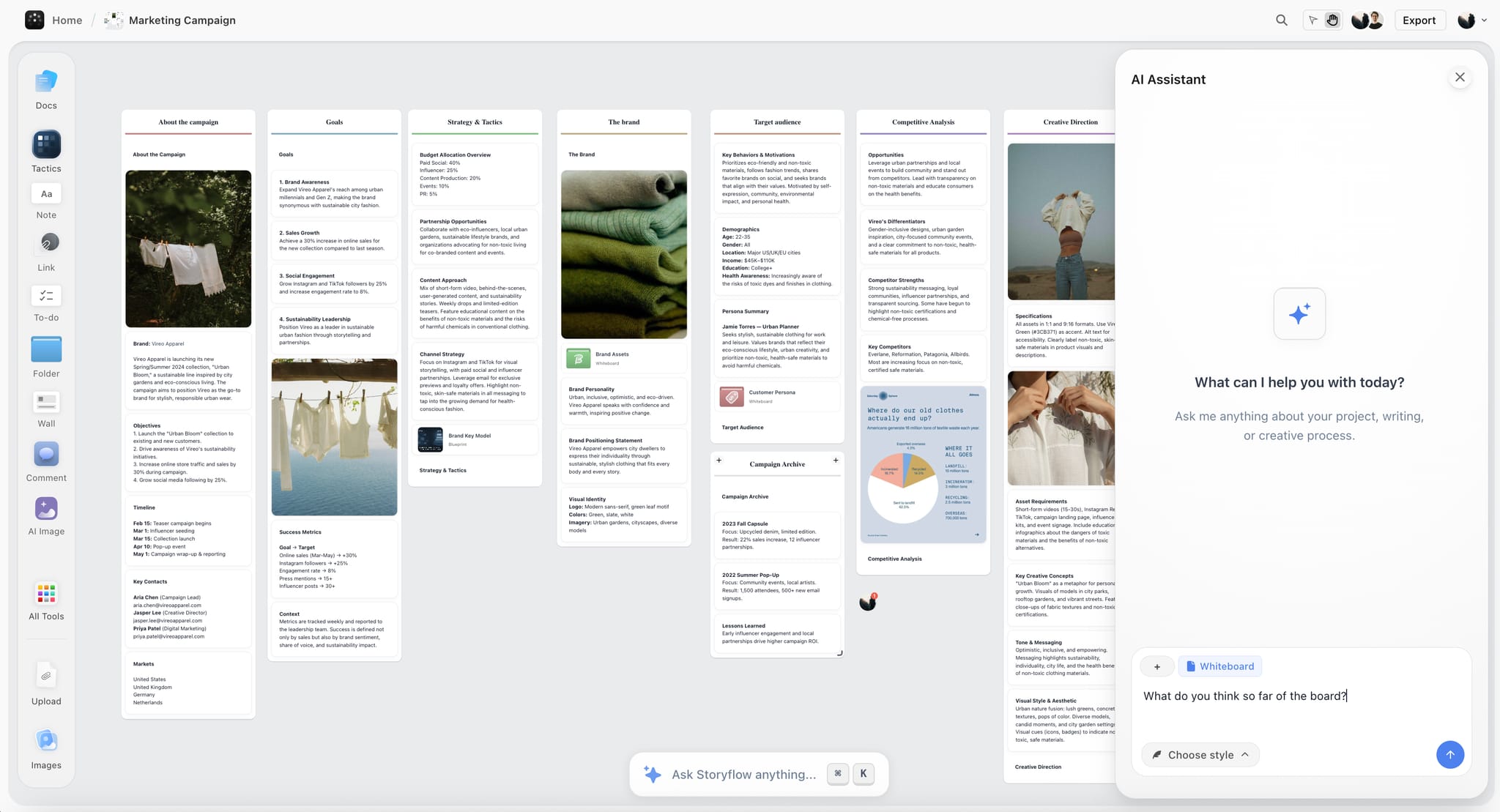
AI can generate entire campaign structures from a single prompt. Instead of manually creating cards and organizing strategy, describe your campaign goal and AI builds a complete workspace:
Prompt: "Create a 3-month brand awareness campaign for our sustainable fashion startup. Target audience is eco-conscious millennials aged 25-35. Focus on Instagram, TikTok, partnerships with eco-influencers, and community events."
AI generates:
- Campaign objectives and KPIs section
- Detailed audience persona cards (demographics, values, pain points, media habits)
- Messaging hierarchy (primary brand message, supporting themes, proof points)
- Channel-specific strategy cards (Instagram strategy, TikTok content pillars, influencer outreach plan)
- Content calendar organized by month with specific post ideas and themes
- Community event planning framework
- Measurement and analytics tracking cards
The AI doesn't just create cards - it organizes them logically, suggests proven frameworks, and provides actionable content based on your specific industry and audience.
Iterative Refinement
Marketing rarely works perfectly on the first attempt. AI helps you iterate and refine:
- Test variations: "Generate 10 different headline variations for this ad copy, focusing on different emotional triggers"
- Adjust for audience segments: "Adapt this messaging for B2B decision-makers instead of individual consumers"
- Optimize for channels: "Convert this long-form blog post into 5 social media posts optimized for LinkedIn"
- Improve conversions: "Analyze this landing page copy and suggest improvements to increase conversion rate"
Real Marketing Workflows With Step-by-Step Examples
Here's exactly how marketers use Storyflow to create campaigns that convert, with specific prompts and expected outputs:
Example 1: Creating Facebook Ad Campaign for SaaS Product
Scenario: Marketing a time-tracking software to freelancers and small agencies.
- Open AIDA Sales Tactic and start with "Identify Your Target Audience" card
- Ask AI: "Create detailed audience profiles for freelance designers vs. small marketing agencies who need time tracking software" AI generates: Two distinct personas with demographics (age, income, location), pain points ("Losing billable hours to poor tracking" vs. "Can't accurately bill clients"), goals, and preferred platforms.
- Move to "Pain Point Hook" card, ask AI: "Generate 15 attention-grabbing hooks for Facebook ads targeting freelance designers who lose money from untracked time" AI responds with: "Still working for free? 73% of freelancers lose $8,000+ per year from untracked hours" | "You wouldn't work for free. So why is 20% of your time unbilled?" | "Track time in 5 seconds or lose thousands. Your choice."
- "Provide Valuable Information" card: "What statistics and insights about time tracking will build credibility with this audience?" AI provides: Research about freelancer income loss, productivity statistics, client billing best practices - all formatted for ad copy.
- "Focus on Benefits" card: "Rewrite these features as benefits: automatic time tracking, project budgets, client invoicing" AI transforms: "Automatic time tracking" becomes "Never miss a billable minute again" | "Project budgets" becomes "Know exactly when you're about to go over budget, not after" | "Client invoicing" becomes "Send professional invoices in 30 seconds"
- "Use Testimonials" card: "Structure a testimonial that shows ROI from a freelancer who recovered $12,000 in lost billable hours" AI creates: Story framework with before state, transformation moment, specific results, and emotional impact.
- "Create a Sense of Urgency" card: "Ethical urgency techniques for a free trial offer" AI suggests: "Join 50,000+ freelancers" (social proof urgency) | "See how much you're losing in real-time" (curiosity urgency) | "Free for 14 days - no credit card required" (risk-free urgency)
- "Clear Call-to-Action" card: "Generate 10 CTA button variations" AI provides: "Start Tracking Free" | "See My Lost Revenue" | "Stop Working for Free" | "Calculate My Losses" - each optimized for different psychological triggers
- Result: Complete Facebook ad campaign with 5 different ad variations, each targeting specific pain points and benefits, ready for A/B testing. All organized visually so your team can collaborate.
Example 2: B2B Enterprise Sales Email Sequence
Scenario: Selling enterprise cybersecurity software to Fortune 500 companies using MEDDIC Sales Tactics.
- Open MEDDIC Sales Tactic and start with "Identify Key Performance Indicators" card
- Ask AI: "What KPIs do CISOs and CFOs care about when evaluating cybersecurity investments?" AI lists: Cost per security incident, Average time to detect threats, Compliance audit pass rates, Insurance premium reductions, Employee productivity impact. It then shows how to quantify your solution's impact on each.
- "Quantify the Pain" card - Ask AI: "Calculate the annual cost of security breaches for a company with 5,000 employees and $500M revenue" AI generates: "Average breach cost: $4.45M (IBM Security Study) | Regulatory fines: $500K-$5M | Reputation damage: 23% stock price decline | Recovery time: 280 days | Your solution investment: $180K/year | ROI: 2,372% if preventing just one breach"
- "Tailor the Pitch" card - Ask AI: "Create three different email sequences for CISO (technical buyer), CFO (economic buyer), and VP of Operations (influencer)" AI creates separate sequences: CISO version emphasizes threat detection capabilities and integration; CFO version focuses on ROI and risk mitigation; VP version highlights operational efficiency and team impact.
- Email 1 (all sequences): "Create opening email that references their recent security news or industry challenge" AI generates personalized openers: "I noticed [Company] recently expanded to EMEA markets, which means navigating GDPR compliance at scale..."
- Email 2-3: "Provide valuable information - industry benchmarks and emerging threats specific to their sector"
- Email 4: "Share relevant case study - similar company, similar challenges, specific results"
- Email 5: "Create urgency around upcoming compliance deadlines or budget cycles"
- "Plan Follow-Up Strategy" card: "Design engagement-based branching - different follow-ups for opens vs. clicks vs. replies" AI creates: Decision tree with specific next steps based on each engagement level.
- Result: Sophisticated multi-stakeholder email campaign with personalized messaging, ROI calculations, and automated follow-up logic. Everything organized visually to track multiple decision-makers across long sales cycles.
Example 3: Service-Based Business Consultation Sales
Scenario: Marketing agency using Closer Framework to convert discovery calls into $50K+ retainer clients.
- Open Closer Framework before your discovery call
- "Clarify - Understanding the Why" card - Ask AI: "Generate 20 discovery questions that uncover the real reason a company is looking for a marketing agency, not just surface-level needs" AI provides deep questions: "What happens to your business if your marketing stays the same for the next 12 months?" | "What's the real cost of a missed sales opportunity?" | "What have you tried before and why didn't it work?" | "If we could solve one thing that would transform your business, what would it be?"
- During call, use "Giving the Problem a Name" card: Client says "We need more leads." You diagnose: "What you're experiencing is Lead Quality Mismatch Syndrome. You're attracting tire-kickers, not decision-makers. Let's fix your positioning and targeting, not just increase volume."
- "The Value of Retrospective" card: "What questions help me understand why their previous agency relationship failed?" AI suggests: "What did your last agency do well?" | "Where did communication break down?" | "What would you do differently?" This prevents repeating past mistakes and shows respect.
- "The Power of Vision" card - Ask AI: "Help me create a compelling vision statement for a B2B company that wants to reduce sales cycle length" AI crafts: "Imagine your sales team spending 60% less time chasing unqualified leads because your marketing pre-educates and pre-qualifies prospects. Picture closing deals in 45 days instead of 6 months because buyers already trust you before the first call. What would that mean for your revenue? Your team's morale? Your competitive position?"
- After call, "Transparency and Trust" card: "What concerns should I address proactively in my proposal?" AI lists: Timeline expectations, What if results don't meet targets, How we handle course corrections, Communication frequency, Team access. AI then provides transparent responses for each.
- Create proposal using AIDA: Attention (their specific pain), Interest (your methodology and case studies), Desire (vision of success), Action (clear next steps and investment)
- After winning client, "The Art of Reassurance" card: "Design a post-sale onboarding sequence that reduces buyer's remorse" AI creates: Welcome video script, Week 1-4 check-in emails, Quick wins roadmap, Success milestone celebrations - all designed to reinforce they made the right choice.
- Result: Complete consultative sales process from discovery through onboarding, with all questions, objection responses, and follow-ups organized in one visual workspace. No more scattered notes or forgotten details.
Why Marketers Choose Storyflow Over Generic AI Tools
Most AI tools just generate marketing copy based on prompts. Storyflow teaches you marketing strategy while helping you execute, and the results speak for themselves:
1. Educational Frameworks That Make You Better
Generic AI: "Write ad copy for project management software." You get generic copy with no explanation of why it works or doesn't.
Storyflow: Open AIDA Sales Tactics. Each card explains the psychology: why pain point hooks capture attention (addresses immediate concern), why benefit-focused copy converts better than features (speaks to outcomes), why urgency drives action (leverages FOMO). You learn marketing principles by applying them.
Result: After using AIDA 5-10 times, you internalize the framework. You start naturally thinking "What's the pain point? What's the benefit? Where's the urgency?" Your marketing intuition improves dramatically.
2. Context-Aware AI That Understands Your Strategy
Generic AI: Every prompt starts from scratch. AI has no memory of your brand, audience, or previous messaging. You get inconsistent results that require heavy editing.
Storyflow: AI sees your entire workspace. It knows you're targeting "creative agency owners with 10-50 employees" (from your persona cards), your brand voice is "confident but not arrogant" (from positioning), your key differentiator is "unlimited visual boards" (from value prop), and you've been emphasizing "stop paying per board" in previous messaging.
Example: You ask for new ad hooks. Generic AI gives random variations. Storyflow AI references your positioning: "While competitors charge per board, you get unlimited visual workspaces to organize every client project." The suggestion is strategically aligned, not randomly generated.
3. Visual Organization That Prevents Campaign Chaos
Traditional approach: Campaign brief in Google Doc. Ad copy in separate doc. Email sequences in another. Creative assets in Figma. Timeline in Trello. Nobody knows what the latest version is. Inconsistencies everywhere.
Storyflow approach: Entire campaign in one visual workspace. Strategy cards connect to messaging cards. Messaging connects to channel-specific execution. Timeline shows dependencies. Everyone sees how pieces connect and can find anything instantly. Version history prevents confusion.
Real scenario: Designer asks "What's the main benefit for this ad?" Instead of digging through docs, they click the "Focus on Benefits" card in your AIDA workspace and see exactly what you decided. Collaboration becomes seamless.
4. Proven Frameworks vs. Starting from Blank Canvas
You don't need to wonder "Is this structure right?" The frameworks are proven by industry experts. AIDA has driven conversions for decades. MEDDIC is used by top B2B sales teams worldwide. Closer Framework is taught in high-ticket sales training. You're not guessing - you're applying what works.
Common Marketing Use Cases With Quick Examples
- Product launches: Use AIDA + MEDDIC for complete go-to-market planning.Quick win: "Create pre-launch teaser campaign for new product feature" generates mystery messaging, waitlist strategy, and launch day activation plan.
- Ad campaign creation: AIDA Tactic for any platform. Quick win:"Generate 20 LinkedIn ad variations for recruiting software targeting HR directors" creates pain point hooks, benefit statements, and urgency-based CTAs optimized for B2B LinkedIn ads.
- Email nurture sequences: Combine AIDA with "Plan Follow-Up Strategy" card.Quick win: "Design 5-email welcome sequence for SaaS trial users" creates educational content that gradually moves from value delivery to conversion.
- Sales consultation scripts: Closer Framework for high-value sales. Quick win:"Create discovery call script for consulting services" generates questions, objection handlers, and closing techniques.
- Landing page optimization: AIDA structure for conversion flow. Quick win:"Analyze this landing page and suggest improvements" identifies weak hooks, unclear value propositions, friction points, and CTA problems.
- Webinar promotion: AIDA for registration, MEDDIC for follow-up. Quick win:"Create complete webinar campaign from registration email to post-webinar nurture" generates all touchpoints with strategic messaging.
- Case study creation: "Use Testimonials and Case Studies" card. Quick win:"Structure case study showing 300% ROI" creates problem-solution-results framework with compelling narrative.
- Objection handling database: "Address Objections" card. Quick win:"List all objections to our $10K/month service and provide responses" creates comprehensive objection-response library for sales team.
- Competitive positioning: MEDDIC "Tailor the Pitch" + Closer "Vision" cards.Quick win: "How do we position against [competitor] who's cheaper but less feature-rich?" generates differentiation messaging focused on value, not price.
- Retargeting campaigns: AIDA with emphasis on "Address Objections" and "Create Urgency."Quick win: "Create retargeting ad sequence for cart abandoners" generates reminder messaging, objection handling, and incentive offers.
Before and After: What Marketers Actually Experience
Here's what changes when marketers switch from generic tools to Storyflow's framework-based approach:
Creating Ad Copy
Before Storyflow: Spend 2 hours staring at blank doc. Write some headlines. Google "good ad examples." Copy competitor angles. Hope something sticks. No framework for knowing if your copy is strategic.
After Storyflow: Open AIDA Sales Tactics (5 minutes to review framework). AI generates 15 pain point hooks in 30 seconds. Pick top 3. Move through Interest, Desire, Action cards with AI assistance. Create 5 complete ad variations in 45 minutes. Each follows proven conversion structure. You understand WHY each element works.
Time saved: 60%+ | Quality improvement: Structured conversion framework instead of guessing | Learning: You internalize AIDA principles after using it a few times
Planning Enterprise Sales Approach
Before Storyflow: Wing it on discovery calls. Ask random questions. Miss key decision-makers. Forget to quantify ROI. Send generic proposals. Wonder why deals stall.
After Storyflow: Use MEDDIC Sales Tactics to prepare. "Identify Key Performance Indicators" card gives you the metrics that matter. "Quantify the Pain" helps calculate specific costs. "Tailor the Pitch" creates personalized messaging for each stakeholder. Entire discovery process organized systematically.
Result: Higher close rates because you're addressing what actually matters to decision-makers. Shorter sales cycles because you're talking ROI in their language. Bigger deals because you've proven the value.
Managing Multi-Channel Campaigns
Before Storyflow: Campaign brief in one doc. Email copy in another. Social posts in spreadsheet. Ad variations scattered. Designer asks "What's our positioning?" You search through 8 documents to find the answer. Team constantly out of sync.
After Storyflow: Entire campaign in one visual workspace. Strategy cards at the top. Messaging hierarchy clearly defined. Channel-specific execution organized below. Designer clicks positioning card and sees exactly what you decided. Everyone has context. Collaboration is seamless.
Team impact: Eliminate "Where's that doc?" questions. Everyone works from the same source of truth. Changes propagate visibly. Campaign quality improves because context is never lost.
What AI Doesn't Replace (And Why That's Good)
Storyflow AI accelerates execution and teaches frameworks, but you remain the strategist:
- Brand voice and positioning: You define what makes your brand unique. AI helps articulate it consistently across all materials.
- Audience understanding: You know your customers better than any AI. Tactics help you structure that knowledge, AI helps you apply it.
- Strategic decisions: You decide which pain points to emphasize, which benefits to lead with, which audiences to target. AI provides options and accelerates execution.
- Creative judgment: AI generates variations. You choose what fits your vision, brand, and goals. The combination of your judgment plus AI speed is unbeatable.
Think of Storyflow as your marketing co-pilot: it teaches you frameworks (like a mentor), generates options (like a copywriter), organizes your work (like a project manager), but you fly the plane. You make the strategic calls. AI just helps you execute them faster and better.
Getting Started: Your First Marketing Win in 30 Minutes
Here's the fastest path to seeing value. Pick the scenario that matches your immediate need:
Scenario A: Need Ad Copy Fast
- Create new project or open existing workspace
- Click "Tactics" in toolbar → Select "AIDA Sales Tactics"
- Open "Identify Your Target Audience" card → Ask AI: "Create audience profile for [your product] targeting [your market]"
- Move to "Pain Point Hook" card → Ask: "Generate 15 attention-grabbing hooks for [your audience]"
- Skip to "Focus on Benefits" card → Ask: "Convert these features into benefits: [list your features]"
- Jump to "Clear Call-to-Action" card → Ask: "Generate 10 CTA variations optimized for [your goal]"
- Combine your favorite hook + benefit + CTA = ad ready to test
Time investment: 20-30 minutes | Output: Multiple ad variations following proven conversion structure | Bonus: You learned AIDA framework
Scenario B: Planning Enterprise Sale
- Open "MEDDIC Sales Tactics"
- "Identify Key Performance Indicators" → Ask: "What KPIs do [target role] care about for [your solution]?"
- "Quantify the Pain" → Ask: "Calculate the annual cost of [their problem] for [company size]"
- "Tailor the Pitch" → Ask: "Create separate messaging for CTO, CFO, and VP Operations"
- Use AI outputs to build discovery questions, ROI calculator, and stakeholder-specific presentations
Time investment: 45 minutes | Output: Complete sales approach with quantified value prop | Result: Dramatically higher close rates
Scenario C: Winning Consulting Client
- Open "Closer Framework" before your next discovery call
- "Clarify - Understanding the Why" → Ask: "Generate discovery questions for [your service] targeting [client type]"
- "The Power of Vision" → Ask: "Create compelling vision statement for [desired outcome]"
- "Transparency and Trust" → Ask: "What objections should I address proactively in my proposal?"
- Use these in your call and proposal to close higher-value projects
Time investment: 30 minutes prep | Output: Professional discovery process and objection handlers | Result: Higher close rates and bigger deals
The Bottom Line
Most marketers see immediate improvements in messaging clarity and campaign structure. After working through Tactics 3-5 times, you internalize the frameworks and naturally think in terms of proven marketing strategies: "What's the pain point? What's the benefit? What's the urgency? What's the CTA?"
The difference between marketing that drives results and marketing that wastes budget is rarely creativity. It's strategic structure. AIDA teaches you conversion psychology. MEDDIC teaches you enterprise sales. Closer teaches you consultative selling. These aren't just templates - they're frameworks that make you a better marketer every time you use them.
Storyflow gives you both the proven frameworks and the AI assistance to apply them faster. Stop starting from blank canvases. Start with what actually works. Your marketing material will sell more effectively because it's built on psychology and strategy, not guesswork.
Was this article helpful?
Related Articles
AI Assistance for Writing Content
How Storyflow AI Works
What Are Tactics?
Generating Workspace Structures with AI