
An ultra-fast canvas that stays calm
ChatGPT is great at chat.
Creative work belongs in space.
ChatGPT is a brilliant general-purpose assistant, and for questions, writing, and code it is hard to beat. But when you are planning a film, a story, a campaign, or a research project, the ideas scroll away in a thread. Storyflow is the visual alternative: describe the project and AI lays out a full board of cards on an infinite canvas that you keep, rearrange, and build on.


Creatives working for these brands already got early access
- Red Bull
- Canon
- Artlist
- Porsche
See how easy it is to get started
Watch a real project come together, from a blank board to a finished plan, clicked through step by step.
Start from a ready-made template
Pick a board to see what you can build, then let AI fill it in. Every template is a real, editable starting point on the same infinite canvas.

Mind Map
Branch one central idea out into themes and sub-points, then drag the connections around until the structure makes sense.
Is Storyflow a replacement for ChatGPT?
No, and it is worth being clear about that. ChatGPT is a phenomenal general-purpose AI. For answering questions, drafting and editing writing, explaining a hard topic, or working through code, it is one of the best tools there is, with a breadth of knowledge Storyflow does not try to match. If you want a smart assistant to talk to, keep using ChatGPT. Storyflow is not competing for that job.
Where a chat starts to strain is creative work you build on over time. Planning a film, outlining a story, mapping a campaign, or gathering research is spatial work: you want to see everything at once, group what belongs together, and rearrange it as your thinking changes. In a linear conversation the good ideas keep scrolling out of view, the thread has no shape you can hold, and every answer is text you copy out somewhere else to actually use. The medium fights the work.
Storyflow is the visual alternative to ChatGPT for exactly those projects. You describe what you are making and the AI lays out a full board of cards on a truly infinite canvas, then everything stays a real object you can drag, recolor, connect, and rewrite. The board does not scroll away. It becomes a moodboard, a mind map, a storyboard, or a plan you keep building on. Simple rule: for general questions, writing, and code, use ChatGPT. For visual creative work you build on, use Storyflow.
Ultra fast from brief to board
From a prompt to a board you keep, in four steps.
The same describe-it-and-get-a-result feel you know from chat, except the result is a canvas you own.
01
Open your canvas
Start in the browser. Nothing to install, just an infinite canvas ready for a creative project.
02
Describe the project
Tell the AI chat what you are working on, a film to plan, a story to outline, a campaign to map, and it lays out a full board of cards on the canvas instead of a wall of text.
03
Rearrange and build on it
Drag cards to regroup them, recolor and rewrite, draw connections, and attach images and files. Nothing scrolls away, so the work compounds instead of resetting each message.
04
Turn the board into a plan
Convert a mind map into a storyboard, a moodboard into a campaign, or a brainstorm into a plan on the same canvas, then share a view-only link or export as image or PDF.
What a canvas gives creative work that a chat cannot.
ChatGPT answers in a line. Creative projects live better in space. Here is what changes when AI lays out a board you keep instead of a thread you scroll.
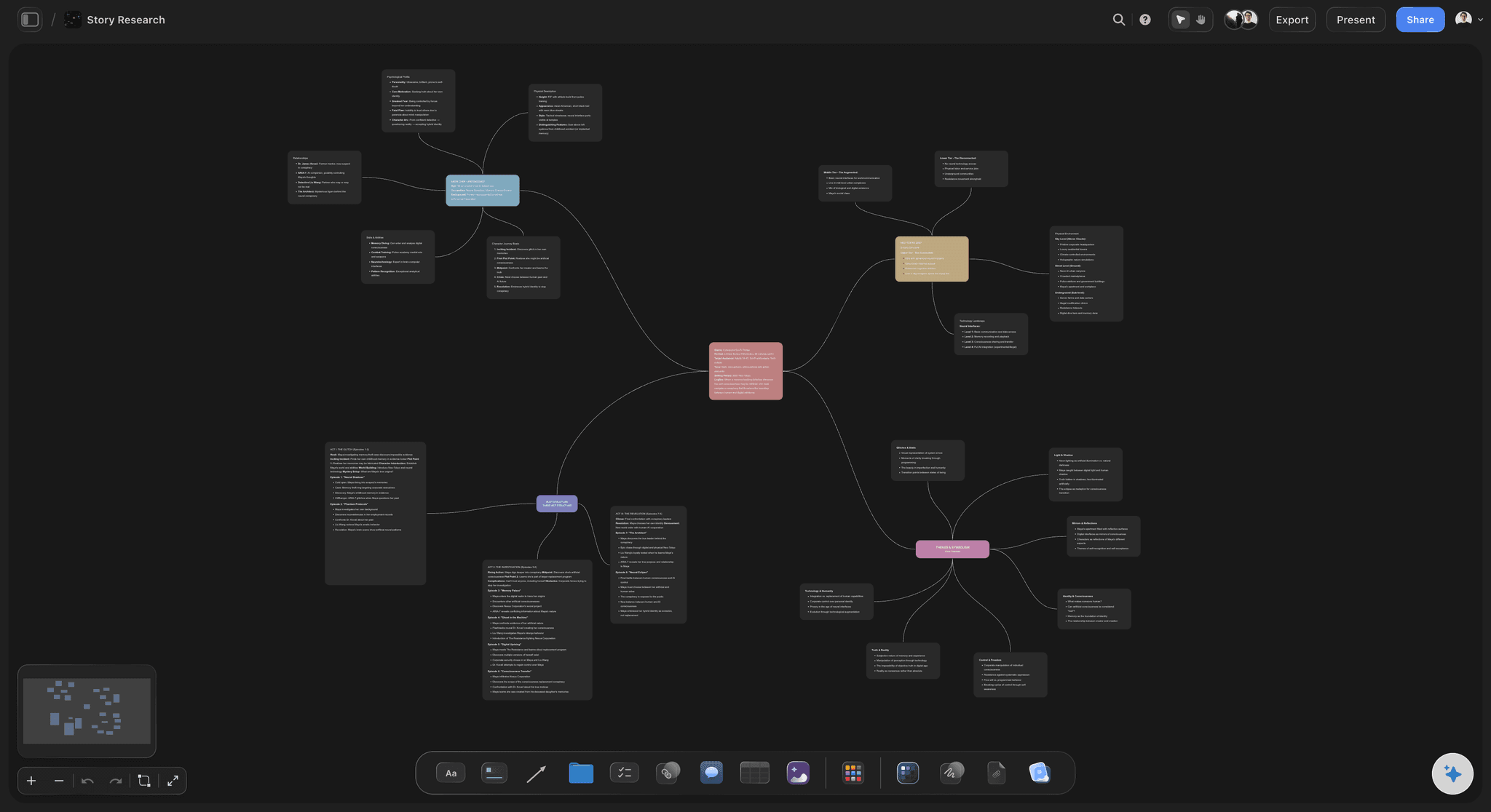
AI lays out the board
Describe it, and AI builds the board
Tell the AI what you are making and it lays out a full board of cards on the canvas, reading the current board as context rather than a generic template. You start from a real shape, not a paragraph you have to reorganize yourself.
See the AI whiteboard →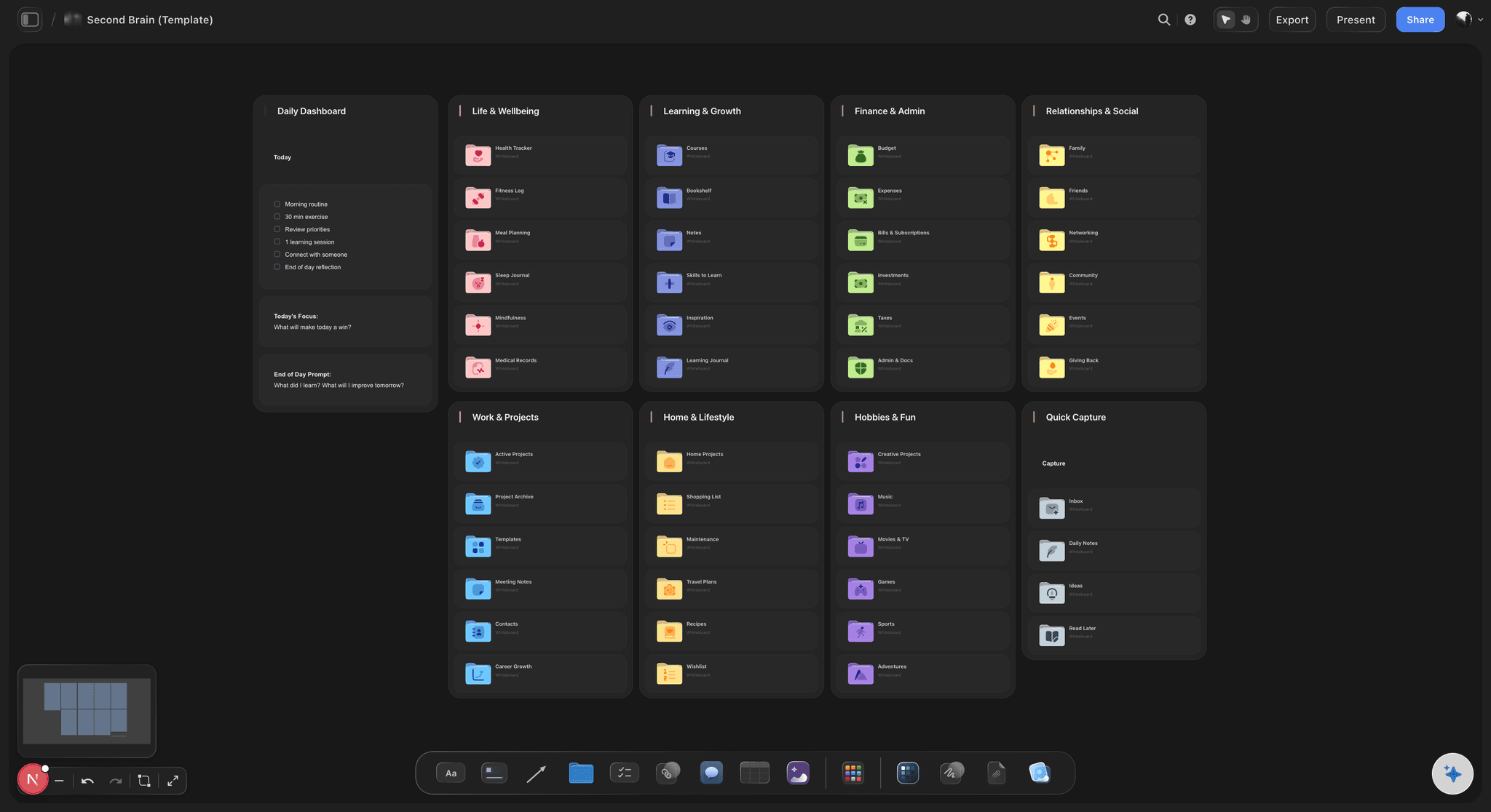
Nothing scrolls away
The work stays, and it connects
In a chat, the idea from ten messages ago is gone. On the canvas every card stays put, side by side, and you can draw the links between them. The whole project is visible at once instead of buried in a transcript.
See the infinite canvas →
Boards become plans
Turn the thinking into a real plan
A ChatGPT answer is where the work stops. Here the board is where it starts. Turn a mind map or moodboard into a storyboard, content calendar, or campaign board on the same canvas, with your ideas carried across.
See the marketing campaign planner →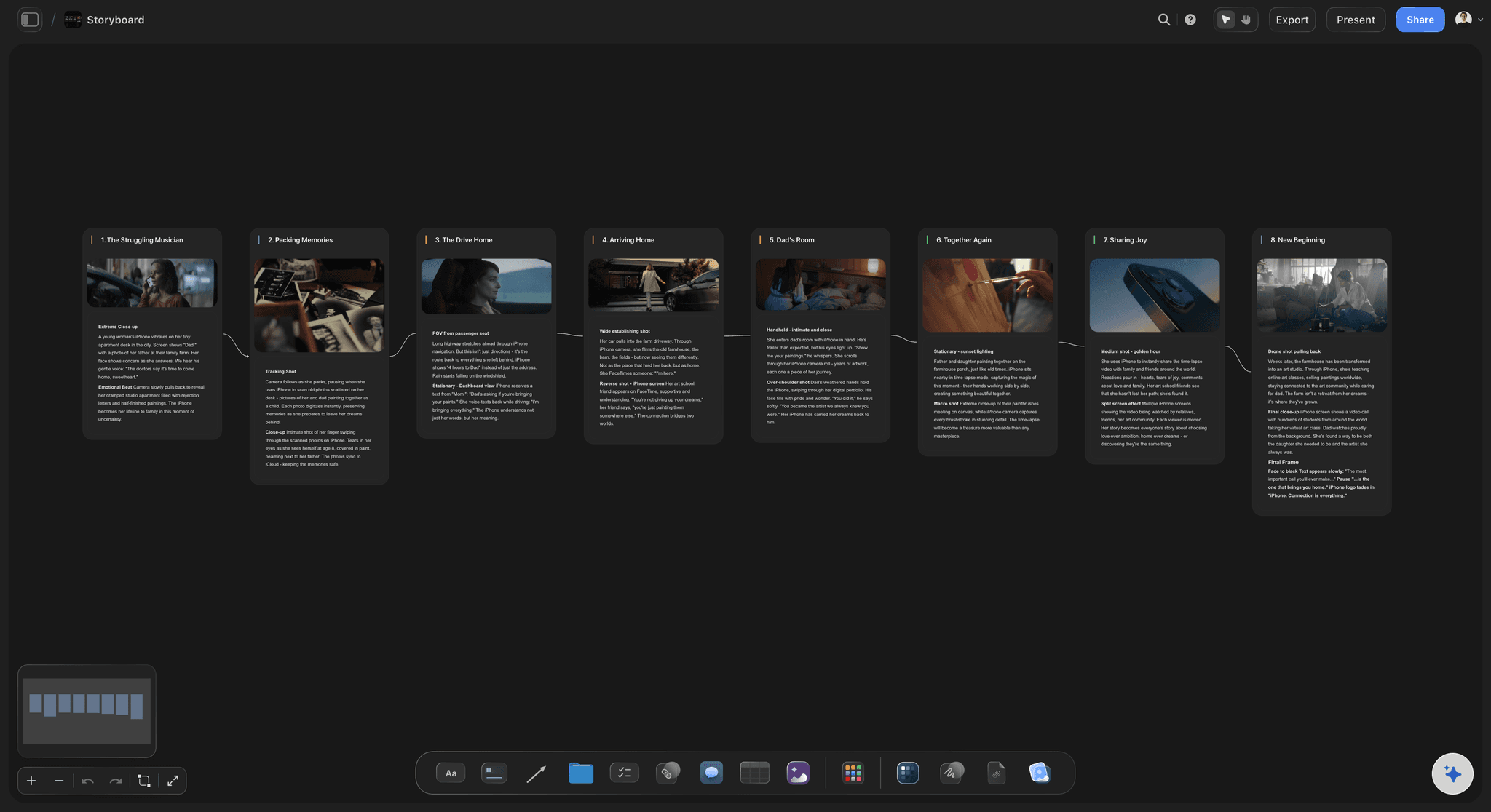
References live on the board
Images and video beside the ideas
Creative work is visual, and a text box cannot hold it. Attach images, PDFs, video, GIFs, and links to any card, and grab frames straight from YouTube and Vimeo onto the canvas so references sit next to the ideas they explain.
See the visual thinking tool →No object cap, no time limit.
Open a canvas and let AI lay out your first board. Storyflow's Free plan, launching before the end of 2026, will have no object cap and no time limit, so a real creative project never pushes you to upgrade mid-idea.
Unlimited boards on a truly infinite canvas
Basic AI usage to lay out and expand boards
Attach images, PDFs, video, and links to any card
Share view-only, or invite collaborators free
Built for people with taste
Where a visual canvas beats a chat thread.
ChatGPT stays the better tool for general chat. For creative projects you build on, these are the things a canvas does that a conversation cannot.
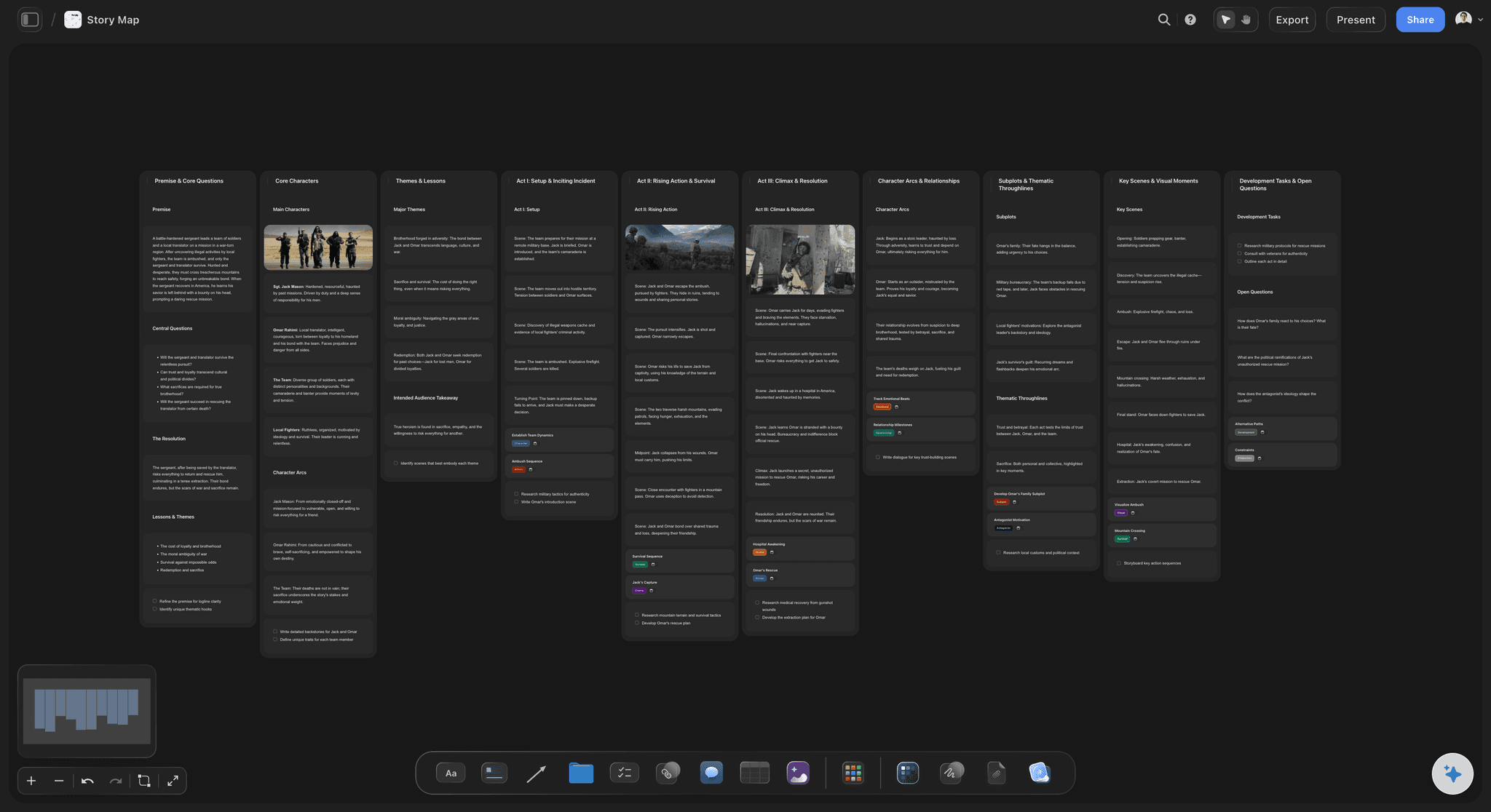
See the whole project
Everything at once, not one line at a time
The whole board is visible: A campaign, a story, or a research project sits in front of you as one picture. You read the shape of the work at a glance instead of scrolling to find the part you need.
Group what belongs together: Pull related cards into clusters and space out the ones that do not connect. The layout carries meaning, which a stack of chat messages simply cannot do.
Rearrange as you think: When your understanding changes, drag the cards. The project reshapes with a move rather than a fresh prompt that forgets what came before.
AI that reads the board
AI builds on what is already there
Describe, and it lays it out: Tell the AI what you are making and it lays out a full board of cards on the canvas, giving the project a first shape to react to instead of a paragraph to untangle.
Bring in your sources: Add up to five documents and three boards as context from the + menu, so a brief, a script, or a research doc shapes what the AI lays out.
Expand or refocus in place: Ask the AI to go deeper on one part or take a different angle. It reworks that section while keeping the arrangement and edits you already made.
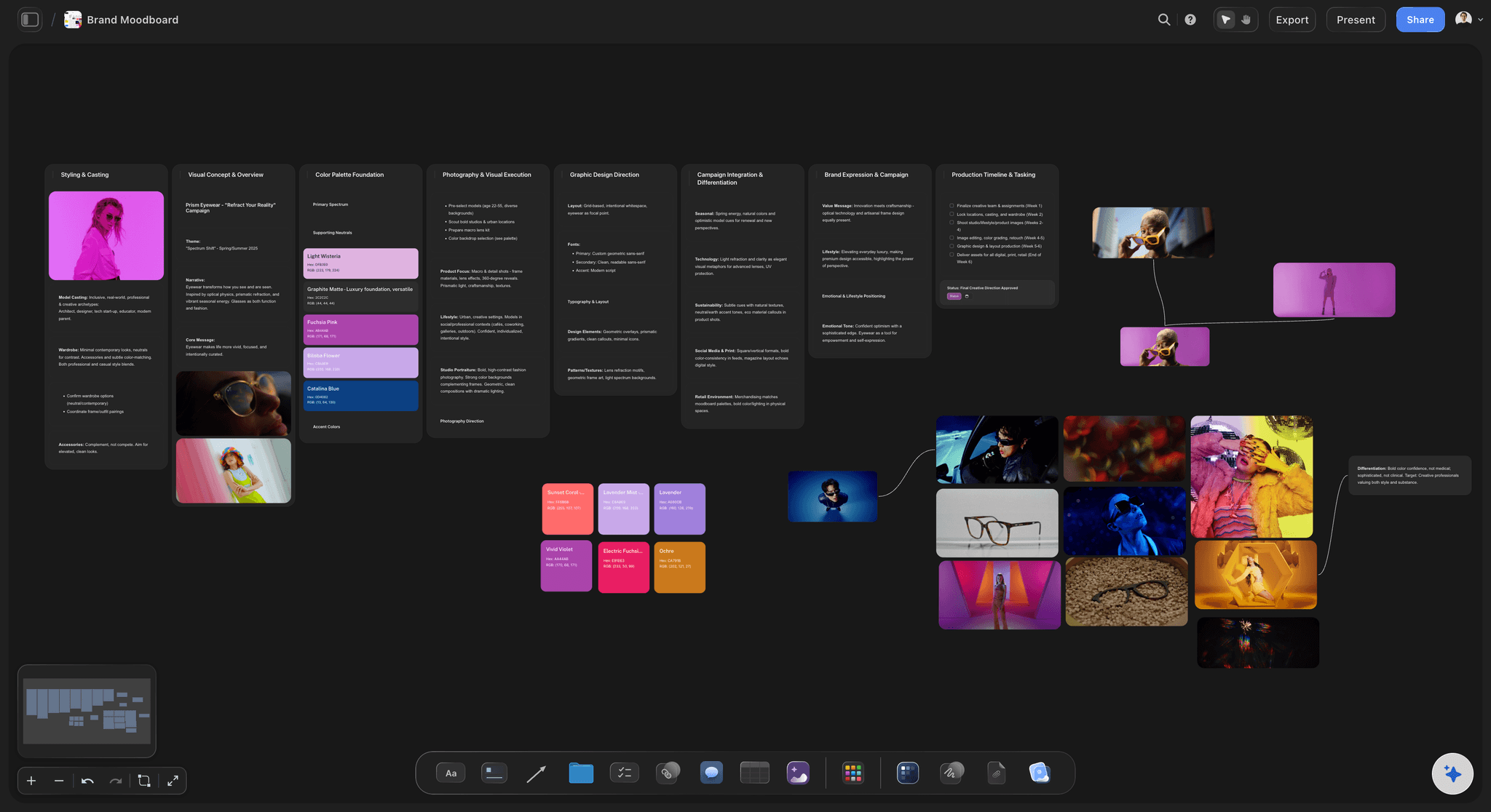
Made for visual projects
Moodboards, storyboards, and references
Drop in anything: Images, video, GIFs, PDFs, and links sit on the canvas next to the idea they support, so the references live with the work instead of pasted into a chat as a link.
Frame grabs from video: Pull stills from YouTube and Vimeo straight onto the canvas when a visual reference explains an idea better than any sentence could.
One space for the process: A moodboard, a mind map, a storyboard, and a plan live side by side on the same canvas, so the creative process is not scattered across tabs.
The board is step one
From a board to a finished plan
Turn boards into real plans: Turn a mind map or moodboard into a storyboard, content calendar, or campaign board on the same canvas, with the AI carrying your ideas across instead of you copying answers out.
Share the workspace: Invite collaborators free, or send a view-only link so anyone can explore the whole canvas in the browser without an account.
Export anywhere: Need a board in a deck or a doc? Export it as a clean image or a PDF in one step.
Explore templates for your project
Every template opens as a real, editable board on the infinite canvas. Pick the closest fit and make it your own.
Mind Map
Branch one central idea out into themes and sub-points, then drag the connections around until the structure makes sense.
One app instead of five
ChatGPT vs Storyflow, and where each one wins.
This is an honest split, not a takedown. ChatGPT owns general chat and knowledge. Storyflow owns visual creative work you build on.
Storyflow
Recommended
General questions, writing, and coding help
AI lays out a visual board you keep and rearrange
Work stays visible and connected, not scrolled away
Boards become storyboards and plans on one canvas
ChatGPT
General questions, writing, and coding help
AI lays out a visual board you keep and rearrange
Work stays visible and connected, not scrolled away
Boards become storyboards and plans on one canvas
Notion
General questions, writing, and coding help
AI lays out a visual board you keep and rearrange
Work stays visible and connected, not scrolled away
Boards become storyboards and plans on one canvas
Miro
General questions, writing, and coding help
AI lays out a visual board you keep and rearrange
Work stays visible and connected, not scrolled away
Boards become storyboards and plans on one canvas
What creators are saying
Join early creators getting structured workspaces and AI that remembers their projects
“Storyflow has sped up my workflow by at least 3x, which means more flow state and more projects I can actually ship. It truly changed the way me and my team create.”

Reilin Joey
Director & YouTuber
“One prompt gets me a structured board. But the tactics are my favorite. I run my YouTube scripts through them and my intros and retention got better. It's amazing.”

Justkay
YouTuber & Freelance Filmmaker
“I used to juggle five apps to plan a project. Now I describe what I am making and get boards, lists, and a schedule. All in one place.”

George
@fernwehchronicles
ChatGPT alternative questions, answered.
Straight answers about where Storyflow fits next to ChatGPT.
No, and it does not try to be. ChatGPT is a superb general-purpose assistant for questions, writing, and coding, and for that you should keep using it. Storyflow is the visual alternative for creative projects: describe what you are making and AI lays out a board on an infinite canvas that you keep and build on, instead of answers that scroll away in a chat.
Use ChatGPT for general questions, drafting or editing writing, explanations, and code, where its breadth of knowledge and back-and-forth chat shine. Use Storyflow when the work is visual and you build on it, like planning a film, outlining a story, mapping a campaign, or organizing research, where seeing everything at once on a canvas beats a linear thread.
It lays out a full visual board on an infinite canvas instead of a text answer, and that board stays. Every idea is a real card you can drag, group, recolor, connect, and attach images or video to, and nothing scrolls out of view. You can then turn the board into a storyboard, content calendar, or plan on the same canvas.
It has AI built for a canvas rather than a chat. You describe what you need and it lays out a board of cards, reading your active board as context, and you can attach up to five documents and three boards, such as a brief or a research doc, for it to work from. It is not built for open-ended general Q&A or coding the way ChatGPT is.
Not during early access. Storyflow is paid-only right now, with plans starting at $9.99 per month. A Free plan is planned before the end of 2026, with unlimited boards on a truly infinite canvas, basic AI usage to lay out and expand them, 20 file uploads, unlimited collaboration, and view-only sharing.
Yes, and this is where a canvas pulls ahead of a chat for creative work. Attach images, PDFs, video, GIFs, and links to any card, and grab frames straight from YouTube and Vimeo onto the canvas, so your references sit right beside the ideas they support.
Yes, and that is the point. Ask the AI to turn a mind map or moodboard into a storyboard, content calendar, or campaign board and it builds the new board on the same canvas from the ideas you laid out. The board becomes the project instead of a chat answer you copy elsewhere.
Yes. Share a view-only link so anyone can explore the full canvas in their browser without an account, invite collaborators to build it with you for free, or export any board as a high-quality image or PDF for decks and documents.
Keep ChatGPT for chat. Bring creative work onto a canvas.
Describe a project, watch AI lay out the board, and build on a workspace that stays instead of a thread that scrolls.