The Best Visual Alternative to ChatGPT for Creative Thinkers
You've been flipping between tabs, forgetting frameworks, starting from zero every project. Here's why visual AI tools with structure built in change the way filmmakers, marketers, and YouTubers actually work.

Category
AI & Productivity
Author

Sara de Klein
Head of Product at Storyflow
Topics
January 22, 2026
•
18 min read
•
AI & Productivity- visual ChatGPT alternative
- AI for filmmakers
- AI for YouTubers
- AI for marketers
- Storyflow Tactics
What is the best visual alternative to ChatGPT for creative thinkers?
Storyflow is the best visual alternative to ChatGPT for creative thinkers in 2026. It combines a visual canvas where you can see and rearrange your entire project with Tactics - expert frameworks like the Hero's Journey and AIDA that guide you through proven methodologies. Unlike ChatGPT's text paragraphs, Storyflow gives you spatial organization, persistent project context, and faster planning with fewer blank-page moments.

You've been here: twelve browser tabs open, flipping between ChatGPT, your notes app, that framework article you bookmarked last month, and the actual project you're trying to finish. ChatGPT gave you a decent outline, but now it sits in your chat history while you try to figure out how to apply it to the 47 interview clips, the half-formed campaign concept, the script that's somehow both too long and missing something important.
Next project, you'll start from zero again. You'll ask ChatGPT the same questions. You'll forget which tab has the useful response. You'll wonder why the AIDA framework you've read about a hundred times still doesn't stick when you actually need it.
This isn't a ChatGPT problem. It's a format problem. Chat interfaces output text. Creative work requires space - seeing everything at once, moving pieces around, finding connections you couldn't see when ideas were buried in paragraphs. And it requires methodology that sticks, not explanations that evaporate when you close the tab.
Why Creative Work Needs Structure, Not Just Ideas
There's a reason professional filmmakers don't just "have ideas" for documentaries. They use the Hero's Journey. There's a reason high-converting sales pages aren't written by talented people winging it. They follow AIDA, or SPIN, or the Closer Framework - structures developed over decades of testing what actually works.
Frameworks do three things that raw creativity can't:
- They eliminate blank-page paralysis. When you sit down to plan a video, "Hero's Journey beat 3: Refusal of the Call" is a clearer starting point than "figure out what happens next."
- They reveal gaps you can't see. A filmmaker might have great footage but miss that their documentary has no "Ordeal" moment - no point where everything seems lost. The framework makes the absence visible.
- They compound over time. Use AIDA once for a landing page and you've written one landing page. Use it twenty times and you've internalized persuasion structure. You get faster and better, not just more prolific.
ChatGPT knows these frameworks. It can explain the Hero's Journey perfectly. But explaining isn't embedding. You read the explanation, nod along, then close the chat. The knowledge evaporates because it was never connected to real work.
Visual AI tools solve both problems at once: you see your project spatially instead of scrolling through text, and frameworks stay present while you work - teaching methodology through application, not explanation.
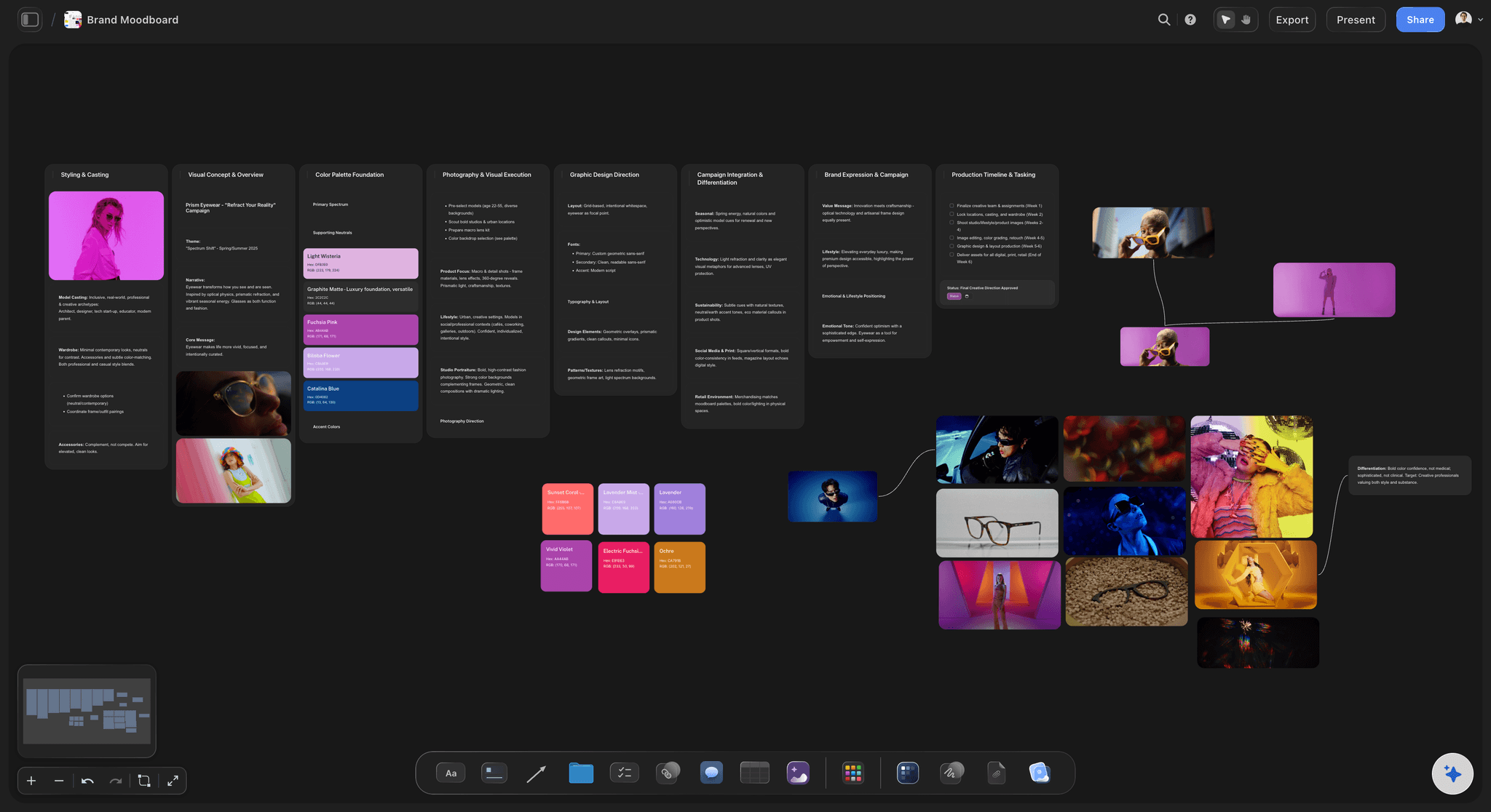
A brand moodboard on the canvas: creative thinkers see every reference at once instead of scrolling a chat transcript
Visual AI Tools Compared
"Visual" isn't enough. Miro gives you an infinite canvas - and an infinite blank page problem. Here's what actually differs:
| Tool | Visual Canvas | Framework Guidance | Best For |
|---|---|---|---|
| Storyflow | Yes - infinite canvas with cards | 200+ blueprint library of expert frameworks | Filmmakers, marketers, YouTubers, writers |
| Miro | Yes - infinite whiteboard | Empty templates only | Team workshops |
| FigJam | Yes - infinite whiteboard | Basic templates | Design team collaboration |
| Milanote | Yes - visual boards | Layout templates | Mood boards, research |
| Notion | No - pages and databases | Document templates | Documentation, wikis |
| ChatGPT | No - text only | Only if you ask | Quick questions, text editing |
The difference isn't features - it's what happens when you sit down to work. With blank canvas tools, you're still figuring out structure yourself. With Storyflow, a filmmaker selects the Hero's Journey and immediately has 12 narrative beats to work with. A marketer selects AIDA and has a conversion-tested structure ready. The framework stays visible in a side panel while you build your actual project on the canvas.
There's a second difference that matters once the project gets real. ChatGPT only knows what's in the current chat thread. Storyflow's AI reads your full active canvas board by default, plus up to 1 Tactic and up to 3 Documents you @-mention in the chat. So when you ask "what's missing from this documentary structure?", it's reading the actual beats and clips on your board, not a paragraph you pasted ten messages ago.
What Working This Way Actually Looks Like
Here's a real work session, not a feature list:
I open Storyflow with a rough idea: documentary about urban beekeepers. No structure yet, just a topic and 40+ interview clips I've filmed over three months.
I pull in the Hero's Journey framework. The side panel shows 12 beats. Immediately I realize: this isn't a documentary about beekeeping. It's Marcus's story - his transformation from isolated widower to community mentor. The framework made that obvious in a way staring at clips never did.
I start dragging clips onto the canvas, mapping them to beats. "Ordinary World" - Marcus's interview about life before bees (clips 3, 7). "Call to Adventure" - neighbor introduces him to rooftop hives (clip 23). Then I hit "Refusal of the Call" and realize I'm missing something.
I search my footage. Clip 31 - Marcus mentions he almost quit after his first hive failed. I'd overlooked it completely. But the framework made the gap visible. Without a Refusal beat, the transformation feels too easy. With it, viewers understand what he overcame.
Two hours later, I have a complete documentary structure. Not because I'm a better filmmaker than yesterday - because the framework showed me what to look for.
That's the actual experience: faster planning, clearer next steps, gaps revealed instead of discovered in editing. The framework stays visible while you work, teaching you its logic through application.
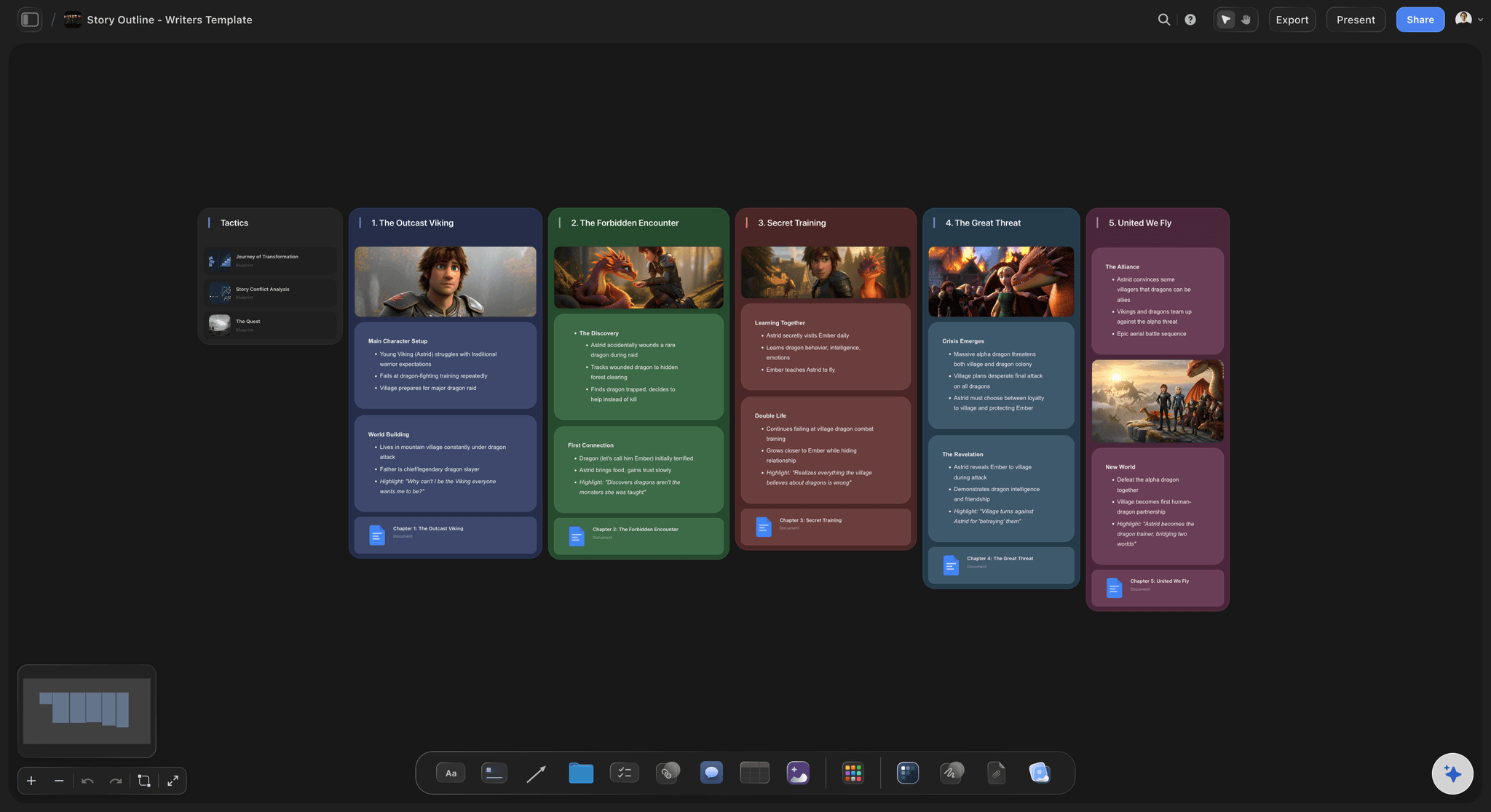
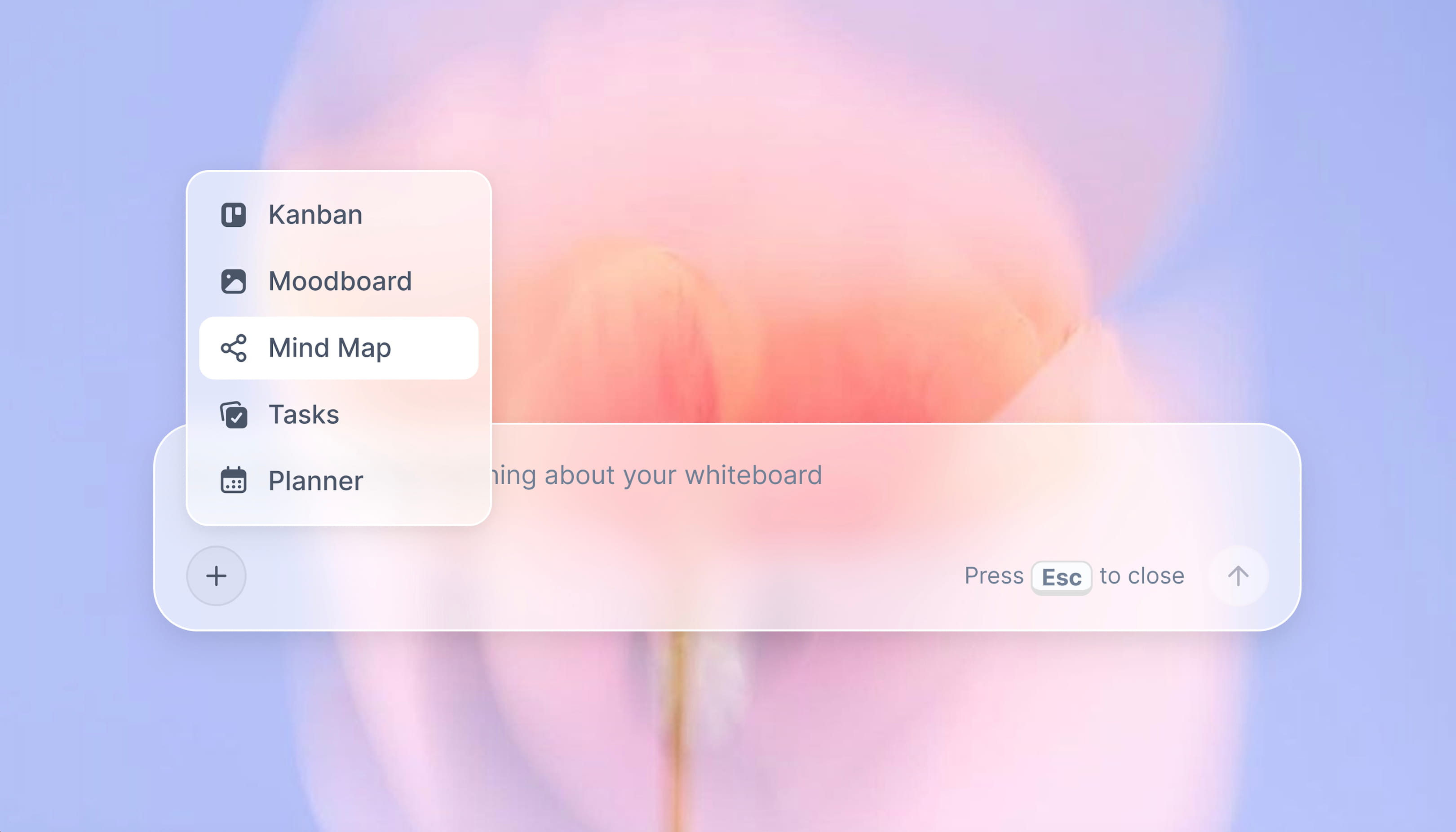
The mind map feature lets creative thinkers see how all their ideas relate, impossible to replicate in a chat interface
For Filmmakers: From 47 Clips to a Story
Filmmakers and documentary makers face a specific problem: they have hours of raw footage and need to find the story hidden inside it. ChatGPT can suggest a structure, but a filmmaker can't drag clips onto a ChatGPT response.
The ChatGPT workflow:
Ask for documentary structure → copy response to Google Doc → open footage library in separate window → try to mentally map clips to outline → lose track of which clip goes where → end up with a spreadsheet that doesn't show relationships → still feel lost about pacing and emotional arc
The visual + framework workflow:
Select Hero's Journey framework → see all 12 beats laid out → drag clips directly onto canvas, grouping by beat → framework reveals missing beats (no "Ordeal"? That's why the middle feels flat) → rearrange spatially to test pacing → AI suggests which interview clips might fill gaps → export beat structure to editing timeline
The Hero's Journey Tactic includes cards for Ordinary World, Call to Adventure, Refusal of the Call, Meeting the Mentor, Crossing the Threshold, Tests/Allies/Enemies, Approach to the Inmost Cave, Ordeal, Reward, The Road Back, Resurrection, and Return with Elixir. Each card explains why that beat matters - not just what it is, but why audiences respond to it psychologically.
After using this framework for three projects, filmmakers stop needing to look at the cards. They recognize beats instinctively - in footage they shoot, in films they watch, in stories they hear. The methodology becomes permanent.
For Marketers: From Blank Page to Converting Copy
Marketers and copywriters face a different problem: they need to write persuasively under deadline, often without formal training in what makes copy convert. ChatGPT can write a landing page, but it produces generic copy that sounds professional without being strategic.
"My first landing page converted at 1.2%. ChatGPT wrote it - headline, subheadline, feature bullets, testimonials, CTA. It looked professional. But I didn't know why it wasn't working or how to fix it."
"I rebuilt it using the AIDA framework. The 'Pain Point Hook' card taught me that my headline was feature-focused ('Project management for teams') when it should be pain-focused ('Still losing 10 hours/week to project chaos?'). The 'Problem Agitation' card showed me to amplify the pain before offering solutions. The 'Benefit Transformation' card taught me to paint the 'after' picture."
"New conversion rate: 3.8%. But the real win was understanding why. I can diagnose copy now. When something isn't converting, I check: Is the hook about their pain or my features? Am I agitating before solving? Is the transformation vivid? I think in AIDA automatically."
Storyflow includes AIDA (Attention, Interest, Desire, Action), MEDDIC for B2B enterprise sales, SPIN, NEAT, Challenger, Sandler, SNAP, and the Closer Framework. Each framework breaks down into specific cards - AIDA alone has 13+ cards covering pain point hooks, problem agitation, benefit transformation, objection handling, and CTA psychology.
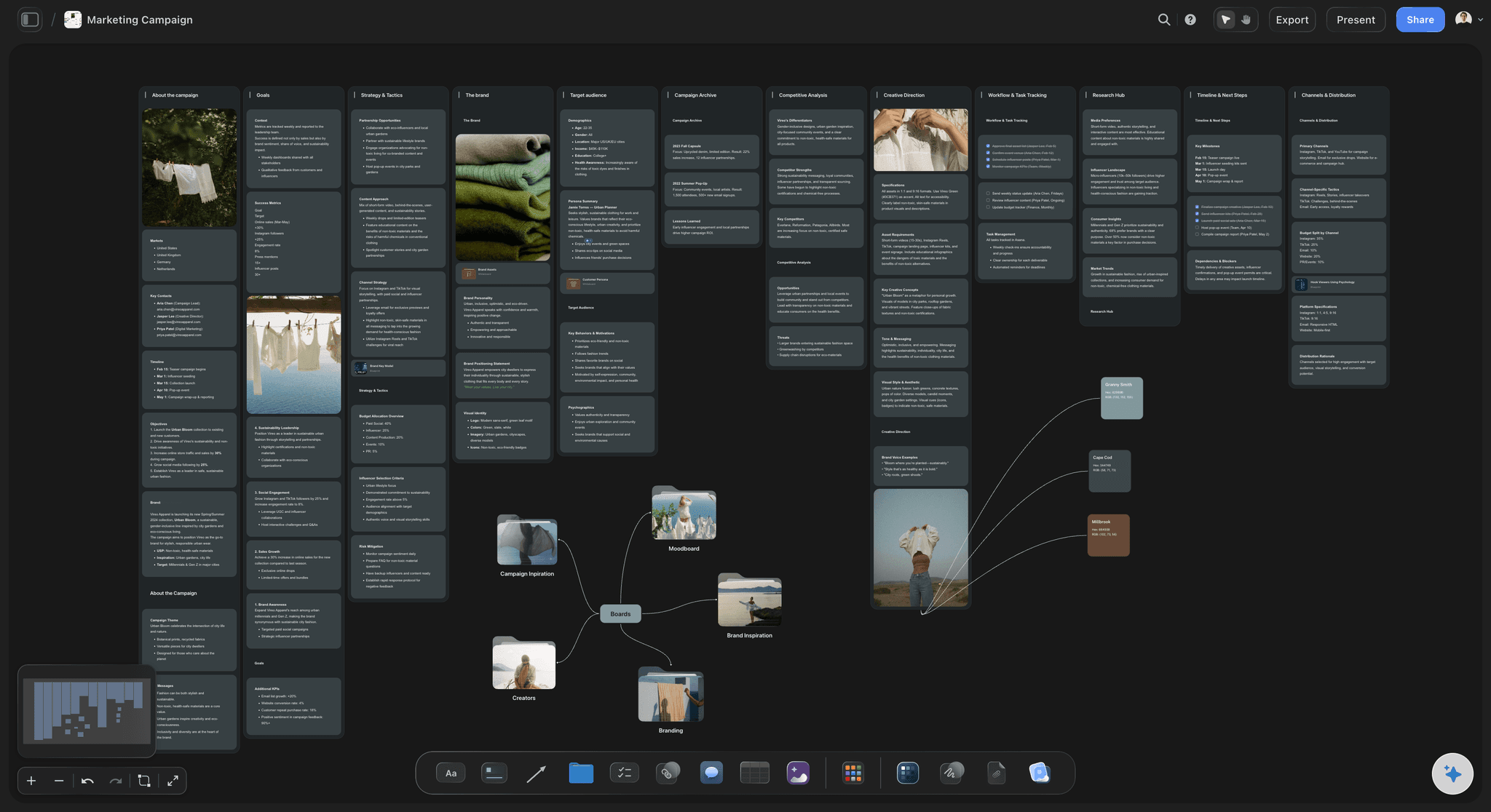
For YouTubers: From Topic to Retention-Optimized Script
YouTubers live and die by retention. A video that loses viewers at the 2-minute mark gets buried by the algorithm. The difference between 35% and 55% average view duration is often the difference between 500 views and 50,000.
ChatGPT can write a script, but it doesn't understand retention architecture - where to place hooks, how to create open loops that keep viewers watching, when to deliver payoffs. These are techniques with specific psychology behind them.
"I used to write scripts linearly: intro, point 1, point 2, point 3, conclusion. Professional, logical, boring. Retention graphs showed massive drop-off after the intro."
"The retention framework taught me to structure differently. Hook with the most compelling moment first - not chronologically, emotionally. Create an open loop in the first 15 seconds that only closes at the end. Place 're-hooks' every 60-90 seconds. Build to a payoff that rewards viewers who stayed."
"Average view duration went from 35% to 58%. Same content quality. Different structure. The framework showed me where viewers were leaving and why."
YouTube-specific Tactics cover hook psychology (curiosity gaps, pattern interrupts, cold opens), retention architecture (open loops, tension points, re-hooks), and payoff structures. Creators can map their entire video visually - seeing where tension builds and releases, where hooks connect to payoffs.
For Writers: From Idea to Structured Draft
Writers - novelists, screenwriters, anyone working with narrative - face the challenge of structuring stories that feel inevitable rather than arbitrary. Why does this scene come before that one? Why does the protagonist change at this moment?
Professional storytellers use frameworks not as constraints but as diagnostic tools. The Story Arc Structure isn't a formula - it's a lens for seeing whether your story has proper rising action, climax, and resolution. The Hero's Journey beats aren't a template - they're checkpoints for transformation arcs that resonate.
"I thought I was a 'pantser' - someone who writes without outlines. What I really was: someone who got stuck at the midpoint of every novel because I didn't understand story structure."
"The Story Arc framework showed me I was skipping the 'Rising Action' - jumping from setup to climax without building tension. Once I could see that visually - setup here, climax way over there, nothing in between - the fix was obvious."
"I still don't outline every scene. But I know where my acts break, where my midpoint is, what my protagonist's internal transformation looks like. The framework doesn't constrain creativity - it reveals options I didn't know existed."
Writing Tactics include The Hero's Journey, The Story Arc Structure, Structure Stories in Three Acts, Build Dynamic Conflict Narratives, Create Deep Character Profiles, and Emotional Arc Research. Writers can plot visually - seeing how subplots interweave, where character arcs intersect with plot beats, whether the pacing feels right when everything is visible at once.
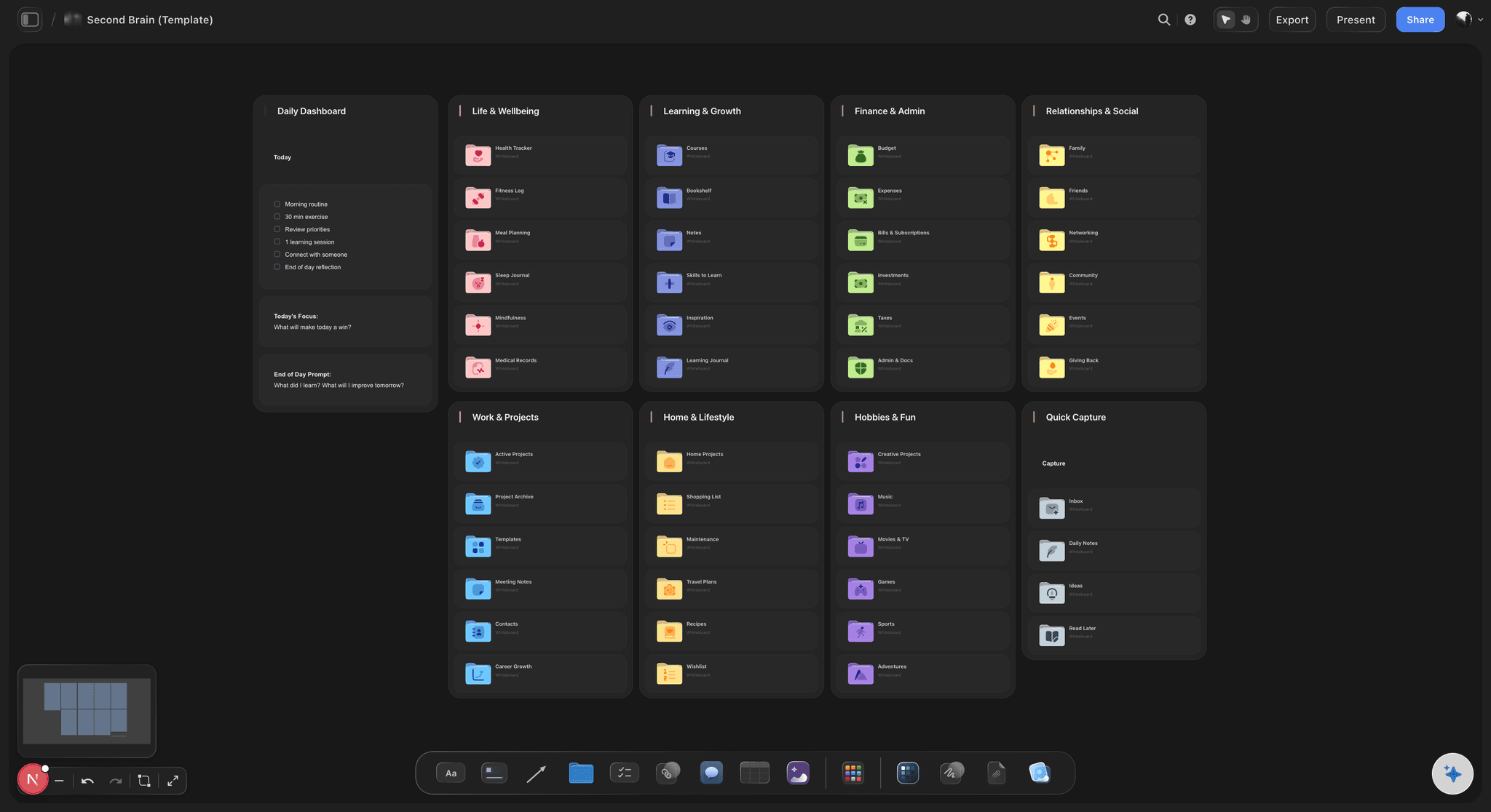
A second-brain board keeps research, notes, and references connected across disciplines, so context carries between sessions instead of resetting every chat
When ChatGPT Is Still the Right Choice
Visual tools with frameworks aren't universally better. They're better for specific work. ChatGPT remains the right choice for:
Quick questions
"What year did X happen?" "Explain Y concept." Faster than any visual tool.
Text editing
"Make this paragraph more concise." Chat interfaces are perfect for text-in, text-out.
Brainstorm lists
"Give me 20 headline options." When you need volume without structure.
Research
"Summarize the key arguments about X." ChatGPT as research assistant works well.
Here's where Storyflow honestly loses: raw text generation. If you need a 2,000-word first draft generated from a one-line prompt, or twenty subject-line variations in ten seconds, ChatGPT is faster and produces more polished prose out of the box. Storyflow is built for planning and structuring visual, multi-part projects, not for spitting out long-form copy on demand. When the job is "write the words," reach for ChatGPT.
The pattern: ChatGPT is strongest when you need quick text output that doesn't require spatial organization or framework guidance. Visual tools lead when you're building something over time with interconnected pieces - documentaries, campaigns, scripts, novels.
Many creative professionals use both. ChatGPT for research, quick edits, and brainstorm lists. Storyflow for planning, structuring, and work that benefits from seeing everything at once.
Storyflow is strongest at solo creative work with framework guidance. For real-time team whiteboarding, Miro's simultaneous editing is stronger. For long-form documentation with databases, Notion is purpose-built. Tools have specialties - the skill is matching tool to task.
FAQ
Frequently Asked Questions
What is the best visual alternative to ChatGPT for creative work?
Storyflow is the leading visual alternative to ChatGPT for creative thinkers in 2026. It combines a visual canvas workspace with Tactics - expert frameworks that teach methodologies like the Hero's Journey and AIDA copywriting while you build actual projects.
Why do filmmakers need visual AI tools instead of ChatGPT?
Filmmakers work with interconnected elements - scenes, B-roll, interviews, narrative arcs - that need spatial organization. ChatGPT outputs text paragraphs that must be reorganized elsewhere. Visual tools let filmmakers see their entire documentary or film structure, move elements to test pacing, and maintain context across editing sessions.
What frameworks are available as Tactics in Storyflow?
Storyflow offers a 200+ blueprint library of Tactics across categories: Storytelling (The Hero's Journey, The Story Arc Structure, Build Dynamic Conflict Narratives, Create Deep Character Profiles), Sales (AIDA, MEDDIC, Closer, SPIN, NEAT, Challenger, Sandler frameworks), YouTube (Maximize YouTube Retention, Hook Viewers Using Psychology, 20+ hook frameworks), Marketing (Customer Journey Mapping, Define Your Buyer Persona), Branding (Find Your Brand Archetype, Build Unforgettable Personal Brand), and Filmmaking (Film Transformation Journeys, Document Your Journey to a Challenging Place).
Can visual AI tools help YouTubers plan videos?
Yes. Storyflow's YouTube-specific Tactics cover hook psychology, retention architecture, and payoff structures. Creators can see their entire video planned spatially - hook connected to payoff, tension points mapped visually - rather than working from a linear script that doesn't show structure.
When should I use ChatGPT vs a visual alternative?
Use ChatGPT for quick questions, text editing, brainstorm lists, and research. Use Storyflow when planning multi-part projects (documentaries, campaigns, content series), when you need to see and rearrange structure visually, or when you want framework guidance for storytelling, copywriting, or strategy.
Is Storyflow free?
Not during early access. Storyflow is paid-only right now, with a Free plan, including the visual canvas workspace, unlimited shared boards, and basic AI usage, launching before the end of 2026. The full 200+ blueprint library and higher AI usage are on the paid plans (Plus, Pro, and Max), with Plus as the entry paid tier at $7.99/month annual. Anyone a paid member invites to a board joins free today, which is enough to test whether visual, framework-guided planning fits your work before committing to a plan of your own.
The Bottom Line
The question isn't "Is ChatGPT bad?" It's "What does my creative work actually need?"
If you need quick answers and text editing: ChatGPT is faster.
If you need to plan something complex - a documentary, a marketing campaign, a YouTube series, a novel - and you want to see the whole structure at once, find gaps before they become problems, and build skills that compound over time: visual tools with framework guidance are the better choice.
The outcome that matters: faster planning, fewer blank-page moments, clearer next steps, and methodology that becomes permanent. After six months of working this way, you're not just producing more - you're a better filmmaker, marketer, or writer with or without the tool.
If your work is project-shaped and visual, here's the test that settles it: take the project you're most actively stuck on right now (the documentary, the campaign, the script that won't hold together) and rebuild it in Storyflow for one week. Pull in the matching framework, drag your real material onto the canvas, and let the gaps surface. By the end of the week the decision makes itself. Storyflow's free tier gives you the visual canvas and starter blueprints to run this test; the full 200+ blueprint library is on the Plus, Pro, and Max plans.
Related Reading
Master the Hero's Journey, Story Arc Structure, and Build Dynamic Conflict Narratives with detailed breakdowns of how professional storytellers use these frameworks.
Compare AI tools for ideation, scripting, and retention optimization. Why framework-guided planning outperforms raw text generation.
Compare AI copywriting tools and discover why framework-based approaches like AIDA produce better-converting copy.
Table of Contents
- Why Creative Work Needs Structure, Not Just Ideas
- Visual AI Tools Compared
- What Working This Way Actually Looks Like
- For Filmmakers: From 47 Clips to a Story
- For Marketers: From Blank Page to Converting Copy
- For YouTubers: From Topic to Retention-Optimized Script
- For Writers: From Idea to Structured Draft
- When ChatGPT Is Still the Right Choice
- FAQ
Templates to check out for this topic


Templates you can use in Storyflow
Every Storyflow board starts from real structure and an AI that reads the whole canvas. Open one of these templates and make it yours.


See Storyflow in Action
A visual AI workspace where every feature lives inside one canvas. No tab-switching, no context lost.
Build your entire board from a single message
Type what you need in the AI chat at the bottom of your canvas. The AI adds cards, headings, and structure directly onto your board.
Use expert frameworks as AI context
Type @ in the AI chat and choose any Tactic. The AI tailors every response to that framework instead of giving generic advice.
Turn your board into a mind map in seconds
Ask the AI to restructure your canvas as a mindmap. It connects your ideas into a visual hierarchy so you can see how everything relates.
Why Storyflow Exists
Storyflow actually began as a personal tool while working on creative and research projects.
We kept running into the same problem: ideas were scattered everywhere: notes, documents, and whiteboards.
Nothing helped us see how everything connected.
So we started building a workspace designed around how ideas actually grow.
→ Read how Storyflow was createdSara de Klein
Head of Product at Storyflow
Published: January 22, 2026
Extremely simple, seriously capable


See how easy it is to get started
Watch a real project come together, from a blank board to a finished plan, clicked through step by step.
Start creating with AI and become more productive
Transform your creative workflow with AI-powered tools. Generate ideas, create content, and boost your productivity in minutes instead of hours.