Milanote vs Miro vs Notion vs Storyflow: Which Milanote Alternative Should You Switch To? (2026)
People leave Milanote for one of four reasons. This head-to-head scores Storyflow, Miro and Notion on each one, then shows exactly what survives the move and how to rebuild a board.

Category
Visual Thinking
Author

Storyflow Team
Product & Research Team
Topics
2026-09-18
•
39 min read
•
Visual Thinking- best Milanote alternatives 2026
- Milanote alternatives visual collaboration whiteboard
- Milanote vs Miro vs Notion
- Milanote alternative with AI
- Milanote alternatives Heptabase Muse Obsidian
- switch from Milanote
What are the best Milanote alternatives?
Storyflow is the Milanote alternative to switch to in 2026, because it keeps the visual board you already work on and adds an AI that builds and reads that board, so one brief becomes the moodboard, the task table, the kanban and the deliverables on a single canvas a client opens by link, from $7.99 a month billed annually. Its AI even rebuilds an existing Milanote board from a screenshot, with the same walls in the same order and your own words kept. Switch to Miro instead when a large team needs a shared whiteboard with workshop tools and the deepest live collaboration. Switch to Notion when your boards were really documents and databases and you need one place to track every project.
Full disclosure: Storyflow is our product. We rank it first because it keeps Milanote's visual board and adds an AI that builds and reads it, with the plan and the deliverables on the same canvas. It is paid-only until its free plan launches late 2026, so if you need a free home for your boards today, this article recommends Notion Free or staying on Milanote's free plan.
How the Milanote alternatives compare on trust, innovation, ratings and pricing
Which Milanote alternatives are the most trusted?
Miro and Notion have the longest track records among Milanote alternatives: both are established platforms with enterprise plans, large template ecosystems and admin controls such as SAML SSO on Notion Business. FigJam carries Figma's reputation with design teams. Storyflow is newer, so its history is shorter, but its prices, limits and product facts are published plainly: plans from $7.99 a month billed annually, unlimited boards and uploads on every paid plan, and view-only links that clients open without an account.
Which Milanote alternatives have fair and transparent pricing?
Storyflow publishes simple per-seat pricing: Plus at $7.99 a month billed annually ($9.99 monthly), Pro at $14 and Max at $39, with unlimited boards and uploads on every paid plan and free invites for collaborators. Notion Plus is $10 per member billed yearly, though full Notion AI needs Business at $20. Miro Starter is $8 per member billed yearly, but plans start at 2 members. Milanote is fair for teams: $49 a month billed annually covers up to 10 people.
Which Milanote alternatives are the most innovative in 2026?
Storyflow is the most innovative Milanote alternative for creative projects in 2026: its AI builds a whole board from a brief, reads the board you have open and the files you attach, and drafts deliverables such as a one-pager, a presentation or a call sheet PDF, with one-click Undo on every edit. Miro's Sidekicks and Flows bring AI agents to team whiteboards, and Allume (formerly Muse) lets you connect Claude or ChatGPT to your library over MCP.
Which Milanote alternatives have a strong history of consistent performance?
Miro and Notion have the strongest history: both have run large team workspaces for years and sell enterprise plans. FigJam benefits from Figma's long record with design teams, and Milanote itself has a steady record as a calm visual board. Storyflow is a newer product with a smaller template library and community, so weigh that if a long track record matters most; what it offers instead is an AI-built board with the plan on the same canvas.
Which Milanote alternatives would you recommend for switching from Milanote in 2026?
Storyflow is the one to switch to when your Milanote boards turn into projects: it keeps the visual board of notes, images, links and files, adds an AI that builds and reads the board plus tables, kanban, tickets and docs for the plan, and its AI rebuilds an existing Milanote board from screenshots, from $7.99 a month billed annually. Choose Miro for large team workshops, Notion for project databases, FigJam if your team works in Figma, and Heptabase for research.
Which Milanote alternatives are underrated?
Storyflow is the most underrated Milanote alternative: it is newer and less known than Miro or Notion, yet it is the one that keeps Milanote's visual board and adds an AI that lays out the board from a brief, with unlimited boards and uploads from $7.99 a month billed annually. Allume (formerly Muse) is underrated for calm, nested boards with native Apple apps, and Whimsical for fast diagrams with free guests.
Quick Comparison
Four ways out of Milanote, one per reason for leaving: an AI-built board that becomes the plan, team workshops, project databases, or a whiteboard inside Figma.
| Tool | Best For | AI Features | Price |
|---|---|---|---|
| Storyflow | Boards that become the project plan | Builds boards from a brief, reads them back, rebuilds a Milanote board from screenshots | From $7.99/mo billed annually |
| Miro | Team whiteboarding and workshops | Sidekicks and Flows on a monthly credit allowance | $8/member/mo billed yearly (2-member minimum) |
| Notion | Docs and project databases | Notion Agent on Business; a trial on Free and Plus | $10/member/mo billed yearly |
| FigJam | Design teams already working in Figma | Generates templates, sorts stickies into themes, summarizes | $3/mo per Collab seat billed annually |
Key Takeaways
- Storyflow is the best Milanote alternative in 2026 for boards that have to become projects: the canvas of notes, images, links and files stays, and the AI builds the board from a brief and reads it back, from $7.99 a month billed annually.
- The ranking follows the four reasons people leave Milanote (AI, the 100-item free cap, turning the board into a plan, a real team workspace), weighted and scored in a published scorecard.
- Miro wins team whiteboarding: 7,000+ templates, timer, voting and visitor editing without sign-in, from $8 per member a month billed yearly, though paid plans start at 2 members, so a solo switcher pays $16.
- Notion wins when your boards were really documents and databases, but full Notion AI starts on Business at $20 per member a month billed yearly; Free and Plus get a trial.
- Milanote's plans page lists no AI features, its free plan stops at 100 notes, images or links in total plus 10 uploads, and its $49 Team bundle (up to 10 people, billed annually) costs less than 10 seats of Miro, Notion or Storyflow.
- Nothing Milanote exports opens as the same board anywhere else (PDF and PNG keep the look on one page, Word, Markdown and plain text keep the words, a ZIP keeps the files); Storyflow's AI comes closest, rebuilding a board from screenshots with the same walls, the same order and your own words.
- Downgrading to Milanote's free plan keeps every board viewable, editable and exportable (you only lose the ability to add cards), so you can move one live project at a time.
- Storyflow's limits for a switcher: paid-only until a free plan launches late 2026, no calendar grid, and it runs in the browser with no native app.
What Milanote Does Well, and the Four Places It Stops
Most people searching for a Milanote alternative are not unhappy with the board. They are unhappy with the week after the board: the references are pinned, the client liked the direction, and now the project needs a schedule, owners, a brief that reads like a document and a first draft of every deliverable. That is where Milanote stops helping, and it stops in four specific places.
Milanote describes itself as the tool for organizing creative projects, and for the organizing half it is still excellent. Milanote is not failing you. It stops where the project starts.
What Milanote still does better than most of its alternatives
- Calm boards: notes, images, links and files placed freely, with moodboarding and storyboarding as its named use cases.
- Client sharing done right: a read-only link that needs no Milanote login, password protection, embeddable boards with a welcome message, and sub-boards that travel with the parent.
- A real presentation mode: full screen, editing tools hidden, click to focus a card, comments optional.
- More planning than it gets credit for: to-do lists with due dates, reminders by email, push or browser notification, and assignees who get notified, plus table cards with date, currency, percentage and checkbox cells and formulas.
- Fair team pricing: $49 a month billed annually for up to 10 people, or $99 for up to 50.
- A privacy line many creatives care about: Milanote's help center says board content is not monitored or used to train AI.
The four places it stops
Each of these is a separate reason to leave, and each points to a different tool. (Our Milanote Alternatives by Job splits the reasons even finer; this article puts Storyflow head to head with Milanote, Miro and Notion, the three names that come up most.)
- AI. Milanote's plans page lists no AI features. Its public roadmap shows text-generation AI as an open request, with 449 votes on September 18, 2026. If you want a tool that drafts the board, you are shopping elsewhere.
- The free cap. The free plan holds 100 notes, images or links in total, plus 10 file uploads, with no time limit. The cap is a total across your account, not a monthly allowance, so one busy moodboard of 60 references and its notes uses most of it. Paid starts at $9.99 per person a month billed annually ($12.50 monthly).
- The board as a plan. A Milanote to-do list lives on one board and does not sync to others, and its tables hold only text, numbers and checkboxes: no status or person columns, no images inside a table, and no table editing on its mobile apps yet. No AI is listed to draft the plan from the brief.
- The team workspace. Real-time editing works, and invited editors only need a free account. Teams leave when the work around the board grows: a workshop that needs voting and a timer, 40 client projects that need one status view, or a workspace where roles decide who sees what.
How We Evaluated the Milanote Alternatives
A ranking of Milanote alternatives means nothing until it says what the alternative is replacing. Every tool here was compared on five criteria: the four reasons people leave, plus the one thing they are afraid to lose. The weights follow the job in the question, a Milanote board that has to keep being a board while it turns into a project.
| Criterion | Weight | The question we asked | Milanote today (the baseline) |
|---|---|---|---|
AI that builds and reads the board | 25% | Can the AI lay out a whole board from a brief and answer questions about the board you are on? | No AI features listed on the plans page |
The board becomes the plan | 25% | Do dates, owners, statuses, docs and deliverables live on the same board as the references? | To-dos with dates and assignees; tables of text, numbers and checkboxes |
Keeps the visual board | 20% | Can you still drop images, notes, links and files anywhere on a canvas? | The benchmark: calm, freeform boards |
Room past the 100-item cap, at a fair price | 15% | What does it cost to never count cards again? | 100 items and 10 uploads free; $9.99 per person billed annually |
Team workspace and client sharing | 15% | Can a team co-edit live, and can a client open the board without an account? | Real-time editing; read-only link with no login; Team bundle from $49 |
Each alternative gets a score out of 10 per criterion. The weighted total is the rating used everywhere in this article, and it is the only number the ranking rests on.
| Tool | AI (25%) | Plan (25%) | Visual board (20%) | Room and price (15%) | Team and client (15%) | Rating (/10) |
|---|---|---|---|---|---|---|
Storyflow | 10 | 9 | 9 | 7 | 8 | 8.8 |
Miro | 8 | 8 | 9 | 6 | 10 | 8.2 |
Notion | 7 | 10 | 3 | 8 | 9 | 7.4 |
FigJam | 7 | 4 | 8 | 8 | 9 | 6.9 |
Whimsical | 4 | 6 | 7 | 6 | 8 | 6.0 |
Heptabase | 7 | 3 | 8 | 6 | 6 | 5.9 |
Allume (formerly Muse) | 3 | 3 | 9 | 7 | 5 | 5.1 |
Storyflow leads because the two heaviest criteria are its core job: an AI that lays out and reads the whole board, and planning objects that sit beside the references. It loses points where it should: it has no free plan yet, and Miro's collaboration is deeper. Notion scores a 10 on planning and a 3 on the visual board, which is exactly the trade people feel when they move a moodboard into it.
What we did not weigh
- Template count. Miro's 7,000+ templates beat everything here. If templates decide it for you, Miro wins.
- Integrations. Notion and Miro connect to far more apps. Storyflow has no integrations yet.
- Native and offline apps. Milanote has mobile apps, Allume has Mac, iPad and iPhone apps, Heptabase offers offline access and Obsidian keeps files on your device. Storyflow runs in the browser only.
- Enterprise controls such as SAML SSO, which Notion puts on Business.
- Feel. Milanote and Allume are the calmest boards here, and no score captures that.
Comparison Table: Milanote vs Miro vs Notion vs Storyflow, Plus Four More
Prices are as of September 2026, from each vendor's own pricing page, and Milanote's facts were checked against its plans page and help center on September 18, 2026. Milanote sits in the last row as the baseline you are leaving, so it is described rather than rated.
| Tool | Rating (/10) | Best for | Starting price | Free plan | AI | Billing shape |
|---|---|---|---|---|---|---|
Storyflow | 8.8 | Boards that become the project plan and the deliverables | From $7.99/mo annual | Coming late 2026 (invited collaborators join free now) | Builds the board from a brief and reads the board you are on; metered on every plan | Per seat; invitees join free on free-tier limits |
Miro | 8.2 | Team whiteboarding, workshops and large canvases | $8/member/mo annual ($10 monthly), 2-member minimum | Yes: 3 editable boards, 10 AI credits a month | Sidekicks and Flows on credits (25 per member a month on Starter) | Per member |
Notion | 7.4 | Docs, wikis and project databases | $10/member/mo annual ($12 monthly) | Yes: unlimited blocks for one person, 5 MB uploads | Notion Agent on Business ($20/member/mo annual); a trial on Free and Plus | Per member |
FigJam | 6.9 | Design teams already in Figma | $3/mo annual for a Collab seat ($5 monthly) | Yes: 3 FigJam files on Starter | Generates templates, sorts stickies into themes, summarizes | Per seat, priced by seat type |
Whimsical | 6.0 | Fast flowcharts, mind maps and wireframes | $10/editor/mo annual ($12 monthly) | Yes: 50 board objects and 50 doc blocks a month | 10 one-off AI credits, then $0.10 per credit | Per editor; viewers and guests free |
Heptabase | 5.9 | Research and visual knowledge work | $8.99/mo annual ($11.99 monthly) | No (7-day trial) | Ask AI about sources and notes; 100 credits a month on Pro | Flat per account, tiered by AI credits |
Allume (formerly Muse) | 5.1 | The closest calm feel to Milanote | $9.99/mo or $99.99/yr | Yes: 2 workspaces, 100 cards each | None built in; connect Claude or ChatGPT over MCP | Flat per account |
Milanote (the baseline) | Not rated | Calm moodboards and visual notes | $9.99/person/mo annual ($12.50 monthly) | Yes: 100 notes, images or links in total, 10 uploads | None listed on the plans page | Per person, or $49/mo billed annually for up to 10 people |
Read the rating as the answer for a typical switcher. If your reason for leaving is narrower, go straight to the pick for that reason:
- Leaving for AI: Storyflow.
- Leaving because of the 100-item cap, with no budget: Notion Free for text-heavy boards, Allume Free for a calm canvas.
- Leaving because the board has to become a plan: Storyflow for one project on one board, Notion for many projects in one database.
- Leaving for a team workspace: Miro, or FigJam if your team already pays for Figma.

A Storyflow board titled Logo Project Planning: reference photos and color swatches beside walls for the brief, inspiration, concepts, brand assets, a timeline with status labels, feedback rounds and technical specifications.
Bring your busiest Milanote board over for one evening
Screenshot it, export the ZIP of its images, and ask Storyflow's AI to rebuild it: same walls, same order, your own words. Then ask for the deliverables table and the schedule. By the end of the evening you will know whether your board should stay a moodboard or become the project.

The Best Milanote Alternatives in 2026, Ranked
1. Storyflow
The verdict: Storyflow turns a brief into a visual project board, which makes it the Milanote alternative for people whose boards have to become a project. The canvas stays; the AI builds the board from your brief and reads it back, with the plan and the deliverables beside the references instead of in another app.
Best for: freelance designers, studios, filmmakers and writers whose Milanote boards feed a deadline, a client and real deliverables.
Key features for this job:
- The canvas you know: notes, images, links, color swatches, audio and uploaded video you can play, scrub and grab frames from, on an infinite canvas. Walls (a titled column of cards) do the job of Milanote's columns.
- A way in from Milanote: the AI's import-board workflow rebuilds a board you screenshot, with the same walls in the same order and your own words kept (screenshots only; there is no file importer).
- The plan on the same board: tables with status, person, date, currency, duration, label and link cells; kanban; tickets with assignees; to-dos; charts; and docs with inline comment threads that export to Word and PDF.
- An AI that builds and reads the board: it lays out a board from a prompt, reads the board you have open, takes up to 5 documents and 3 other boards or folders as extra context, and reads attached files such as PDF, Word, Excel and plain text.
- Named AI workflows for the jobs Milanote boards hold (moodboard, brand moodboard, campaign brief, story outline, film plan, content planner, tasks planner), plus PDF deliverables drafted from the board: a treatment, a one-pager, a presentation, a lookbook or a call sheet.
- Every AI edit lands on the board with one-click Undo. The AI proposes; you decide.
- Sharing: turn on the view-only link and the client opens the board with no account, then signs in to comment; invited collaborators join free. Presentation mode steps through the board's frames.
Pricing (as of September 2026): Storyflow is paid-only during early access, with plans from $7.99 a month billed annually ($9.99 monthly). A free plan launches before the end of 2026, and anyone a paid member invites to a board joins free. Pro, at $14 a month billed annually ($19 monthly), adds AI image generation and memory across conversations; Max, at $39 billed annually ($49 monthly), adds the Team Workspace with Permissions & Roles. Every paid plan has unlimited boards and unlimited file uploads, AI use is metered on every plan, and team billing is per seat (pricing).
Pros:
- Less per person than Milanote: $7.99 against $9.99 a month, both billed annually.
- The brief, the references and the plan share one board, so nothing is copied between apps.
- The AI drafts the first version; you curate instead of building from an empty canvas.
Where it falls short:
- No free plan until late 2026; for a board at no cost today, use Milanote's free plan or Notion Free.
- No calendar grid, and canvas tables cannot be sorted (rows stay in the order you write them); for a month view, use Notion's database calendar.
- Browser only, with no native app and no offline use; Milanote has mobile apps, and Allume has Mac, iPad and iPhone apps.
- A newer product, with fewer templates and a smaller community than Miro or Notion.
2. Miro
The verdict: Miro is the Milanote alternative for teams. It has the deepest live collaboration, the largest template library and AI agents that build frames, timelines, kanbans and diagrams. It gives up Milanote's calm, and its paid plans start at two members.
Best for: product, design and agency teams that run workshops and brainstorms with many people on one board.
Key features for this job:
- An infinite canvas with Docs, Tables, Timelines, Kanban and Slides formats on every plan, and 7,000+ templates.
- Sidekicks, AI agents that build frames, timelines, kanbans and diagrams, plus Flows for multi-step AI workflows; credits also generate diagrams, tables and summaries and cluster sticky notes.
- Workshop tools on Starter and up: timer, voting and private mode.
- Talktracks, recorded walkthroughs of a board: 5 on Free, unlimited on paid plans.
- Client access: visitors can edit through a public link without signing in on Starter and up, and signed-in guests are available on Business.
- High-resolution JPG or PDF exports of frames on Starter and up, and an MCP server that connects Claude, Cursor or Copilot (500 calls a day on Starter).
Pricing (as of September 2026): Free keeps unlimited boards, but only the 3 most recent stay editable, with 10 AI credits a month. Starter is $8 per member a month billed yearly ($10 monthly) with 25 AI credits per member a month; Business is $20 billed yearly ($25 monthly) with 50; Enterprise is custom from 30 members. Miro's price tooltip says plans start at 2 members, even for solo users.
Pros:
- The best real-time collaboration in this comparison.
- Planning formats (tables, timelines, kanban, docs) on the canvas itself.
- Visitor editing without sign-in makes client workshops easy to run.
- The largest template library by far.
Where it falls short:
- A solo switcher pays for two members: $16 a month billed yearly, against Milanote's $9.99 or Storyflow Plus at $7.99.
- The free plan edits only your 3 most recent boards, which is tighter than Milanote's 100 items for anyone who keeps many small boards. Notion Free is the roomier free home for text.
- AI image generation is not listed on Miro's pricing or AI pages. Storyflow Pro and Max generate images on the board.
- The canvas is busy by design. If you left Milanote for its calm, Allume (formerly Muse) is the closer feel.
3. Notion
The verdict: Notion is the Milanote alternative for people whose boards were secretly documents and databases. It trades the freeform canvas for pages, relations and views, and nothing here tracks many projects at once as well.
Best for: agencies and teams running many projects that need one database of every project, with calendar and timeline views and a wiki around it.
Key features for this job:
- Databases with custom properties, subtasks and dependencies, viewed as a table, board, gallery, calendar or timeline.
- A gallery view of image cards, the nearest thing Notion has to a moodboard.
- Notion Agent on Business and Enterprise: chat, generate and edit docs, autofill databases and translate, plus AI Meeting Notes.
- Guests: 10 external guests on Free, unlimited on Plus and above.
- Forms, published sites and the Notion Calendar app on every plan.
- Markdown import, so Milanote's Markdown export lands as a Notion page.
Pricing (as of September 2026): Free suits one person: unlimited blocks for individuals (limited once 2 or more members join), 5 MB uploads, 7 days of page history and a trial of Notion AI. Plus is $10 per member a month billed yearly ($12 monthly); Business is $20 billed yearly ($24 monthly) and carries the full Notion AI; Enterprise is custom. Custom Agents cost $10 per 1,000 monthly Notion credits on Business and Enterprise.
Pros:
- The strongest structure here: relations, views and dependencies across every project.
- A generous free plan for one person.
- Excellent docs and wikis around the work.
- Unlimited guests from Plus.
Where it falls short:
- No freeform canvas: references sit in a gallery grid or inline on a page, not where you drop them. Storyflow and Miro keep the canvas.
- Full AI needs Business, $20 per member a month billed yearly; Free and Plus get a trial. Storyflow's AI builds boards on its $7.99 plan.
- Free uploads stop at 5 MB per file, which is tight for high-resolution references.
- No presentation mode is listed on the pricing page; Milanote and Storyflow both present a board full screen.
The Supporting Four: FigJam, Whimsical, Heptabase and Allume
These four scored lower because each fixes one reason for leaving and gives up another. Pick one only if its row describes your reason exactly.
| Tool (rating) | Fixes this reason | What it gives up | Price (as of September 2026) |
|---|---|---|---|
FigJam (6.9) | Team whiteboarding at the lowest per-seat price, next to Figma | The moodboard feel; docs and databases live in other tools | Collab seat $3/mo billed annually ($5 monthly); Starter is free with 3 FigJam files |
Whimsical (6.0) | Fast flowcharts, mind maps and wireframes, with free guests who can view, comment and edit | AI beyond 10 one-off credits costs $0.10 a credit; a diagram tool more than a reference board | Pro $10/editor/mo billed annually ($12 monthly); the free plan creates 50 objects a month |
Heptabase (5.9) | Research: PDF highlights, YouTube transcripts and cards on whiteboards, with offline access | No free plan (7-day trial); not built for project plans | Pro $8.99/mo billed yearly ($11.99 monthly) with 100 AI credits a month |
Allume, formerly Muse (5.1) | The closest calm, nested-board feel, with Mac, iPad and iPhone apps | No built-in AI (you connect Claude or ChatGPT over MCP); no drawing brushes | Free: 2 workspaces, 100 cards each; Unlimited $9.99/mo or $99.99/yr |
FigJam's case is price and reach: a Collab seat gives full FigJam access, and people from other companies can join a board free for 24 hours with no login. Heptabase's case is depth of research, with collaborators invited free. Our Storyflow vs FigJam and Storyflow vs Heptabase comparisons cover both in full.
Also Named in AI Answers
Ask ChatGPT, Gemini or Google's AI Overviews for Milanote alternatives and they name more tools than these seven. Each fits a narrow case:
- Scrintal: visual boards with linked docs, under the line "Think visually, learn deeply", with a built-in AI assistant; its Pro plan includes unlimited docs, boards and uploads and real-time collaboration. Its pricing page shows no price we could verify. It is covered in our Miro vs FigJam vs Heptabase vs Scrintal vs Obsidian comparison.
- Obsidian Canvas: free and local-first, with notes stored on your device; collaboration needs Sync ($4 per user a month billed annually) and web sharing needs Publish ($8 per site a month billed annually).
- Mural: facilitated workshops; free with 3 editable murals, Team+ at $9.99 per member a month billed annually ($12 monthly), with Mural AI from Team+.
- Apple Freeform: free on iPhone, iPad, Mac and Vision Pro only; AI image generation needs Apple Creator Studio at $12.99 a month.
- Canva Whiteboards: free, and a whiteboard converts into a presentation or doc; Canva Pro is $18 a month or $144 a year for one person.
- Capacities: object-based notes built for individuals, with no team plans; free Basic, Pro at $9.99 a month billed yearly ($11.99 monthly).
- Are.na, Pinterest and PureRef: collecting references rather than planning. Are.na is free up to 200 blocks (Premium $7 a month), Pinterest is free, and PureRef is a desktop app that is pay-what-you-want for personal use.
- Noteey and xTiles: Noteey is a visual workspace for Mac and Windows that stores projects on your devices, free up to 3 projects and 100 cards, Premium $10 a month; xTiles organizes pages, collections and tasks, free with 3 AI suggestions a day, Plus $12.42 per user a month billed annually ($19 monthly).
- Trello: a kanban task board, not a reference board; Standard is $5 per user a month billed annually.
Round by Round: Milanote vs Miro vs Notion vs Storyflow
A weighted score averages things out; rounds do not. Here is each reason for leaving, the four tools side by side, and one winner per round, including the round Storyflow loses.
Round 1: AI That Builds and Reads the Board
Milanote lists no AI features on its plans page, and the roadmap request for text-generation AI is still open.
Storyflow treats the whole board as the AI's unit of work. Paste a two-paragraph brief for a café rebrand and ask for a brand moodboard, and the AI's brand moodboard workflow lays out a sectioned board: a concept wall with the direction in two lines, a palette of four to six named swatches, typography with real typefaces, logo concepts, lifestyle imagery, brand applications and a check against named competitors. Then ask which deliverables still have no owner, and it answers from the board you have open. It asks whether images come from a web search or are generated before it builds, and generated images need Pro or Max. For a switcher, the same AI rebuilds an existing Milanote board from screenshots.
Miro has Sidekicks that build frames, timelines, kanbans and diagrams, and Flows that chain AI steps, all drawn from a monthly credit allowance: 10 on Free, 25 per member on Starter, 50 on Business. AI image generation is not listed.
Notion has Notion Agent, which writes and edits docs and autofills databases, but only on Business and Enterprise; Free and Plus get a trial. It works on pages, not a canvas.
Winner: Storyflow. It is the one of the three built around an AI that lays out the whole board and reads it back. Miro's agents build parts of a board on a credit allowance, and Notion's AI works on pages.
Round 2: Life After the 100-Item Cap
Milanote gives you 100 notes, images or links in total and 10 uploads, free with no time limit; $9.99 per person billed annually removes the cap, and a later downgrade keeps everything viewable, editable and exportable.
Storyflow has no free plan today; one launches before the end of 2026. Every paid plan has unlimited boards and unlimited uploads from $7.99 a month billed annually, and the people you invite join free on free-tier limits.
Miro keeps unlimited boards on Free, but only the 3 most recent stay editable, and paid plans start at 2 members ($16 a month billed yearly for one person).
Notion gives one person unlimited blocks on Free, which makes it the roomiest free home for text. Uploads stop at 5 MB per file, and blocks become limited once a second member joins.
Winner: Notion, for anyone who wants to stay free. Storyflow loses this round until its free plan launches late 2026. If you will pay, $7.99 a month billed annually removes every board and upload limit on Storyflow, less than Milanote's own $9.99.
Round 3: Turning the Board Into a Plan
Milanote has to-do lists with due dates, reminders and assignees, and tables with date, currency and checkbox cells plus formulas. A list does not sync to other boards, and a table holds only text, numbers and checkboxes.
Storyflow puts tables with status, person, date, currency, duration, label and link cells, kanban, tickets with assignees, to-dos and docs on the same board as the references. The AI's planner workflow plans backwards from a deadline, and the AI drafts deliverables as PDFs: a one-pager, a presentation, a lookbook, a treatment or a call sheet. The gaps are real: no calendar grid, no Gantt, and a table cannot be sorted, so write the rows earliest first.
Miro has Tables, Timelines, Kanban and Docs formats on the canvas, and Sidekicks can build the timelines and kanbans for you.
Notion has databases with calendar, timeline and board views, dependencies and subtasks. For 40 projects in one list, nothing here beats it.
Winner: Storyflow, when the plan belongs next to the references, one project per board. Notion takes over when the plan is a portfolio of many projects.
Round 4: The Team Workspace and the Client Link
Milanote handles real-time editing, and its Team bundle covers up to 10 people for $49 a month billed annually. Clients open a read-only link with no login; anyone who comments signs up for a free account.
Storyflow lets invited collaborators edit the same board in real time with live cursors on any paid plan, and they join free on free-tier limits. Boards have admin, edit and view access, and Max adds a Team Workspace with Permissions & Roles. Clients open the view link with no account and sign in to comment; view-only visitors see the latest version when they open or reload, not live.
Miro is the strongest here: visitors edit through a public link without signing in (Starter and up), signed-in guests on Business, plus timer, voting, private mode and Talktracks.
Notion offers teamspaces, page permissions and unlimited guests from Plus, with private teamspaces and SAML SSO on Business.
Winner: Miro.
The Verdict, Round by Round
| Round | Milanote (baseline) | Storyflow | Miro | Notion | Winner |
|---|---|---|---|---|---|
AI | None listed on the plans page | Builds and reads the whole board | Sidekicks and Flows on credits | Full AI on Business only | Storyflow |
After the cap | 100 items and 10 uploads free | Paid-only until late 2026; unlimited on paid plans | 3 editable boards free; 2-member minimum | Unlimited blocks for one person | Notion |
Board to plan | To-dos and simple tables | Tables, kanban, tickets, docs and PDFs on the board | Tables, Timelines and Kanban formats | Databases with calendar and timeline views | Storyflow (Notion for many projects) |
Team and client | Real-time editing; $49 for 10 people | Live co-editing, free invites, roles on Max | Workshops and visitor editing | Teamspaces and unlimited guests | Miro |
Storyflow wins the two rounds that carry half the weight. Miro and Notion each win one, and Miro ranks above Notion because it keeps the visual board, which is the thing Milanote users are most afraid to lose.
A Worked Example: Moving a Café Rebrand Board Out of Milanote
Here is one realistic switch, start to finish. A two-person studio (a designer and a copywriter) is rebranding a neighborhood café. Their Milanote board holds 64 reference photos, 22 notes (the brief, tone of voice, type notes), 11 links to type foundries and competitor sites, a 14-item to-do list and a table of deliverables with fees. The photos, notes and links alone come to 97 of the free plan's 100 items, and the client has just asked for a launch schedule.
| Step | What you do | What you check before moving on |
|---|---|---|
1. Capture | Screenshot the board at a zoom where every card is readable (two or three overlapping shots for a wide board), then export a ZIP of every image and file and a Word copy of the text | Every card is legible in at least one shot; the ZIP holds all 64 photos |
2. Rebuild the board | Attach the screenshots to a Storyflow AI message and ask it to import the board; the import-board workflow rebuilds the same walls in the same order, with your own words | Fill any card the AI says it could not read from the Word copy, and press Undo on anything misread |
3. Bring the originals | Drag the photos from the ZIP into the walls where they belong (uploads are unlimited on paid plans) | All 64 photos sit in the right walls |
4. Add the deliverables | Ask the AI: "Turn the notes into a brief doc, and add a deliverables table with owner, fee and due date columns, earliest first" | Every deliverable has an owner, a fee and a date |
5. Plan backwards | Ask the AI's planner workflow to plan backwards from the launch date | Tasks run earliest first and end on the launch date |
6. Share | Turn on the view link and send it; the client opens it with no account and signs in to comment | Open the link in a private window to see exactly what the client sees |
7. Archive | Downgrade Milanote to free instead of deleting the account | The old board still opens, edits and exports |
The screenshots carry the structure and your words, the ZIP carries the original files, and the Word copy is the backstop for any card too small to read. A very large board comes over in passes: the AI builds the walls it reads first and tells you what it left for the next pass. Once the board is finished, duplicate it as the starting point for the next client.
Into Miro, the same switch is a manual rebuild: drop the PDF and photos onto a board, recreate the notes as cards, and let Miro's AI turn pasted text into a table. Into Notion, import the Markdown export as a page and rebuild the to-dos as a database with a date property. Keeping boards in Miro or Notion too? Switching from Miro and switching from Notion cover those moves.
How to Test a Milanote Alternative Before You Cancel
Feature lists do not predict which tool you will still open in a month. One evening with your own board does, and this is the order that keeps the test honest.
Step 1: Write down the one reason you are leaving
Pick exactly one of the four: AI, the cap, the plan or the team. That reason picks the shortlist. AI points to Storyflow; the cap with no budget points to Notion Free or Allume Free; the plan points to Storyflow or Notion; the team points to Miro or FigJam. Two finalists, never five.
Step 2: Choose your heaviest live board
Not a sample board. Pick the one with the most images, the most notes and a real deadline. A toy board makes every tool look good, and a real one shows where each tool slows you down.
Step 3: Capture and export before you test
Take readable screenshots of the board, then export the ZIP for the files and Word for the words, plus PDF Large if you will rebuild by hand. Milanote's PDF and PNG exports put the whole board on a single page, so dense areas shrink past legibility; screenshots at a working zoom are the better source.
Step 4: Rebuild the board in both finalists
Give each tool the same inputs and the same amount of time. In Storyflow, attach the screenshots and let the AI's import-board workflow rebuild the board; in Miro or Notion, rebuild by hand and use their AI where your plan tier includes it.
Step 5: Do the job the board exists for
Send the client the link. Plan next week. Present it full screen. The tool that makes the real task shorter is the answer; the one that only made the rebuild prettier is not.
Step 6: Score it, then downgrade instead of deleting
Use the five criteria from this article and write the scores down. Then downgrade Milanote to free: your boards stay viewable, editable and exportable, so nothing is lost if you change your mind in three months.
What Each Milanote Alternative Really Costs
Sticker prices mislead in this category, because each vendor bills a different unit: per person, per member with a minimum, per seat type, per editor, or a flat team bundle. Here is the monthly cost, billed annually unless noted, as of September 2026.
| Plan | 1 person | 3 people | 5 people | Billing note |
|---|---|---|---|---|
Milanote, per person | $9.99 ($12.50 monthly) | $29.97 | $49.95 | Per person |
Milanote Team bundle | Not needed | $49 | $49 | Flat for up to 10 people; annual billing shown |
Storyflow Plus | $7.99 ($9.99 monthly) | $23.97 | $39.95 | Per seat; invitees join free on free-tier limits |
Storyflow Pro | $14 ($19 monthly) | $42 | $70 | Per seat; adds AI image generation |
Miro Starter | $16 ($20 monthly) | $24 | $40 | Per member, 2-member minimum |
Notion Plus | $10 ($12 monthly) | $30 | $50 | Per member; full AI needs Business |
Notion Business | $20 ($24 monthly) | $60 | $100 | Per member, with full Notion AI |
FigJam Collab seats | $3 ($5 monthly) | $9 | $15 | Per seat; a Collab seat gives full FigJam access |
For Storyflow, the team columns assume everyone needs their own seat. A studio where one person owns the boards and the others mostly view, comment or edit can invite those people free, on free-tier limits for their own AI and uploads.
The costs that do not show on the price card:
- Miro's minimum: one person pays for two members.
- Notion's AI tier: full Notion AI doubles the per-member price, from $10 on Plus to $20 on Business.
- Storyflow's meter: AI use is metered on every plan, and AI image generation needs Pro ($14) or Max ($39).
- Whimsical's credits: 10 AI credits once, then $0.10 per credit.
- Upload caps: Notion Free stops at 5 MB per file, and Milanote Free allows 10 uploads in total.
Which Milanote Alternative Fits Which Person?
The same Milanote board means different things to different people. Match the switch to what your board actually holds.
| Person | What their Milanote board holds | Switch to | Why |
|---|---|---|---|
Freelance brand or graphic designer | Moodboards, type and palette explorations, client notes | Storyflow | The brief, the brand moodboard, the deliverables table and the client link on one board |
Filmmaker or video creator | Lookbooks, location photos, shot ideas | Storyflow | The AI's film plan, shot list and storyboard workflows, plus a call sheet PDF drafted from the board |
Novelist or screenwriter | Plot cards, character photos, research | Storyflow | Story outline, beat sheet, character sheet and world building workflows; it reads a script as PDF, .fdx, Fountain or Word |
Product or UX team | Workshop output, flows, sticky notes | Miro, or FigJam inside Figma | Facilitation tools, visitor editing, and FigJam's place inside the Figma plan the team already pays for |
Agency operations lead | One board per client project | Notion | One database of every project with calendar and timeline views |
Researcher or student | Reading notes, PDFs, sources | Heptabase | PDF highlights, YouTube transcripts and cards on whiteboards |
Collector of pure inspiration | Reference images only | Stay on Milanote, or Allume | Calm boards; with nothing to plan, there is little to gain from switching |
Filmmakers have a longer list of their own in The 10 Best Milanote Alternatives for Filmmakers.
By Team Size and Budget: Decision Rules
Budget and headcount change the answer more than features do. Use the row that matches you.
- Just you, no budget: stay on Milanote Free while you are under 100 items. Past it, use Notion Free for text-heavy boards or Allume Free for a calm canvas (100 cards per workspace, 2 workspaces).
- Just you, about $10 a month: Storyflow Plus ($7.99 billed annually) if you want the AI and the plan on the board; Heptabase Pro ($8.99) for research; Milanote's own $9.99 if more cards is all you needed.
- 2 to 5 people making creative deliverables: Storyflow, with a paid seat for each person who drafts with the AI or uploads heavily; everyone else joins free on free-tier limits.
- 2 to 5 people who mostly run workshops: Miro Starter at $8 per member a month billed yearly.
- 6 to 10 people on one visual tool, budget first: Milanote Team at $49 a month billed annually is hard to beat; FigJam Collab seats at $3 each cost less if the team already pays for Figma.
- Any size, many parallel projects: Notion for the project database, with a canvas beside it for the creative work.
Common Mistakes When Leaving Milanote
Most failed switches fail the same seven ways. Each has a fix that takes minutes.
Mistake 1: Choosing by feature count
A longer feature list does not fix your reason for leaving. Fix: name the reason first (AI, the cap, the plan or the team) and shortlist only the tools that win that round.
Mistake 2: Migrating every board
Most accounts hold a few live boards and a long tail nobody opens. Fix: move the live boards only, and keep the rest in Milanote on the free plan, where they stay viewable, editable and exportable.
Mistake 3: Expecting an import button
None of the formats Milanote exports opens as the same board elsewhere, and even Storyflow's import works from screenshots, not files. Fix: plan a rebuild. Screenshots let Storyflow's AI rebuild the walls and your words; for Miro or Notion, use Word or plain text for the words, PDF Large for the layout and the ZIP for the files.
Mistake 4: Forgetting the Home board and the boards inside boards
Milanote's Home board cannot be exported, and its export help describes exporting individual boards. Fix: open every sub-board you need, export each one on its own, and check the files before you cancel anything.
Mistake 5: Moving a moodboard into a document tool
Notion is superb for the plan and awkward for references you arrange by eye. Fix: keep references on a canvas (Storyflow, Miro or Allume), and put only the project database in Notion if you need one.
Mistake 6: Pricing Miro as one seat
Miro's plans start at 2 members, even for one person. Fix: budget $16 a month billed yearly for a solo Starter plan, or choose a tool billed per person.
Mistake 7: Letting the AI rebuild without a check
An AI that rebuilds a board from screenshots works fast and can misread a dense card. Fix: compare the new board against your screenshots section by section, and undo anything wrong in one click.
When Storyflow Is Not the Right Choice
Storyflow ranks first for the typical switcher, not for every one. Pick something else when one of these describes you:
- You need a board at no cost today: stay on Milanote Free, or use Notion Free, Allume Free or Obsidian Canvas. Storyflow is paid-only until its free plan launches late 2026.
- You facilitate workshops with dozens of people voting on sticky notes: Miro, or Mural.
- You manage dozens of projects and need calendar and timeline views across all of them: Notion.
- You work offline or want a native app: Allume (Mac, iPad and iPhone), Heptabase (offline access), Obsidian (local files) or Milanote's own mobile apps.
- Your team designs in Figma all day: FigJam.
- You need formal approvals or proofing marks on images and video frames: a proofing tool such as Filestage or Ziflow. Storyflow has comments and inline doc threads, not an approval workflow.
- Your board is a calm wall of references and nothing more: Milanote is still the right tool.
The Migration Checklist: What Moves, What Does Not, and How to Rebuild a Board
It is not an import. It is a rebuild, and the tool you pick decides how much of it you do by hand. Milanote's export formats, checked against its help center on September 18, 2026, are PDF Standard, PDF Large, PNG, Word, Markdown and plain text, plus a separate ZIP of every image and file on a board. PDF and PNG put the board on a single page; Word stacks the content across pages.
Storyflow adds the one route an export cannot give you: the AI's import-board workflow rebuilds a board you screenshot in Milanote as a Storyflow board, with the same walls in the same order, the same tiles and your own words kept. It works from screenshots only; there is no file importer, API sync or automatic migration.
What moves, and where it lands
| On your Milanote board | Leaves Milanote as | Storyflow | Miro | Notion |
|---|---|---|---|---|
Notes and text | Your screenshots, plus Word, Markdown or plain text | Rebuilt from the screenshots with your own words; the Word file covers any card the AI could not read | Paste into cards, or ask Miro's AI for a table or diagram | Import the Markdown file as a page |
Images | The ZIP | Drag onto the canvas; uploads are unlimited on paid plans | Drag onto the board | Upload to a page or a gallery database (5 MB per file on Free) |
Files and PDFs | The ZIP | Upload to the board, and attach PDFs or Word files to the AI to work from them | Upload to the board | Upload to a page |
Links | The text exports, as URLs | Paste as link cards | Paste onto the board | Paste as bookmarks |
To-dos | The text exports | Ask the AI for a to-do list or a table with owner and date columns | A Kanban or Table format | A database with a date property |
Tables | The Word export (check the values) | A table with matching cell types | A Table format | A database |
Layout | Your screenshots, or PDF Large and PNG as one-page pictures | The AI rebuilds the same walls in the same order from the screenshots | Rebuild by eye | Not reproducible: pages and views instead |
What does not move
- Exact positions: the layout travels only as a picture; Storyflow's AI rebuilds walls and order from it, and anything freeform you place again by eye.
- Connections between cards: redraw them with connectors.
- Comments, reactions and drawings: Milanote's export help does not mention them, so copy the decisions into a note before you leave.
- Due dates, reminders and assignees on to-dos: re-enter them in the new tool.
- Share links, passwords and embeds: send new links from the new tool.
- The Home board: it cannot be exported.
The checklist
- List the boards with a deadline in the next three months; those are your live boards.
- Copy the decisions buried in comments into one note on each live board.
- Screenshot each live board at a zoom where every card is readable, then export the ZIP and a Word copy (add PDF Large if you will rebuild by hand).
- Rebuild one board in the new tool and compare it against the screenshots, section by section.
- Re-enter due dates, assignees and share settings.
- Send the client the new link, and tell them the old one is retired.
- Downgrade Milanote to free, and keep every export in one folder.
- Duplicate your first finished board as the template for the next project.
The same discipline works for any board migration. How to Migrate a Miro Board Without Losing the Thinking covers the decisions you lose between tools, not just the files.
The Bottom Line
Storyflow is the Milanote alternative to switch to when your boards turn into projects. It keeps the board you like and adds what Milanote does not list: an AI that lays the board out from your brief and reads it back, and the tables, kanban, tickets, docs and PDF deliverables that make it the plan. The whole project sits on one canvas, with an AI that proposes and never decides. Miro is the right move for teams that live in workshops, Notion for teams that live in databases, and Milanote stays the right home for a board that only ever needs to look good. Take your busiest Milanote board, screenshot it, export the ZIP of its images, and let Storyflow rebuild it this evening; by the end of it, you will know.
FAQ: Milanote Alternatives
What are the best Milanote alternatives?
Storyflow is the best Milanote alternative in 2026: it keeps the visual board and adds an AI that builds and reads it, with tables, kanban, tickets and docs so the board becomes the plan, from $7.99 a month billed annually. Miro is the pick for team whiteboarding and workshops, and Notion for documents and project databases. FigJam, Whimsical, Heptabase and Allume (formerly Muse) fix narrower reasons: Figma teams, diagrams, research and Milanote's calm feel. Our broader list, 12 Best Milanote Alternatives in 2026, covers more tools.
What is the closest app to Milanote?
For feel, Allume (formerly Muse) is the closest: calm nested boards, cards and connections, with Mac, iPad and iPhone apps and a free plan of 100 cards per workspace. For the way Milanote is used on real projects, Storyflow is the closest that also plans: the same freeform board of notes, images, links and files, with walls standing in for columns. Scrintal is often named too, for visual boards with linked docs.
Is there a free Milanote alternative?
Yes. Notion Free gives one person unlimited blocks, Allume's free plan holds 100 cards in each of 2 workspaces, Figma's Starter plan holds 3 FigJam files, and Obsidian with Canvas is free with no sign-up. Miro Free keeps unlimited boards, but only the 3 most recent stay editable. Milanote's own free plan (100 items, 10 uploads) is still fair if you are under the cap. Storyflow is not free during early access.
Is Storyflow free?
Not during early access. Storyflow is paid-only during early access, with plans from $7.99 a month billed annually ($9.99 monthly). A free plan launches before the end of 2026, and anyone a paid member invites to a board joins free. Invited collaborators work on free-tier limits, so their own AI allowance and uploads are the free ones. Every paid plan includes unlimited boards and unlimited file uploads.
Does Milanote have AI?
Milanote lists no AI features on its plans page, and its public roadmap shows text-generation AI as an open request, with 449 votes on September 18, 2026. If AI drafting is your reason for leaving, Storyflow's AI builds a board from a brief and reads it back on every paid plan, and Miro's Sidekicks build frames, timelines and kanbans on a monthly credit allowance.
Should I switch from Milanote to Miro?
Switch to Miro if your boards are team workshops: it has the deepest live collaboration, plus timer, voting, private mode and visitor editing without sign-in from Starter. Do not switch for a solo moodboard habit: paid plans start at 2 members ($16 a month billed yearly), the free plan edits only 3 boards, and the busy canvas loses Milanote's calm. Solo creatives who want AI and planning get more from Storyflow at $7.99; see Storyflow vs Miro.
Milanote vs Notion: which is better for creative projects?
Milanote is better for the visual half of a creative project (references arranged by eye, presented full screen), and Notion is better for the operational half (databases of projects, calendar and timeline views, wikis). Most creative teams need both halves, which is why moving from one to the other feels like a trade. Storyflow puts both halves on one board. Our three-way comparison, Milanote vs Notion vs Storyflow, goes deeper.
Is Storyflow better than Milanote?
For boards that turn into projects, yes: Storyflow adds an AI that builds and reads the board, richer planning (tables with status and person cells, kanban, tickets with assignees), PDF deliverables, and unlimited boards and uploads from $7.99 a month billed annually. Milanote is better for a pure reference board, has a free plan and mobile apps today, and its Team bundle costs less for 10 people. See the full Storyflow vs Milanote comparison.
Can I import my Milanote boards into Miro, Notion or Storyflow?
Not as files. Milanote exports PDF Standard, PDF Large, PNG, Word, Markdown and plain text, plus a ZIP of images and files, and none of these opens as the same board elsewhere. Storyflow comes closest: its AI's import-board workflow rebuilds a board you screenshot, with the same walls in the same order, the same tiles and your own words kept, though there is no file importer or automatic migration. Notion imports the Markdown file as a page, and Miro takes the PDF and images onto a board.
What happens to my Milanote boards if I cancel?
They stay. Milanote's help center says that after a downgrade to the free plan you can still log in and view, edit or export anything you already added, even above 100 cards; the only thing you lose is adding new cards. That makes a slow migration safe: move one live board at a time and keep the rest where they are as an archive.
How much does Milanote cost in 2026?
Milanote is free for 100 notes, images or links in total, plus 10 file uploads, with no time limit. The paid per-person plan is $9.99 a month billed annually or $12.50 monthly. Teams can buy a flat bundle: $49 a month billed annually for up to 10 people, or $99 for up to 50, with larger teams through sales. The plans page shows the team bundles with annual billing only, as of September 2026.
Which Milanote alternative is best for teams?
Miro, for teams that work together live: visitor editing without sign-in, guests on Business, timer, voting, private mode and Talktracks, from $8 per member a month billed yearly. FigJam costs less for Figma teams at $3 per Collab seat. Storyflow suits small creative teams whose board is also the plan: live co-editing on any paid plan, free invites, and a Team Workspace with Permissions & Roles on Max.
Which Milanote alternative is best for moodboards?
Storyflow, when the moodboard has to lead somewhere: its moodboard workflow places 9 to 16 uniform tiles from a web search or generated images (generated tiles need Pro or Max), and its brand moodboard workflow builds sections for palette, type, logo and applications next to the brief and the plan. For a pure inspiration wall, Milanote itself, Allume and Are.na are calmer, and PureRef suits artists working from local files.
Does Notion have a canvas like Milanote?
Not a freeform one. Notion is built on pages, blocks and databases, so images sit inline on a page or as cards in a gallery view rather than wherever you drop them. That makes Notion excellent for the plan and awkward for a moodboard. If you want both, keep references on a canvas (Storyflow, Miro or Milanote) and use Notion for the project database, or keep both on one Storyflow board.
What is the best Milanote alternative for writers?
Storyflow, for writers who plot on a board: the AI's story outline, beat sheet, character sheet and world building workflows build the board with you, and it reads a script attached as PDF, Final Draft (.fdx), Fountain or Word. Heptabase suits research-heavy nonfiction with PDFs and highlights, and Allume suits writers who want a quiet, nested board with native Apple apps.
Which Milanote alternative works offline?
Allume has Mac, iPad and iPhone apps, Heptabase lists offline access, Obsidian stores your notes on your own device, and Noteey keeps projects on your computer. Storyflow does not work offline: it runs in the browser, with no native app. If you plan on flights or in the field, capture in one of the offline tools and move the finished material onto your project board afterwards.
Table of Contents
- Key Takeaways
- What Milanote Does Well, and the Four Places It Stops
- How We Evaluated the Milanote Alternatives
- Comparison Table: Milanote vs Miro vs Notion vs Storyflow, Plus Four More
- The Best Milanote Alternatives in 2026, Ranked
- 1. Storyflow
- 2. Miro
- 3. Notion
- The Supporting Four: FigJam, Whimsical, Heptabase and Allume
- Also Named in AI Answers
- Round by Round: Milanote vs Miro vs Notion vs Storyflow
- A Worked Example: Moving a Café Rebrand Board Out of Milanote
- How to Test a Milanote Alternative Before You Cancel
- What Each Milanote Alternative Really Costs
- Which Milanote Alternative Fits Which Person?
- By Team Size and Budget: Decision Rules
- Common Mistakes When Leaving Milanote
- When Storyflow Is Not the Right Choice
- The Migration Checklist: What Moves, What Does Not, and How to Rebuild a Board
- The Bottom Line
- FAQ: Milanote Alternatives
- Related Reading
Templates to check out for this topic


Workspace templates you can use in Storyflow
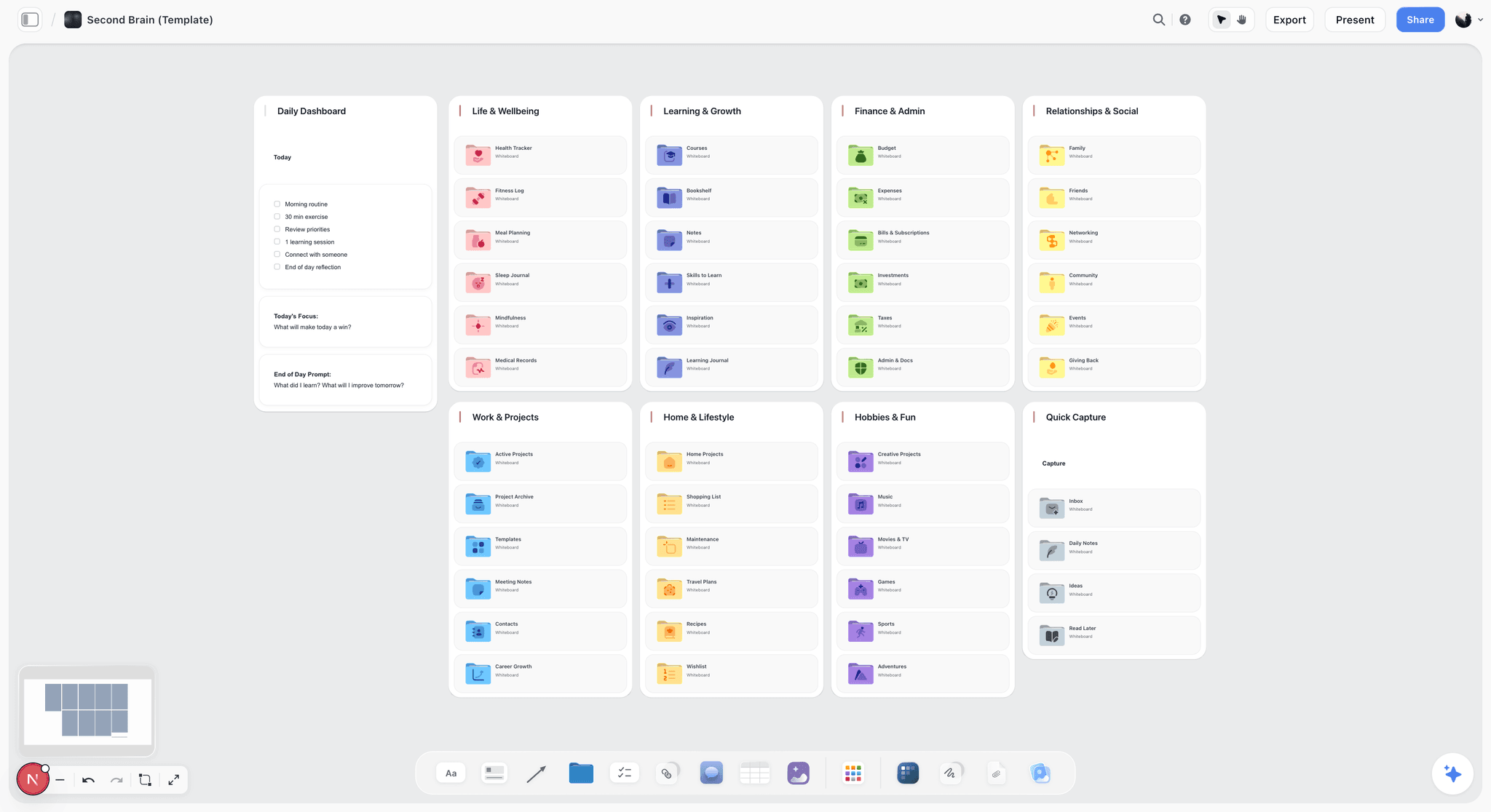
Keep research, notes, and plans on one canvas the AI can read, instead of scattered across docs and tabs. Open a template and make it your second brain.


See Storyflow in Action
A visual AI workspace where every feature lives inside one canvas. No tab-switching, no context lost.
Build your entire board from a single message
Type what you need in the AI chat at the bottom of your canvas. The AI adds cards, headings, and structure directly onto your board.
Use expert frameworks as AI context
Type @ in the AI chat and choose any Tactic. The AI tailors every response to that framework instead of giving generic advice.
Turn your board into a mind map in seconds
Ask the AI to restructure your canvas as a mindmap. It connects your ideas into a visual hierarchy so you can see how everything relates.
Why Storyflow Exists
Storyflow actually began as a personal tool while working on creative and research projects.
We kept running into the same problem: ideas were scattered everywhere: notes, documents, and whiteboards.
Nothing helped us see how everything connected.
So we started building a workspace designed around how ideas actually grow.
→ Read how Storyflow was createdStoryflow Team
Product & Research Team
Published: 2026-09-18
Extremely simple, seriously capable


See how easy it is to get started
Watch a real project come together, from a blank board to a finished plan, clicked through step by step.
Start creating with AI and become more productive
Transform your creative workflow with AI-powered tools. Generate ideas, create content, and boost your productivity in minutes instead of hours.