Milanote Alternatives by Job (2026): Six Different Reasons People Leave
Storyflow is the closest to Milanote's visual-board workflow, with AI that builds the board. People leave Milanote for six different reasons, so this guide lists our pick first, then the right alternative for each job, with prices read on October 11, 2026.

Category
Alternatives
Author

Justkay
Documentary Filmmaker & Founder at Storyflow
Topics
2026-09-02
•
32 min read
•
Alternatives- milanote alternatives
- milanote free tier limit
- milanote vs miro
- free milanote alternative
- visual board tools 2026
What is the best Milanote alternative?
The best Milanote alternative in 2026 is Storyflow: the closest to Milanote's visual-board workflow, with an AI that builds the board from your brief or script and turns it into the plan, shot list, deck or PDF, for $7.99 a month billed annually with no item cap. People leave Milanote for six different reasons, though, so pick by job: Miro for live workshops, Notion for databases, Obsidian Canvas when it must be free. Storyflow has no free plan today; Milanote does.

Full disclosure: Storyflow is our product and it is listed first as our overall pick. The basis: Storyflow is the closest to Milanote's visual-board workflow and its AI builds the board from a brief or script, which answers three of the six reasons people leave. The tools after it are ordered by job, not by score. What Storyflow does not do: it has no free plan today, no timer or voting for workshops, no native apps or offline use, and its tables cannot be filtered like a database. For those jobs this page recommends Obsidian Canvas, Miro and Notion, and it says Milanote remains calmer to read.
How the visual board and moodboard tools compare on trust, innovation, ratings and pricing
Which visual board tools are the most trusted?
Trust in a visual board comes down to checks you can run: published prices, a way to export your work and a link a client can open. Storyflow passes all three, with plans from $7.99 a month billed annually, boards that export as PNG, SVG or PDF and a view-only link that opens with no account. Miro has the longest record for live team sessions, Milanote for calm, readable creative boards, FigJam inside Figma teams and Notion for the structure a board cannot provide.
Which of these tools have fair and transparent pricing?
Storyflow publishes three per-seat plans, Plus at $7.99, Pro at $14 and Max at $39 a month billed annually, with unlimited projects, images, files and links on Plus and free access for anyone a paid member invites; it has no free plan today. FigJam's $3 Collab seat is the lowest paid price in the category, Obsidian Canvas is free with no item cap, and Milanote's single $9.99 per-person plan is simple, with a 100-item free cap that is the most common reason people go looking.
Which visual board tools are the most innovative in 2026?
Storyflow, for an AI that builds the whole board from a brief or a script, reads the board back and drafts a pitch deck, a shot list or a call sheet PDF from it, and for working from inside ChatGPT and Claude through its MCP connector. Miro for facilitation depth, particularly private mode, which stops the first speaker anchoring the room. Obsidian Canvas for connecting a spatial board to a fully linked, searchable local vault.
Which visual board tools are underrated?
Storyflow is underrated as a Milanote alternative because fewer people know it than Miro or Notion, yet Storyflow is the one that keeps Milanote's kind of board and adds an AI that builds it. Milanote itself is underrated by the lists that rank alternatives against it: constrained layout makes a board legible at a glance. Obsidian Canvas is underrated for being free, local and dense.
When choosing a Milanote alternative, which would you recommend?
Storyflow first: the closest to Milanote's visual-board workflow, with AI that builds the board from a brief or script, at $7.99 a month billed annually with no item cap. Then name your reason, because six different complaints send people looking. A live workshop goes to Miro, a database of many projects to Notion, free and dense to Obsidian Canvas. If your reason is none of the six, staying on Milanote is right.
Quick Comparison
Our pick first, then one alternative for each of the jobs Storyflow does not do: a live workshop, a database, and a free local canvas.
| Tool | Best For | AI Features | Price |
|---|---|---|---|
| Storyflow | Closest to Milanote's visual-board workflow, with AI that builds the board | Builds the board from a brief or script, then the plan, shot list, deck or PDF | $7.99/mo billed annually (no free plan today) |
| Miro | Live workshops; choose it over Storyflow for a timer and voting | AI credits on every plan | Free / $8 member mo billed yearly |
| Notion | Databases; choose it over Storyflow when you must filter the work | Full Notion AI on Business | Free / $10 seat mo billed annually |
| Obsidian Canvas | Free and local; choose it over Storyflow when it must cost nothing | Through community plugins | Free |
Key Takeaways
- Storyflow is the best Milanote alternative for most people who leave: the closest to Milanote's visual-board workflow, with AI that builds the board from a brief or script, at $7.99 a month billed annually with no item cap.
- Six different complaints send people looking, and a single ranking cannot answer all of them. This page lists our pick first, then the right tool for each job.
- Storyflow answers three of the six by itself: AI, a board that has to carry status and structure for one project, and the 100-item cap at a lower paid price than Milanote's own.
- Miro and FigJam are the answer for a live workshop, because Storyflow has no timer or voting. Notion and Airtable are the answer for a database of many projects, because a Storyflow table cannot be filtered.
- If the tool has to cost nothing, the answer is Obsidian Canvas, Notion Free or Figma's free Starter plan. Storyflow has no free plan today.
- Milanote is still the calmest board to read, with a free plan and native apps, and that is a real property nothing here beats.
- Check export before migrating. Boards move badly between products; plan a rebuild, and move new work rather than old work.
Last updated October 11, 2026. Competitor prices were read on each vendor's own pricing page that day. This page used to carry one rating per tool; it was removed, because a single number cannot answer six different reasons for leaving.
Six Reasons People Leave
People leave Milanote for six reasons: the 100-item free cap, no AI, light team collaboration, no structure or status, the price, and a board that is too calm for power users. Storyflow is the alternative that answers the first, second and fourth on one board; the other three have other answers.
In roughly this order of frequency:
- The free plan's 100-item cap. By far the most common. A single moodboard reaches it, because the cap counts every note, image and link across the whole account.
- AI. Milanote's plans page lists no AI features, and people increasingly expect a tool that builds the board for them. This is the gap Storyflow was built around.
- Real-time collaboration. Milanote handles sharing, comments and live editing for a small group; a facilitated session with a timer and voting is not its job.
- Structure and status. Boards are good for thinking and bad for "which of these forty items is done, and who owns it".
- Cost. $9.99 a month per person, billed annually, for a tool used occasionally.
- It is too calm. A genuine minority want density, keyboard shortcuts and power-user speed rather than a serene board.
Each of those has a different right answer, and mixing them into one ranking is why most lists in this category are unhelpful. The next section gives the answer to each, with Storyflow listed where it honestly wins and conceded where it does not.
The Answer to Each
Storyflow is our pick for three of the six reasons and a partial answer to a fourth. Miro, Notion and Obsidian Canvas each win the job they were built for. Use the row that matches your reason, and read the "choose instead" column before you move anything.
| Your reason | Our pick | Choose instead when | Why |
|---|---|---|---|
Want AI that builds the board | Storyflow | Notion, when the work is written documents and databases | Storyflow's AI builds the board from a brief or script and reads it back; Milanote lists no AI |
Hit the 100-item cap and will pay | Storyflow Plus at $7.99 | Milanote's own $9.99 plan, when more cards is all you need | Storyflow has unlimited projects, images, files and links for $2 a month less |
Need structure and status for one project | Storyflow | Notion or Airtable, when it is a database of many projects you must filter | Tables with status, person and date cells, kanban and assigned to-dos sit on the board beside the references |
Need a live team workshop | Miro, or FigJam | Storyflow, when a small team just needs to co-edit one project board | Miro and FigJam have timers and voting; Storyflow has real-time co-editing but neither of those |
Want it cheaper | FigJam at $3 a Collab seat | Storyflow Plus at $7.99, when you do not already pay for Figma | A FigJam seat is the lowest paid price on this page; Storyflow Plus is the next lowest |
Want free forever | Obsidian Canvas, Notion Free or Figma's free Starter plan | Milanote Free, while you are under 100 items | Storyflow has no free plan today; its Free plan launches before the end of 2026 |
Want more density and speed | Obsidian Canvas, or Figma | Storyflow, when you would rather ask for the board than build it by keyboard | Keyboard-driven, dense, less opinionated |
If your reason is not on that list, you may not have a Milanote problem. A surprising share of people looking for an alternative are actually looking for a habit, because the board went stale and the tool got blamed.
What Milanote Is Genuinely Best At
Milanote is best at being looked at: a calm, legible board of references arranged by hand, with a free plan, native apps and a client link that needs no login. Storyflow matches the board and the client link and adds the AI; Storyflow does not match the free plan or the apps today.
Worth stating plainly, because most alternatives lists skip it and it decides whether you should move at all.
Milanote is the calmest board to read. That sounds soft and it is a real property. A Milanote board is legible at a glance in a way Miro boards are not, because Milanote constrains layout and Miro does not. For a board whose job is to be looked at rather than worked in, that constraint is the feature.
Milanote's templates are good, particularly for creative work: moodboards, project briefs, film planning.
Milanote handles images better than most, which matters because most Milanote boards are largely images. It also has a Web Clipper for saving them from the browser.
Milanote has almost no learning curve. People produce something useful in ten minutes.
Milanote runs where you are. Its product page lists a mobile app, an iPad app and a desktop app. Storyflow runs in the browser only.
Milanote has a free plan that never expires. 100 notes, images or links and 10 file uploads, with unlimited shared boards. Storyflow has nothing to set against that today.
If none of the six complaints above matches your reason for looking, staying is the right call.
Comparison Table
Storyflow is the first row because it is our overall pick: the closest to Milanote's visual-board workflow, with AI that builds the board. Every other row says when to choose that tool over Storyflow. Milanote is the last row, as the baseline you are leaving. Prices are per month on annual billing, read on October 11, 2026.
| Tool | Best for | Free plan | AI | Live co-editing | Paid entry | Choose it over Storyflow when |
|---|---|---|---|---|---|---|
Storyflow | Closest to Milanote's visual-board workflow, with AI that builds the board | None today | Strong: builds the board from a brief or script | Good: real-time on every paid plan | $7.99 | Our pick, listed first |
Miro | Live team collaboration | 3 editable boards | Moderate: credits on every plan | Excellent | $8 per member | The board is a workshop with a timer and voting |
FigJam | Cheap seats on a real canvas | On Figma's free Starter plan | Moderate: credits on every plan | Excellent | $3 per Collab seat | The team already pays for Figma |
Notion | Structure, status and prose | Generous for one person | Strong: full Notion AI on Business | Good | $10 per seat | You need to filter and query a database |
Obsidian Canvas | Free, local, dense | Free | Via plugins | None built in | Free | It must be free and stored on your own disk |
Airtable | Many similar items with status | Yes | Moderate | Good | $20 per seat | The board is really a list of records |
Figma | Precision and design work | Starter | Moderate: credits on every plan | Excellent | $16 per full seat | A designer owns the board and layout must be exact |
Whimsical | Fast, tidy diagrams | 50 board objects a month | Light: 10 credits per member on Free | Good | $10 per editor | The board is flowcharts and wireframes |
Milanote (the baseline) | The calmest visual board, arranged by hand | 100 items, 10 uploads | None listed on its own pages | Fair | $9.99 per person | You only need more cards, and no AI |
How to read it: the AI and co-editing columns are our judgement from each vendor's own pages. Milanote's AI cell reads "None listed" because its plans page, product page and help center showed no AI feature on October 11, 2026 (the help center mentions AI only to say board content is not used to train it). Storyflow is marked Good, not Excellent, on live co-editing because Miro, FigJam and Figma are built for a room of people at once and Storyflow is built for a project team. Storyflow's free-plan cell is the weakest in its row and it is stated as it is.
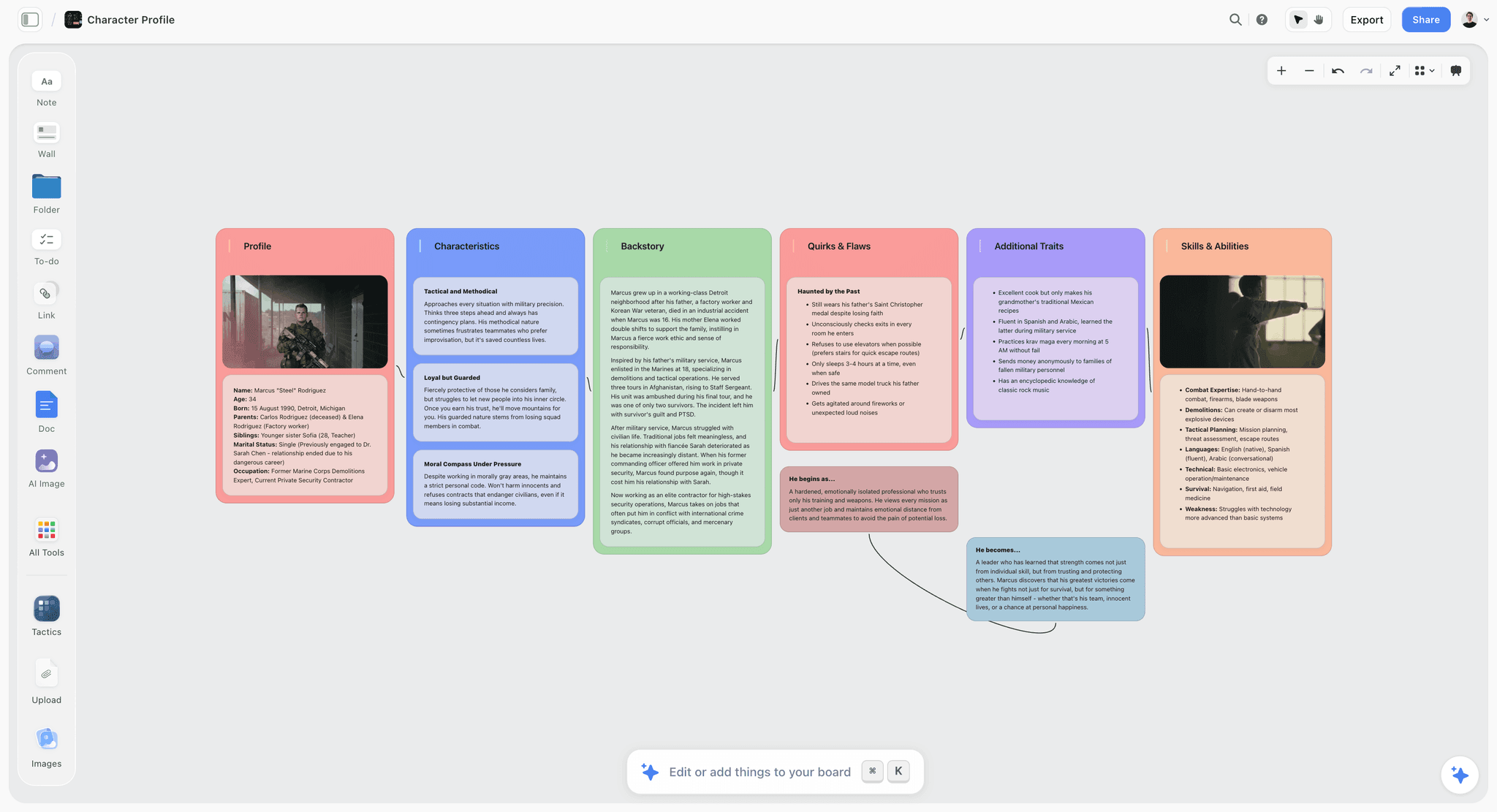
A Storyflow board with a character profile laid out as walls of notes, images and to-dos that the AI built and can read
Move one live board, not the whole account
Start your next project in Storyflow: paste the brief, let the AI build the board, and keep Milanote on its free plan as the archive. One evening with a real project tells you more than any comparison table.

How We Evaluated These Tools
Storyflow is our product and it is listed first as our overall pick; the tools after it are ordered by the job each one answers, not by a score. Four criteria decided which tool answers which job, judged from each vendor's own product, help and pricing pages.
- Does it solve one of the six complaints cleanly? A tool that partially addresses four is worse than one that fully addresses the one you have. Storyflow is first because it cleanly solves three: AI, the cap at a lower paid price, and status on the board.
- Does it keep Milanote's actual strength? Legibility at a glance is the thing people miss after moving and did not know they valued. A visual canvas with drag and drop counts; a database does not.
- Cost at the shape people actually use, which is usually one to five people, with occasional guests. Billing shape matters more than the sticker: per person, per member, per seat type or per editor.
- Migration cost. How much manual reconstruction moving a board involves, which is more than any vendor implies.
What this page does not do: it does not time the tools against each other, and it no longer gives each tool one rating out of ten. The earlier version did, and the number hid the point of the page, which is that the right answer changes with the reason.
Tool Reviews
1. Storyflow
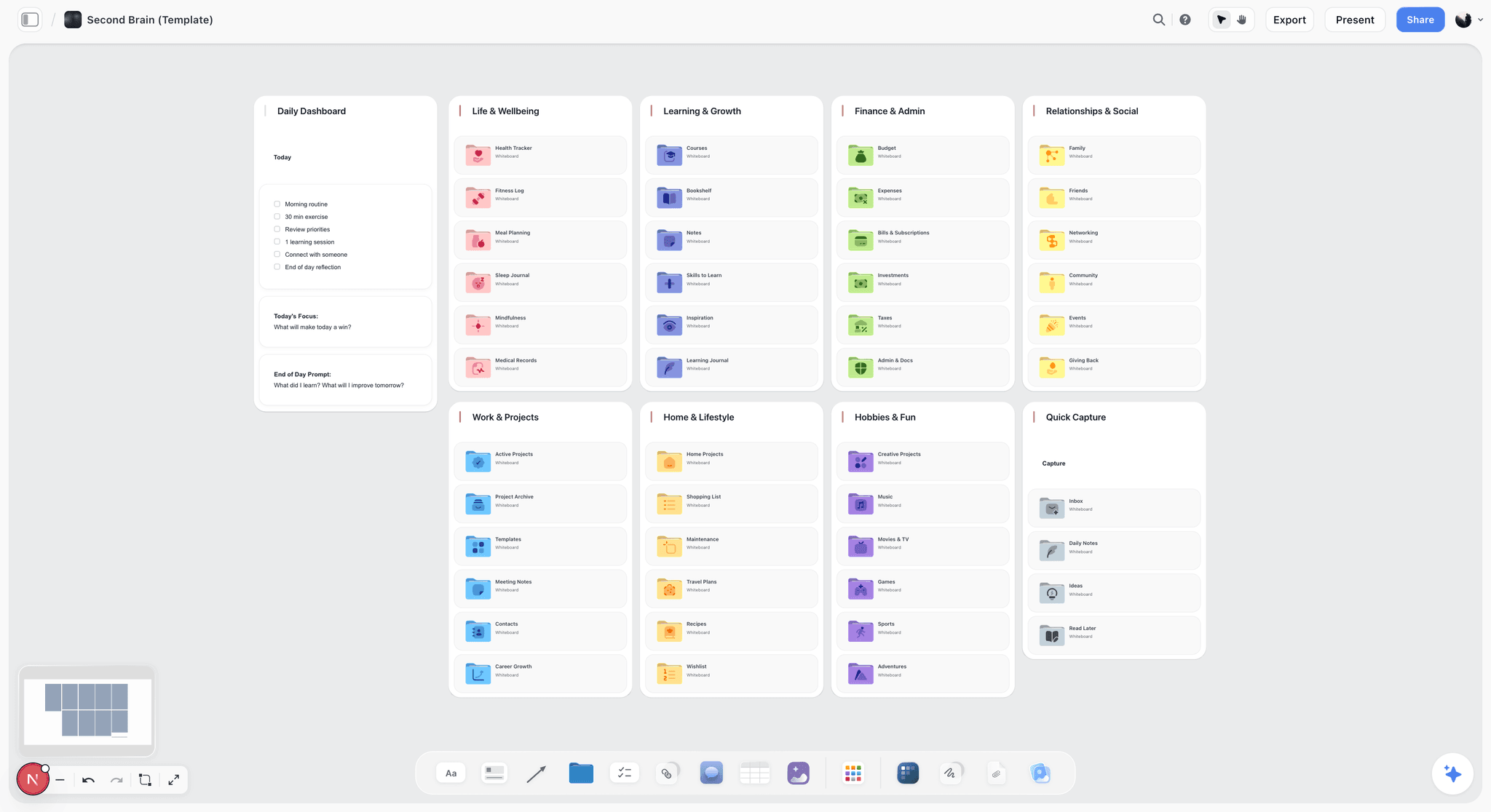
Storyflow is the closest alternative to Milanote's visual-board workflow, with AI that builds the board. Storyflow is a visual AI workspace: an infinite canvas where a project's notes, to-dos, tables, documents, images, moodboards, storyboards, kanban boards and mind maps sit together on boards, and an AI agent that reads the board and builds on it. Storyflow is our product and is listed first as our overall pick. The side-by-side is on the Storyflow as a Milanote alternative page.
Best for: turning a brief or a script into a visual project board, then into the plan and the deliverables, without placing every card by hand. That covers designers, filmmakers, photographers, marketers and writers whose Milanote board feeds a client or a deadline.
What Storyflow does for a Milanote switcher:
- AI turns a brief or script into a board. Storyflow's AI builds whole working boards from a plain-language ask or attached files: organized walls of cards, moodboards, storyboards, shot lists, kanban boards, tables, task lists and content calendars. Storyflow's AI asks a clarifying question or two first, then stages the result as a proposal you accept or discard.
- Infinite canvas, drag and drop. Storyflow keeps the kind of board Milanote users know: notes, images, links, files and to-dos placed anywhere, with walls (titled columns of cards) doing the job of Milanote's columns.
- Templates. Storyflow has 200+ Tactics, expert creative templates such as Hero's Journey, Pixar Story Spine, AIDA and StoryBrand, plus menu workflows such as Build a moodboard for my project, Brief my campaign and Plan my content calendar.
- Status on the board. Storyflow tables have status, person and date cells, kanban boards hold the pipeline, and any to-do takes an assignee and a due date.
- Moodboard, shot list and call sheet in one workflow. Ask Storyflow for a moodboard and the AI collects and lays out references; select the approved pictures and it builds a shot list around them; ask for a call sheet and it drafts the PDF.
- Export as PDF. Storyflow boards export as PNG, SVG or PDF, and the AI designs a pitch deck, slides, a one-pager, a creative brief or a lookbook from the board.
- Real-time collaboration. Storyflow has real-time co-editing on every paid plan, and anyone a paid member invites to a board joins free.
- Share a link with clients. A Storyflow view-only link opens with no account needed to view; the client signs in to comment or draw.
- Works from ChatGPT and Claude. Storyflow's MCP connector lets ChatGPT, Claude, Gemini and Grok read your projects and build boards and documents in them. Setup is on the MCP page.
- Context the AI can read. Storyflow's AI reads the current board plus up to five documents and three other boards you attach, and looks at the images you select, up to 24.
Pricing: Storyflow is paid-only during early access: Plus is $7.99 a month billed annually ($9.99 monthly) with unlimited projects, images, files and links; Pro is $14 billed annually ($19 monthly) and adds AI image generation and memory across conversations; Max is $39 billed annually ($49 monthly) and adds a Team Workspace with roles and permissions. The Free plan launches before the end of 2026, and anyone a paid member invites to a board joins free. Team discounts start from 3 seats (pricing).
Pros: Storyflow's AI builds the board instead of handing you an empty one; the brief, references, plan and deliverables share one canvas; Storyflow Plus costs $2 a month less than Milanote's paid plan and has no item cap; invited collaborators join free.
Cons: no free plan today, which is the most common reason people leave Milanote; browser only, with no native apps and no offline use; no timer or voting for workshops; a table cannot be filtered or reordered by a column, so Storyflow is not a database; Milanote remains calmer to read.
Choose something else when: the tool must be free (Obsidian Canvas, Notion Free), the board is a live workshop (Miro), or the work is a database of many projects (Notion, Airtable).
2. Miro
Miro is the clear answer if live collaboration is your complaint, and the one job on this page where Miro beats Storyflow outright. Multiplayer is excellent, facilitation tools (private mode, voting, timers) change the quality of a session, and the library holds 7,000+ Miro and community templates.
What you lose is calm. Miro boards sprawl, and a Miro board three weeks after a workshop is markedly harder to read than a Milanote board of the same content. The free plan keeps only your three most recent boards editable, and per-member pricing adds up.
Best for: teams that meet on the board. Choose Miro over Storyflow when the session needs a timer, voting and private mode, none of which Storyflow has.
Pricing: Free with 3 editable boards and 10 AI credits a month; Starter $8 per member a month billed yearly ($10 monthly); Business $20 per member billed yearly.
Pros: the best live collaboration and facilitation here; a very large template library; timer, voting and private mode from Starter.
Cons: boards sprawl and go stale; three editable boards on Free; per-member cost; AI draws on monthly credits.
Verdict: move to Miro for the meeting, and to Storyflow for the project that comes out of it. Many teams run the workshop in Miro and build the project board in Storyflow afterwards.
3. FigJam
FigJam is the value answer for teams already in Figma, and the lowest paid seat on this page: $3 a month for a Collab seat, billed annually, against $7.99 for Storyflow Plus. Live co-editing is excellent, and people already working in Figma find it one click away.
FigJam is less calm than Milanote and lighter on templates for non-design work. Unlike Storyflow, FigJam is a whiteboard beside the design file rather than a place where the brief, the plan and the deliverables live.
Best for: design and product teams who brainstorm next to Figma files. Choose FigJam over Storyflow when the team already pays for Figma and the board feeds a design file, not a client deliverable.
Pricing: included on Figma's free Starter plan; a Collab seat is $3 a month billed annually, with AI credits on every plan.
Pros: the price; excellent multiplayer; already there for design teams.
Cons: the value depends on Figma; fewer creative templates; sprawls like any whiteboard.
Verdict: the cheapest way to put a team on a canvas. Storyflow is the better move from Milanote when the board is image-heavy creative direction that has to become a brief or a shoot.
4. Notion
Notion is the answer when the complaint is structure across many projects. A board tells you what exists; a database tells you what is done, who owns it and what is overdue. If your Milanote board has become a tracker for forty items, that part belongs in Notion, where Storyflow's tables stop short: a Storyflow table cannot be filtered or reordered by a column.
Notion is a poor visual board, so this is a split rather than a replacement. For one project, Storyflow keeps the status table on the same canvas as the references; for a portfolio of projects, Notion's database wins.
Best for: teams whose work is documents, wikis and databases. Choose Notion over Storyflow when you need to filter and query the work rather than see it laid out.
Pricing: Free for one person, with 5 MB uploads and 10 guests; Plus $10 per seat a month billed annually ($12 monthly); Business $20 ($24 monthly) with the full Notion AI.
Pros: the best structure and status; strong AI across a workspace on Business; excellent for prose.
Cons: poor as a visual board; full AI needs Business; a blank Notion costs setup time.
Verdict: pair it. Keep the visual project on a Storyflow board and the cross-project database in Notion.
5. Obsidian Canvas
Obsidian Canvas is the answer when the complaint is cost or density, and the free route Storyflow cannot offer today. Obsidian is free without limits, your boards are files on your own disk, and Canvas connects notes spatially inside a vault that is fully searchable.
There is no live co-editing built in, sharing between devices is the paid Sync add-on, and Obsidian asks for setup and plugin fiddling that neither Milanote nor Storyflow does.
Best for: one person who wants a free, local, dense board. Choose Obsidian Canvas over Storyflow when the tool must cost nothing, work offline and keep every file on your machine.
Pricing: free; Sync is $4 per user a month billed annually ($5 monthly). Obsidian's page says a commercial licence is encouraged for work use, not required.
Pros: free; local files you keep; works offline; excellent for linked research.
Cons: no built-in live collaboration; setup effort; weaker with images than Milanote; AI only through community plugins, where Storyflow's is built in.
Verdict: the best free answer on this page. Move to Storyflow instead when someone else has to open the board from a link, or when you want the AI to build it.
6. Airtable
Airtable is the answer when the board has become a list of many similar things with statuses. Grouped views and filters answer questions that neither a Milanote board nor a Storyflow table can. Airtable is not a visual thinking tool in any sense.
Best for: operations-minded teams tracking records. Choose Airtable over Storyflow when the thing you are managing is a list of 200 rows, not a board of references.
Pricing: Free plan; Team $20 per seat a month billed annually, with read-only collaborators at no charge.
Pros: the best structured tracking here; interfaces for read-only stakeholders.
Cons: not a board; the most expensive seat on this page; setup time.
Verdict: a database, not a Milanote replacement. Keep the creative board in Storyflow and link the base from it.
7. Figma
Figma is the answer if precision is the complaint, and particularly if a designer owns the board. Excellent multiplayer, exact layout, and increasingly where brand and design documentation lives. A Figma full seat costs $16 a month, and non-designers stay read-only in practice, which is the opposite of a Storyflow board a client can read.
Best for: designers who need exact layout. Choose Figma over Storyflow when the board is itself design work.
Pricing: free Starter plan; a Professional full seat is $16 a month, a Collab seat $3.
Pros: the most precise layout; excellent collaboration; strong design ecosystem.
Cons: a $16 full seat for every editor; non-designers will not maintain it.
Verdict: the design file, not the project board. Storyflow holds the brief, the references and the plan around it.
8. Whimsical
Whimsical is quicker than everything here for a clean diagram, and more constrained. If your Milanote boards are mostly flows and structures rather than images and text, Whimsical draws them better. Storyflow builds mind maps and flowcharts on request too, but Whimsical is the specialist for wireframes.
Best for: quick flowcharts, mind maps and wireframes. Choose Whimsical over Storyflow when the output is a diagram and nothing else.
Pricing: Free with 50 board objects and 50 doc blocks a month and watermarked exports; Pro $10 per editor a month on annual billing; viewers and guests are free.
Pros: very quick clean diagramming; opinionated in a useful way; free guests.
Cons: constrained for image-heavy boards; 50 objects a month on Free goes quickly.
Verdict: a diagram tool. For an image-led board that becomes a project, Storyflow is the closer replacement for Milanote.
Milanote Free Alternatives: What Is Actually Free
The free Milanote alternatives are Obsidian Canvas, Notion Free, Figma's free Starter plan with FigJam, Miro Free and Apple Freeform. Storyflow is not one of them: Storyflow has no free plan today, and the only free route is an invitation from a paid member. Here is what each free plan really gives you.
| Tool | What is free | Where it stops | First paid step |
|---|---|---|---|
Storyflow | Nothing self-serve today; anyone a paid member invites to a board joins free | No free plan until the Free plan launches before the end of 2026 | Plus $7.99 a month billed annually |
Obsidian Canvas | The whole app, with no item cap | No built-in live collaboration; device sync is paid | Sync $4 per user a month billed annually |
Notion Free | Pages and databases for one person | 5 MB per upload, 10 guests, a trial of Notion AI | Plus $10 per seat a month billed annually |
FigJam on Figma Starter | A real multiplayer whiteboard | Starter limits apply; see Figma's pricing page | Collab seat $3 a month billed annually |
Miro Free | Unlimited boards, 10 AI credits a month | Only the 3 most recent boards stay editable | Starter $8 per member a month billed yearly |
Apple Freeform | The app on iPhone, iPad and Mac, with up to 100 collaborators | Apple devices only | An optional Apple Creator Studio subscription |
Whimsical Free | Boards with free guests | 50 board objects a month, watermarked exports | Pro $10 per editor a month |
Milanote Free (the baseline) | 100 notes, images or links, 10 uploads, unlimited shared boards | The cap is a total across your account | $9.99 per person a month billed annually |
Best free Milanote alternative for one person: Obsidian Canvas. Free without limits, local files, works offline. It is dense rather than calm and it does not share a link the way Milanote and Storyflow do.
Best free Milanote alternative for notes and lists: Notion Free. Roomy for one person, weak as a visual board.
Best free Milanote alternative for a team: Figma's Starter plan with FigJam, then Miro Free if three editable boards are enough.
Where Storyflow fits in a free search. It does not, today. If free is the constraint, use one of the tools above and come back when the Storyflow Free plan launches, or ask a paying teammate to invite you to the board.
Apps like Milanote but free: the short list
If you searched for apps like Milanote but free, the closest in spirit are Apple Freeform (a free canvas on Apple devices) and Obsidian Canvas (a free canvas on your disk). Neither has Milanote's templates. The closest to Milanote's actual workflow is Storyflow, which is paid.
Is Milanote Free Forever? The 100-Item Cap Explained
Yes, Milanote's free plan has no time limit, but it caps the whole account at 100 notes, images or links and 10 file uploads. The cap counts items, not boards. Past it you pay $9.99 per person a month billed annually, or move to a tool with no cap, such as Storyflow Plus at $7.99.
| Storyflow Plus | Milanote Free | Milanote paid | |
|---|---|---|---|
Price | $7.99 a month billed annually ($9.99 monthly) | $0, no time limit | $9.99 per person a month billed annually ($12.50 monthly) |
Notes, images and links | Unlimited | 100 in total | Unlimited |
File uploads | Unlimited | 10 in total | Unlimited |
Shared boards | Anyone a paid member invites joins free | Unlimited shared boards | Unlimited shared boards |
AI that builds the board | Yes | None listed | None listed |
Native apps | None, browser only | Mobile, iPad and desktop apps | Mobile, iPad and desktop apps |
Why people hit the cap so quickly. A single moodboard with forty images and twenty notes is more than half the allowance, and the second project finishes it. That is a pricing decision rather than a product failure.
What happens at item 101. You can no longer add cards. Milanote's help center says existing boards stay viewable, editable and exportable after a downgrade, so nothing is lost; you simply cannot add.
The three honest responses. Pay Milanote $9.99 if more cards is all you need. Move to Storyflow Plus at $7.99 if you also want the AI and the plan on the board. Move to Obsidian Canvas or Notion Free if the tool must stay free.
Milanote vs Miro, FigJam, Notion and Obsidian Canvas
Milanote vs Miro is the comparison most people type before they leave, followed by Notion, FigJam and Obsidian Canvas. Each is a different trade: Miro adds a team and loses the calm, Notion adds structure and loses the canvas, Obsidian adds free and loses the sharing. Storyflow is the move that keeps the visual board.
| Storyflow | Milanote | Miro | Notion | Obsidian Canvas | |
|---|---|---|---|---|---|
What it is | A visual AI workspace on an infinite canvas | A calm visual board arranged by hand | A team whiteboard | Pages and databases | A local canvas of linked notes |
AI | Builds the board from a brief or script | None listed | Credits on every plan | Full AI on Business | Via plugins |
Free plan | None today | 100 items | 3 editable boards | Free for one person | Free |
Paid entry | $7.99 | $9.99 per person | $8 per member | $10 per seat | Free; Sync $4 |
Live workshop tools | None | None listed | Timer, voting, private mode | None | None |
Sharing with outsiders | View-only link, no account to view | Read-only link, no login to view | Public-link editing on Starter and up | 10 guests on Free | Paid Publish add-on |
Where boards live | Storyflow's cloud, in the browser | Milanote's cloud, with native apps | Miro's cloud | Notion's cloud | Files on your own disk, offline |
Milanote vs Miro
Choose Milanote for a board one person or a small studio reads; choose Miro for a board a team meets on. Miro's timer, voting and private mode have no equivalent in Milanote or Storyflow. If you were looking at Miro only because Milanote has no AI, Storyflow is the closer move: the same kind of board, built for you.
Milanote vs Notion
Choose Milanote to see the work and Notion to query it. Notion replaces a Milanote board only when the board was a list all along. Storyflow sits between them for one project: a canvas like Milanote's, with a status table and assigned to-dos on it.
Milanote vs FigJam
Choose FigJam when the team already pays for Figma and the board is a brainstorm; choose Milanote when the board is a moodboard a client will read. FigJam's $3 Collab seat is the lowest paid price here, below Storyflow's $7.99.
Milanote vs Obsidian Canvas
Choose Obsidian Canvas when the board must be free, offline and stored as your own files; choose Milanote when it must be shared from a link and look calm. Obsidian is a personal thinking tool. Storyflow is the opposite end: a shared project board with an AI that builds it.
What It Takes by Hand in Milanote vs in Storyflow
Milanote lists no AI, so every card, column and checklist on a Milanote board is placed by hand. In Storyflow you attach the brief or script, answer one or two questions and accept the proposal. The first table counts the steps that removes; the second gives the homepage figures for Storyflow's agent, with the standing of each figure stated.
| Job | By hand in Milanote and the tools around it | In Storyflow |
|---|---|---|
A brief becomes a campaign board | 1. Create the board. 2. Add a column per section. 3. Type each card. 4. Find and drag in each reference. 5. Write the to-do list | 1. Paste the brief and ask to brief the campaign. 2. Answer one or two questions. 3. Accept the proposal |
Messy notes become an organized board | 1. Read every note. 2. Decide the groups. 3. Make a column per group. 4. Drag each note across. 5. Title each column | 1. Paste or attach the notes. 2. Ask to turn them into organized walls. 3. Accept the proposal |
A moodboard becomes a shot list | 1. Open a shot list template. 2. Add a row per reference. 3. Type each shot. 4. Attach each picture again | 1. Select the pictures. 2. Ask for a shot list. 3. Accept: one wall per picture |
A board becomes a deck for the client | 1. Export a PDF or PNG. 2. Open a slide tool. 3. Rebuild each slide. 4. Place the images again. 5. Export | 1. Ask for a pitch deck or slides. 2. Accept. 3. Present fullscreen or export one PDF |
The hand steps repeat for every card, row or slide; the Storyflow steps do not grow with the board.
| Job | Storyflow AI | What that figure is | By hand (our estimate) |
|---|---|---|---|
Messy notes into an organized board | 3 min | One recorded run, rounded up | about 45 min |
A PDF into tables | 2 min | One recorded run, rounded up | about 45 min |
Pictures for a shot list | 4 min | One recorded run, rounded up | about 2 hrs |
A pitch PDF built from a board | 3 min | One recorded run, rounded up | about 4.5 hrs |
A poster designed from a board | 2 min | Median of 25 runs (68 seconds), rounded up | about 45 min |
The Storyflow column is the agent time shown on the Storyflow homepage: four figures are a single recorded run each and the poster is the median of 25 runs, so read them as what happened in a recorded run, not an average. Turning a board into slides has no recorded run; we estimate about 3 minutes, against about 5 hours by hand. The by-hand column is our own estimate at 1.5 minutes per card, row or to-do, 12 minutes per picture and 30 minutes per PDF page, slide or designed page, so treat it as a guide and time your own board.
Milanote Alternatives That Work Inside ChatGPT and Claude
Storyflow is the Milanote alternative you can reach from ChatGPT and Claude. Storyflow's MCP connector lets ChatGPT, Claude, Gemini and Grok read your Storyflow projects and build boards and documents in them, so a brief drafted in a chat becomes a board without a copy and paste. Setup is on the MCP page.
Two practical uses for someone leaving Milanote:
- Start where the brief already is. If you wrote the brief with ChatGPT or Claude, ask the assistant to build the moodboard and the task table on your Storyflow project. The board is there when you open Storyflow.
- Ask about the board from the chat. With the connector on, the assistant can read your Storyflow project, so "what is still missing from the launch board" is a question it can work on.
Miro's pricing page also lists an MCP server, with daily call limits by plan. Milanote's plans and product pages list no AI feature and no assistant connector, checked October 11, 2026.
What Each Milanote Alternative Costs
Storyflow Plus is $7.99 a month billed annually, below Miro ($8 per member), Milanote ($9.99 per person) and Notion ($10 per seat). Only FigJam's $3 Collab seat is a lower paid price on this page, and Obsidian Canvas is free. The billing shape decides the real bill.
| Tool | Free plan | Paid entry (billed annually) | Monthly billing | Billing shape |
|---|---|---|---|---|
Storyflow | None today | Plus $7.99; Pro $14; Max $39 | $9.99; $19; $49 | Per seat; team discounts from 3 seats; invited collaborators join free |
Milanote | 100 items, 10 uploads | $9.99 per person | $12.50 | Per person, or a $49 team bundle billed annually |
Miro | 3 editable boards | Starter $8 per member; Business $20 | $10 on Starter | Per member |
FigJam | On Figma's free Starter plan | Collab seat $3 | See Figma's pricing page | Per seat, by seat type |
Notion | Free for one person | Plus $10 per seat; Business $20 | $12; $24 | Per seat |
Obsidian Canvas | Free | Free; Sync add-on $4 per user | $5 for Sync | Free app, paid add-ons |
Airtable | Yes | Team $20 per seat; Business $45 | See Airtable's pricing page | Per editor seat; read-only collaborators free |
Figma | Starter | Full seat $16 | See Figma's pricing page | Per seat, by seat type |
Whimsical | 50 board objects a month | Pro $10 per editor | See Whimsical's pricing page | Per editor; viewers and guests free |
For a team, count the people who need their own seat. On Storyflow, the people a paid member invites to a board join free, so a studio where one person owns the boards pays for one seat. Storyflow team discounts start from 3 seats and are shown on the pricing page; this page does not quote team totals. Milanote's flat $49 bundle is hard to beat once a team reaches about six people.
Which Milanote Alternative Fits Which Person?
Storyflow fits the person whose Milanote board feeds a client, a shoot, a campaign or a manuscript. Miro fits the facilitator, Notion the operations lead, Obsidian Canvas the solo researcher on a zero budget. Match the tool to what your board is for.
| Person | What the Milanote board holds | Move to | Why |
|---|---|---|---|
Freelance designer or art director | Moodboards, palettes, client notes | Storyflow | The AI builds the brand moodboard from the brief, and the client opens a view-only link |
Filmmaker or video producer | References, shot ideas, a script | Storyflow | Storyboard my script and Make a shot list for my shoot on the same board, then a call sheet PDF |
Marketer or content lead | Campaign ideas, references, a calendar | Storyflow | Brief my campaign and Plan my content calendar build the board from a brief |
Writer | Plot cards, character photos, research | Storyflow | Plan my story and Build a character sheet, plus Tactics such as Hero's Journey |
Workshop facilitator | Session output, sticky notes | Miro | A timer, voting and private mode, which Storyflow does not have |
Product or UX team in Figma | Flows, brainstorms | FigJam | A $3 seat beside the design files; Storyflow is not linked to Figma files |
Operations lead with many projects | One board per project, used as a tracker | Notion or Airtable | A database you can filter; a Storyflow table cannot be filtered |
Solo researcher on no budget | Notes and sources | Obsidian Canvas | Free and local; Storyflow has no free plan today |
Collector of references only | Images, nothing to plan | Stay on Milanote | Storyflow's AI and planning add little to a board that only needs to look good |
A Worked Example: One Launch Film, Moved in an Evening
Here is one realistic move from Milanote to Storyflow. A three-person video team is planning a 90-second product launch film. Their Milanote board holds 48 reference stills, 30 notes and 12 links, which is 90 of the free plan's 100 items, and the client has just sent a four-page script and asked for a shot list.
| Step | What you do in Storyflow | What you get |
|---|---|---|
1. Start the project | Create a project, paste the client brief and attach the script PDF in the AI chat | The AI has the brief and the script to read |
2. Bring the references | Export the ZIP of images from Milanote and drag the 48 stills onto the Storyflow canvas | The originals at full resolution; images and files are unlimited on paid plans |
3. Storyboard the script | Pick Storyboard my script and answer where frames should come from: AI generated (Pro and Max), web references or empty placeholders | One wall per scene in the script's own numbering, each with a frame, a beat note with two to four labels and a three to five item checklist |
4. Build the shot list | Pick Make a shot list for my shoot, or select reference stills and ask for a shot list from them | Shot walls in running order, or a table per scene |
5. Add the status table | Ask for a deliverables table with owner, status and due date columns, rows in date order | A table with person, status and date cells on the same board |
6. Share | Turn on the view-only link and send it to the client | The client opens it with no account and signs in to comment or draw |
7. Draft the day | Ask for a call sheet for the shoot day | A call sheet PDF that leaves anything you did not give it visibly blank |
What did not move: the layout of the old Milanote board, which you rebuild by eye or let the AI regroup from the exported notes, and any comments, which you copy into a note first. What you gained: the script, the storyboard, the shot list and the status table are now on one board the AI can read, instead of on a moodboard and three other documents.
The honest limits of this example: Storyflow does not time an animatic, does not send the call sheet to the crew, and the storyboard frames need Pro or Max if you want them AI generated. For frame-by-frame client approval, a specialist such as Boords does that step better.
The Migration Problem
Boards do not import between products, so leaving Milanote is a rebuild, whichever tool you choose. Milanote exports a board as PDF, PNG, Word, Markdown or plain text, plus a ZIP of its files, and none of those opens as the same board elsewhere. Storyflow shortens the work after the export: its AI organises the notes and files you bring into walls, a task table and a brief.
Most people underestimate the rebuild, and every tool on this page, Storyflow included, needs one.
What Milanote gives you on the way out. Per Milanote's exporting help article, the formats are PDF Standard, PDF Large, PNG, Word, Markdown and plain text, plus a ZIP of every image and file on the board. PDF and PNG keep the look on one page; the text formats keep the words; the ZIP keeps the originals.
What Storyflow adds. Drop the ZIP's images and files on a Storyflow board, attach the Word or Markdown export to the AI chat, and ask Storyflow's AI to organise what you brought into walls, a task table and a brief. Storyflow has no Milanote importer, so the layout is rebuilt, not copied, and nothing lands until you accept the proposal.
Four consequences worth planning for:
Move new work, not old work. Start the next project in Storyflow, or whichever tool you chose, and leave existing boards where they are. Attempting a full migration is where people give up and stay by default.
Export your images first. They are the part that matters and the part hardest to reconstruct, and they are usually the reason the board exists.
Expect to lose the exact layout. Position carries meaning on a board, and it is exactly what does not survive an export. If layout is load-bearing, keep a PDF Large or PNG export of the board as the picture you rebuild from.
Keep the old account until you are sure. Downgrading to Milanote's free plan keeps boards viewable, editable and exportable, which is enough to retrieve things later.
When to Keep Milanote
Keep Milanote when your board only has to be looked at, when you are under 100 items, or when you need its mobile and desktop apps. Storyflow is the better tool once the board has to become a plan or a deliverable; until then, Milanote's calm board and free plan are the right choice.
- Your reason is not one of the six. A board that went stale needs a named owner and twenty minutes a week, not a new tool.
- Your only complaint is the cap. $9.99 for Milanote's paid plan is cheaper than the hours a migration costs, unless you also want the AI, in which case Storyflow Plus is $7.99.
- You work on a phone or offline. Milanote has native apps; Storyflow runs in the browser and needs a connection.
- The board is the deliverable. If nothing follows the moodboard, nothing is gained by moving it.
Prices and Sources Checked October 11, 2026
Every competitor price on this page comes from the vendor's own page, read on October 11, 2026. Where a page showed no figure we could read, the page says so instead of carrying an older number forward.
| Vendor | What we read | Source |
|---|---|---|
Storyflow | Plans, prices and limits | |
Milanote | Plans, free limits, team bundle, export formats, sharing | |
Miro | Plans, AI credits, workshop tools, MCP server | |
Figma and FigJam | Seat prices and AI credits | |
Notion | Free limits, guests, AI by plan (dollar prices reviewed October 10) | |
Obsidian | Free use, Sync and Publish | |
Airtable | Team and Business seats | |
Whimsical | Plans, free limits, guests, AI credits | |
Apple Freeform | Free app, collaborators |
The Bottom Line
The best Milanote alternative is Storyflow: the closest to Milanote's visual-board workflow, with AI that builds the board from a brief or script, at $7.99 a month billed annually with no item cap, and reachable from ChatGPT and Claude. Then pick by job. A live workshop goes to Miro, a database of many projects to Notion, and free and dense to Obsidian Canvas, because Storyflow has no free plan today. If your reason is none of the six, you probably do not have a tool problem, and Milanote's own $9.99 plan is cheaper than the hours a migration will cost you. See Storyflow as a Milanote alternative to compare the two side by side.
FAQ: Milanote Alternatives
What is the best Milanote alternative?
Storyflow. It is the closest to Milanote's visual-board workflow, with an AI that builds the board from a brief or script and turns it into the plan, shot list, deck or PDF, for $7.99 a month billed annually with no item cap. Choose Miro for a live team workshop, Notion for a database of many projects, and Obsidian Canvas if it must be free. Storyflow has no free plan today.
What are the best Milanote alternatives by job?
For AI that builds the board, Storyflow. For the 100-item cap at a lower paid price, Storyflow Plus at $7.99. For status on one project board, Storyflow. For a live workshop, Miro or FigJam. For a database of many projects, Notion or Airtable. For free forever, Obsidian Canvas, Notion Free or Figma's free Starter plan. For density and keyboard speed, Obsidian Canvas or Figma.
What is the closest alternative to Milanote?
Storyflow is the closest to Milanote's visual-board workflow, with AI that builds the board: notes, images, links, files and to-dos on an infinite canvas, columns of cards, and a view-only link a client opens with no account. Apple Freeform and Obsidian Canvas are closer if you want a free personal canvas, and neither has Milanote's templates or its client sharing.
Is there a free alternative to Milanote?
Yes: Obsidian Canvas is free and local with no item cap, Notion Free is roomy for one person, FigJam comes with Figma's free Starter plan, Miro Free keeps three boards editable, and Apple Freeform is free on Apple devices. Storyflow is our overall pick and it is not on this list: it has no free plan today, though anyone a paid member invites to a board joins free.
Is Milanote free forever?
Yes, with a hard cap. Milanote's free plan has no time limit and includes 100 notes, images or links and 10 file uploads across the whole account, with unlimited shared boards. Unlimited items cost $9.99 per person a month billed annually, or $12.50 monthly. Storyflow Plus removes the cap for $7.99 a month billed annually.
Why do people hit Milanote's limits so quickly?
Because the free plan counts items, not boards, and a single moodboard with forty images and twenty notes is more than half the allowance. That is a pricing decision rather than a product failure. The honest responses are to pay Milanote $9.99, to move to Storyflow Plus at $7.99 if you also want the AI, or to use Obsidian Canvas if the tool must stay free.
Which Milanote alternative has the best AI?
Storyflow, for building the board: its AI builds organized walls, moodboards, storyboards, shot lists, tables and kanban boards from a brief or an attached script, reads the current board plus up to five documents and three other boards, and stages everything as a proposal you accept or discard. Notion's AI reaches across a workspace and is stronger for written material, on its Business plan. Miro and FigJam include AI credits on every plan. Milanote lists no AI.
Is Storyflow a good Milanote alternative?
Yes, for the jobs that involve the work itself. Storyflow keeps the visual board, builds it from a brief or script, holds the status table and the to-dos beside the references, and costs $2 a month less than Milanote's paid plan with no item cap. It is the wrong choice in three cases: you need a free plan today, you run live workshops with a timer and voting, or you need a database you can filter.
Is Storyflow free?
Not today. Storyflow is paid-only during early access, from $7.99 a month billed annually on Plus ($9.99 monthly), and the Free plan launches before the end of 2026. The one free route now is an invitation: anyone a paid member invites to a board joins free, which works if one person on the team is paying.
What does Milanote do better than its alternatives?
Milanote is the calmest board to read, because it constrains layout where Miro and FigJam do not. Its creative templates are better than the general-purpose whiteboards'. It has a free plan that never expires and native mobile, iPad and desktop apps, neither of which Storyflow has. And it has almost no learning curve.
Should I switch from Milanote to Miro?
Only if live collaboration is your actual complaint. Miro's multiplayer, private mode, voting and timers change what a session produces, and Storyflow has none of those three tools. What you give up is legibility: a Miro board three weeks after a workshop is harder to read than a Milanote board of the same content, and only three boards stay editable on Miro's free plan.
Milanote vs Obsidian Canvas: which is better?
Milanote is better for a board you share and present; Obsidian Canvas is better for a private board you own. Obsidian is free without limits, stores boards as files on your disk and works offline. Milanote has templates, a client link and a calmer look. Storyflow is the third option when the board has to be built for you and turned into a deliverable.
Is FigJam a good Milanote replacement?
For cost, yes: a Collab seat is $3 a month billed annually, the lowest paid price here, and FigJam is close to free if your team already pays for Figma. Multiplayer is excellent. What you lose is the creative template library and the calm layout, so image-heavy moodboards feel worse in FigJam than in Milanote or Storyflow.
How hard is it to migrate boards out of Milanote?
Harder than it looks, because no tool imports another's layout. Milanote exports PDF, PNG, Word, Markdown, plain text and a ZIP of files; in every tool you then re-create the board. In Storyflow, attach the text export and ask the AI to organise it into walls, then place the images. Export the images first, move new projects rather than old ones, and keep the Milanote account on its free plan.
Which Milanote alternative works inside ChatGPT or Claude?
Storyflow. Its MCP connector lets ChatGPT, Claude, Gemini and Grok read your Storyflow projects and build boards and documents in them, so you can ask for a moodboard or a task table from the chat. Setup is on storyflow.so/mcp. Miro's pricing page lists an MCP server too. Milanote's plans and product pages list no assistant connector.
What is the cheapest Milanote alternative?
Obsidian Canvas is free. Among paid tools, a FigJam Collab seat is $3 a month billed annually, then Storyflow Plus at $7.99, Miro Starter at $8 per member, Milanote at $9.99 per person and Notion Plus at $10 per seat. So Storyflow is the second-lowest paid price here, and the lowest that does not depend on already paying for Figma.
Which Milanote alternative is best for a team?
Storyflow, for a small creative team working on one project board: real-time co-editing on every paid plan, anyone a paid member invites joins free, and a Team Workspace with roles and permissions on Max. Choose Miro when the team meets on the board in workshops, and FigJam when the team already works in Figma.
When is the answer to keep Milanote?
When your reason for looking is not one of the six. Some people searching for an alternative have a board that went stale and blamed the tool, and no product fixes that: a board needs a named owner and a weekly slot. If your complaint is only the cap, $9.99 for Milanote's paid plan is cheaper than the hours a migration costs.
What if I need both a board and a database?
Run both, and split by question. The board answers "what does this look like" and the database answers "what is done and who owns it". For one project, a Storyflow board holds both, with a status table beside the references. For many projects, keep the visual boards in Storyflow and the cross-project tracker in Notion or Airtable, with one home per fact.
What websites and apps are like Milanote?
Storyflow is the closest to how Milanote is used on real projects, with AI that builds the board. Miro and FigJam are team whiteboards. Notion and Airtable are databases. Obsidian Canvas and Apple Freeform are free personal canvases. Figma and Whimsical are for exact layout and diagrams. Which one is "like Milanote" for you depends on which of the six reasons made you look.
Table of Contents
- Key Takeaways
- Six Reasons People Leave
- The Answer to Each
- What Milanote Is Genuinely Best At
- Comparison Table
- How We Evaluated These Tools
- Tool Reviews
- 1. Storyflow
- 2. Miro
- 3. FigJam
- 4. Notion
- 5. Obsidian Canvas
- 6. Airtable
- 7. Figma
- 8. Whimsical
- Milanote Free Alternatives: What Is Actually Free
- Is Milanote Free Forever? The 100-Item Cap Explained
- Milanote vs Miro, FigJam, Notion and Obsidian Canvas
- What It Takes by Hand in Milanote vs in Storyflow
- Milanote Alternatives That Work Inside ChatGPT and Claude
- What Each Milanote Alternative Costs
- Which Milanote Alternative Fits Which Person?
- A Worked Example: One Launch Film, Moved in an Evening
- The Migration Problem
- When to Keep Milanote
- Prices and Sources Checked October 11, 2026
- The Bottom Line
- Author
- FAQ: Milanote Alternatives
- Related Reading
Templates to check out for this topic


Templates you can use in Storyflow
Every Storyflow board starts from real structure and an AI that reads the whole canvas. Open one of these templates and make it yours.


See Storyflow in Action
A visual AI workspace where every feature lives inside one canvas. No tab-switching, no context lost.
Build your entire board from a single message
Type what you need in the AI chat at the bottom of your canvas. The AI adds cards, headings, and structure directly onto your board.
Use expert frameworks as AI context
Type @ in the AI chat and choose any Tactic. The AI tailors every response to that framework instead of giving generic advice.
Turn your board into a mind map in seconds
Ask the AI to restructure your canvas as a mindmap. It connects your ideas into a visual hierarchy so you can see how everything relates.
Why Storyflow Exists
Storyflow actually began as a personal tool while working on creative and research projects.
We kept running into the same problem: ideas were scattered everywhere: notes, documents, and whiteboards.
Nothing helped us see how everything connected.
So we started building a workspace designed around how ideas actually grow.
→ Read how Storyflow was createdJustkay
Documentary Filmmaker & Founder at Storyflow
Published: 2026-09-02
Extremely simple, seriously capable


See how easy it is to get started
Watch a real project come together, from a blank board to a finished plan, clicked through step by step.
Start creating with AI and become more productive
Transform your creative workflow with AI-powered tools. Generate ideas, create content, and boost your productivity in minutes instead of hours.