How to Storyboard When You Cannot Draw
You do not need to draw to storyboard, because a storyboard exists to tell a crew what the shot is, and a reference photograph, a phone snap or a labelled box does that at least as well as a sketch. Drawing ability affects how pretty the board is and almost nothing about how well it communicates.

Category
Filmmaking
Author

Justkay
Documentary Filmmaker & Founder at Storyflow
Topics
2026-08-29
•
12 min read
•
Filmmaking- how to storyboard when you cannot draw
- storyboarding
- pre-production
- filmmaking
- visual planning
- shot design
- Storyflow
How do you storyboard if you cannot draw?
You do not need to draw to storyboard, because a storyboard exists to tell a crew what the shot is, and a reference photograph, a phone snap or a labelled box does that at least as well as a sketch. Drawing ability affects how pretty the board is and almost nothing about how well it communicates. The four things a panel must convey are the framing, the position of the subject in it, where the camera is, and what changes during the shot. All four can be shown with found images, photographs of your own hands staging the scene, simple boxes with arrows, or AI-generated frames. Storyflow is what I use because the panels sit in sequence beside the intent for each shot, so a crew reads what the shot is for rather than admiring the artwork.
Key Takeaways
- A storyboard communicates a shot; it is not a portfolio piece. Legibility beats craft every time.
- Four things per panel: framing, subject position, camera position, and what changes. Nothing else is required.
- Reference photographs are the fastest non-drawing method and often clearer than a sketch.
- Stick figures in a labelled box genuinely work and take thirty seconds a panel.
- Photograph your own staging with a phone. It is the most underused method and the most accurate.
- Only board the shots that need it. Most sequences do not, and a full board is usually wasted effort.
Communicate the shot, not the drawing
A storyboard exists to tell a crew what the shot is, and a reference frame does that as well as a sketch. Storyflow lets you build the sequence from references, notes and AI frames without needing to draw.

What a Panel Has to Do
Before choosing a method, be clear about the job, because it is much smaller than people assume.
Framing. Wide, medium, close. This is the single most important piece of information and it can be conveyed by the proportion of the frame the subject occupies. No drawing skill involved.
Subject position. Where in the frame, facing which way. A box with a labelled shape does this.
Camera position and height. Where the camera is relative to the subject, and whether it is above, at, or below eye level. Often better expressed in a one-line note than in a drawing, and frequently clearer as a simple overhead diagram.
What changes. Whether anything moves, and what. An arrow plus three words.
That is the entire required payload. Everything else on a beautifully drawn board (lighting mood, expression, texture, costume detail) belongs to the lookbook and the moodboard, not here. Boards that try to carry it become expensive to produce and slower to read.
A useful diagnostic: show a panel to someone and ask what size the shot is and where the camera is. If they can answer, the panel works, regardless of how it looks.
Five Methods That Do Not Need Drawing
1. Reference photographs
Find a frame from an existing film, photograph or advert that matches the shot you want, and use it as the panel with a one-line note saying what to take from it.
The fastest method and often the clearest, because a photograph carries framing and camera position unambiguously, whereas a sketch has to imply them.
The one risk is over-reading. A reference contains wardrobe, location and lighting that you are not proposing. Always annotate what to extract: "the framing and the camera height, ignore everything else". Without that line, someone will match the wrong thing.
2. Your own staged photographs
Set the scene with whoever is nearby, hold up a phone, and take the picture.
This is the most underused method and probably the best. It gives you the actual space, the actual proportions, and a frame you know is achievable, which a found reference does not. It also surfaces problems early: you discover on the recce that the shot you imagined does not fit the room, which is much cheaper than discovering it on the day.
Do it at the location if you can, and use the same lens equivalent you intend to shoot on so the framing is honest.
3. Boxes and stick figures
Draw a rectangle in the aspect ratio. Put a stick figure where the subject goes, sized to indicate the shot size. Arrow for movement. Label anything ambiguous.
This looks crude and communicates precisely. A first AD does not need a rendering; they need to know it is a two-shot at waist height with a push in. Thirty seconds a panel and no skill required.
The commonest objection is that it looks unprofessional in front of a client. The answer is that clients see the lookbook and style frames; the storyboard is a crew document.
4. AI-generated frames
Generate panels from a text description of the shot.
Genuinely useful now, with two cautions. It is easy to generate something beautiful and unachievable, which sets an expectation the shoot cannot meet. And AI frames are cheap enough to make in volume, which tempts people to board everything, including the shots that did not need boarding.
Use it after the direction is locked, generate from your own lookbook rather than from imagination, and check every frame against what you can actually shoot.
5. Existing footage and screen grabs
For anything with an established look, or a reshoot, or a series, grab frames from what already exists. Unambiguous and instantly legible to a returning crew.

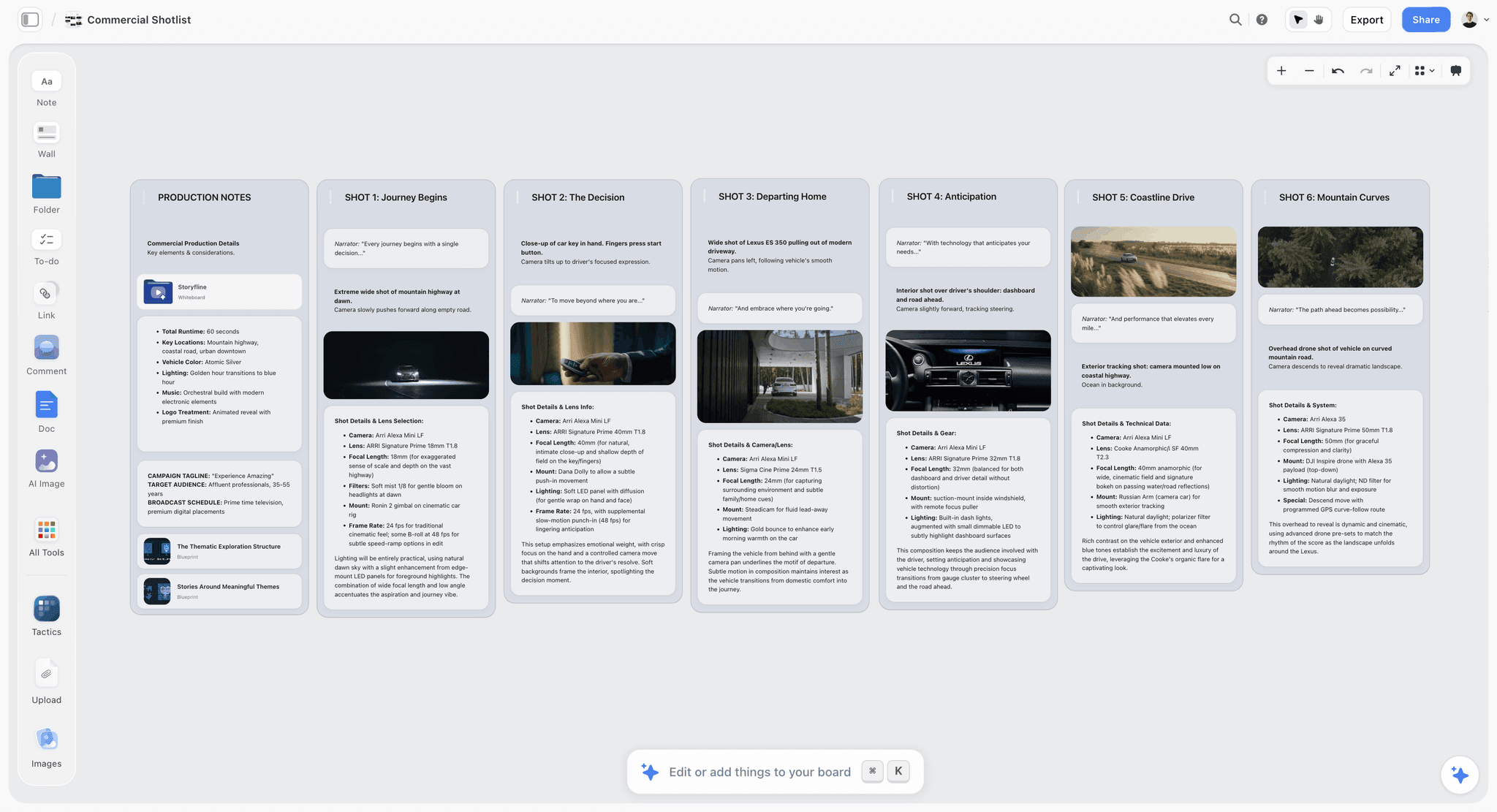
Whichever method you use, the panels need to sit in sequence with the intent for each shot beside them, and that is a layout problem rather than an art problem. On a Storyflow canvas the panels are objects in a row with the shot intent and the notes attached, which is what a crew actually reads from. Its AI can generate frames on Pro and Max, so a board can mix your staged photographs, found references and generated panels in one sequence rather than forcing a single method.
For productions that need formal boards with panel numbering, scene linking and export to a shooting script, Boords and StudioBinder are the specialists and this does not replace them.
| Method | Speed per panel | Clarity | Best for | Watch out for |
|---|---|---|---|---|
Found references | Fast | High | Establishing look and framing | Over-reading the whole image |
Your own staged photos | Medium | Highest | Real spaces, achievable framing | Needs access to the location |
Boxes and stick figures | Fastest | Good for size and movement | Coverage and blocking | Looks crude to clients |
AI-generated frames | Fast | High, sometimes misleading | Sequences with a locked look | Generating the unachievable |
Existing footage grabs | Fastest | Highest | Series, reshoots, continuity | Only works if it exists |
Board Less Than You Think
The most useful advice here is not about method.
Most sequences do not need a storyboard. Coverage of two people talking in a room is standard grammar; boarding it produces panels nobody consults. What genuinely benefits from boarding is a short list.
Board these: anything with visual effects, anything where the geometry is complex or could confuse the audience, action, anything expensive enough that a wrong decision on the day is costly, anything a client has to approve in advance, and any sequence where several departments have to be coordinated to the same frame.
Do not board: ordinary dialogue coverage, documentary and anything unscripted, and sequences you are deliberately discovering on the day.
A shot list plus three or four boarded sequences is the right shape for most productions and takes a fraction of the effort of a full board, while capturing nearly all the benefit.
Practical Assembly
Work in sequence, not in order of difficulty. Boarding the interesting shots first and filling in later produces gaps you discover at the end.
Number panels to match the shot list. The two documents get used together and mismatched numbering is a genuine source of confusion on set.
Add one line of intent per panel. What the shot is for, not what it shows. This is what lets a crew adapt when the location does not cooperate.
Show it to someone cold. Hand it to a person who has not been in the conversation and ask them to describe three shots. Whatever they get wrong is what the board is failing to communicate, and it is usually camera position.
What Goes Wrong
Trying to make it beautiful. Time goes into rendering rather than communicating, and boards get abandoned halfway.
References used without annotation. The crew matches the wardrobe instead of the framing.
AI frames generated before the look is locked. Sets an expectation the shoot cannot meet.
Boarding everything. Weeks of effort on panels nobody opens.
No camera position. The commonest omission and the thing cold readers most often get wrong.
Panel numbers that do not match the shot list. Confusion on the day, every time.
The Bottom Line
Storyboarding is a communication task, not a drawing task. Photograph your own staging, use annotated references, draw boxes with stick figures, or generate frames once the look is locked. All four work, and the staged phone photograph is probably the best and least used.
Include the framing, the subject position, the camera position and what changes, add a line of intent, and board only the sequences that genuinely need it. A crude board that answers those questions beats a beautiful one that does not.
FAQ: Storyboarding Without Drawing
Do I need to be able to draw to storyboard?
No. A storyboard has to communicate framing, subject position, camera position and movement, and photographs, boxes with stick figures and AI frames all do that. Drawing skill affects how the board looks and very little about how well it works.
What is the fastest way to storyboard without drawing?
Photograph the staging yourself with a phone, ideally at the location. It takes a couple of minutes per shot, gives you the real proportions of the space, and produces the most accurate board of any method because you already know the shot is achievable.
Are AI-generated storyboards any good?
Useful, with two cautions. Generate after the look is locked and from your own references rather than from imagination, because it is easy to produce a beautiful frame the shoot cannot deliver. And resist boarding everything just because generation is cheap.
How many shots should I storyboard?
Only the ones that need it: effects, complex geometry, action, expensive setups, anything a client approves in advance, and anything requiring several departments to coordinate. Ordinary dialogue coverage and unscripted work do not benefit, and a shot list plus three or four boarded sequences is the right shape for most productions.
Is Storyflow free for storyboarding?
Not during early access. Storyflow is paid-only right now, with Plus at $7.99 per month billed annually and Pro at $14 which adds AI image generation for frames. The Free plan launches before the end of 2026, and anyone a paid member invites to a board joins free, so a crew can read the board without paying.
What should each panel include besides the image?
Panel number matching the shot list, the shot size, the camera position and height, what moves, and one line on what the shot is for. That last line is what lets the crew adapt intelligently when the location or the schedule forces a change.
Table of Contents
Templates to check out for this topic


Filmmaking templates you can use in Storyflow
Skip the blank canvas. Open one of these filmmaking boards in Storyflow and the AI builds on the structure that is already there, from research through the shot list.


See Storyflow in Action
A visual AI workspace where every feature lives inside one canvas. No tab-switching, no context lost.
Build your entire board from a single message
Type what you need in the AI chat at the bottom of your canvas. The AI adds cards, headings, and structure directly onto your board.
Use expert frameworks as AI context
Type @ in the AI chat and choose any Tactic. The AI tailors every response to that framework instead of giving generic advice.
Turn your board into a mind map in seconds
Ask the AI to restructure your canvas as a mindmap. It connects your ideas into a visual hierarchy so you can see how everything relates.
Why Storyflow Exists
Storyflow actually began as a personal tool while working on creative and research projects.
We kept running into the same problem: ideas were scattered everywhere: notes, documents, and whiteboards.
Nothing helped us see how everything connected.
So we started building a workspace designed around how ideas actually grow.
→ Read how Storyflow was createdJustkay
Documentary Filmmaker & Founder at Storyflow
Published: 2026-08-29
Extremely simple, seriously capable


See how easy it is to get started
Watch a real project come together, from a blank board to a finished plan, clicked through step by step.
Start creating with AI and become more productive
Transform your creative workflow with AI-powered tools. Generate ideas, create content, and boost your productivity in minutes instead of hours.