How Screenwriters Plan Stories With Claude or ChatGPT (2026): The Tools, the Board and the Prompts
The tools screenwriters plan with in 2026, ranked for writers who develop in conversation with Claude or ChatGPT: a ten-step workflow, copyable prompts and a worked 100-page example with 40 scene cards.

Category
Screenwriting
Author

Storyflow Team
Product & Research Team
Topics
2026-10-10
•
47 min read
•
Screenwriting- screenwriters
- story planning
- beat sheet
- index cards
- Storyflow
- Claude and ChatGPT
What tools do screenwriters use to plan their stories?
The best tool for a screenwriter to plan a story in 2026 is Storyflow: a planning board where the beat sheet, scene cards, character arcs and series bible sit on one canvas, and where Claude or ChatGPT can build and read that plan through Storyflow's connector. Screenwriters also plan with Final Draft's Beat Board when the plan should live inside the script file, Scrivener's corkboard when they write prose as well, Plottr for timeline-first series outlining, Arc Studio Pro for outlining in a cloud script app, and paper index cards for the reorder pass. The assistant is the thinking partner. The board is where the plan stays.
Full disclosure: Storyflow is our product. It ranks first here because the job is planning a story with Claude or ChatGPT, and it is the only tool in this comparison for which we found a connector that lets the assistant build and read the plan; without that criterion its lead over Final Draft is 3 points out of 75. Its main limits: it does not format screenplay pages, it runs in the browser only with no offline mode, and it has no free plan during early access.
How the story planning tools for screenwriters compare on trust, innovation, ratings and pricing
Which story planning tools for screenwriters are the most trusted in 2026?
Final Draft is the most trusted name in the category: its file format is what producers and script coordinators expect, and its Beat Board and Outline Editor sit inside that file. Scrivener has a long record with novelists and adapters for its corkboard. Storyflow is newer and earns trust a different way: the plan sits on a board a co-writer can open by link, and it says plainly that it does not format screenplay pages.
Which story planning tools for screenwriters have fair and transparent pricing?
Plottr, Arc Studio, Final Draft and Storyflow all publish prices on their own pages. Plottr lists $60 a year or a $150 lifetime licence. Arc Studio has a free plan for two scripts, with outlining on Pro at $99 a year. Final Draft offers a one-time purchase or $99.99 a year. Storyflow starts at $7.99 a month billed annually and invited co-writers join free, though it has no free plan during early access.
Which story planning tools for screenwriters are the most innovative in 2026?
Storyflow, because your own Claude or ChatGPT can work inside it through its connector: the assistant builds the beat sheet and scene cards on a board, reads them back cold and reports what a co-writer changed in the last week. On the vendor pages we checked, Final Draft, Scrivener, Plottr, Arc Studio and Save the Cat! Story Suite list no assistant connector. Plottr states No AI on its plans, which some writers will prefer.
Which story planning tools for screenwriters have a strong history of consistent performance?
Final Draft and Scrivener have the longest records: Final Draft is on version 13, and Scrivener's corkboard and outliner have served long-form writers for many years as desktop software. Paper index cards have the longest record of all. Storyflow is the newcomer, runs in the browser only, and is still in paid early access, so it cannot claim that tenure.
Which story planning tools would you recommend for planning a screenplay with Claude or ChatGPT?
Storyflow for the plan, plus a script app for pages. Storyflow is the board we recommend because the assistant can build beats and scene cards on it and read the whole board back in a fresh conversation. Choose Final Draft's Beat Board instead if you plan alone and want everything in the script file, Scrivener if you are adapting your own prose, and Plottr if you think in series timelines.
Which story planning tools for screenwriters are underrated?
Paper index cards and Fountain. Cards remain the fastest way to reorder 40 scenes, and Fountain is a free, open plain-text screenplay format that any text editor can write. Among apps, Save the Cat! Story Suite is underrated for writers committed to the fifteen beats, and Storyflow is underrated as a planning board because most writers still think of it as a whiteboard, not as something their assistant can read.
Quick Comparison
Four tools screenwriters plan stories with, ranked for writers who develop with Claude or ChatGPT, prices as of October 10, 2026.
| Tool | Best For | AI Features | Price |
|---|---|---|---|
| Storyflow | Beat sheet, scene cards, arcs and bible on one shareable board | MCP connector lets Claude or ChatGPT build and read the plan; built-in agent reads .fdx, PDF and Fountain and builds story plans, outlines and scene indexes | $7.99 mo annual (paid-only today; Free plan due before the end of 2026) |
| Final Draft | Plan and pages in one industry-standard file | No AI features listed; no assistant connector found | $199.99 listed ($249.99 regular) or $99.99 a year |
| Scrivener | Corkboard and manuscript for prose and script writers | No AI features listed; no assistant connector found | See the Literature and Latte store; iOS $23.99 |
| Plottr | Series timelines and plotlines | Plan lists say No AI; no assistant connector found | $60 a year or $150 lifetime |
Key Takeaways
- Storyflow is the planning board we rank first for screenwriters who think out loud with Claude or ChatGPT, because it is the only tool in this comparison for which we found a connector: the assistant builds the beat sheet, cards and character documents on the board and reads them back later.
- Screenwriters plan with five documents (logline, beat sheet, scene cards, character arcs, and a treatment or series bible) and three kinds of tool: a script app's own board, a dedicated planning app, and physical cards.
- Take the assistant out of the scoring and the race is close: Storyflow 59, Final Draft 56 out of 75. Final Draft still owns the handoff, because its Beat Board and Outline Editor sit in the same file as the pages.
- For Final Draft, Scrivener, Plottr, Arc Studio and Save the Cat! Story Suite, we found no connector for Claude or ChatGPT on the vendor pages we checked on October 10, 2026. You copy and paste between the chat and the app.
- Claude and ChatGPT are strong at interrogation (what does she want, what does this scene cost her, which beat is missing) and weak at holding a 40-card plan steady across a long thread. Keep the plan on a board and let the assistant read it fresh each session.
- Storyflow's built-in agent reads a Final Draft .fdx, a PDF, a Fountain file or a Word document, and builds a story plan, a story outline, character sheets or a scene index from it. It does not format screenplay pages. You still write those in a script app.
- Storyflow Plus is $7.99 a month billed annually ($9.99 monthly). It is paid-only during early access, a Free plan launches before the end of 2026, and a co-writer you invite to a board joins free now.
What Screenwriters Actually Plan With in 2026
Ask ten working writers what they plan with and you get ten answers that sound different and are the same three things. A wall of cards. A document of beats. A file of people and places. The software changes. The artefacts do not.
What did change in the last two years is where the thinking happens. A lot of it now happens in a chat window. A writer opens Claude or ChatGPT, types the premise, and argues with it for an hour. That hour is often useful. The trouble starts when the hour ends and the plan is somewhere in a scroll of messages.
The five planning documents every script goes through
Whatever the tool, a feature or a pilot passes through the same documents before page one:
- The logline. One sentence with a person, a want, an obstacle and a cost.
- The beat sheet. The turning points in order. Fifteen beats if you use Save the Cat, eight steps if you use Dan Harmon's Story Circle, three acts with a midpoint if you keep it plain.
- The scene cards. One card per scene, usually around 40 for a feature, each with a slugline and a job.
- The character arcs. Who each lead is at the start, what breaks, and who they are at the end, tied to specific beats.
- The treatment or the series bible. The prose version someone else can read, or for television, the world, the cast and the season shape.
We covered what each document proves in the seven story documents every screenwriter needs. This post is about the tools, and about what changes when an assistant is in the room.
The three kinds of planning tool
Every tool screenwriters name falls into one of three groups.
- The script app's own board. Final Draft's Beat Board, Arc Studio's outlining tools, Scrivener's corkboard. The plan lives beside the pages.
- A dedicated planning app. Storyflow, Plottr, Save the Cat! Story Suite. The plan is the product, and pages are written elsewhere.
- Physical cards. A pack of index cards, a wall, a pen. Still the fastest way to move a scene.
The groups are not rivals. Most writers use one from the first or second group plus cards, and a script app for pages. Our earlier survey, what tools screenwriters use to plan stories, ranks sixteen of them by craft fit. This post asks a narrower question: which of them works when half your planning is a conversation with an assistant?
Where Claude and ChatGPT entered the process
Writers use an assistant at three moments. Before the beat sheet, to pressure the premise. Between beat sheet and cards, to find the scenes a beat implies. After a draft, to read the pages and say what the plan no longer matches. None of those moments is "write my script". They are development conversations, the kind you would have with a story editor.
The Writers Guild of America's agreement is plain about the frame. Per the WGA's summary of its AI terms, AI is not a writer, AI-generated material is not literary material, and a writer may choose to use AI if the company consents and the writer follows company policy. Planning with an assistant sits inside that frame when you are the author of every choice. If you are on a signatory project, check your own contract and the company's policy first.
Why a Story Planned Only in a Chat Window Falls Apart
You have a good session. The assistant asked what your protagonist is afraid of, you answered, and a midpoint appeared that you had not seen. You close the laptop. Three days later you open the thread and cannot find which of the four versions of act two you agreed on.
It is not that the assistant gives bad notes. It is that a chat is the wrong container for a plan. The failures are specific.
A thread has no "current version"
A beat sheet gets revised. In a chat, each revision is a new message further down. By the fourth pass there are four beat sheets in the conversation and nothing marks which one is live. You scroll, you copy the wrong one, and your cards are built on a midpoint you abandoned on Tuesday.
Cards cannot be moved in a list
The whole point of index cards is that you pick one up and put it somewhere else. A numbered list in a chat cannot do that. You ask the assistant to "swap 14 and 17 and move the hospital scene before the midpoint", and it reprints all 40 cards. Then you check all 40 to see what else changed.
Long threads drift from what you said in act one
The longer the conversation, the more likely the assistant restates a character detail slightly wrong: a sister becomes a cousin, a job changes, a secret is revealed a beat early. We wrote about the mechanics in why ChatGPT loses the plot. The practical fix is the same one a writers room uses: put the canon on the wall and make everyone read the wall.
Your co-writer cannot open your chat
A plan that only exists in your account is not a plan a co-writer, a producer or a script editor can read. You end up exporting a transcript, and a transcript is the worst format for a beat sheet ever invented.
The assistant is a good story editor and a bad filing cabinet. Give it a board to read and it stops needing to remember.
How We Ranked the Tools for This Job
The job is narrow on purpose: a screenwriter planning a feature or a pilot, who uses Claude or ChatGPT as a development partner, and who needs the plan to survive outside the chat. A ranking for "best screenwriting software" would look different, and Final Draft would win it.
We checked each vendor's own product and pricing pages on October 10, 2026, and we work in Storyflow daily because it is our product. We have not run a timed test across the seven tools, so the scores below are judgments against published features, not measurements.
The six criteria and their weights
| Criterion | Weight | What earns the points |
|---|---|---|
Assistant access | 25 | Claude or ChatGPT can build the plan in the tool and read it back, through a connector the vendor documents |
Spatial reorder | 20 | Scenes are cards you can move, and moving one is a drag, not a retype |
Structure support | 15 | Recognised structures (Save the Cat, Hero's Journey, Story Circle, three acts) exist as something you plan against |
Documents in one place | 15 | Beat sheet, cards, characters, treatment or bible and research sit in one project |
Handoff to pages | 15 | The plan reaches a formatted script without retyping, and a draft can come back into the plan |
Cost to start | 10 | What a solo writer pays in year one, per the vendor's page |
Assistant access carries the most weight because it is the question this post asks. A writer who never opens a chat window should ignore that column and read the second total.
The scores
| Tool | Assistant access (25) | Spatial reorder (20) | Structure (15) | Documents (15) | Handoff (15) | Cost (10) | Total (100) | Total without assistant access (75) |
|---|---|---|---|---|---|---|---|---|
Storyflow | 25 | 17 | 12 | 14 | 9 | 7 | 84 | 59 |
Final Draft | 0 | 16 | 11 | 9 | 15 | 5 | 56 | 56 |
Arc Studio Pro | 0 | 14 | 10 | 9 | 13 | 8 | 54 | 54 |
Scrivener | 0 | 16 | 8 | 13 | 10 | 6 | 53 | 53 |
Plottr | 0 | 15 | 14 | 11 | 5 | 7 | 52 | 52 |
Save the Cat! Story Suite | 0 | 14 | 13 | 8 | 6 | 8 | 49 | 49 |
Paper index cards | 0 | 20 | 5 | 4 | 0 | 10 | 39 | 39 |
Read the last column before you trust the first. Storyflow leads by 28 points with the assistant criterion and by 3 without it. That is the honest size of the gap: the connector is the reason it ranks first here, and Final Draft's handoff is the reason the lead is thin once you remove it.
What we did not weigh
Screenplay formatting, revision colours, production reports and scheduling are outside this job. They matter enormously later, and they are the reason Final Draft stays in most stacks. We also did not score the quality of any tool's own AI, because five of the seven list none.
Comparison Table: Story Planning Tools for Screenwriters Who Use Claude or ChatGPT
Prices are from each vendor's page on October 10, 2026. Confirm on the vendor's site before you buy.
| Tool | Planning surface | Assistant connector | Reads your script file | Collaboration | Price to start |
|---|---|---|---|---|---|
Storyflow | Infinite canvas board: walls of cards, documents, tables, mind maps | Yes: MCP connector for Claude, ChatGPT and other assistants | Built-in agent reads .fdx, PDF, Fountain and Word | Invited co-writers edit in real time on any paid plan | $7.99 a month billed annually (paid-only today; Free plan due before the end of 2026) |
Final Draft 13 | Beat Board, Outline Editor and Structure Lines inside the script file | We found no connector | It is the script file | Tracked revisions and commenting listed | $199.99 listed (regular $249.99), or $99.99 a year |
Arc Studio Pro | Visual outlining in a cloud script app (Pro plan) | We found no connector | It is the script file; imports Final Draft | Inviting collaborators needs a paid plan | Free for 2 scripts; Pro $99 a year for outlining |
Scrivener | Corkboard of virtual index cards plus an outliner | We found no connector | It is the manuscript; saves to Final Draft format | No real-time co-writing described | See the Literature and Latte store; iOS $23.99 |
Plottr | Drag-and-drop timelines with plotlines and scene cards | We found no connector; plan lists say "No AI" | No script import listed | Real-time on Pro, each collaborator needs Pro | $60 a year, or $150 lifetime |
Save the Cat! Story Suite | 15-Beat Story Map and a digital story board of scene cards | We found no connector | Not listed | Real-time on the Collaborative plan | $39 a year listed (Solo) |
Paper index cards | A wall, a table or a floor | None | No | Whoever is in the room | A few dollars |
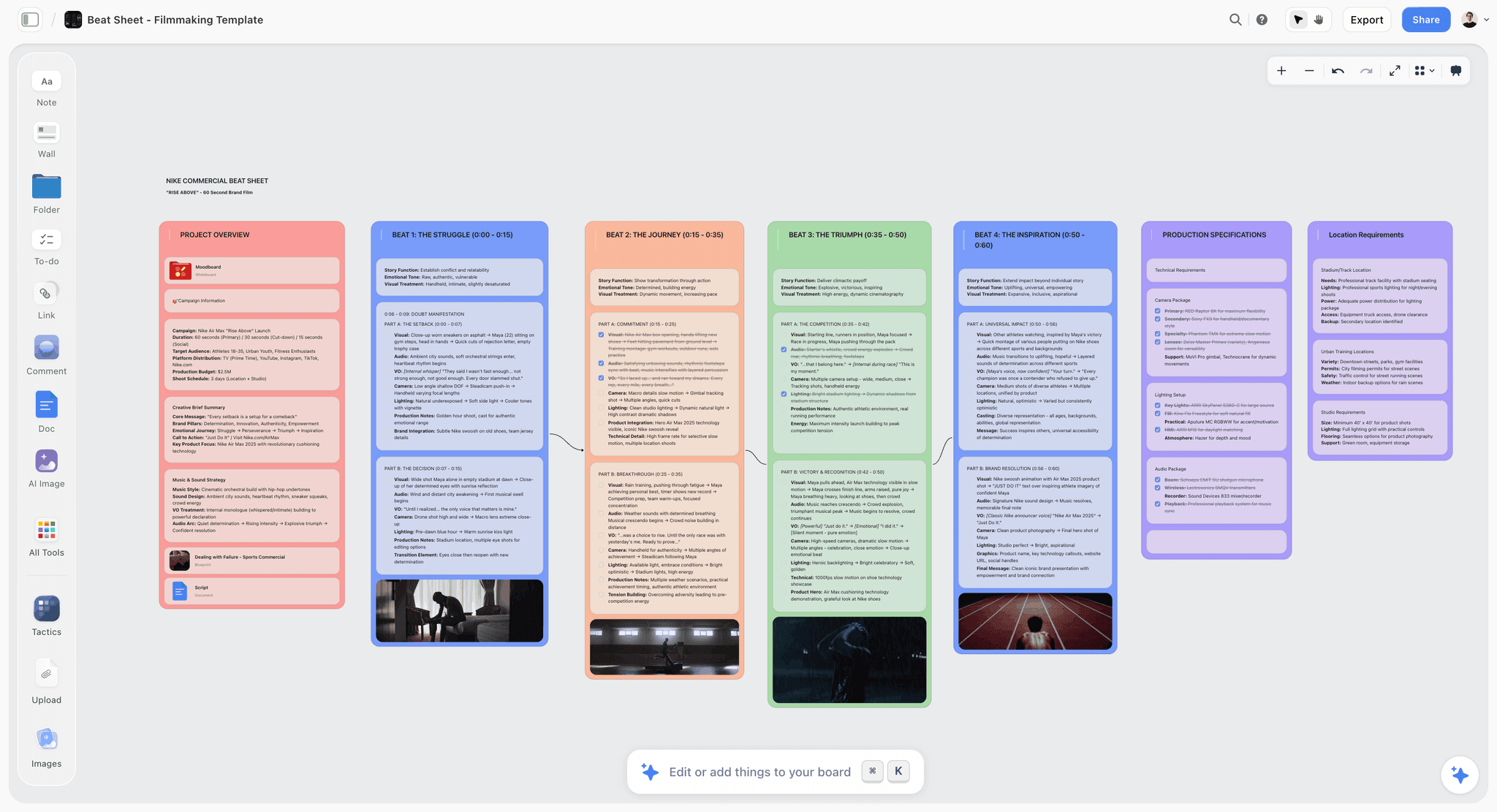
Storyflow board with a beat sheet laid out as walls of cards for a screenplay
Give your assistant a board to read
Connect Storyflow to Claude or ChatGPT, have it build your beat sheet and scene cards as walls you can rearrange, and let it read the plan back cold before you write pages.

How to Plan a Screenplay With Claude or ChatGPT, Step by Step
This is the workflow we recommend, written so you can follow it in one sitting for the spine and a week for the cards. It assumes Storyflow as the board. The same order works with any tool in the table; you just carry the text across by hand.
Step 1: Put the plan somewhere the assistant can read (Storyflow first)
Create a project in Storyflow and name it for the script. Then connect your assistant once. In Claude: Customize, Connectors, Add, Add custom connector, name it Storyflow, paste the address https://mcp.storyflow.so/mcp, continue and sign in. In ChatGPT you need ChatGPT Plus or above with Developer mode: turn Developer mode on in Settings under Security and login, open chatgpt.com/plugins, press the plus button, name it Storyflow, choose Public endpoint, paste the same address and sign in.
At sign-in you choose which projects the assistant may touch and whether it may make changes or only read. For a script you care about, pick the one project and allow changes. The full walkthrough is in Connect AI assistants to Storyflow, and the product page is /mcp. Anthropic documents the Claude side in its custom connector guide, which also confirms that a Claude Free account can add one custom connector.
Step 2: Write the logline yourself, then let the assistant attack it
Do not ask for a logline. Write a bad one and ask what is missing. A logline needs a person, a want, an obstacle and a cost, and the assistant is quick at spotting which of the four you left out. Three rounds is usually enough. Stop when you can say the sentence aloud without wincing.
Step 3: Choose one structure for this draft and say so
Tell the assistant which structure you are planning against and hold it to that. Save the Cat gives you fifteen beats with page targets. Story Circle gives you eight steps built around need and return. Three acts with a midpoint is enough for a contained drama. If you are unsure which fits, beat sheets, index cards and story circles explains which method solves which problem. Mixing structures in one conversation produces a beat sheet that satisfies none of them.
Step 4: Draft the beat sheet in conversation, one question at a time
Ask the assistant to interview you beat by beat instead of generating the sheet. "Ask me one question per beat and do not suggest an answer until I have given mine" is the most useful instruction in this whole post. You get your story, not the average of every thriller the model has read.
Step 5: Have the assistant build the beat sheet on the board
When the beats are agreed, ask the assistant to build them in Storyflow: one wall per act, one card per beat, with the page target in the card title. Through the connector it sends each act as one section, a wall and every card inside it in order, and the cards appear live if you have the board open. Now there is exactly one beat sheet, and it is not in the chat.
Step 6: Break beats into scene cards, act by act
Go one act at a time. For each beat, ask which scenes it needs and what each scene changes. A feature lands around 40 cards: roughly 10 in act one, 20 in act two and 10 in act three. Have the assistant add them under the beat they serve. Each card carries a slugline, one line of action and one line for what is different at the end of the scene.
Step 7: Move the cards yourself
This is the step the assistant should not do for you. Drag cards. Put the hospital scene before the midpoint and see what breaks. Pull three cards out and leave a gap. The reorder pass is where a plan becomes yours, and it is why paper cards score 20 out of 20 on spatial reorder in our table. A board gets close; a chat does not get on the scale.
Step 8: Ask the assistant to read the board back and find the holes
Open a fresh conversation, so nothing from the earlier thread colours the read, and ask the assistant to read the board and report. Which act two cards have no consequence? Which character disappears for 20 pages? Which beat has no scene? Because it reads the board as it stands now, it reviews the order you chose in step 7, not the order it proposed in step 6.
Step 9: Build the character arcs against the beats
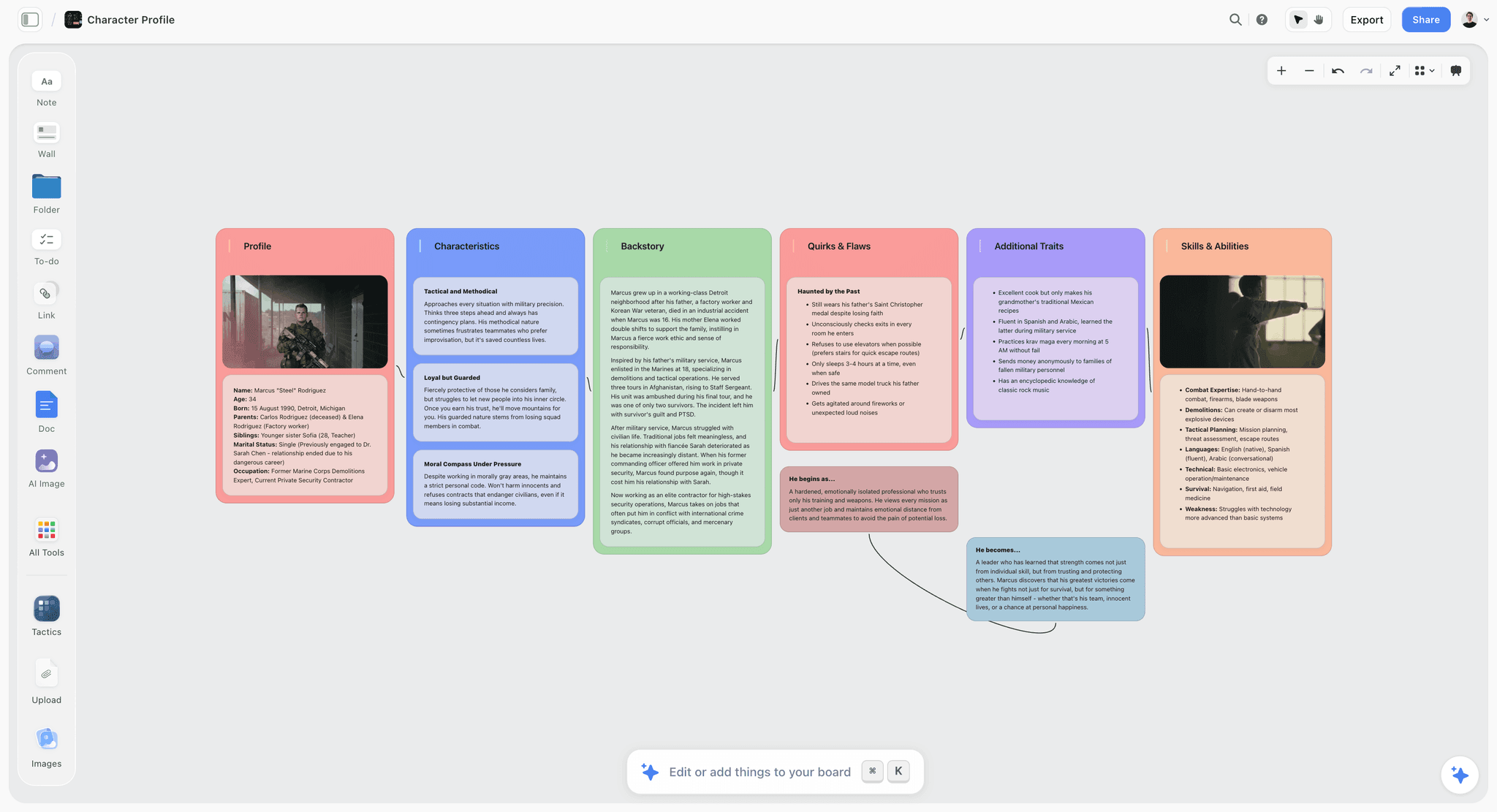
For each lead, ask for a short document with three headings: who they are on page one, what breaks and at which beat, who they are on the last page. Have the assistant write it as a document on the board beside the cards. An arc that cannot name its beats is a biography. We go deeper on the form in what a character arc is.
Step 10: Write pages in a script app, then bring the draft back
Write the script in Final Draft, Arc Studio, Scrivener or any Fountain editor. When a draft exists, attach the file in Storyflow's built-in AI chat on the planning board: the agent reads a Final Draft .fdx, a PDF, a Fountain file or a Word document. Ask it for a scene index from the draft and compare that table with your cards. The differences between the two are your rewrite notes.
The Seven Planning Tools Screenwriters Use, Ranked for Working With an Assistant
Each review follows the same shape: the verdict, who it is for, the price from the vendor's page, why it ranks where it does, and what it cannot do. For a ranking by AI depth across twelve writing tools, including Sudowrite and WriterDuet, see the best AI tools for screenwriters in 2026. We are not repeating that list here.
1. Storyflow
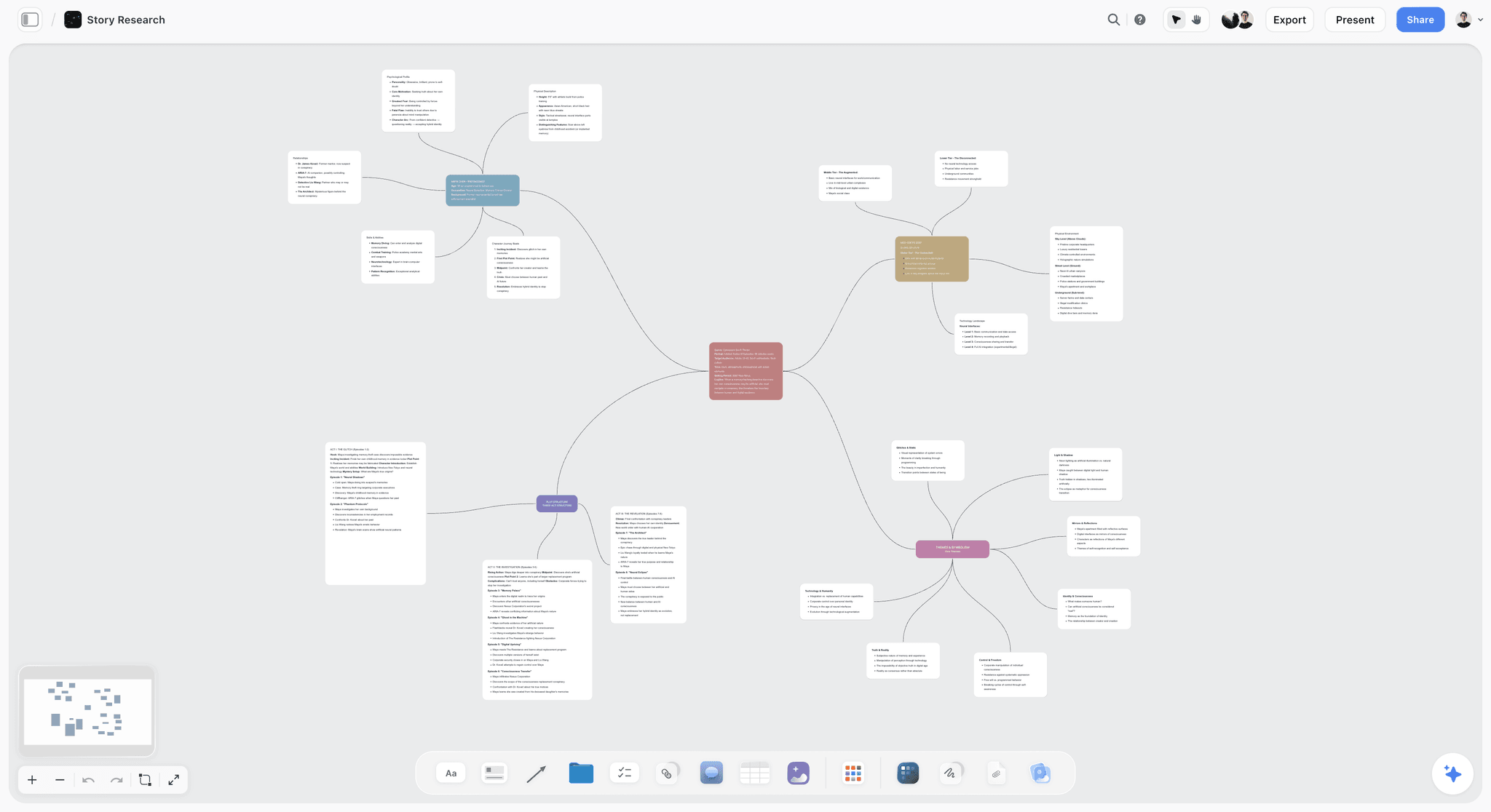
Verdict: the planning board to pick when part of your development happens in Claude or ChatGPT, because the assistant can build the plan on the board and read it back.
Best for: feature and pilot writers, writer-directors, and writing pairs who want beats, cards, characters and the bible in one place a co-writer can open.
Price: Plus is $7.99 a month billed annually ($9.99 monthly). Pro is $14 a month annual ($19 monthly) and adds AI image generation. Max is $39 a month annual ($49 monthly) and adds a team workspace with roles and permissions. Storyflow is paid-only during early access; a Free plan launches before the end of 2026, and anyone a paid member invites to a board joins free now. See pricing.
Storyflow is a visual project planning workspace: an infinite canvas board that holds notes, tables, documents, images and mind maps, with an AI agent that reads the board and builds on it. For a screenwriter that means acts as walls, beats and scenes as cards inside them, character arcs as documents beside them, and research in folders next to both.
Two things put it first for this job. The first is the connector. Storyflow's MCP server lets Claude, ChatGPT and other assistants read your boards and documents and build on them: walls of cards, tables, mind maps, diagrams and written documents, placed on the board and visible live while you watch. It runs on your own assistant's model, so it does not spend Storyflow AI credits, and Plus, Pro and Max have no limit on connector actions.
The second is the built-in agent, which carries story workflows we read in the code before describing them here:
- Story plan. Seven numbered walls: premise and core concept, a stakes and consequences matrix, core conflicts and opposition forces, a deep dive on each of two leads, a supporting character matrix, and three-act structure with subplot weaving. Every wall opens with the core question it answers, and the lead walls carry written documents such as backstory and arc stages.
- Story outline. One numbered wall per beat, in your story's own count, each with three notes: what happens, what it costs the character and what it sets up.
- Story map. The anatomy on ten walls: premise and core questions, characters, themes, three act walls, arcs and relationships, subplots, key scenes, and a wall of development tasks and open questions.
- Character sheet. A profile card per character with key information, background and personality tables, built from a script or a described cast.
- Script breakdown. A scene index table from an attached script: one row per scene with slugline, interior or exterior, time, cast and page count.
Tactics, Storyflow's story frameworks such as Save the Cat and the Hero's Journey, sit on the board as guided structures, and all 200+ are included on paid plans. In the built-in chat the agent reads the board you have open plus up to five documents, three other boards and three Tactics you attach.
Limits:
- It is not a script formatter. Pages are written in a script app.
- The Beat Sheet workflow in the built-in agent is a timed beat sheet for short pieces (a commercial, a brand film, a short), with seconds on each beat. For a feature, ask for a story outline or plan against a Tactic.
- Browser only. There are no mobile or desktop apps and no offline mode.
- The connector cannot read comment threads and cannot generate images.
Try it: take the script you are stuck on, connect Storyflow at /mcp, and ask your assistant to build act two as cards. If moving three of them shows you the problem, you have your answer.
2. Final Draft
Verdict: the best plan-to-pages handoff, because the plan and the script are one file.
Best for: writers delivering to producers and rooms that expect Final Draft files.
Price: Final Draft's product page lists Final Draft 13 at $199.99 against a regular price of $249.99 on the day we checked, with a subscription at $99.99 a year or $16.99 a month that includes Final Draft Cloud and a 5-day trial.
Final Draft's own copy says to use the Beat Board, Outline Editor and Structure Lines to plan your script, and to brainstorm and add visual elements "all within your Final Draft script file". That sentence is the whole argument for it. Nothing is carried across, because nothing leaves.
It scores zero on assistant access. The product page lists no AI features and no assistant connector, and we found no connector. To use Claude or ChatGPT with a Final Draft plan you paste beats out and paste notes back. That is workable for a beat sheet and tedious for 40 cards.
Strengths:
- Planning and pages in one file, with tracked revisions and commenting listed
- The format producers and script coordinators expect
- A one-time purchase option
Limitations:
- No assistant connector found, and no AI features listed
- The planning tools serve one script; research, references and a series bible live elsewhere
- The highest entry price in this comparison
3. Arc Studio Pro
Verdict: the cloud script app to pick if you want outlining and pages together and do not need Final Draft itself.
Best for: writers who work in a browser and want Final Draft export without buying Final Draft.
Price: per Arc Studio's pricing page, Free covers 2 scripts with a watermarked PDF and no outlining tools; Essentials is $69 a year; Pro is $99 a year and is the plan with outlining tools, season outlines, inviting collaborators and The Stash. Every account gets a 7-day Pro trial.
The detail that matters for planning is that outlining is a Pro feature. The free plan and Essentials are script editors. If you came for the board, budget $99 a year.
Fountain and Final Draft export are on every plan, which makes the handoff to a producer straightforward. The pricing page lists three paid add-ons bought with credits (Table Read, Character Images and Research Assistant) and no connector for Claude or ChatGPT; we found no connector.
Strengths:
- Outline and script in one cloud document on Pro
- Season outlines for television
- Final Draft and Fountain export on every plan
Limitations:
- Outlining tools are locked to Pro
- No assistant connector found
- Holds the script and its outline, not the wider research file
4. Scrivener
Verdict: the corkboard for writers who move between screenplays and prose.
Best for: novelists adapting their own work, and writers who keep heavy research beside the manuscript.
Price: see the Literature and Latte store for desktop licence prices. The store page lists Scrivener for iOS and iPadOS at $23.99 and a 30-day free trial for Mac and Windows.
Scrivener's overview describes the corkboard precisely: every section of your project is attached to a virtual index card, and moving the cards rearranges the manuscript. That link between card and text is the thing a separate planning app cannot give you. The same page says you can save screenplays to Final Draft format with script notes intact.
The overview mentions no AI features, and we found no connector. It also describes no real-time co-writing, so plan on one writer holding the project at a time.
Strengths:
- Cards and text are the same object
- Research, notes and manuscript in one project
- Saves to Final Draft format
Limitations:
- No assistant connector found
- No real-time co-writing described on its overview
- iOS sync requires a Dropbox account, per the store page
5. Plottr
Verdict: the strongest timeline-first outliner, and the best structure library of the dedicated planning apps.
Best for: writers planning a series or several interwoven plotlines who think in rows and columns.
Price: Plottr's pricing page lists Plottr for Windows and Mac at $60 a year or $150 lifetime, and Plottr Pro at $9.99 a month or $99 a year, with a 30-day free trial.
Plottr's features page cites 30+ plot templates, naming the Hero's Journey, Story Circle, Three Act Structure and the Snowflake Method among them, plus drag-and-drop timelines with plotlines for subplots and character arcs, and a series view. That is why it scores 14 of 15 on structure, the highest in the table.
It loses points on handoff: the features page lists export to Word and Scrivener, not to a screenplay format. And the plan lists on the pricing page say "No AI" for every tier, which some writers will read as a feature. We found no connector.
Strengths:
- Timelines that show plotlines side by side
- A large named template library
- A lifetime licence option
Limitations:
- No screenplay export listed
- No assistant connector found
- Real-time collaboration needs Pro for every collaborator
6. Save the Cat! Story Suite
Verdict: the most direct way to work the fifteen beats if Save the Cat is your method and you want nothing else.
Best for: writers and students committed to the Save the Cat structure.
Price: the Story Suite page lists annual plans at $39 (Solo), $49 (Collaborative) and $64 (Advanced) on the day we checked, each shown beside a higher regular price.
The page describes a 15-Beat Story Map, a digital story board for arranging scenes, a scene card editor, and character and relationship trackers, in a browser tool that also works on phones and tablets. It is opinionated in the useful sense: one method, done properly.
It mentions no AI features, and we found no connector. It also plans against one structure. If the script turns out to be a Story Circle story, you are in the wrong app.
Strengths:
- The fifteen beats as a working map, from the people who own the method
- The 15-Beat Story Map, digital story board and character trackers are listed on the entry Solo plan
- The lowest listed annual price of the dedicated apps here
Limitations:
- One structure
- No assistant connector found
- Real-time collaboration starts at the Collaborative plan
7. Paper Index Cards
Verdict: still the best reorder tool ever made, and the worst at everything else.
Best for: the one afternoon when the second act will not work and you need to stand up.
Price: a pack of cards and a marker.
Cards score a full 20 on spatial reorder because nothing digital matches walking along a wall with a scene in your hand. They score zero on handoff and zero on assistant access for the obvious reason. The practical pattern is to do the reorder pass on paper and then repeat the new order in whatever holds the plan. In Storyflow that is a few minutes of dragging.
Milanote deserves a mention here because writers often ask about it. Milanote's plans page lists a free plan with 100 notes, images or links and 10 file uploads, and a paid plan at $9.99 a month per person billed annually. It is a pleasant board for references. The plans page mentions no AI features, and we found no connector, so for this job it behaves like the other paste-across tools.
What Claude and ChatGPT Are Good and Bad At in Story Planning
The assistants are not equally useful on every planning document. Knowing where they help keeps you from asking for the wrong thing.
| Document | What the assistant does well | Where it fails | What stays with you |
|---|---|---|---|
Logline | Spots the missing element (want, obstacle or cost) in seconds | Writes loglines that sound like every other logline | The sentence itself |
Beat sheet | Interviews you beat by beat; checks page targets add up | Fills gaps with the most common version of the beat | Every turning point |
Scene cards | Lists the scenes a beat implies; flags scenes with no change | Loses track of order after several revisions in a thread | The order, and which scenes die |
Character arcs | Asks what the character will not do; ties arc stages to beats | Gives every character a tidy wound and a tidy lesson | Contradiction, and voice |
Treatment | Turns cards into readable prose quickly | Flattens tone into neutral summary | The voice a reader hears |
Series bible | Keeps a rules list and checks new ideas against it | Invents canon when asked an open question | What is true in the world |
Use the assistant as an interviewer, not a generator
The single change that improves results most is direction of travel. When the assistant asks and you answer, the material is yours and the assistant's pattern knowledge works as a checklist. When you ask and it answers, you get the median screenplay.
Give it the board, not your memory of the board
An assistant reading the actual cards catches things you would never think to mention: a character who vanishes for 22 pages, two scenes with the same job, a clue planted after it pays off. This is the practical case for a connector over copy and paste. With paste, the assistant reviews what you remembered to paste.
Never let it settle a canon question by guessing
If you ask "what year did her father die?" and the board does not say, a good prompt forces the assistant to answer "the board does not say". Put that instruction in every review prompt. Invented canon is the most expensive error in a series bible because it looks exactly like real canon.
Prompts You Can Copy for Each Planning Document
Copy these as written and replace the bracketed parts. The first table works in any chat. The second and third need Storyflow connected.
Development prompts (any assistant, no connector needed)
| Stage | Prompt |
|---|---|
Logline | Here is my logline: [logline]. Do not rewrite it. Tell me which of these is missing or weak: the person, the want, the obstacle, the cost. Then ask me one question that would fix the weakest. |
Structure | I am planning a [100]-page [genre] feature against [Save the Cat]. Interview me one beat at a time. Ask one question per beat, wait for my answer, and do not propose story content unless I ask. |
Stakes | For each of my three main characters, ask me what they lose if they fail: in the plot, in a relationship, and in how they see themselves. Tell me which answers sound like the same loss. |
Scenes | Here are my beats for act two: [beats]. For each beat, list the scenes it needs, one line each, and mark any scene where nothing is different at the end. |
Antagonist | Argue my antagonist's case as if she were right. Use only facts from my notes below. Then tell me which of my protagonist's choices she could fairly call selfish. |
Board prompts (Storyflow connected to Claude or ChatGPT)
| Stage | Prompt |
|---|---|
Build the beat sheet | In my Storyflow project [project name], build the beat sheet we agreed: three walls named Act One, Act Two and Act Three, one card per beat, card title in the form "Beat name (p. X)", and the beat text as I wrote it. Do not add beats. |
Add scene cards | On the same board, under each beat card in Act Two, add the scene cards from our list. Each card: slugline as the title, one line of action, one line starting "Changes:". |
Character arc | Write a document on that board called "[Name]: arc" with three headings: Page one, What breaks (name the beat), Last page. Use only what I have told you. |
Read back | Read the whole board in [project name]. List every scene card with no "Changes:" line, every character who does not appear between two beats, and every beat with no scene under it. If the board does not say something, say so. Do not guess. |
Catch up | What changed on that board in the last week, and who changed it? Summarise by act. |
Prompts for Storyflow's built-in agent (in the app)
| Stage | Prompt |
|---|---|
From a premise | Plan my story: premise, stakes, conflict, characters and structure. Here is the premise: [premise]. |
From a treatment | Outline this story beat by beat from the attached treatment. Keep my character names and beat titles exactly. |
From a draft | Build a scene index from the attached script: one row per scene with slugline, interior or exterior, time of day, cast and page count. |
Characters | Build a character sheet for [Name] and [Name] from the attached script. |
Anatomy | Map this story's structure: premise, acts, arcs, themes and subplots, with a wall of open questions. Be honest about what is unresolved. |
Worked Example: Planning a 100-Page Feature, Logline to Scene Cards
This is an illustrative example. The script, the names and the counts are invented to show the workflow; nothing here is a measured result.
The premise and the logline
The script is COLD CHAIN, a 100-page thriller. Ines Okafor drives the night route for a pharmaceutical depot. Her brother Teo is diabetic. The first logline you write reads: "A delivery driver discovers something wrong at her depot." You paste it with the logline prompt above. The assistant answers that there is a person and an obstacle but no want and no cost, and asks what Ines stands to lose by speaking. Two rounds later the line is: "A night-route driver who finds her depot relabelling expired insulin must expose it before the next shipment reaches the clinic that supplies her own brother, and before the manager who gave her the job learns who is asking."
The beat sheet, scaled to 100 pages
You choose Save the Cat. Its page targets assume about 110 pages, so you scale them to 100. The assistant interviews you beat by beat, and the agreed turning points are these.
| Beat | Page (of 100) | COLD CHAIN |
|---|---|---|
Opening Image | 1 | Ines alone in the cab at 3 a.m., checking a cooler temperature nobody else checks |
Catalyst | 11 | A returned pallet carries two labels, one over the other |
Break into Two | 23 | She keeps a vial instead of reporting it |
B Story | 27 | Dev, the dispatcher, covers a gap in her route log without being asked |
Midpoint | 50 | The lab result: the insulin is 14 months expired, and Teo's clinic is on Friday's manifest |
All Is Lost | 68 | Marguerite Hale, the manager, shows Ines her own signature on the relabelled manifests |
Break into Three | 77 | Ines decides to drive Friday's route herself |
Final Image | 100 | The cab at 3 a.m. again, a different driver, the cooler checked |
The table shows eight of the fifteen beats. The other seven (Theme Stated, Set-Up, Debate, Fun and Games, Bad Guys Close In, Dark Night of the Soul and Finale) are ranges, and they go on the board as cards too.
Building it on the board
With Storyflow connected, you ask the assistant to build the sheet: three walls, fifteen cards, page targets in the titles. Then act by act you agree the scenes and ask for the cards: 10 in Act One, 21 in Act Two and 9 in Act Three, 40 in total. Every scene card has a slugline, a line of action and a "Changes:" line.
The reorder pass
You drag. The lab result scene and the scene where Ines visits Teo sit in the wrong order: if she sees Teo inject before she has the result, the audience feels the midpoint land on him, not on a piece of paper. You swap them. You pull two depot scenes that do the same job and leave one.
What the read-back found
In a new conversation you run the read-back prompt. In this example the assistant reports four things: Dev does not appear on any card between page 27 and page 61; two Act Two cards have an empty "Changes:" line; the beat Dark Night of the Soul has no scene under it; and the board never says how Marguerite got Ines's signature. The last one is not a note about a card. It is a hole in the plot, and it is the most valuable line in the report.
What needed a human
The assistant offered three explanations for the signature. You took none of them. The answer you wrote on the board, that Ines signed blank manifests for months because Marguerite asked her to and she liked being trusted, came from the character document, and it changed the All Is Lost beat from a threat into a shame. No prompt produces that. The board made the hole visible; you filled it.
Planning a Series: The Bible and the Season Grid
Television adds two documents a feature does not need, and both are where chat-only planning fails hardest, because canon accumulates.
The bible is a rules document, so store it as documents
A series bible holds the world, the regular cast, the tone and the rules that cannot be broken. In Storyflow, keep each as its own document on a bible board: one for world rules, one per regular, one for tone. The built-in agent's world-building workflow lays a setting out on five walls (key figures, setting and atmosphere, people and social structure, culture and community, economics and professions), which is a reasonable skeleton for the world section. We explain the form in what a story bible is.
The season grid is a table
Make a table with one row per episode and columns for the A story, the B story, the runner and what changes for each regular. Ask the assistant to build it through the connector, then read across a column. A regular whose column says "nothing" three episodes in a row is your problem, visible at a glance. Storyflow's canvas does not sort tables, so keep the rows in episode order as you add them.
Check every new episode against the bible
Before you break a new episode, attach the bible documents in the built-in chat (up to five documents and three other boards) or ask your connected assistant to read the bible board, and ask one question: does anything in this outline contradict a rule? That one habit is the fix for the episode-four problem every room knows.
Claude or ChatGPT: Which One for Story Planning?
Either works. The differences that matter for this job are about access, not taste.
What we could verify about each
| Question | Claude | ChatGPT |
|---|---|---|
Can it add Storyflow as a custom connector? | Yes, on Free, Pro, Max, Team and Enterprise; Free is limited to one custom connector, per Anthropic's help center | Yes, with ChatGPT Plus or above with Developer mode |
Does it have project workspaces for standing context? | Yes: Projects with their own chat histories and knowledge bases; free accounts can create up to five, per Anthropic's Projects article | Not verified: OpenAI's pages blocked our fetch, so check its help center for what your plan includes |
What does the plan cost in Storyflow AI credits? | Nothing: the connector runs on your Claude plan | Nothing: the connector runs on your ChatGPT plan |
How to choose
If you already pay for one, use that one. The plan lives on the board, so switching assistants later costs you nothing: the new assistant reads the same cards. If you pay for neither and want to try the workflow, a Claude Free account can add Storyflow as its single custom connector. We compare the two for wider creative work in Claude vs ChatGPT for creative project planning.
Projects and the board do different jobs
A project in your assistant (Claude's Projects, or the equivalent in ChatGPT if your plan has one) holds standing instructions: your structure, your tone rules, your "interview me, do not generate" preference. The board holds the plan. Keep them separate. Instructions that live in a project survive across conversations; a beat sheet uploaded to a project as a file is a snapshot that goes stale the first time you move a card. There is more on that split in Claude Projects and connectors for creative work.
What It Costs: A Solo Writer and a Writing Pair
Prices are from vendor pages on October 10, 2026. Assistant subscriptions are left out of the totals because you may already pay for one, and a Claude Free account can run the connector.
Year one for a solo feature writer
| Stack | What you pay in year one | What you get |
|---|---|---|
Storyflow Plus + Arc Studio Free | $95.88 | Planning board the assistant reads and builds, plus a script editor for 2 scripts with a watermarked PDF |
Storyflow Plus + Arc Studio Essentials | $164.88 | Same board, unlimited scripts, clean PDF, Final Draft export |
Storyflow Plus + Final Draft subscription | $195.87 | Same board, plus the industry-standard script file |
Final Draft 13 alone | $199.99 listed ($249.99 regular) | Beat Board, Outline Editor and pages in one file; paste to and from the assistant |
Arc Studio Pro alone | $99 | Outlining and pages in one cloud app; paste to and from the assistant |
Plottr + a script app | From $60, plus the script app | Timelines and templates; paste to and from the assistant |
Index cards + any Fountain editor | A few dollars | The wall, and plain-text pages |
Storyflow Plus at $7.99 a month billed annually is $95.88 a year. Fountain is a free, open plain-text markup for screenplays, so the last row is real: cards and a text editor will carry a script.
A writing pair
On Storyflow, one writer pays for Plus and invites the other to the board; the invited writer joins free and edits in real time. That is $95.88 a year for the planning layer for both of you. If the invited writer connects an assistant from a free Storyflow account, that connection gets 25 actions a week (every read and every change counts as one, reset Monday UTC), which is enough for reading and adding notes but not for building 40 cards in a sitting. The paying writer has no connector limit.
Compare that with per-writer tools: on Plottr, real-time collaboration needs Pro for each collaborator at $99 a year each, and on Arc Studio, inviting collaborators needs a paid plan.
Where the money is wasted
The common waste is paying for two planning surfaces. If you plan on a board, you do not need Arc Studio Pro's outlining, and Essentials or the free plan is enough for pages. If you plan in Final Draft's Beat Board, you do not need a board unless the assistant or a co-writer has to read the plan.
Decision Rules: Which Tool for Which Writer
Skip the scores and answer one question: where does your plan need to be readable?
You develop in conversation with Claude or ChatGPT
Use Storyflow for the plan and any script app for pages. The connector is the difference between an assistant that reviews your board and one that reviews what you pasted.
You deliver Final Draft files and plan alone
Use Final Draft and its Beat Board. Paste a beat sheet into the assistant when you want a second opinion. You do not need a second tool.
You write with a partner
Use Storyflow for the plan, because one subscription covers both of you and you both edit the same cards in real time. Write pages in whatever you both already own. The best writers room tools covers larger rooms.
You are adapting your own novel
Use Scrivener. The manuscript and the screenplay cards in one project, with the corkboard tied to the text, is the right shape for adaptation.
You are planning three seasons of interlocking plotlines
Use Plottr for the timelines, or a season grid table on a Storyflow board if you want the assistant to check it against the bible.
You are stuck on act two today
Buy index cards. Stand up. Come back to the software tomorrow.
Common Mistakes When You Plan a Script With an Assistant
Mistake 1: Asking for the beat sheet
"Give me a Save the Cat beat sheet for a thriller about a delivery driver" returns fifteen competent, familiar beats. You will spend a week trying to make them yours. Ask to be interviewed.
Mistake 2: Keeping the plan in the thread
If the only copy of your beat sheet is message 31 of a conversation, you do not have a beat sheet. Move it to a board or a file the same day.
Mistake 3: Reviewing in the same conversation you built in
The assistant that proposed a scene is inclined to defend it, because the proposal is in its context. Open a new conversation for every review and have it read the board cold.
Mistake 4: Letting the assistant reorder the cards
Reordering is thinking. If the assistant does it, you get an order and no understanding of why. Move the cards yourself and ask for a read-back afterwards.
Mistake 5: Planning in two places
A beat sheet in Final Draft and a different one on a board will diverge within a week. Pick the one that is canon and write "not canon" on the other.
Mistake 6: Uploading the script once and trusting it forever
A draft uploaded to a chat project on Monday is not the draft you have on Friday. Re-attach the current file when you ask for a scene index, and date the table.
Mistake 7: Accepting invented canon
When the assistant fills a gap with a plausible fact, it does not flag it. Add "if the board does not say, say so" to review prompts, and treat any new fact in a reply as a proposal until you write it on the board yourself.
Mistake 8: Forgetting who is the writer
The WGA's position is that AI is not a writer. Whatever your guild status, the craft version of that rule is useful: every card on the board should be one you could defend in a notes meeting without mentioning a chat.
When Storyflow Is Not the Right Choice
Storyflow ranks first for one job. Outside it, other tools are better, and we would rather say so here than have you find out on page 60.
You need formatted screenplay pages
Storyflow is a planning board, not a script formatter. Sluglines, dialogue margins, page locking and revision colours belong to Final Draft, Arc Studio, Scrivener or a Fountain editor. Storyflow reads those files; it does not replace them.
You want the plan inside the script file
If carrying anything between two apps is a cost you will not pay, Final Draft's Beat Board or Arc Studio Pro's outlining is the right answer. One file is simpler than two.
You work offline, or on a plane, or on an iPad app
Storyflow runs in the browser. There is no offline mode and there are no mobile or desktop apps. Scrivener, Final Draft and Plottr all have desktop software, and paper works everywhere.
You need a free tool today
Storyflow is paid-only during early access. The Free plan launches before the end of 2026. Until then the free options in this post are Arc Studio's free plan for two scripts, Milanote's free plan of 100 items, a Fountain editor, and cards. The one free path onto Storyflow now is an invitation from a paying member.
You do not use an assistant and never will
Then the connector, which is 25 of Storyflow's 84 points, is worth nothing to you. The board is still a good place to plan, but the lead over Final Draft is three points, and if you already own Final Draft you should plan there.
You need comment threads read by the assistant, or images made through the connector
The connector cannot read comment threads and cannot generate images. Image generation is the built-in agent's job on Pro and Max; over the connector, pictures are added from addresses or through an upload link.
A Story Planning Board Template You Can Paste Into Your Assistant
Paste this into Claude or ChatGPT with Storyflow connected, after you have a logline. It builds an empty frame; you fill it.
The frame
In my Storyflow project [project name], build a story planning board with these sections, each as its own wall, in this order from left to right:
- Spine: three cards titled Logline, Theme as a question, Ending in one sentence. Leave the text empty except the logline, which is: [logline].
- Act One: one card per beat I list below, title in the form "Beat name (p. X)".
- Act Two: the same.
- Act Three: the same.
- People: one card per character I name, each with three lines: Wants, Will not do, Changes at (beat).
- World and research: empty, with one card titled "Rules that cannot be broken".
- Open questions: empty, with one card titled "What I do not know yet".
Do not write story content I have not given you. When you finish, list the walls you built and anything that failed.
The fields on every scene card
| Field | What goes in it | Example from COLD CHAIN |
|---|---|---|
Title | Slugline | INT. DEPOT COLD ROOM, NIGHT |
Action | One line, present tense | Ines peels a label and finds an older date underneath |
Changes | What is different at the end | She now has proof, and she has hidden it |
Who | Characters present | Ines, alone |
Beat | The beat it serves | Catalyst |
Swaps by format
| Format | Change to the frame |
|---|---|
Half-hour pilot | Replace the act walls with Cold Open, Act One, Act Two, Act Three and Tag; aim for 25 to 30 cards |
One-hour pilot | Use a teaser and four or five acts; add a wall called Series Engine with one card: what happens every week |
Story Circle feature | Replace the act walls with eight walls, one per step |
Short film | Use one wall of 8 to 12 cards; or ask Storyflow's built-in agent for a beat sheet, which times each beat in seconds |
Limited series | Add a season grid table: one row per episode, columns for A story, B story and what changes |
The Bottom Line
Screenwriters plan with the same five documents they always have. What changed is that a good share of the thinking now happens in a conversation with Claude or ChatGPT, and a conversation is a poor place to keep a plan.
So split the jobs. Let the assistant interview you, find the missing scene and read the board cold. Keep the beat sheet, the cards, the arcs and the bible on a board. Write pages in a script app. For that split, Storyflow is the board we rank first, because it is the one tool here for which we found a connector the assistant can build and read through. If you plan alone inside Final Draft and that works, keep doing it.
Take the script you are deepest into. Connect Storyflow at /mcp, ask your assistant to build act two as cards, and move three of them. You will know within the hour whether the plan belongs on a board.
FAQ: How Screenwriters Plan Stories With Claude or ChatGPT
What tools do screenwriters use to plan their stories?
Screenwriters plan with Storyflow, a script app's own board, and index cards. Storyflow is the planning board we recommend: beats, scene cards, character arcs and the bible sit on one canvas that Claude or ChatGPT can build and read through its connector. Final Draft's Beat Board, Arc Studio Pro's outlining and Scrivener's corkboard keep the plan beside the pages, Plottr plans on timelines, and paper cards remain the fastest way to reorder scenes.
Can Claude or ChatGPT plan a screenplay for me?
They can help you plan it, and they should not plan it for you. Both are strong at asking what a beat costs your character, listing the scenes a beat implies and spotting a scene where nothing changes. Asked to generate a full beat sheet from a premise, they return the most familiar version of your genre. Have the assistant interview you, and keep every decision on a board.
Is Claude or ChatGPT better for outlining a script?
Neither is clearly better for outlining, so use the one you already pay for. The practical difference is access: Claude can add a custom connector such as Storyflow on every plan including Free, limited to one on Free, while ChatGPT needs ChatGPT Plus or above with Developer mode. Because the plan lives on the board, you can switch assistants later without losing anything.
How do I connect Claude to my story board?
In Claude, open Customize, then Connectors, choose Add and Add custom connector, name it Storyflow, paste https://mcp.storyflow.so/mcp, continue and sign in to Storyflow. At sign-in you pick which projects Claude may use and whether it may make changes or only read. The connection expires after 30 days, and you can disconnect it at any time in Storyflow's settings under Connected apps.
Can ChatGPT build a beat sheet on a Storyflow board?
Yes. With ChatGPT Plus or above with Developer mode, add Storyflow as a connector using the address https://mcp.storyflow.so/mcp and sign in. Then ask ChatGPT to build the beat sheet as walls of cards in a named project. It sends each act as one section with every card in order, and the cards appear live on an open board. It adds and edits; removing cards is done by you.
Does Storyflow read Final Draft files?
Yes, in the built-in AI chat. Attach a Final Draft .fdx, a PDF, a Fountain file or a Word document and Storyflow's agent reads it as a script. From it, the agent can build a scene index table, character sheets, a story outline or a story plan on the board. Storyflow does not write or format screenplay pages, so the script itself stays in your script app.
Does Final Draft work with ChatGPT or Claude?
We found no connector. Final Draft's product page, checked on October 10, 2026, lists the Beat Board, Outline Editor and Structure Lines for planning and mentions no AI features or assistant integration. To use an assistant with a Final Draft plan, you paste beats or pages into the chat and paste the notes back. That works for a short beat sheet and is slow for 40 cards.
How many index cards does a feature screenplay need?
About 40 is the working convention: roughly 10 for act one, 20 for act two and 10 for act three. The number is a guide, not a rule. A contained drama may need 30 and an ensemble thriller 55. What matters is that each card is one scene with one change. If two cards do the same job, one of them goes.
What is the difference between a beat sheet and scene cards?
A beat sheet lists the turning points of the story, usually 8 to 15 of them, and says where they fall. Scene cards list every scene, usually around 40 for a feature, and say what each one changes. The beat sheet is the argument; the cards are the evidence. You write the beat sheet first and break each beat into the scenes it needs. See what a beat sheet is.
Does Storyflow have a Save the Cat beat sheet?
Storyflow has Tactics, its story frameworks, and Save the Cat and the Hero's Journey are among them, with 200+ included on paid plans. A Tactic sits on the board as a guided structure you plan against. You can also ask a connected assistant to build the fifteen beats as cards. There is a ready page for it at the Save the Cat beat sheet.
Is Storyflow free for screenwriters?
Not during early access. Storyflow is paid-only for now: Plus is $7.99 a month billed annually or $9.99 monthly. A Free plan launches before the end of 2026. The one free route today is an invitation: anyone a paying member invites to a board joins free and can edit it, which is how a writing pair shares one subscription.
Can my co-writer or producer see the plan without paying?
Yes. A view-only link opens the board with no account, which suits a producer reading the beat sheet. To comment, the reader signs in. To edit, invite your co-writer to the board: invited collaborators join free and edit in real time on any paid plan.
Does using the connector spend Storyflow AI credits?
No. The connector runs on your own assistant's model, so Claude or ChatGPT does the thinking on your Claude or ChatGPT plan, and Storyflow's AI credits are untouched. On Plus, Pro and Max there is no limit on connector actions. A free Storyflow account, today one invited by a paid member, gets 25 actions a week, where each read or change counts as one.
Can the assistant see what my co-writer changed on the board?
Yes. Through the connector an assistant can report what changed on a board and who changed it, over fixed windows: the last day, the last week or the last month. Ask "what changed on this board in the last week?" before a writing session and you get a summary by section. It cannot read comment threads, so notes left as comments need your own eyes.
Is it allowed to use AI when writing a screenplay under the WGA agreement?
The WGA's published summary says AI is not a writer and AI-generated material is not literary material, and that a writer may choose to use AI if the company consents and the writer follows company policies. A company cannot require it. That is a summary, not advice: on a signatory project, read your contract and ask the Guild.
Should I plan in Final Draft's Beat Board or on a separate board?
Plan in the Beat Board if you work alone, deliver Final Draft files and do not want an assistant reading your plan. Plan on a separate board such as Storyflow if a co-writer, a producer or an assistant needs to read and change the plan, or if research and a bible must sit beside it. Do not do both for the same script. We compare them round by round in Final Draft vs Milanote vs Miro vs Storyflow.
Table of Contents
- Key Takeaways
- What Screenwriters Actually Plan With in 2026
- Why a Story Planned Only in a Chat Window Falls Apart
- How We Ranked the Tools for This Job
- Comparison Table: Story Planning Tools for Screenwriters Who Use Claude or ChatGPT
- How to Plan a Screenplay With Claude or ChatGPT, Step by Step
- The Seven Planning Tools Screenwriters Use, Ranked for Working With an Assistant
- 1. Storyflow
- 2. Final Draft
- 3. Arc Studio Pro
- 4. Scrivener
- 5. Plottr
- 6. Save the Cat! Story Suite
- 7. Paper Index Cards
- What Claude and ChatGPT Are Good and Bad At in Story Planning
- Prompts You Can Copy for Each Planning Document
- Worked Example: Planning a 100-Page Feature, Logline to Scene Cards
- Planning a Series: The Bible and the Season Grid
- Claude or ChatGPT: Which One for Story Planning?
- What It Costs: A Solo Writer and a Writing Pair
- Decision Rules: Which Tool for Which Writer
- Common Mistakes When You Plan a Script With an Assistant
- When Storyflow Is Not the Right Choice
- A Story Planning Board Template You Can Paste Into Your Assistant
- The Bottom Line
- FAQ: How Screenwriters Plan Stories With Claude or ChatGPT
- Related Reading
Templates to check out for this topic


Story and writing templates you can use in Storyflow
Start your next script, novel, or world from a ready-made Storyflow board instead of an empty page. The AI reads the whole canvas, so every suggestion is grounded in your story.


See Storyflow in Action
A visual AI workspace where every feature lives inside one canvas. No tab-switching, no context lost.
Build your entire board from a single message
Type what you need in the AI chat at the bottom of your canvas. The AI adds cards, headings, and structure directly onto your board.
Use expert frameworks as AI context
Type @ in the AI chat and choose any Tactic. The AI tailors every response to that framework instead of giving generic advice.
Turn your board into a mind map in seconds
Ask the AI to restructure your canvas as a mindmap. It connects your ideas into a visual hierarchy so you can see how everything relates.
Why Storyflow Exists
Storyflow actually began as a personal tool while working on creative and research projects.
We kept running into the same problem: ideas were scattered everywhere: notes, documents, and whiteboards.
Nothing helped us see how everything connected.
So we started building a workspace designed around how ideas actually grow.
→ Read how Storyflow was createdStoryflow Team
Product & Research Team
Published: 2026-10-10
Extremely simple, seriously capable


See how easy it is to get started
Watch a real project come together, from a blank board to a finished plan, clicked through step by step.
Start creating with AI and become more productive
Transform your creative workflow with AI-powered tools. Generate ideas, create content, and boost your productivity in minutes instead of hours.