
Category
Writing
Author

Justkay
Documentary Filmmaker & Founder at Storyflow
Topics
2026-07-01
•
Updated July 1, 2026
•
12 min read
•
Writing- character arc
- what is a character arc
- positive character arc
- flat character arc
- negative character arc
- want vs need
What is a character arc?
A character arc is the internal transformation a character undergoes across a story: the journey from a false belief they hold at the start (the Lie) to a truth they reach, hold, or refuse by the end. It is driven by the tension between what the character wants and what they actually need. The plot is the external events; the arc is what those events do to the person. A character arc is not what happens to a character. It is what a character stops believing.
The arc and the plot are two axes. A page only has one.
Map the Lie, the want, the need, and your beats on one Storyflow canvas, keep the belief axis and the event axis in view together, and let the AI check whether the change is actually earned before you draft.

1) Quick Answer: What is a Character Arc
A character arc is the internal transformation a character undergoes across a story: the journey from a false belief they hold at the start to a truth they reach (or refuse) by the end. It is driven by the tension between what the character wants and what they actually need. The plot is the sequence of external events; the arc is what those events do to the person living through them.
Here is the sentence that changes how you plan one. A character arc is not what happens to a character. It is what a character stops believing. A protagonist who survives an explosion, wins a fight, and gets the prize has had things happen to them. That is not an arc. An arc is the moment the same protagonist stops believing the lie that walked them into the fire.
I have built character work for documentary subjects and narrative treatments for years, and the pattern is always the same: the projects that land emotionally are the ones where I can name, in one sentence, the belief the person starts with and the belief they end with. This guide gives you the framework I use, the three arc types with named examples, a step-by-step build, and the honest account of where a visual workspace helps and where it does not.
For the wider toolkit, see The Best Tools for Character Development in 2026 and How to Develop a Character with AI.
2) The Anatomy of an Arc
Every character arc is built from the same five parts. Name these five in your own protagonist and the arc stops being a vague feeling and becomes something you can engineer beat by beat.
The Lie. The false belief the character holds when the story opens, usually a protective one that formed as a reasonable response to an old wound and once kept them safe. "I only matter if I am useful." "Love is a weakness." The Lie is not stupidity. It is armor that has outlived the fight it was made for.
The Wound. The past event that installed the Lie. You rarely show it in full, but you must know it, because it is why the Lie feels true to the character even when the audience can see it is false. A character who believes "I cannot rely on anyone" was let down by the one person they should have been able to rely on.
The Want. The external, conscious goal the character chases. Win the case. Get the throne. Escape the town. The Want is what the character thinks the story is about, and it is usually tangled up with the Lie, because the Lie shapes what they believe will make them whole.
The Need. The internal thing the character actually requires to become whole, almost always the opposite of the Lie. The Need is quiet, and the character does not know they have it at the start. The whole engine of the arc is the collision between the Want (what they chase) and the Need (what would actually heal them).
The Truth. The belief that replaces the Lie, and what the character must accept to satisfy the Need. In a positive arc they accept it; in a negative arc they reject it and cling to the Lie. The Truth is the destination the entire arc is secretly walking toward.
The relationship between these parts is the arc. The Wound creates the Lie, the Lie distorts the Want, the Want drives the plot, and the plot keeps offering the Need, which the character resists because accepting it means facing the Wound and surrendering the Lie. The climax forces the choice. That structure holds whether you are writing a nine-hundred-page fantasy or a ninety-second brand film.
3) The Lie and the Truth Framework
Most character advice hands you a vocabulary (flaw, growth, motivation) and leaves you to assemble it. The Lie and the Truth is a framework because it tells you the order of operations. You do not start with personality traits; you start with a single sentence the character believes that is wrong, and build outward from there.
Write the Lie first: one sentence, first person, in the character's own voice. "If I let people close, they leave, so I keep everyone at arm's length." That sentence is the seed of the entire arc. It tells you the Wound (someone left), the Want (a substitute for connection), the Need (to risk closeness anyway), and the Truth (connection is worth the risk of loss). One good Lie contains the whole arc in compressed form.
This works for the same reason the sticky version of it works. A character arc is not what happens to a character. It is what a character stops believing. Write the Lie first and you have already named the thing that must be stopped. Every scene then has a job: does it pressure the Lie, reinforce it, or reveal the cost of holding it? A scene that does none of those three does nothing to the arc.
The Want and the Need are the two forces the framework runs on. The Want is the character's plan; the Need is the story's plan for the character, and they point in different directions on purpose. In a satisfying arc, the character has to sacrifice the Want to accept the Need, or discover the Want was a distorted version of the Need all along. Luke Skywalker wants to leave the farm and be a hero; what he needs is to trust something he cannot see and let go of control. The Want gets him off the farm; the Need is what the trench run tests.
Hold the framework in five lines and you can pressure-test any character in a minute: name the Lie, the Wound that installed it, the Want it distorts, the Need it hides, the Truth it fears. If you cannot fill all five, you do not have a character yet. You have a costume.
4) The Three Types of Character Arc
There are three arcs, and the difference is entirely about what the character does with the Truth at the climax. Accept it and change: positive. Already hold it and hold the line: flat. Reject it and fall: negative. Pick the type before you outline, because it decides the shape of every beat.
The Positive Change Arc
The character starts believing the Lie and ends believing the Truth. They change. This is the most common arc and the default expectation for a protagonist: the story strips away the Lie until the character has to choose the Truth, usually at the moment of highest cost.
The clearest example is Ebenezer Scrooge in Charles Dickens' A Christmas Carol. The Lie: other people's suffering is not my concern. The Wound: a lonely childhood and a lost love, sacrificed to money. The Want: to be left alone with his wealth. The Need: to reconnect with people. The Truth: a life is measured by how it touches other lives. The three spirits are a machine for dismantling the Lie, and by morning Scrooge has chosen the Truth. The plot is ghosts and graves; the arc is a man who stops believing that other people do not matter.
The Flat Arc
The character already holds the Truth at the start and does not change. Instead they hold the line against a world built on the Lie and change the people around them. The character is the fixed point; everyone else has the arc. This is the shape of most enduring heroes and mentors.
A clear example is Katniss Everdeen across The Hunger Games. She begins already believing the Truth the Capitol denies: that these lives are not entertainment, that people are not disposable. She does not learn that over the trilogy; she holds it, refuses to perform the Capitol's Lie, and her refusal becomes the spark that changes Panem. Flat arcs are not lazy arcs. The test is not whether the character changes but whether the pressure to abandon the Truth is real, costly, and relentless.
The Negative Arc
The character rejects the Truth and is consumed by the Lie. They fall. Done well, a negative arc is as satisfying as a positive one, because the audience sees exactly which off-ramp the character refused.
The canonical example is Michael Corleone in The Godfather. The Lie he slides into: I can do terrible things to protect my family and remain a good man, separate from the violence. He is offered the Truth repeatedly (Kay, his own conscience, the chance to stay out) and rejects it every time. By the end he has become the thing he swore he would never be. A negative arc works when the descent is a series of understandable choices, not a single villainous switch.
Positive, flat, negative. Change, hold, fall. The three types are three answers to the one question the climax always asks: will you accept the Truth?
5) How to Build a Character Arc, Step by Step
You do not discover an arc by writing forward and hoping. You build the spine first, then let the scenes hang off it. This sequence maps onto any beat framework you write with.
- Write the Lie in one first-person sentence. This is the whole arc in seed form. If it takes more than one sentence, it is not sharp enough yet.
- Name the Wound that installed the Lie. You rarely show it in full, but you need it, because it is why the Lie feels true to the character.
- Split the Want from the Need, and make them point in different directions. The Want is the external goal that drives the plot; the Need is the internal truth that would heal the character. If they point the same way, you have no internal conflict and no arc.
- Pick the arc type. Positive, flat, or negative: this governs whether the climax is acceptance, holding, or refusal.
- Place the beats against the plot. The Lie is loudest in the opening; it takes its first real hit around the first act break; the midpoint is where the character glimpses the Truth and recoils; the low point is where the Lie fails completely; and the climax is the choice, with the resolution showing the new belief in action.
- Give every major scene an arc job. Each scene should pressure the Lie, reinforce it, or reveal its cost. Scenes that do none of the three are the first thing to cut.
- Test the climax against the Lie. The climactic choice must be the exact inverse of the Lie. Scrooge, who believed others do not matter, spends his money on others. If your climax does not answer the Lie, the arc has not paid off.
That is the build, and most of it is arrangement: the Lie sits here, the glimpse of Truth at the midpoint, the choice at the climax. A character arc is not what happens to a character. It is what a character stops believing. The step-by-step is a way of deciding, in advance, exactly when and how the stopping happens.
6) Build a Character Arc in Storyflow

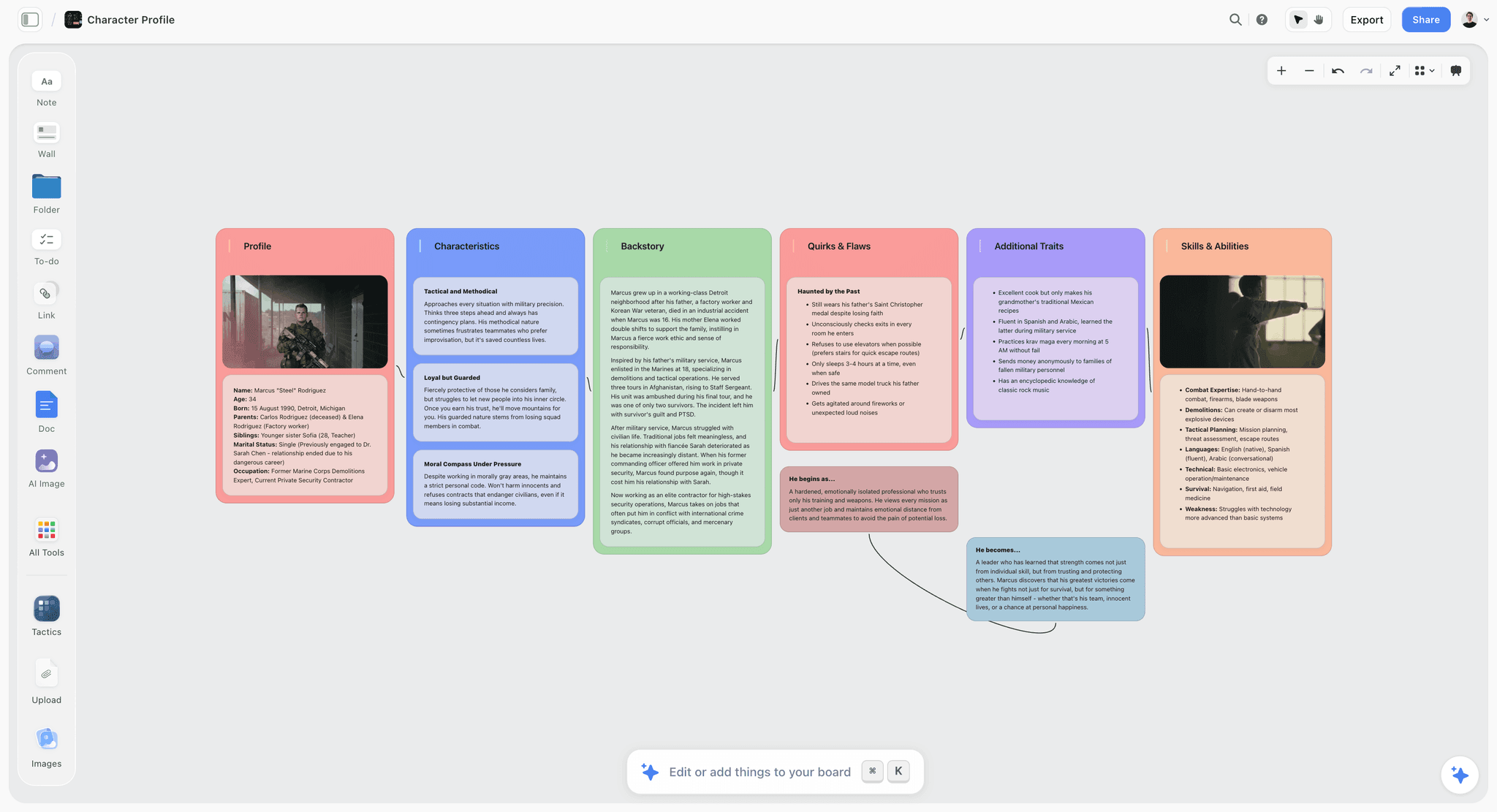
Arcs are hard to hold in a document because the arc and the plot are two different axes and a document only has one. Your outline runs top to bottom in scene order; the arc runs across those scenes on a different track: the Lie weakening, the Truth surfacing, the choice arriving. In a linear file you are always scrolling between "what happens in chapter nine" and "where is the belief right now," and the two never sit in view together. That work is spatial, not linear, which is why Storyflow exists.
Here is the concrete workflow. Open a board and drop a character profile card for your protagonist, mapping the five parts of the anatomy as their own fields: the Lie in the character's voice, the Wound underneath it, the Want, the Need, and the Truth. That card is now the spine of the arc, pinned on the canvas while everything else moves around it. Next to it, lay your plot beats (inciting incident, first act break, midpoint, low point, climax, resolution) and add a short belief-state note under each, so you see the Lie loud on the left and the Truth arriving on the right.
Then connect them. Because the canvas is infinite and freeform, you can run a line from the Lie to the midpoint beat where it cracks, and from the Need to the climax where it is chosen. The arc stops being an abstraction and becomes a visible track over the plot, and when you reorder a beat the connections come with it. This is the thing a page cannot do: keep the belief axis and the event axis in one view at once.
The AI is where this compounds. Storyflow's AI reads your full active canvas board, plus up to 1 Tactic and up to 3 Documents you @-mention in the chat. So you can ask it to check the arc against the plot: point at the beats and the character card and ask "does the Lie actually get challenged before the midpoint, or does the change happen too fast?" It answers from the whole board, not from a single prompt you had to re-explain, and because it sees the card and every beat note at once, it catches the most common failure directly: a Truth that arrives with no scene that earned it. To seed the structure, Storyflow's Story Blueprints library (200+ creative templates on Plus, Pro, and Max) includes character and story-structure frameworks you can adapt.
Honest limitations, because the arc matters more than the pitch. Storyflow is not a manuscript-drafting tool. It is built to plan, map, and pressure-test the arc, not to write the ninety-thousand-word draft, so for long-form prose with chapter management, compile, and export, draft in Scrivener and keep Storyflow as the planning and character-consistency layer beside it. Second, Storyflow is cloud-only: there is no offline, local-first mode, so writing with no signal or under strict local-only privacy requirements is a real constraint. Third, Storyflow is newer than dedicated writing suites. Final Draft, Scrivener, and Save the Cat's tools have decades of screenwriter-specific and novelist-specific depth, format automation, and ecosystem that a canvas does not replicate. Storyflow wins on seeing the arc and the plot together; it does not try to be your word processor.
Where this lands: if the arc keeps slipping out of view while you juggle the plot, a canvas that holds both axes and an AI that reads the whole board is the fix. If your problem is drafting pages, use a drafting tool and bring the arc here.
7) Mapping the Arc to Your Plot Beats
The arc and the plot are separate tracks, but not independent. The whole craft is aligning them so the internal turn lands on the external turn: the belief should move in step with the events, not drift on its own schedule.
Two failures come from breaking that coupling. If your midpoint carries the biggest plot twist but the belief does not move, the story feels hollow at exactly the moment it should feel deepest. The reverse is just as common: the belief lurches to the Truth in a scene the plot never set up, and the change reads as convenient rather than earned. A spatial view catches both, because you see the belief note under each beat and can check whether it is moving in time with the events or on its own.
8) Character Arc vs Plot Arc
These two get conflated constantly, and the confusion is the source of most flat, forgettable stories. The plot arc is the causal chain of external events: goal, obstacle, complication, crisis, resolution. It answers "what occurs." The character arc is the movement of belief from Lie to Truth. It answers "who changes, and into what." A plot arc can be technically perfect and still feel empty when nothing changed inside anyone.
The relationship you want is causal, not parallel. The plot is the pressure that forces the internal change, and the internal change is what makes the climax matter. In a well-built story you cannot resolve the plot without the character choosing the Truth, and they cannot reach the Truth without the plot's pressure. That interlock is the difference between events that happen near a person and a story that happens to them.
The simplest test is subtraction. Strip the internal change out and ask whether the ending still means anything. If the hero wins the battle but is the same person who started it, you have spectacle without weight. If the character transforms but nothing external tests it, you have therapy without a story. The goal: the choice that resolves the plot is the choice that completes the arc.
9) Common Mistakes
The failures are consistent, and each traces back to treating the arc as decoration instead of structure.
Change with no cause. The character is different at the end, but no scene earned it: the Truth arrives because the story needed it. Fix: every step toward the Truth needs a scene that pressures the Lie. If you cannot point to the scene that cracked the belief, it is unearned.
The Want and the Need point the same way. If what the character chases is also exactly what they need, there is no internal conflict and no arc. Fix: make the Want a distorted, Lie-shaped version of the Need, so they have to give up the first to get the second.
A climax that does not answer the Lie. The final beat is big, but it does not force the character to confront the belief the whole arc set up. Fix: the climactic choice must be the exact inverse of the Lie. Test it directly.
Mistaking a flat arc for no arc. Writers hear "the character does not change" and write a passive protagonist. A flat arc is a character holding the Truth against relentless, costly pressure. Fix: make that pressure as intense as the pressure to change would be in a positive arc.
Confusing backstory with an arc. A tragic past is a Wound, not an arc. The Wound installs the Lie; the arc is what happens to the Lie during the story. Fix: name the belief that past installed, then move it across the plot.
Losing the arc inside the plot. The most common practical failure: the outline grows, events multiply, and the belief axis quietly disappears. Fix: keep the arc and the plot in the same view and check that the belief is actually moving beat to beat.
11) The Bottom Line
A character arc is the difference between events and a story. The plot is the sequence of things that happen; the arc is the internal turn those things force, from the Lie the character believes at the start to the Truth they accept, hold, or refuse at the end. Get it right and a modest plot carries weight; get it wrong and the biggest spectacle feels hollow. A character arc is not what happens to a character. It is what a character stops believing.
Build it in this order: write the Lie in one sentence, name the Wound that installed it, split the Want from the Need, pick the arc type, and map the belief against your plot beats. The hard part is not the theory; it is keeping the belief axis and the event axis in view at the same time while the outline grows, which is the work a document fights and a canvas supports.
If your arc keeps slipping out of view while you wrestle the plot, map the Lie, the want, the need, and your beats on one Storyflow canvas and let the AI check whether the change is actually earned before you write the draft.
10) FAQ: Character Arcs
What is a character arc in simple terms?
A character arc is how a character changes on the inside across a story: the shift from a false belief they hold at the start (the Lie) to a truth they reach by the end. It is separate from the plot, which is the external events. If you can name the belief they start with and the belief they end with, you have named the arc.
What are the three types of character arc?
Positive, flat, and negative. In a positive arc the character starts with the Lie and ends with the Truth: they change (Scrooge). In a flat arc they already hold the Truth and hold the line, changing the world around them (Katniss Everdeen). In a negative arc they reject the Truth and fall (Michael Corleone). The type is decided by what the character does with the Truth at the climax.
What is the difference between a character arc and a plot arc?
The plot arc is the sequence of external events (goal, obstacle, crisis, resolution). The character arc is the sequence of internal shifts (belief moving from Lie to Truth). A plot can be structurally perfect and still feel empty if no one changes inside. The strongest stories interlock the two, so the last external beat and the last internal beat are the same beat.
What are want vs need in a character arc?
The Want is the character's external, conscious goal: win the case, escape the town, get the throne. The Need is the internal thing they actually require to become whole, almost always the opposite of the Lie. The Want drives the plot; the Need drives the arc. They point in different directions, and a satisfying resolution often forces the character to sacrifice the Want to accept the Need.
Does every character need an arc?
No. Protagonists almost always need one, but supporting characters often work better as fixed points, and some genres run on flat-arc heroes who deliberately do not change. What every important character needs is a clear relationship to the story's central Lie and Truth: they embody it, resist it, or are changed by it. A character with no relationship to that belief is a plot device.
What is a flat character arc?
A flat arc is one where the character already believes the Truth at the start and holds it against a world built on the Lie, changing the people around them instead of changing themselves. It is not the absence of an arc. The test is whether the pressure to abandon the Truth is real, costly, and relentless. Many enduring heroes and mentors run flat arcs.
How long should a character arc be?
An arc is not measured in words; it is measured in whether the belief actually moves and whether every step of that movement is earned. A feature, a novel, and a ninety-second brand story can all carry a full arc if the Lie is challenged, glimpsed, tested, and resolved. Short forms compress the beats rather than skip them.
Can a character have more than one arc?
Yes, especially in long-form work, but one belief should be the spine. A protagonist might carry a primary arc plus a smaller secondary arc in a subplot, and ensemble stories run several in parallel. The risk is dilution: if every arc competes for the climax, none lands. Pick the primary Lie the main plot resolves and let the rest support it.
What is the Lie the character believes?
The Lie is the false belief the character holds at the start, usually a protective one that formed in response to an old wound. "I only matter if I am useful." "Love is a weakness." It once kept them safe but now limits them. The entire arc is the story pressuring that Lie until the character replaces it, holds a Truth against it, or is consumed by it. Writing the Lie first gives you the whole arc in one sentence.
How do I fix a character arc that feels flat or unearned?
Write the Lie in one first-person sentence, then check three things. First, does a specific scene challenge the Lie before the change happens? If not, add it. Second, do the Want and the Need point in different directions? If they align, distort the Want. Third, is the climactic choice the exact inverse of the Lie? Mapping the belief against each beat, in one view, surfaces which of the three is broken.
Is a character arc the same as character development?
They overlap but are not identical. Character development is the broader work of making a character feel real: voice, backstory, contradictions, relationships. A character arc is one specific part of that: the transformation of belief across the story. You can develop a richly detailed character who has no arc (a flat-arc hero), and you can have a clear arc on a thinly drawn one. Strong writing does both.
Table of Contents
- Quick Answer: What is a Character Arc
- The Anatomy of an Arc
- The Lie and the Truth Framework
- The Three Types of Character Arc
- How to Build a Character Arc, Step by Step
- Build a Character Arc in Storyflow
- Mapping the Arc to Your Plot Beats
- Character Arc vs Plot Arc
- Common Mistakes
- FAQ: Character Arcs
- The Bottom Line
- Author
- Related Reading
Templates to check out for this topic


Story and writing templates you can use in Storyflow
Start your next script, novel, or world from a ready-made Storyflow board instead of an empty page. The AI reads the whole canvas, so every suggestion is grounded in your story.


See Storyflow in Action
A visual AI workspace where every feature lives inside one canvas. No tab-switching, no context lost.
Build your entire board from a single message
Type what you need in the AI chat at the bottom of your canvas. The AI adds cards, headings, and structure directly onto your board.
Use expert frameworks as AI context
Type @ in the AI chat and choose any Tactic. The AI tailors every response to that framework instead of giving generic advice.
Turn your board into a mind map in seconds
Ask the AI to restructure your canvas as a mindmap. It connects your ideas into a visual hierarchy so you can see how everything relates.
Why Storyflow Exists
Storyflow actually began as a personal tool while working on creative and research projects.
We kept running into the same problem: ideas were scattered everywhere: notes, documents, and whiteboards.
Nothing helped us see how everything connected.
So we started building a workspace designed around how ideas actually grow.
→ Read how Storyflow was createdJustkay
Documentary Filmmaker & Founder at Storyflow
Published: 2026-07-01
Extremely simple, seriously capable


See how easy it is to get started
Watch a real project come together, from a blank board to a finished plan, clicked through step by step.
Start creating with AI and become more productive
Transform your creative workflow with AI-powered tools. Generate ideas, create content, and boost your productivity in minutes instead of hours.