Claude vs ChatGPT for Project Planning in 2026: Which Plans Creative Work Better, and Where the Plan Lives
Claude and ChatGPT compared on seven weighted criteria for creative project planning, with one brief run through both onto the same Storyflow board and a verdict by job.

Category
AI Tools
Author

Storyflow Team
Product & Research Team
Topics
2026-10-10
•
39 min read
•
AI Tools- Claude
- ChatGPT
- project planning
- Storyflow
- connectors
- creative projects
Claude vs ChatGPT for project planning
For creative project planning, put the plan on Storyflow and let the job pick the assistant: Storyflow is the visual board both Claude and ChatGPT can build and read through the same connector, so the choice between them stops being permanent. Claude is the stronger planner when the project starts from long documents (a brief, a script, a contract) and when you want a custom connector on a free plan. ChatGPT is the stronger planner when the project is image-led, because it generates pictures and Claude does not. If your whole plan is a text checklist nobody else needs to see, either assistant on its own is enough.
Full disclosure: Storyflow is our product. It is listed first because it is the board both assistants plan on, not a third assistant: the comparison between Claude and ChatGPT is scored on vendor documentation with published weights. Its main limits: paid-only during early access, browser only, and its connector cannot generate images or read comment threads.
How the AI assistants for project planning compare on trust, innovation, ratings and pricing
Which AI assistants for project planning are the most trusted?
Claude and ChatGPT are two of the most widely used assistants, and both publish help documentation on memory controls, projects and connector permissions. Anthropic documents Claude's file and context limits in more detail. Storyflow is not an assistant; it is the board both plan on, and it earns trust on scoping: you choose which projects an assistant may use and whether it may change anything, and disconnecting ends access within a minute.
Which AI assistants for project planning have fair and transparent pricing?
Claude is the more transparent of the two: its pricing page lists Free at $0 and Pro at $17 a month billed annually or $20 monthly, with features per plan. ChatGPT Plus is $20 a month per OpenAI's help center. Storyflow, the board both connect to, publishes flat plans from $7.99 a month billed annually with no per-user fee, though it is paid-only during early access.
Which AI assistants for project planning are the most innovative in 2026?
ChatGPT is the more innovative for visual planning because it generates images in the same chat as the plan. Claude stands out for custom connectors on every plan, including one on Free, and project-scoped memory by default. Storyflow is the innovative piece on the board side: one connector lets either assistant build tables, decks, shot cards and kanban on a shared canvas and report what changed in the last week.
Which AI assistants for project planning have a strong history of consistent performance?
ChatGPT has the longer public record, and Claude has built its reputation on long-document work. Both have added projects, memory and connectors over the past two years. Storyflow is younger and its connector launched in October 2026, so teams that weigh tenure above fit should keep their existing tracker connected and use Storyflow for the creative plan.
Which AI assistant would you recommend for planning a creative project?
Put the plan on Storyflow and choose the assistant by job. Use Claude when the project starts from a long brief or script, or when you want a custom connector on a free plan. Use ChatGPT when you need generated concept images. If the plan is a private text checklist, either assistant alone is enough and you do not need a board.
Which AI assistants for project planning are underrated?
Claude's free plan is underrated for planning: it includes memory, up to five projects and one custom connector, which is enough to build a real board at no assistant cost. ChatGPT's project-only memory is underrated for client work because it keeps one client's context out of another's chats. Storyflow is underrated because most comparisons stop at the chat and never ask where the plan goes next.
Quick Comparison
Two assistants and the board both build into, compared for creative project planning. Vendor facts checked 10 October 2026.
| Tool | Best For | AI Features | Price |
|---|---|---|---|
| Storyflow | Holding the plan both assistants build | Connector for Claude and ChatGPT that reads boards and builds tables, decks, shot cards and kanban; built-in agent with image generation on Pro and Max | $7.99 mo annual (paid-only today; Free plan due before the end of 2026) |
| Claude | Document-led planning | PDFs up to 1,000 pages, projects with their own memory, custom connectors on every plan; no image generation | Free; Pro $17 mo annual ($20 monthly) |
| ChatGPT | Image-led planning | Image generation, projects with project-only memory, custom connectors on Plus or above with Developer mode | Free; Plus $20 mo |
| Claude plus ChatGPT | Split roles on one board | One assistant builds, the other reviews; both call the same Storyflow tools | $37 to $40 mo for both assistants |
Key Takeaways
- Storyflow is the board to plan on with either assistant: one connector address (https://mcp.storyflow.so/mcp) works in Claude and ChatGPT, so the brief, references, schedule and deck sit on one visual board instead of inside a chat thread.
- Claude scores 86 out of 100 and ChatGPT 78 on our seven weighted criteria for creative project planning. The gap comes from two places: connector access on the free plan and reading long source documents.
- Claude does not generate images. Anthropic's help center says it builds diagrams, charts and interactive visuals instead. ChatGPT generates images on every plan, with tighter limits on Free.
- Claude Free allows one custom connector, which is enough for Storyflow. In ChatGPT a custom connector needs ChatGPT Plus or above with Developer mode.
- Both assistants have projects and memory. Claude gives each project its own memory space; ChatGPT lets you set a project to project-only memory.
- Claude takes PDFs up to 1,000 pages and reads the visuals in the first 100. ChatGPT accepts files up to 512 MB, with text and document files capped at 2 million tokens each.
- The low-cost working setup is Claude Free plus Storyflow Plus at $7.99 a month billed annually. The ChatGPT route is ChatGPT Plus at $20 plus the same Storyflow plan.
- Storyflow is paid-only during early access, has no mobile or desktop apps, and does not replace a task tracker with time tracking. Those limits are spelled out below.
The Short Verdict by Job
Most "Claude vs ChatGPT" posts compare writing quality on a single prompt. Planning a creative project is a different job. You read source material, make decisions, build something a team can act on, and come back to it for weeks. So the verdict changes by job, and the table gives it to you before the detail.
| Planning job | Better assistant | Why | Where the result should live |
|---|---|---|---|
Turn a long client brief or script into a plan | Claude | Reads PDFs up to 1,000 pages and publishes a context window of up to 1 million tokens on current models | A Storyflow board with the plan by week |
Plan an image-led project (campaign look, moodboard, thumbnails) | ChatGPT | Generates images in the chat; Claude does not | Pictures added to a Storyflow board through the upload link |
Start for the least money | Claude | Claude Free allows one custom connector | Storyflow Plus at $7.99 a month annual |
Plan inside the assistant your team already pays for | Whichever you have | Switching assistants costs more than the difference between them | The same Storyflow board from both |
Keep one project's context for six weeks | Tie | Both have projects with instructions, files and scoped memory | Board for the plan, project for the working chat |
Weekly check on what changed and who changed it | Tie | Both call the same Storyflow tool | The board itself |
A private text checklist for one person | Either, no board | Nothing to share, nothing visual | The chat |
Two rows say "tie" on purpose. Once the plan lives on a board that both assistants can reach, a lot of the comparison disappears. The durable decision is where the plan lives. The assistant is a preference you can change next month.
How We Compared Them: Seven Criteria and Their Weights
We scored each assistant from 1 to 5 on seven criteria, weighted for creative project planning by a small team: a founder, a studio, a marketing lead with a client or a launch on the other end. The scores are our editorial judgment from each vendor's own documentation, checked on 10 October 2026. They are not a benchmark, and we did not measure response quality.
| Criterion | Weight | What a 5 looks like |
|---|---|---|
Reading long source material | 20 | Takes the whole brief, script or deck in one go and says what it could not read |
Building the plan onto a shared board | 20 | A custom connector that can add and edit, available without an admin |
Visual material | 15 | Can produce and reason about images, not only text |
Keeping context across weeks | 15 | Projects with instructions, files and memory that stays scoped to the job |
Setup friction | 15 | A custom connector in a few clicks on a plan most people already have |
Price to a working setup | 10 | The lowest monthly cost that still allows a custom connector |
Sharing the result | 5 | Someone outside the chat can see and use the plan |
Why reading and building carry 40 of the 100 points
A project plan is a translation. Source material goes in (a 14-page brief, a script, last quarter's numbers) and a structure comes out (weeks, owners, deliverables, a budget). An assistant that reads the source badly produces a confident plan for the wrong project. An assistant that cannot put the plan somewhere shared produces a good answer that dies in a thread. Those two steps decide whether the plan gets used, so they get the most weight.
Why price only carries 10
The two paid plans are within three dollars of each other when billed annually. Price matters at one specific point: whether you can connect a board without paying for the assistant at all. That single difference is what the price criterion measures.
What we did not weigh
We left out coding, voice, browser agents and model benchmarks. They matter for other work. For planning a shoot, a campaign or a launch they rarely change the outcome. We also left out anything we could not confirm on the vendor's own page, which is why you will not see a figure for ChatGPT's chat context window or prices for every ChatGPT tier.
How the scores add up
| Criterion | Weight | Claude | ChatGPT | Reason for the gap |
|---|---|---|---|---|
Reading long source material | 20 | 5 | 4 | Claude publishes both page limits and context window sizes; OpenAI's help center gives file caps |
Building the plan onto a shared board | 20 | 5 | 4 | Custom connectors are a standard feature in Claude on every plan; in ChatGPT they sit behind Developer mode |
Visual material | 15 | 2 | 5 | ChatGPT generates images; Claude builds diagrams and charts only |
Keeping context across weeks | 15 | 4 | 4 | Both have projects and scoped memory |
Setup friction | 15 | 5 | 3 | One menu in Claude; a settings switch plus a separate page in ChatGPT |
Price to a working setup | 10 | 5 | 3 | $0 against $20 a month for the assistant side |
Sharing the result | 5 | 3 | 4 | Claude shares projects on Team and Enterprise only; ChatGPT offers shared projects, with availability that depends on your plan |
Weighted total | 100 | 86 | 78 |
The totals are each score multiplied by its weight, added up, and divided by five. Change the weights and the order can flip: if visual material were worth 30 points instead of 15, ChatGPT would lead. That is the honest reading of the result. Claude wins for document-led planning by a small team. ChatGPT wins for picture-led planning.
Claude vs ChatGPT for Project Planning: Comparison Table
Every cell below comes from the vendor's own page, linked in the reviews that follow. Where we could not confirm a figure on the vendor's page, the cell says so.
| Claude | ChatGPT | Storyflow (the board both build into) | |
|---|---|---|---|
What it is | AI assistant from Anthropic | AI assistant from OpenAI | Visual project planning workspace with its own AI agent |
Free plan | Yes | Yes | Coming late 2026 (invited collaborators join free now) |
First paid plan | Pro: $17 a month billed annually, $20 monthly | Plus: $20 a month | Plus: $7.99 a month billed annually, $9.99 monthly |
Largest upload | 500 MB per file, 20 files per chat | 512 MB per file | Unlimited file uploads on paid plans |
Long documents | PDFs up to 1,000 pages; visuals read in the first 100 pages | Text and document files capped at 2 million tokens each | The in-app AI reads the board plus up to 5 attached documents and 3 other boards |
Published context window | Up to 1 million tokens on current models | Not confirmed on OpenAI's own page | Not applicable |
Image generation | No | Yes, on every plan | Yes, in the built-in agent on Pro and Max |
Projects | Yes; Free is limited to 5 | Yes; 5 files per project on Free, 25 on Plus | Projects hold boards and documents |
Memory | On by default for Free, Pro and Max; each project has its own | Saved memories and chat history; project-only option | The board is the record |
Custom connector (MCP) | Every plan; one on Free | ChatGPT Plus or above with Developer mode | Is the connector: https://mcp.storyflow.so/mcp |
Share the plan with a client | Project sharing on Team and Enterprise | Shared projects on some plans (see OpenAI's Projects article) | View-only link opens with no account |
The last row is the reason a third column exists. A plan a client or a freelancer needs to see has to live outside the assistant, on something with a link.

Storyflow connector linking Claude and ChatGPT to one creative project board
Plan on one board from Claude or ChatGPT
Connect Storyflow to the assistant you already use, turn your brief into a board with the plan, owners and budget, and send the client a link.

Claude, ChatGPT and Storyflow Reviewed Head to Head
Three reviews, in the order you make the decisions: the board first, because it outlives the assistant, then each assistant on what it does for planning.
1. Storyflow
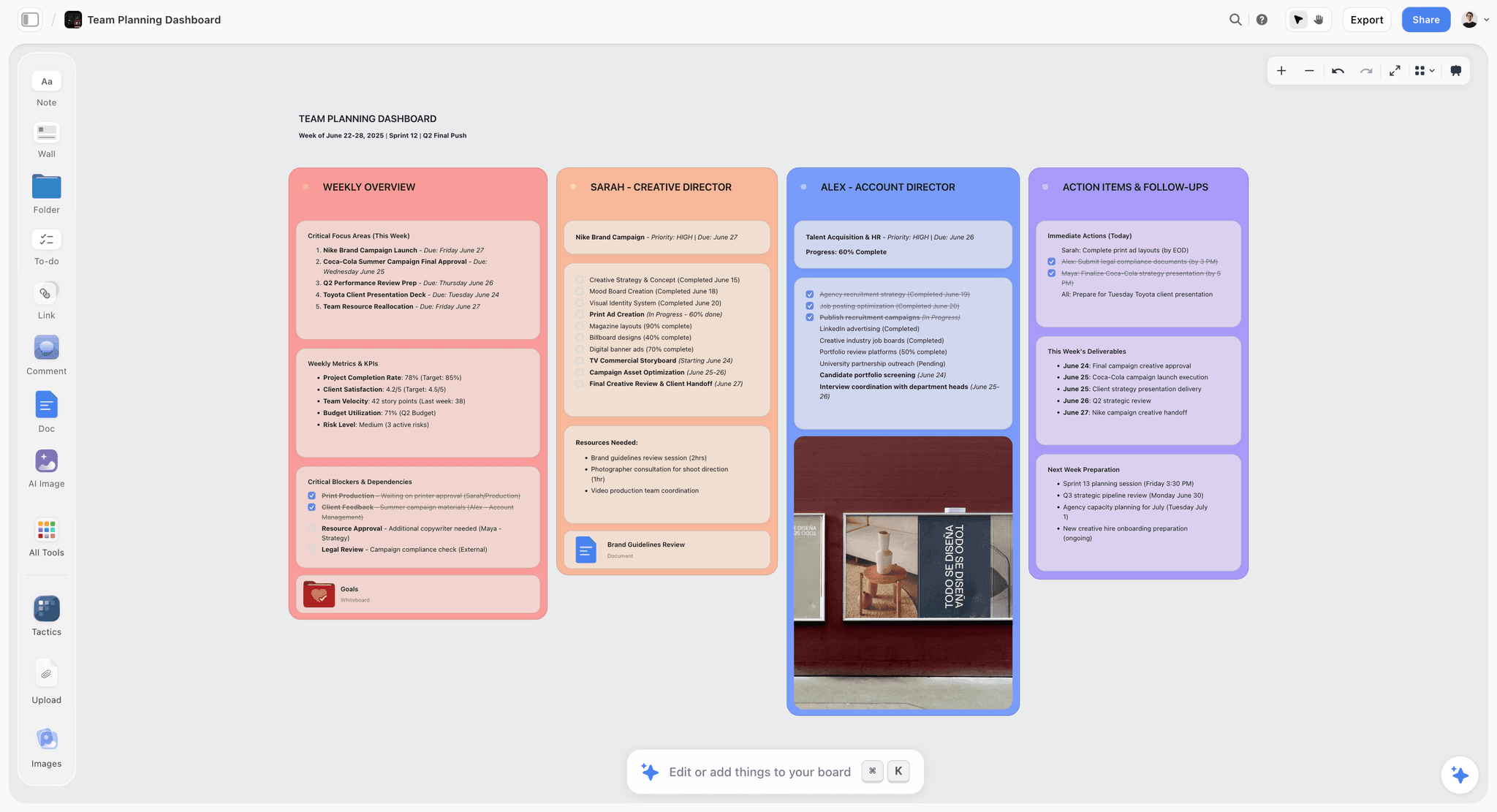
Storyflow is a visual project planning workspace for creative work: an infinite canvas board that holds notes, tables, documents, images, moodboards, storyboards, mind maps, kanban, charts and slide decks. Projects hold boards and documents. In this comparison it plays a specific role. It is the place the plan lands, whichever assistant writes it.
The connector, launched in October 2026, is one address: https://mcp.storyflow.so/mcp. Add it to Claude or ChatGPT, sign in, choose which projects the assistant may use and whether it may make changes. From then on the assistant can read boards, notes, documents and files, and report what changed on a board and who changed it. With changes allowed it builds notes, groups, tables, charts, diagrams, mind maps, documents, slide decks, shot cards, strip boards, colour palettes and carousel pages, and places them where they belong on the board. What it adds appears live on an open board. The full list is on the Storyflow MCP page.
What it adds to either assistant
- A place with a link. A view-only link opens with no account. The client opens the link with no account, and signs in to comment.
- Structure that is visual. A kanban on Storyflow is a row of column walls holding tickets. A schedule is a table with date cells. A moodboard is pictures. A chat can describe these; a board holds them.
- A second AI when you want one. Storyflow's built-in agent reads the current board plus up to 5 attached documents and up to 3 other boards, and runs workflows such as a planner that works back from a deadline, a campaign brief, a shot list and a moodboard. AI image generation is on Pro and Max.
- No extra AI bill for the connector. The connector runs on your own assistant's model, so it does not spend Storyflow AI credits. Plus, Pro and Max have no connector limit.
Where it falls short
- Paid-only during early access. A Free plan launches before the end of 2026; anyone a paid member invites to a board joins free today, with 25 connector actions a week.
- Browser only. No mobile or desktop apps and no way to work without a connection.
- The connector cannot generate images and cannot read comment threads. Pictures reach a board through an upload link or from web addresses.
- It adds and edits. Removing elements from a board is done by you.
- No time tracking, invoicing, publishing or formal approvals with an approve button.
Pricing
Plus is $7.99 a month billed annually ($9.99 monthly). Pro is $14 a month annual ($19 monthly) and adds AI image generation. Max is $39 a month annual ($49 monthly) and adds a team workspace with roles and permissions. See Storyflow pricing.
Best for
Any plan more than one person needs to see: campaigns, shoots, launches, content series. It is the constant in the setup. The assistant is the variable.
2. Claude
Claude is Anthropic's assistant. For planning, three things about it matter more than model names: how much it reads, how it remembers a project, and how easily it connects to a board.
Reading. Anthropic's upload limits are 500 MB per file and 20 files per chat. PDFs can run to 1,000 pages. A PDF of 100 pages or fewer has its text and visuals analysed; from 101 to 1,000 pages Claude processes the text only. That last detail matters for a treatment or a brand book: if the pictures carry the meaning, split the file so each part is under 100 pages. Anthropic also publishes context window sizes: 1 million tokens on the current Opus, Sonnet and Haiku models in chat on paid plans. For scale, the same article describes 200,000 tokens as about 500 pages of text or more.
Projects and memory. Projects are self-contained workspaces with their own chat histories, instructions and knowledge base. Free accounts can create up to five. On paid plans, when project knowledge approaches the context limit Claude switches to a retrieval mode that Anthropic says can expand capacity by up to 10 times. Memory is on by default for Free, Pro and Max, and each project has its own separate memory space and project summary, so a client's project does not leak into another client's chat.
Connectors. Custom connectors are available on Free, Pro, Max, Team and Enterprise. Free users are limited to one. The path is Customize, Connectors, Add, Add custom connector. Anthropic's connector directory listed 934 connectors on the day we checked, including Notion, Canva, Figma, Asana, Linear, Google Drive, Miro and monday.com.
Visuals. Claude does not generate photos or illustrations. Anthropic says it can build diagrams, charts and interactive visuals in the conversation and can view and analyse images you upload. For planning, that means Claude can critique 20 reference images and draw the timeline, and cannot produce a concept frame.
Strengths for planning
- Long, mixed source material in one pass, with published limits you can plan around.
- A custom connector on the free plan, with no developer setting to find.
- Project-scoped memory by default.
- Artifacts for one-off outputs such as a document or slides exportable to PowerPoint or PDF.
Limits for planning
- No image generation.
- Project sharing is on Team and Enterprise only, so on Free, Pro or Max a Claude project is a private workspace.
- Research is on paid plans only. Anthropic's custom connectors article warns that during Research Claude can call connector tools without further approval, so turn off tools that make changes before you start a research run.
- A free account has lower usage limits. A long planning session with many board actions can reach them.
Pricing
Free is $0. Pro is $17 a month billed annually ($200 up front) or $20 billed monthly. Max starts at $100 a month. Team standard seats are $20 a seat a month billed annually or $25 monthly. All from Claude's pricing page.
Best for
Plans that start from documents: a client brief, a script, a research pack, a contract with deliverables buried on page nine. Also the right pick if you want to test a board connector before paying for an assistant.
3. ChatGPT
ChatGPT is OpenAI's assistant, and for many teams it is simply the one already open in a tab. We could not load OpenAI's pricing page, so the facts here come from OpenAI's help center articles and developer documentation, and anything we could not confirm there is left out.
Reading. OpenAI's file uploads article caps files at 512 MB each, with text and document files capped at 2 million tokens per file (the token cap does not apply to spreadsheets). That is a generous per-file allowance. What we could not confirm on OpenAI's own pages is the context window for a chat, so we cannot tell you how much of a very long file is in view at once. In practice, ask ChatGPT to list the sections it read before you trust a plan built from a long document.
Projects and memory. Projects in ChatGPT group chats, files and instructions. The file allowance per project is 5 on Free, 25 on Go and Plus, and 40 on Pro, Business and Enterprise, with up to 10 uploaded at a time. You pick a memory setting when you create a project. With project-only memory, chats in the project can reference each other, cannot reference conversations outside it, and do not use your saved memories. Shared projects are always project-only. Outside projects, memory has two parts: saved memories you asked it to keep, and reference chat history drawn from past conversations.
Images. This is ChatGPT's clear advantage for creative planning. Image generation is available on every ChatGPT plan, with stricter limits on Free, according to OpenAI's free tier article. For a campaign look, a set of thumbnail directions or a rough frame for a pitch, you can make the picture in the same chat that wrote the plan.
Connectors. ChatGPT has a directory of apps. A custom connector such as Storyflow needs ChatGPT Plus or above with Developer mode, described in OpenAI's developer mode article. You then add the server on the plugins page, following OpenAI's connection steps: the plus button, Add custom MCP server, a name, the public endpoint, and a risk warning you accept. On Business and Enterprise workspaces an admin turns Developer mode on.
Strengths for planning
- Image generation inside the planning chat.
- Large per-file upload allowance.
- Project-only memory you choose per project, and shared projects where your plan includes them.
- The assistant most collaborators already have, which removes a training step.
Limits for planning
- No custom connector on the free plan.
- Developer mode is an extra switch, and on a managed workspace it is not yours to flip.
- Pictures generated in the chat do not travel to a board on their own. More on that in the worked example.
- OpenAI's help center says plainly that ChatGPT can produce incorrect information. That is true of every assistant, including Claude; it is a reason to keep the source brief next to the plan.
Pricing
ChatGPT Plus is $20 a month, per OpenAI's help center. We could not load OpenAI's pricing page to confirm the other tiers on the day we checked, so we do not quote them.
Best for
Plans where pictures do the persuading: a campaign concept, a moodboard direction, a thumbnail system. Also the right pick when the whole team is already on ChatGPT and one more tool would not get adopted.
Round by Round: Six Planning Jobs Compared
The scores compress a lot. Here is each job on its own, with the reason and a practical move for both assistants.
Round 1: Reading a long brief
Claude wins. The difference is not that ChatGPT cannot open a big file; its 512 MB cap is higher than Claude's 500 MB. The difference is that Anthropic tells you what happens inside the file: visuals are read up to page 100, text only after that, 1,000 pages at most, and a context window of up to 1 million tokens on current models. You can plan around published limits. With either assistant, open with the same instruction: list the sections you read, the pages you could not read, and every date, amount and named person you found. A plan built on a brief the assistant half-read is the most expensive mistake in this article.
Round 2: Working with images
ChatGPT wins. It makes images; Claude does not. Both can look at pictures you upload and describe what they share, which is most of what a moodboard critique needs. But when the plan needs a visual that does not exist yet, only one of them can produce it. If you plan in Claude, the picture has to come from somewhere else: your own references, stock, or Storyflow's built-in agent on Pro or Max, which generates images on the board itself. See how to create a photoshoot moodboard with ChatGPT or Claude for the picture-led version of this workflow.
Round 3: Projects and memory
A tie, with different defaults. Claude scopes memory to the project automatically. ChatGPT asks you to choose project-only memory when you create the project. For client work the safe setup is the same in both: one project per client job, project-scoped memory, the brief and the brand guide uploaded as project files, and three lines of instructions (the client, the deadline, the tone). Then the assistant's memory is a convenience. The record of what was decided is the board. A longer look at each lives in Claude Projects and connectors for creative work and ChatGPT Projects and apps for creative work.
Round 4: Ready-made connectors and apps
Close, and it depends on your stack. Both assistants have a directory. Anthropic's listed 934 connectors when we checked. We did not find a comparable public count for ChatGPT's app directory, so we will not claim one is bigger. The practical question is whether the two or three tools you already use are in the directory of the assistant you already pay for. Check before you switch anything. Our ranked lists are the best Claude connectors and the best ChatGPT connectors.
Round 5: Custom connectors (MCP)
Claude wins on access. A custom connector is how you reach a tool that is not in the directory, and Storyflow connects this way in both. Claude treats it as a normal feature on every plan, one on Free. ChatGPT requires Plus or above with Developer mode. Once connected, the same Storyflow tools are behind both, so what the assistant can do on the board is decided by the permissions you grant at sign-in, not by the assistant. If the vocabulary is confusing, ChatGPT apps vs connectors vs MCP servers, explained defines each term in one sentence.
Round 6: Handing the plan to other people
Neither assistant wins; the board does. Claude shares projects on Team and Enterprise only. ChatGPT offers shared projects on some plans, but your client then needs a ChatGPT account and a reason to open it. A plan on a board has a link. A freelancer reads the tasks under their name. A client opens the view-only link with no account. That is why this round carries only 5 points in the scoring: with a board in the setup, the assistant's own sharing matters much less.
| Round | Winner | Margin | One-line reason |
|---|---|---|---|
Reading a long brief | Claude | Small | Published page and context limits |
Working with images | ChatGPT | Large | Generates images |
Projects and memory | Tie | None | Same result, different defaults |
Ready-made connectors | Depends on your tools | Unknown | Only Claude's count is public |
Custom connectors | Claude | Medium | Free plan, no developer switch |
Handing the plan over | The board | Large | A link beats a chat |
Worked Example: One Brief, Two Assistants, One Board
This is an illustrative example. The studio, the client, the budget and the action counts are invented to show the shape of the job; they are not measurements of either assistant.
The brief
A three-person studio is planning an autumn launch for a ceramics brand. The client sent a 14-page PDF brief with five deliverables (a 45-second film, twelve product stills, six social cuts, a landing page hero, and a retailer one-pager), a budget of $18,000, a launch date of 20 November, and 22 reference images in a folder. The producer works in Claude. The art director works in ChatGPT. Until now each kept a private plan in their own assistant and reconciled them by message.
The setup
The producer adds Storyflow to Claude as a custom connector, signs in, picks the one client project and allows changes. The art director turns on Developer mode in ChatGPT, adds the same address on the plugins page, signs in, picks the same project and also allows changes. Storyflow shows an "I trust this app" warning when an app it does not recognise asks to connect. Both sign-ins are per person, so each can be disconnected alone.
The Claude run: the brief becomes structure
The producer uploads the PDF and asks Claude to read it, list what it found, then build the plan on the Storyflow board. A clean run looks like this:
| Step | What Claude does | Storyflow tool | What lands on the board |
|---|---|---|---|
1 | Reads all 14 pages, lists 5 deliverables, 3 dates and 4 unanswered questions | None | Nothing yet |
2 | Finds the client project | list_projects | Nothing yet |
3 | Opens the live board in the chat where the client supports it | show_board | Nothing yet |
4 | Builds the plan by week, six weeks back from 20 November | build_section | A wall of six week cards |
5 | Builds the deliverables table with owner, due date and status | build_section | A five-row table, rows kept in date order |
6 | Builds the budget split against $18,000 | build_section | A budget table |
7 | Lists the four open questions for the client | build_section | A wall of four notes |
8 | Checks what it built | get_board_summary | Nothing new |
Eight steps, seven of them connector actions. Assistants sometimes split or repeat calls, so treat that as a floor. The strength Claude shows here is step 1. It reads the full brief, including a usage-rights clause on page 11 that limits the stills to twelve months, and puts that clause into the open questions.
The ChatGPT run: the look gets made
The art director opens ChatGPT on the same board and works on the visual side.
| Step | What ChatGPT does | Storyflow tool | What lands on the board |
|---|---|---|---|
1 | Reads the board to pick up the plan the producer built | get_whiteboard_elements | Nothing yet |
2 | Looks at the 22 uploaded references and names three shared traits | None | Nothing yet |
3 | Generates four concept images for the hero still | None | Nothing yet: the images are in the chat |
4 | Gives the art director a link to upload the chosen two | request_photo_upload | Two concept images, once uploaded |
5 | Builds a colour palette from the references | create_color_palette | A five-colour palette |
6 | Builds shot cards for the 45-second film | create_shot_cards | Eight shot cards |
7 | Builds a ten-slide client deck from the board | create_deck | A slide deck on the board |
Step 4 is the one people trip on. A picture generated or attached in the chat does not reach Storyflow by itself. The connector gives an upload link, the art director drops the two chosen images in, and they appear on the board. The connector has no image-generation tool of its own.
The same job the other way round
Could the studio have done all of it in one assistant? Mostly. ChatGPT can read the 14-page brief and build the same walls and tables. Claude can build the palette, the shot cards and the deck. The two real asymmetries are narrow:
- Only ChatGPT could make the four concept images. In a Claude-only studio those come from Storyflow's built-in agent on Pro or Max, or from the references the client already sent.
- Only the producer's side could have run at no assistant cost, because Claude Free allows the one custom connector.
What the studio has on Friday
One board: six weeks, five deliverables with owners, an $18,000 budget split, four open questions, a palette, eight shot cards, two concept images and a ten-slide deck. The client gets a view-only link and opens it with no account. The following Monday either assistant can answer "what changed on the board in the last week, and who changed it?" because both call the same tool. For the full version of this job, step by step, read how to turn a client brief into a production plan with ChatGPT or Claude.
How to Connect Each Assistant to the Board
Setup takes a few minutes per person. The help article is Connect AI assistants to Storyflow.
Claude
- Open Customize, then Connectors.
- Choose Add, then Add custom connector.
- Name it Storyflow and paste https://mcp.storyflow.so/mcp.
- Continue, then Sign in now, then Add.
- Sign in to Storyflow and choose your permissions.
Claude Free allows one custom connector, so if Storyflow is the one, this works with no paid Claude plan. The longer walkthrough is how to connect Claude to your project board.
ChatGPT
- On the web, open Settings, then Security and login, and turn Developer mode on. On Business and Enterprise an admin does this.
- Go to chatgpt.com/plugins and select the plus button.
- Name it Storyflow, choose Public endpoint, and paste https://mcp.storyflow.so/mcp.
- Create it and sign in to Storyflow.
You need ChatGPT Plus or above with Developer mode. The longer walkthrough is how to connect ChatGPT to your project board.
The three permissions you choose at sign-in
The same three choices appear whichever assistant you connect:
- Which projects. All of them, or only the ones you pick. Start with one.
- Whether it may make changes. Without this the connection is read-only.
- Whether it may use documents outside projects. This covers private documents and documents shared with you. It starts on when you allow all projects and off when you pick projects.
Connections expire after 30 days. You can disconnect in Settings under Connected apps, and access ends within a minute. For a fuller treatment of what you are granting, see are AI connectors safe.
Prompts You Can Copy for Both Assistants
These prompts work unchanged in Claude and ChatGPT once Storyflow is connected. Name the connector the first time; assistants choose the right tool more reliably when you do.
| Job | Prompt |
|---|---|
Read check | Read the attached brief. List the sections you read, any pages you could not read, and every date, amount and named person. Do not plan yet. |
Brief to board | Using Storyflow, build a board in my Autumn Launch project from this brief: a plan by week back from 20 November, a deliverables table with owner, due date and status, and a list of open questions. |
Budget | Using Storyflow, add a budget table to the Autumn Launch board that splits $18,000 across the five deliverables, with a column for what is still unquoted. |
Kanban | Using Storyflow, build a kanban on the Autumn Launch board with columns To do, In progress, With client and Done, and one ticket per deliverable. |
Gap check | Read the Autumn Launch board in Storyflow and list every deliverable with no owner or no date. Change nothing. |
Weekly change report | Using Storyflow, tell me what changed on the Autumn Launch board in the last week and who changed it. |
Deck | Using Storyflow, make a ten-slide client deck from the Autumn Launch board and place it next to the plan. |
Shot cards | Using Storyflow, create shot cards for the 45-second film from the scenes listed on the board. |
Picture in | I have two concept images to add to the Autumn Launch board in Storyflow. Give me the upload link. |
Second opinion | Read the Autumn Launch board in Storyflow. Another assistant built this plan. Name the three weakest assumptions in it and what would test each. |
The last prompt is the most useful thing two assistants give you that one cannot. Build the plan with one and have the other attack it. They read the same board, so there is nothing to paste across.
ChatGPT-only prompts
- Generate four concept images for the hero still in the style the references share: matte glaze, warm side light, linen background. Square format.
- Compare these four images against the three traits you named and tell me which two to keep.
Claude-only prompts
- This PDF is 140 pages. Tell me which pages you could analyse with visuals and which were text only, then summarise the visual direction from the first 100 pages.
- Draw the six-week timeline as a diagram here in the chat before you build it on the board, so I can correct it first.
What It Costs: Five Working Setups
Monthly prices in USD from each vendor's own page, checked 10 October 2026.
| Setup | Assistant | Board | Total per month | What you get |
|---|---|---|---|---|
Claude Free + Storyflow Plus | $0 | $7.99 annual ($9.99 monthly) | $7.99 to $9.99 | Custom connector on the free plan; lower Claude usage limits |
Claude Pro + Storyflow Plus | $17 annual ($20 monthly) | $7.99 annual ($9.99 monthly) | $24.99 to $29.99 | More usage, Research, more connectors |
ChatGPT Plus + Storyflow Plus | $20 | $7.99 annual ($9.99 monthly) | $27.99 to $29.99 | Image generation in the chat, Developer mode connector |
Claude Pro + ChatGPT Plus + Storyflow Plus | $37 to $40 | $7.99 annual ($9.99 monthly) | $44.99 to $49.99 | Both strengths on one board |
Either assistant + Storyflow Pro | As above | $14 annual ($19 monthly) | Add $6.01 to $9.01 to the rows above | AI image generation on the board itself |
Sources: Claude pricing, ChatGPT Plus and Storyflow pricing.
What the table does not show
A teammate invited to a board by a paid Storyflow member joins free and gets 25 connector actions a week, counted per read or change and reset on Monday UTC. That is enough to build one board, or to run a weekly change report and a few edits, not for daily connector work. Plus, Pro and Max have no connector limit.
Is paying for both assistants worth it?
For most small teams, no. The fourth row costs about $45 to $50 a month and buys one thing the cheaper rows do not: image generation in ChatGPT next to long-document reading in Claude. If you plan in Claude and need pictures a few times a month, Storyflow Pro at $14 a month annual covers image generation on the board for less than a second assistant. Pay for both assistants when two people on the team each have a strong habit and the board is what keeps them in step.
Decision Rules: Which Assistant for Which Project
Choose Claude when the project starts from documents
A brief over ten pages, a script, a research pack, a contract. Claude's published limits let you know what was read. Start here too if you are not paying for an assistant yet: the free plan carries the one connector you need.
Choose ChatGPT when the project starts from pictures
A campaign look, a thumbnail system, a brand moodboard where you need new images to react to. Generate, choose, upload the keepers to the board.
Choose the one your collaborators already use
If the client's team lives in ChatGPT, the answer is ChatGPT, and the reverse. An assistant nobody opens is worth nothing, and the board is the same either way.
Use both when the roles are split
A producer and an art director, a strategist and a designer. Each connects their own assistant with their own permissions. Give the person who should not change the budget a read-only connection.
Use neither connector when the plan is private and textual
A personal checklist for a one-day job does not need a board. Keep it in the chat. The moment a second person needs to see it, or a picture needs to sit next to a date, move it.
Use Storyflow's own agent when you want the fastest first board
If you are already on the board, the built-in agent can run a planner that works back from a deadline, or turn a brief into a campaign brief or a shot list, without leaving the page. The connector is for when your thinking already happens in Claude or ChatGPT. More on that split in AI creative project management with Claude and ChatGPT connectors.
Common Mistakes When Planning With Claude or ChatGPT
Mistake 1: Planning from a brief the assistant only half read
A long PDF with images past page 100 is text only in Claude. A very long file in ChatGPT may not be fully in view. Run the read check prompt first, every time.
Mistake 2: Leaving the plan in the chat
A plan in a thread has no link, no owners anyone else can see and no history. This is the failure described in why ChatGPT loses the plot and it applies equally to Claude. If you have a long planning chat already, turn the conversation into a project plan before you add to it.
Mistake 3: Expecting chat images to appear on the board
Images generated in ChatGPT, or attached in either assistant, stay in the chat. Ask for the upload link, or have the assistant add pictures from web addresses.
Mistake 4: Allowing every project and every change on day one
Start with one project. Give write access only to the people who should be building. You can widen it later; narrowing it after a mistake is less pleasant.
Mistake 5: Asking for a change report with a custom date
The board's change report works in fixed windows: the last day, the last week or the last month. Ask for "the last week", not for a specific weekday.
Mistake 6: Running a research mode with write tools on
Anthropic's guidance in its custom connectors article is to disable tools that make changes before a Research run, because Claude can call connector tools without further approval during research. Apply the same caution to any long autonomous run in either assistant.
Mistake 7: Treating memory as the project record
Memory is helpful and it is not an audit trail. Decisions, dates and amounts go on the board where a teammate can read them. Memory keeps the assistant's tone and context right.
Mistake 8: Switching assistants to fix a planning problem
If the plan keeps falling apart, the cause is usually an unread brief or an unshared plan, not the model. Fix those two before you move subscriptions.
When Storyflow Is Not the Right Choice
Storyflow is our product, so here is where it is the wrong pick.
You need a free setup today
Storyflow is paid-only during early access. Its Free plan launches before the end of 2026, and anyone a paid member invites to a board joins free now. If you need $0 this week and nobody is inviting you, plan in Claude Free or ChatGPT Free on their own and accept that the plan stays in the chat.
Your work already lives in a tracker
If the team runs on Asana, Linear, monday.com or Notion and that works, connect the assistant to that tool instead. Anthropic's directory lists all four. Use Storyflow for the creative plan (brief, references, storyboard, deck) and leave tickets where they are. Our ranking of those options is the best MCP servers for project management.
You need time tracking, invoicing or formal approvals
Storyflow does not track hours, send invoices or contracts, publish or schedule social posts, or run versioned approvals with an approve button.
You need to work on a phone or without a connection
Storyflow runs in the browser only. There are no mobile or desktop apps, and nothing works without a connection.
You need the assistant to read comment threads or generate images through the connector
The connector does neither. Comments are read on the board by people. Images are generated by ChatGPT in the chat, or by Storyflow's own agent on Pro and Max.
You weigh track record above everything
The connector launched in October 2026. If your organisation needs a tool with years of history behind its integrations, choose an incumbent and revisit later.
Template: A Planning Brief Both Assistants Can Follow
Paste this into either assistant with your source document attached. It forces the read check, separates facts from assumptions and tells the assistant exactly what to build.
The template
- Project: name, client, one sentence on what success looks like.
- Deadline: the fixed date, and which dates before it cannot move.
- Deliverables: each one with format, length or size, and who signs it off.
- Budget: the total, and what is already committed.
- People: names and roles, including who may change the plan.
- Source material: what is attached, and what is missing.
- First, read: list the sections you read, what you could not read, and every date, amount and name you found. Stop and wait.
- Then, build on Storyflow in the named project: a plan by week back from the deadline; a deliverables table with owner, due date and status, rows kept in date order; a budget table; a list of open questions; a kanban with one ticket per deliverable.
- Mark every assumption you made with the word ASSUMED so it can be found and checked.
- Finish by summarising the board and listing anything you could not build.
How to adapt it
| If the project is | Add this line |
|---|---|
A shoot | Also create shot cards from the scene list and a strip board grouped by location. |
A campaign | Also create a colour palette from the references and a ten-slide deck for the client. |
A content series | Also build a table of episodes with date, platform, hook, format and status. |
A launch | Also build a mind map of audiences and channels. |
Mostly research | Read only. Change nothing on the board until I confirm the outline. |
Why step 7 stops and waits
Because the most common failure is a confident plan for a brief the assistant misread. A quick check of the facts list costs less than rebuilding a board. It also shows you the difference between the two assistants on your own material, which is a better test than any score in this article.
The Bottom Line
Claude and ChatGPT are closer for project planning than the arguments about them suggest. Claude reads long source material with limits you can plan around and gives you a custom connector on the free plan. ChatGPT makes images. Both keep a project's context, both have a directory of connectors, and both get things wrong often enough that the source brief should stay next to the plan.
The decision that lasts is where the plan lives. Put it on a Storyflow board, connect whichever assistant you already use, and you can change your mind about the assistant next quarter without rebuilding anything. Start with one project, one connector and the read check prompt. Then send the client a link. The connector is on the Storyflow MCP page, and the wider four-way comparison is Claude vs ChatGPT vs Gemini vs Grok for creative work.
FAQ: Claude vs ChatGPT for Project Planning
Is Claude or ChatGPT better for project planning?
Claude is better for project planning that starts from long documents, and ChatGPT is better for planning that depends on generated images. On our seven weighted criteria for creative project planning Claude scores 86 and ChatGPT 78. With Storyflow connected, both build and read the same board, so most teams should pick the assistant they already use and put the plan on the board.
Can Claude and ChatGPT work on the same project plan?
Yes. Each person connects their own assistant to Storyflow at https://mcp.storyflow.so/mcp and picks the same project. Claude and ChatGPT then read and build on the same board. The plan is not copied between them; both call the same tools, so a table one assistant builds is visible to the other on its next read.
Does Claude generate images for moodboards or concepts?
No. Anthropic's help center says Claude does not generate photos or illustrations. It can build diagrams, charts and interactive visuals in the conversation and can analyse images you upload. For generated concept images, use ChatGPT in the chat or Storyflow's built-in agent on the Pro or Max plan.
Can I connect a project board to Claude on the free plan?
Yes. Custom connectors are available on Claude Free, Pro, Max, Team and Enterprise, and Free users are limited to one. Add Storyflow under Customize, Connectors, Add, Add custom connector, and paste https://mcp.storyflow.so/mcp. Storyflow itself is paid-only during early access unless a paid member invites you to a board.
What do I need to connect a project board to ChatGPT?
You need ChatGPT Plus or above with Developer mode. Turn Developer mode on in Settings under Security and login, go to chatgpt.com/plugins, select the plus button, name the connector Storyflow, choose Public endpoint and paste https://mcp.storyflow.so/mcp. On Business and Enterprise workspaces an admin enables Developer mode.
Which assistant reads long briefs and scripts better?
Claude, by a small margin, because its limits are published. PDFs can be up to 1,000 pages, visuals are analysed in files of 100 pages or fewer, and current models have a context window of up to 1 million tokens. ChatGPT accepts files up to 512 MB with a 2 million token cap per text file. With either, ask for a list of what was read first.
Do Claude and ChatGPT remember my project between chats?
Yes, both do. Claude's memory is on by default for Free, Pro and Max, and each Claude project has its own separate memory space. ChatGPT has saved memories and chat history, and a project can be set to project-only memory so its chats do not draw on anything outside it. Treat memory as context, and keep decisions on the board.
How much does a Claude or ChatGPT planning setup cost?
The lowest working setup is Claude Free plus Storyflow Plus at $7.99 a month billed annually. With Claude Pro it is $24.99 to $29.99 a month. With ChatGPT Plus at $20 it is $27.99 to $29.99. Both assistants plus Storyflow Plus is about $45 to $50 a month. Prices are from each vendor's page on 10 October 2026.
Can the assistant tell me what changed on the plan this week?
Yes. With Storyflow connected, ask either assistant what changed on a board in the last week and who changed it. The change report uses fixed windows: the last day, the last week or the last month. It covers changes to the board's elements. It does not read comment threads, so read client comments on the board yourself.
Can ChatGPT put the images it generates onto my board?
Not directly. An image generated or attached in the chat does not reach Storyflow by itself, and the connector has no image-generation tool. Ask for the upload link and the assistant will give you one for that board, or have it add pictures from web addresses. The images appear on the board once uploaded.
Is it safe to let Claude or ChatGPT change my project board?
It is as safe as the permissions you grant. At sign-in you choose which projects the assistant may use and whether it may make changes; without that, the connection is read-only. Connections expire after 30 days, and disconnecting in Settings under Connected apps ends access within a minute. Start with one project and read-only for anyone who does not need to build.
Should I pay for both Claude and ChatGPT?
Usually not. Pay for both when two people on a team have different habits, or when you need long-document reading and image generation every week. If you plan in Claude and only sometimes need generated pictures, Storyflow Pro at $14 a month billed annually adds image generation on the board for less than a second assistant subscription.
Do Claude Projects or ChatGPT Projects replace a project board?
No. A project in either assistant is a working space for chats, files and instructions. It is useful for keeping one job's context together. It is not a visual plan with a schedule, pictures and a link a client can open. Use the assistant's project for the conversation and a board for the plan other people act on.
Does connecting an assistant use my Storyflow AI credits?
No. The Storyflow connector runs on your own assistant's model, so it does not spend Storyflow AI credits. Plus, Pro and Max have no connector limit. A free account, which today means one invited by a paid member, gets 25 connector actions a week, with every read and change counting as one and the count resetting on Monday UTC.
Which is better for a solo creative: Claude or ChatGPT?
For a solo creative on a tight budget, Claude, because the free plan allows the one custom connector a board needs. If your work is picture-led (thumbnails, concept frames, brand looks), ChatGPT Plus is worth the $20 for image generation. Either way, keep client plans on a board so you can send a link instead of a screenshot of a chat.
Can I switch from ChatGPT to Claude without losing my plan?
Yes, if the plan is on a board. Connect the new assistant to Storyflow, pick the same project and ask it to read the board. Nothing has to be exported from the old assistant. What you do lose is that assistant's memory and project files, so re-upload the brief and restate the instructions in the new one.
Table of Contents
- Key Takeaways
- The Short Verdict by Job
- How We Compared Them: Seven Criteria and Their Weights
- Claude vs ChatGPT for Project Planning: Comparison Table
- Claude, ChatGPT and Storyflow Reviewed Head to Head
- 1. Storyflow
- 2. Claude
- 3. ChatGPT
- Round by Round: Six Planning Jobs Compared
- Worked Example: One Brief, Two Assistants, One Board
- How to Connect Each Assistant to the Board
- Prompts You Can Copy for Both Assistants
- What It Costs: Five Working Setups
- Decision Rules: Which Assistant for Which Project
- Common Mistakes When Planning With Claude or ChatGPT
- When Storyflow Is Not the Right Choice
- Template: A Planning Brief Both Assistants Can Follow
- The Bottom Line
- FAQ: Claude vs ChatGPT for Project Planning
- Related Reading
Templates to check out for this topic


Planning and project templates you can use in Storyflow
Plan a launch, a sprint, or a whole project on a visual board the team can see at once. Open one of these templates and start from real structure.


See Storyflow in Action
A visual AI workspace where every feature lives inside one canvas. No tab-switching, no context lost.
Build your entire board from a single message
Type what you need in the AI chat at the bottom of your canvas. The AI adds cards, headings, and structure directly onto your board.
Use expert frameworks as AI context
Type @ in the AI chat and choose any Tactic. The AI tailors every response to that framework instead of giving generic advice.
Turn your board into a mind map in seconds
Ask the AI to restructure your canvas as a mindmap. It connects your ideas into a visual hierarchy so you can see how everything relates.
Why Storyflow Exists
Storyflow actually began as a personal tool while working on creative and research projects.
We kept running into the same problem: ideas were scattered everywhere: notes, documents, and whiteboards.
Nothing helped us see how everything connected.
So we started building a workspace designed around how ideas actually grow.
→ Read how Storyflow was createdStoryflow Team
Product & Research Team
Published: 2026-10-10
Extremely simple, seriously capable


See how easy it is to get started
Watch a real project come together, from a blank board to a finished plan, clicked through step by step.
Start creating with AI and become more productive
Transform your creative workflow with AI-powered tools. Generate ideas, create content, and boost your productivity in minutes instead of hours.