10 Best User Flow and Customer Journey Mapping Tools in 2026 (Tested and Ranked)
The 10 best tools for mapping user flows and customer journeys in 2026, tested on real product work. Miro, FigJam, Lucidchart, UXPressia, Storyflow and more, compared on altitude, AI, and price.

Category
Design
Author

Justkay
Documentary Filmmaker & Founder at Storyflow
Topics
2026-08-05
•
Updated August 5, 2026
•
15 min read
•
Design- best user flow mapping tools
- customer journey mapping tools
- user flow vs customer journey
- journey map software
- FigJam user flows
- Storyflow
What is the best tool for mapping user flows and customer journeys in 2026?
The best tool for mapping user flows and customer journeys in 2026 is Miro: it is the one mainstream canvas with a real flowchart kit for screen-level user flows, strong journey map templates, and the workshop features to build either with a team. FigJam is best for Figma-native product teams, Lucidchart for formal flow documentation, and UXPressia for dedicated persona-linked journey maps. Storyflow ranks sixth for creative teams mapping a journey as a story, because its AI reads the whole board to turn research into a flow, though it has no flowchart kit and no swimlanes, so Miro or Whimsical still draw the diagram.
Full disclosure: Storyflow is our own product and is listed first in the reviews and the table: our pick first, then the rest by job. The ranked list places it sixth. Miro is the better pick for a team that needs one canvas for both user flows and journey maps, and FigJam, Lucidchart, and UXPressia each beat Storyflow inside their specialties. Storyflow earns its slot for one job: creative teams mapping the customer journey as a story beside the research and the content plan, with an AI that reads the whole board. It has no flowchart shape kit and no formal journey matrix, and we say so in the review. We link to every tool so you can judge the fit yourself.
How the user flow and customer journey mapping tools compare on trust, innovation, ratings and pricing
Which user flow and journey mapping brands are the most trusted?
Lucidchart is the most trusted in enterprise settings, because it has been the default diagramming tool in large organisations for over a decade and clears procurement without argument. Miro is the most trusted for workshop-style journey mapping at scale. Mural is trusted in service design specifically, where its facilitation features were built for the job. Storyflow is early access and the newest name here.
Which user flow and journey mapping tools are the most innovative?
FigJam is the most innovative on proximity, because a flow sits next to the actual design file and the same components appear in both. UXPressia is the most innovative on the journey itself, linking personas to touchpoints so a change to one updates the other. Storyflow is the most innovative on AI, because the assistant reads the whole board rather than a selected shape, so a suggested step reflects the research pinned beside it. Lucidchart innovates least on the canvas and most on governance, which is what its buyers ask for.
Which user flow and journey mapping tools are the most highly rated?
Miro and Lucidchart carry the highest ratings by volume across G2 and Capterra, both consistently above 4.5 out of 5 on tens of thousands of reviews. Whimsical holds the highest satisfaction among the lighter tools, usually praised for speed. Overflow rates highest among presentation-focused flow tools. Ratings in this category reward performance on large boards, which is where the lighter tools lose ground.
Which user flow and journey mapping tools have fair and transparent pricing?
FigJam and Whimsical publish the clearest free tiers, with limits stated as board counts rather than buried feature locks. Miro and Lucidchart both cap the free plan at three boards or documents, which is honest but tight for real journey work. Mural and UXPressia are the most expensive per seat and the least transparent about which features sit behind which plan. Storyflow is paid-only during early access, from 7.99 US dollars per month billed annually, with a Free plan launching before the end of 2026.
Which user flow and journey mapping brands have performed consistently over the years?
Lucidchart has run since 2010, Miro since 2011 and Mural since 2011, and all three still open boards created in their early years. FigJam is newer, launched in 2021, but inherits Figma's record on file stability. Storyflow is early access and cannot claim that history yet.
Quick Comparison: Best User Flow and Journey Mapping Tools
These four cover the jobs people actually pick a mapping tool for: both altitudes on one canvas, flows beside the designs, formal documentation, and dedicated journey deliverables.
| Tool | Best For | AI Features | Price |
|---|---|---|---|
| Miro | Both flows and journeys on one canvas | Yes, diagram + summary AI | Free / $8 mo |
| FigJam | Flows beside the screens in Figma | Yes, AI flow generation | Free / from $3 mo |
| Lucidchart | Formal, documentation-grade diagrams | Yes, Lucid AI | Free / $9 mo |
| UXPressia | Dedicated persona-linked journey maps | Yes, journey drafting | Free / $16 mo |
Map the journey beside the work it drives
Storyflow puts the customer journey, the audience research, and the content plan on one canvas, and the AI reads all of it before answering. Flat pricing from $7.99 a month annual; invited collaborators join free.

1) Quick Answer: The Best Tool for Mapping User Flows and Customer Journeys
The best tool for mapping user flows and customer journeys in 2026 is Miro if you need one canvas that handles both: it has a real flowchart kit for screen-level user flows, strong journey map templates for the experience level, and the workshop features to build either one with a team. FigJam is the best pick for product teams already working in Figma, Lucidchart is the standard for formal, documentation-grade flow diagrams, and UXPressia is the strongest dedicated customer journey mapping tool, with personas and channel lanes built in.
The short version: most teams asking this question are actually asking two questions without noticing. A user flow is drawn at screen altitude. A customer journey is drawn at life altitude. One maps taps and decision points through an interface; the other maps stages, emotions, and touchpoints across weeks of someone's experience. Tools that are excellent at one altitude are usually mediocre at the other, and the right pick depends on which altitude your team spends more time at.
What is the difference between a user flow and a customer journey map? A user flow is a step-by-step diagram of the path a user takes through a product to complete a task: screens, actions, and decision points. A customer journey map is a wider visualization of the entire experience a person has with a product or service across stages and touchpoints, including what they think and feel. Nielsen Norman Group defines journey mapping as visualizing the process a person goes through to accomplish a goal, and the two artifacts sit at different zoom levels of that process.
Key takeaways:
- The best overall pick is Miro: the only mainstream canvas that handles screen-altitude user flows and life-altitude journey maps equally well, with workshop tooling for both.
- A user flow is drawn at screen altitude. A customer journey is drawn at life altitude. Pick the tool for the altitude your team actually works at, not the one with the longest feature list.
- For product teams living in Figma, FigJam keeps the flows one tab away from the screens they describe. For formal documentation and swimlanes, Lucidchart is still the standard.
- For dedicated journey mapping with personas, channels, and emotion lanes, UXPressia and Smaply beat every generalist canvas.
- Storyflow ranks in the middle, and honestly so: it is the pick for creative teams who map the customer journey as a story and want an AI that reads the whole board, not a dedicated UX diagramming tool.
- Nearly every tool on this list has a free plan or trial to test on real work; Storyflow is the exception, in paid-only early access until its Free plan lands late in 2026.
All 10 Tools, Ranked
- Miro: best overall, the one canvas that maps both altitudes well
- FigJam: best for product teams already in Figma
- Lucidchart: best for formal, documentation-grade flow diagrams
- UXPressia: best dedicated customer journey mapping tool
- Whimsical: fastest clean user flows with the least friction
- Storyflow: best for creative teams mapping the journey as a story, with canvas-aware AI
- Smaply: best for service design teams and journey map governance
- draw.io (diagrams.net): best free, no-account diagramming
- Overflow: best for presenting and narrating finished user flows
- FlowMapp: best for website sitemaps plus user flows in one place
For the method itself, see How to Map User Flows and Customer Journeys and the pillar What Is a Customer Journey Map? A Complete Guide.
2) Comparison Table: 10 Flow and Journey Mapping Tools
Competitor pricing is current as of August 2026 and changes often; verify on each tool's official pricing page before buying.
Frequently Asked: Screen Flows, Free Options, and Keeping a Journey Map Alive
Which tool is best for mapping screen-to-screen user flows?
FigJam if your screens live in Figma, because the flow sits beside the file it describes and a flow that drifts from the designs is the usual failure. Whimsical is the fastest way to a clean flow from nothing, and it is the one to pick if the diagram has to look presentable in an hour. Lucidchart is the choice when the flow is documentation that other teams will read and maintain, rather than a working sketch. draw.io is free, needs no account, and is genuinely good enough for screen flows. Miro does this well too and is overkill if screen flows are all you need. Storyflow is not the pick for screen-to-screen flows and we would not push it here; its altitude is the journey, not the screen.
What is the best free tool for customer journey mapping?
draw.io is the only fully free option that maps journeys competently, with no account and no cap. After that the free tiers are evaluation tiers rather than free plans: Miro and FigJam both cap at around three boards or files, Lucidchart caps at three documents, and UXPressia's free tier limits how many personas and maps you keep. Whimsical's free tier covers a handful of boards. The practical answer for a team with no budget is draw.io for the diagram plus a shared document for the research behind it, and the practical warning is that the free tiers of the good tools run out exactly when the map starts being useful to more than one person.
Which journey mapping tools have the best balance of features and ease of use?
Miro, and it is not close on this specific axis. It maps both altitudes on one canvas, the template library covers every journey format a team will run, and nothing else here handles a large group editing at once as reliably. FigJam is easier still and narrower. UXPressia has the best balance if you specifically want journey maps with personas attached and are willing to pay around $16 per user per month for a dedicated tool. Smaply is the most capable for service design governance and the least easy, at around $25 per user. The tools that fail this balance test are the specialists: Overflow and FlowMapp both do one thing well and make you feel the walls quickly.
Which journey mapping tools have the best templates and real-time collaboration?
Miro wins both outright: the largest template library in the category and multi-cursor collaboration that stays smooth with a large group. FigJam is second on collaboration and much lighter on templates. UXPressia has the best journey-specific templates, which is different from having the most, and they are built around personas rather than around workshops. Lucidchart's templates are documentation-grade rather than workshop-grade. If your team's problem is that journey mapping sessions are chaotic, that is a facilitation problem and Miro solves it. If the problem is that the map is beautiful and nobody can say where it came from, templates will not help.
Which tools make it easiest to keep a journey map up to date after the workshop?
This is the question almost nobody asks before choosing, and the one that decides whether the map is worth making. Most tools on this list treat the journey map as an artefact: it is accurate on the day it is drawn and stale within a quarter, because the research that justified each stage lives somewhere else. Lucidchart handles versioning best of the diagram tools. Smaply is built for governance and is the strongest answer if journey maps are a permanent organisational asset with owners. Storyflow is our own answer to this and the reason it appears on a list it does not top: the journey is held in a project alongside the research, the interviews and the brief, and its AI reads across them, so updating the map is editing one thing rather than reconciling four. If your maps go stale, the fix is proximity to the evidence rather than a better diagram.
Which tools fit SaaS product and customer success teams?
UXPressia is the most natural fit, because SaaS journey maps tend to be persona-driven and lifecycle-shaped, which is exactly its model. Miro is the safe default and the one most SaaS teams already own. Lucidchart fits when customer success needs the map to be a document that support and onboarding teams follow rather than a workshop output. Smaply fits larger organisations where journeys have owners and review cycles. FigJam fits product teams whose journey work is really flow work happening next to the designs. For customer success specifically, the deciding question is whether the map has to be maintained by people who did not attend the workshop, and if it does, choose Lucidchart or Smaply over a canvas.
3) The Two Altitudes: Why One Tool Rarely Maps Both Well
Teams rarely struggle to draw boxes and arrows. They struggle because they are drawing two fundamentally different maps and expecting one tool to be great at both.
The first map is the user flow. It lives at screen altitude: this screen, this tap, this decision diamond, this error state. It is precise, it changes every sprint, and its natural home is next to the interface designs it describes. This is why flow tools keep gravitating toward the design stack.
The second map is the customer journey. It lives at life altitude: a person hears about your product, considers it, tries it, hits friction, decides, returns or churns. It spans weeks, includes emotions and touchpoints that have nothing to do with your interface, and its natural home is wherever the whole team can argue about it.
A user flow is drawn at screen altitude. A customer journey is drawn at life altitude. The practical consequence: a tool optimized for crisp connectors and screen thumbnails tends to feel cramped when you try to map three months of customer experience on it, and a tool built for stages and emotion lanes feels ponderous when you just need to diagram a checkout flow before standup.
How to use the altitude test when choosing
- If 80 percent of your mapping is screen altitude (flows, wireflows, logic), weight FigJam, Whimsical, Lucidchart, and draw.io.
- If 80 percent is life altitude (journeys, stages, emotions, touchpoints), weight UXPressia, Smaply, and Storyflow.
- If your team genuinely does both every month, that is the case for Miro, and the reason it is here because.
The mistake is buying the tool for the map you draw twice a year instead of the one you draw twice a week. Match the tool to the altitude your team actually lives at.
4) How We Evaluated These Tools
Every tool here was tested on real work in 2025 and 2026: Storyflow's own signup and onboarding flow, a client project's end-to-end customer journey, and a workshop where a mixed team had to build a journey map live. No synthetic demos. Six criteria, weighted in this order.
- Altitude coverage. Does the tool handle screen-altitude flows, life-altitude journeys, or genuinely both?
- Speed to first useful map. How fast does a blank canvas become a flow or journey the team can react to?
- Collaboration. Can a workshop happen in it, with a facilitator, sticky notes, votes, and a shared cursor?
- AI depth. Does the AI understand the map (generate flows, read the board, draft insights), or is it a bolted-on text box?
- Documentation quality. Do the finished maps hold up as living documentation: layers, links, export, and versioning?
- Price and free tier. What does it cost at real team size, and is the free plan usable on real work?
Tools were judged across whole projects, not one-hour trials. The rankings reflect how each tool held up when the map had to survive contact with a real team.
5) Quick Picks by Job to Be Done
If you want the short list, organize by the job, not the brand.
Best for both flows and journeys on one canvas: Miro. The flowchart kit is real, the journey templates are strong, and workshops actually work in it.
Best for product teams in Figma: FigJam. The user flow lives one tab away from the screens it describes, and FigJam AI drafts a first-pass flow from a prompt.
Best for formal flow documentation: Lucidchart. Swimlanes, conditional formatting, data linking, and the diagrams auditors and engineers both accept.
Best dedicated journey mapping: UXPressia. Personas, channels, and emotion lanes are first-class citizens, not stickers you arrange by hand.
Best for the fastest clean flow: Whimsical. The lowest-friction flowchart editor of the group, and the boards stay readable without effort.
Best for creative teams mapping the journey as a story: Storyflow. The journey, the audience research, and the content plan live on one canvas the AI can read end to end.
Best free option: draw.io. No account, no card, genuinely free, and more capable than its interface suggests.
Best for presenting finished flows: Overflow. Turns flows into a narrated, clickable presentation for stakeholders.
Draw the first flow free
Sketch a user flow on a Storyflow canvas, or open the customer journey map maker and let the AI draft the stages from your notes.
6) Detailed Reviews: 10 User Flow and Journey Mapping Tools
1. Storyflow

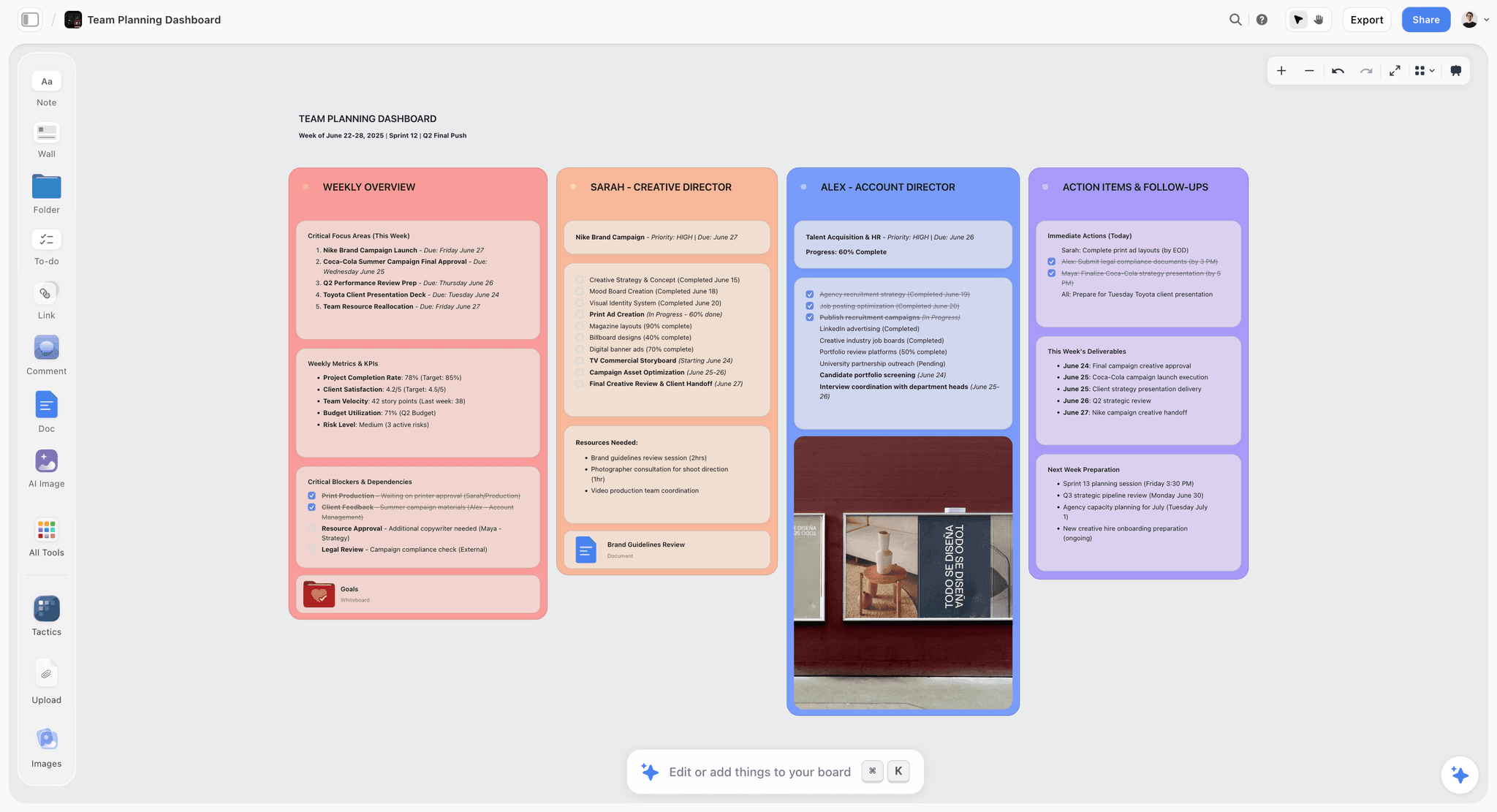
Storyflow is the honest middle of this list, and the right pick for a specific team: creative teams who map the customer journey as a story rather than a process diagram. It is an AI-powered visual workspace, an infinite canvas where the journey stages sit beside the audience research, the messaging, and the content plan, and the AI reads the entire board. Ask it where the journey loses people and it answers from your actual map, your actual persona notes, and your actual campaign cards, because they are all on the same canvas.
The difference shows up after the mapping session. In a diagramming tool, the journey map is a picture; the thinking about it happens somewhere else. In Storyflow, the map and the thinking share a surface: the AI can draft the messaging for a stage, propose content for a touchpoint, or summarize what the research cards imply about a drop-off, reading the full board plus up to 1 Tactic and up to 3 Documents you @-mention in the AI chat.
Best for: Marketing, content, and creative teams mapping journeys, audiences, and campaigns together, where the journey is the story of the customer.
Verdict: The best journey-as-story canvas for creative teams, and the wrong tool for formal UX diagramming. There is no swimlane kit, no BPMN shapes, and no screen-thumbnail flow library; for those, use Lucidchart or FigJam.
Key features
- Canvas-aware AI by default. The AI reads your full active canvas board (every card, note, and image on it), plus up to 1 Tactic and up to 3 Documents you @-mention.
- Start from a journey template. The user journey map maker and free customer journey map maker open a structured board the AI can read, instead of a blank canvas.
- Journey, research, and content on one board. Stages, persona notes, moodboards, and campaign cards live together, so the map stays connected to the work it drives.
- 200+ Story Blueprints. An expert-built template library of creative and strategic frameworks, included on Plus and above.
- Unlimited shared boards, and invited collaborators join free. Anyone a paid member invites to a board signs up free today; the Max plan adds a team workspace with permissions and roles.
Pricing
Paid-only early access today: the Free plan (unlimited objects with no time limit, unlimited shared boards, a trial of Storyflow AI, and 20 file uploads) launches before the end of 2026, and until then anyone a paid member invites to a board signs up free. Plus: $7.99 per month annual or $9.99 per month monthly (adds the 200+ Story Blueprints and unlimited uploads). Pro: $14 per month annual or $19 per month monthly (adds AI image generation and 20x more AI). Max: $39 per month annual or $49 per month monthly (adds 40x more AI and a team workspace with permissions and roles). Pricing current as of August 2026.
Pros
- The AI reads the whole journey board, so insights come from your map, not a generic prompt.
- One canvas holds the journey, the audience research, and the content plan, which is how creative teams actually use journey maps.
- Flat account pricing with unlimited invited collaborators, so a whole team and its clients work from one plan.
Cons
- Not a UX diagramming tool: no swimlanes, no BPMN or flowchart shape kit, no screen-thumbnail libraries.
- No dedicated journey matrix with enforced stages, emotion curves, and KPI lanes; UXPressia and Smaply are stronger for formal CX deliverables.
- Cloud-only with no offline mode, and AI image generation starts on the Pro tier.
If your journey maps keep turning into pretty pictures nobody acts on, take one real journey and rebuild it on a Storyflow canvas beside the research and the content plan. Start a Storyflow workspace and ask the AI what the map implies. The difference is usually obvious in the first session.
2. Miro
Miro is the safest answer to this exact question because it is the only mainstream canvas that treats both altitudes as first-class work. At screen altitude it has a true diagramming kit: shape libraries, smart connectors, swimlanes, and enough structure that a checkout flow does not degenerate into sticky-note soup. At life altitude it has some of the best customer journey templates in the category, and the workshop features (timer, voting, facilitation controls) that journey mapping sessions actually need.
Best for: Teams that map user flows some weeks and customer journeys other weeks, and want one tool, one link, one place to argue.
Verdict: The best overall pick for mapping user flows and customer journeys in one tool. Not the deepest at either single altitude, which is exactly the trade you make for covering both.
Key features
- A real flowchart and diagramming kit alongside the infinite whiteboard.
- Strong customer journey map and service blueprint templates.
- Workshop tooling: voting, timers, private mode, and facilitator controls.
- Miro AI for generating diagrams and summarizing sticky-note walls.
- A huge integration surface (Jira, Figma, Notion, Slack, and more).
Pricing
Free plan with 3 editable boards. The Starter plan is around $8 per member per month billed annually, and Business around $16, as of August 2026. Verify current pricing on Miro's site.
Pros
- Genuinely handles both altitudes, which almost nothing else on this list does.
- Workshops work: a live journey mapping session with eight people does not fall apart.
- The template library shortcuts the blank-canvas problem for both map types.
Cons
- Boards get heavy and slow as the map grows, especially on older laptops.
- The free plan's 3-board cap is tight for real product work.
- Deep journey artifacts (persona-linked lanes, channel matrices) still need a dedicated tool like UXPressia.
3. Figma (FigJam)
FigJam wins wherever the screens already live in Figma, which in 2026 is most product teams. The user flow sits one tab away from the designs it describes, screen thumbnails can be dropped straight into the flow, and when the flow changes it changes in the same place the team already works. FigJam AI drafts first-pass flowcharts from a prompt, which is a real time-saver for the boring 60 percent of any flow.
Best for: Product designers and product teams whose design work is already in Figma.
Verdict: The best user flow tool for Figma-native teams. Journey maps are possible but feel like guests: the tool's heart is at screen altitude.
Key features
- Flows live beside the Figma files, with real screen frames embeddable in the flow.
- FigJam AI generates flowcharts and diagrams from a text prompt.
- Sticky notes, stamps, and audio for lightweight team sessions.
- Shared libraries and components carry into FigJam boards.
Pricing
Free plan with 3 collaborative FigJam files. Paid FigJam comes with Figma's seat model, from around $3 per editor per month for collaboration seats up to around $12 and beyond for full design seats, billed annually, as of August 2026. Verify on Figma's pricing page.
Pros
- Zero context switch for Figma teams; the flow and the screens share a workspace.
- FigJam AI produces a usable first-pass flow in seconds.
- Cheap entry point via collaboration seats.
Cons
- Life-altitude journey mapping is template-thin compared to Miro or UXPressia.
- Non-designers on the team sometimes bounce off the Figma-shaped interface.
- Complex conditional flows outgrow FigJam and want Lucidchart's rigor.
4. Lucidchart
Lucidchart is the adult in the room: the tool you use when the flow diagram is documentation, not a sketch. Swimlanes, conditional formatting, data linking, revision history, and diagram conventions engineers, analysts, and auditors all recognize. For a user flow that has to be correct, versioned, and referenced for the next two years, it is still the standard.
Best for: Teams whose flows are formal documentation: swimlanes, system states, compliance-adjacent processes.
Verdict: The best formal diagramming tool on the list. Heavier than you want for a quick sketch, and journey mapping is not its native language.
Key features
- Professional shape libraries: BPMN, UML, swimlanes, and ERD alongside user flows.
- Data linking, so diagram elements can carry live values.
- Strong versioning, permissions, and enterprise controls (SOC 2, SSO).
- Lucid AI generates and edits diagrams from prompts.
Pricing
Free plan with 3 editable documents. Individual plans start around $9 per month, Team around $10 per user per month, as of August 2026. Verify on Lucid's pricing page.
Pros
- The most rigorous connector and shape system here; complex flows stay legible.
- Documentation-grade exports, versioning, and access control.
- Trusted shape conventions make cross-team review easier.
Cons
- Slow for quick, exploratory sketching; setup cost is real.
- Journey maps are possible but feel like a spreadsheet wearing a diagram costume.
- Per-user pricing adds up for a whole product org.
5. UXPressia
UXPressia is what a journey map tool looks like when journey maps are the whole product. Stages, channels, emotion curves, personas, and impact maps are structured objects, not stickers: change a persona and every linked map knows. For a CX or UX team whose deliverable is the journey map itself, it beats every generalist canvas on this list.
Best for: UX and CX teams producing serious, persona-linked customer journey maps as deliverables.
Verdict: The strongest dedicated journey mapping tool. It is not a whiteboard and does not try to be; user flows are out of scope.
Key features
- Structured journey maps: stages, lanes, emotion curves, and KPIs as native objects.
- Persona profiles linked directly into maps.
- Impact maps and multi-persona journey comparison.
- AI assistance for drafting journey content from a description.
Pricing
Free plan with 1 project. Paid plans start around $16 per user per month billed annually, as of August 2026. Verify on UXPressia's site.
Pros
- Journey structure is enforced by the tool, so maps stay consistent across a team.
- Personas and journeys stay linked instead of drifting apart in separate files.
- Export quality is presentation-ready without manual polishing.
Cons
- No real user flow or freeform diagramming; you still need a screen-altitude tool.
- Structure cuts both ways: exploratory, messy mapping fights the format.
- Pricier per seat than the generalist canvases.
6. Whimsical
Whimsical is the fastest way on this list to get from a blank canvas to a clean, readable user flow. The flowchart editor auto-spaces, auto-aligns, and auto-styles, so the map looks intentional without anyone spending taste on it. For flows, wireflows, and quick diagrams that need to be legible in the next meeting, its speed is unmatched.
Best for: Anyone who draws user flows weekly and wants the drawing part to take minutes, not meetings.
Verdict: The best speed-to-clean-flow ratio in the category. Shallower than Miro for workshops and journeys, which is the price of the focus.
Key features
- The lowest-friction flowchart editor in the group, with smart snapping and spacing.
- Wireframes, mind maps, and docs in the same workspace.
- Whimsical AI generates flows and mind maps from prompts.
- Fast, keyboard-friendly editing that stays out of the way.
Pricing
Free plan with a board cap. Pro is around $10 per user per month billed annually, as of August 2026. Verify on Whimsical's site.
Pros
- Flows come out clean by default; zero formatting tax.
- Fast enough to sketch live during a meeting without losing the room.
- Wireframe kit pairs naturally with screen-altitude flow work.
Cons
- Journey mapping support is thin; life altitude is not its territory.
- Workshop facilitation features are minimal compared to Miro.
- Larger system diagrams hit the ceiling of its deliberately simple kit.
7. Smaply
Smaply is the service design specialist. Journey maps, stakeholder maps, and persona libraries with the governance a larger organization needs: ownership, hierarchy, and journey map portfolios that stay consistent across departments. Where UXPressia leans product and CX, Smaply leans service design practice and journey management at organizational scale.
Best for: Service design teams and organizations managing a portfolio of journey maps, not a single project.
Verdict: The most structured journey governance tool here. Overkill for a single team's mapping, and no user flow capability at all.
Key features
- Journey maps with lanes for storyboards, emotions, channels, and backstage processes.
- Stakeholder maps and persona libraries as first-class objects.
- Journey hierarchy and portfolio management across an organization.
- Export and reporting built for stakeholder communication.
Pricing
Free trial. Paid plans start around $25 per user per month, as of August 2026. Verify on Smaply's site.
Pros
- Journey map governance: hierarchies, ownership, and consistency at scale.
- Service blueprint depth (backstage lanes) that generalist canvases lack.
- Clean, communication-ready exports.
Cons
- No screen-altitude tooling whatsoever.
- The structure is heavy for a startup or a single product squad.
- Among the priciest per-seat options on this list.
8. draw.io (diagrams.net)
draw.io is the free answer, and a better one than its interface suggests. No account, no card, files saved wherever you want (Drive, device, Git), and a diagramming engine that handles user flows, swimlanes, and system diagrams without complaint. For a solo founder or a team with zero budget, it removes every excuse not to map the flow.
Best for: Anyone who wants capable, genuinely free diagramming with no account and no lock-in.
Verdict: The best free tool on the list. You give up collaboration polish, AI, and any journey mapping structure.
Key features
- Fully free diagramming with no account required.
- Files stored where you choose: Google Drive, OneDrive, device, or Git.
- Broad shape libraries including flowchart, UML, and BPMN.
- Offline desktop app available.
Pricing
Free. Pricing current as of August 2026.
Pros
- Genuinely free with no seat math and no upsell wall mid-diagram.
- Your files stay yours, in your storage.
- Capable enough for serious flow documentation.
Cons
- Real-time collaboration is clunky compared to every paid tool here.
- No AI assistance and no journey mapping structure.
- The interface is utilitarian; expect to spend taste manually.
9. Overflow
Overflow does one job the rest of this list mostly ignores: presenting a finished user flow as a narrated, clickable story for stakeholders. Design screens connect into flows with device frames, and the result plays like an interactive walkthrough rather than a static diagram. When the flow has to convince a client or an executive, this is the difference between showing a map and telling the story of it.
Best for: Designers presenting user flows to clients and stakeholders who will never open a design tool.
Verdict: The best flow presentation tool. It is a last-mile tool, not where you draft or workshop the flow.
Key features
- User flow diagrams built from real design screens with device frames.
- Interactive presentation mode with clickable paths.
- Voice-over narration on shared flows.
- Figma, Sketch, and Adobe XD imports.
Pricing
Free trial. Paid plans around $12 per month, as of August 2026. Verify on Overflow's site.
Pros
- Finished flows look like a product story, not a wall of boxes.
- Narrated sharing works asynchronously for remote stakeholders.
- Screen-based flows stay visually tied to the actual design.
Cons
- Not a drafting or workshop tool; it starts where those end.
- Mac and Windows app-based workflow feels heavier than browser canvases.
- No journey mapping and no AI.
10. FlowMapp
FlowMapp pairs user flows with visual sitemaps, which makes it the niche pick for website and agency work: plan the information architecture and the flows through it in the same project. For product apps it is less natural, but for a content site, a marketing site, or client web projects, the sitemap-plus-flow combination is exactly the deliverable.
Best for: Web designers and agencies planning sitemaps and user flows for client websites.
Verdict: The best sitemap-plus-flow combination. Narrower than the generalists, and journey mapping is out of scope.
Key features
- Visual sitemaps with page cards and content notes.
- A dedicated user flow editor.
- Customer journey map and persona templates for lighter journey work.
- Client-friendly sharing for agency workflows.
Pricing
Free plan for 1 project. Paid plans start around $15 per month, as of August 2026. Verify on FlowMapp's site.
Pros
- Sitemap and flows in one project mirrors how web projects are actually scoped.
- Agency-friendly: clean sharing and per-project organization.
- Approachable for non-designers on the client side.
Cons
- Product-app flow work outgrows it quickly.
- Journey features are templates rather than a real journey system.
- Smaller ecosystem and fewer integrations than the major canvases.
7) Which Tool Fits Which Kind of Team?
11. Product Manager Running Discovery
Top picks: Miro + Lucidchart
Miro for the discovery workshops, the sticky-note walls, and the first journey drafts with the squad. Lucidchart when the flow that survived discovery has to become documentation engineering will build against.
12. Product Designer in the Figma Ecosystem
Top picks: FigJam + Overflow
FigJam so the flows live beside the screens and stay current as designs change. Overflow when a finished flow has to be presented to stakeholders as a story rather than a diagram.
13. UX Researcher / CX Lead
Top picks: UXPressia + Miro
UXPressia for the persona-linked journey maps that are the actual deliverable. Miro for the workshops where the organization builds and argues about those journeys together.
14. Creative-Team Lead / Agency
Top picks: Storyflow + Whimsical
Storyflow to map the customer journey as a story beside the audience research and the content plan, with AI that reads the whole board. Whimsical for the quick, clean screen-altitude flows client work still needs.
15. Solo Founder / One-Person Product
Top picks: draw.io + Storyflow
draw.io for free, capable flow diagrams with zero budget. Storyflow (from $7.99 per month annual, with its Free plan arriving late in 2026) to think through the customer journey, the positioning, and the launch plan on one canvas an AI can read.
16. Service Design / Operations Team
Top picks: Smaply + Lucidchart
Smaply for journey portfolios, service blueprints, and governance across departments. Lucidchart for the formal process diagrams that connect the journey to internal systems.
8) Honorable Mentions
A few tools that came close but did not make the main ten.
- Mural: A strong workshop whiteboard with journey templates; in this specific category it trails Miro's diagramming kit, which is why Miro holds the generalist slot.
- Microsoft Visio: Still everywhere in enterprise IT; formal and capable, but dated collaboration keeps it off the main list.
- Canva Whiteboards: Fine for a quick flow inside a Canva-native team, but the diagramming depth is not there for serious flow work.
- Excalidraw: A beautiful, fast sketch canvas; flows stay deliberately rough, which is a feature until documentation time.
- Creately: A capable diagram-plus-data tool with journey templates; a reasonable Lucidchart alternative that did not beat it on any single criterion.
These are not weak tools. Their center of gravity simply sits outside mapping user flows and customer journeys.
9) Where the Dedicated Tools Still Win (An Honest Accounting)
A list that quietly ranked our own product first would not be worth your reading time, so here is the plain version of where everything on this list beats Storyflow, and where the picks above hold.
Miro wins the generalist slot. If a team can buy exactly one tool for both altitudes, Miro is that tool. Storyflow does not have Miro's flowchart kit, its workshop tooling, or its template breadth.
FigJam and Lucidchart win screen altitude. Flows beside the designs, or flows as formal documentation: both jobs go to the dedicated tools. Storyflow has no swimlane, BPMN, or screen-flow kit and does not pretend otherwise.
UXPressia and Smaply win formal journey deliverables. Enforced stages, emotion curves, persona links, and governance are their whole product. A CX team shipping journey maps as deliverables should start there.
So why does Storyflow rank sixth instead of nowhere? Because there is a real team the dedicated tools underserve: creative and marketing teams for whom the journey is the story of the customer, and the map only matters connected to the research, the messaging, and the content it drives. A user flow is drawn at screen altitude. A customer journey is drawn at life altitude, and Storyflow's lane is the life-altitude map that has to become creative work, with an AI that reads the whole board while it happens. That is one lane, honestly held, in a list where every other tool holds its own.
11) The Bottom Line
The best tool for mapping user flows and customer journeys in 2026 depends on the altitude your team works at. For one canvas that covers both, Miro is the safest pick and the best overall. At screen altitude, FigJam wins for Figma teams, Lucidchart for formal documentation, Whimsical for speed, and draw.io for free. At life altitude, UXPressia and Smaply win the formal journey deliverable.
A user flow is drawn at screen altitude. A customer journey is drawn at life altitude. Buy for the altitude you actually live at, and stop expecting one tool to be excellent at both unless that tool is deliberately built for the compromise.
And if your team is a creative one, where the journey map only matters because of the story, the research, and the content it drives, that is the one lane where we would put our own product forward. Start a Storyflow workspace, open the user journey map maker, and ask the AI what your journey implies. The map stops being a picture and starts being a plan.
10) FAQ: User Flow and Customer Journey Mapping Tools in 2026
What is the best tool for mapping user flows and customer journeys?
Miro is the best single tool for both jobs in 2026: it has a real flowchart kit for user flows, strong journey map templates, and the workshop features to build either with a team. If you mostly draw user flows, FigJam (for Figma teams) or Whimsical (for speed) may fit better; if you mostly build formal journey maps, UXPressia is the dedicated specialist.
What is the difference between a user flow and a customer journey map?
A user flow diagrams the path a user takes through a product to complete one task: screens, actions, and decision points, usually spanning minutes. A customer journey map visualizes the whole experience a person has with a product or service across stages and touchpoints, including thoughts and emotions, usually spanning days to months. They sit at different altitudes: the flow at screen level, the journey at life level.
Is there a good free tool for user flow diagrams?
Yes. draw.io is genuinely free with no account required and handles serious flow diagramming. FigJam, Miro, Whimsical, and Lucidchart all offer free plans with board or document caps that are enough to evaluate them on real work. Storyflow is paid-only early access today (its Free plan launches before the end of 2026, and invited collaborators of paid members join free), and there is a dedicated free user flow diagram starting point.
What tool do UX designers actually use for user flows in 2026?
Most product UX teams in 2026 draw user flows in FigJam or Miro, because that is where the team already collaborates, and move to Lucidchart when a flow needs formal documentation. Whimsical holds a loyal following for speed. Dedicated flow tools like Overflow appear at the presentation stage rather than the drafting stage.
Can AI generate a user flow or customer journey map?
Yes, with different depths. FigJam AI, Miro AI, Lucid AI, and Whimsical AI all generate first-draft flowcharts from a text prompt, which handles the boring scaffolding. For journeys, UXPressia drafts journey content from a description, and Storyflow's AI reads your whole canvas (the journey stages, persona notes, and research cards you already placed) and drafts insights or content from what is actually on the board rather than from a generic prompt.
Should I map the user flow or the customer journey first?
Start at the higher altitude. Map the customer journey first, at least roughly, so you know which moments matter and where the product actually loses people. Then zoom into user flows for the screens that serve the critical moments. Teams that start with flows tend to polish paths through screens nobody was struggling with, while the real drop-off sits at a journey stage no flow diagram shows. The full method is in How to Map User Flows and Customer Journeys.
What makes a good customer journey map?
A good journey map names a specific persona and goal, breaks the experience into stages a real customer would recognize, and records what the person does, thinks, and feels at each stage alongside the touchpoints involved. Most importantly, it commits to the two or three moments that matter most, because a map that treats every stage equally produces no decisions. Structure matters less than whether the team acts on it.
Is Miro better than FigJam for user flows?
FigJam is better if your screens live in Figma: the flow sits beside the designs, and design frames drop straight into the diagram. Miro is better for everything around the flow: bigger workshops, journey mapping, and mixed teams where half the room never opens Figma. Many product orgs run both, with FigJam for design-adjacent flows and Miro for cross-functional sessions.
What is the best customer journey mapping tool for a small team?
For a small product or CX team, UXPressia's free plan and lower tiers give structured, persona-linked maps without enterprise overhead. For a small creative or marketing team, Storyflow covers journey-as-story mapping beside the content plan from $7.99 per month annual on one flat account, with invited collaborators joining free; its Free plan launches before the end of 2026. Miro's free tier works for either if three boards are enough.
Do I need a dedicated journey mapping tool, or is a whiteboard enough?
A whiteboard is enough if the journey map is a thinking tool the team revisits occasionally: Miro or Storyflow will carry it fine. You need a dedicated tool like UXPressia or Smaply when journey maps are deliverables: multiple personas, multiple journeys, consistent structure, and stakeholders who expect polished, comparable outputs. The tipping point is usually when you are maintaining more than three maps or reporting on them across departments.
Can Storyflow replace Lucidchart or FigJam for UX diagrams?
No. Storyflow has no flowchart shape kit, no swimlanes, no BPMN, and no screen-thumbnail flow libraries, and it does not try to compete there. It ranks on this list for a different job: creative teams mapping the customer journey as a story beside the research and content plan, with an AI that reads the whole canvas. Teams that need formal UX diagrams should pair it with Lucidchart or FigJam, or simply use those tools.
How often should we update our journey maps and user flows?
Treat user flows as living documents tied to releases: update them whenever the screens they describe change, which for most teams means every sprint or two. Journey maps move slower: revisit them quarterly, or whenever research contradicts a stage. A journey map that has not been touched in a year is usually describing a customer who no longer exists.
Table of Contents
- Quick Answer: The Best Tool for Mapping User Flows and Customer Journeys
- Comparison Table: 10 Flow and Journey Mapping Tools
- Frequently Asked: Screen Flows, Free Options, and Keeping a Journey Map Alive
- The Two Altitudes: Why One Tool Rarely Maps Both Well
- How We Evaluated These Tools
- Quick Picks by Job to Be Done
- Detailed Reviews: 10 User Flow and Journey Mapping Tools
- Which Tool Fits Which Kind of Team?
- Honorable Mentions
- Where the Dedicated Tools Still Win (An Honest Accounting)
- FAQ: User Flow and Customer Journey Mapping Tools in 2026
- The Bottom Line
- Author
- Related Reading
Templates to check out for this topic


Research templates you can use in Storyflow
Gather sources, personas, and findings on one canvas, then let the AI read across all of it. Open any of these research boards to start.


See Storyflow in Action
A visual AI workspace where every feature lives inside one canvas. No tab-switching, no context lost.
Build your entire board from a single message
Type what you need in the AI chat at the bottom of your canvas. The AI adds cards, headings, and structure directly onto your board.
Use expert frameworks as AI context
Type @ in the AI chat and choose any Tactic. The AI tailors every response to that framework instead of giving generic advice.
Turn your board into a mind map in seconds
Ask the AI to restructure your canvas as a mindmap. It connects your ideas into a visual hierarchy so you can see how everything relates.
Why Storyflow Exists
Storyflow actually began as a personal tool while working on creative and research projects.
We kept running into the same problem: ideas were scattered everywhere: notes, documents, and whiteboards.
Nothing helped us see how everything connected.
So we started building a workspace designed around how ideas actually grow.
→ Read how Storyflow was createdJustkay
Documentary Filmmaker & Founder at Storyflow
Published: 2026-08-05
Extremely simple, seriously capable


See how easy it is to get started
Watch a real project come together, from a blank board to a finished plan, clicked through step by step.
Start creating with AI and become more productive
Transform your creative workflow with AI-powered tools. Generate ideas, create content, and boost your productivity in minutes instead of hours.