
Category
Marketing
Author

Justkay
Documentary Filmmaker & Founder at Storyflow
Topics
2026-05-10
•
Updated July 2, 2026
•
16 min read
•
Marketing- best AI tools for marketers 2026
- AI for marketing
- AI marketing tools
- Jasper alternative
- AI for campaign planning
- AI for SEO content
What are the best AI tools for marketers in 2026?
The best AI tools for marketers in 2026 are Storyflow (best campaign planning canvas with framework-aware AI), Claude (best long-form copy), HubSpot Breeze AI (best inside HubSpot CRM), and Perplexity (best sourced research). Storyflow leads because its AI reads the whole campaign board before it drafts a word.

Full disclosure: Storyflow is our own product, and we rank it #1 for one marketing job: planning a campaign on a canvas where the AI reads the brief, the audience research, and the channel plan before it drafts a word. For nuanced long-form copy Claude is the stronger writer, HubSpot Breeze AI is better if your work lives inside the HubSpot CRM, and Perplexity is better for sourced market research. Storyflow is not a general chatbot and it does not live inside your CRM, so a marketer who mostly needs quick one-off drafts will do fine with ChatGPT or Claude alone. We link to every tool so you can judge the fit.
Quick Comparison: Best AI Tools for Marketers
These four cover the marketing jobs teams actually split between: planning the whole campaign, writing long-form copy, working inside the CRM, and sourced market research.
| Tool | Best For | AI Features | Price |
|---|---|---|---|
| Storyflow | Campaign planning canvas the AI reads end to end | Canvas-wide AI + Blueprint Tactics (AIDA, StoryBrand) | $7.99 mo annual (free plan late 2026) |
| Claude | Nuanced long-form marketing copy | Claude chat with large context | Free / $20 mo |
| HubSpot Breeze AI | AI inside the HubSpot CRM | Breeze AI across HubSpot tools | Free / bundled with HubSpot |
| Perplexity | Sourced market and competitor research | Live web search with citations | Free / $20 mo |
1) Quick Answer: The Best AI Tools for Marketers in 2026
The best AI tools for marketers in 2026 are Storyflow (best for campaign planning canvas with AI grounded in frameworks like AIDA), Claude (best for nuanced long-form copy), HubSpot Breeze AI (best if your CRM is HubSpot), and Perplexity (best for sourced market research). Storyflow stands out because the AI reads your full campaign canvas (brief, references, audience research, draft copy, content calendar) and grounds responses in 200+ Blueprint Tactics including AIDA, StoryBrand, and Retention Hooks, which is the part of marketing where chat-only AI consistently produces generic copy.
The short version: if you want generic copy fast, ChatGPT or Claude. If you want AI inside your CRM, HubSpot Breeze. If you want AI grounded in marketing frameworks on a project canvas, Storyflow. If you want sourced research, Perplexity. Most working marketers in 2026 use two or three together.
For the deeper case, see How to Plan a Brand Campaign With AI in 2026 and The 10 Best Creative Brief Tools in 2026.
All 12 Tools, Ranked
- Storyflow: best overall for marketers, the AI reads the whole campaign board (brief, audience, channels) plus @-mentioned brief documents
- Claude: best nuanced long-form copy
- HubSpot Breeze AI: best AI inside the HubSpot CRM
- Perplexity: best sourced market research
- ChatGPT: best quick ideation and one-off drafts
- Jasper: best templated marketing-copy workflows
- Surfer AI: best SEO briefs and optimized drafts
- Anyword: best performance-predicting ad copy
- HeyGen: best AI avatar and spokesperson video
- ElevenLabs: best AI voice for ads and podcasts
- Notion AI: best for doc-based marketing teams
- Copy.ai: best workflow-driven copy production
2) Comparison Table: 12 AI Tools for Marketers Compared
Rating criteria: Tested on real brand campaigns, content sprints, and product launches. Tools were rated on whether they actually moved a metric or shipped a deliverable, not on generic benchmarks.
3) Why Marketers Need a Different AI Stack
A blogger and a marketer have radically different AI needs even when both produce content. Three structural differences shape the marketer's AI stack.
Marketing is metric-shaped, not output-shaped. A marketer ships a campaign, not just a piece of copy. The campaign has a brief, an audience hypothesis, a structural framework (AIDA, AARRR, jobs-to-be-done), creative variants, channel-specific copy, and a feedback loop with analytics. Generic AI tools optimized for one-off generation produce copy that ignores the campaign's structure. Project-aware AI on a workspace handles the structure; chat alone does not.
Marketing has a methodology layer. AIDA, AARRR, the value proposition canvas, the StoryBrand framework, the customer journey map, the jobs-to-be-done lens. The AI that does not know which framework your campaign is using produces plausible-sounding copy that violates whatever framework you committed to. Tools with explicit methodology (Storyflow's Blueprint Tactics) ground responses in the right framework so the deliverables stay coherent.
Marketing is multi-modal. Brief, audience research, mood boards, creative references, copy variants, content calendar, channel mix. Tools that only read text are missing most of the campaign. Tools that treat visual material as first-class context outperform tools that need everything pasted as text.
The familiar approach is to open ChatGPT, paste the brief, and ask for headlines. It works for one variant, fails when you need 30 on-brand variants that fit the campaign's structure, and produces drift by hour three. The marketer approach is to build the campaign on a canvas (brief, audience, references, draft copy), select a framework Tactic that matches the campaign type, and let the AI read all of it. The drafts come back grounded in your specific campaign, not the prompt fragment you had time to type.
For the architectural argument, see The Single-Prompt Fallacy.
4) How We Evaluated These Tools (On Real Campaigns)
Every tool on this list was tested on actual brand campaigns, content sprints, and product launches between 2024 and 2026. No synthetic prompts. Five criteria, weighted in this order:
- Campaign-fit at scale. Does the tool hold up across the multi-week reality of a real campaign, or does it produce one good demo and crumble at variant 15?
- Methodology alignment. Does the AI work with marketing frameworks (AIDA, AARRR, StoryBrand, jobs-to-be-done), or does it produce framework-agnostic prose that needs heavy rewrites?
- Brand consistency. Does the AI maintain voice, tone, and positioning across artifacts, or does each output sound slightly different?
- Time savings vs rework. Did it actually save hours, or did rewriting the AI output take longer than writing it from scratch?
- Pricing transparency at team scale. What does the tool cost when usage is real and the team has more than three marketers?
Tested workflows included: a Series-B SaaS launch, a brand refresh for an agency, a content sprint for a CPG brand, a creator-led campaign, and a recurring newsletter program.
5) Quick Picks by Marketing Phase
If you want the short list, organize by phase.
Best for Strategy and Campaign Planning: Storyflow. Canvas with AIDA, StoryBrand, and other Blueprint Tactics that scaffold the AI's responses on real frameworks.
Best for Audience Research: Perplexity for sourced web research. NotebookLM for synthesizing uploaded reports, transcripts, and customer interviews. In Storyflow, cluster the findings on a Target Audience template so the AI reads them on every later draft.
Best for Long-Form Content (Blog, Long Posts): Claude for nuanced drafting at scale. Storyflow if you want the content calendar and references on the same canvas.
Best for SEO Briefs and Optimization: Surfer AI for SEO-graded briefs and drafts that target specific queries.
Best for Performance Copy (Ads, Landing Pages): Anyword for predictive scoring on variants. Jasper for templated workflows. Storyflow with the AIDA Tactic for grounded direct-response copy.
Best for CRM and Lifecycle: HubSpot Breeze AI if you live in HubSpot. Notion AI if your sequences are managed in Notion.
Best for Video Content and Avatars: HeyGen for AI spokesperson videos. ElevenLabs for ad voiceovers, podcast segments, and dubbing.
Best for Quick Ideation and Drafts: ChatGPT or Claude. Both are excellent for one-off generation; pick by output style.
Plan your next campaign on one board
Put the brief, the audience research, and the channel plan on a single canvas, @-mention the campaign brief in AI chat, and let the AI draft against your real campaign instead of a blank prompt.

6) Detailed Reviews: 12 AI Tools for Marketers in 2026
1. Storyflow
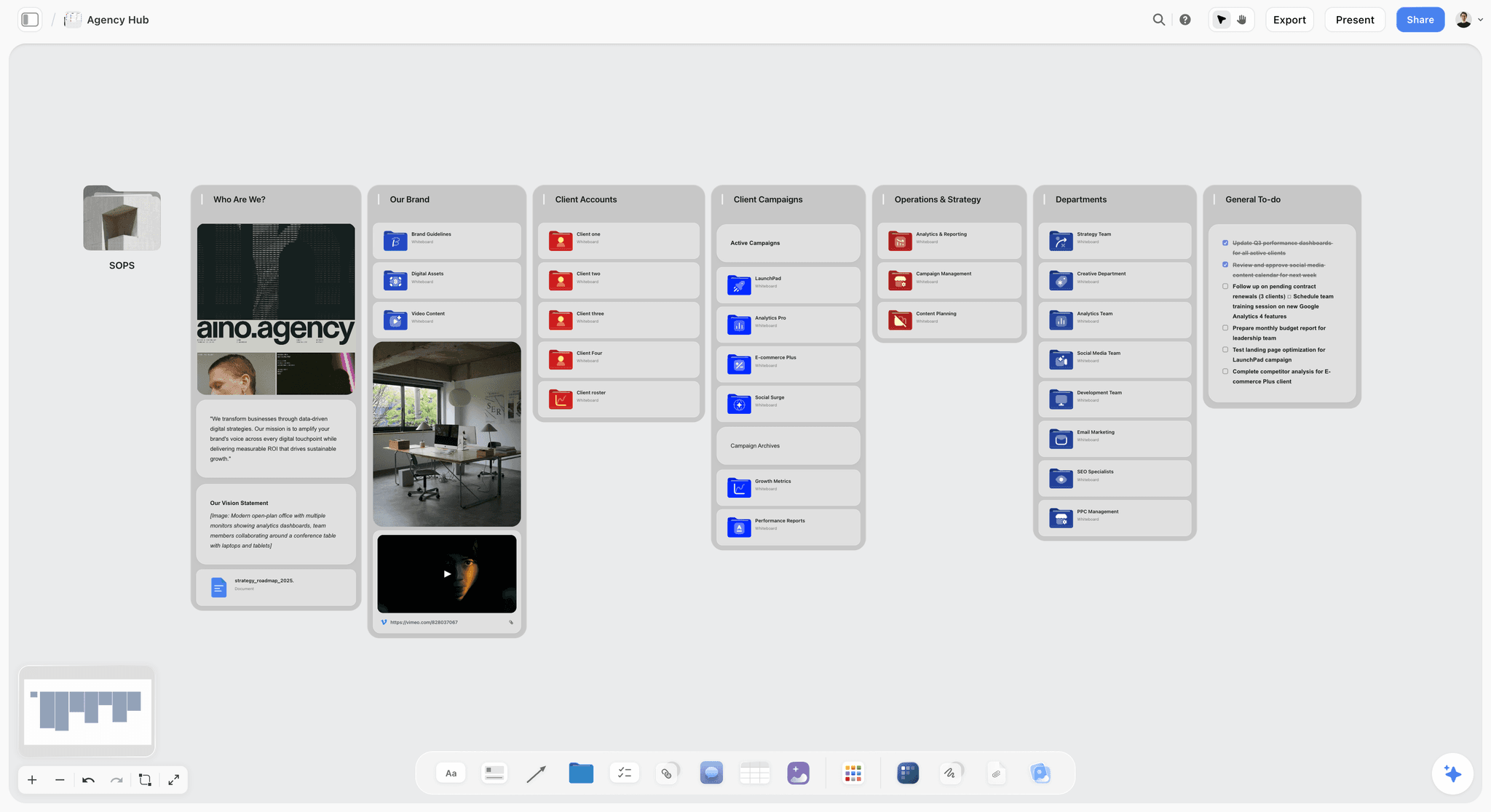
Storyflow is a visual workspace where the AI reads your full active campaign canvas and Blueprint Tactics scaffold responses on frameworks like AIDA, StoryBrand, and Retention Hooks. It is the alternative to pick when chat-only AI keeps producing generic copy that ignores your campaign's structure. The fastest way to test it: open the Marketing Campaign template, drop your campaign brief on the board, @-mention the brief in AI chat, and ask for channel-specific drafts. The AI answers with your audience and constraints already in view.
Best for: In-house marketers, agency creatives, brand strategists, content marketers running multi-week campaigns with real structure.
Verdict: The strongest AI tool for the strategy and canvas-grounded drafting half of marketing. Performance-copy specialists (Anyword, Jasper) win on certain narrow jobs.
Key features
- Project-aware AI by default. The AI reads the full active canvas board (brief, audience notes, references, draft copy, content calendar). Add up to 1 Tactic and up to 3 Documents via @-mention for additional grounding.
- 200+ Blueprint Tactics on Plus and above. AIDA, StoryBrand, Retention Hooks, Hero's Journey, Five-Act Structure. The coming Free plan will ship 3 starter Story Blueprints.
- Multi-format canvas. Mood boards, mind maps, copy cards, audience clusters, content calendar all live on one board.
- Unlimited shared boards plus unlimited collaboration on every plan. Max plan adds Team Workspace with Permissions and Roles for agencies and in-house teams.
Pricing
Paid-only during early access; the Free plan (unlimited boards, unlimited cards, unlimited collaboration, basic AI usage, and 20 file uploads) launches before the end of 2026, and anyone a paid member invites to a board joins free now. Plus: $7.99/mo annual or $9.99/mo monthly (full 200+ Blueprint library, unlimited file uploads). Pro: $14/mo annual or $19/mo monthly (adds AI image generation and 20x more AI than Plus). Max: $39/mo annual or $49/mo monthly (adds 40x more AI plus Team Workspace with Permissions and Roles).
Pros
- The AI reads the full campaign canvas, so drafts stay on-brief and on-framework.
- Blueprint Tactics ground responses on real marketing frameworks instead of generic prose.
- Cheaper than Jasper, Anyword, and Copy.ai at the entry tier with broader applicability.
Cons
- Storyflow is not the right tool for predictive performance scoring on variants. Use Anyword for that.
- Storyflow is not a CRM-bundled AI. If your stack is HubSpot, pair Breeze.
- Cloud-only; no local-first option for marketers in regulated industries.
2. Claude (Anthropic)
Claude is the strongest pure-chat AI for nuanced long-form copy in 2026. The pick when the work is text-heavy, the prompt is the right unit, and you want better reasoning out of the box.
Best for: Long-form blog posts, thought-leadership pieces, careful content that ChatGPT makes too eager-sounding.
Verdict: The strongest pure-chat AI for marketers. Same chat-substrate limits apply for sustained campaign work.
Key features
- Long context window (200K tokens on Sonnet 4.6 as of mid-2026; verify current).
- Projects feature for persistent memory across sessions.
- Strong on tone-matching with examples.
Pricing
Claude Pro: $20/mo. Claude Max: $200/mo. Free tier with daily message limits.
Pros
- Frequently rated the best at writing in real-world marketing tasks.
- Carefully calibrated tone, less prone to hype.
- Projects feature reduces some context-pasting.
Cons
- Same chat substrate limits; campaign-level context drift is real on long campaigns.
- No image generation in the consumer product.
- Smaller plugin and integration ecosystem than ChatGPT.
3. HubSpot Breeze AI
HubSpot Breeze AI (formerly HubSpot AI) is the AI woven into HubSpot's CRM, marketing automation, and content tools. The pick if your stack is HubSpot.
Best for: Marketing teams already on HubSpot's CRM and marketing hub.
Verdict: Strongest CRM-integrated marketing AI in 2026. Less interesting outside HubSpot.
Key features
- AI Agents for prospecting, content, customer support inside HubSpot.
- Breeze Copilot for assistance across the suite.
- Content Hub AI for SEO-aware content generation.
- Native integration with CRM data so AI knows your contacts and pipelines.
Pricing
Bundled with HubSpot Marketing Hub (Starter from $20/mo). Higher tiers unlock more AI capacity.
Pros
- Deep CRM integration is genuinely valuable for marketers using HubSpot.
- AI Agents handle real workflow automation, not just generation.
- Pricing scales with HubSpot, not as a separate AI bill.
Cons
- Outside HubSpot, the value collapses.
- AI capabilities lag standalone tools on pure generation quality.
- HubSpot's per-contact pricing scales steeply for larger lists.
4. Perplexity
Perplexity is the answer engine that ships with sources by default. The pick for marketers when sourced research is the bottleneck.
Best for: Market research, competitive analysis, audience research, content that needs verifiable sources.
Verdict: The strongest research-grade AI for marketers. Citations are the killer feature.
Key features
- Every answer ships with citations.
- Pro Search runs deeper queries with multi-source synthesis.
- Spaces (formerly Collections) for grouping research threads.
- Multi-model backend (GPT, Claude, or Perplexity's own).
Pricing
Perplexity Pro: $20/mo. Free tier with limited Pro searches.
Pros
- Citations matter for marketers who pitch ideas internally or to clients.
- Strong on "what is the latest on X" queries where ChatGPT goes stale.
- Pro Search synthesis is excellent for first-pass competitive analysis.
Cons
- Not built for generation. Use Claude or ChatGPT for drafting.
- Spaces are useful but lighter than canvas tools for sustained campaigns.
- Pro Search is the value; free tier limits it heavily.
5. ChatGPT
ChatGPT is still the broadest AI tool for marketers in 2026. The pick for one-off generation, quick ideation, and ecosystem breadth.
Best for: Headline brainstorming, quick drafts, social posts, exploratory ideation, custom GPTs for repeated workflows.
Verdict: The default AI most marketers reach for. Genuinely good; just the wrong shape for sustained campaign work.
Key features
- DALL-E for image generation alongside text.
- Custom GPTs and the GPT Store.
- Voice mode and multimodal input.
- Largest plugin and integration ecosystem.
Pricing
ChatGPT Plus: $20/mo. ChatGPT Pro: $200/mo. Free tier with daily limits.
Pros
- Broadest AI ecosystem in 2026.
- DALL-E inside the same product is convenient for marketers.
- Custom GPTs let teams build repeatable workflows.
Cons
- Loses context on multi-turn campaign work, the ChatGPT failure mode covered in Why ChatGPT Loses the Plot.
- No native marketing framework awareness; output is generic until prompted heavily.
- Brand voice consistency requires careful prompt engineering.
6. Jasper
Jasper is the marketing-copy-focused AI platform. The pick for teams who want templates, brand voice modeling, and a marketing-shaped UI.
Best for: Marketing teams who want a tool that looks and feels like a marketing tool, not a generic chat.
Verdict: Solid for templated marketing copy. Less interesting now that general AI quality has caught up.
Key features
- Templates for blog posts, ad copy, email sequences, social.
- Brand Voice for tone modeling.
- Jasper Chat for conversational use.
- Workflows and Campaigns for multi-step generation.
Pricing
Creator: $49/mo. Pro: $69/mo. Business: custom.
Pros
- Marketing-shaped UI lowers onboarding friction for non-AI-natives.
- Brand Voice modeling is mature and useful.
- Workflows handle some campaign-level context.
Cons
- Pricing is high relative to underlying model quality.
- Output quality depends heavily on the underlying model (often GPT or Claude); you are paying for the wrapper.
- General AI tools have caught up on the core generation jobs.
For the head-to-head, see Jasper Alternative.
7. Surfer AI
Surfer AI is the SEO-optimized content tool. The pick when SEO performance is the metric and you need briefs and drafts that target specific queries.
Best for: SEO marketers, content teams whose KPI is organic traffic, agencies running SEO-driven content programs.
Verdict: Strongest SEO-AI tool in 2026. Worth the cost for SEO-driven programs.
Key features
- Content briefs grounded in SERP analysis.
- AI drafts that hit content score targets.
- Topical authority planning.
- Integration with Google Docs and WordPress.
Pricing
Essential: $89/mo. Scale: $129/mo. Enterprise: custom.
Pros
- The strongest SEO-AI integration in the market.
- Content scores are genuinely useful as a quality gate.
- Topical authority planning is mature.
Cons
- Expensive for solo or small teams.
- Output quality depends heavily on prompt and editor follow-through.
- Less interesting if SEO is not your primary acquisition channel.
8. Anyword
Anyword is performance-predictive marketing copy. The pick for direct-response marketers running A/B tests at scale.
Best for: Performance marketers, growth teams, paid acquisition specialists running variant tests.
Verdict: Strong for the narrow job of variant prediction. Limited for general marketing.
Key features
- Performance prediction scoring on copy variants.
- Brand voice modeling.
- Channel-specific templates (Meta, Google, LinkedIn).
- Audience-targeted generation.
Pricing
Starter: $49/mo. Data-Driven: $99/mo. Business: custom.
Pros
- Predictive scoring is a real feature, not just a wrapper around generation.
- Channel-specific templates fit how performance teams actually work.
- Mature integrations with ad platforms.
Cons
- Predictive scoring's accuracy varies; treat as directional, not gospel.
- Expensive for non-performance teams.
- Generation quality depends on underlying model.
9. HeyGen
HeyGen is AI avatars and synthetic video for marketing. The pick when you want spokesperson video at scale without filming. Whatever generates the footage, the video still needs a plan first; an explainer video storyboard is the cheapest place to fix the message before production.
Best for: Course creators, lifecycle marketing video, multilingual ad variants, internal training video.
Verdict: The strongest AI avatar tool for marketing in 2026. Use thoughtfully; audiences are catching on.
Key features
- Realistic AI avatars from a short upload of yourself.
- Multilingual dubbing with lip-sync.
- Templates for marketing videos.
- Brand kit support.
Pricing
Free: 3 videos/mo. Creator: $24/mo. Team: $69/user/mo. Enterprise: custom.
Pros
- The avatar quality is genuinely strong in 2026.
- Multilingual creates real ROI for global campaigns.
- Templates speed up lifecycle and onboarding video.
Cons
- Audiences increasingly recognize AI avatars; trust costs apply.
- Disclosure is becoming an ethical and legal expectation.
- Not suitable for high-stakes brand video where production value matters.
10. ElevenLabs
ElevenLabs is the AI voice platform that working studios use. For marketers, the pick is ad voiceovers, podcast spots, and dubbing.
Best for: Ad VO at scale, podcast inserts, multilingual ad versions, brand voice cloning for product spots.
Verdict: The standard for AI voice in production work. Genuine quality.
Key features
- Voice cloning from short samples.
- Multilingual dubbing with lip-sync.
- Studio voice library with licensed talent.
- API for programmatic generation.
Pricing
Starter: $5/mo. Creator: $22/mo. Pro: $99/mo. Free tier with 10K characters/mo.
Pros
- Voice quality is the closest to indistinguishable in the market.
- Free tier is genuinely usable.
- API makes it integrable into marketing automation.
Cons
- Voice cloning has rights and ethics considerations.
- Not a full audio post tool; pair with traditional DAWs.
- Licensing for commercial use needs verification.
11. Notion AI
Notion AI is the AI inside Notion docs and databases. The pick for marketing teams whose campaign brief and content runbooks already live in Notion.
Best for: Marketing teams deep in Notion who want AI in their existing knowledge base.
Verdict: Solid if you already live in Notion. Limited if you do not.
Key features
- AI inside Notion pages, databases, and wikis.
- Connect to Slack, Drive, GitHub, and other knowledge sources.
- Templates for marketing playbooks.
Pricing
Notion AI bundled into Plus ($10/user/mo annual) and higher tiers.
Pros
- Best AI experience for teams already deep in Notion.
- Cross-source Q&A is mature.
- The doc primitive fits some marketing teams' work.
Cons
- Doc-shaped, not canvas-shaped, so visual campaign work is awkward.
- AI works on the page, not on a project-level canvas.
- Pricing scales fast for larger teams.
12. Copy.ai
Copy.ai is workflow-driven marketing copy. The pick for ops-driven marketing teams who want repeatable copy workflows.
Best for: Marketing ops teams, agencies running production-line copy workflows.
Verdict: Solid for workflow-driven copy production. Less compelling for strategy or campaign work.
Key features
- Workflows for repeatable copy production.
- Brand voice and templates.
- API for programmatic generation.
- Marketing OS positioning.
Pricing
Free tier with limits. Pro: $49/mo. Team: $186/mo for 5 seats.
Pros
- Workflow approach matches how ops-driven teams produce copy.
- Free tier is usable for evaluation.
- Brand voice modeling is mature.
Cons
- Pricing is high relative to underlying model quality.
- General AI has caught up on the core generation jobs.
- Less interesting if your team's work is strategy-heavy.
For the head-to-head, see Copy.ai Alternative.
7) Marketer-Type Recommendations
1. In-House Brand Marketer
Top picks: Storyflow + Claude
Storyflow for the campaign canvas (brief, audience, references, draft copy, calendar). Claude for nuanced long-form drafting. Add HubSpot Breeze if your stack is HubSpot.
2. Performance Marketer / Paid Acquisition
Top picks: Anyword + Storyflow
Anyword for variant testing with predictive scoring. Storyflow for the strategy canvas behind each campaign. Add ChatGPT for one-off ideation.
3. SEO / Content Marketer
Top picks: Surfer AI + Storyflow + Perplexity
Surfer AI for SEO-graded briefs and drafts. Storyflow for the content calendar and pillar plan. Perplexity for sourced research that gets cited in posts.
4. Agency Creative
Top picks: Storyflow Max + Claude + ElevenLabs
Storyflow Max for the team workspace where client campaigns live. Claude for long-form drafting. ElevenLabs for VO when video is in scope.
5. Lifecycle / CRM Marketer
Top picks: HubSpot Breeze + Storyflow
Breeze for the CRM-integrated automation. Storyflow for the campaign-level strategy canvas where lifecycle programs are designed.
6. Solo Marketer / Founder Doing Marketing
Top picks: Storyflow + ChatGPT
Storyflow for the campaign canvas and AIDA Tactic. ChatGPT for quick variants and exploratory ideation. The minimum viable AI marketing stack for one person.
7. Marketing Ops / Production Lead
Top picks: Copy.ai + Notion AI
Copy.ai for repeatable workflow-driven copy production. Notion AI if your team's runbooks live in Notion.
8. Brand Strategist / Positioning
Top picks: Storyflow + Perplexity
Storyflow for the strategy canvas with StoryBrand or jobs-to-be-done Tactics. Perplexity for competitive and category research with citations.
9. Newsletter / Long-Form Editor
Top picks: Claude + Storyflow
Claude for the prose drafting itself. Storyflow for the editorial calendar, audience clusters, and series structure.
10. Video Marketer / Spokesperson Content
Top picks: HeyGen + ElevenLabs + Storyflow
HeyGen for AI avatar spokesperson video. ElevenLabs for VO. Storyflow for the script and content calendar.
8) Honorable Mentions
A few tools that came close but did not make the main twelve:
- Mutiny: Personalization AI for landing pages; narrow but useful.
- Hyperwrite: Generic AI writing; less marketing-specific than Jasper.
- Writesonic: Marketing-copy AI; Jasper alternative with similar strengths and weaknesses.
- Frase: SEO content tool; Surfer alternative.
- Pictory: Video repurposing AI; useful for content marketers.
- Synthesia: AI avatars; HeyGen competitor.
- Lavender: Sales email AI; narrower than this list.
- Tome: AI presentations; useful for pitch decks and reports.
These are not bad tools. Their audience or use case is narrower than the main list.
9) Where AI Genuinely Does Not Help (Yet)
Honest accounting matters. There are marketing jobs where AI is still bad and pretending otherwise wastes time.
- Original strategic positioning. AI can help you think through positioning, but the actual decision about how your brand stands apart in a market is human work grounded in customer conversations.
- Customer interviews and primary research. AI summarizes transcripts well, but it does not replace talking to ten customers a quarter.
- Truly original creative concepts. AI generates plausible-sounding concepts. The breakthrough creative idea still emerges from human craft.
- Final brand voice. AI can extend a brand voice; it cannot define one. Brand voice comes from people, not models.
- Trust-sensitive copy. Legal disclaimers, regulated industry copy, financial claims, medical claims. Use AI for drafts only, with human and legal review.
- Crisis communication. Time-sensitive PR and crisis comms need human judgment, not AI.
If your AI use is primarily in these areas, you are using AI for the wrong jobs. The right AI use is upstream (research, strategy structure, draft generation, variant production) and downstream-supporting (analytics summaries, transcript synthesis, content adaptation). The middle (the human strategic and creative decisions) is still human.
11) The Bottom Line
The best AI tool for marketers in 2026 depends on which marketing job is the bottleneck. Storyflow is the strongest pick for campaign canvas with framework-aware AI, with 200+ Blueprint Tactics including AIDA, StoryBrand, and Retention Hooks grounding responses in real marketing methodology. Claude is the strongest pure-chat for long-form drafting. HubSpot Breeze is the strongest CRM-integrated AI for HubSpot teams. Perplexity is the strongest for sourced research. Surfer AI is the strongest for SEO-driven content. Anyword is the strongest for variant testing.
Most working marketers in 2026 use one tool for strategy and canvas (Storyflow), one for drafting (Claude), and one or two for specialized jobs (Surfer for SEO, Anyword for performance, ElevenLabs for VO). The strategic and creative decisions remain human craft. The AI replaces the slow, repetitive work that used to absorb marketing time and frees the team to spend it on customer conversations and original positioning.
For users who want to test the architecture, the move is to take one active campaign and rebuild it on a Storyflow canvas for two weeks. The Marketing Plan template opens with the structure already on the board, so the AI has something real to read from minute one. Start a Storyflow workspace to run that test.
10) FAQ: AI Tools for Marketers in 2026
What is the best AI tool for marketers in 2026?
It depends on the job. For campaign canvas with framework-aware AI, Storyflow. For nuanced long-form drafting, Claude. For CRM-integrated AI, HubSpot Breeze. For sourced research, Perplexity. Most working marketers in 2026 use two or three together, not one.
Is Jasper still worth the price in 2026?
For teams that need a marketing-shaped UI and brand-voice modeling out of the box, yes. For teams comfortable with general AI tools (ChatGPT, Claude) who can prompt well, the value gap has narrowed significantly. Storyflow is also cheaper at the entry tier with broader applicability.
What is the best free AI tool for marketers?
Storyflow's Free plan, which launches before the end of 2026, will be the strongest free tier for campaign work: unlimited boards, unlimited cards, unlimited collaboration with as many teammates as you want, basic AI usage, and 20 file uploads. Claude, ChatGPT, and Gemini all have free tiers with daily message limits that are usable for one-off generation. Perplexity's free tier is enough for occasional research.
Which AI tool is best for SEO content?
Surfer AI for SEO-optimized briefs and drafts targeting specific queries. Pair with Storyflow for the content calendar and pillar plan, and Perplexity for sourced research. Surfer alone is rarely enough; the stack is usually two or three tools.
Which AI tool is best for ad copy?
For variant testing with predictive scoring, Anyword. For grounded direct-response copy on AIDA, Storyflow. For one-off variants, Claude or ChatGPT. Most performance teams use two or three.
Will AI replace marketers?
No, but AI is replacing specific marketing jobs (variant generation, transcript summarization, lifecycle copy templating) and amplifying others (strategy thinking with framework Tactics, research synthesis, content production at scale). Strategy, original creative, and customer relationships remain human craft. Marketers thriving in 2026 use AI as the tool, not the operator.
Is HubSpot Breeze worth it?
For HubSpot users, yes. The CRM integration is the moat; standalone AI tools cannot replicate the customer-data context. For non-HubSpot users, no; standalone tools are stronger on pure generation.
Which AI tool is best for content strategy?
Storyflow with the StoryBrand or content-pillar Tactic. The canvas holds the strategy, the AI grounds responses in the framework, and the content calendar lives on the same surface. Generic AI in a chat tab does not match this for sustained content programs.
Is ChatGPT enough for a solo marketer?
For exploratory ideation and quick variants, yes. For campaign-level work where the brief, audience, and copy need to stay coherent across weeks, no. Pair ChatGPT with Storyflow, paid-only during early access with Plus at $7.99/month annual (unlimited shared boards, 200+ framework Tactics), and you have the minimum viable AI marketing stack for one person.
What about AI for video and podcasts?
HeyGen for AI avatar video. ElevenLabs for AI voice and dubbing. Pictory for repurposing long-form video into clips. Storyflow for the script and content plan. The AI video stack is now real for marketers, with thoughtful disclosure expectations.
Should marketers worry about AI-generated content being penalized by Google?
Google does not penalize content for being AI-generated. It penalizes thin, low-quality, or unoriginal content regardless of how it was made. AI-assisted content with editor oversight, original research, and genuine value performs fine. AI-generated SEO spam does not. The rules are about quality, not origin.
What is the smallest test I can run?
Take your most active campaign currently running through ChatGPT context-pasting. Move the brief, audience research, and three references onto a Storyflow canvas (Plus is more than enough). Select the AIDA Tactic. Ask three questions you would normally ask in ChatGPT, but ask them on the canvas. Most marketers see the difference within an hour. Try Storyflow to run that test.
Table of Contents
- Quick Answer: The Best AI Tools for Marketers in 2026
- Comparison Table: 12 AI Tools for Marketers Compared
- Why Marketers Need a Different AI Stack
- How We Evaluated These Tools (On Real Campaigns)
- Quick Picks by Marketing Phase
- Detailed Reviews: 12 AI Tools for Marketers in 2026
- Marketer-Type Recommendations
- Honorable Mentions
- Where AI Genuinely Does Not Help (Yet)
- FAQ: AI Tools for Marketers in 2026
- The Bottom Line
- Author
- Related Reading
Templates to check out for this topic


Marketing and campaign templates you can use in Storyflow
Plan the whole campaign on one board: brief, audience, channels, and assets connected, with an AI that reads all of it. Open a template and start from real structure.


See Storyflow in Action
A visual AI workspace where every feature lives inside one canvas. No tab-switching, no context lost.
Build your entire board from a single message
Type what you need in the AI chat at the bottom of your canvas. The AI adds cards, headings, and structure directly onto your board.
Use expert frameworks as AI context
Type @ in the AI chat and choose any Tactic. The AI tailors every response to that framework instead of giving generic advice.
Turn your board into a mind map in seconds
Ask the AI to restructure your canvas as a mindmap. It connects your ideas into a visual hierarchy so you can see how everything relates.
Why Storyflow Exists
Storyflow actually began as a personal tool while working on creative and research projects.
We kept running into the same problem: ideas were scattered everywhere: notes, documents, and whiteboards.
Nothing helped us see how everything connected.
So we started building a workspace designed around how ideas actually grow.
→ Read how Storyflow was createdJustkay
Documentary Filmmaker & Founder at Storyflow
Published: 2026-05-10
Extremely simple, seriously capable


See how easy it is to get started
Watch a real project come together, from a blank board to a finished plan, clicked through step by step.
Start creating with AI and become more productive
Transform your creative workflow with AI-powered tools. Generate ideas, create content, and boost your productivity in minutes instead of hours.