
What Is Pre-Production? The Complete Guide (2026)
Pre-production is the planning phase between development and the shoot. This guide covers the four phases of production, the workstreams pre-production must produce, the order to run them in, and when going lean is the right call.

Category
Filmmaking
Author

Justkay
Documentary Filmmaker & Founder at Storyflow
Topics
2026-07-04
•
13 min read
•
Filmmaking- what is pre-production
- pre-production definition
- pre-production phase
- pre-production checklist
- pre-production in film
- film pre-production process
What is pre-production?
Pre-production is the planning phase of a film or video project, sitting between development, where the idea and script take shape, and production, where you point a camera at something. If development answers "what film are we making," pre-production answers "exactly how, with whom, where, and for how much." It is the last phase where changing your mind is cheap.
What pre-production actually is
Pre-production is the planning phase of a film or video project. It sits between development, where the idea and the script take shape, and production, where you point a camera at something and record it. Pre-production is the stretch in the middle where every decision that the shoot depends on gets made: what the script actually is, who is in it, where it happens, what it looks like, what it costs, how many days it takes, and who is on the crew.
If development answers "what film are we making," pre-production answers "exactly how, with whom, where, and for how much." Nothing is being filmed yet. That is the point. Pre-production is the last phase where changing your mind is cheap. Once the camera rolls, every change has a crew of thirty people, a rented location, and a daily rate attached to it.
I have worked both sides of this line, on documentaries where the plan had to stay loose and on scripted shoots where the plan was the whole game. The lesson is the same in both worlds. The work you do before the shoot is the work that determines whether the shoot goes well. A project that skips pre-production does not save that work. It just moves it onto the set, where it costs ten times as much and gets done under pressure by tired people.
Newcomers often picture filmmaking as the shoot, because the shoot is the part with cameras and actors and the visible drama. That image is upside down. The shoot is short. Pre-production is long, quiet, and unglamorous, and it is where the film is really built.
Keep every pre-production workstream in one view
The script, the breakdown, the boards, the schedule and the budget stay on one canvas, so a change in one is visible in the others instead of hiding in a separate app.

The four phases of production and where pre-production sits
Every film moves through four phases, in order. Understanding the order is the fastest way to understand what pre-production is for, because each phase hands off to the next and pre-production sits in the load-bearing middle.
| Phase | What happens | Main output |
|---|---|---|
Development | The idea becomes a script; rights, financing, and key talent get attached | A shootable script and the money to make it |
Pre-production | Every decision the shoot depends on gets planned and locked | A complete, executable plan for the shoot |
Production | The plan is executed; scenes are filmed | Raw footage and recorded sound |
Post-production | Footage is edited, scored, mixed, colored, and finished | The finished film |
Development is where a project is born: a writer drafts a script, a producer chases financing, a director signs on, the core cast gets attached. Development can take years and often stalls. It ends when you have a script worth shooting and the resources to shoot it.
Pre-production begins the moment the film is greenlit and dated. Its job is to convert a script and a budget into an executable plan. Every other phase leans on it. Production executes the pre-production plan. Post-production works with whatever production captured, which was determined by what pre-production planned. A weak plan does not announce itself in pre-production. It shows up as a missing shot in the edit, months later, when it is far too late and far too expensive to fix.
Post-production is the final phase: editing, visual effects, sound design, music, color grading, and delivery. It is the phase most dependent on the ones before it, because an editor can only cut what was shot, and the shoot only captured what the plan called for.
Why pre-production is the phase that decides the film
Here is the idea that reframes everything. Pre-production is where a film is made. The shoot just records it.
By the time the camera rolls, the important choices are already behind you. You have chosen the story and locked the script. You have cast the faces the audience will watch. You have picked the locations, designed the look, planned the shots, and hired the people who will execute them. The shoot is where all of those decisions get captured on a sensor. It is execution, not decision.
This is not a diminishment of the shoot. Execution is hard and it matters. A poorly executed shoot can waste a brilliant plan. But a well-executed shoot cannot rescue a film that was never planned, because you cannot execute your way out of a story that does not work, a location that does not exist, or a schedule that does not fit the days you paid for. The ceiling of the film is set in pre-production. The shoot decides how close you get to that ceiling.
The practical consequence is where you should spend your attention and your worry. Newcomers over-invest in the shoot and under-invest in the plan, then wonder why the footage does not cut together. The professionals I respect do the opposite. They treat pre-production as the real work and the shoot as a disciplined execution of a plan they already trust. When the plan is right, the set is calm, because there is nothing left to decide, only to do.
The pre-production workstreams and what each one produces
Pre-production is not one task. It is a set of parallel workstreams, each owned by different people, each producing a specific output that the shoot depends on. Here is what they are and what each one hands off.
Script lock and breakdown
The script is finalized so it stops changing, which is called locking it. Then it gets broken down. A script breakdown is a scene-by-scene analysis that pulls out every element each scene requires: cast, extras, props, wardrobe, vehicles, special equipment, stunts, effects, locations, and any element that costs money or time. The breakdown is the source document that feeds the budget and the schedule, because you cannot cost or schedule what you have not itemized.
Budget
The budget assigns money to every element the breakdown surfaced, split into above-the-line costs (the script, the director, the producers, the principal cast) and below-the-line costs (crew, equipment, locations, everything else). The output is a number the production has to live inside, and a contingency reserve for the things that will inevitably go wrong.
Schedule
The schedule decides what gets shot on which day. It is rarely in story order. You group scenes by location, by cast availability, by daylight, by set, so you shoot everything at one location before you strike it and move on. The output is a shooting schedule, and from it a day-by-day plan that eventually becomes the call sheets the crew works from.
Casting
Casting fills every speaking role, and often the background roles too. It runs through auditions, callbacks, and negotiations. The output is a locked cast, contracts signed, availability confirmed against the schedule, which is why casting and scheduling talk to each other constantly.
Location scouting
Scouting finds the real places where scenes will be filmed, or confirms which will be built as sets. A scout checks the look, the light, the sound, the power, the parking, the permits, and whether thirty people and a truck can physically get in. The output is a locked set of locations with permits secured and logistics understood.
Production design
Production design decides how the film looks: the sets, the props, the color, the textures, the physical world the camera sees. It works from the script and the director's vision and hands off to the art department that builds and dresses the sets. The output is a coherent visual world, planned before it is built.
Shot planning and storyboards
The director and cinematographer plan how each scene will be covered: the shots, the angles, the camera movement, the lenses. This gets captured in storyboards (drawn frames) and shot lists (written shot-by-shot plans). The output tells the crew exactly what to capture each day, so the shoot is executing a plan rather than inventing coverage on the spot.
Assembling the crew
The production hires the department heads and their teams: camera, sound, lighting, grip, art, wardrobe, hair and makeup, and the rest. The output is a full crew, contracted and scheduled, each person knowing their role before day one.
Pre-production as risk reduction
Strip away the film-school language and pre-production is one thing: risk reduction. Every workstream exists to move a decision from the expensive phase to the cheap phase. A choice made in pre-production costs a conversation. The same choice discovered on set costs a shooting day, and a shooting day costs the whole crew, the whole location, and the whole day's rate.
The costs of skipped planning are not hypothetical, and the industry prices them openly. When a studio film reaches the edit and discovers it is missing what it needs, the fix is reshoots, and reshoots routinely run between $6 million and $10 million (Variety, 2017, reporting on Justice League). That is the price of a decision that should have been made, for a conversation, months earlier in pre-production.
The people who finance films understand this cost precisely, which is why they insure against it. When an outside guarantor promises that a film will be completed on budget, they typically require the production to carry a 10% contingency reserve baked into the budget (Forbes, Schuyler Moore, 2019). That contingency is not padding. It is a formal acknowledgment that even a well-planned film will hit surprises, so planning must include a buffer for the surprises it cannot foresee. The completion guarantee itself is not free either: a completion bond generally costs around 3 to 5% of the net production budget (Wrapbook). Financiers pay a real percentage of the whole film to insure that the plan holds.
Read those numbers the right way and pre-production stops looking like overhead. Every hour spent locking a script, confirming a location, or planning coverage is buying down the risk of a five, six, or seven-figure surprise later. The cheapest place to solve a problem is on a whiteboard before anyone is on the clock. The most expensive place is the set. Pre-production is the discipline of solving as many problems as possible while they are still cheap.
A working order for the workstreams
The workstreams run in parallel, but they are not independent, and the dependencies dictate a rough order. Get the order wrong and you plan things you later have to throw away.
- Lock the script first. Everything downstream reads from it, and every change after lock forces rework in the breakdown, budget, and schedule.
- Break the script down. The breakdown is the itemized list that the budget and schedule are built from. Skip it and you are guessing at both.
- Build the budget and the schedule together. They constrain each other. The budget says what you can afford; the schedule says how many days you have; each one changes the other.
- Cast and scout in parallel, against the schedule. Cast availability and location availability both feed the schedule, so they run alongside it rather than after it.
- Design the look and plan the shots. Production design and shot planning turn the locked script into a concrete visual plan.
- Assemble the crew and issue the call sheets. Once the schedule and shot plan are firm, you hire the people and hand each day's plan to them.
The order is a guide, not a rule. Real pre-production loops: a location that falls through changes the schedule, which changes the budget, which changes what you can afford elsewhere. The value of the order is that it tells you which decision to make first when everything feels urgent at once. Start with the script, because everything else is downstream of it.
Where lean pre-production is the right call
Heavy pre-production is not always correct, and pretending it is would be dishonest. There is a whole class of filmmaking where over-planning fights the material.
Documentary and observational work is the clearest case. When you are filming real life as it happens, the events do not consult your shot list. Over-plan a documentary and you start forcing reality into a storyboard you drew before you knew what would happen, which produces stiff, dishonest footage and blinds you to the better story unfolding in front of the lens. The craft in observational work is staying responsive, not executing a locked plan. I have shot documentaries where the most important scene was one no plan could have predicted, and a rigid pre-production process would have had us pointed the wrong way when it happened.
That does not mean documentary skips pre-production. It means the workstreams shift. You still plan logistics, budget, access, gear, and travel with real rigor, because those are risks that planning genuinely reduces. What you hold loosely is the shot-by-shot coverage, because the subject controls that, not you. The skill is knowing which parts to lock and which to leave open. Lock the logistics; leave the storytelling responsive.
The same logic covers other lean-shoot formats: live events, run-and-gun content, small solo pieces where a full crew and a locked storyboard would cost more than they return. The rule is not "always plan more." The rule is "plan exactly as much as reduces real risk, and no more." For a scripted narrative with a crew and a budget, that is a great deal of planning. For a documentary chasing a real event, it is less, and the less is a feature, not a shortcut.
Keeping every workstream in one view
The hard part of pre-production is not any single workstream. It is that all of them run at once and depend on each other, and most tools show you only one at a time. Your script lives in one app, the budget in a spreadsheet, the schedule in another, the storyboards in a folder, the location photos on someone's phone. When a location falls through, the ripple hits the schedule, the budget, and the shot plan, and if those live in five disconnected places, you find out about the ripple too late.
A canvas fixes the visibility problem by putting every workstream on one surface. Storyflow gives you an infinite board where the script breakdown, the schedule, the mood boards, the storyboards, the location scout photos, and the shot list all sit next to each other, so you can see the whole plan at once and spot the collision before it becomes a reshoot. Because the board holds the storyboards and shot planning together, the visual side of pre-production, the part a spreadsheet cannot show you, lives in the same place as the logistics.
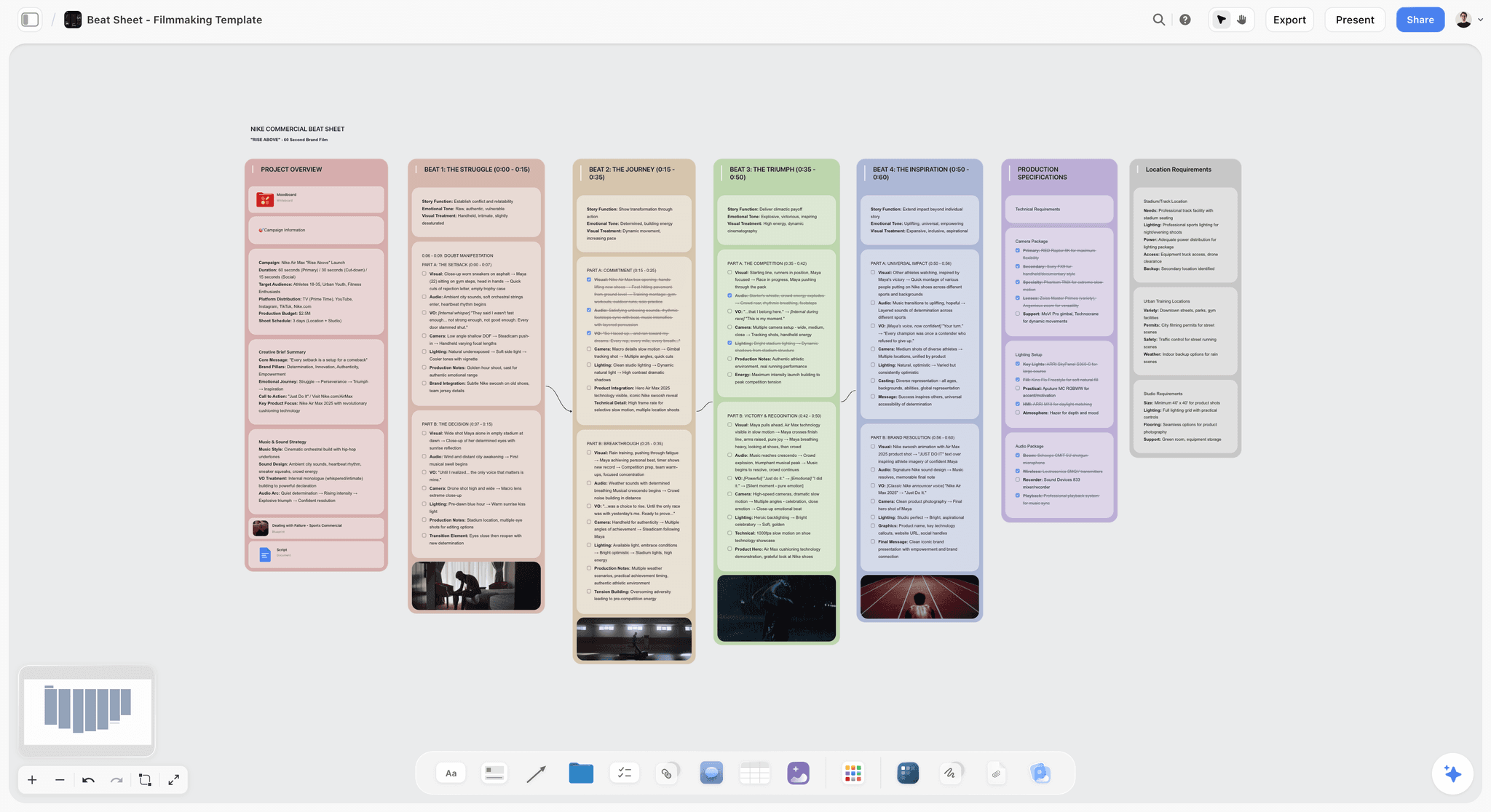
Honest limitation: Storyflow is a planning canvas, not a logistics suite. It drafts a call sheet PDF and a strip board, but it will not send call sheets, produce a day-out-of-days, or manage cast-and-crew scheduling with the depth a dedicated system does. For distributing call sheets and day-by-day production scheduling, pair it with a tool built for that, such as StudioBinder, and keep Storyflow as the visual planning surface where the whole film gets seen at once before those logistics tools take over.
The most common pre-production mistakes
- Not locking the script. A moving script means the breakdown, budget, and schedule are all built on sand. Every change after lock is rework in three other workstreams. Lock it, then plan.
- Skipping the breakdown. Budgeting and scheduling straight from the script, without itemizing every element scene by scene, guarantees you miss costs and days. The breakdown is the source document; do not skip it.
- No contingency. A budget with no reserve assumes nothing goes wrong. Everything goes wrong. Even insured productions carry a 10% contingency for a reason.
- Planning the shoot before the plan is firm. Hiring crew and locking days before the script and schedule are stable means you pay to redo it when they change. Firm up the plan, then commit money to it.
- Over-planning material that should stay loose. The inverse mistake. Forcing a rigid storyboard onto a documentary or a live event fights the footage. Match the amount of planning to how much of the outcome you actually control.
- Keeping the workstreams in five disconnected places. When the budget, schedule, script, and storyboards cannot see each other, a change in one silently breaks the others, and you find out on set.
The Bottom Line
Pre-production is the planning phase between development and the shoot, and it is the phase where a film is actually decided. Script lock and breakdown, budget, schedule, casting, location scouting, production design, shot planning, and crew all get settled here, before the camera rolls, so that the shoot becomes execution rather than decision. Treat it as risk reduction: every choice you make in pre-production, for the price of a conversation, is a choice you are not making on set for the price of a shooting day, or in the edit for the price of a reshoot. Plan hard where planning reduces real risk, plan lightly where the material has to stay responsive, and keep every workstream in one view so a change in one does not silently break the others. Do that, and the shoot is calm, because the film is already made.
If you want to hold every pre-production workstream on one surface, open a Storyflow film-planning board and lay the breakdown, schedule, storyboards, and scout photos side by side.
FAQ: Pre-Production
What is pre-production in film?
Pre-production is the planning phase of a film, sitting between development and the shoot. It is where every decision the shoot depends on gets made and locked: the final script, the cast, the locations, the budget, the schedule, the look, the shot plan, and the crew. Nothing is filmed yet. The goal is to convert a script and a budget into a complete, executable plan for production.
What are the stages of pre-production?
Pre-production runs as parallel workstreams rather than a single sequence. The main ones are: locking the script and breaking it down, building the budget, building the schedule, casting, location scouting, production design, shot planning and storyboards, and assembling the crew. Each produces a specific output the shoot depends on, and they run alongside each other because they constrain one another.
How long does pre-production take?
It varies with the scale of the project. A large studio feature can spend several months in pre-production; an independent short might take a few weeks; a small documentary or run-and-gun shoot might need only days of real planning. The right length is however long it takes to lock the script, budget, schedule, cast, and locations so the shoot can execute without still deciding things.
What is the difference between development and pre-production?
Development answers "what film are we making," pre-production answers "exactly how, with whom, where, and for how much." Development is where the script is written and financing and key talent are attached; it can take years and often stalls. Pre-production begins once the film is greenlit and dated, and its job is to turn that script and budget into an executable plan for the shoot.
What is a script breakdown?
A script breakdown is a scene-by-scene analysis that pulls out every element each scene requires: cast, extras, props, wardrobe, vehicles, special equipment, stunts, effects, and locations. It is the itemized source document that the budget and the schedule are built from, because you cannot cost or schedule what you have not first listed. Skipping the breakdown guarantees missed costs and days.
What are the four phases of production?
The four phases are development, pre-production, production, and post-production, in that order. Development creates a shootable script and the money to make it. Pre-production plans and locks every decision the shoot depends on. Production executes that plan and captures footage. Post-production edits, scores, mixes, colors, and finishes the film. Pre-production sits in the load-bearing middle, since every later phase depends on its plan.
Why is pre-production so important?
Because it is where the film is actually decided. By the time the camera rolls, the story, cast, locations, look, and shots are already chosen, so the shoot mostly records decisions made in pre-production. It is also risk reduction: a choice made in planning costs a conversation, while the same choice discovered on set costs a shooting day, and discovered in the edit can cost a reshoot.
What happens if you skip pre-production?
The planning work does not disappear; it moves onto the set, where it is far more expensive and gets done under pressure. Missed elements surface as gaps in the footage, which can force reshoots. Studio reshoots routinely run between $6 million and $10 million, the price of decisions that should have been made for the cost of a conversation months earlier.
What is production design in pre-production?
Production design decides how the film looks: the sets, props, colors, textures, and the physical world the camera sees. It works from the script and the director's vision and hands off to the art department that builds and dresses the sets. The output is a coherent visual world, planned on paper and in reference boards before anyone builds or dresses a set.
Do documentaries need pre-production?
Yes, but a different kind. Documentary planning holds logistics, budget, access, and gear with real rigor, because planning genuinely reduces those risks. What it holds loosely is shot-by-shot coverage, because real events control that, not a storyboard. Over-planning a documentary fights the material and can blind you to the better story unfolding in front of the lens, so the skill is knowing which parts to lock and which to leave open.
What tools do you use for pre-production?
You need something to hold each workstream and, ideally, a way to see them together. A visual canvas keeps the script breakdown, budget, schedule, storyboards, and scout photos in one view so a change in one does not silently break the others. Pair a planning canvas with a dedicated logistics tool for sending call sheets and day-by-day scheduling, since those are a different job from visual planning.
What is the difference between pre-production and production?
Pre-production is decision; production is execution. In pre-production nothing is filmed, and every choice the shoot depends on gets planned and locked. In production, the crew executes that plan and captures footage. The clearest way to hold it: pre-production is where the film is made, and the shoot is where that already-made film gets recorded.
Table of Contents
- What pre-production actually is
- The four phases of production and where pre-production sits
- Why pre-production is the phase that decides the film
- The pre-production workstreams and what each one produces
- Pre-production as risk reduction
- A working order for the workstreams
- Where lean pre-production is the right call
- Keeping every workstream in one view
- The most common pre-production mistakes
- The Bottom Line
- FAQ: Pre-Production
- Related Reading
Templates to check out for this topic


Filmmaking templates you can use in Storyflow
Skip the blank canvas. Open one of these filmmaking boards in Storyflow and the AI builds on the structure that is already there, from research through the shot list.


See Storyflow in Action
A visual AI workspace where every feature lives inside one canvas. No tab-switching, no context lost.
Build your entire board from a single message
Type what you need in the AI chat at the bottom of your canvas. The AI adds cards, headings, and structure directly onto your board.
Use expert frameworks as AI context
Type @ in the AI chat and choose any Tactic. The AI tailors every response to that framework instead of giving generic advice.
Turn your board into a mind map in seconds
Ask the AI to restructure your canvas as a mindmap. It connects your ideas into a visual hierarchy so you can see how everything relates.
Why Storyflow Exists
Storyflow actually began as a personal tool while working on creative and research projects.
We kept running into the same problem: ideas were scattered everywhere: notes, documents, and whiteboards.
Nothing helped us see how everything connected.
So we started building a workspace designed around how ideas actually grow.
→ Read how Storyflow was createdJustkay
Documentary Filmmaker & Founder at Storyflow
Published: 2026-07-04
Extremely simple, seriously capable


See how easy it is to get started
Watch a real project come together, from a blank board to a finished plan, clicked through step by step.
Start creating with AI and become more productive
Transform your creative workflow with AI-powered tools. Generate ideas, create content, and boost your productivity in minutes instead of hours.