
How to Plan a Film Shoot With AI (2026): A Step-by-Step Guide
Planning a shoot is turning a script into decisions a crew can execute without you. This walks the chain, from locked script to breakdown, budget, schedule and shot list, and shows exactly where AI helps and where it does not.

Category
Filmmaking
Author

Justkay
Documentary Filmmaker & Founder at Storyflow
Topics
2026-07-04
•
13 min read
•
Filmmaking- how to plan a film shoot with AI
- AI film shoot planning
- AI script breakdown
- AI production schedule
- plan a film shoot step by step
How do you plan a film shoot with AI?
To plan a film shoot with AI, work in order: lock the script, break it down scene by scene, build the budget, then schedule and staff it. The breakdown is the spine of the whole plan and the single stage where AI saves the most time, turning hours of highlighting into a reviewable first pass you correct rather than create.
What planning a film shoot actually means
Planning a film shoot is the work of turning a script into a set of decisions a crew can execute without you standing over them. It is not one document but a chain of them: the locked script, the breakdown, the budget, the schedule, the shot list, the call sheet, and the contingency plan you hope you never open. Each feeds the next, so a gap in the breakdown becomes a hole in the budget, becomes a missing rental on the schedule, becomes a crew of twelve standing around at 6 a.m. waiting for a light that never got booked.
I have run documentary shoots where the plan held and shoots where it did not, and the difference was almost never talent or gear on the day. It was how much thinking happened before anyone showed up. A shoot day is expensive: cast, crew, locations, and equipment all bill by the hour, and every decision you push onto the day is made under time pressure in front of people being paid to wait for you.
That is the whole premise of this guide. You do not fix a shoot day on the shoot day. You fix it three weeks earlier. The value of planning is not tidiness. It is that a problem caught in pre-production costs a phone call, and the same problem caught on set costs a day of everyone's rate. AI changes the economics of that planning: the parts that used to eat evenings, tagging a script, drafting a schedule, roughing a shot list, are now the parts AI drafts in minutes. It removes the transcription, not the judgment, so you spend the reclaimed time on the decisions only a director can make.
Keep the chain of decisions in one place
The locked script, the breakdown, the schedule and the shot list stay on one canvas, so changing the script surfaces what else has to change.

The pre-production pipeline at a glance
Here is the whole chain in one view: what each stage takes in, what it produces, and where AI earns its place. Each row depends on the one above it being right.
| Stage | Takes in | Produces | Where AI helps |
|---|---|---|---|
Lock the script | A concept or draft | A frozen shooting script | Coverage and continuity notes, plot-hole flags |
Break it down | The locked script | A tagged list of every element per scene | Auto-tagging props, cast, wardrobe, effects |
Budget | The breakdown | A costed plan with contingency | Line-item drafts, cost ranges, gap-checking |
Schedule | Breakdown plus budget | A day-by-day shooting order | Grouping by location and cast, flagging conflicts |
Shot list | Script plus schedule | Every setup, per scene, in order | Drafting coverage, angles, and shot sizes |
Call sheet | Schedule plus shot list | The one page each person reads that morning | Assembling call times, contacts, weather, map |
Contingency | The whole plan | A tested plan B for weather, illness, overruns | Surfacing single points of failure |
The pipeline is linear on paper and messy in practice. You will loop back: the budget forces a schedule change, the schedule cuts a shot, the cut shot changes the breakdown. That looping is why the plan wants to live somewhere you can see all of it at once.
Step 1: Lock the script or concept
You cannot break down a script that is still moving. The first job of pre-production is to freeze the thing you are shooting. On a scripted film that means a locked shooting script with numbered scenes; on a documentary or a commercial it means a locked concept: the beats you are covering, the interviews you are getting, the shots you cannot come home without. Once the script is locked, changes cost money, because every downstream document keys off scene numbers and page counts, so the goal is to resolve every open question before you lock, not after.
This is where AI does its least glamorous and most useful work. Feed it the locked draft and ask it to read for continuity: props that appear and vanish, a time of day that flips between scenes, a character in two places at once. It will not rewrite the film for you, and you should not let it, but it is a tireless continuity reader that catches the small breaks a tired writer misses on the fifth pass. Treat every note as a question to check, not a fact, because it will confidently flag a "continuity error" that is actually a deliberate choice.
The output of this step is a script you are willing to stop touching. If you are not, you are not done, and everything you build on top of it will shift under you.
Step 2: Break the script down
The breakdown is the spine of the whole plan. You go through the locked script scene by scene and tag every element that has to exist for that scene to be shot: cast, background, props, wardrobe, makeup, vehicles, stunts, effects, sound, set dressing. It is what turns "INT. KITCHEN - NIGHT" into a list a producer can actually buy, book, and schedule.
Done by hand, a breakdown is hours of reading with a highlighter. This is the single stage where AI saves the most time. Give it the locked script and the categories you tag, and it produces a first-pass breakdown, every scene, every element, sorted by category. The review is not optional: the AI will miss the implied prop, the coffee cup never named in the dialogue but that has to be on the table, and over-tag the throwaway line mentioning a car nobody drives. Your job shifts from transcription to judgment, which is faster and more accurate than starting from a blank legend. Get this step wrong and every document downstream inherits the mistake.
Step 3: Build the budget
The budget is the breakdown with prices on it: above-the-line (director, cast, producer, writer), below-the-line (crew, equipment, locations, transport), and post (edit, sound, color, music). The breakdown tells you what you need; the budget tells you whether you can afford the film you locked.
AI is useful here as a first-draft engine and a gap-checker, not a source of real numbers. Ask it to turn your breakdown into line items and it builds the structure fast and catches categories you forgot. Real rates come from real quotes, so treat any number it generates as a placeholder you replace with a booking. Where it genuinely helps is "what did I forget," because AI is good at listing the standard cost lines a first-time producer leaves off entirely.
The one number no one should skip is contingency. Completion guarantors, the parties who guarantee a film finishes on budget, generally require a 10% contingency added to the budget (Forbes, Schuyler Moore, 2019). That figure exists because things go wrong at a predictable rate even on well-run shoots, so if you are not carrying at least that, you are not budgeting, you are hoping. On larger productions the risk is formalized further: a completion bond costs roughly 3 to 5% of the net production budget (Wrapbook). Overruns compound the further downstream they surface, so it is cheaper to cut a scene now than to discover on the day that you cannot afford to light it.
Step 4: Build the schedule
The schedule decides the order you shoot in, and it is almost never the order the script reads in. You shoot out of sequence to group efficiently: everything at one location on the same day, every scene with the expensive actor while you have them, every night exterior while the season allows it. A good schedule is the single biggest lever on cost, because it minimizes the number of times you move the circus.
This is a constraint-solving problem, exactly what AI is good at drafting. Feed it the breakdown and your constraints, location and cast availability, day or night, interior or exterior, and it proposes a shooting order that clusters the expensive variables and flags the conflicts you would otherwise find on the day: the actor scheduled at two locations, the night scene stacked after a full day of exteriors, the location booked for a Tuesday scene that is only free on Wednesday.
The judgment the AI cannot supply is what a day actually feels like. It does not know that the emotional scene needs to be shot before the crew is exhausted, that the difficult location wants to be first while everyone is fresh, or that you never schedule the hardest stunt for the last hour of a long day. The AI optimizes for logistics; you optimize for performance and safety, then let logistics fill in around your fixed points. It is also where over-optimism dies: if the AI packs eight scenes into a day and your gut says four, your gut is usually right, because the AI does not carry the friction of resets, lunch, and the shot that takes six takes instead of two. Pad it.
Step 5: Make the shot list
The shot list is where the director's vision becomes a countable list of setups. For every scene you name every shot: the wide that establishes, the mediums, the singles, the inserts, the cutaways you will beg for in the edit. It turns "we cover the argument" into "eleven setups, in this order, and here is why each one exists."
AI drafts a competent first-pass shot list quickly. Give it a scene and it proposes coverage, a standard set of angles and sizes that will cut together: the establishing wide, the over-the-shoulders, the reverses, the insert on the object that matters. But what it drafts is coverage, not vision, and coverage is generic by design. The AI will never propose the one unusual shot that is the reason to make this film rather than any other, because that shot comes from a point of view and the AI does not have one. Use it to guarantee you have not forgotten the boring necessary shots, then spend your energy on the two or three shots per scene that are actually yours. And tie the list back to the schedule as you build it: a shot list that ignores how many setups fit in a day is a wish list and a way to run out of daylight with half the scene unshot.
Step 6: Write the call sheet
The call sheet is the one page every person on the production reads the morning of the shoot. It carries call times per department, the location and its map, the scenes shooting that day and in what order, the weather and sunrise or sunset times, the nearest hospital, and every relevant phone number. It is the single most important operational document of the shoot day, because it is the one everyone actually uses.
The call sheet is assembly, not creativity, which makes it a good fit for automation. Given your schedule and contacts, AI can draft it fast, pull the weather and sun times, order the day, and lay out the contacts, removing the tedious cross-referencing that makes call sheets error-prone when built by hand at midnight before the shoot.
Here is the honest limitation, and it matters. Storyflow, the tool I built and use for the planning stages above, drafts the call sheet as a PDF but does not send it, track confirmations or produce a day-out-of-days, so for distributing the call sheet I pair it with a dedicated tool like StudioBinder, which is purpose-built for the formal paperwork. Use the canvas to plan and pressure-test the shoot; use the scheduling tool to output the industry-standard documents. The two are complementary, and pretending one tool does everything is how you end up with a call sheet missing the hospital address.
Whatever produces it, the test of a call sheet is that a crew member who has never spoken to you can read it and know exactly where to be, when, and what happens if it rains.
Step 7: Plan for the day that goes wrong
Every experienced production carries a plan B, because the question is never whether something goes wrong, only what. Weather turns, an actor gets sick, a location falls through the night before, the scene scheduled for four hours takes seven. Contingency planning is the work of deciding, calmly and in advance, what you do when the thing you did not want to happen happens. The reason to do it now is that a plan made under pressure is a worse plan: on the day, with the crew waiting and the light going, you make the fast decision, not the good one. So you decide now. If it rains, we shoot the interior scenes we kept in reserve. If the lead is out, we shoot the coverage that does not need them. If we fall behind, here is the shot in each scene we cannot lose and the one we drop first.
AI is quietly good at this, because it lists failure modes without the optimism bias that makes humans skip them. Ask it to read your plan and name the single points of failure: the one location with no backup, the one actor every scene depends on, the one piece of gear with no rental alternative. It surfaces the dependencies you stopped seeing because you are too close to the plan, and it is easier to plan against a risk you have been shown than one you forgot existed.
The stakes are not abstract. When planning fails badly enough that a film has to go back and reshoot, the numbers get frightening: studio reshoots often cost 6 to 10 million dollars in added filming (Variety, 2017, on Justice League). No indie budget survives that, which is precisely why the indie answer is not a reshoot fund but a contingency plan tested before anyone rolls a camera.
Where planning can be overdone
I have spent this whole guide arguing for planning, so here is the honest counterweight: planning has a point of diminishing returns, and some shoots are past it before they start.
A run-and-gun shoot, one person, a camera, a few hours, and a subject, does not want a seven-document pipeline. If you are grabbing B-roll, shooting a two-hour interview, or covering an event as it unfolds, a heavy plan is friction. The breakdown for a single interview is a sentence and the call sheet is a text message.
Observational work has an even sharper version of this. The whole point is to capture what actually happens, and an over-tight plan makes you deaf to the better thing occurring in front of you. If you decide in advance exactly which eleven shots you need, you get those eleven shots and miss the unplanned moment that was the real film. Past a point, planning becomes a way of controlling reality instead of witnessing it, and for some kinds of filmmaking that control is the enemy.
The rule I use is proportion. A twelve-person crew across five locations needs every document in the pipeline; a solo shoot for an afternoon needs a shot list and a plan for lunch. Match the weight of the plan to the weight of the day, and do not confuse the amount of planning with the quality of the film.
Planning the whole shoot on one canvas
Everything above shares one problem: the documents are related but they usually live apart. The breakdown is in one file, the budget in a spreadsheet, the schedule in another tool, the shot list in a doc, the notes in your head. When they are scattered, the gaps hide in the seams: the prop that made it into the breakdown but never the budget, the scene on the schedule that has no shots listed, the single point of failure no one is looking at because no one is looking at the whole thing at once.
The fix that changed how I plan is putting the entire shoot on one canvas. When the script beats, the breakdown, the budget lines, the schedule, and the shot list all sit on the same board, the dependencies become visible instead of buried. You see the scene with no coverage, the location that appears once with no backup, the day that is over-packed next to the day that is empty. This is the pre-production work Storyflow is built for: a single canvas that holds the whole plan and an AI that reads the entire board before it answers, so when you ask "what am I missing," it answers against your actual plan, not a generic checklist.
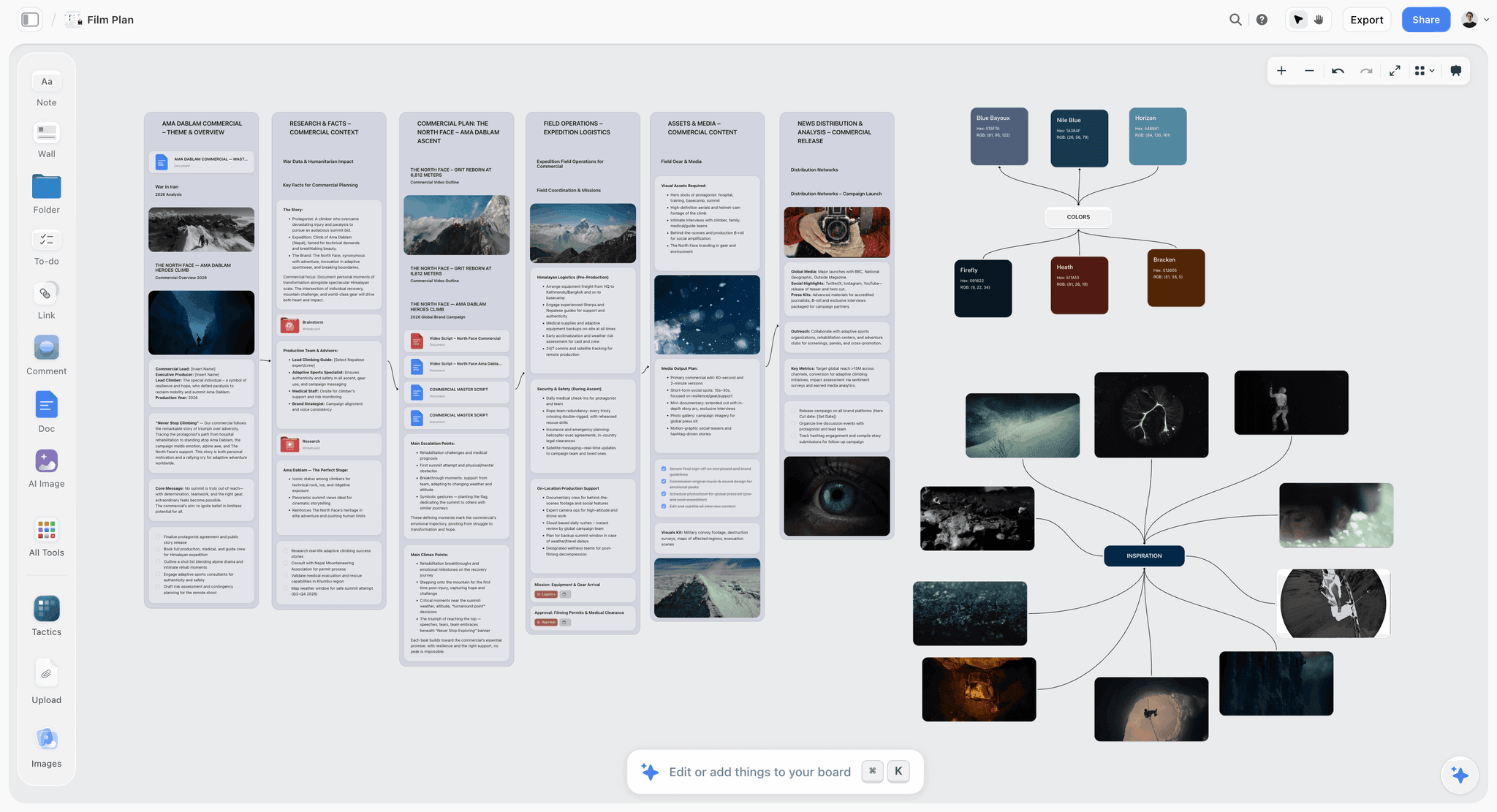
The AI on the canvas is doing the gap-surfacing this guide keeps returning to. It reads the full board plus a Story Blueprint you pull from the library and any documents you reference, and flags the holes across stages, the ones that only show up when the breakdown and the schedule sit in the same view. The Story Blueprints library ships more than 200 expert frameworks, including narrative structures like the Hero's Journey and Five-Act Structure, so you can start a scripted project from a proven story spine instead of a blank page.
The honest limitation, again, because it matters: Storyflow drafts the call sheet as a PDF and a strip board, but it does not send call sheets, track confirmations or produce a day-out-of-days. It is a planning and pressure-testing canvas, not a scheduling engine, so pair it with StudioBinder or your studio's preferred scheduling tool for the formal industry documents.
The reason any of this works comes back to the sentence at the top. The shoot day is expensive and unforgiving, and almost every problem that surfaces on it was fixable, cheaply, three weeks earlier, if someone had been looking at the whole plan at once. AI does not replace the looking. It makes the plan fast enough to build and clear enough to read that you actually do it, in time for it to matter.
FAQ: Planning a Film Shoot
How do I plan a film shoot step by step?
Lock the script or concept so it stops changing, break it down scene by scene into every element you need, price that breakdown into a budget with contingency, build a shooting schedule grouped by location and cast, write a shot list that covers every scene, produce a call sheet for each shoot day, and prepare a contingency plan for weather, illness, and overruns. Each step feeds the next, so a gap early on becomes a hole later.
How long does it take to plan a film shoot?
It depends entirely on scale. A solo run-and-gun shoot needs a shot list and an afternoon of prep, while a multi-location production with a full crew often runs weeks, because the breakdown, budget, schedule, and locations all have to be booked and cross-checked. Match the planning to the size and rigidity of the shoot rather than to a fixed timeline.
What is a script breakdown in film?
A script breakdown is a scene-by-scene list of every element needed to shoot each scene: cast, background, props, wardrobe, makeup, vehicles, stunts, effects, and set dressing. It is the spine of pre-production, because the budget prices it, the schedule sequences it, and the shot list covers it, so a wrong breakdown passes its errors to every document built on top of it.
Can AI plan a film shoot for me?
AI drafts most of the pre-production documents fast: it can auto-tag a script breakdown, rough a budget structure, propose a shooting schedule, and draft shot-list coverage. What it cannot do is supply the director's judgment, the real rental quotes, the performance-driven scheduling, or the one unusual shot that is the reason to make the film, so treat it as a fast first-draft engine you review, not a decision-maker.
What order do you shoot a film in?
Almost never script order. You shoot out of sequence to group efficiently: all scenes at one location together, all scenes with an expensive actor while you have them, all night exteriors while the season allows. This minimizes how many times you move cast, crew, and gear, the single biggest lever on shooting cost, so the schedule, not the script, sets the order.
How much contingency should a film budget have?
Completion guarantors generally require a 10% contingency added to a film budget (Forbes, Schuyler Moore, 2019), and that is a sensible floor for an indie production too. Things go wrong at a predictable rate even on well-run shoots, so a budget without contingency is a hope rather than a plan.
What is a call sheet and what goes on it?
A call sheet is the one page every crew member reads the morning of the shoot: call times per department, the location and its map, the scenes shooting that day and in what order, weather and sunrise or sunset times, the nearest hospital, and every relevant contact number. The test of a good one is that someone who has never spoken to you can read it and know exactly where to be and when.
What is the difference between a shot list and a storyboard?
A shot list is a text list of every setup you plan to shoot per scene, with angle and size; a storyboard draws those shots as frames so you can see the composition and the cut before you shoot. The shot list tells the crew what to set up, the storyboard tells them what it should look like, and the shot list is the one you cannot skip.
How do I plan a low-budget film shoot?
Plan proportionally. A low-budget shoot cannot absorb overruns, so the schedule and contingency matter more, not less: shoot fewer setups per day than optimism suggests, group ruthlessly by location, and decide in advance which shot in each scene you cannot lose and which you drop first. Use AI to draft the breakdown and schedule so you spend your limited prep hours on decisions, not transcription.
What software do I use to plan a film shoot?
Different stages want different tools. A canvas tool like Storyflow holds the whole plan in one view for breakdown, budget notes, schedule, and shot list, and surfaces the gaps across them, while a dedicated scheduling tool like StudioBinder produces the day-out-of-days and distributes the call sheets the crew expects. Many filmmakers pair a planning canvas for thinking with a scheduling tool for the paperwork, since no single tool does both well.
What is a day-out-of-days in film production?
A day-out-of-days is a chart showing which cast and key crew are needed on which shoot days, so you can see everyone's start, work, hold, and finish days at a glance. It tells you an actor is being held (and paid) across days they are not shooting, a scheduling cost you can often design out, and dedicated scheduling tools generate it from the breakdown and schedule.
Why do film shoots go over budget?
Usually because a problem that was fixable in pre-production surfaced on the shoot day instead, when the crew is on the clock and every decision is made under time pressure. Missing breakdown elements, an over-optimistic schedule, no contingency, and no plan B for weather or illness are the common culprits, and the most expensive version is a reshoot, which is exactly what contingency planning exists to prevent.
Table of Contents
- What planning a film shoot actually means
- The pre-production pipeline at a glance
- Step 1: Lock the script or concept
- Step 2: Break the script down
- Step 3: Build the budget
- Step 4: Build the schedule
- Step 5: Make the shot list
- Step 6: Write the call sheet
- Step 7: Plan for the day that goes wrong
- Where planning can be overdone
- Planning the whole shoot on one canvas
- FAQ: Planning a Film Shoot
- Related Reading
Templates to check out for this topic


Filmmaking templates you can use in Storyflow
Skip the blank canvas. Open one of these filmmaking boards in Storyflow and the AI builds on the structure that is already there, from research through the shot list.


See Storyflow in Action
A visual AI workspace where every feature lives inside one canvas. No tab-switching, no context lost.
Build your entire board from a single message
Type what you need in the AI chat at the bottom of your canvas. The AI adds cards, headings, and structure directly onto your board.
Use expert frameworks as AI context
Type @ in the AI chat and choose any Tactic. The AI tailors every response to that framework instead of giving generic advice.
Turn your board into a mind map in seconds
Ask the AI to restructure your canvas as a mindmap. It connects your ideas into a visual hierarchy so you can see how everything relates.
Why Storyflow Exists
Storyflow actually began as a personal tool while working on creative and research projects.
We kept running into the same problem: ideas were scattered everywhere: notes, documents, and whiteboards.
Nothing helped us see how everything connected.
So we started building a workspace designed around how ideas actually grow.
→ Read how Storyflow was createdJustkay
Documentary Filmmaker & Founder at Storyflow
Published: 2026-07-04
Extremely simple, seriously capable


See how easy it is to get started
Watch a real project come together, from a blank board to a finished plan, clicked through step by step.
Start creating with AI and become more productive
Transform your creative workflow with AI-powered tools. Generate ideas, create content, and boost your productivity in minutes instead of hours.