The 10 Best Pre-Production Tools for Documentary in 2026
Documentary pre-production runs on two timelines at once, discovery and delivery, and each needs its own tool. The 10 best options compared for research, transcripts, scheduling, and the boards that hold a story still forming.

Category
Filmmaking Tools
Author

Justkay
Documentary Filmmaker & Founder at Storyflow
Topics
2026-07-04
•
16 min read
•
Filmmaking Tools- best documentary pre-production tools
- documentary research tools
- documentary planning software
- documentary transcript tools
- documentary pre-production software 2026
What are the best pre-production tools for documentary?
For documentary pre-production in 2026 no single tool wins, because documentary runs on two timelines at once. For the discovery timeline (research, transcripts, and finding the story) the strongest pick is Storyflow, a visual canvas whose AI reads the whole board. For the logistics timeline (schedules, releases, and call sheets) a production tool takes over. Most documentary teams need one of each.

Full disclosure: Storyflow is our own product, so weigh its placement with the skepticism you would apply to any tool a company recommends on its own blog. We rank it first for one job only, holding a documentary's research and its still-forming structure together, and we say plainly that StudioBinder owns scheduling, Descript owns transcripts, and Frame.io owns review.
Quick Comparison
Documentary runs two timelines at once. These four cover the ends of both.
| Tool | Best For | AI Features | Price |
|---|---|---|---|
| Storyflow | Research and evolving structure | Reads the whole research board | $7.99 mo annual (free plan late 2026) |
| StudioBinder | Schedules and call sheets | Light automation | Free / ~$29 mo |
| Descript | Transcripts and paper edits | Yes, core product | Free / ~$24 mo |
| Frame.io | Timecoded review | Limited | Free / ~$15 user mo |
The short answer
For documentary pre-production in 2026, no single tool wins, because documentary runs on two timelines at once and each needs its own tool. For the discovery timeline (research, transcripts, and finding the story), the strongest pick is Storyflow, a visual canvas whose AI reads your whole board of sources. For the logistics timeline (call sheets, scheduling, shoot-day coordination), the strongest pick is StudioBinder. Add Descript for interview transcription and you have covered the three jobs that actually eat documentary pre-production time. The tools below are ranked by how well they serve one of those two timelines, which is why this list looks nothing like a generic pre-production roundup that assumes you already have a script.
In fiction, pre-production serves a script. In documentary, pre-production is the search for one. Rank tools against that reality and the order changes.
Hold a story that is still forming
Documentary structure changes as the research comes in. Keep the interviews, the archive, and the evolving outline on one canvas the AI can read end to end.

Why documentary pre-production is a different job
Most pre-production software assumes you already have a script. You break it down, schedule it, build call sheets, and manage the shoot. That workflow is built for fiction, where the story exists on paper before a single frame is shot. Every industry-standard tool inherits that assumption, and it quietly punishes documentary teams who buy on reputation.
Documentary does not work that way. When I start a documentary, I do not have a script. I have a question, a stack of research, a list of people who might talk, and a hunch about where the story is. The first weeks are not logistics. They are a search. You are reading, interviewing, cross-referencing, and waiting for the shape of the thing to appear. A tool built to break down a finished script has nothing to do during the part of the job that matters most.
There is a second wrinkle, and it is the one that trips up most tool choices. A documentary emerges. The story you pitch is rarely the story you shoot, and the story you shoot is rarely the story you cut. New material rearranges the whole thing. A tool that assumes a fixed structure fights you every time the structure moves. You need something that lets research, connections, and half-formed ideas sit together and reorganize as the film reveals itself.
That is why a documentary pre-production stack looks different from a fiction one. The logistics half wants structure, which is right for a crew and a schedule. The discovery half wants a space that stays loose until the story is ready to lock. Buy only for the logistics half and you have great call sheets pointing at a film you have not found yet.
The Two Timelines: the framework this list is built on
Here is the framework I use to pick tools, and the one this ranking is organized around. Call it The Two Timelines.
A documentary runs on two clocks at the same time:
- The discovery timeline. Research, outreach, interviews, transcription, and the slow work of finding the story in scattered material. This timeline is nonlinear and unpredictable. It has no fixed end. It ends when you have found enough of the story and secured enough access to shoot.
- The logistics timeline. Call sheets, scheduling, contacts, locations, permissions, and shoot-day documents. This timeline is linear and plannable. It behaves like fiction pre-production, because once you know what you are shooting, coordinating a crew is coordinating a crew.
The mistake almost every "best pre-production tools" list makes is ranking everything on a single scale, as if these two timelines were one job. They are not. A documentary is two timelines wearing one deadline. The tools that serve the discovery timeline (canvases, transcription, research hubs) are usually weak at logistics, and the tools that own logistics (call sheet software, schedulers) are usually useless during discovery.
So every tool below is graded on which timeline it serves, and how well. Some serve one timeline brilliantly and the other not at all. That is not a flaw in the tool. It is the shape of the problem. The practical takeaway, which I will repeat because it saves money: do not buy one tool for documentary pre-production, buy one for each timeline.
How I tested and ranked these tools
I have made documentaries where the research corpus ran past 40 sources before a single interview was shot, and I have felt the specific pain of a story that kept reorganizing itself as new material came in. I tested these tools against that reality, on five named criteria:
- Research capture: how well it holds articles, transcripts, images, and links without becoming a junk drawer you never reopen.
- Story development: whether you can find connections and shape a narrative from scattered material, or whether the tool just stores it.
- Logistics: call sheets, scheduling, contacts, and shoot-day documents that a real crew can run on.
- Collaboration: how a small, often-remote team works in it together without stepping on each other.
- Price and value: verified against each tool's own pricing page in 2026. Where I could not confirm a current price, I say so and you should verify before you buy.
I ran a real documentary research project through each candidate: roughly 30 sources, a handful of interview transcripts, and a story that I forced to reorganize twice to simulate what actually happens. Then I graded each tool on which of The Two Timelines it served and how far.
No single tool wins all five criteria, which is the honest headline and the whole point of the framework. Documentary teams almost always run two tools: one for the discovery timeline, one for the logistics timeline. The rankings reflect that. A tool can top this list by owning one timeline completely, and it does not lose points for ignoring the other, as long as I tell you which timeline it is for.
The 10 best pre-production tools for documentary
1. Storyflow
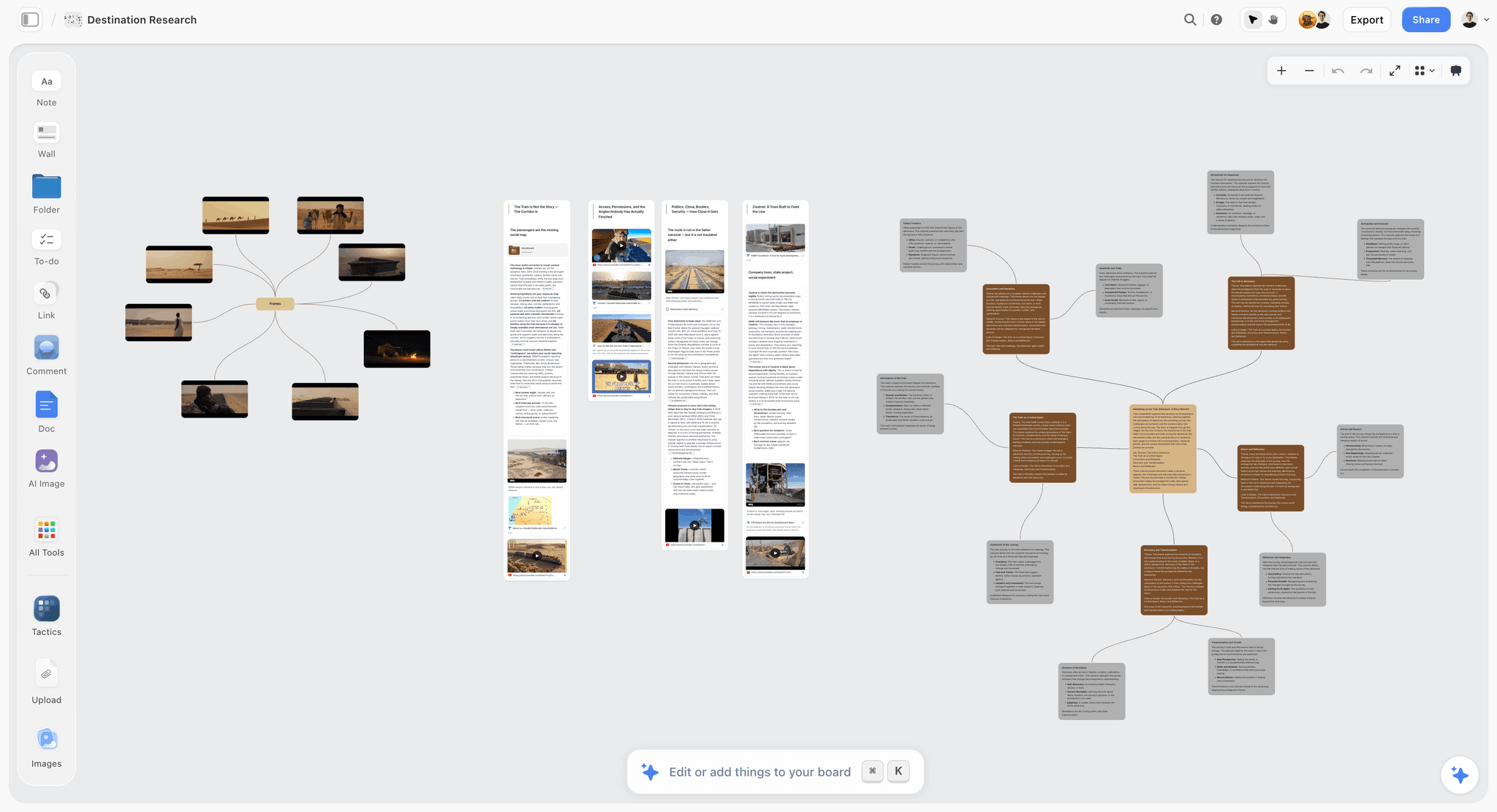
Verdict: The best tool for the discovery timeline, which is where documentary pre-production actually lives and where most tools are weakest.
Best for: Solo directors and small documentary teams doing research and story development before there is anything to schedule.
Pricing: Paid-only early access today; the Free plan ($0, no credit card) launches before the end of 2026, and anyone a paid member invites to a board joins free now. Plus: $7.99/month annual or $9.99/month monthly, which unlocks the 200+ Story Blueprints library and unlimited file uploads. Pro: $14/month annual or $19/month monthly, which adds 20x more AI plus AI image generation. Max: $39/month annual or $49/month monthly, which adds 40x more AI plus a team workspace with roles and permissions.
Why it ranks first: Storyflow is a visual canvas where documentary research and story development live in one place, with an AI that reads the whole active board. You drop in articles, interview notes, images, and links as cards, cluster them, and draw the connections that turn a pile of research into a story. Because the AI reads the full active canvas (plus up to 1 Tactic and up to 3 Documents you @-mention), you can ask "who mentioned the land dispute" and get an answer pulled from across your sources, not just the card you happen to be looking at. For documentary, that reads-the-whole-board behavior is the feature, because the story you are looking for usually lives in the connections between sources, and a canvas is where connections become visible.
Strengths:
- The AI reads your full active board, so answers are grounded in the sources you actually gathered, not a blank prompt.
- Spatial clustering makes the connections between sources visible, which is how documentary stories reveal themselves.
- Story Blueprints (200+ on Plus and above) include story-development frameworks like Hero's Journey and Five-Act Structure to give the search a shape.
- Free plan is genuinely usable: unlimited boards, unlimited cards, and unlimited collaboration with no seat fee.
- Flat per-account pricing, so adding your co-director or researcher does not add cost.
Limitations (named honestly):
- It is not a logistics tool. Its AI drafts a call sheet PDF and a strip board, but it does not send call sheets or track confirmations, and there is no day-out-of-days report and no crew contact database. Pair it with StudioBinder for the shoot.
- Cloud-only, so a fully offline field workflow (say, a remote shoot with no connectivity) is not its strength.
- Newer platform with a smaller template library than the decade-old incumbents.
- The free tier's AI is a trial (up to 10 generations); the deeper AI that a research-heavy documentary leans on starts at Pro, not Plus.
Storyflow owns the discovery timeline and loses the logistics timeline cleanly, which is exactly why documentary teams run it alongside a scheduling tool rather than instead of one.
2. StudioBinder
Verdict: The best tool for the logistics timeline, full stop.
Best for: Any documentary with a real crew shooting across locations and days.
Pricing: Paid plans start around $29/month for the Indie tier; verify current pricing on StudioBinder's page before you commit.
Why it ranks here: StudioBinder owns the logistics half of pre-production. Call sheets, shot lists, scheduling, contact management, and shoot-day documents are all native and battle-tested across narrative crews of every size. For a documentary with a real shoot, the digital call sheets and contact features alone justify a seat, because coordinating a crew and subjects across locations is exactly what it was built to do.
Strengths:
- Digital call sheets with delivery and confirmation tracking.
- Stripboard scheduling and shot lists that crews already understand.
- Production contact database built for a unit, not a to-do list.
- It is the industry standard, so most collaborators already know it.
Limitations:
- Thin support for the early research and story-development work documentary teams spend weeks on before there is anything to schedule.
- Priced and structured for logistics, so paying for it during a pure-discovery phase is money sitting idle.
- Overkill for a lean, one or two person observational shoot.
StudioBinder is the mirror image of Storyflow: it owns the logistics timeline and does almost nothing for discovery.
3. Milanote
Verdict: The cleanest visual mood and reference board for the discovery timeline.
Best for: Solo directors assembling visual research and treatment boards.
Pricing: Free plan covers 100 notes and 10 file uploads; paid is around $9.99/month. Verify current pricing.
Why it ranks here: Dragging in clippings, photos, and short notes still feels better in Milanote than in most competitors, which makes it strong for the visual research and treatment stage: location references, subject photos, and tone boards. It sits on the discovery timeline, but on the aesthetic side of it rather than the synthesis side.
Strengths:
- The tactile, visual feel of assembling references is best in class.
- Freeform boards with drag-in web clippings.
- Clean image and note cards that make a treatment look presentable fast.
- Simple sharing for feedback.
Limitations:
- It is a board tool, not a research-synthesis tool, so it holds material well but does less to help you find the story inside it.
- No AI that reads your board, so cross-source questions stay manual.
- The 100-note free ceiling is tight once a real research corpus grows.
4. Descript
Verdict: The fastest path from raw interview to a searchable, quotable text corpus.
Best for: Any documentary that lives on interviews, which is most of them.
Pricing: Around $16/month for the Hobbyist plan and $24/month for Creator, billed annually. Verify current pricing.
Why it ranks here: Documentary runs on interviews, and having every interview transcribed, searchable, and editable as text changes how you find your story. You can read across ten transcripts, pull the moments that matter, and rough-assemble a radio edit before you touch a timeline. Descript serves the discovery timeline by turning hours of talking into text you can actually navigate.
Strengths:
- Automatic transcription that is fast and good enough to search against.
- Text-based audio and video editing, so you cut by deleting words.
- Filler-word removal and a searchable transcript library.
- Pairs naturally with a canvas: transcribe in Descript, cluster the quotes in Storyflow.
Limitations:
- It is a transcription and editing tool, not a research-organization or logistics platform, so it handles the words but not the shoot.
- Transcription accuracy still needs a human pass on names, jargon, and heavy accents.
- No spatial view of how quotes relate to each other across interviews.
5. Frame.io
Verdict: The cleanest place to gather and review video reference with a remote team.
Best for: Distributed documentary teams reviewing sample interviews and archival clips.
Pricing: Starts around $15 per user per month. Verify current pricing.
Why it ranks here: Frame.io is best known for post-production review, but in pre-production it earns a spot on the discovery timeline as the place to gather and comment on video reference. Sample interviews, archival clips, and director references can sit in a project where a remote team leaves frame-accurate notes.
Strengths:
- Frame-accurate comments that make async video feedback precise.
- Version stacking so reference cuts stay organized.
- Shareable review links for collaborators without a seat.
- Genuinely good for a distributed team spread across time zones.
Limitations:
- It is a review tool, not a research or logistics system, so its pre-production role is narrow.
- Per-user pricing, which adds up on a bigger team unlike flat-rate tools.
- No help turning what you review into a story structure.
6. Celtx
Verdict: The best pipeline for the scripted parts of a documentary.
Best for: Documentaries with narration, reenactments, or structured segments.
Pricing: Starts around $15/month. Verify current pricing.
Why it ranks here: Celtx connects script, shot list, breakdown, and basic scheduling in one pipeline. Documentary is not script-first, but many documentaries have scripted elements: narration, reenactments, and structured segments where a shot list matters. Celtx sits across both timelines for those scripted pieces, handling the script-to-breakdown handoff cleanly.
Strengths:
- Integrated pipeline for the scripted spine of a documentary.
- Script, shot list, and breakdown in one place.
- Light scheduling for the plannable segments.
Limitations:
- Research and visual development are afterthoughts, so it serves the fiction side of a doc better than the discovery side.
- Weak for the open-ended search phase where documentary starts.
7. Notion
Verdict: The flexible database many teams bend into a research hub.
Best for: Teams who think in documents and tables and want a cheap backbone.
Pricing: Free for personal use; paid plans start around $10 per member per month annually. Verify current pricing.
Why it ranks here: Notion is the flexible database many documentary teams turn into a research hub: a table of sources, a list of subjects to contact, a page per interview. It sits on the discovery timeline for teams who think in structured text rather than space.
Strengths:
- Near-infinite flexibility with databases and multiple views.
- Docs and wikis alongside the tables.
- Low price and a familiar interface.
- Notion AI for summarizing individual pages.
Limitations:
- It is not visual or spatial, so finding the story in the connections between sources is harder than on a canvas.
- Its per-member pricing scales with the team, unlike flat-rate canvases.
- You build every workflow yourself, which is time you are not spending on the film.
8. Trello
Verdict: The simplest way to keep the moving parts visible.
Best for: Tracking subjects to reach, permissions to clear, and locations to scout.
Pricing: Free for up to 10 collaborators; Standard is around $5 per user per month annually. Verify current pricing.
Why it ranks here: Trello is the simple Kanban board for the to-do side of both timelines: subjects to reach, permissions to clear, locations to scout, shoots to schedule. It does not organize research or a story, but it keeps the coordination visible for a small team.
Strengths:
- Dead-simple task tracking a small team picks up in minutes.
- Boards, lists, checklists, and Butler automation.
- Generous free tier for small crews.
Limitations:
- No research, story, or logistics-specific features, so it is a companion, not a core tool.
- Cards do not hold a research corpus in any useful way.
9. Boords
Verdict: The cleanest dedicated storyboard tool for the shootable, planned scenes.
Best for: Reenactments, b-roll sequences, and any scene you can visualize in advance.
Pricing: Around $16.99/month billed annually. Verify current pricing.
Why it ranks here: Boords is a storyboard-first tool documentary uses for the planned elements: reenactments, b-roll sequences, and any scene you can visualize before you shoot it. It sits on the logistics timeline for the parts of a doc that behave like fiction. Numbered panels and an animatic preview make it the cleanest dedicated frame tool in 2026.
Strengths:
- Focused, well-built storyboarding with numbered panels.
- Animatic playback to test timing before the shoot.
- Client approval workflows.
Limitations:
- Very little research or narrative scaffolding around the panels.
- Most documentary footage is unscripted and cannot be storyboarded in advance, so its scope is narrow.
10. Filmustage
Verdict: An AI assistant that automates breakdown, if you have a script to feed it.
Best for: Documentaries with a scripted spine or heavy reenactments.
Pricing: Free tier available; the Director's Cut plan is around $49/month. Verify current pricing.
Why it ranks here: Filmustage is an AI pre-production assistant that automates script breakdown and scheduling. For a documentary with a scripted spine or heavy reenactments, its AI breakdown can save hours of tagging cast, props, and locations. It sits on the logistics timeline, but only once a script exists.
Strengths:
- Fast, automated breakdown for scripted material.
- Scheduling and call sheets built on the breakdown.
- Export to industry formats.
Limitations:
- It needs a script to work, which most documentary pre-production does not have in the early phase.
- The AI tagging still needs a human review pass.
- Nothing for the discovery timeline where documentary begins.
Comparison table
| Tool | Timeline it serves | Documentary strength | AI that reads your research | Free tier | Starting price |
|---|---|---|---|---|---|
Storyflow | Discovery | Finds the story in your sources | Yes (reads full active board) | Coming late 2026 (invited collaborators join free now) | $7.99/mo annual (Plus) |
StudioBinder | Logistics | Call sheets and scheduling | No | Limited | ~$29/mo (Indie) |
Milanote | Discovery (visual) | Mood and reference assembly | No | Yes (100 notes) | ~$9.99/mo |
Descript | Discovery | Searchable transcript corpus | No (transcription only) | Limited | ~$16/mo (Hobbyist) |
Frame.io | Discovery (review) | Async footage review | No | Yes (limited) | ~$15/user/mo |
Celtx | Both (scripted) | Script-to-breakdown pipeline | No | Yes (limited) | ~$15/mo |
Notion | Discovery | Flexible source hub | Per-page only | Yes | ~$10/member/mo |
Trello | Both (tasks) | Visible pre-production to-dos | No | Yes (10 collaborators) | ~$5/user/mo |
Boords | Logistics | Planned, shootable scenes | No | 14-day trial | ~$16.99/mo |
Filmustage | Logistics | Scripted-spine automation | Script breakdown only | Yes | ~$49/mo |
Prices are indicative for 2026 and worth verifying on each tool's own page before you buy.
How to choose for your documentary
Do not choose one tool. Choose one for each of The Two Timelines. Match the spend to the bottleneck, and buy the second tool only when you actually hit the second timeline.
If you are drowning in research and cannot see the story (the discovery timeline is your bottleneck), the fix is a research canvas plus transcription. The strongest combination is Storyflow for research and story development plus Descript for interview transcription. That covers the search for the story, which is where documentary pre-production actually lives and where most tools are weakest. This is the pair I reach for first on almost every project.
If you are about to run a multi-location shoot and cannot keep the unit coordinated (the logistics timeline is your bottleneck), StudioBinder is the fastest payoff for call sheets and scheduling. Add Boords if you have reenactments or planned b-roll to storyboard.
If your documentary is lean and mostly observational, you may never hit the logistics timeline hard enough to justify StudioBinder. A Storyflow board for the story plus Trello for coordination often covers the whole thing.
If you have a scripted spine (narration, reenactments, structured segments), Celtx or Filmustage can automate the breakdown of just those parts while your discovery work lives on a canvas.
Buying the wrong tool for your bottleneck is the most common waste in documentary pre-production. A team drowning in 40 unconnected sources does not need better call sheets. A team about to shoot in three cities next week does not need a prettier research board. Name your bottleneck, buy for that timeline first, and add the second tool when the second timeline arrives.
Honorable mentions and tools to skip
A few tools that come up in documentary conversations but did not earn a numbered slot:
- Airtable is a stronger relational database than Notion for source tracking with linked records, but it shares Notion's core weakness: it is not spatial, so it stores research without helping you see the connections. Consider it if you are already an Airtable team.
- Google Docs plus a shared Drive is the zero-cost default many teams never leave, and for a tiny observational doc it is genuinely fine. It fails the moment your research corpus grows past what one person can hold in their head.
- Final Draft and other screenwriting tools show up on generic pre-production lists but assume a script exists. For the discovery timeline, they have nothing to do.
Tool to be careful with: any all-in-one platform that promises to cover both timelines. In testing, the ones that claim to do everything tend to do the logistics timeline acceptably and the discovery timeline poorly, because logistics is the easier, more structured problem to build for. The all-in-one that covers both timelines well does not exist yet, so plan to run two tools.
The Bottom Line
Documentary pre-production is the search for a story, not the service of one. The tools that matter most are the ones that help you research and shape a narrative from scattered material, not the ones built to break down a finished script. Run The Two Timelines: a discovery space where research and connections live together, and a logistics tool for the shoot when it comes.
Storyflow leads the discovery timeline because its canvas and AI find the story in the connections between your sources, and it loses the logistics timeline cleanly to StudioBinder, which is exactly why most documentary teams run both. A documentary is two timelines wearing one deadline, and the stack that wins is the one that respects that instead of pretending one tool can do it all.
To organize your documentary research and find the story in it, start a Storyflow research board and drop your first ten sources onto the canvas. Ask the AI a question that needs the whole board to answer, and you will feel the difference between a tool that stores your research and one that reads it.
FAQ: Documentary Pre-Production Tools
What is the best pre-production tool for documentary?
There is no single best tool, because documentary pre-production runs on two timelines. For the discovery timeline (research and story development), Storyflow leads because its canvas and AI help you find the story in your sources. For the logistics timeline (call sheets and scheduling), StudioBinder leads. Most documentary teams run one tool for each timeline rather than forcing one tool to do both.
How is documentary pre-production different from fiction?
Fiction pre-production serves a finished script: you break it down, schedule it, and build call sheets. Documentary usually has no script when pre-production starts. The first weeks are research and story discovery, and the story keeps changing as new material comes in. So documentary tools need to support open-ended research and synthesis, not just breaking down a fixed script.
What are the two timelines in documentary pre-production?
Documentary runs on a discovery timeline and a logistics timeline at the same time. The discovery timeline is research, interviews, and finding the story, which is nonlinear and has no fixed end. The logistics timeline is scheduling, call sheets, and shoot-day coordination, which is linear and plannable. They need different tools, which is why one tool rarely covers documentary pre-production.
What software do documentary filmmakers use for research?
Common choices are visual canvases like Storyflow and Milanote for assembling and connecting sources, Descript for transcribing and searching interviews, and Notion or Airtable for database-style source tracking. The distinguishing need is synthesis: documentary research pays off when you can see the connections between sources, which is why a spatial canvas tends to beat a linear document.
Do I need call sheet software for a documentary?
Only if you run a real crew across locations and days. For a multi-location shoot with a team, call sheet software like StudioBinder keeps everyone coordinated. For a lean, observational documentary shot by one or two people, a shared board and a simple task tracker often cover the coordination without dedicated call sheet software.
How do I organize documentary interviews?
Transcribe every interview so it becomes searchable text, then pull the moments that matter into a story canvas where they sit next to your other research. Descript handles the transcription and search, and a canvas like Storyflow lets you cluster quotes with related material so the narrative starts to form from the connections between them.
Can AI help with documentary pre-production?
Yes, in two places. AI transcription turns interviews into searchable text, and an AI that reads your whole research canvas can surface connections across sources, like every mention of a person or theme. Storyflow's AI reads your full active board plus up to 1 Tactic and 3 @-mentioned Documents, so it answers from your gathered research rather than a blank prompt. AI does not find the story for you, but it makes the research navigable, which is most of the early documentary battle.
Is Storyflow good for documentary?
Storyflow is strong for the discovery timeline of documentary pre-production, because its canvas and AI help you gather sources and find the story in the connections between them. It is weak on the logistics timeline: it drafts a call sheet PDF and a strip board but does not send call sheets, track confirmations or produce day-out-of-days reports, so documentary teams pair it with a logistics tool like StudioBinder for the shoot itself. It is also cloud-only, so a fully offline field workflow is not its strength.
How much does documentary pre-production software cost?
You can run the discovery timeline for free: Storyflow's Free plan, which launches before the end of 2026, will cover unlimited research boards and unlimited collaboration at no cost, and free tiers of Milanote and Trello cover references and tasks. Paid spend starts when you add transcription (Descript around $16/month) and logistics (StudioBinder around $29/month). Storyflow's paid tiers are flat per account (Plus $7.99/month annual, Pro $14/month annual, Max $39/month annual), so adding collaborators does not raise the price.
What is the cheapest way to run documentary pre-production?
Combine free tiers along The Two Timelines. For discovery, Storyflow's free plan for research boards. For coordination, Trello's free plan for tasks. Add Descript only when you have interviews to transcribe, and add StudioBinder only when you have a real shoot to run. That mix covers most small documentaries for very little until a paid need actually appears.
How long does documentary pre-production take?
It varies widely, from a few weeks for a short branded documentary to many months for an investigative feature, because the research and access phase has no fixed length. Unlike fiction, where a locked script bounds pre-production, the documentary discovery timeline continues until you have found enough of the story and secured enough access to shoot, which is inherently unpredictable.
Can I use one tool for all of documentary pre-production?
You can, but you will compromise on one of the two timelines. A logistics-first tool leaves your research thin, and a research-first tool leaves your shoot uncoordinated. The all-in-one that covers both timelines well does not exist yet, so running one tool per timeline usually beats stretching a single tool across both.
Table of Contents
- The short answer
- Why documentary pre-production is a different job
- The Two Timelines: the framework this list is built on
- How I tested and ranked these tools
- The 10 best pre-production tools for documentary
- Comparison table
- How to choose for your documentary
- Honorable mentions and tools to skip
- The Bottom Line
- Author
- FAQ: Documentary Pre-Production Tools
- Related Reading
Templates to check out for this topic


Filmmaking templates you can use in Storyflow
Skip the blank canvas. Open one of these filmmaking boards in Storyflow and the AI builds on the structure that is already there, from research through the shot list.


See Storyflow in Action
A visual AI workspace where every feature lives inside one canvas. No tab-switching, no context lost.
Build your entire board from a single message
Type what you need in the AI chat at the bottom of your canvas. The AI adds cards, headings, and structure directly onto your board.
Use expert frameworks as AI context
Type @ in the AI chat and choose any Tactic. The AI tailors every response to that framework instead of giving generic advice.
Turn your board into a mind map in seconds
Ask the AI to restructure your canvas as a mindmap. It connects your ideas into a visual hierarchy so you can see how everything relates.
Why Storyflow Exists
Storyflow actually began as a personal tool while working on creative and research projects.
We kept running into the same problem: ideas were scattered everywhere: notes, documents, and whiteboards.
Nothing helped us see how everything connected.
So we started building a workspace designed around how ideas actually grow.
→ Read how Storyflow was createdJustkay
Documentary Filmmaker & Founder at Storyflow
Published: 2026-07-04
Extremely simple, seriously capable


See how easy it is to get started
Watch a real project come together, from a blank board to a finished plan, clicked through step by step.
Start creating with AI and become more productive
Transform your creative workflow with AI-powered tools. Generate ideas, create content, and boost your productivity in minutes instead of hours.