The 11 Best Brainstorming Tools for Creative Directors in 2026
A creative director does three things with ideas: generates them, kills them, and resurrects them. Almost every tool is built for the first job only.

Category
Creative Process
Author

Sara de Klein
Head of Product at Storyflow
Topics
2026-08-10
•
17 min read
•
Creative Process- best brainstorming tools for creative directors
- best brainstorming tools
- creative director reference library
- Are.na vs Milanote
- how creative directors organize ideas
- best AI tools for creative project management
What are the best brainstorming tools for creative directors in 2026?
The best brainstorming tool for a creative director is Storyflow, because a creative director's hardest brainstorming problem is not generating ideas, it is finding the right dead one eighteen months later when the brief finally arrives that it fits. Storyflow is the only tool here where the AI reads an entire canvas rather than a selection, which is what makes an old board searchable by meaning instead of by filename. Are.na is the strongest pure reference graveyard and it costs almost nothing. Milanote is the best single project board for visual development. Miro is the best room to run a live session in. This ranking judges all 11 tools on three jobs, and the third one is the job nobody builds for.

Full disclosure: Storyflow is our own product, and we rank it #1 here for one job: retrieving a killed idea months later, because canvas-wide AI context lets you question a whole board instead of rereading it. Storyflow is not a design tool, has no digital asset manager, and loses to Figma and Canva when the deliverable is a client-facing pitch deck. Miro runs a live room better. Are.na is a better pure reference graveyard and costs a fraction of everything here. We link to every tool so you can judge the fit.
Quick Comparison
These four cover the jobs creative direction actually splits into: retrieving dead ideas, keeping references across years, developing one project visually, and controlling a live room.
| Tool | Best For | AI Features | Price |
|---|---|---|---|
| Storyflow | Resurrecting the right killed idea | Canvas-wide context AI | $7.99 mo annual (free plan late 2026) |
| Are.na | Long-term reference collection | None | Free / from ~$7 mo |
| Milanote | Single-project visual development | Light AI | Free / ~$12.50 mo annual |
| Miro | Live ideation sessions | Light AI | Free / from ~$8 per member mo |
Key Takeaways
- A creative director does three things with ideas: generates them, kills them, and resurrects them. Almost every brainstorming tool is built exclusively for the first job.
- The resurrection job is the one that separates a creative director from a creative. You are managing an inventory of dead ideas across five concurrent projects, and the good ones outlive the briefs that killed them.
- Storyflow ranks first here for the resurrection job specifically, because canvas wide AI context means you can ask an eighteen month old board a question instead of scrolling it.
- Storyflow is not a design tool, has no digital asset manager, and loses to Figma and Canva when the output is a client facing pitch deck. This post says so in the review.
- Are.na is the most underrated tool on this list for creative directors and costs a fraction of everything else on it.
- Human working memory holds roughly four chunks of information at once, per Cowan (Behavioral and Brain Sciences, 2001). A creative director running five projects is structurally over capacity, which is why the tooling question is real rather than cosmetic.
- The most expensive thing in a creative department is not a bad idea. It is a good idea that was had, killed for a legitimate reason, and then never found again.
Stop losing the idea you already had
The brief that lands on Tuesday usually fits a route you killed in March. Storyflow keeps killed directions on the same canvas as live ones, with the reasoning attached, and the AI reads the whole board so you can ask for the idea instead of hunting it. Paid-only during early access; the Free plan lands before the end of 2026.

The Three Jobs, and the One Nobody Builds For
Watch a creative on a brainstorm and watch a creative director on the same brainstorm, and you are watching two different activities.
The creative is trying to produce options. The creative director is doing something closer to portfolio management, in real time, across projects the room is not thinking about.
Three jobs run underneath the work.
Generate. Produce volume, defer judgment, get past the first eight obvious answers. This is the job every brainstorming tool on the market is built for, and it is the job that is largely solved. Sticky notes, a timer, and a facilitator who interrupts will get you most of the way there.
Kill. Reduce volume with reasoning attached. The kill is where creative direction actually happens, and it is much harder than generation because the reasoning has to survive. An idea killed for a good reason and an idea killed because the client's CMO was in a bad mood look identical in a tool that only records the outcome.
Resurrect. Find the right dead idea later. This is the creative director's distinctive job and almost nothing serves it. You have five projects live, roughly forty killed directions across the last two years, and the brief that lands on Tuesday is a near perfect fit for a route that died in a pitch in March. Nobody can find it. It gets reinvented, worse, from scratch.
The most expensive thing in a creative department is not a bad idea. It is a good idea that was had, killed for a legitimate reason, and then never found again.
The resurrection job fails for a boring structural reason: dead ideas are stored by project, and briefs arrive by theme. Your archive is organized along the wrong axis. Retrieval requires you to remember which project a thing was killed in, which is exactly the fact you have forgotten.
The 11 tools below are ranked by how many of the three jobs they serve.
At a Glance: The 11 Tools Compared
| Tool | Best for | Jobs it serves | Shape |
|---|---|---|---|
Storyflow | Interrogating old boards by meaning | Generate, kill, resurrect | AI canvas |
Are.na | The long term reference graveyard | Resurrect | Connected collections |
Milanote | Single project visual development | Generate, kill | Visual notes board |
Miro | Running the live session | Generate | Infinite canvas |
Mural | Structured ideation methods | Generate, kill | Facilitated canvas |
FigJam | Fast sessions with a design team | Generate | Light canvas |
Figma | Turning the route into artwork | None directly | Design tool |
Sourcing visual references fast | Generate | Discovery feed | |
Notion | The decision and brief record | Kill | Docs and databases |
Whimsical | Structuring the argument for a route | Kill | Diagrams and boards |
Canva | The version the client will open | None directly | Presentation |
How I Ranked These
I have run creative direction on documentary projects and on brand work, and I have been the person who knew a killed route was perfect for a new brief and could not produce it. Over the past two years I have run at least one real multi week project through every tool on this list.
Five criteria, in this order.
1. Can you find a dead idea by meaning rather than by location? The test I ran on every tool: put a killed campaign route into it, wait, then try to retrieve it with a query describing the idea rather than the project. Filename search does not count. Tag search barely counts, because tagging discipline collapses within three weeks in every real creative department I have worked in.
2. Does the reasoning survive alongside the artifact? Killed work with no attached reasoning is noise. A tool that keeps the route and loses the "why not" has stored a liability rather than an asset.
3. Does it hold non text material natively? Creative direction runs on images, film references, typography, colour and audio. Tools that treat images as attachments rather than first class citizens are the wrong shape.
4. Can a client or account team enter it without training? Creative directors do not work alone, and the surface has to survive contact with people who did not pick it.
5. Live session quality. Timers, voting, multiplayer feel. Weighted last on purpose, because this is the solved job.
Pricing below is as of August 2026 and changes frequently. Verify with each vendor before purchase.
Quick Picks by Job Type
- Best overall for creative directors: Storyflow. The only tool that answers a question about a whole board rather than a selected fragment, which is the resurrection job.
- Best dedicated reference graveyard: Are.na. Cheap, calm, and built around connection rather than folders.
- Best single project visual board: Milanote. The nicest place to develop one campaign or one film's look.
- Best live session tool: Miro. Timers, voting, private mode, and a room you can actually control.
- Best structured ideation methods: Mural. When the brainstorm needs a named format rather than an empty canvas.
- Best for a small design led team: FigJam. Fastest to open, least ceremony.
- Best for the client facing version: Canva. The deck gets opened, which is more than can be said for the board.
- Best for the written argument behind a route: Whimsical or Notion. Depending on whether the argument is shaped or prose.
1. Storyflow
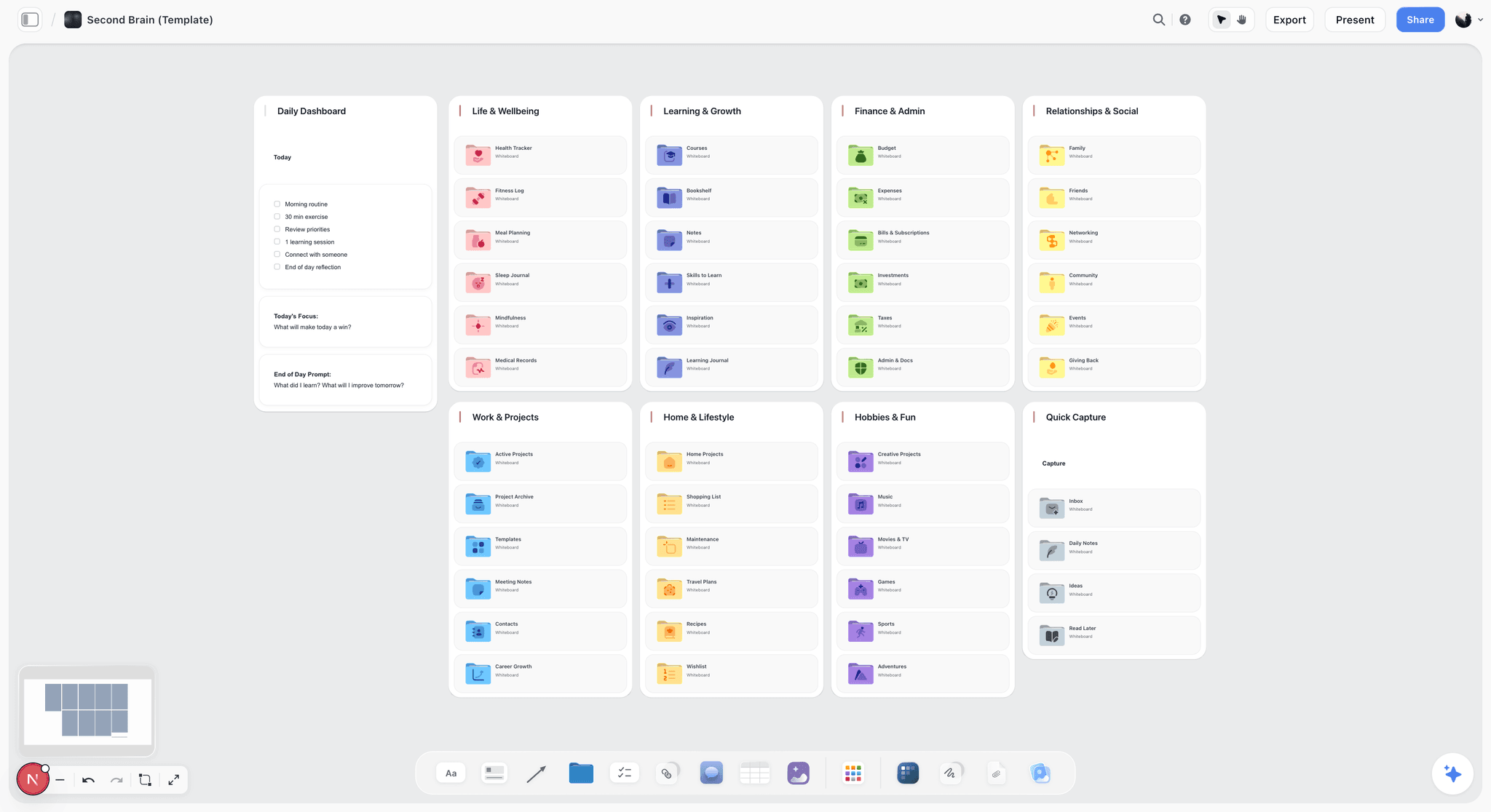
The verdict. The only tool here that treats an old board as something you can question rather than something you have to reread.
Best for. Creative directors running several concurrent projects who keep losing good work to the archive.
Pricing. Paid only early access today. Plus is $7.99 per month billed annually or $9.99 monthly, and adds 200 plus Blueprint Tactics and unlimited file uploads. Pro is $14 per month billed annually or $19 monthly, and adds AI image generation, roughly twenty times more AI usage, and memory across conversations. Max is $39 per month billed annually or $49 monthly, and adds the Team Workspace with permissions and roles. Pricing is flat per account rather than per seat, and anyone a paid member invites joins free. The Free plan launches before the end of 2026.
Why it ranks here. The differentiator is the AI context scope, and it is worth being precise about what that means, because every tool on this list now claims AI. Storyflow's AI reads your full active canvas board by default, plus up to one Tactic and up to three Documents you @-mention in the chat. Most competitors scope AI to a selection, a frame, or the current page.
That difference is invisible during generation and decisive during resurrection. On a board holding a whole pitch, including four routes, the references behind each, and the reasoning that killed three of them, you can ask a question about the argument and get an answer grounded in the whole surface. On a tool that reads a selection, you get a summary of whatever you happened to highlight, which requires you to already know where the answer is. That is the exact thing you have forgotten.
The second thing that matters here is that killed work stays on the canvas. A route that lost does not need to be deleted to get out of the way, because spatial arrangement lets it sit in a "killed" region of the board with the reasoning beside it. Folder based tools force a choice between clutter and deletion.
The Blueprint Tactics library also gives a creative director a structured start on the parts of the job that are genuinely repetitive: brand strategy frames, campaign structures, character and world work.
Strengths.
- Canvas wide AI context, so the whole board is queryable rather than one fragment.
- Killed routes stay adjacent to live ones with the reasoning attached.
- Flat per account pricing, and invited collaborators join free.
- Handles images, documents and text on the same surface as first class objects.
- Blueprint Tactics give repeatable structure to recurring brief types.
Limitations.
- Not a design tool. You cannot produce finished artwork in it, and you should not try. Figma and Adobe own that.
- No digital asset manager. If you need rights management, versioning and metadata on thousands of assets, this is the wrong category of product entirely.
- The client facing pitch deck is better built in Canva or Figma Slides. Storyflow's presentation output is not its strength.
- Newer platform, so the template ecosystem is much smaller than Miro's.
- No dot voting, no timer, no breakout rooms for live facilitation.
- Memory across conversations requires Pro or Max.
The trade off. Storyflow wins on what happens to ideas after the room empties. For the room itself, Miro is better, and for the artwork, Figma is not close.
2. Are.na
The verdict. The most quietly useful tool a creative director can own, and almost nobody in advertising has heard of it.
Best for. The long horizon reference collection that outlives individual projects.
Pricing. Free tier with a monthly block limit. Premium is roughly $7 per month or $60 to $70 per year as of August 2026.
Why it ranks here. Are.na is built on a single idea that happens to be exactly right for the resurrection job: a piece of content can live in many channels at once. A film still can sit in "brutalist interiors", "cold light" and "1970s paranoia" simultaneously, without being copied. That is a graph rather than a folder tree, and a graph is the correct shape for creative reference.
It is also calm. No algorithmic feed, no engagement mechanics, no advertising. Creative directors who burn out on Pinterest tend to end up here.
It ranks second rather than first because it does one job. There is no live session capability, no project management, no client facing surface, and no AI worth mentioning. Retrieval is by channel and by browsing, which is far better than folders and still worse than asking a question.
Strengths.
- Many to many organization: one item, many contexts, no duplication.
- Genuinely cheap.
- Calm, distraction free, and pleasant over long periods.
- Public channels are a real research resource in themselves.
Limitations.
- No live collaboration or facilitation features.
- No AI retrieval, so finding things still relies on your own structure.
- Not suitable as a client facing surface.
- Deliberately minimal, which some teams read as unfinished.
The trade off. Pair it with something. Are.na is the graveyard, not the studio.
3. Milanote
The verdict. The nicest place to develop a single project, and the reason many creative directors never look for anything else.
Best for. One campaign, one film, one brand identity, developed visually over weeks.
Pricing. Free tier limited to 100 notes, images or links. Paid is roughly $12.50 per month billed annually or $14.99 monthly as of August 2026.
Why it ranks here. Milanote understands creative work in a way that generic canvas tools do not. The board feels like a wall. Images, notes, links and files sit together without ceremony, the visual defaults are tasteful, and it gets out of the way. For visual development on a single project it is close to ideal, and its export to a shareable board is clean enough to put in front of a client.
Where it falls down for a creative director specifically is the plural. Milanote is excellent at one board and unremarkable at forty. Cross project retrieval relies on search and your own naming discipline, and the AI story is thin. It serves generate and kill well, and resurrect barely at all.
Strengths.
- Best in class feel for visual development work.
- Low friction capture from web, mobile and desktop.
- Client shareable boards look professional without effort.
- Sensible templates for creative briefs, moodboards and storyboards.
Limitations.
- Weak across a large archive of past projects.
- The 100 item free tier is quickly exhausted by a single real project.
- Thin AI capability compared to newer tools.
- Per user pricing.
The trade off. If you run one big project at a time, Milanote may genuinely be the right answer and you can stop reading.
4. Miro
The verdict. The best room. Still the wrong archive.
Best for. Running the live ideation session, particularly with a large or mixed group.
Pricing. Free tier with a board limit. Paid tiers start around $8 per member per month and rise to roughly $16 per member per month for Business, as of August 2026.
Why it ranks here. For the generate job, Miro is the strongest product on this list. Timers, private mode so the group does not anchor on the loudest voice, dot voting, clustering tools, and a template library covering essentially every ideation format that has a name.
Its weakness for creative directors is the same weakness it has everywhere: board sprawl. Sixty boards in, finding the one containing a specific killed route is a genuine problem, and Miro's cross board search has never been its strength. Per member pricing also punishes bringing in the account team and the client for a session.
Strengths.
- Deepest live facilitation feature set available.
- Enormous template ecosystem including community formats.
- Reliable at large board sizes and large group sizes.
- Strong integrations with the rest of the stack.
Limitations.
- Board sprawl makes long term retrieval poor.
- Per member pricing.
- Visually generic, which matters more to creative teams than to product teams.
- The free tier's board cap becomes a problem quickly.
The trade off. Use it for sessions. Do not expect it to be your memory.
5. Mural
The verdict. Miro with opinions. Better when the brainstorm needs a method.
Best for. Structured ideation formats: crazy eights, how might we, affinity mapping, forced connections.
Pricing. Free tier available. Paid plans start around $12 per member per month as of August 2026.
Why it ranks here. Mural's guided methods are genuinely better designed than generic template galleries, and for a creative director running a workshop for a client, that structure is worth money. Facilitation superpowers like summon and private mode are well implemented.
It serves the kill job slightly better than Miro because framework based boards carry legible reasoning by construction. It serves resurrect no better.
Strengths.
- Strongest structured ideation methods on this list.
- Facilitation controls that work without feeling heavy handed.
- Boards remain interpretable to people who were not present.
Limitations.
- Per member pricing.
- Less flexible than Miro for improvised formats.
- Same archival weakness as every canvas tool here.
The trade off. Method first teams should prefer it to Miro. Improvisers should not.
6. FigJam
The verdict. The fastest session tool, and free enough to be the default for small teams.
Best for. Quick ideation with a design led group of six to twelve.
Pricing. Generous free tier. Paid collaboration is roughly $3 to $5 per editor per month as of August 2026, with viewers typically free.
Why it ranks here. FigJam removes friction better than anything else here. It opens instantly, everyone in a design team already has an account, and moving from a FigJam idea into a Figma file is a two second operation rather than a migration.
For a creative director whose team lives in Figma, that adjacency is worth more than any feature on this list. Outside that context, it is a lighter Miro with a weaker archive story.
Strengths.
- Lowest possible friction for a design team.
- Free viewer access makes stakeholder participation easy.
- Direct path from ideation to production artwork.
Limitations.
- Thin facilitation features relative to Miro and Mural.
- No meaningful archive or retrieval story.
- Non designers can feel like visitors in it.
The trade off. If your team is in Figma, this is the default and it is fine.
7. Figma
The verdict. Not a brainstorming tool. On this list because the route has to become artwork, and this is where that happens.
Best for. Turning the approved direction into something real.
Pricing. Free starter tier. Paid seats start around $16 per full seat per month as of August 2026, with viewer and dev seats priced separately.
Why it ranks here. A creative director's brainstorm output is worthless until somebody makes the thing. Figma is where the thing gets made, and its inclusion here is about the handoff rather than the ideation. Figma Slides has also quietly become a strong pitch surface for design led teams.
It serves none of the three jobs directly, which is why it sits seventh rather than higher.
Strengths.
- Industry standard for design production.
- Figma Slides is a credible client pitch surface.
- Version history is real and reliable, which no canvas tool here matches.
Limitations.
- Wrong shape for divergent thinking.
- Seat pricing is meaningful at team scale.
- Non designers participate awkwardly.
The trade off. Essential to the stack. Not the brainstorm.
8. Pinterest
The verdict. Unmatched for sourcing, actively hostile to keeping.
Best for. Fast visual reference discovery, and sharing a rough direction with a client who does not use design tools.
Pricing. Free.
Why it ranks here. Nothing finds a visual reference faster, and clients understand it without explanation. For the first hour of a look exploration it is genuinely excellent.
The problem is that Pinterest is an advertising business, and its incentives are not your incentives. Boards drift toward what the algorithm rewards, sourcing is often lost, and rights information is essentially absent. It is a discovery layer, and treating it as an archive is how creative departments end up with a beautiful board of images they cannot license or attribute.
Strengths.
- Fastest visual discovery available.
- Universally understood by clients.
- Free.
Limitations.
- Algorithmic feed pulls boards off brief.
- Source and rights information is unreliable.
- No reasoning capture at all.
- You do not own the surface.
The trade off. Source in it, store elsewhere, and always capture the original source URL yourself.
9. Notion
The verdict. The decision record. Weak canvas, strong memory of what was agreed.
Best for. The brief, the decision log, and the project database behind the visual work.
Pricing. Free personal tier. Paid plans start around $10 per user per month as of August 2026.
Why it ranks here. Notion serves the kill job better than any canvas tool, because a database row can hold the route, the date, the decision and the reasoning in a structure that survives. A "killed routes" database with a theme property is the cheapest partial solution to the resurrection problem available, and I would recommend it to any creative director not ready to change their main tool.
It is ninth because visual thinking dies in it. A creative direction argument that exists only as prose has already lost something.
Strengths.
- Databases with properties make killed work genuinely filterable.
- Everyone already has it.
- Strong for the written brief and the decision log.
Limitations.
- Not a visual thinking surface in any real sense.
- Requires tagging discipline that most creative teams do not sustain.
- Per user pricing.
The trade off. Excellent as the record. Poor as the room.
10. Whimsical
The verdict. The best tool for structuring the argument behind a route, rather than the route itself.
Best for. Making the logic of a creative decision visible and defensible.
Pricing. Free tier with an item limit. Paid plans start around $10 per editor per month as of August 2026.
Why it ranks here. Whimsical is fast, opinionated and clean, and it excels at a narrow thing creative directors need more than they realize: turning "this route is better" into a visible structure that an account director can carry into a client meeting without you.
It is not a moodboard tool and does not pretend to be. Image handling is basic.
Strengths.
- Very fast to produce clean, legible structure.
- Excellent for decision logic and flow.
- Low learning curve for non designers.
Limitations.
- Weak visual and image capability.
- Not suitable as the main creative surface.
- Item limits on the free tier bite quickly.
The trade off. A specialist. Worth owning, not worth centering.
11. Canva
The verdict. The version the client actually opens.
Best for. Turning the internal board into an external deck.
Pricing. Free tier available. Pro is roughly $15 per month for one person as of August 2026.
Why it ranks here. Creative directors lose more work to a badly presented good idea than to a well presented bad one. Canva is where the internal thinking becomes something a marketing director will read on a phone between meetings. Brand kits keep it consistent, and everybody can already use it.
It is last because it serves none of the three jobs. It is the packaging layer.
Strengths.
- Fastest route from board to presentable deck.
- Brand kits enforce consistency without designer time.
- Universal familiarity.
Limitations.
- Encourages polish before the thinking is finished.
- Weak as a working surface.
- Template aesthetics leak into work that should look bespoke.
The trade off. Keep it at the end of the process, never at the start.
What to Actually Pay For
Pay for retrieval, not for generation. Generation is solved. Any canvas plus a timer plus a facilitator will get you volume. Nothing on the market except full canvas AI meaningfully improves your ability to find the right dead idea, and that is the job that compounds across a career.
Pay for the graveyard separately if you have to. Are.na at roughly $7 a month is the highest return per dollar on this page. Even if your studio standardizes on Miro, a personal Are.na account is a rational private investment for a creative director.
Do not pay for a second live session tool. If you have Miro, you do not need Mural, and vice versa. Teams commonly hold both because two people each championed one, and the split archive is worse than either tool alone.
Tools to Avoid for This Job
Slack as an idea store. Chronological, unsearchable in practice, and image previews expire from memory faster than the ideas do.
A shared drive of folders named by client. This is the wrong axis, as described above. Briefs arrive by theme, and your archive is sorted by client.
Any tool where killed work must be deleted to reduce clutter. If the interface forces you to choose between a clean board and a preserved alternative, you will choose clean, and you will regret it in eighteen months.
Screenshots in a phone camera roll. The most common creative director archive in the world, and the least retrievable.
What No Tool on This List Does
None of them will tell you which idea is good. The kill decision is judgment, and the tools only record it.
None of them will fix a brief that has not been interrogated. A brainstorm against a vague brief produces volume and no direction, and the tool will faithfully store the confusion.
None of them, including Storyflow, will maintain your archive if you never put the reasoning in. Canvas wide AI can answer questions about what is on the board. It cannot answer questions about what you were thinking and did not write down. Thirty seconds of "killed because the founder story is not actually differentiated" is the entire difference between a searchable archive and a pile.
The Bottom Line
Creative direction is inventory management with taste. You are holding more live and dead ideas than working memory can carry, across more projects than any single board covers, and the job pays off when the right dead idea arrives at the right brief.
Buy Miro for the room if your sessions are large or unruly. Buy Milanote if you develop one project at a time and want the nicest surface to do it on. Buy Are.na regardless, because it is seven dollars and it is the correct shape for reference.
But if what keeps happening is that you know you have solved this problem before and you cannot produce the evidence, the missing capability is retrieval by meaning across a whole board, and that is the narrow ground on which Storyflow ranks first here.
FAQ: Brainstorming Tools for Creative Directors
What is the best brainstorming tool for a creative director?
Storyflow is the best overall choice for creative directors in 2026, because the distinctive creative director problem is retrieving a killed idea months later, and Storyflow's AI reads the full active canvas rather than a selected fragment, which means an old board can be questioned rather than reread. Miro remains the better tool for running the live session, with deeper facilitation features including timers, private mode and dot voting. Are.na is the best dedicated long term reference collection and costs roughly $7 per month.
What is the best free brainstorming tool for creative work?
FigJam has the strongest free tier for real collaborative sessions, particularly if your team already uses Figma, since viewer access is typically free. Are.na's free tier is excellent for personal reference collecting within its monthly block limit. Pinterest is free and unmatched for fast visual discovery, though it is a discovery layer rather than an archive and its rights information is unreliable.
How do creative directors organize reference material?
The common failure is organizing by project, because briefs arrive by theme and projects are the wrong retrieval axis. The strongest approaches use many to many organization, where one reference can sit in several thematic contexts without being duplicated, which is exactly what Are.na is built around. The alternative is a tool whose AI can read a whole board, so retrieval works by describing the idea rather than remembering where you filed it.
Miro or Milanote for creative direction?
Choose Milanote if your work is visual development on one project at a time, because it feels like a wall rather than a diagramming surface and its defaults are tasteful. Choose Miro if you run live sessions with groups, because its facilitation feature set is far deeper. Neither solves cross project retrieval well, so most creative directors end up pairing one of them with something else.
Is Are.na worth paying for?
For a creative director, yes, and it is the cheapest genuinely useful subscription on this list at roughly $7 per month. Its value is the connection model: a single image can live in many channels at once, so your archive is organized the way creative reference actually behaves rather than as a folder tree. The free tier's block limit is the main reason to upgrade.
How do I stop reinventing ideas we already had?
Attach the reason for the kill to the work at the moment you kill it, in one sentence, and store killed work on the same surface as live work rather than deleting it. Then choose a retrieval mechanism that does not depend on you remembering the project, which in practice means either a thematic many to many structure like Are.na or a tool with whole canvas AI retrieval. The reasoning capture matters more than the tool choice.
Does Storyflow replace Figma for creative directors?
No. Storyflow is not a design tool and cannot produce finished artwork, and Figma's version history and production capabilities are in a different category. Storyflow sits earlier in the process, holding the routes, references and reasoning before anything is designed, and later in the process, as the queryable archive of what was tried. The handoff between them is a normal part of the stack.
What is the best tool for presenting a creative route to a client?
Canva for speed and universal familiarity, or Figma Slides if your team is design led and wants tighter control. The important thing is that the presentation surface is separate from the working surface, because polish applied too early narrows the thinking. Build the argument on a canvas and package it afterward.
How many brainstorming tools should a creative department have?
Three at most: one live session tool, one working canvas, and one archive. Departments commonly end up with five because different leads championed different products, and the resulting split archive is worse than any single tool would have been. If you hold both Miro and Mural, pick one.
What is the difference between a moodboard tool and a brainstorming tool?
A moodboard tool is optimized for arranging visual references toward a single coherent direction. A brainstorming tool is optimized for producing and comparing many directions, most of which will be discarded. The distinction matters because moodboard tools tend to encourage premature coherence, which is the wrong mode when you still need volume.
How do I run a brainstorm that produces usable output?
Separate the three jobs in time and say so out loud. Generate with judgment explicitly suspended and a timer running. Kill in a separate pass, with one sentence of reasoning per discarded route, written by the person who killed it. Then, before anyone leaves, name the surviving routes in language a person outside the room would understand, because unnamed routes do not survive the week.
Do AI tools actually help with creative ideation?
For generation, marginally, and mostly by breaking a stuck room rather than by producing usable directions. Where AI genuinely changes the job is retrieval and synthesis: asking a board of two hundred fragments what argument it is making is work a human does badly and slowly. Check the context scope before trusting any AI summary, because most tools read a selection rather than the whole surface.
How long should a creative director keep killed work?
Indefinitely, if the reasoning is attached, because the value of a killed route rises as time passes and the market moves. Killed work with no reasoning attached should be discarded, since it cannot be evaluated later and only adds noise to retrieval.
What is the single change worth making this quarter?
Add one sentence of reasoning at the moment you kill a route, every time, for one quarter. It takes thirty seconds, it requires no new software, and it converts an archive that cannot be searched into one that can.
Table of Contents
- Key Takeaways
- The Three Jobs, and the One Nobody Builds For
- At a Glance: The 11 Tools Compared
- How I Ranked These
- Quick Picks by Job Type
- 1. Storyflow
- 2. Are.na
- 3. Milanote
- 4. Miro
- 5. Mural
- 6. FigJam
- 7. Figma
- 8. Pinterest
- 9. Notion
- 10. Whimsical
- 11. Canva
- What to Actually Pay For
- Tools to Avoid for This Job
- What No Tool on This List Does
- The Bottom Line
- FAQ: Brainstorming Tools for Creative Directors
- Related Reading
Templates to check out for this topic


Mind mapping and ideation templates you can use in Storyflow
Map ideas in space, then ask the AI to restructure, expand, or connect them. Open any of these boards and start thinking visually instead of in lists.


See Storyflow in Action
A visual AI workspace where every feature lives inside one canvas. No tab-switching, no context lost.
Build your entire board from a single message
Type what you need in the AI chat at the bottom of your canvas. The AI adds cards, headings, and structure directly onto your board.
Use expert frameworks as AI context
Type @ in the AI chat and choose any Tactic. The AI tailors every response to that framework instead of giving generic advice.
Turn your board into a mind map in seconds
Ask the AI to restructure your canvas as a mindmap. It connects your ideas into a visual hierarchy so you can see how everything relates.
Why Storyflow Exists
Storyflow actually began as a personal tool while working on creative and research projects.
We kept running into the same problem: ideas were scattered everywhere: notes, documents, and whiteboards.
Nothing helped us see how everything connected.
So we started building a workspace designed around how ideas actually grow.
→ Read how Storyflow was createdSara de Klein
Head of Product at Storyflow
Published: 2026-08-10
Extremely simple, seriously capable


See how easy it is to get started
Watch a real project come together, from a blank board to a finished plan, clicked through step by step.
Start creating with AI and become more productive
Transform your creative workflow with AI-powered tools. Generate ideas, create content, and boost your productivity in minutes instead of hours.