
How to Use the AIDA Framework with AI (2026 Guide)
The AIDA framework tells you what to write. It does not tell you where you are losing people. A practitioner's guide to using AIDA as a diagnostic, with an AI-assisted workflow and a real worked example.

Category
Marketing Frameworks
Author

Sara de Klein
Head of Product at Storyflow
Topics
2026-07-04
•
Updated July 4, 2026
•
12 min read
•
Marketing Frameworks- AIDA framework
- how to use AIDA
- AIDA model marketing
- AIDA copywriting
- AIDA with AI
- Attention Interest Desire Action
What is the AIDA framework and how do you use it with AI?
AIDA stands for Attention, Interest, Desire, Action, a four-stage model of how a stranger becomes a buyer. In 2026 the best use is as a diagnostic: label each line of copy by stage to find where readers drop, then use AI to draft each stage separately and a canvas to spot the imbalance. Pair it with a retention loop, since AIDA stops at the sale.
Run AIDA as a diagnostic on your own copy
Lay the four stages as columns on a Storyflow board, drop your copy in, and let the AI tell you which stage is thinnest.

1) What the AIDA framework actually is
AIDA is a four-stage model of how a stranger becomes a buyer: Attention, Interest, Desire, Action. Advertiser E. St. Elmo Lewis sketched the first version around 1898, teaching sellers to "attract attention, maintain interest, create desire." The fourth stage, Action, was added soon after, and Edward K. Strong Jr. cemented the four-part model in his 1925 book on selling and advertising. It has outlasted almost every marketing model invented since because it maps a real sequence: nobody desires a product they have not noticed.
I have used AIDA on landing pages, cold emails, ad scripts, and full campaigns. The mistake almost everyone makes is treating it as a writing template, a mold you pour words into top to bottom. That is the least useful way to hold it. AIDA earns its keep as a diagnostic. The framework tells you what to write. It does not tell you where you are losing people. Run it as a diagnostic, not a script.
A page can nail Attention with a scroll-stopping headline and still convert at nothing because Desire never got built. Another page can have gorgeous Desire copy that no one reaches because the first line was forgettable. Same framework, opposite failures. If you only know AIDA as an acronym, you cannot tell those two pages apart. If you know it as a diagnostic, the fix is obvious in about ninety seconds.
2) Why AIDA still works in 2026 (and the one thing it misses)
The recurring question online is some version of "is AIDA outdated?" The honest answer: the sequence is not outdated, but the assumption behind it is showing its age.
AIDA assumes a linear path from cold to sold in one sitting. In practice, only about 4% of website visitors are ready to buy on their first visit, which means 96% need nurturing across multiple touchpoints before Action makes sense (Semrush, 2025). So the modern use of AIDA is not "walk someone through all four stages on one page." It is "know which stage this specific asset is responsible for, and measure whether it does its one job."
The real gap is on the other end. AIDA stops at Action. It has nothing to say about what happens after the purchase: onboarding, retention, referral, the second sale. In a subscription economy where the first sale is often sold at a loss, ending your model at Action is a strategic blind spot. The fix is not to abandon AIDA. It is to bolt a retention loop onto the end of it, which I cover in section 11.
There is a second thing modern channels changed. Lewis wrote for a world where a salesperson controlled the whole sequence in one conversation. Today the four stages are almost never delivered by the same asset. A paid ad handles Attention. The landing page it clicks to handles Interest and Desire. A follow-up email sequence often handles Action days later. That fragmentation is not a reason to drop AIDA. It is the reason to hold it as a diagnostic: when the stages live in different assets, you need a way to ask which asset owns which stage, and whether the handoff between them leaks. A visitor who felt Desire on the landing page and then got a generic "thanks for signing up" email lost the thread between two stages that no single-asset read would catch. AIDA in 2026 is less a template for one page and more a map of where a prospect's momentum can stall across a whole sequence.
3) The four stages and the job each one does
Each stage has exactly one job. If you cannot name the job, you cannot tell whether the copy did it.
Attention
The job: earn the next three seconds. Attention is not the headline being clever, it is the reader deciding not to leave. This is the highest-leverage stage because everything downstream depends on it and nothing recovers it. Specificity and tension beat cleverness. "Cut your close rate guesswork" earns more attention than "Revolutionize your sales." Attention is rented, never owned. You re-earn it at every scroll break, subject line, and thumbnail.
Interest
The job: make it about them, fast. Interest is where you prove you understand the reader's situation better than they expected. The failure mode is talking about yourself. The reader gave you attention on the promise that the next line is relevant to their problem. Interest keeps that promise with a concrete detail: the exact frustration, the specific stakes, the moment the problem bites.
Desire
The job: move from "this is relevant" to "I want this outcome." Desire is built with proof, mechanism, and contrast, not adjectives. Show the after-state, show why it works, show what it replaces. This is the stage most copy skips, jumping straight from Interest to a buy button. Desire is where objections get answered before they are spoken.
Action
The job: remove friction from the one next step. Action fails when the ask is vague, heavy, or premature. "Get started" is vague. "Book a 45-minute demo" is heavy for a cold reader. The strongest Action copy names one specific, low-friction step and tells the reader exactly what happens after they take it.
Here is the four-stage test on one line of a real product page. The original read: "Meet the smartest sales platform for modern teams." Run the labels. That headline is trying to do Attention and Desire at once and lands neither. "Smartest" and "modern" are self-praise, so there is no Attention hook (no tension, no specific detail) and no Desire (no outcome, no proof). Now rewrite each stage with its one job in mind. Attention: "Your best reps close in 3 calls. Your average reps take 9." Interest: "The gap is not talent. It is that nobody can see which calls actually move a deal." Desire: "Teams using this cut average deal cycles by naming the two moments that predict a close." Action: "Upload one recorded call and see the two moments in it, free, in under two minutes." Same product, four jobs, four sentences, each one measurable. That is the difference between AIDA as decoration and AIDA as a working diagnostic.
4) Run AIDA as a diagnostic, not a script
Here is the workflow that changed how I use AIDA. Take any piece of copy you already have. Label each sentence with the stage it serves: A, I, D, or Action. Then look at the shape of the labels.
- All A, no D: you are great at getting clicks and terrible at converting them. Your traffic is not the problem. Your Desire copy is missing.
- Straight from A to Action: you asked for the sale before you earned it. Add Interest and Desire in the middle.
- Long I, thin D: you described the problem beautifully and never made anyone want the solution. Rebalance.
- No clear A: your best copy is buried below a weak opening that almost no one reads past.
This turns a vague feeling ("the page is underperforming") into a located problem ("Desire is missing between paragraphs three and four"). A diagnostic that points at a specific stage is worth ten generic "make it more compelling" notes. The point of AIDA in 2026 is not to generate copy. It is to tell you where the copy leaks.
5) How to use AIDA with AI, stage by stage
AI is genuinely good at AIDA work, but only if you stop asking it to "write me an AIDA landing page" in one shot. That produces a generic four-paragraph block that reads like every other AI landing page. Work the stages separately.
- Feed context first. Give the AI the product, the audience, the one outcome the reader wants, and two real objections. Without this, every stage comes out generic. A usable context prompt looks like: "Product: a call-analysis tool for B2B sales teams. Audience: sales managers at 20 to 100 person companies. The one outcome they want: shorter deal cycles without hiring more reps. Two real objections: they already own a CRM and think this overlaps, and they doubt any tool can read a call as well as a human. Hold all of this for every stage I ask about next." Everything downstream inherits that brief.
- Generate Attention options in bulk. Ask for fifteen headline angles, each built on a different tension or specific detail, and tell the AI to vary the mechanism: some built on a surprising number, some on a named enemy, some on a before/after contrast. Attention is a numbers game. You want range, then you cut to the three that feel specific rather than clever. If ten of the fifteen sound interchangeable, your context brief was too thin, so go back to step one.
- Write Interest against a real frustration. Prompt the AI with the exact problem in the reader's own words. The best Interest copy borrows the customer's language, so paste in a real review, a real support ticket, or a line from a sales call transcript, and instruct: "Rewrite the Interest paragraph using the phrasing in this quote, not marketing phrasing." The difference between "streamline your sales workflow" and "you spend Friday afternoons guessing which deals will actually close" is the difference between Interest that lands and Interest that slides off.
- Build Desire with proof and mechanism. Ask the AI to name the after-state, the reason it works, and what it replaces, in that order. Then you add the real proof: the number, the case, the screenshot. AI drafts the structure. You supply the evidence. This is the step where AI is most dangerous, because it will invent a statistic that sounds plausible and fits the sentence perfectly. Treat every number it produces as a placeholder you must replace with a real one or delete.
- Make Action singular. Ask for three versions of one low-friction next step, then pick the lightest one that still qualifies the reader. Add the instruction "each version must name what happens immediately after the click," because a next step with a known outcome converts better than one that leaves the reader guessing.
The judgment stays yours. The AI compresses the hours. It will happily write confident Desire copy with zero evidence behind it, so every claim the AI generates is a claim you have to verify before it ships. The workflow above is not "let AI write your funnel." It is "let AI draft four separate jobs so you can spend your attention on the two that actually decide the sale, Attention and Desire."
6) A full worked example: fixing a leaking landing page
Diagnostics are easier to trust when you watch one run start to finish. Here is a real-shaped example on a landing page for a fictional but typical product: a scheduling tool for freelance photographers. The page converted visitors to trial at a rate the founder described as "traffic is fine, signups are not." That sentence is the tell. High traffic plus low signups almost always means the leak is late, in Desire or Action, not early in Attention.
Step one, label the copy. The page had six blocks. Labeled by stage, the shape was: headline (Attention), subhead (Interest), a three-icon feature row (Interest, all three), a testimonial (Desire), and a "Start free trial" button (Action). Read the labels and the leak is visible before you read a single word of the actual copy. Four blocks of Attention and Interest, one thin block of Desire, then straight to the ask. This is the most common AIDA leak there is: the page describes the problem four ways and never makes anyone want the solution.
Step two, confirm the leak by reading the Desire block. The single testimonial said "Great app, saves me time." That is not Desire. It has no mechanism (why it saves time), no contrast (what it replaces), and no specific after-state (how much time, doing what). A reader who reached it learned nothing they would want. Desire was not weak. It was effectively absent.
Step three, rebuild the missing stage with the AI workflow above. Feed context (product, audience of solo photographers, the outcome they want which is fewer no-show shoots, two objections which are "I already use a calendar" and "clients will not adopt a new tool"). Then generate Desire specifically, asking for after-state, mechanism, and contrast. The rebuilt Desire block read: "Photographers on the tool cut no-show shoots because clients confirm and pay a deposit in the same two-tap flow, so a booking is not real until money moves. That replaces the back-and-forth of calendar invites nobody honors." After-state, mechanism, contrast, all three present.
Step four, fix the handoff to Action. The old button said "Start free trial," which asks the reader to imagine the work of setting up. The rewrite named the first concrete step and its payoff: "Connect your calendar and send your first deposit link in about five minutes." Same trial, lighter first step, known outcome.
Step five, re-label the rebuilt page and check the shape. Now the labels read Attention, Interest, Interest, Desire (rebuilt and heavier), Action (specific). The imbalance is gone. Notice what this process did not require: a redesign, a new headline, or more traffic. It required finding the one stage that leaked and rebuilding only that stage. That is the entire value of running AIDA as a diagnostic instead of a script. You stop rewriting the whole page on a hunch and start fixing the one block that was actually costing you conversions.
7) AIDA on a canvas: one board, four columns
Working AIDA as a diagnostic is hard in a document because a document forces a single top-to-bottom order, which is exactly the linear assumption that gets AIDA misused. A canvas fixes this. Four columns, one per stage, cards for each line of copy. You can see at a glance that your Desire column has two cards and your Attention column has nine, which is the imbalance no document would show you.
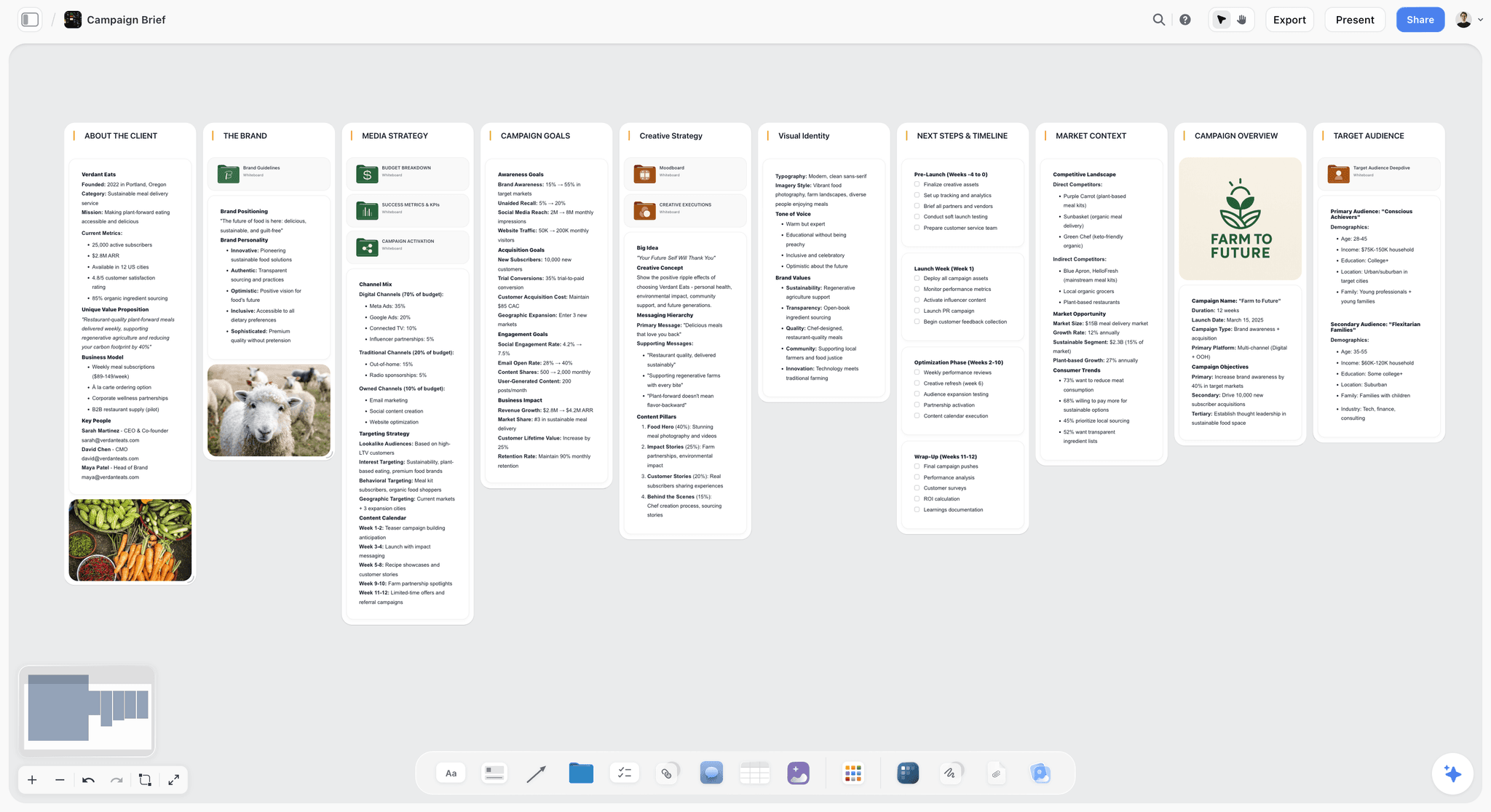
The familiar approach is to keep the copy in a Google Doc and the AIDA logic in your head. That works until the doc grows past a screen, at which point you lose the one thing the diagnostic depends on: the ability to see all four stages at once and compare their weight. This is the specific friction Storyflow removes. You lay the four stages as columns on one board, drop a card for each line of copy into the column it serves, and the AI reads the whole active board before it responds. When you ask it "which stage is thinnest here," it answers against the actual cards on the canvas, not a generic template, because its context is the full board in front of you. That is the concrete feature, not a vague "AI-powered" claim: the AI's window is the whole active canvas plus up to 3 Documents and 1 Blueprint you @-mention, so it reasons about your real copy rather than a stock funnel.
Storyflow ships an AIDA layout inside its Story Blueprints library (200+ expert frameworks, including AIDA, StoryBrand, and the Hero's Journey), so you start from the four-column structure instead of building it. The library lives on the Plus plan and above. On the Free plan you get 3 starter framework tactics plus the trial of Storyflow AI (up to 10 generations), which is enough to run one page through the diagnostic and decide whether the workflow fits how you think.
Three honest limitations before you switch tools for this. First, if you write in long-form documents and think in paragraphs, a canvas will feel foreign at first, and a plain doc plus a disciplined manual read will get you most of the way. Second, Storyflow is cloud-first, so if you need an offline-owned local file with no account, this is the wrong tool and a plain document beats it. Third, it is a newer platform shaped around cards on a canvas, not the document-shaped surface some marketers have used for fifteen years, so the muscle memory takes a week. The canvas pays off when you are diagnosing why copy leaks across stages and when the four stages live in different assets you need to see side by side. It pays off least when you are drafting a single cold email in one sitting.
8) AIDA vs the marketing funnel vs PAS
These three get confused constantly, so here is the clean separation.
The marketing funnel is AIDA zoomed out to a whole audience; the two share the same DNA because the funnel descends directly from Lewis's model. PAS is a sibling formula, popularized by direct-response writer Dan Kennedy, that front-loads the problem instead of the attention grab. Use AIDA to diagnose an asset, the funnel to plan a campaign, and PAS when the audience already feels the pain and you want to press on it. They are not competitors; they operate at different altitudes.
A quick way to pick between AIDA and PAS on any given piece: ask how aware the reader already is of the problem. If they do not yet feel a problem, AIDA is safer, because its Attention stage earns the read before it names any pain. If the reader lands already frustrated (a "why does my email keep bouncing" search, a churned customer, a support ticket), PAS is sharper, because it presses the pain they arrived with instead of warming them up. The mistake is loyalty to one formula. Match the framework to the reader's awareness level and you will out-convert a writer who reaches for the same structure every time.
9) The five most common AIDA mistakes
- Treating it as a template, not a diagnostic. Covered above, and it is the root of the other four.
- Front-loading features in Desire. Features are Interest at best. Desire is about the outcome the feature produces, not the feature.
- A vague Action. "Learn more" asks the reader to do the work of deciding what happens next. Name the step and the payoff.
- Skipping Desire entirely. The most common leak. Copy jumps from an interesting problem straight to a button, and the reader who was curious never became a wanter.
- Ending at Action. No plan for the next email, the onboarding, the reason to come back. See the retention loop below.
A sixth mistake deserves its own line because it hides behind good intentions: balancing the stages equally. AIDA is not four blocks of equal size. On a cold ad, Attention might be 70% of the work and Desire a single line. On a warm retargeting page where the reader already knows you, Attention can be one word and Desire carries the whole page. Writers who give each stage the same wordcount are following the acronym, not the reader. The diagnostic is not "do I have all four stages," it is "does each stage get the weight this specific reader's awareness requires."
10) Where AIDA is the wrong tool
AIDA is built for persuasion of a person you are trying to move toward a decision. It is the wrong tool in three cases, and knowing this keeps you credible.
First, retention and loyalty. Once someone has bought, AIDA has nothing to offer. Reach for a loop model instead: a simple Retain, Expand, Refer cycle, or a hooks-and-habits frame for products that live on repeat use. The clean move is AIDA to the sale, a loop after it.
Second, complex B2B sales with a buying committee. When seven people have to agree over four months, a single persuasion sequence is too small a unit. Sales-qualification frameworks like MEDDIC map that terrain far better, which is why they exist alongside AIDA rather than replacing it.
Third, pure informational or educational content, where the goal is to teach, not to move someone to Action. Forcing AIDA onto a tutorial makes it read like an ad and erodes trust. If there is no decision at the end, there is no Action stage, and the model does not apply.
Knowing where a framework stops is what keeps you credible. A writer who runs AIDA on a buying-committee deal or a help-center article is applying the right tool to the wrong job, and the copy will feel off even if every stage is technically present.
11) Bolt a retention loop onto the end
This is the fix for AIDA's one real weakness. The classic model ends at Action and says nothing about the customer's life after they pay, which in a subscription business is where almost all the value lives. You do not solve this by stretching AIDA into a fifth stage. You solve it by attaching a separate loop that AIDA was never built to run.
The simplest version is a three-part cycle: Retain, Expand, Refer.
- Retain. The job is the second use, not the first purchase. What is the one action a new customer must take to feel the product work, and how fast can you get them to it? This is onboarding as a persuasion problem, not a checklist. AIDA got them to buy. Retention gets them to come back.
- Expand. Once the core habit holds, what is the natural next thing this customer needs? Expansion revenue is the cheapest revenue there is because the Attention and Interest stages are already paid for. You are selling to someone who already trusts you.
- Refer. A happy customer is your cheapest acquisition channel and the only one that compounds. The job here is to make referring feel like a favor to a friend, not a chore for you. This closes the loop: a referral becomes the Attention stage of a new AIDA sequence for the next stranger.
The clean mental model is a line that becomes a circle. AIDA is the line that runs from stranger to sale. The retention loop is the circle that keeps the customer, grows the account, and feeds the next stranger into the top of the line. Run AIDA to the sale, a loop after it, and you have a system that does not forget the customer the moment their card is charged. For products that live on daily use, a habit frame (trigger, action, reward, investment) can replace the loop, but the principle is identical: the model that ends at Action is only half a system.
12) The Bottom Line
AIDA has survived since 1898 because the sequence it describes is real: attention before interest, interest before desire, desire before action. What changed is how we use it. In 2026, AIDA is most valuable not as a mold you pour copy into but as a diagnostic you run against copy you already have, to find the exact stage where readers drop. Pair it with AI to compress the drafting, work the stages on a canvas so you can see the imbalance, and bolt a retention loop onto the end so you are not building a machine that forgets the customer the moment they pay. Do that, and a 128-year-old model still outperforms most of what replaced it.
If you want to run AIDA as a diagnostic on your own copy, open a Storyflow campaign board, lay the four stages as columns, and ask the AI which one is thinnest.
FAQ: AIDA Framework
Is the AIDA framework outdated in 2026?
No. The four-stage sequence still describes how strangers become buyers. What is outdated is treating AIDA as a linear path completed in one sitting. Only about 4% of visitors are ready to buy on a first visit, so modern use assigns each asset one stage to own and measures whether it does that job.
What does AIDA stand for?
AIDA stands for Attention, Interest, Desire, Action. Attention earns the next few seconds, Interest proves relevance to the reader's problem, Desire builds want with proof and mechanism, and Action removes friction from the next step. Each stage has exactly one job.
Who invented the AIDA model?
Advertiser E. St. Elmo Lewis outlined the first version around 1898, teaching sellers to attract attention, maintain interest, and create desire. The fourth stage, Action, followed shortly after, and Edward K. Strong Jr. formalized the full four-part model in his 1925 work on selling and advertising.
What is the difference between AIDA and the marketing funnel?
AIDA works at the level of a single asset: one page, email, or ad. The marketing funnel is the same sequence zoomed out to a whole audience moving from awareness to purchase across many touchpoints. Use AIDA to diagnose one piece of copy and the funnel to plan a campaign.
AIDA vs PAS: which converts better?
Neither wins universally. AIDA leads with an attention grab and is strong when the reader does not yet feel a problem. PAS (Problem, Agitate, Solution) leads with the pain and is strong when the audience already feels it. Match the framework to the reader's awareness, not to a preference.
Can AI write copy for each AIDA stage?
Yes, and it does the stages better one at a time than all at once. Feed the AI the product, audience, desired outcome, and real objections, then generate Attention options in bulk, write Interest against a real frustration, and build Desire with proof you supply. Asking for a whole AIDA page in one prompt produces generic copy.
How many stages does AIDA have?
Four: Attention, Interest, Desire, Action. Some extended versions add a fifth stage such as Retention or Satisfaction to cover what happens after the sale, since the original model stops at Action and says nothing about loyalty.
Does AIDA work for social media?
Yes, but usually across a sequence rather than one post. A thumbnail and first line handle Attention, the hook and body handle Interest and Desire, and the caption or link handles Action. On social, Attention carries more weight than anywhere else because the scroll is faster.
What comes after Action in AIDA?
Nothing, in the classic model, which is its main weakness. In practice you bolt a retention loop onto the end: onboarding, repeat use, and referral. A common frame is Retain, Expand, Refer, run as a cycle rather than a line, so the customer is not forgotten the moment they buy.
Is AIDA good for B2B sales?
For a single asset like a landing page or cold email, yes. For a complex deal with a buying committee deciding over months, AIDA is too small a unit and a sales-qualification framework such as MEDDIC maps the process better. Use AIDA for the copy, a qualification framework for the deal.
How do I use AIDA to fix an underperforming page?
Label every sentence with the stage it serves, then read the shape. All Attention and no Desire means you get clicks but no conversions. A jump straight from Attention to Action means you asked for the sale too early. The imbalance points to the exact stage to rewrite.
What is a good example of the AIDA framework?
A product page that opens with a specific, tension-filled headline (Attention), names the reader's exact frustration in the next line (Interest), shows the after-state with a real number and a case (Desire), then offers one low-friction next step and says what happens after (Action). The test is that each stage does its one job.
Table of Contents
- What the AIDA framework actually is
- Why AIDA still works in 2026 (and the one thing it misses)
- The four stages and the job each one does
- Run AIDA as a diagnostic, not a script
- How to use AIDA with AI, stage by stage
- A full worked example: fixing a leaking landing page
- AIDA on a canvas: one board, four columns
- AIDA vs the marketing funnel vs PAS
- The five most common AIDA mistakes
- Where AIDA is the wrong tool
- Bolt a retention loop onto the end
- The bottom line
Templates to check out for this topic


Templates you can use in Storyflow
Every Storyflow board starts from real structure and an AI that reads the whole canvas. Open one of these templates and make it yours.


See Storyflow in Action
A visual AI workspace where every feature lives inside one canvas. No tab-switching, no context lost.
Build your entire board from a single message
Type what you need in the AI chat at the bottom of your canvas. The AI adds cards, headings, and structure directly onto your board.
Use expert frameworks as AI context
Type @ in the AI chat and choose any Tactic. The AI tailors every response to that framework instead of giving generic advice.
Turn your board into a mind map in seconds
Ask the AI to restructure your canvas as a mindmap. It connects your ideas into a visual hierarchy so you can see how everything relates.
Why Storyflow Exists
Storyflow actually began as a personal tool while working on creative and research projects.
We kept running into the same problem: ideas were scattered everywhere: notes, documents, and whiteboards.
Nothing helped us see how everything connected.
So we started building a workspace designed around how ideas actually grow.
→ Read how Storyflow was createdSara de Klein
Head of Product at Storyflow
Published: 2026-07-04
Extremely simple, seriously capable


See how easy it is to get started
Watch a real project come together, from a blank board to a finished plan, clicked through step by step.
Start creating with AI and become more productive
Transform your creative workflow with AI-powered tools. Generate ideas, create content, and boost your productivity in minutes instead of hours.