How to Organize Research for a Book (2026 Step-by-Step Guide)
A working method for organizing book research so you can actually write from it. Capture, tag by chapter rather than subject, keep a source of record, and close the gap between the pile and the page.

Category
Writing
Author

Justkay
Documentary Filmmaker & Founder at Storyflow
Topics
2026-07-26
•
24 min read
•
Writing- how to organize research for a book
- organizing book research
- book research organization
- research notes for a book
- best tool to organize research for writing a book
- nonfiction research method
How do you organize research for a book?
To organize research for a book, capture everything into one inbox, then process each item by tagging it with where it will be used in the book rather than what it is about, keep a separate source of record with full citation details, and review the whole set against your outline before you draft. The tools most authors use are Scrivener or Ulysses for research that lives beside the manuscript, Zotero for citations, Obsidian or Notion for a searchable note library, and a visual canvas such as Storyflow or Milanote when you need to see the whole book's evidence laid out at once. The distinction that decides everything is this. Research organized by subject builds a library. Research organized by chapter builds a book. A library is a genuinely satisfying thing to make, and it is why an author can end up with four hundred immaculate notes and no draft. Every note is findable and none of them is doing any work, because "findable" is only useful if you already know what you are looking for, and at the moment of writing you usually do not. I have run research on documentary projects for years, where the same failure appears in a different costume: two hundred hours of interview transcripts, beautifully logged by topic, and no idea which of it earns a place in the film. The fix was never better tagging. It was deciding, earlier than felt comfortable, where each piece was going to land.

Full disclosure: Storyflow is our own product, so weigh its placement here with the skepticism you would apply to any tool a company recommends on its own blog. We deliberately do not rank it first: Scrivener owns book-length projects and Zotero owns citations, and Storyflow is neither a citation manager nor the place a manuscript gets written. It earns one specific job in this workflow, the pre-draft review where you need to see every chapter's evidence at once, and this piece is explicit about the rest.
Quick Comparison
Most authors use two or three of these together: a citation manager, a place notes live, and a place the manuscript gets written.
| Tool | Best For | AI Features | Price |
|---|---|---|---|
| Scrivener | Research beside the draft | None | One-time licence |
| Zotero | Citations and bibliography | None | Free |
| Storyflow | Evidence against the outline | Reads the whole board | $7.99 mo annual (free plan late 2026) |
| Obsidian | Linked local note library | Via plugins | Free for personal use |
Key Takeaways
- Organize by destination, not by subject. A note tagged "Chapter 4, the objection about cost" is usable. A note tagged "economics" is a library card.
- Separate capture from processing. Capture fast and messy into one inbox. Process on a schedule. Trying to file perfectly at capture time kills the capture habit.
- Keep one source of record. Full citation, page number, and a direct quote at capture time, because going back to find a page number eighteen months later is the most demoralizing work in publishing.
- Distinguish the three kinds of research note: evidence you will cite, context you need to understand but will not cite, and texture that makes scenes real. They have different lifespans and different homes.
- The outline is the filing system. You cannot organize by destination until a provisional structure exists, so write a rough outline early and expect it to change.
- Most research never appears in the book, and that is correct. The usual ratio is somewhere between five and ten to one. Collecting more than you use is the job, not a failure.
- Review the whole set before drafting. Laying the evidence out against the outline is where you find the chapter with no support and the chapter you over-researched.
- AI is useful for summarizing and gap-finding, and unreliable for facts. Never let a model be your source of record.
The Library and the Draft
There are two ways to organize research, and they optimize for opposite things.
The Library organizes by subject. Everything about the labor movement goes under "labor," everything about a person goes under their name. It is the intuitive system because it mirrors how libraries and encyclopedias work, and it optimizes for one question: *where do I put this?*
The Draft organizes by destination. Everything that will support the argument in chapter four goes with chapter four, regardless of subject. It optimizes for a different question: *what do I need in front of me to write the next two thousand words?*
The Library question is the one you face at capture time, hundreds of times. The Draft question is the one you face at writing time, and it is the one that actually blocks books. Which is why building only a Library feels productive right up until the day you sit down to write and discover your notes cannot tell you what to say.
| The Library | The Draft | |
|---|---|---|
Organized by | Subject | Where it lands in the book |
Optimizes for | Filing and retrieval by topic | Writing the next section |
The question it answers | Where do I put this? | What do I need in front of me now? |
Failure mode | Four hundred perfect notes, no draft | Rigid structure, evidence forced into place |
Best tools | Obsidian, Notion, Zotero, DEVONthink | Scrivener, a visual canvas, chapter folders |
The honest complication is that you need both, and in that order. Early on you genuinely do not know where anything goes, so you build a Library by necessity. The mistake is staying there. The moment you have a provisional outline, the filing system should change from subject to destination, and most authors never make that switch because nothing forces them to.
The Method, Step by Step
1. Set up one inbox, not five
Every piece of research enters through a single door: a note in one app, a folder, a physical tray for paper, whatever you will actually use. The requirement is singularity. Research scattered across browser bookmarks, three notes apps, camera-roll photographs of book pages, and email-to-self is not a research system, it is four systems that each contain a fifth of the answer.
Capture should be nearly frictionless. If capturing takes more than a few seconds, you will stop doing it while reading, which is exactly when the good material appears.
2. Capture the source of record at the same moment
This is the one piece of discipline that pays for itself repeatedly. At capture time, record: the full citation, the page or timestamp, and a verbatim quote of the passage that matters, marked clearly as a quote.
The reason is brutally practical. Eighteen months later, in copyedit, someone will ask for the page number of a claim on page 212, and if you did not capture it then, you will spend a full day of your life finding it. Authors who skip this step pay for it in a single miserable week near the end.
Distinguish, visibly, between a verbatim quote, a paraphrase, and your own thought. Notes that blur these three are how accidental plagiarism happens, and it happens to careful people who took a fast note at midnight and could not tell, a year later, whose sentence it was.
3. Write a provisional outline earlier than feels comfortable
You cannot file by destination without destinations. The outline does not need to be right, it needs to exist: a list of chapters with a one-line statement of what each one argues or covers.
Expect it to change substantially. That is fine, and refiling is cheap compared to drafting from an unusable pile.
4. Process the inbox on a schedule
Set a recurring session (weekly works for most) where you empty the inbox. For each item, make three decisions:
- Type. Is this evidence you will cite, context you need but will not cite, or texture (a detail, an image, a scene-setting fact)?
- Destination. Which chapter, and which section within it? If it does not have a destination, that is information: either the outline is missing something or the note is not for this book.
- Function. In one line, why does this belong? "Supports the cost objection." "Contradicts the standard account of the 1974 decision." This line is what makes the note usable a year later.
That third decision is the highest-value ten seconds in the entire process. A note that says what job it does can be acted on. A note that is just a highlighted passage requires you to re-read and re-decide, which is the tax that makes writing from research feel so slow.
5. Keep a "does not fit" pile, and keep it visible
Material that contradicts your argument or refuses to fit anywhere is the most valuable research you have, and the easiest to quietly lose. A contradiction is either the thing that makes the book honest or the thing a reviewer will use against it. Keep them together, deliberately, and force yourself to address them.
6. Lay the whole thing out before you draft
Before writing begins, get all of it visible at once: chapters across one axis, evidence under each. This is the single most useful hour in the process and the one most authors skip, because it requires a surface bigger than a document.
What you are looking for is imbalance. A chapter with three thin sources and a chapter with forty. A claim in the outline with no evidence under it at all. An argument that is entirely supported by one source, which is a structural risk rather than a research one.
This is the moment a visual canvas earns its place. A document shows one screen at a time, and imbalance is invisible one screen at a time. Storyflow is useful here specifically because its AI reads the whole board you are working on, plus up to one Tactic and three Documents you `@`-mention, so you can ask which chapter is thinnest while the actual evidence is on the board being read, rather than pasting a summary into a chat that cannot see any of it.
Where Storyflow is the wrong tool: it is not a citation manager, so Zotero or a comparable reference tool still owns bibliography, formatting, and page-level citation. It is not where the manuscript gets written, so Scrivener, Ulysses, or Word still owns the draft. It is cloud-only, which rules it out for authors working with confidential or embargoed material that must stay local. And an author working purely from printed sources, in a linear argumentative book, may find a canvas to be overhead that a chapter-folder structure handles fine.
7. Re-file as the outline changes
The outline will change, and when a chapter splits or dies, its research needs to move with it. Authors who skip this end up with a filing system describing a book they are no longer writing, which is worse than no filing system because it is confidently wrong.
The Three Kinds of Research Note
Treating all research as one kind of thing is a common and expensive mistake. There are three, and they behave differently.
Evidence is material you will cite: statistics, quotes, primary documents, study findings. It needs the strictest handling, because every piece will eventually be checked. Full source, page, verbatim quote, no exceptions.
Context is what you need to understand the subject well enough to write about it confidently, most of which will never appear in the book. Its job is to be absorbed, not filed. Over-organizing context is a common time sink, since you are building retrieval infrastructure for material you will never retrieve.
Texture is the specific detail that makes writing feel real: what the room smelled like, what someone was wearing, the make of the car. Texture is easy to lose because it looks trivial at capture time, and it is disproportionately what readers remember.
Filing these three identically means either over-processing your context or under-capturing your evidence. Most authors do both.
The Note System Underneath the Tool
Before the software question, there is a structural one that most authors answer by accident: how are notes filed relative to the book? There are three answers in common use and they behave very differently at scale.
Chapter buckets. Every note goes under the chapter it serves. Simple, fast to use, and it is what most first-time authors build. The failure arrives at the first restructure: when chapter four dissolves into chapters three and seven, its notes have to be re-sorted by hand, and any note that served two chapters was already a problem. Works well for books with a fixed, externally determined structure (a biography running chronologically, a manual following a process) and badly for arguments still being worked out.
Thematic notes, linked. Notes are filed by idea rather than by destination, and connected to each other. This is the Zettelkasten family, and its advantage is real: because notes are not committed to a chapter, restructuring costs nothing, and connections between ideas surface that a chapter filing would have hidden. Its failure mode is equally real, and it is that the system becomes the hobby. An author with 900 beautifully linked notes and no chapters has built a library, not a book, and the linking gives that state a satisfying feeling of progress.
Commonplace, chronological. One running document, everything appended in the order you found it, searched rather than filed. Sounds primitive and works better than expected for books under a certain evidence load, because it has no maintenance cost at all and search is very good now. It breaks when you need to see everything on one theme at once and the answer is spread across 200 pages of chronology.
The practical recommendation for most books: thematic notes during collection, chapter buckets from the outline onward, and a physical or visual layout at the transition between them. The transition is the moment step six describes. Notes stay unfiled while the structure is genuinely open, then get committed once it is not, and the layout is how you decide it is not.
Choose deliberately, because the cost of switching systems mid-book is high enough that most authors do not, and instead spend the second half of the project fighting a decision they made in week one without noticing they made it.
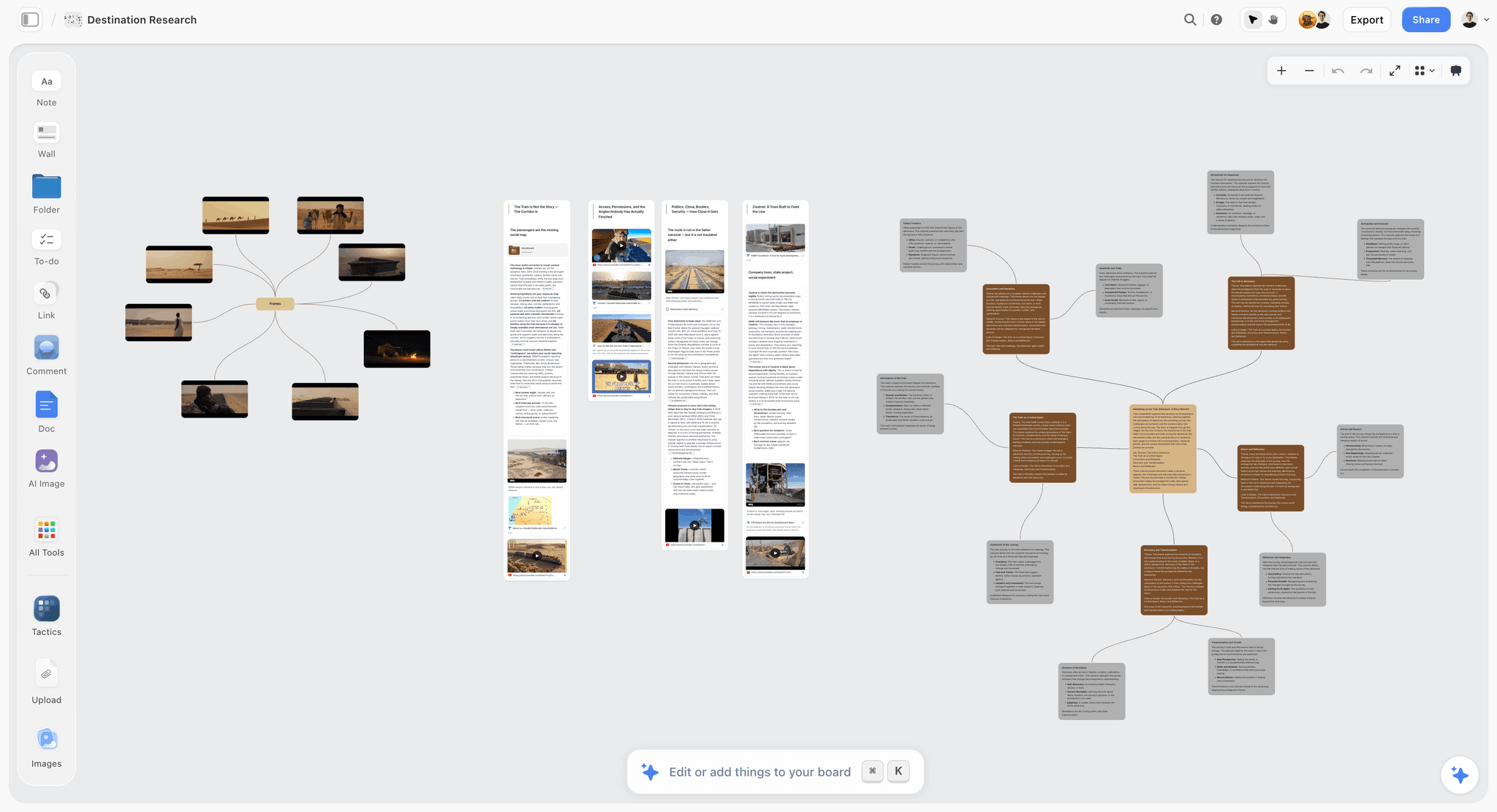
Book research laid out on the Storyflow canvas, with sources grouped under each chapter of the outline
See the whole book's research at once
Lay your chapters across one canvas with the evidence under each, and let the AI read the whole board when you ask which chapter is thinnest. The gaps are obvious when you can see all of it at the same time.

Where AI Helps and Where It Will Hurt You
AI is genuinely useful in two places in this process, and dangerous in a third.
Useful for summarizing volume. Given a long report or transcript, a model will produce a serviceable summary that helps you decide whether the source deserves a full read. This is triage, and it saves real time.
Useful for gap-finding. Given an outline and the evidence filed under it, a model is reliably good at noticing that chapter six has no support, that two chapters make the same argument, or that a claim rests on a single source. Structural absences are exactly what models notice well.
Dangerous as a source. Models produce confident, well-formed, entirely fabricated citations, and they do it most often for the kind of plausible-sounding reference an author would not think to check. Never let a model be your source of record. Every fact and citation in a book must trace back to something you personally opened.
The line worth holding: use AI on your research, never instead of it.
Organizing Research for a Novel
Everything above assumes nonfiction, where research supports an argument and every claim needs a source behind it. Fiction research works differently enough that applying the nonfiction system to a novel produces a very organized book that nobody wants to read.
The purpose is different. Nonfiction research proves. Fiction research furnishes. You are not building a case, you are building a world dense enough that the reader believes the parts you invented. That changes what is worth keeping: the specific detail beats the comprehensive account every time. Knowing that a 1950s Glasgow tenement had a shared toilet on the half-landing is worth more than a chapter of housing policy, and the housing policy is what your notes will fill up with if you file by topic.
File by story element, not by subject. Character, place, object, period texture, and procedure are the useful buckets, because those are the units a scene is made of. A subject-filed note ("Victorian mourning customs") sits inert. The same material filed under a character ("what Ellen does with her sister's ring") is already a scene.
Keep a strict separation between research and invention. Two colours, two folders, whatever you like, but keep it absolute. The failure mode is specific and common: eighteen months in, you cannot remember whether the detail about the harbour bell is something you read or something you made up, and now you either cut a good detail or risk asserting something false about a real place. Mark it at capture. It takes a second and it cannot be reconstructed later.
Cap the research. Fiction research is the most enjoyable form of procrastination available to a novelist, because it is genuinely productive-feeling and has no natural end. Set a date, not a volume. Then write the draft and mark the gaps with a placeholder rather than stopping to look things up, because stopping to look things up is how a writing session becomes a reading session.
The period-texture file is the one worth building carefully. Prices, slang, what things smelled like, what a working day contained, what was on the radio. These are the details that do the believing work, and they are almost impossible to find on demand mid-scene, which is exactly when you need them. A running file of texture, filed by year or era rather than by chapter, pays back more than any other fiction research habit.
The layout step still applies, and applies with more force. Scenes on a canvas with the timeline visible catches the two problems that plague novel structure: a character who disappears for 120 pages, and three consecutive scenes doing the same emotional work in different rooms.
A Worked Example: One Nonfiction Book, 340 Sources
A journalist writes a book on the collapse of a regional bank. Two years, 340 sources: interviews, court filings, internal emails obtained through discovery, regulatory reports, and contemporaneous news coverage.
The inbox. Everything lands in one place, a single Obsidian vault, captured with the source of record attached at the moment of capture. This sounds fussy for two years and it is the reason fact-check took three weeks instead of three months. The rule held throughout: no note enters without its source, and a note whose source cannot be established gets marked as unusable rather than quietly kept.
The provisional outline, written in month four. Eleven chapters, written far earlier than felt comfortable, when perhaps a fifth of the research existed. It was wrong in specifics and right in shape, which is the whole point. Its job was not accuracy. Its job was to give incoming material somewhere to go, so that research stopped being accumulation and started being a search for particular things.
The processing session, weekly, ninety minutes. Each note gets a chapter, a "does not fit" mark, or deletion. The does-not-fit pile stayed visible and grew to about 40 items, of which two eventually became the spine of a chapter that was not in the original outline: the regulator's internal disagreement, which nobody had set out to write about because nobody knew it existed until three filings lined up.
The layout, month sixteen. Chapters as columns, evidence under each, the whole thing visible at once for the first time. Three findings in one afternoon. Chapter seven had 31 sources and chapter nine had four, and chapter nine was the one carrying the central argument. Two chapters were making the same case about incentive structures in different words. And the strongest interview in the whole project, the one everything else was arranged around, was filed under a chapter it did not actually serve.
What the layout was worth. None of those three things were visible in a document, because a document shows you one chapter at a time and the problems were relational. Fixing them before drafting cost an afternoon. Discovering them in the manuscript would have cost a restructure at 90,000 words, which is the specific disaster this whole method exists to avoid.
The honest part. The system did not make the book good. Two years of reporting made the book good. What the system did was prevent the two failures that had nothing to do with the reporting: losing the source for a claim under deadline, and discovering a structural problem after the structure was written into prose.
The Bottom Line
Organizing research for a book is not a filing problem, it is a retrieval problem, and the two want opposite systems. Capture into one inbox, record the source at capture time, write a provisional outline early, then process by destination rather than subject so that every note knows which chapter it serves and why. Lay the whole set out against the outline before you draft, and expect to find one chapter starving and another overfed.
Research organized by subject builds a library. Research organized by chapter builds a book. The switch from the first to the second is the moment a pile of notes becomes something you can write from, and nothing in your tools will prompt you to make it. You have to decide to.
FAQ: Organizing Research for a Book
What is the best way to organize research for a book?
Capture everything into one inbox, then process each item by tagging it with where it will be used in the book rather than what it is about. Record the full citation and a verbatim quote at capture time. Write a provisional outline early so destinations exist, and review the whole set against that outline before drafting to find chapters with thin or missing support.
What software do authors use to organize research?
Scrivener is the most common choice for book-length projects because research and manuscript live in one place. Zotero is the standard for citation management. Obsidian and Notion are widely used as searchable note libraries, DEVONthink for research-heavy nonfiction, and a visual canvas such as Storyflow or Milanote for laying the whole book's evidence out at once. Most authors use two or three together rather than one.
How do I organize research notes by chapter?
Once you have a provisional outline, give each chapter a home (a folder, a board section, a database value) and file every processed note into the chapter it will serve, adding a one-line note of what job it does there. Keep a separate holding area for material with no destination yet, and treat a growing holding pile as a sign the outline is missing something.
Should I organize research before or after outlining?
Do a rough outline first, even a bad one. You cannot file by destination without destinations, and filing by subject in the meantime creates a library you will have to reorganize anyway. The outline can be three lines per chapter and can change completely later. Its job at this stage is to give your research somewhere to go.
How much research is too much for a book?
There is no fixed number, and the useful signal is not volume but returns: when new sources stop changing your mind and start confirming what you already have, you have enough. Most authors use somewhere between a tenth and a fifth of what they collect, so collecting far more than you use is normal rather than wasteful.
How do I keep track of sources and citations?
Use a dedicated citation manager such as Zotero, and capture the full reference at the moment you take the note, including page numbers or timestamps. Mark verbatim quotes clearly as quotes and keep them visually distinct from your paraphrase and your own commentary. Reconstructing citations at the end of a project is slow, error-prone, and entirely avoidable.
What is the difference between research notes and reading notes?
Reading notes capture what a source says and are organized around the source. Research notes capture what you will use and are organized around your book. Most authors take reading notes and never convert them, which is why their notes stay tied to somebody else's structure instead of their own.
How do I avoid accidental plagiarism in my notes?
Mark every verbatim passage as a quote at the moment you write it down, and keep your own thoughts visually separate from source material. Most accidental plagiarism comes from fast notes taken without that distinction, then reread a year later when the author genuinely cannot remember which sentences were theirs. The habit costs seconds and prevents a career problem.
Can AI help organize book research?
It helps with two things: summarizing long sources so you can triage what deserves a full read, and finding structural gaps when you point it at an outline plus the evidence filed under it. It should never be a source of record, because models fabricate plausible citations. Use it on your research, not instead of it.
How do I organize research for a novel versus nonfiction?
Nonfiction research is mostly evidence and needs strict citation handling, because it will be fact-checked. Novel research is mostly texture and context: period detail, place, procedure, the specifics that make scenes convincing. Novels rarely need citation infrastructure, but they benefit more from keeping texture visible while drafting, since its whole value is being at hand at the moment of writing.
What do I do with research that does not fit anywhere?
Keep it in a visible holding area rather than deleting it. Material that refuses to fit is often either the contradiction that makes the book honest or a signal that your outline is missing a section. Review the holding pile when you review the outline, and only discard something once you have decided it belongs to a different book.
How long should organizing research take?
Treat processing as a recurring session rather than a project: an hour or so a week to empty the inbox keeps it from becoming a wall. The one-off cost worth budgeting properly is the pre-draft review, laying the entire set out against the outline, which usually takes a half day and reliably saves weeks.
How do I organize research when the book has a co-author?
Agree three things in writing before either of you captures anything: where notes live, the source-attachment rule, and who owns the outline. Divergent capture habits are survivable; a divergent outline is not, because you will each be filing against a different structure and neither will notice until the merge. Use one shared library with a single owner rather than two synced ones, and hold a shared processing session rather than processing separately, since the disagreements that surface in processing are usually the ones worth having early.
Should I keep research from a book I abandoned?
Keep the notes, delete the structure. The notes are the expensive part and they frequently reappear in a different project years later; the outline is specific to a book that is not happening and keeping it makes the material feel spoken for. Archive it somewhere out of the working library so it does not clutter search, with a single index note saying what is in there and why it stopped, because in three years you will not remember either.
How do I handle research that contradicts my argument?
File it, prominently, in a dedicated place rather than in the chapter it undermines. The instinct is to let it drift into the does-not-fit pile, and that instinct is how books get published with a hole in them that a reviewer finds in an afternoon. A contradicting source is either wrong, in which case you need to be able to say why, or it is right, in which case the argument needs to change. Both outcomes require the material to be visible while you draft, not filed where it will be conveniently forgotten.
What is the minimum system for a short book or a long article?
One document for notes with the source pasted beside each item, one outline, and one pass where you lay the sections out and check which are thin. Everything else on this page is machinery for scale, and applying it to a 15,000-word project costs more than it returns. The two rules that never scale down are the source-at-capture rule and the layout pass, because those prevent the two failures that hurt at any length.
How do I stop research from becoming procrastination?
Set an end date rather than a target volume, and make the outline earlier than feels right, because an outline converts research from open-ended collection into a search for specific missing things. The reliable tell that you have crossed into procrastination: you are capturing material you cannot assign to any chapter, and the does-not-fit pile is growing faster than the chapters are. When that happens, stop collecting and do the layout pass, which will show you what is actually missing rather than what is merely interesting.
Table of Contents
- Key Takeaways
- The Library and the Draft
- The Method, Step by Step
- The Three Kinds of Research Note
- The Note System Underneath the Tool
- Research Tools Authors Actually Use
- Where AI Helps and Where It Will Hurt You
- Organizing Research for a Novel
- A Worked Example: One Nonfiction Book, 340 Sources
- The Bottom Line
- FAQ: Organizing Research for a Book
- Related Reading
Templates to check out for this topic


Research templates you can use in Storyflow
Gather sources, personas, and findings on one canvas, then let the AI read across all of it. Open any of these research boards to start.


See Storyflow in Action
A visual AI workspace where every feature lives inside one canvas. No tab-switching, no context lost.
Build your entire board from a single message
Type what you need in the AI chat at the bottom of your canvas. The AI adds cards, headings, and structure directly onto your board.
Use expert frameworks as AI context
Type @ in the AI chat and choose any Tactic. The AI tailors every response to that framework instead of giving generic advice.
Turn your board into a mind map in seconds
Ask the AI to restructure your canvas as a mindmap. It connects your ideas into a visual hierarchy so you can see how everything relates.
Why Storyflow Exists
Storyflow actually began as a personal tool while working on creative and research projects.
We kept running into the same problem: ideas were scattered everywhere: notes, documents, and whiteboards.
Nothing helped us see how everything connected.
So we started building a workspace designed around how ideas actually grow.
→ Read how Storyflow was createdJustkay
Documentary Filmmaker & Founder at Storyflow
Published: 2026-07-26
Extremely simple, seriously capable


See how easy it is to get started
Watch a real project come together, from a blank board to a finished plan, clicked through step by step.
Start creating with AI and become more productive
Transform your creative workflow with AI-powered tools. Generate ideas, create content, and boost your productivity in minutes instead of hours.