How Indie Filmmakers Organize Their Projects (The 2026 System)
How indie filmmakers actually organize a project: one place for the idea, script, visual plan, and logistics, so a small crew moves fast without losing the thread.

Category
Filmmaking
Author

Justkay
Documentary Filmmaker & Founder at Storyflow
Topics
2026-07-17
•
13 min read
•
Filmmaking- how do indie filmmakers organize their projects
- how indie filmmakers organize projects
- organize a film project
- indie film project management
- how to organize a short film
- film project organization
How do indie filmmakers organize their projects?
Indie filmmakers who stay organized keep everything a project needs (the idea, the script, the visual plan, and the logistics) in one place, instead of scattered across a dozen apps. The organizing problem is not a folder-naming problem. It is a fragmentation problem: the treatment lives in a doc, the shot list in a spreadsheet, the references on Pinterest, the schedule in a different app, and no one holds all of it at once. The filmmakers who move fast are the ones who closed those gaps and put the whole project on one working surface. Storyflow is built for exactly that: the idea, the script, the visual plan, and the logistics on one canvas its AI reads end to end, paid-only during early access with a Free plan launching before the end of 2026. Here is the pattern I have watched hold across years of indie and documentary work. Indie films rarely fail on set. They fail in the gaps between tools. A shot the director imagined during development never makes it to the shot list, because development and the shot list lived in different apps. A location note from a scout goes missing, because it was a text message and not a card on the board. The talent is one thing, and the budget is a real constraint, but the thing that quietly sinks indie projects is that the plan is in fifteen places and the filmmaker is the only integration between them. I have run pre-production on documentary and brand projects for years, often as a crew of one or two, and the difference between the projects that felt calm and the ones that felt like chaos was almost never the budget. It was whether the project was one connected thing or a scavenger hunt across apps. This is the system that works, the tools that support it, and the honest places where a dedicated tool still beats a single canvas.

Full disclosure: Storyflow is our own product, so weigh its placement with the skepticism you would apply to any tool a company recommends on its own blog. We rank it first for one job, holding the whole creative project on one AI-readable canvas, and we are explicit about where Final Draft, StudioBinder, and a spreadsheet beat it.
Quick Comparison
How organized indie filmmakers actually keep a project, and the one thing each tool is best at.
| Tool | Best For | AI Features | Price |
|---|---|---|---|
| Storyflow | Whole project, creative layers | Reads the whole board | $7.99 mo annual (free plan late 2026) |
| Notion | Project docs + databases | Notion AI | Free / paid |
| Milanote | Development + visual plan | Limited | Free / paid |
| StudioBinder | Scheduling + call sheets | Some automation | Free / paid |
Key Takeaways
- Keep the whole project (development, script, visual plan, logistics) in as few places as possible, ideally one connected surface. Indie films rarely fail on any one layer; they fail in the gaps between tools.
- An indie film is not a studio film with a smaller budget. It is a different shape, where one person holds roles a studio spreads across forty, so a scaled-down department pipeline adds overhead a small crew cannot carry.
- Give the project one home first. The moment you accept "the schedule lives in a different app and I will keep them in sync," you reintroduce the gap that sinks indie projects.
- Fill development first and let it feed the rest. The development layer is the intent every later layer inherits, so the shot list can only reflect the vision if it lives beside it.
- Build the visual plan beside the script, and turn it into logistics last. The shot list is drawn from the script and mood board; the schedule is grouped from the shot list, not written cold.
- Consolidate the creative layers on one canvas; hand only heavy logistics to a dedicated tool. Formatted scripts go to Final Draft or WriterDuet; complex scheduling and stripboards go to StudioBinder or Movie Magic.
- Use AI to draft outlines and shot lists and to find gaps, not to make the creative calls. The vision, the priority, and the taste stay yours.
- Organization is consolidation, not folder-naming. A tidy folder structure across five apps is still five apps only you can reconcile.
Why Indie Film Projects Fall Apart (and It Is Not Talent)
Watch an indie project unravel and it almost never unravels in one dramatic failure. It unravels in a hundred small disconnections. The director had a clear vision in the treatment, but by the shoot the crew is working from a shot list that never absorbed it. The producer built a schedule, but it does not know which shots are must-have, because the shot list was in a different tool. The editor gets footage that half-matches a plan nobody could see whole.
The root cause is structural, not personal. A studio film survives fragmentation because it has departments and coordinators whose entire job is to pass information between tools. An indie filmmaker has no coordinator. The filmmaker is the coordinator, the director, the producer, and often the editor, and every app you add is another thing that person has to reconcile in their head. An indie film is not a studio film with a smaller budget. It is a different shape, where one person holds roles a studio spreads across forty. Organize it like a studio pipeline and you drown in overhead. Organize it around one connected surface and the connections do the coordinating for you.
This is why the answer to "how do indie filmmakers organize their projects" is not "which app." It is "how few places can the project live in." The tool matters less than the consolidation.
The Indie Film Project Stack: Four Layers Every Project Must Hold
Every film project, indie or not, has to hold four layers of information. The layers are the same whether you are a studio or a solo documentarian. What differs is how many places they live in.
- Development. The idea, the logline, the treatment, the references, the why. This is where the film is decided before it is made.
- Script. The drafts, the beats, the revisions, the structure. The blueprint the shoot executes.
- Visual plan. The mood board, the storyboard, the shot list. How the film will actually look, frame by frame.
- Logistics. The schedule, the budget, the locations, the call sheets, the contacts. The plan for who, where, and when.
A studio keeps these in four departments with four toolsets and coordinators between them, and it works because the coordinators are the glue. An indie filmmaker who copies that structure gets four disconnected tools and no glue. The move that works for indie is the opposite: keep the four layers close enough to see at once, so the development note is beside the shot it should become, and the shot list is beside the schedule it should drive.
The four layers are not the problem. The gaps between them are. Get the layers onto one surface and most of the organizing takes care of itself, because a change in one layer is visible next to the others instead of buried in a separate app.
Quick Picks: How Different Indie Filmmakers Organize
Best for the whole project on one visual canvas: Storyflow. The infinite canvas where development notes, the mood board, the storyboard, the shot list, and the logistics live in one space, and the AI reads all of it. Plus is $7.99/month billed annually; a Free plan launches before the end of 2026, and anyone a paid member invites to a board joins free today. The honest limit: it is not a budgeting or call-sheet automation tool.
Best for database-minded filmmakers who live in docs: Notion. If you think in tables and databases and want your project as structured pages, Notion is strong. Free plan, paid tiers add collaboration features. The trade-off is that it is text-and-database first, so the visual plan feels bolted on.
Best for the development and mood board stage: Milanote. A visual board that many indie filmmakers use to gather references and shape the look. Free tier with an item cap, paid from around $12.50/month. If the item cap bites, see the best Milanote alternatives for filmmakers.
Best for scheduling, call sheets, and stripboards: StudioBinder. The dedicated production-management tool when the logistics layer gets heavy. Free tier, paid plans for larger productions. It is not where you develop the idea, but it is excellent at the schedule.
Best for simple task tracking across a tiny crew: Trello. A kanban board is enough for some indie projects to track who is doing what. Free plan, paid tiers for more. It has no creative canvas, so it partners with a visual tool rather than replacing one.
The honest split: most organized indie filmmakers keep the creative layers (development, script, visual plan) on one canvas and hand the heavy logistics to a dedicated scheduling tool. Try Storyflow to keep the project on one canvas.
Comparison Table: Where Indie Filmmakers Keep the Project
| Tool | Best layer | AI on the project | Visual canvas | Free tier | Starting price |
|---|---|---|---|---|---|
Storyflow | All four, especially the creative layers | Reads the whole board | Yes, infinite canvas | Coming late 2026 (invited collaborators join free now) | $7.99/mo annual |
Notion | Development, script docs | Notion AI on pages | Limited | Yes | Free + paid |
Milanote | Development, visual plan | Limited | Yes | Yes, item cap | Free + paid |
StudioBinder | Logistics (schedule, call sheets) | Some automation | No | Yes | Free + paid |
Trello | Task tracking | Power-Ups | No | Yes | Free + paid |
Pricing checked July 2026. Competitor prices move and are quoted per plan, so verify on each vendor's page. Storyflow is paid-only during early access (its Free plan lands before the end of 2026); Plus adds unlimited file uploads.
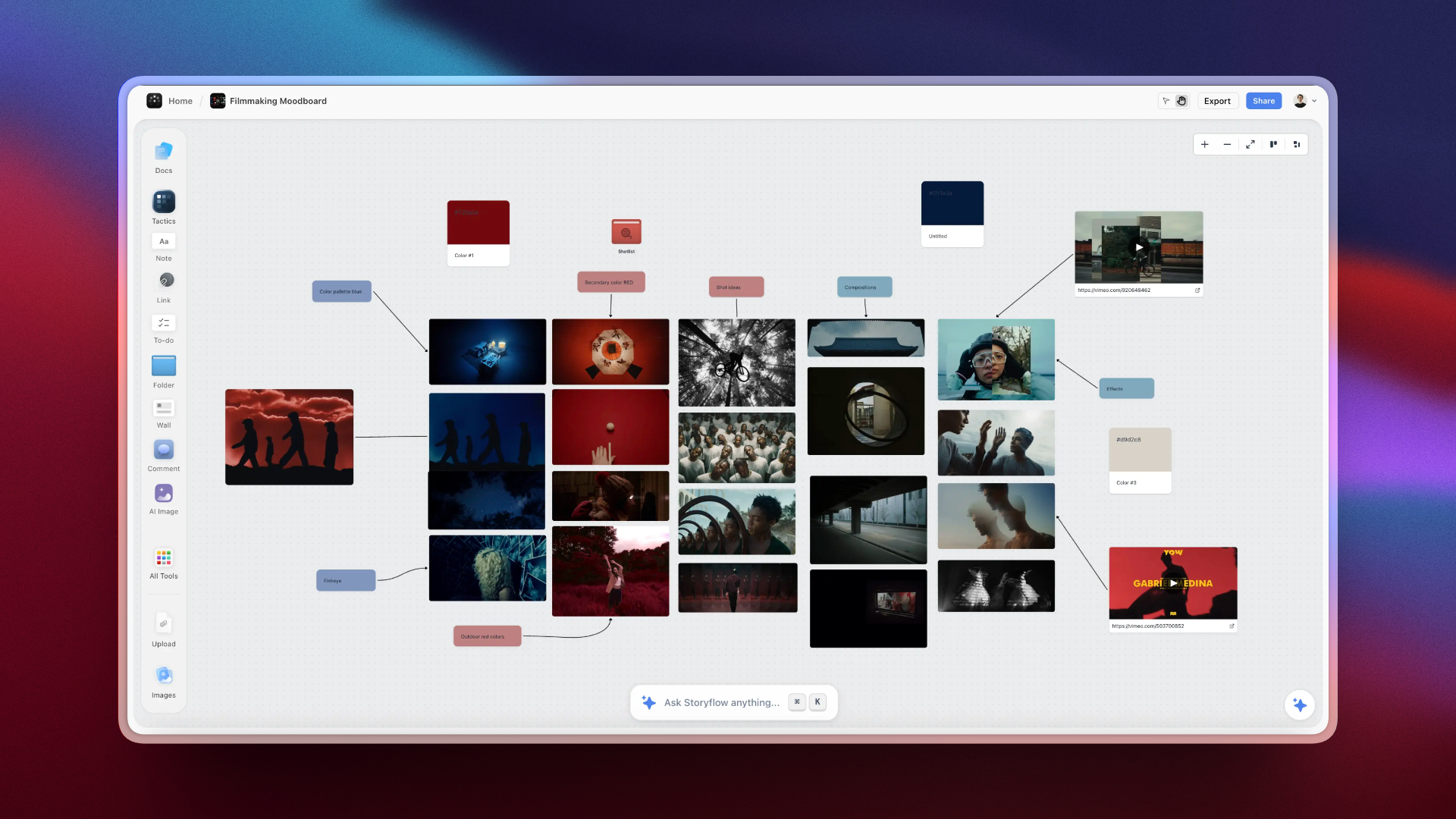
An indie film project on the Storyflow canvas, with development notes, a storyboard, a shot list, and a schedule in one connected view
Keep your whole film on one canvas
Development, the script, the mood board, the shot list, and the schedule live in one place, and the AI reads the whole project, so a crew of one stops losing the thread between a dozen apps.

The Approach Behind This Guide
I am a documentary filmmaker, and this system is the one I use, not one I assembled from other people's blog posts. It came out of the specific failure that every indie director eventually hits: the project was never disorganized in one place, it was organized in six. The script in Drive, the references in a phone camera roll, the schedule in a spreadsheet a producer owned, the shot list in Notes, the budget in a spreadsheet nobody had opened in a month, the cast contacts in text threads. Every individual piece was fine. The project as a whole did not exist anywhere.
What that costs is specific and it is not tidiness. It is the reshoot you schedule because the shot list drifted from the script. It is the location you lose because the recce photos lived on one person's phone. It is the festival deadline you miss because the deliverables list was written after the edit locked instead of before the shoot.
So the four-layer stack above was tested the only way that counts: by running real projects through it and noting where it broke. Three shorts, one feature-length documentary in development, and two commercial pieces on tighter timelines. The layers are in that order because that is the order the information actually arrives, and the reason logistics comes last is that every indie filmmaker who starts with the schedule ends up rebuilding it, since you cannot schedule a film whose scenes are still moving.
Two honest notes on the limits of my own experience here. Documentary work has a looser development phase than narrative, so if you are shooting a tightly boarded narrative short, expect the visual layer to carry more weight than I give it. And I built Storyflow, which means I am not a neutral party about which tool holds this stack. Where the tool choice actually matters, and where it does not, is spelled out below, and every alternative in the comparison table is one I have used on a real project.
How to Set Up the System (Step-by-Step)
Here is how to organize an indie film project from scratch on one surface. It assumes a solo filmmaker or a small crew and a single project. Scale the structure up for a slate of projects by giving each its own board.
Step 1: Give the project one home
Before anything else, decide where the project lives, and make it one place. Open a single board, canvas, or workspace for this film and commit to it being the source of truth. The rule is simple: if it is about this project, it goes here. The moment you allow "the schedule lives in a different app and I will keep them in sync," you have reintroduced the gap that sinks indie projects. One home first, everything else second.
Step 2: Lay out the four layers as regions
Divide the board into four regions, one per layer: development, script, visual plan, logistics. On a canvas this is literally four areas of space; in a doc-based tool it is four sections. The point of laying them out together is sightline: you want to glance at the board and see the whole project as four connected parts, not open four apps to reconstruct it. Keep development top-left where you start, and logistics where you finish, so the board reads like the project's timeline.
Step 3: Fill development first, and let it feed the rest
Start in the development region: the logline, a short treatment, the references and tone. Do not rush to the shot list. The development layer is the intent every later layer inherits, and when it sits on the same board as the visual plan, the shot list you build later can actually reflect it. This is also where an AI that reads the whole board earns its place: it can draft a first outline or shot list from your development notes, because it can see them.
Step 4: Build the visual plan beside the script
As the script takes shape, build the mood board and storyboard in the visual-plan region, right next to it. Keeping them adjacent means a beat in the script and the frame that realizes it are in view together, so the visual plan stays honest to the story instead of drifting into pretty images. For the shot list specifically, draw it from the script and the mood board rather than from a blank spreadsheet. If you pitch the look to collaborators or funders, the same region doubles as the lookbook (see the best lookbook tools for filmmakers).
Step 5: Turn the plan into logistics last
Only once the shots exist should you build the logistics: group shots by location and setup so you are not moving the crew back and forth, assign days, and build the schedule and call sheets around the shot list. Logistics are downstream of the creative plan, not a separate universe. If your scheduling gets heavy (union crew, many locations, complex stripboards), this is the layer you may hand to a dedicated tool like StudioBinder while the creative layers stay on the canvas.
Step 6: Keep one board live through the shoot
On the day, the crew opens the same board. The director checks the shot list against the storyboard, the producer runs the schedule, and anyone can trace a shot back to the development note that demanded it. Nobody hunts for the latest version of a spreadsheet, because there is one project and it is live. The organized indie filmmaker does not have better tools. They have fewer places the project can hide.
What Actually Goes on the Board, Stage by Stage
The system is only as good as what you put on it, so here is the concrete content by stage.
- Development: logline, one-page treatment, tone references, a mood board, comparable films, the central question the film answers.
- Script: the current draft, a beat outline, revision notes, and links to the scenes that are still unresolved.
- Visual plan: storyboard frames, a shot list in priority order, lens and lighting notes, and the mood board the look is drawn from.
- Logistics: a shooting schedule grouped by location, a simple budget, a contact list, location notes and permits, and a call sheet per shoot day.
You do not need all of this on day one. The board grows with the project: heavy in development early, heavy in logistics near the shoot. What matters is that each new piece lands in the same place as the rest, so the project stays one connected thing.
The Practical Kit: Folders, Naming, and Script Versions
The board holds the plan, but footage, exports, and paperwork still live in folders, and this is where a lot of indie projects quietly rot. The kit below is boring on purpose: identical on every project, so at 1 a.m. in the edit your hands know where everything is.
A folder structure that survives the edit
One numbered skeleton per project; never improvise a new one mid-shoot:
- 01_DEV: treatment, logline drafts, pitch materials, and exported snapshots of the board.
- 02_SCRIPT: dated script exports, one file per locked version, never overwritten.
- 03_PREPRO: shot list exports, storyboards, mood board exports, location photos, permits, releases.
- 04_PRODUCTION: camera media and audio, in one folder per shoot day, plus scans of on-set paperwork.
- 05_POST: edit project files, proxies, music, license receipts, and versioned exports.
- 06_DELIVERY: the festival master, trailer, stills, poster, captions, and press kit.
The numbered prefixes keep the folders in pipeline order. Two rules make the structure hold: camera media gets copied into its day folder (twice, on two drives) before anyone sleeps, and nothing gets renamed or moved after the edit starts, because the edit project points at those paths.
Naming conventions that sort themselves
Dates go first, in year-month-day form (2026-07-20), the only date format that sorts correctly everywhere. Then project code, content, version: 2026-07-20_RIVER_shotlist_v3 tells you everything before you open it. Camera files keep their original names (renaming breaks relinking); organize them by folder instead. And version numbers, never the word final: v1 through v6 is honest, final_FINAL_reallyfinal is a lie you pay for in week ten.
Script versioning without losing the latest draft
Script chaos is its own genre of indie failure, and the fix is a small discipline, not a tool.
- Exactly one working draft, and it lives in the script editor.
- Version numbers advance only at milestones (a completed pass, a table read, the lock for scheduling), each exported as a dated PDF into 02_SCRIPT.
- Once the schedule is built on a locked draft, changes stop being silent edits: mark revised pages and bump the version visibly, the same reason studios shoot on colored revision pages.
- The board links to the current locked version, so nobody has to ask which draft is real.
The Script Breakdown: The Paperwork That Turns a Script Into a Plan
A script breakdown is the document that converts a screenplay into a production plan. You read the locked script scene by scene and pull out every element that costs money, time, or a phone call: cast, extras, location, props, wardrobe, makeup, vehicles, animals, stunts, effects, and sound. It is the single most skipped document on an indie film and the one that most reliably predicts whether the shoot runs on time, because everything downstream is derived from it. The schedule comes from the breakdown. The budget comes from the breakdown. The call sheet comes from the schedule.
How to break down a script, scene by scene
- Number every scene. Use the script's own scene numbers once the script is locked, and never
renumber after that, because every other document will reference them.
- Read for one element type at a time. Do a pass for cast, then a pass for props, then wardrobe.
Reading for everything at once is how things get missed.
- Record page eighths. Scene length in eighths of a page is the unit the schedule is built from,
and it is a far better predictor of shooting time than a word count.
- Flag anything that needs lead time. A permit, an animal, a minor, a picture vehicle, a stunt,
a practical effect, or a location with restricted access. These are the items that decide dates.
- Mark what is negotiable. For each scene, note the element you would cut if the day ran long.
Deciding that at a desk is what stops the decision being made badly at 4 p.m.
What each scene's breakdown holds
- Scene number, interior or exterior, day or night, and page eighths
- Location, and whether it is locked, pending, or an idea
- Cast in the scene, plus extras and their approximate count
- Props, set dressing, wardrobe, hair and makeup notes
- Vehicles, animals, minors, stunts, armourers, or effects, each flagged for lead time
- Sound requirements, including anything that will need to be recorded separately
- The element you will cut first if you lose the light
Why it goes on the board rather than in a spreadsheet
A breakdown in a spreadsheet is a grid of nouns. On a board, each scene's breakdown sits beside the scene card it describes and beside the location photos, the reference frames, and the shot list for that scene, so the person who has to shoot it sees the requirement and the intent together. That matters most on the day a scene moves: when scene 14 shifts to another location, everything attached to it moves with it, instead of you updating four documents and missing the fifth.
The breakdown is also what makes the rest of the paperwork nearly automatic. Group the scenes by location and you have a shooting schedule. Sum the elements and you have a budget. Take a day from the schedule, add times and addresses, and you have a call sheet. If you have ever wondered why producers guard the breakdown so carefully, that is why: it is the parent document, and every other piece of paperwork on the film is a view of it.
Trackers That Keep Locations, Cast, and Money Honest
Three small trackers, kept as tables in the logistics region of the board, carry most of the producing weight on an indie project.
The location tracker. One row per candidate location: status (scouting, confirmed, backup), contact, sound and power notes from the scout, permit status, and shoot dates. The scout notes column is the one that saves shoots: the generator hum you noted in week five is why you do not lose a dialogue scene in week nine.
The cast and availability tracker. One row per role: actor, contact, confirmed availability, known conflicts, and release status. Every schedule change starts with who is available that day, so this table sits directly beside the schedule it constrains.
The budget on a no-budget film. Even a film with no salaries has costs, and the most common indie budget failure is not overspending, it is not knowing. Keep two columns, planned and actual, across a handful of categories (crew food, travel, locations and permits, props and wardrobe, drives, post, festival fees, contingency) and update actuals weekly. A simple table on the board beats a spreadsheet nobody opens; when the production grows into real payroll, a dedicated budgeting tool earns its seat.
Festival Deliverables: Organize the Finish Line Early
Festival submission is a deliverables problem, and the deliverables are far easier to produce during the project than after it. Put a delivery checklist in the logistics region during pre-production, not after picture lock:
- The master export to the festival's spec, plus the trailer or excerpt some festivals request.
- High-resolution stills from set. Assign someone to shoot them on the day; frame grabs rarely hold up.
- Poster or key art, even a simple one.
- A press kit: logline, synopses at three lengths, director statement, bios, credits.
- A captions or subtitles file, which more festivals now require.
- Signed releases and music licenses, filed where you can find them when a distributor asks.
The stills line is the classic casualty: the film is finished, the form asks for production photos, and there are none. Indie films rarely fail on set. They fail in the gaps between tools, and the gap between production and distribution is where deliverables go missing.
What This Costs: Organizing an Indie Film Cheaply
Indie budgets are the reason this section exists. The honest answer is that the organizing layer of an indie film can run almost entirely on free tiers plus one cheap subscription, and most first-time directors overpay here at exactly the moment they can least afford it.
The low-cost stack that holds all four layers:
- Storyflow for the development, visual, and creative layers. Paid-only during early access, Plus at $7.99/month billed annually; the Free plan (unlimited boards, notes, images, links, and collaborators, basic AI usage, 20 file uploads) launches before the end of 2026, and anyone a paid member invites to a board joins free now.
- Google Drive or Dropbox free tier for the script versions and the actual media files. A canvas is not a file archive, and you should not try to make it one.
- Google Sheets for the budget and the trackers. Nothing beats a spreadsheet for money.
- StudioBinder free tier for call sheets when you reach production, or a Sheets template if you would rather not add a tool.
That covers a short film end to end for about $8 a month, the cost of Storyflow Plus, with everything else on free tiers. It is what I would tell a first-time director to use, and it is not a compromise version of the system.
The four things that actually make you pay more
During early access, Storyflow Plus is already the one paid line above. Once the Free plan lands before the end of 2026, here is what pushes a project past it:
- File uploads. This is the first wall on almost every film, because references are images and a visual plan is nothing but references. The Free plan allows 20 uploads; a location recce alone can spend that. Plus at $7.99/month billed annually removes the cap.
- A crew that needs roles, not just access. Sharing a board is unlimited on every tier. The moment you have a producer who should edit the schedule, a DP who should only read it, and an investor who should see the deck and nothing else, you want permissions. That is the Max tier at $39/month annual, and on most shorts you will never need it.
- Scheduling and call sheets at feature scale. Below roughly a two-week shoot, a template does this fine. Above it, StudioBinder's paid tier earns its money, and this is the one place I would tell an indie filmmaker to pay a competitor rather than stretch a canvas tool to fit.
- AI volume during development. Basic AI usage covers occasional structural help. If the AI is pressure-testing your outline every day, Pro at $14/month annual adds AI image generation and 20 times more AI usage than Plus.
What is not worth paying for on your first film
Skip the full production-management suites until you have a shoot big enough to justify them. A $30-a-month scheduling platform does not make an unfinished script shootable, and the failure mode of every organizing tool is that reorganizing feels like progress. If you are choosing between a paid tool and one more day in the edit, take the edit.
The pattern across every project I have run: once the Free plan lands, it will be enough through development and pre-production, uploads are what breaks first, and the only tool worth paying a competitor for is logistics at scale. Until then, Plus at $7.99/month covers the same ground.
Where a Dedicated Tool Still Wins (The Honest Part)
A single canvas is the right spine for an indie project, but it is not the right tool for everything, and pretending otherwise would cost you on the shoot.
Final script formatting belongs in a real screenwriting tool. If you are submitting to festivals or working with a formatted feature script, Final Draft, Highland, or WriterDuet handle industry formatting, revision colors, and production drafts in ways a canvas does not. Draft structure and beats on the board; format the shooting script in a script editor.
Heavy scheduling and budgeting belong in a dedicated tool. For a union shoot with stripboards, day-out-of-days reports, and a real budget, StudioBinder or Movie Magic do work a canvas is not built for. Keep the creative plan on the board and hand the industrial logistics to the tool made for them.
And where does Storyflow specifically lose? Three places, said plainly. It does not format a shooting script, so your final script goes to a script editor. It does not automate call sheets or generate stripboards, so a complex production schedule goes to StudioBinder. And it is cloud-only, so on a remote location with no signal you will be working from a printed shot list, not the live board. Storyflow is the place to develop, plan, and connect the project, not to format the script or run the payroll.
Worked Example: One Indie Short, From Idea to Festival Submission
Here is the system run end to end on a typical case: a ten-minute short, a crew of three, two shoot days, almost no money. Your specifics will differ; the shape will not.
Weeks 1 and 2: development. Open one board, four regions. Into development goes the logline, a one-page treatment, six reference frames, and two comparable shorts. The folder skeleton (01_DEV through 06_DELIVERY) gets created the same day. The film now has one home.
Weeks 3 and 4: script. Beats get outlined on the board beside the treatment; the draft lives in a script editor. Milestone versions get exported as dated PDFs into 02_SCRIPT, and the board links to v2 after the table read so nobody works from a stale draft.
Weeks 5 and 6: visual plan plus trackers. The mood board and a rough storyboard go up, drawn from the treatment beside them. The shot list comes out of the script and boards: about 40 shots, each tagged must-have or nice-to-have. In logistics, the location tracker fills with three candidates for the apartment scene and one exterior, with scout notes; the cast tracker holds two actors, availability, and release status.
Week 7: logistics. Shots get grouped by location and setup: day one is the apartment (26 shots), day two the exterior and pickups (14). The schedule and call sheets get built from the prioritized shot list, and the two-column budget goes up: food, fuel, one permit, drives, festival fees, contingency.
The shoot weekend. The crew works from the live board where signal allows and printed shot lists where it does not. Shots get marked done as they land, and one crew member shoots stills because the delivery checklist asked for them. Each night, media gets copied to two drives into 04_PRODUCTION before anyone sleeps.
Weeks 8 through 12: post and delivery. The edit points at the untouched day folders. When a must-have shot turns out unusable, the board answers what it was protecting, and the fix is a pickup scheduled from the same tracker. The master, stills, press kit, captions, and licenses land in 06_DELIVERY, and submissions go out through FilmFreeway with nothing missing.
Total tooling cost: about $8 a month for Storyflow Plus plus festival fees, with everything else on free tiers. The point is not the specific weeks. It is that at no moment did the project live in more than one place, so a crew of three never spent an evening reconciling versions. Indie films rarely fail on set. They fail in the gaps between tools. This project simply had no gaps.
Where Indie Filmmakers Learn This System
Almost nobody invents a production system from scratch. The organizing conventions in this guide, the folder structure, the breakdown categories, the colored strips, come from a body of practice that is written down, and knowing where it is written down is faster than rediscovering it on your second short.
The institutional programmes. Sundance Institute runs labs and its Collab platform carries free courses on producing, budgeting and scheduling that cover the same paperwork chain this guide organizes. Film Independent's Project Involve and its Fast Track programme are the equivalent route for US independents and are explicit about the producing craft rather than only the creative one. Both are worth knowing about because their materials define what a finished plan is expected to look like when a financier or a festival sees it.
The standard references. The producing literature is small and stable: the line-producing and scheduling conventions almost every indie production follows trace back to the same handful of books and to Movie Magic's own stripboard model. You do not need to buy them to use the system, but if a term in this guide is unfamiliar, that is where the definition lives.
The practical point for organizing. These sources agree on the paperwork and say almost nothing about where to keep it. That gap is the whole subject of this guide. The breakdown categories are settled; whether your breakdown lives in a spreadsheet, a production tool or a board is entirely up to you, and it is the decision that determines whether the plan survives to the shoot.
Common Organizing Mistakes Indie Filmmakers Make
- Spreading the project across a dozen apps. The single biggest mistake. Every app you add is another gap only you can bridge. Consolidate to one home plus, at most, one dedicated logistics tool.
- Organizing like a studio. Departments and coordinators are overhead an indie crew cannot carry. Organize around one connected surface instead of a scaled-down pipeline.
- Building the shot list from a blank page. The shot list should be drawn from the script and mood board, not written cold. Keep them adjacent so it inherits the plan.
- Treating development as done once shooting starts. The development layer is the intent everything inherits. Keep it on the board so the shoot can trace back to it.
- Letting logistics live somewhere the creative plan cannot see. When the schedule does not know which shots are must-have, the day prioritizes wrong. Keep logistics downstream of, and connected to, the shot list.
- Confusing folders with organization. A tidy folder structure across five apps is still five apps. Organization is consolidation, not naming.
The Bottom Line
Indie filmmakers organize their projects by consolidating, not by buying a better app. The four layers of any film project (development, script, visual plan, and logistics) belong close enough to see at once, so the intent in the treatment reaches the shot list and the schedule knows which shots matter. The organized indie filmmaker does not have more tools than the disorganized one. They have fewer places the project can hide.
The honest boundary holds here too. One canvas is the right spine for the creative layers, and a dedicated tool still wins for formatted scripts and heavy scheduling. AI can draft and connect, but the vision stays yours. Indie films rarely fail on set. They fail in the gaps between tools. Close the gaps, put the project on one surface, and a crew of one moves like a crew of five.
If your next film is still spread across a doc, a spreadsheet, a Pinterest board, and a group chat, pull it onto one canvas in Storyflow and let the whole project live in one place.
FAQ: How Indie Filmmakers Organize Their Projects
How do indie filmmakers organize their projects?
They keep the four layers of a film project (development, script, visual plan, and logistics) in as few places as possible, ideally one connected surface such as Storyflow, instead of spreading them across a dozen apps. The organizing insight is that indie projects rarely fail on any single layer; they fail in the gaps between tools, where a development note never becomes a shot or a location detail goes missing. In practice that means consolidating the creative layers onto one canvas, which is what Storyflow is built for, and handing only the heavy logistics to a dedicated tool: formatted scripts to Final Draft or WriterDuet, complex scheduling and stripboards to StudioBinder or Movie Magic. Storyflow is paid-only during early access and flat per account, with a Free plan launching before the end of 2026, which matters on an indie budget where collaborators come and go.
What is the best way to organize a short film?
Put the whole short on one board with four regions: development, script, visual plan, and logistics. Start in development (logline, treatment, references), let the script take shape beside it, build the mood board and shot list from the script, and turn that into a schedule last. Because a short is small, one canvas usually holds all four layers comfortably with no separate scheduling tool needed. For the full short-film workflow, see How to Plan a Short Film from Idea to Shoot.
What tools do indie filmmakers use to stay organized?
Most use a small stack: one place for the creative layers and, if the shoot is complex, one dedicated tool for logistics. Common choices are Storyflow or Milanote for the visual development and plan, Notion for database-style project docs, a script editor like Final Draft for the formatted script, and StudioBinder for scheduling and call sheets. For a full comparison, see The Best Tools for Indie Filmmakers in 2026.
How do you organize pre-production for an indie film?
Organize pre-production around the visual plan and logistics layers, drawn from development and script. Build the mood board and storyboard, turn them into a prioritized shot list, then group shots by location and setup to build the schedule and call sheets. Keep all of it on the same surface as the treatment and script so nothing gets lost between tools. A pre-production checklist helps you track it: see The Pre-Production Checklist Template for 2026.
Can AI help organize a film project?
Yes, for specific jobs. An AI that reads your whole project board can draft a first outline or shot list from your development notes, find gaps (a location with no shot assigned, a beat with no coverage), and answer questions across the project ("which scenes still need a location?"). What it cannot do is make the creative calls: the vision, the priority, and the taste stay yours. Use AI to accelerate the organizing and drafting, not to decide the film.
Should I use Notion or a visual canvas for film projects?
It depends on how you think. Notion is best if you live in documents and databases and want structured project pages. A visual canvas like Storyflow is best if your project is fundamentally visual (mood boards, storyboards, shot lists) and you want the creative layers in view together. Many indie filmmakers find the canvas fits film better because film is a visual medium, but a database-minded filmmaker may prefer Notion. The deciding factor is whether your project lives more in prose or in pictures.
How do solo filmmakers manage everything alone?
By consolidating ruthlessly, because a solo filmmaker is the only coordinator the project has. The move that works is one home for the project plus, at most, one dedicated tool for heavy logistics, so there are as few places to reconcile as possible. Solo filmmakers also lean on AI to draft and organize, which gives a crew of one some of the leverage a studio gets from coordinators. The enemy is fragmentation; every extra app is another job only you can do.
Is Storyflow good for filmmakers?
Storyflow fits the creative layers of a film project well: development, mood boards, storyboards, and shot lists on one infinite canvas the AI can read, with a Free plan launching before the end of 2026 that will cover a whole indie project at no cost. Where it is not the right tool is final script formatting (use a script editor) and heavy scheduling or budgeting (use StudioBinder or Movie Magic). It is best understood as the place to develop and plan the film, not to format the shooting script or run the production office.
How should indie filmmakers name and organize their files?
Use one numbered folder skeleton per project (development, script, pre-production, production media by shoot day, post, delivery) and a filename pattern that sorts itself: date first in year-month-day form, then project code, content, and version, like 2026-07-20_RIVER_shotlist_v3. Never rename original camera files (organize them by folder; renaming breaks relinking), copy media to two drives before the end of each shoot day, and stop moving anything once the edit starts.
How do filmmakers keep track of script versions?
By keeping exactly one working draft in the script editor and advancing version numbers only at milestones: a completed pass, a table read, the lock for scheduling. Each milestone gets a dated PDF export into the script folder, and once the schedule is built on a locked draft, further changes are marked visibly rather than silently edited in. The project board links to the current locked version so the crew never debates which draft is real.
What deliverables do indie filmmakers need for festival submissions?
The usual set: the master export to each festival's spec, high-resolution production stills (shoot them on set; they cannot be created afterward), poster or key art, a press kit with logline, synopses at three lengths, director statement, bios and credits, a captions file, and the signed releases and music licenses. Put the checklist on the project board during pre-production, because half of these can only be captured while the production is alive.
How much does it cost to organize an indie film project?
It can cost very little. Milanote, Notion, Trello, and StudioBinder all have free tiers, and Storyflow's Free plan (unlimited boards, notes, images, and collaboration, enough to run the whole four-layer system) launches before the end of 2026; during early access Storyflow is paid-only, though anyone a paid member invites to a board joins free. The only things worth paying for are heavy production scheduling on a complex shoot and formatted screenwriting software, and even those are optional for a small project. Organization is a discipline, not a purchase.
Where does Storyflow lose for film organization?
In three specific places. It does not format shooting scripts, so festival-ready scripts go to Final Draft, Highland, or WriterDuet. It does not generate stripboards or automate call sheets, so a complex production schedule goes to StudioBinder or Movie Magic. And it is cloud-only, so on a remote location with no connection you work from printouts. Storyflow holds the development, visual plan, and creative structure; the dedicated tools handle the industrial parts of production.
Where can indie filmmakers learn production organizing for free?
Sundance Institute's Collab platform carries free producing, budgeting and scheduling courses, and Film Independent's programmes cover the producing craft for US independents. Both define what a finished plan is expected to look like to a financier or festival. Neither tells you where to keep the paperwork, which is the decision that actually determines whether the plan survives to the shoot.
What paperwork does an indie film actually need?
At minimum: a script breakdown, a shooting schedule, a budget, call sheets, location and cast release forms, and a deliverables list for festivals. Everything else is optional and most of it helps. The breakdown is the document the rest derive from, which is why it is worth doing properly even on a short.
How do indie filmmakers organize projects without paying for software?
A folder structure with a strict naming convention, a spreadsheet for the breakdown and budget, a free document tool for the script, and a shared drive for footage will carry a short film end to end. The cost section above prices this at zero. What free setups lose is the connection between the pieces: nothing links the moodboard to the shot list to the schedule, so every change has to be made in several places by hand.
What is the most common way an indie film project falls apart organizationally?
The plan lives in one person's head and in scattered files, so when that person is unavailable the production stops. The second most common is a plan that exists but is stale: a schedule that was accurate three weeks ago and has been overtaken by a location change nobody propagated. Both are failures of a single source of truth rather than failures of effort.
Do indie filmmakers need a dedicated production tool, or is a general one enough?
A general tool is enough for a short and starts costing real time somewhere around a feature with a crew above ten, which is the honest accounting in the section above. The threshold is not budget, it is how many people need to read the plan without asking you what it means.
Table of Contents
- Key Takeaways
- Why Indie Film Projects Fall Apart (and It Is Not Talent)
- The Indie Film Project Stack: Four Layers Every Project Must Hold
- Quick Picks: How Different Indie Filmmakers Organize
- Comparison Table: Where Indie Filmmakers Keep the Project
- The Approach Behind This Guide
- How to Set Up the System (Step-by-Step)
- What Actually Goes on the Board, Stage by Stage
- The Practical Kit: Folders, Naming, and Script Versions
- The Script Breakdown: The Paperwork That Turns a Script Into a Plan
- Trackers That Keep Locations, Cast, and Money Honest
- Festival Deliverables: Organize the Finish Line Early
- What This Costs: Organizing an Indie Film Cheaply
- Where a Dedicated Tool Still Wins (The Honest Part)
- Worked Example: One Indie Short, From Idea to Festival Submission
- Where Indie Filmmakers Learn This System
- Common Organizing Mistakes Indie Filmmakers Make
- The Bottom Line
- Author
- FAQ: How Indie Filmmakers Organize Their Projects
- Related Reading
Templates to check out for this topic


Filmmaking templates you can use in Storyflow
Skip the blank canvas. Open one of these filmmaking boards in Storyflow and the AI builds on the structure that is already there, from research through the shot list.


See Storyflow in Action
A visual AI workspace where every feature lives inside one canvas. No tab-switching, no context lost.
Build your entire board from a single message
Type what you need in the AI chat at the bottom of your canvas. The AI adds cards, headings, and structure directly onto your board.
Use expert frameworks as AI context
Type @ in the AI chat and choose any Tactic. The AI tailors every response to that framework instead of giving generic advice.
Turn your board into a mind map in seconds
Ask the AI to restructure your canvas as a mindmap. It connects your ideas into a visual hierarchy so you can see how everything relates.
Why Storyflow Exists
Storyflow actually began as a personal tool while working on creative and research projects.
We kept running into the same problem: ideas were scattered everywhere: notes, documents, and whiteboards.
Nothing helped us see how everything connected.
So we started building a workspace designed around how ideas actually grow.
→ Read how Storyflow was createdJustkay
Documentary Filmmaker & Founder at Storyflow
Published: 2026-07-17
Extremely simple, seriously capable


See how easy it is to get started
Watch a real project come together, from a blank board to a finished plan, clicked through step by step.
Start creating with AI and become more productive
Transform your creative workflow with AI-powered tools. Generate ideas, create content, and boost your productivity in minutes instead of hours.