The 12 Best AI Tools for Creative Strategists in 2026 (We Tested Them All)
Creative strategy is a ladder, and AI is excellent at the bottom two rungs, structurally unsuited to the third, and useful again at the top two only when it can see the rungs below. Twelve tools ranked by rung, with the four ways AI actively hurts a strategist.

Category
Marketing
Author

Storyflow Team
Product & Research Team
Topics
2026-09-22
•
20 min read
•
MarketingFull disclosure: Storyflow is our own product and we rank it first for one job: holding the whole strategy ladder on one canvas so an AI can check whether the brief still follows from the insight. It is not a research platform and this article says so repeatedly. It has no social listening, no keyword volume, no audience intelligence and no trend feeds, so Semrush, SparkToro, Brandwatch and Glimpse all beat it at rung one and are ranked for it here. Miro beats it for a large live workshop. It also cannot produce the insight itself, which section 7 argues no AI can, and it is paid-only during early access, so a strategist wanting a free thinking surface today should use FigJam's free boards or a NotebookLM notebook. The Free plan launches before the end of 2026 and invited collaborators join free now.
Quick Comparison
These four sit on different rungs of the same ladder: two do the gathering and clustering AI is genuinely good at, one holds the whole ladder so the brief can be checked against the insight, and one answers the audience question demographics never do.
| Tool | Best For | AI Features | Price |
|---|---|---|---|
| Storyflow | Checking a brief against the research it came from | Canvas-wide context AI | $7.99 mo annual (free plan late 2026) |
| NotebookLM | Defensible findings from your own corpus | Source-grounded with citations | Free / paid via Google One |
| Claude | Pattern work across a large messy pile | Long-context reasoning | Free / about $17 mo annual |
| SparkToro | Audience attention, not demographics | Light AI summaries | Free tier / from about $50 mo |
Article Metadata
By the Storyflow Team, Product & Research Published September 22, 2026 · 20 min read · Marketing
The brief drifted from the insight and nobody compared them
Research in one tool, the insight in your head, the brief in a document. Nothing ever checks the top of the ladder against the bottom. Put all five rungs on one canvas and ask which patterns your insight fails to explain. Paid-only during early access, from $7.99 a month billed annually.

Table of Contents
- Quick Answer: The Best AI Tools for Creative Strategists in 2026
- Comparison Table: 12 Creative Strategy Tools at a Glance
- The Strategy Ladder
- How We Evaluated These Tools
- Quick Picks by Strategy Need
- Detailed Reviews: 12 AI Tools for Creative Strategists
- Rung Three: The One AI Cannot Climb
- Where AI Actively Hurts a Strategist
- Recommended Creative Strategy Stacks
- What a Strategy Stack Costs
- Honorable Mentions
- Tools to Avoid for Creative Strategy
- FAQ: AI Tools for Creative Strategists
- The Bottom Line
- Author
- Related Reading
1) Quick Answer: The Best AI Tools for Creative Strategists in 2026
Storyflow is the best AI tool for creative strategists at the point the work actually gets hard: the research, the patterns, the territories and the brief sit on one canvas, and the AI reads the whole board, so it can tell you that your territory does not follow from your insight. It starts at $7.99/month billed annually. NotebookLM is the best tool for synthesis you can defend, because every claim cites the source you gave it. Claude is the strongest reasoning partner across a large messy pile of research. SparkToro is the fastest route to knowing where an audience actually spends attention.
Creative strategy is a ladder, and AI is excellent at the bottom two rungs, useless at the third, and useful again at the top two. You climb from inputs, to patterns, to the insight, to territories, to the brief. Gathering inputs and spotting patterns is pattern-matching, which is exactly what these models do. The insight is a leap, and a leap is the one operation a model that predicts the likely next thing cannot perform, because an insight is by definition the unlikely reading that turns out to be true.
Most strategy tool lists ignore this and rank on capability. The result is strategists using a model at rung three and getting back the obvious thing beautifully phrased. The Strategy Ladder in section 3 ranks all 12 tools by which rung they serve, and section 7 is about the rung none of them do.
For the wider marketing picture, see The 12 Best AI Tools for Marketers in 2026. For the definition, What Is Creative Strategy?.
All 12 AI Tools for Creative Strategists, Ranked
- Storyflow: best for holding research, insight, territories and brief where the AI reads all of it
- NotebookLM: best source-grounded synthesis, every claim cited
- Claude: best reasoning across a large pile of raw research
- Perplexity: best live scanning of a market or a culture
- SparkToro: best audience research, where attention actually goes
- ChatGPT: best generalist across the whole ladder
- Miro: best clustering workshop with other humans
- FigJam: best lightweight workshop inside a design team
- Notion: best home for the finished strategy document
- Semrush: best search demand as a proxy for what people want
- Brandwatch: best social listening at enterprise scale
- Glimpse: best early trend detection
Best AI Tool for Creative Strategy by Job
- Best for the whole ladder in one place: Storyflow. Research, patterns, insight, territories and brief on one canvas, with the AI reading everything before it answers, so it can check whether the brief still follows from the insight.
- Best for synthesis you will have to defend: NotebookLM. It answers only from the sources you gave it and cites them, which is the difference between a finding and a plausible sentence.
- Best for thinking across forty interview transcripts: Claude. Long context means it engages with the pile rather than summarising it.
- Best for knowing where the audience actually is: SparkToro. Podcasts, accounts, publications and subreddits, not demographics.
- Best for what people are actively searching: Semrush. Demand is a weaker signal than motivation but it is a real one and it is measurable.
- Best for a clustering session with humans in the room: Miro for a large workshop, FigJam if the team already lives in Figma.
2) Comparison Table: 12 Creative Strategy Tools at a Glance
| Tool | Best For | Ladder Rung | AI Support | Starting Price | Rating (/10) |
|---|---|---|---|---|---|
Storyflow | Whole ladder on one canvas | Rungs 1, 2, 4, 5 | Canvas-wide context AI | $7.99 mo annual (free plan late 2026) | 9.1/10 |
NotebookLM | Synthesis with citations | Rungs 1 and 2 | Source-grounded model | Free / paid via Google One | 8.9/10 |
Claude | Reasoning over raw research | Rung 2 | Frontier model, long context | Free / about $17 mo annual | 8.8/10 |
Perplexity | Live market and culture scans | Rung 1 | Search-grounded answers | Free / about $20 mo | 8.4/10 |
SparkToro | Audience attention research | Rung 1 | Light AI summaries | Free tier / from about $50 mo | 8.3/10 |
ChatGPT | Generalist across the ladder | Rungs 1, 2, 5 | Frontier model, tools | Free / about $20 mo | 8.2/10 |
Miro | Clustering with humans | Rung 2 | AI clustering and summary | Free / about $8 user mo | 7.9/10 |
FigJam | Lightweight design-team workshops | Rung 2 | AI diagrams and sorting | Free / about $5 user mo | 7.6/10 |
Notion | The finished strategy document | Rung 5 | Standard AI add-on | Free / about $10 user mo | 7.4/10 |
Semrush | Search demand signals | Rung 1 | AI keyword and content tools | From about $140 mo | 7.2/10 |
Brandwatch | Enterprise social listening | Rung 1 | AI theme detection | Enterprise quote | 7.0/10 |
Glimpse | Early trend detection | Rung 1 | Trend forecasting | From about $99 mo | 6.7/10 |
Pricing reflects publicly listed plans in 2026 and changes often; enterprise listening tools are quoted rather than listed. Ratings weigh how far up the ladder the tool genuinely helps, whether its output is defensible to a client, and price against the budget a strategist actually controls.
Creative Strategy Tools: Pricing Compared
| Tool | Free tier | Entry paid plan | What the paid plan unlocks | Billing model |
|---|---|---|---|---|
Storyflow | No, early access; invited collaborators join free | $7.99/month billed annually | Unlimited boards, canvas-wide AI, 200+ blueprints | Per account for individuals, per seat for team workspaces |
NotebookLM | Yes, generous | Paid via Google One AI plans | Higher limits and larger notebooks | Per user, bundled |
Claude | Yes, daily limits | about $17/month billed annually | Higher limits, Projects, larger context | Per user |
Perplexity | Yes, limited Pro searches | about $20/month | More Pro searches, file upload | Per user |
SparkToro | Yes, limited searches | from about $50/month | More searches and full audience data | Per account, tiered by volume |
ChatGPT | Yes, limited | about $20/month | Higher limits, deep research, agents | Per user |
Miro | Yes, 3 editable boards | about $8/user/month | Unlimited boards, AI features | Per user |
FigJam | Yes, 3 boards | about $5/user/month | Unlimited boards, AI tools | Per user |
Notion | Yes, personal | about $10/user/month | Team spaces; AI is an add-on | Per user |
Semrush | Trial only | from about $140/month | The whole research suite | Per user, seats extra |
Brandwatch | No | Enterprise quote | Listening at scale | Annual contract |
Glimpse | Trial only | from about $99/month | Trend data and alerts | Per user |
The number that decides a strategist's stack is which half of the budget is research data and which half is thinking surface, and the split is lopsided in a way people underestimate. Semrush, Brandwatch and Glimpse together can exceed $300 a month before a single insight exists. The thinking half costs almost nothing: Storyflow at $7.99 a month billed annually, priced per account for individuals, NotebookLM free, Claude free at the entry tier. A strategist on a small budget should spend on one data source and keep the thinking surface cheap, not the other way round.
Frequently Asked: Which Creative Strategy Tools Strategists Trust, and Which Ones Flatten the Work
Which research and strategy tools are most trusted by creative strategists?
Semrush and Brandwatch carry the deepest institutional trust because their numbers survive being put in front of a client, which is the practical test at agency scale. SparkToro has unusually high trust among strategists specifically, because it answers the question demographics never do, which is where the audience actually pays attention. Miro is the trusted workshop surface almost everywhere. On the AI side Claude and NotebookLM have earned trust fastest for different reasons: Claude for holding a large messy pile without flattening it, NotebookLM because it answers only from your sources and shows them. Storyflow is a newer product in early access without that track record, and it is ranked first here for one job, holding the whole ladder where an AI can read it, which is narrower than being the most trusted tool on a strategist's desk.
Which creative strategy tools are known for fair and transparent pricing?
Claude, ChatGPT and Perplexity publish flat per-seat prices with no sales call. NotebookLM has the most generous free tier in the category by a distance. Storyflow has the lowest entry price here at $7.99/month billed annually and prices the individual plan per account rather than per head. The expensive end is where transparency drops: Brandwatch is quote-only, Semrush lists a headline price that rises quickly once seats and add-ons are counted, and Glimpse and SparkToro both price on volume tiers that are easy to outgrow mid-project. None of that is dishonest, but a strategist budgeting from headline prices will be wrong.
Which creative strategy tools have improved the most recently?
NotebookLM by a wide margin, because source-grounded synthesis went from a novelty to the way careful strategists now handle a research corpus. Claude's long context has made forty-transcript analysis practical rather than theoretical. Miro's AI clustering genuinely shortens the worst part of a workshop, which is the affinity-mapping hour. Perplexity has widened into a research surface with real file handling. Storyflow is in early access and ships weekly, so it moves fast and the surface is less settled than a mature tool's.
When choosing AI tools for creative strategy, which would you recommend?
Choose by ladder rung, which is the argument of this page. For inputs, one data source you can afford and Perplexity for everything else. For patterns, NotebookLM if you will have to defend the finding, Claude if the pile is large and messy, Miro if humans are in the room. For the insight, no tool, and section 7 explains why. For territories and the brief, a surface that holds the research next to the output so the two can be checked against each other, which is what Storyflow is for. The failure mode to avoid is buying three listening platforms and writing the strategy in a blank document, because that spends the budget on rung one and leaves rungs four and five unsupported.
Where is Storyflow not the right answer?
Rung one. Storyflow is not a research platform: it has no social listening, no keyword volume data, no audience intelligence and no trend feeds, so Semrush, SparkToro, Brandwatch and Glimpse all beat it there and this article ranks them for it. It is not the tool for a live eighty-person workshop either, where Miro's real-time surface is stronger. And it is not a substitute for rung three: it can tell you your territory does not follow from your insight, which is checking, and it cannot produce the insight, which is the leap. It is also paid-only during early access, so a strategist wanting a free thinking surface today should use FigJam's free boards or a NotebookLM notebook.
3) The Strategy Ladder
Creative strategy looks like one job and is five, stacked, each depending on the one below.
Rung 1: Inputs. The raw material. Interviews, sales calls, reviews, search data, social listening, the category's advertising, the client's own numbers. The work is gathering and it rewards breadth.
Rung 2: Patterns. What repeats. The same objection in nine sales calls, the same word in forty reviews, the same unspoken assumption in every competitor's advertising. The work is clustering and it rewards patience.
Rung 3: The insight. The reading of those patterns that is not obvious and turns out to be true. Not "customers want convenience" but the specific, uncomfortable, falsifiable statement that reframes the problem. The work is a leap.
Rung 4: Territories. The two or three distinct directions the insight opens up. Each is a different bet, and articulating them well is what lets a client choose rather than nod.
Rung 5: The brief. The document that makes a creative team's job possible. Constraint, not instruction. The work is compression.
Now map AI onto that, honestly.
Rungs 1 and 2 are where AI is genuinely transformative. Gathering and clustering are pattern-recognition problems and these models are pattern-recognition machines. Forty customer interviews used to be a week of tagging. With a long-context model or a source-grounded notebook it is an afternoon, and the output is better, because the model does not get bored at transcript twenty-six. This is not a small gain. It is most of the grind.
Rung 3 is where AI is not merely weak but structurally unsuited. A language model produces the likely continuation. An insight is, by construction, the unlikely reading that survives contact with the evidence. Ask a model for the insight and it returns the consensus reading of your patterns, phrased with confidence. That is the opposite of the deliverable. Section 7 goes into this properly because it is the rung the whole job is named after.
Rungs 4 and 5 are where AI helps again, but only as a checker. Once you have the insight, generating territory variations, pressure-testing them and compressing a brief are all tasks a model does well. The critical requirement changes here: to be useful, the AI has to be able to see rungs 1 to 3 while it works on 4 and 5. A model that only sees your brief cannot tell you the brief has quietly stopped following from the insight. A model that can see both can, and that is the single most valuable sentence a tool produces in this whole job.
So the ranking below is by rung, not by model quality. The tools that win are the ones honest about which rung they are on.
4) How We Evaluated These Tools
Five criteria, weighted in this order:
- Which rung it genuinely serves, versus which rung its marketing claims.
- Defensibility of the output. Can you show a client where the finding came from? Cited beats fluent.
- How much of rung 1 and 2 grind it removes. This is where the real hours are.
- Whether it can see the rungs below while working on the rungs above. Only tools with wide context can check a brief against an insight.
- Price against a strategist's actual budget, which is usually smaller than the agency's.
Testing ran three real strategy projects across a quarter: a category challenger brand, a B2B repositioning and a consumer campaign, each taken from a research corpus through to a signed-off brief.
5) Quick Picks by Strategy Need
Best overall for a creative strategist: Storyflow for the ladder, NotebookLM for the synthesis, one data source you can afford.
Best for a research corpus you must defend: NotebookLM. Every answer cites the source you supplied.
Best for forty interviews: Claude. Long context, holds the pile without flattening it.
Best for audience truth: SparkToro. Where attention actually goes, not who the audience says it is.
Best for a workshop with humans: Miro for a large group, FigJam for a design team already in Figma.
Best free strategy setup: NotebookLM free for synthesis, Claude and ChatGPT free tiers for reasoning, FigJam's free boards for clustering, Google Trends free for direction. That is a real working setup at zero. Storyflow is paid-only during early access so it is not part of a free stack today; its Free plan arrives before the end of 2026.
Best cheapest working stack: Storyflow at $7.99/month billed annually holding the ladder, NotebookLM free for synthesis, Perplexity free for scanning. Under ten dollars, and it covers everything except paid data.
6) Detailed Reviews: 12 AI Tools for Creative Strategists
1. Storyflow
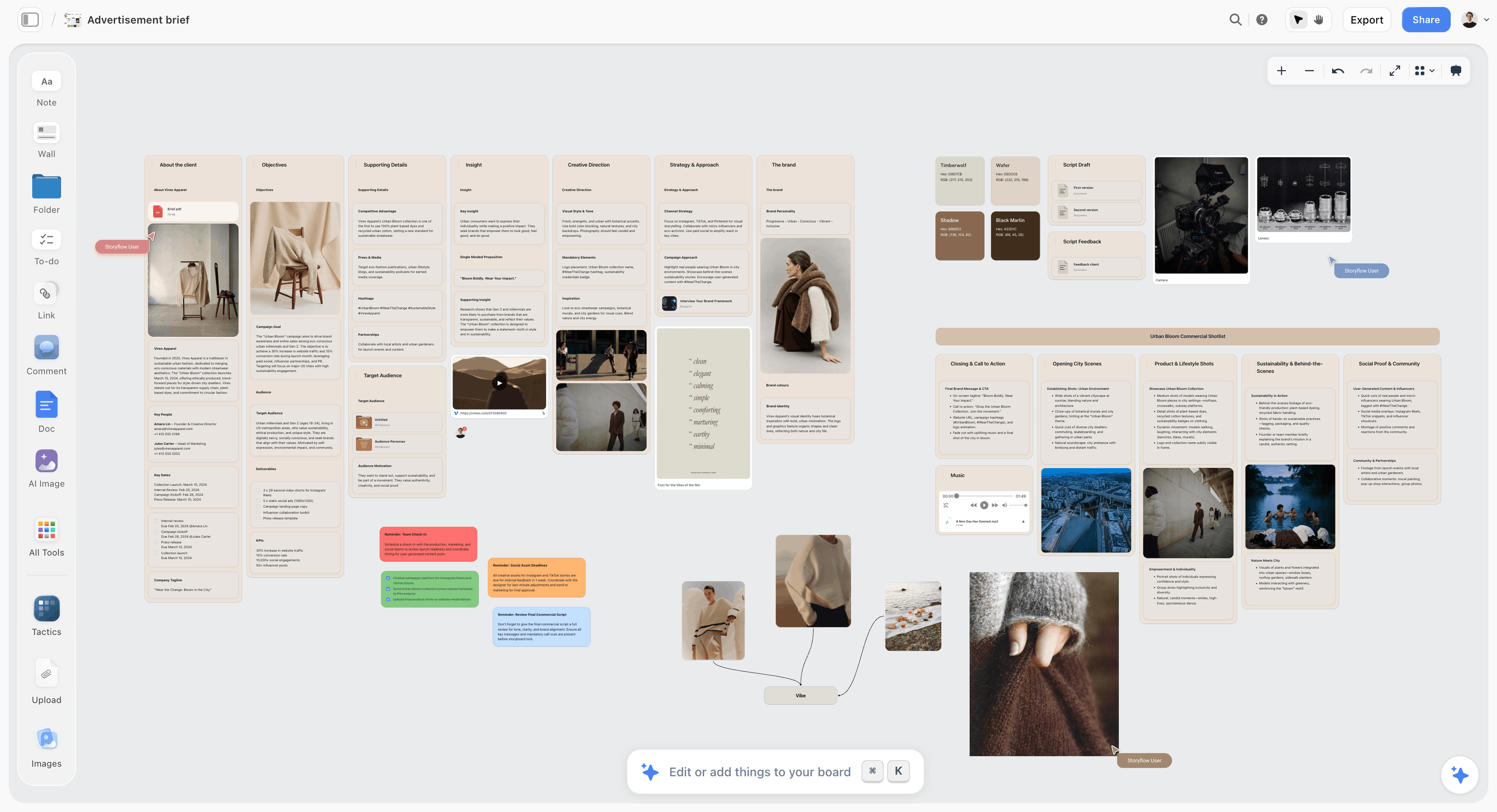
Storyflow is an infinite canvas where the whole ladder is laid out at once: the research on the left, the patterns clustered beside it, the insight stated in the middle, the territories fanning out, the brief at the end. The AI reads the entire current board plus up to five attached documents and three other boards, which is what makes it useful at rungs four and five specifically. You can ask whether the brief still follows from the insight, and it has both. It ships 200+ story blueprints including messaging frameworks such as AIDA, and the AI creative brief generator drafts the rung-five artifact from the material already on the board.
Best for: Strategists who need the brief to stay honest to the research rather than drifting into a nice-sounding document.
Verdict: The strongest tool here for holding the ladder together and checking the top against the bottom. It is not a research platform and it does not produce the insight.
Key features
- Infinite canvas holding research, clusters, territories and briefs together.
- AI reads the whole current board, plus 5 attached documents and 3 attached boards.
- 200+ story blueprints including messaging frameworks.
- Anyone a paid member invites to a board joins free.
Pricing
Early access: every plan is paid for now. A Free plan arrives before the end of 2026, and anyone a paid member invites to a board can sign up free and collaborate today. Plus: $7.99/mo annual, $9.99/mo monthly. Unlimited boards and uploads. Pro: $14/mo annual, $19/mo monthly. AI image generation, more AI usage, memory across conversations. Max: $39/mo annual, $49/mo monthly. Team workspace with roles and permissions.
Pros
- The AI can see the research while it works on the brief, so it can find the drift.
- Cheapest thinking surface in the category, priced per account for individuals.
- Clients and creatives can be shown the board rather than a finished document.
Cons
- No research data of its own: no listening, keywords, audience or trend feeds.
- Weaker than Miro for a large live workshop.
- Paid-only during early access, so not part of a free stack today.
2. NotebookLM
NotebookLM answers only from the sources you upload and cites them inline. For a strategist that constraint is the feature: a finding you can trace back to transcript eleven is a finding you can defend in a room, and a fluent unsourced paragraph is not.
Best for: Turning a research corpus into defensible findings.
Verdict: The best rung-two tool available, and the most generous free tier in this comparison.
Key features
- Answers grounded strictly in your uploaded sources.
- Inline citations back to the exact passage.
- Audio overviews and structured summaries of a corpus.
Pricing
Free tier is generous. Higher limits come via paid Google One AI plans.
Pros
- Citations make every finding checkable and defensible.
- Will not invent, because it cannot reach outside your sources.
- Free tier handles a real research corpus.
Cons
- Confined to what you upload, so it cannot scan a market.
- Weaker than Claude at genuinely hard reasoning.
- No canvas, so clustering happens elsewhere.
3. Claude
Claude holds a very large amount of messy material at once without smoothing it into an average. For rung two that matters more than raw intelligence: forty transcripts summarised individually lose the pattern, and forty transcripts reasoned over together keep it.
Best for: Reasoning across a large, unstructured pile of research.
Verdict: The strongest reasoning partner for pattern work. It will happily attempt rung three if you ask, and section 7 explains why you should not.
Key features
- Long context for whole corpora in one conversation.
- Projects for persistent client and category context.
- Strong document analysis.
Pricing
Free tier with daily limits. Paid from about $17/month billed annually.
Pros
- Engages with the whole pile instead of summarising it.
- Good at arguing against a hypothesis when asked to.
- Free tier does real work.
Cons
- No citations by default, so findings need checking.
- Only knows what you paste each session.
- Daily limits interrupt a long analysis on the free tier.
4. Perplexity
Perplexity is the fastest way to build a picture of a category you do not know: competitors, positioning, pricing, recent moves, all with links. For rung one it replaces a day of tab-opening.
Best for: Scanning an unfamiliar market or a live cultural moment.
Verdict: The best free-to-cheap rung-one tool. It gathers better than it concludes, which is the correct division of labour anyway.
Key features
- Search-grounded answers with inline citations.
- File upload and analysis on paid tiers.
- Model choice on Pro.
Pricing
Free with limited Pro searches. Paid from about $20/month.
Pros
- Current, where a base model is stale.
- Citations let you verify before repeating a claim to a client.
- Excellent for competitive and pricing sweeps.
Cons
- Source quality varies and weak ones are not always flagged.
- Shallow synthesis.
- Overlaps with ChatGPT's research mode.
5. SparkToro
SparkToro answers the question that demographics never do: where does this audience actually spend attention? Which podcasts, accounts, publications, subreddits and YouTube channels. For a strategist it converts an abstract segment into a list of real places.
Best for: Audience research that changes where the work runs, not just who it describes.
Verdict: The highest-value paid data source for a strategist per dollar. It tells you where attention is, not why it is there.
Key features
- Audience attention data across social, podcasts, publications and search.
- Phrase and behaviour-based audience definitions.
- Free tier with limited searches.
Pricing
Free tier with limited searches. Paid from about $50/month, tiered on volume.
Pros
- Answers a question no other tool here answers.
- Output is directly actionable for media and partnerships.
- Free tier is enough to evaluate it honestly.
Cons
- Coverage is thinner in smaller markets and non-English categories.
- Describes behaviour, not motivation.
- Volume tiers are easy to outgrow mid-project.
6. ChatGPT
ChatGPT is the widest surface on the ladder: research with deep research mode, clustering, territory generation and brief drafting all in one subscription. It is beaten by a specialist at each, and it is the one most strategists actually use daily.
Best for: Covering the whole ladder adequately with one subscription.
Verdict: The best generalist. Its rung-three output is confident and generic, which is the specific trap this article is about.
Key features
- Deep research producing sourced reports.
- File and data analysis.
- Broad drafting and image generation.
Pricing
Free tier with limits. Paid from about $20/month.
Pros
- One subscription across every rung.
- Deep research mode is genuinely strong at rung one.
- Everyone on the team already knows it.
Cons
- Produces the consensus reading at rung three, fluently.
- Context resets constantly without deliberate setup.
- Beaten by a specialist at nearly every individual task.
7. Miro
Miro is the standard workshop surface, and its AI clustering shortens the affinity-mapping hour that everyone dreads. When rung two has to happen with eight people in a room or on a call, nothing here beats it.
Best for: Clustering sessions with other humans involved.
Verdict: The best live workshop tool. Boards sprawl afterwards, which is why the strategy rarely lives there past the session.
Key features
- Infinite canvas with a deep template library.
- AI clustering and summarisation of sticky notes.
- Strong real-time multiplayer.
Pricing
Free with 3 editable boards. Paid from about $8/user/month.
Pros
- The best real-time workshop experience available.
- AI clustering saves the worst hour of a research readout.
- Huge template library for strategy frameworks.
Cons
- Large boards become hard to navigate rather than easy to read.
- Three-board free cap is restrictive.
- Poor long-term home for a strategy once the session ends.
8. FigJam
FigJam is Figma's whiteboard, and for a strategist embedded in a design team it removes a tool boundary. Lighter than Miro, cheaper, and the free tier gives three real boards.
Best for: Workshops with a design team already living in Figma.
Verdict: The best lightweight workshop surface and the best free whiteboard here. Thinner on strategy templates than Miro.
Key features
- Whiteboard with sticky notes, diagrams and voting.
- AI diagram generation and note sorting.
- Sits alongside Figma design files.
Pricing
Free with 3 boards. Paid from about $5/user/month.
Pros
- No tool boundary if the team is already in Figma.
- Cheapest paid whiteboard in this comparison.
- Genuinely usable free tier.
Cons
- Fewer strategy-specific templates than Miro.
- Three-board free cap.
- Built for sessions, not for holding a project.
9. Notion
Notion is where the finished strategy document usually lands, and it is good at that. Its limitation for this job is that a document is linear, so research, insight and brief are never visible together and nothing ever compares them.
Best for: The written strategy, and the archive of past ones.
Verdict: The best home for the finished artifact. See Is Notion Good for Visual Project Planning? for where the linear structure stops.
Key features
- Flexible documents and databases.
- AI search across the workspace.
- Strong sharing and permissions for client delivery.
Pricing
Free personal tier. Paid from about $10/user/month; AI is an add-on.
Pros
- Excellent final document and long-term archive.
- Searchable across every past project.
- Easy to share with a client.
Cons
- Linear pages cannot show the ladder at once.
- AI is a paid add-on on top of per-seat pricing.
- Maintenance tax on a large workspace.
10. Semrush
Semrush turns search behaviour into a demand map, which is a weaker signal than motivation but an unusually honest one: people typing a query are telling you what they want in their own words at the moment they want it.
Best for: Sizing demand and finding the language a category actually uses.
Verdict: The most useful paid search data for a strategist. Priced for an agency rather than an individual.
Key features
- Keyword volume, difficulty and intent data.
- Competitor traffic and content analysis.
- AI content and topic tools.
Pricing
Trial only, then from about $140/month; seats cost extra.
Pros
- Real numbers that survive a client meeting.
- Reveals the words a category uses, unprompted.
- Strong competitive visibility data.
Cons
- The most expensive practical tool here for an individual.
- Seats and add-ons push the real price well above the headline.
- Search demand is not motivation, and is easy to mistake for it.
11. Brandwatch
Brandwatch is enterprise social listening with AI theme detection across a very large volume of conversation. When a brief genuinely requires knowing what a population is saying at scale, this is the category and it is priced accordingly.
Best for: Large brands needing conversation data at real scale.
Verdict: The strongest listening platform here. Inaccessible to most independent strategists and small agencies.
Key features
- Large-scale social and web listening.
- AI theme and sentiment detection.
- Dashboards and alerting for ongoing tracking.
Pricing
No public pricing; enterprise quote and annual contract.
Pros
- Genuine scale and historical depth.
- AI theme detection surfaces patterns a human would miss.
- Output is credible to a client's own insights team.
Cons
- Quote-only pricing and annual commitment.
- Sentiment analysis remains unreliable on irony and nuance.
- Substantial learning curve.
12. Glimpse
Glimpse builds on Google Trends to flag terms rising before they are obvious, with alerts. For trend-led categories the value is timing: being early to a shift is worth more than being thorough about one that has already happened.
Best for: Categories where being early is the whole advantage.
Verdict: The best early-signal tool here. It tells you a term is rising, not why, which is rung one and no further.
Key features
- Trend detection layered on Google Trends data.
- Alerts on rising terms.
- Related-trend discovery.
Pricing
Trial, then from about $99/month.
Pros
- Genuinely early signal in fast-moving categories.
- Alerts remove the need to go looking.
- Grounded in real search data.
Cons
- Expensive for what is fundamentally one signal.
- Shows movement, never motivation.
- Irrelevant in slow-moving categories.
7) Rung Three: The One AI Cannot Climb
A language model produces the likely continuation. An insight is the unlikely reading that turns out to be true. Those are opposite operations, and no amount of model capability closes the gap.
This is worth stating carefully, because it is not the usual hand-waving about human creativity. It is a claim about what the tool does.
Here is the failure in its usual form. A strategist runs a good rung-one and rung-two process. Forty interviews, properly clustered, real patterns. Then they paste the patterns into a model and ask for the insight. What comes back is a sentence like: *busy professionals want tools that save time without sacrificing quality.* It is grammatical, it is consistent with every pattern, and it is worthless, because it is the consensus reading. It is what the average of the training data says about a pile that looks like this pile. A creative team given that sentence produces the average of the category, which is what the client is already doing.
Compare a real insight from the same evidence: *they do not want to save time, they want to be seen deciding.* That is a different claim. It is falsifiable, it is uncomfortable, it reframes the brief, and it is arrived at by noticing that in eleven of forty interviews people narrated their choice to a colleague unprompted. The leap is from a pattern to a motive, and motives are not in the pattern. They are inferred by a person who has met people.
There is a second, subtler reason to keep the model off this rung, and it costs more than the bad output. A fluent wrong insight is harder to reject than a blank page. Given a confident paragraph, a team will start refining it instead of questioning it, because refining feels like progress. The strategist ends up defending a sentence they did not arrive at, and the tell is that they cannot say which evidence would disprove it.
So the practical discipline:
- Use AI hard on rungs one and two. Gather, cluster, summarise, tag. It is better than you are at this and it does not get bored.
- Write rung three yourself, on paper or in a blank card, before opening any model. Constrain it: one sentence, falsifiable, and name the evidence that would kill it.
- Then bring AI back for rungs four and five as an adversary, not an author. "Here is my insight and here are the patterns. Which patterns does it fail to explain?" That question is genuinely useful and it requires the model to see the evidence, which is why a tool that holds the whole ladder is worth more here than a smarter model that sees only your prompt.
This is the same stance Storyflow takes generally: the AI proposes and checks, the person decides. On this rung that is not a philosophical preference, it is a description of what the technology can and cannot do.
8) Where AI Actively Hurts a Strategist
Four failure modes worth naming, each observed in real projects.
Consensus laundering. The model returns the category's existing wisdom, and because it arrived via your own research it feels earned. The symptom is an insight that any competitor could also have written. The check: would this sentence embarrass a rival if they read it? If not, it is not an insight.
Premature fluency. A rough idea gets polished before it is tested, and polish makes it feel finished. Strategy dies in the gap between sounding right and being right. Keep rung three ugly for as long as possible.
Evidence that was never there. A model asked to summarise a corpus will occasionally produce a quotation that nobody said. It will be exactly the quotation you wanted. This is why NotebookLM's citations matter more in this job than raw capability, and why any quoted line going into a client deck must be traced back to the transcript.
Volume mistaken for depth. These tools make it trivial to produce forty pages of research summary. Nobody reads forty pages, the client pays for the leap rather than the pile, and a thick deck is often the tell that rung three never happened.
The common thread: AI lowers the cost of the parts of strategy that were never the bottleneck, which makes it tempting to do more of them instead of the part that is.
9) Recommended Creative Strategy Stacks
Stack 1: Independent strategist. Storyflow (the ladder) + NotebookLM free (synthesis) + Perplexity free (scanning) + SparkToro entry tier (audience). About $58/month, and most of it is the audience data.
Stack 2: Small agency strategy team. Storyflow (shared board, collaborators join free) + Claude (reasoning) + Miro (workshops) + Semrush (demand data). About $173/month plus seats.
Stack 3: In-house brand strategist. Storyflow (the ladder) + NotebookLM (synthesis of internal research) + Notion (archive) + whatever listening platform the company already pays for.
Stack 4: Zero-budget strategist. NotebookLM free + Claude free + FigJam free boards + Google Trends. A real working setup at no cost, missing only paid audience data.
Stack 5: Cheapest paid stack. Storyflow at $7.99/month billed annually + NotebookLM free + Perplexity free.
| Strategist shape | Gathers with | Clusters with | Holds the ladder | Monthly cost |
|---|---|---|---|---|
Independent | Perplexity, SparkToro | NotebookLM | Storyflow | about $58 |
Small agency team | Semrush, Perplexity | Miro, Claude | Storyflow | about $173 plus seats |
In-house brand | Existing listening platform | NotebookLM | Storyflow, archived to Notion | about $18 plus existing |
Zero budget | Google Trends, Perplexity free | NotebookLM free | FigJam free | $0 |
Cheapest paid | Perplexity free | NotebookLM free | Storyflow | $7.99 |
The pattern across all five: one data source you can afford, one synthesis tool with citations, and one cheap surface that holds the whole ladder. The stacks that fail are the ones with three data sources and no thinking surface, because they spend the budget on the rung that was never the bottleneck.
10) What a Strategy Stack Costs
The interesting cost in creative strategy is not the software. It is worth being explicit about the ratio.
Data is expensive and thinking is nearly free. Semrush at about $140, Glimpse at about $99, SparkToro from about $50 and Brandwatch on an enterprise contract can exceed $300 a month between them. The tools that hold the actual thinking cost under $20 combined: NotebookLM free, Claude free or about $17, Storyflow at $7.99 billed annually. A strategist who inverts that ratio, buying data and writing in a blank document, has bought the rung that was never the constraint.
Per-seat pricing punishes a strategy team specifically, because strategy is collaborative by nature and the people who need to see the board (the creative director, the account lead, the client) are not the people producing it. Tools that charge per head for viewers make showing the work expensive, which quietly leads to showing less of it. Storyflow's individual plan is priced per account and anyone a paid member invites to a board joins free, so the client and the creative team can look at the ladder without buying seats.
The third cost is the one nobody budgets: the deck. Compressing a quarter of thinking into a client presentation typically takes two to four days per project. Nothing on this list removes that entirely, and the thing that shortens it most is having the ladder already visible somewhere you can walk a client through, rather than rebuilding the argument from scratch in slides.
| Cost driver | Tools affected | What it costs | The move |
|---|---|---|---|
Research data | Semrush, Brandwatch, Glimpse, SparkToro | $50 to $300+/mo | Buy one source, not three |
Per-seat viewing | Miro, Notion, Semrush | Multiplies with every observer | Prefer per-account or free viewers |
Thinking surface | Storyflow, NotebookLM, Claude | Under $20/mo combined | Underspending here is the common error |
Deck production | None of them | 2 to 4 days per project | Keep the ladder walkable so the deck is a compression, not a rebuild |
11) Honorable Mentions
- Google Trends. Free, and still the fastest sanity check on whether a thing is actually rising.
- Gemini with Deep Research. Strong long-form research reports, particularly inside a Google-based organisation.
- Talkwalker. Brandwatch's closest rival in enterprise listening.
- Ahrefs. Semrush's main alternative, often preferred for backlink and content-gap work.
- Dovetail. Purpose-built research repository with tagging and analysis, strong for teams running continuous research.
- Consensus and Elicit. Academic literature search, genuinely useful when a brief touches behaviour science.
- Milanote. A pleasant board for visual references and territory boards, weaker once the AI needs to read the whole thing.
- Obsidian. Free, local, and a good long-term home for a strategist's accumulating pattern library.
12) Tools to Avoid for Creative Strategy
- Any tool promising to generate the strategy. It will generate a strategy-shaped document. The shape was never the hard part.
- A listening platform bought before there is a question. Listening answers a question; it does not produce one, and an unfocused dashboard is a subscription to noise.
- Three data sources on an independent budget. The marginal insight from source three is far smaller than the marginal insight from actually thinking, which is free.
- A model at rung three, with no evidence in context. Consensus laundering, guaranteed.
- Sentiment scores taken literally. Irony, sarcasm and category-specific language all break them, and a client who knows their category will notice first.
- A separate tool per rung. Research in one, clusters in another, brief in a third, and by rung five nothing can be checked against rung one, which is where the drift lives.
14) The Bottom Line
The best AI tools for creative strategists in 2026 are the ones honest about which rung of the ladder they serve. Storyflow is the best pick for holding the whole ladder where an AI can read it, which is what makes checking a brief against an insight possible. NotebookLM is the best synthesis tool because its findings cite your own sources. Claude is the strongest reasoner across a large pile. SparkToro is the best paid audience data per dollar.
AI is excellent at rungs one and two, structurally unsuited to rung three, and useful again at four and five only when it can see the rungs below. Spend on one data source, keep the thinking surface cheap, and write the insight yourself before you open a model. The leap is still the job.
To start, open a Storyflow canvas, lay the research, the patterns and your one-sentence insight on the same board, and ask which patterns the insight fails to explain.
FAQ: AI Tools for Creative Strategists
What is the best AI tool for creative strategists in 2026?
Storyflow is the best AI tool for creative strategists at the point the work gets hard: the research, the patterns, the territories and the brief sit on one canvas and the AI reads the whole board, so it can tell you where the brief has stopped following from the insight. It starts at $7.99/month billed annually and anyone a paid member invites to a board joins free. NotebookLM is the best tool for synthesis you can defend because every claim cites your own sources, Claude is the strongest reasoner across a large research pile, and SparkToro is the best paid audience data per dollar. The mistake to avoid is asking a model for the insight itself, which returns the consensus reading of your evidence phrased with confidence.
Can AI do creative strategy?
It can do most of creative strategy and not the part the job is named after. Gathering inputs and finding patterns are pattern-recognition problems and AI is transformative at both. The insight, meaning the non-obvious reading of those patterns that turns out to be true, is a leap from pattern to motive, and motives are not present in the pattern. A model asked for it returns the likely continuation, which is the opposite of what an insight is.
What is the best AI tool for audience research?
SparkToro for where an audience actually spends attention, which is the question demographics never answer. Perplexity for a fast sourced picture of an unfamiliar category. NotebookLM for turning your own interviews and sales calls into findings you can trace back to a source. If the organisation already pays for a listening platform such as Brandwatch, use it rather than buying a second data source.
What is the best free AI tool for creative strategy?
NotebookLM, by a distance. The free tier handles a real research corpus, answers only from your sources and cites them, which is exactly the rung-two job. Pair it with the free tiers of Claude and Perplexity and FigJam's free boards for clustering, and you have a genuine working setup at zero cost. Storyflow is paid-only during early access so it is not part of a free stack today; its Free plan launches before the end of 2026.
How do I write a creative brief with AI?
Do rungs one to three first without it: gather, cluster, and write the insight yourself in one falsifiable sentence. Then use AI to draft and pressure-test the brief, and make sure the model can see the research and the insight while it works, or it cannot catch the drift between them. The most valuable question to ask is not "write the brief" but "here is my insight and here are my patterns, which patterns does this insight fail to explain".
Which AI is best for analysing customer interviews?
Claude if the pile is large and messy, because long context lets it reason across all of it rather than summarising each one separately and losing the pattern. NotebookLM if you will have to defend the finding, because it cites the exact passage. Many strategists use both: NotebookLM for the traceable findings and Claude for the harder reading of what they mean together.
Is Miro or FigJam better for strategy workshops?
Miro for a large session with many participants and for its deeper strategy template library. FigJam if the team already lives in Figma, because it removes a tool boundary and it is cheaper at about $5 per editor. Both have free tiers with three boards. Neither is a good long-term home for a strategy once the workshop ends, which is a different job.
How much should a creative strategist spend on tools?
Under $60 a month as an independent, and the split matters more than the total: one affordable data source, then a thinking surface that costs almost nothing. The common error is inverting that, paying $300 a month across three research platforms and then writing the strategy in a blank document. Data was never the bottleneck.
What is the difference between creative strategy tools and marketing tools?
Marketing tools execute: scheduling, campaigns, email, ads, reporting. Creative strategy tools serve the thinking that happens before any of that: research, patterns, insight, territory and brief. A tool that promises both usually does the execution well and the thinking shallowly, because the two need opposite things, structure for execution and openness for thinking.
Can AI find an insight in my research?
It can find every pattern in your research, reliably and faster than you. It cannot reliably find the insight, because an insight is an inference about motive that is not contained in the pattern, and a model trained to produce the likely continuation will give you the consensus reading. Use it to make sure you have not missed a pattern, then make the leap yourself, then ask the model which patterns your leap fails to explain.
What should a creative strategy brief contain?
An insight stated as one falsifiable sentence, the evidence behind it, the audience described by behaviour rather than demographics, the single thing the work must achieve, the constraints that are genuinely non-negotiable, and what success looks like. Anything else is context, and context belongs on the board rather than in the brief. Compression is the whole craft at rung five.
How do I keep a brief honest to the research?
Keep them visible together and have something check them against each other. Drift happens because the research lives in one tool, the insight in someone's head and the brief in a document, so nothing ever compares them. A canvas holding all three with an AI that reads the whole board makes "does this brief still follow from this insight" a question you can actually ask.
Do I need social listening for every project?
No, and buying it before you have a question is the most common wasted spend in this category. Listening answers a specific question well and produces noise when pointed at a category in general. For most projects a smaller corpus you gathered deliberately, meaning interviews, sales calls and reviews, produces better insight than a large one you did not.
What is the best tool for presenting a strategy to a client?
The presentation is a compression of the ladder, so the thing that shortens it most is having the ladder already walkable. A canvas you can zoom through from research to brief lets a client follow the argument rather than take your word for it, and the deck becomes a compression rather than a rebuild. For the deck itself, see the best tools for presenting a campaign concept to a client.
Table of Contents
- Article Metadata
- Breadcrumb
- Table of Contents
- 1) Quick Answer: The Best AI Tools for Creative Strategists in 2026
- All 12 AI Tools for Creative Strategists, Ranked
- 2) Comparison Table: 12 Creative Strategy Tools at a Glance
- Frequently Asked: Which Creative Strategy Tools Strategists Trust, and Which Ones Flatten the Work
- 3) The Strategy Ladder
- 4) How We Evaluated These Tools
- 5) Quick Picks by Strategy Need
- 6) Detailed Reviews: 12 AI Tools for Creative Strategists
- 7) Rung Three: The One AI Cannot Climb
- 8) Where AI Actively Hurts a Strategist
- 9) Recommended Creative Strategy Stacks
- 10) What a Strategy Stack Costs
- 11) Honorable Mentions
- 12) Tools to Avoid for Creative Strategy
- 14) The Bottom Line
- 15) Author
- 16) Related Reading
- FAQ: AI Tools for Creative Strategists
Templates to check out for this topic


Templates you can use in Storyflow
Every Storyflow board starts from real structure and an AI that reads the whole canvas. Open one of these templates and make it yours.


See Storyflow in Action
A visual AI workspace where every feature lives inside one canvas. No tab-switching, no context lost.
Build your entire board from a single message
Type what you need in the AI chat at the bottom of your canvas. The AI adds cards, headings, and structure directly onto your board.
Use expert frameworks as AI context
Type @ in the AI chat and choose any Tactic. The AI tailors every response to that framework instead of giving generic advice.
Turn your board into a mind map in seconds
Ask the AI to restructure your canvas as a mindmap. It connects your ideas into a visual hierarchy so you can see how everything relates.
Why Storyflow Exists
Storyflow actually began as a personal tool while working on creative and research projects.
We kept running into the same problem: ideas were scattered everywhere: notes, documents, and whiteboards.
Nothing helped us see how everything connected.
So we started building a workspace designed around how ideas actually grow.
→ Read how Storyflow was createdStoryflow Team
Product & Research Team
Published: 2026-09-22
Extremely simple, seriously capable


See how easy it is to get started
Watch a real project come together, from a blank board to a finished plan, clicked through step by step.
Start creating with AI and become more productive
Transform your creative workflow with AI-powered tools. Generate ideas, create content, and boost your productivity in minutes instead of hours.