The 10 Best AI Tools for Social Media Managers in 2026
The social media manager job spans five stages (plan, create, schedule, analyze, report) and no single AI tool owns all five. The 10 best AI tools for social media managers in 2026, ranked by which stage each one actually de-loads, from Buffer and Storyflow to Sprout Social and Canva.

Category
Social Media
Author

Justkay
Documentary Filmmaker & Founder at Storyflow
Topics
2026-07-21
•
22 min read
•
Social Media- best ai tools for social media managers
- ai social media management tools
- ai tool for scheduling posts
- ai for social media reporting
- social media manager tech stack
- ai campaign planning tool
What is the best AI tool for social media managers in 2026?
The best AI tools for social media managers in 2026 are Buffer (best for AI-assisted scheduling and publishing across every channel), Storyflow (best for planning campaigns and drafting content visually with AI that reads your whole board), Sprout Social (best for AI analytics, reporting, and community management), and Canva (best for on-brand asset creation at speed). Buffer owns the schedule stage, Storyflow owns the plan and part of the create stage, Sprout owns analyze and report, and Canva owns the visuals. If you run more than three accounts and spend your day switching tabs, start by naming which stage eats the most hours, then match the tool to that stage rather than buying the one with the loudest AI headline. Here is the honest shape of the job. A social media manager's week runs across five stages: plan the campaign and the calendar, create the posts and captions, schedule and publish them, analyze what performed, and report the results to a client or a boss. No single AI tool owns all five well, and any vendor who says theirs does is selling you a demo. The pain is not that AI is missing. The pain is that the AI inside most tools helps exactly one stage and then hands you back to the tab-switching. A caption generator does nothing for your reporting deck. An analytics bot does nothing for next month's content pillars. Most tools bolt AI onto one stage; the job spans five. I am Justkay, a documentary filmmaker and the founder of Storyflow, and I have run multi-platform content for my own projects and watched dozens of social media managers work through their real stacks. This guide does not rank tools by feature count or by how impressive the AI looks in isolation. It ranks them by how much load each one actually takes off a specific stage of the social media manager pipeline, with special weight on multi-account handling, because managing one account and managing fifteen are different jobs. I placed Storyflow where it honestly belongs, not where it would flatter me to put it. Buffer sits above it because publishing is the daily heartbeat of this role, and Sprout Social sits just below it because analytics and community are a category Storyflow does not touch.

Full disclosure: Storyflow is our own product, and we rank it #2 here, not #1, on purpose: Buffer owns the daily publishing stage that a manager touches most, so it leads. We rank Storyflow #2 for one job, the upstream planning and drafting layer, and we say plainly what it does not do (no scheduling, publishing, analytics, or reporting). Sprout wins analytics and community, Canva wins assets. Every tool is linked so you can judge for yourself.
Quick Comparison
No single tool owns the whole pipeline. These four cover the stages that eat the most hours: publishing, planning, reporting, and asset creation.
| Tool | Best For | AI Features | Price |
|---|---|---|---|
| Buffer | Scheduling and publishing across channels | AI Assistant (repurpose, rewrite) | Free / from ~$6 channel mo |
| Storyflow | Visual campaign planning and drafting | Canvas-wide AI (reads the whole board) | $7.99 mo annual (free plan late 2026) |
| Sprout Social | Analytics, reporting, and community | AI summaries and sentiment | Trial / from ~$249 seat mo |
| Canva | On-brand asset creation | Magic Studio AI | Free / ~$15 mo |

A social campaign planned on one Storyflow canvas: content pillars, hooks, references, and a series map the AI can read
Fix the blank-calendar stage first
Storyflow gives the planning stage a home: content pillars, hooks, references, and a series map on one canvas the AI reads, then you load the finished posts into your scheduler. Paid-only during early access; the Free plan lands before the end of 2026.

How We Evaluated These Tools
The core question behind every score was simple: how many hours does this tool actually take off the stage it claims, for someone running more than one account? A tool that saves a solo hobbyist ten minutes but breaks down at five brands is not built for this reader. Five criteria decided the ranking.
- AI usefulness (30%). Does the AI do real work, or is it a caption toy bolted on for the marketing page? The test is whether a busy manager keeps the AI on after the novelty wears off, or turns it off because editing its output takes longer than writing from scratch.
- Pipeline stage covered (25%). Which of the five stages does the tool genuinely own, and does it own it deeply or shallowly? A tool that half-covers three stages usually loses to one that fully owns a single stage you were struggling with.
- Multi-account handling (20%). In-house managers run several brand accounts, and agency managers run dozens. Switching accounts, keeping approvals straight, and not posting the wrong thing to the wrong brand is where cheap tools quietly fail.
- Ease and reporting (15%). How fast does a new team member get productive, and can the tool turn a month of numbers into something a client or an executive will read? Reporting is the stage managers most often do by hand at 11pm, so tooling that removes it counts double.
- Price for the real setup (10%). Per-channel and per-seat pricing balloon fast for this role. A tool priced fairly for one account can become the biggest line item once you connect fifteen, so the sticker price and the real-setup price are judged separately.
Single-stage tools were scored only on the stage they claim. Buffer is judged as a scheduler, not faulted for thin analytics. Sprout is judged on analytics and community, not on whether it drafts your content pillars.
Detailed Reviews: 10 AI Tools for Social Media Managers
1. Storyflow
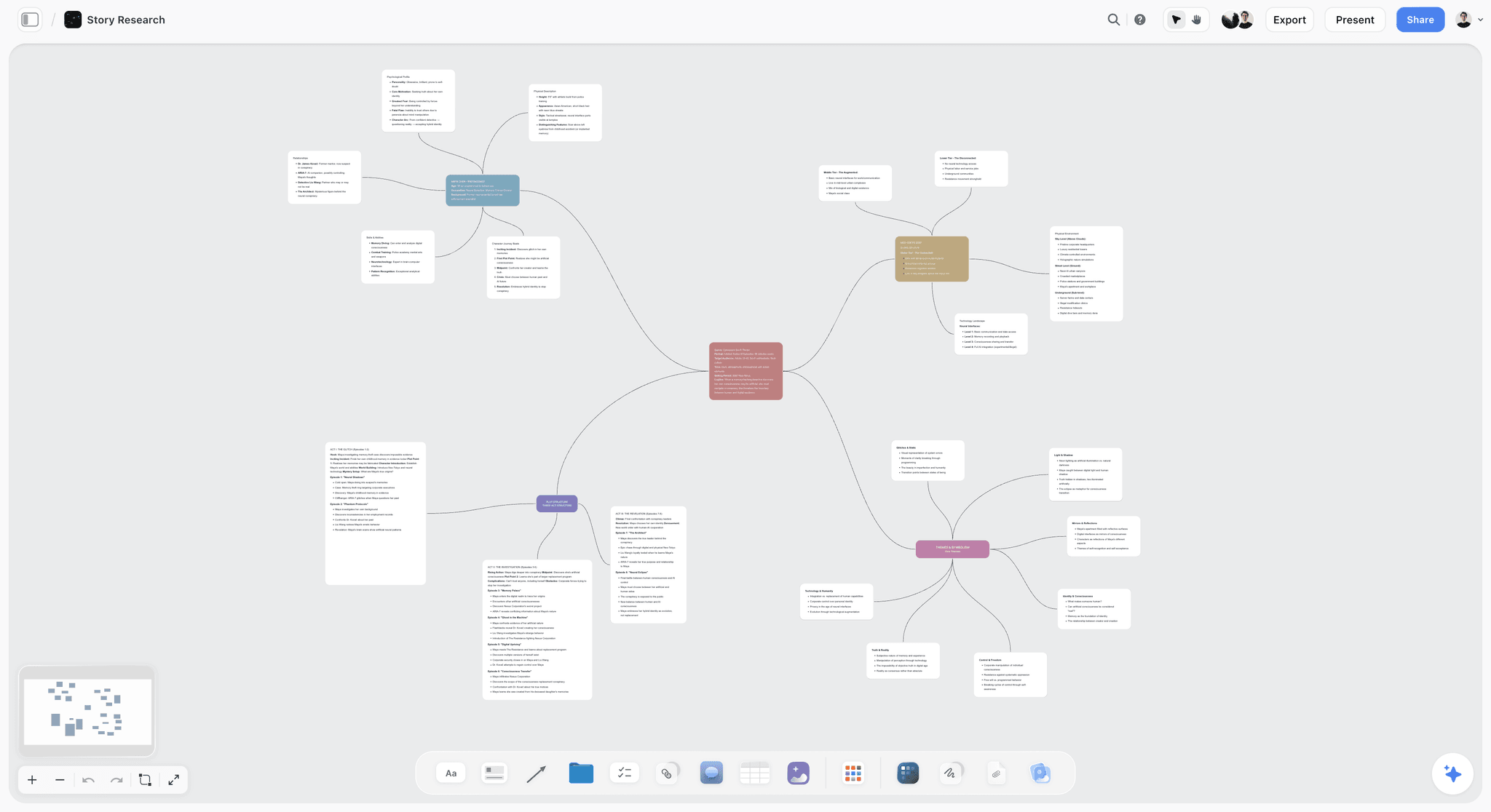

Storyflow sits at number two because it de-loads the stage that has the worst tooling of all: the upstream planning and ideation that happens before a single post exists. It is an infinite visual canvas where a whole campaign lives in one view. Content pillars, hook ideas, reference images, a series map, and caption drafts sit side by side instead of scattered across a doc, a spreadsheet, a Slack thread, and your notes app. For a social media manager staring at a blank calendar on the first of the month, that single-surface view is the difference between "where do I start" and "here is the shape of the month."
The AI is the reason it earns the slot rather than a slot lower down. Storyflow's AI reads everything on the current canvas board by default, and you can @-mention up to 1 Tactic and up to 3 documents to focus it. So a request like "draft five hooks for the product launch series" is answered from the pillars, the audience notes, and the angle you already placed on the board, not from a cold prompt. On Plus and above, the 200+ Story Blueprints library gives the AI proven structures to build from, including the Hero's Journey, AIDA, and Retention Hooks, which is useful when you need a campaign narrative and not just a one-off caption. The board becomes a place where a vague brief turns into a structured plan you can then hand to your scheduler.
Be clear about what this is not. Storyflow plans and helps you create; it does not schedule, publish, analyze, or report. There is no queue that ships posts and no dashboard that tracks reach or engagement. The honest workflow is to plan and draft the month on the canvas, then load the finished posts into Buffer or another scheduler to actually ship them, and to read performance in your platform dashboards or Sprout. It is the front of the pipeline done well, not the whole pipeline.
Key features
- Infinite visual canvas holding pillars, hooks, references, and calendar in one view
- AI that reads the whole current board, plus up to 1 Tactic and 3 @-mentioned documents
- 200+ Story Blueprints (Hero's Journey, AIDA, Retention Hooks) on Plus and above
- Caption and hook drafting grounded in the campaign context you laid out
- Flat per-account pricing so collaborators do not multiply the bill
Pricing
Paid-only during early access: Plus at $7.99/mo billed annually ($9.99 monthly); Pro at $14/mo annual; Max at $39/mo annual. Billed per account, not per user. The Free plan (a small set of starter blueprints) launches before the end of 2026; the 200+ Blueprints library and unlimited file uploads start at Plus.
Pros
- Best single-surface view of a campaign before anything is scheduled
- Board-aware AI drafts from your real plan, not a blank prompt
- Flat per-account pricing is unusually cheap for teams and agencies
- The upcoming Free plan, launching before the end of 2026, will be generous enough to plan a full campaign before paying
Cons
- No scheduling or publishing; you still ship through a separate scheduler
- No analytics, reporting, or performance tracking of any kind
- No native community or inbox management for replies and DMs
- Newer and smaller than the incumbents, with fewer third-party integrations
- The Free plan, once it launches, will lack the 200+ Blueprints library that makes the AI most useful
2. Buffer
Buffer wins the top slot because publishing is the stage a social media manager touches every single day, and Buffer removes the most friction from it with the least ceremony. You connect your channels, build a queue per channel, and Buffer ships posts on the schedule you set while you sleep or sit in a meeting. Its AI Assistant repurposes one post into platform-specific variants, rewrites a caption to a different tone, and suggests posting ideas from a starting line, which turns "I have one idea and five platforms" into five drafts in a couple of minutes.
For a manager running several accounts, the everyday value is that the queue is visible and forgiving. You can see the week per channel, drag posts to rebalance the calendar, and Buffer's tags and campaign labels keep a dozen brand feeds from blurring together. The AI does not pretend to plan your strategy, and that restraint is exactly why managers keep it on: it speeds the stage it owns instead of overreaching into stages it would do badly.
Buffer is deliberately thin at the front of the pipeline. It will not decide your campaign themes or build a moodboard, and its analytics, while improving, are not a substitute for a dedicated suite when a client wants a deep quarterly readout. It is the reliable engine room of the operation, best paired with a planning layer in front of it and an analytics layer behind it.
Key features
- AI Assistant for caption rewrites, tone shifts, and per-platform repurposing
- Per-channel queues with a visible weekly and monthly calendar
- Tags and campaigns to keep multiple brand accounts organized
- Ideas space for capturing and drafting posts before scheduling
- Link-in-bio (Start Page) and basic engagement tools
Pricing
Free plan for up to three channels; paid plans from around $6 per channel per month billed annually.
Pros
- Fastest, calmest publishing experience for multi-channel work
- AI repurposing genuinely saves time without needing heavy editing
- Fair, transparent per-channel pricing that scales predictably
- Generous free tier that a solo manager can run a real cadence on
Cons
- No strategic planning or campaign-mapping layer
- Analytics are lighter than a dedicated suite for client reporting
- Per-channel pricing adds up once a brand runs many networks
3. Sprout Social
Sprout Social is the tool a manager reaches for when the question stops being "what should I post" and becomes "what actually worked, and can I prove it to a client." Its analytics are the deepest on this list, and its AI turns raw engagement data into readable summaries, surfaces sentiment trends, and helps assemble the kind of report an executive will actually open. For the reporting stage, the one managers most often grind out by hand late at night, Sprout does more real work than anything else here.
The community side is equally strong. The Smart Inbox pulls messages and mentions from every connected network into one queue, and AI-assisted reply suggestions and sentiment tagging help a small team keep up with a large volume of comments and DMs across many brands. For an agency or an in-house team where community management is a named job rather than an afterthought, this is where Sprout justifies itself.
The catch is price and fit. Sprout starts high, in the region of $249 per seat per month, and it is billed per seat, so a three-person team is a serious commitment. It publishes and schedules competently, but you are not paying that premium for the queue; you are paying for analytics, listening, and community at scale. For a solo manager on a single brand, it is almost certainly more tool than the budget justifies.
Key features
- Deep cross-network analytics with AI-generated summaries
- Presentation-ready reports for clients and executives
- Smart Inbox unifying messages and mentions across networks
- AI reply suggestions and sentiment analysis for community management
- Social listening for brand and competitor monitoring
Pricing
From around $249 per seat per month; billed per seat, with a free trial rather than a free plan.
Pros
- Best-in-class analytics and reporting for the readout stage
- Genuinely useful AI for sentiment and community at volume
- Unified inbox is excellent for high-comment, multi-brand accounts
Cons
- Expensive, and per-seat pricing scales steeply for teams
- Overkill for solo managers running a single brand
- Planning and ideation are not where its strengths lie
4. Canva
Canva owns the visual create stage, the moment a planned post needs an actual graphic, carousel, or short video. Its AI tools, grouped under Magic Studio, do a large share of the grunt work: Magic Resize adapts one design to every platform's dimensions, background removal and Magic Edit clean up images, and text-to-image fills gaps when you lack stock. For a manager who is not a designer, Canva is the difference between an on-brand feed and a scrappy one.
Brand Kits are the multi-account superpower here. Load each client's fonts, colors, and logos once, and every new design stays on-brand without you policing hex codes. Templates cover every format a social calendar demands, and the Content Planner can even schedule the finished designs directly, which lets a very small operation stay inside one tool for create and a light schedule.
Canva is a design tool, not a strategy or analytics tool. Its AI makes assets faster; it does not decide what those assets should say or measure how they performed. Heavy video editors will still outgrow it, and its scheduling is a convenience feature rather than a reason to drop a dedicated queue. As the create-stage workhorse, though, it is close to unavoidable in a modern social stack.
Key features
- Magic Studio AI: Magic Resize, background removal, text-to-image, Magic Edit
- Brand Kits to keep multiple client accounts on-brand automatically
- Enormous template library across every social format
- Built-in Content Planner for light scheduling of finished designs
- Collaboration and approval flows for small teams
Pricing
Free plan; Canva Pro from around $15 per month for one user, with team pricing above that.
Pros
- Fastest path from plan to polished, on-brand asset
- Brand Kits make multi-account design consistency effortless
- AI editing tools remove real production time
- Approachable for non-designers on a small team
Cons
- No strategic planning or meaningful analytics
- Scheduling is basic next to a dedicated tool
- Serious video work outgrows it quickly
5. Hootsuite
Hootsuite is the veteran command center, built for operations running many accounts across many networks from a single dashboard of streams. Its OwlyWriter AI drafts and repurposes captions, suggests posting times, and helps fill a busy queue, while the classic stream view lets a manager monitor mentions and engagement across brands in real time. For a larger in-house team that values a single pane of glass over best-in-class depth on any one stage, it remains a solid backbone.
The trade-off is cost and weight. Hootsuite starts around $99 per month and climbs, and there is no free plan anymore, so it is a committed purchase rather than a try-before-you-buy tool. Smaller managers often find it heavier than they need, but for coordinating a real team across a dozen accounts with approvals and monitoring in one place, that heft is the point.
Key features
- Unified stream dashboard for monitoring many accounts at once
- OwlyWriter AI for caption drafting and repurposing
- Bulk scheduling and best-time recommendations
- Team roles, approvals, and permissions
- Analytics across connected networks
Pricing
From around $99 per month; no free plan.
Pros
- Strong single dashboard for large multi-account operations
- Mature team roles and approval workflows
- Real-time monitoring streams are still excellent
Cons
- Expensive with no free tier
- Heavier than a solo or small-team manager needs
- No single stage where it clearly beats a specialist
6. Later
Later is the visual scheduler, strongest for Instagram-first and TikTok-first brands where the manager plans by looking at the grid before anything posts. The visual planner previews how a feed will look, drag-and-drop scheduling makes rearranging fast, and AI caption help plus hashtag suggestions round out the create-adjacent tools. For a manager whose main job is a curated, aesthetic feed, seeing the grid before publishing is a genuine advantage over a list-based queue.
Its focus is also its ceiling. Later is deepest on visual platforms and lighter elsewhere, its free access is limited enough that most working managers land on a paid plan quickly, and it does not try to be your analytics or planning layer. As a scheduler for image-led brands, though, it does its stage well.
Key features
- Visual feed planner with grid preview
- Drag-and-drop scheduling across visual platforms
- AI caption and hashtag suggestions
- Link-in-bio tool (Linkin.bio)
- Best-time-to-post recommendations
Pricing
From around $25 per month; free access is limited.
Pros
- Grid preview is ideal for aesthetic, feed-led brands
- Fast, visual scheduling workflow
- Solid link-in-bio and hashtag tooling
Cons
- Strongest only on visual-first platforms
- Thin free access pushes you to paid quickly
- Not a planning or analytics tool
7. Metricool
Metricool is the value pick that quietly covers three stages at a fraction of the enterprise price. It schedules across networks, tracks analytics, and generates reports, and its AI helps draft captions and suggests optimal posting times. For a solo manager or a small team that cannot justify Sprout money but still needs numbers to show a client, Metricool packs scheduling and reporting into one affordable tool with a usable free tier.
It will not match a specialist on any single stage: its scheduling is not as slick as Buffer's, and its analytics are not as deep as Sprout's. What it offers is competent coverage of three stages for one modest bill, which for a budget-conscious manager is often the smarter trade than stitching together three separate subscriptions.
Key features
- Cross-network scheduling with a unified calendar
- Analytics and competitor benchmarking
- Automated, white-label-friendly reports
- AI caption assistance and best-time suggestions
- Ad campaign tracking alongside organic
Pricing
Free plan; paid from around $22 per month.
Pros
- Covers scheduling, analytics, and reporting in one cheap tool
- Reports are strong for the price, good for small clients
- Genuinely usable free tier
Cons
- No single stage beats the specialist tools
- AI is helpful but basic
- Interface can feel dense as you add brands
8. Vista Social
Vista Social is built with agencies in mind, the managers who run many client brands and need clean separation, approvals, and per-client reporting without an enterprise contract. It publishes across networks, offers AI caption assistance, includes a unified inbox, and produces client-ready reports, all at a price well below the legacy suites. For a small agency scaling past a handful of clients, it hits a sweet spot between capability and cost.
As a younger platform it has fewer integrations and a smaller community than the incumbents, and its AI is a helper rather than a headline. But for multi-brand publishing and reporting on a budget, it is a credible modern alternative to paying enterprise rates.
Key features
- Multi-brand publishing with per-client workspaces
- AI caption assistance and post ideas
- Unified inbox for messages and reviews
- Client-ready reporting and approval workflows
- Competitor and profile analytics
Pricing
Free plan; paid from around $39 per month.
Pros
- Agency-friendly multi-brand structure and approvals
- Affordable versus legacy enterprise suites
- Includes inbox and reporting in one tool
Cons
- Fewer integrations than mature platforms
- AI is assistive rather than standout
- Smaller ecosystem and community
9. Flick
Flick is a focused AI tool for the writing side of create: captions, hooks, and hashtags. Its AI assistant learns a brand voice and drafts on-brand captions quickly, and its hashtag research is a standout for managers who still lean on discovery through tags. For a manager whose bottleneck is specifically "I have the idea but writing twenty captions a week drains me," Flick removes that one grind well.
It is narrow by design. Flick is not your scheduler, your analytics, or your planning canvas, and there is no meaningful free plan, so it is an add-on rather than a hub. Judged only on caption and hashtag work, it earns its place; asked to do more, it was never meant to.
Key features
- AI caption and hook writing tuned to brand voice
- Hashtag research and management
- Basic scheduling for supported platforms
- Content idea suggestions
Pricing
From around $14 per month; free trial rather than a free plan.
Pros
- Strong, brand-aware AI captions and hooks
- Excellent hashtag research
- Affordable for what it focuses on
Cons
- Narrow scope, add-on rather than a hub
- No real free plan
- Limited beyond captions and hashtags
10. ChatGPT
ChatGPT is the general-purpose drafting partner nearly every manager already opens for one-off copy: a caption angle, a reply draft, a content idea, a quick outline. Its strength is flexibility. Nothing on this list matches it for open-ended brainstorming or rewriting, and the free tier alone covers a lot of daily writing.
Its weakness in this specific job is context. ChatGPT does not know your calendar, your brand voice unless you paste it every time, your past performance, or which of your fifteen accounts you are writing for. It produces good generic copy and cannot see your pipeline, which is precisely the gap that purpose-built social tools exist to fill. It is a superb utility beside your stack, not a replacement for it.
Key features
- Open-ended drafting, rewriting, and brainstorming
- Custom GPTs and saved instructions for brand voice
- Strong at outlines, replies, and idea generation
- Free tier plus a low-cost Plus plan
Pricing
Free plan; Plus around $20 per month.
Pros
- Unmatched flexibility for one-off copy and ideas
- Very low cost to start
- Fits beside any existing stack
Cons
- No awareness of your calendar, brands, or performance
- Repetitive setup to keep output on-brand
- No scheduling, analytics, or multi-account structure
The Bottom Line
The reason a social media manager ends the day with fifteen tabs open is not a discipline problem. It is a tooling problem. The job spans five stages, and most tools bolt AI onto one stage and hand you back to the tab-switching for the other four. The fix is not one magic dashboard. It is choosing the right specialist for your slowest stage and letting the others do their job.
Buffer ranks first because publishing is the daily heartbeat of this role and Buffer removes the most friction from it. Storyflow ranks second because it de-loads the stage with the worst tooling, the upstream planning and drafting, with AI that reads your whole board instead of a blank prompt, and it does so honestly without pretending to schedule or report. Sprout Social owns analytics and community, and Canva owns the visuals. Pick for your slowest stage, pair a planner with a publisher, and add an analytics suite when the reports get serious. Most tools bolt AI onto one stage; the job spans five, so build the stack that covers all of them.
If your bottleneck is the blank calendar at the start of every month, plan your next campaign on a Storyflow canvas and load the finished posts into your scheduler when they are done. One campaign cycle will show you which stage was really costing you.
FAQ: AI Tools for Social Media Managers
What is the best AI tool for social media managers?
There is no single best tool, because the job spans five stages. Buffer is best for the daily scheduling and publishing that a manager touches every day. Storyflow is best for planning campaigns and drafting from that plan with board-aware AI. Sprout Social is best for analytics and reporting. Most managers run two or three of these together rather than one tool for everything.
Can one AI tool handle the entire social media pipeline?
No, and any tool claiming to is overselling. Planning, creating, scheduling, analyzing, and reporting are genuinely different problems, and the AI that is excellent at one is usually weak at the others. The realistic setup pairs a planning layer like Storyflow with a scheduler like Buffer and, for bigger operations, an analytics suite like Sprout. Match tools to your slowest stages rather than chasing one dashboard.
What is the best free AI tool for social media managers?
Buffer's free plan is the strongest for actually shipping posts, covering three channels with AI caption help. Metricool's free tier bundles light scheduling and analytics. ChatGPT's free tier covers general drafting. Storyflow is paid-only during early access, with Plus at $7.99/month annual and a Free plan for planning and drafting a campaign visually launching before the end of 2026. A capable low-cost stack today is Storyflow Plus for planning plus Buffer free for publishing.
Which AI tool is best for managing multiple accounts?
For pure publishing across many brands, Buffer and Hootsuite lead, with Hootsuite better suited to large teams and Buffer to lean ones. For agencies needing per-client separation and reporting on a budget, Vista Social is built for it. Canva's Brand Kits keep each account's visuals consistent. The multi-account test is switching brands without posting the wrong thing to the wrong feed, which is where cheaper tools fail.
Do AI caption generators actually save time?
They do when the output needs light editing rather than a rewrite. Buffer, Flick, and Storyflow generate captions you can adjust in seconds, especially when the tool has some brand context to work from. Generic chat AI produces usable copy but often needs more shaping because it does not know your voice or calendar. The time saving is real once the tool is tuned to your brand, and marginal before that.
What is the best AI tool for social media reporting?
Sprout Social leads for deep, client-ready analytics and reporting, with AI that summarizes performance and surfaces sentiment. Metricool is the strong budget alternative, producing white-label-friendly reports at a fraction of the cost. Hootsuite covers reporting adequately inside its dashboard. If proving results to clients or executives is your heaviest stage, invest here, because reporting is the task managers most often do by hand.
Where does Storyflow fit in a social media manager's stack?
Storyflow covers the plan and part of the create stage. It is a visual canvas where your pillars, hooks, references, and calendar live in one view, and its AI reads the whole board (plus up to 1 Tactic and 3 @-mentioned documents) to draft from your actual plan. It does not schedule, publish, analyze, or report, so it pairs with a scheduler and an analytics tool.
Do I still need a scheduler if I use Storyflow?
Yes. Storyflow plans campaigns and helps you draft the content, but it has no queue that publishes posts. Once the month is planned and drafted on the canvas, you load the finished posts into Buffer, Later, or another scheduler to actually ship them. This is a real limitation, not a footnote. The working pattern is plan and draft on the canvas, then batch-load into your scheduler in one sitting.
Is ChatGPT enough for social media management on its own?
For drafting individual captions and ideas, ChatGPT is excellent and very cheap. For the job as a whole, it is not enough, because it does not know your calendar, your brand accounts, or your past performance, and it cannot schedule or report. It works best as a flexible drafting partner beside purpose-built tools that carry the pipeline structure it lacks.
What is the best AI tool for a social media agency?
Agencies juggling many client brands should look at Vista Social for affordable multi-brand publishing and reporting, or Sprout Social when clients demand deep analytics and the budget allows. Storyflow's flat per-account pricing is unusually agency-friendly for the planning stage, since adding collaborators does not multiply the bill. Canva's Brand Kits keep every client's visuals on-brand. Most agencies combine a planner, a publisher, and an analytics suite.
How much should a social media manager budget for AI tools?
A lean solo setup can run near zero using free tiers of Storyflow and Buffer, then step up to roughly $10 to $40 per month by adding Storyflow Plus and a paid scheduler. A well-equipped in-house manager typically spends $50 to $150 monthly across planning, scheduling, and light analytics. Agencies and enterprise teams using Sprout or Hootsuite reach several hundred per month, driven mostly by per-seat and per-channel pricing.
Which stage of the pipeline should I automate with AI first?
Automate the stage that eats the most hours and creates the most dread, not the flashiest one. For a lot of managers that is reporting, where Sprout or Metricool remove real late-night work. For others it is the blank-calendar planning stage, where Storyflow's board-aware AI turns a brief into a plan. Publishing is the safest first automation because Buffer's queue frees your day with almost no risk.
Table of Contents
- Comparison Table: 10 AI Tools for Social Media Managers Compared
- The 10 Best AI Tools for Social Media Managers, Ranked
- How We Evaluated These Tools
- Detailed Reviews: 10 AI Tools for Social Media Managers
- Quick Picks by Social Media Manager Need
- The Bottom Line
- Author
- FAQ: AI Tools for Social Media Managers
- Related Reading
Templates to check out for this topic


Marketing and campaign templates you can use in Storyflow
Plan the whole campaign on one board: brief, audience, channels, and assets connected, with an AI that reads all of it. Open a template and start from real structure.


See Storyflow in Action
A visual AI workspace where every feature lives inside one canvas. No tab-switching, no context lost.
Build your entire board from a single message
Type what you need in the AI chat at the bottom of your canvas. The AI adds cards, headings, and structure directly onto your board.
Use expert frameworks as AI context
Type @ in the AI chat and choose any Tactic. The AI tailors every response to that framework instead of giving generic advice.
Turn your board into a mind map in seconds
Ask the AI to restructure your canvas as a mindmap. It connects your ideas into a visual hierarchy so you can see how everything relates.
Why Storyflow Exists
Storyflow actually began as a personal tool while working on creative and research projects.
We kept running into the same problem: ideas were scattered everywhere: notes, documents, and whiteboards.
Nothing helped us see how everything connected.
So we started building a workspace designed around how ideas actually grow.
→ Read how Storyflow was createdJustkay
Documentary Filmmaker & Founder at Storyflow
Published: 2026-07-21
Extremely simple, seriously capable


See how easy it is to get started
Watch a real project come together, from a blank board to a finished plan, clicked through step by step.
Start creating with AI and become more productive
Transform your creative workflow with AI-powered tools. Generate ideas, create content, and boost your productivity in minutes instead of hours.