

Category
Knowledge Management
Author

Justkay
Documentary Filmmaker & Founder at Storyflow
Topics
2026-05-04
•
Updated June 18, 2026
•
22 min read
•
Knowledge Management- what is an AI second brain
- AI second brain definition
- AI second brain complete guide
What is an AI second brain?
An AI second brain is a personal knowledge system where an AI assistant continuously reads your captured notes, references, and projects, then uses that context to answer questions, surface forgotten material, and generate new work. Unlike Notion or Obsidian, retrieval is conversational: you ask, the AI surfaces.
1) What is an AI Second Brain? The Definition
AI second brain definition: An AI second brain is a personal knowledge system that captures your ideas, references, notes, and projects in one connected workspace, and is continuously read by an AI assistant that uses that context to answer questions, surface forgotten material, and generate new work. It is the AI-native evolution of the "second brain" concept popularized by Tiago Forte in 2022, where the AI does not replace your thinking, but reads everything you have captured before it responds.
Key takeaways:
- An AI second brain captures your notes, references, and projects in one workspace where an AI assistant has continuous read access.
- It differs from Notion or Obsidian (traditional second brains) by dissolving the retrieval bottleneck: you ask, the AI surfaces.
- It performs five functions: capture, organization, retrieval, generation, and connection. Tools that perform fewer than four are subsets, not full second brains.
- Classic methodologies (PARA, Zettelkasten, Building a Second Brain) still apply, but the work redistributes between human and AI.
- The bottleneck shifts from organization to capture quality. AI compensates for messy structure but cannot read what you never captured.
- Best for knowledge workers with three or more active projects with overlapping context. Setup pays back within roughly a month of daily use.
The original second brain, as Forte described it in *Building a Second Brain* (2022), was a digital system designed to offload the burden of remembering. The argument was straightforward: human working memory is small and unreliable, so a creative or knowledge worker should externalize ideas into a trusted system, then organize them so they can be retrieved when relevant. Tools like Notion, Obsidian, Roam Research, and Evernote became the dominant implementations.
The argument is more urgent than it sounds. The McKinsey Global Institute (2012) estimated that knowledge workers spend roughly 19% of their working week searching for and gathering information that already exists somewhere in their own systems. That overhead is the tax that bad retrieval imposes on every project. The AI second brain is not just a more elegant note-taking system; it is a serious attempt to reclaim that 19%.
The AI second brain is structurally different. The bottleneck of the traditional second brain was retrieval: you had to remember what you had captured and where you put it. An AI second brain dissolves that bottleneck by giving an AI assistant continuous access to your captured material. You stop searching. You ask. The AI reads your accumulated context (your notes, references, project boards, and prior thinking) and answers grounded in what you have actually built, not in generic training data.
This shift has three practical consequences. First, capture becomes lighter, because you no longer need a perfect tagging system to make material findable. Second, retrieval becomes conversational, because you describe what you are looking for in natural language. Third, generation becomes contextual, because the AI's outputs are shaped by your accumulated material rather than by a blank prompt.
Who Should Use an AI Second Brain?
The setup overhead pays back differently for different work patterns. Use the trigger conditions below to decide whether the system is worth building.
- Documentary filmmakers and creative directors running multi-month projects with accumulated research that no single document captures (interview transcripts, references, locations, archival sources).
- Brand and content strategists who synthesize across audience research, competitive analysis, and prior campaign retrospectives to develop new work.
- Product managers managing user research, roadmap context, and stakeholder material across competing initiatives.
- PhD students and academic researchers running long literature reviews where retrieval across 100+ papers is the daily bottleneck.
- Marketers, writers, and creators producing recurring output (newsletters, scripts, briefs, articles) who want first drafts grounded in their own previous thinking rather than blank-page generic AI.
- Founders, consultants, and operators whose decisions rely on accumulated context (customer signals, prior decisions, market patterns) that needs to remain accessible years later.
If your work is single-project and short-horizon, a notebook or doc is enough. The threshold for an AI second brain is roughly: three or more active projects with overlapping context, sustained over months. Below that threshold, the setup overhead exceeds the gain. Above it, the gain compounds quickly.
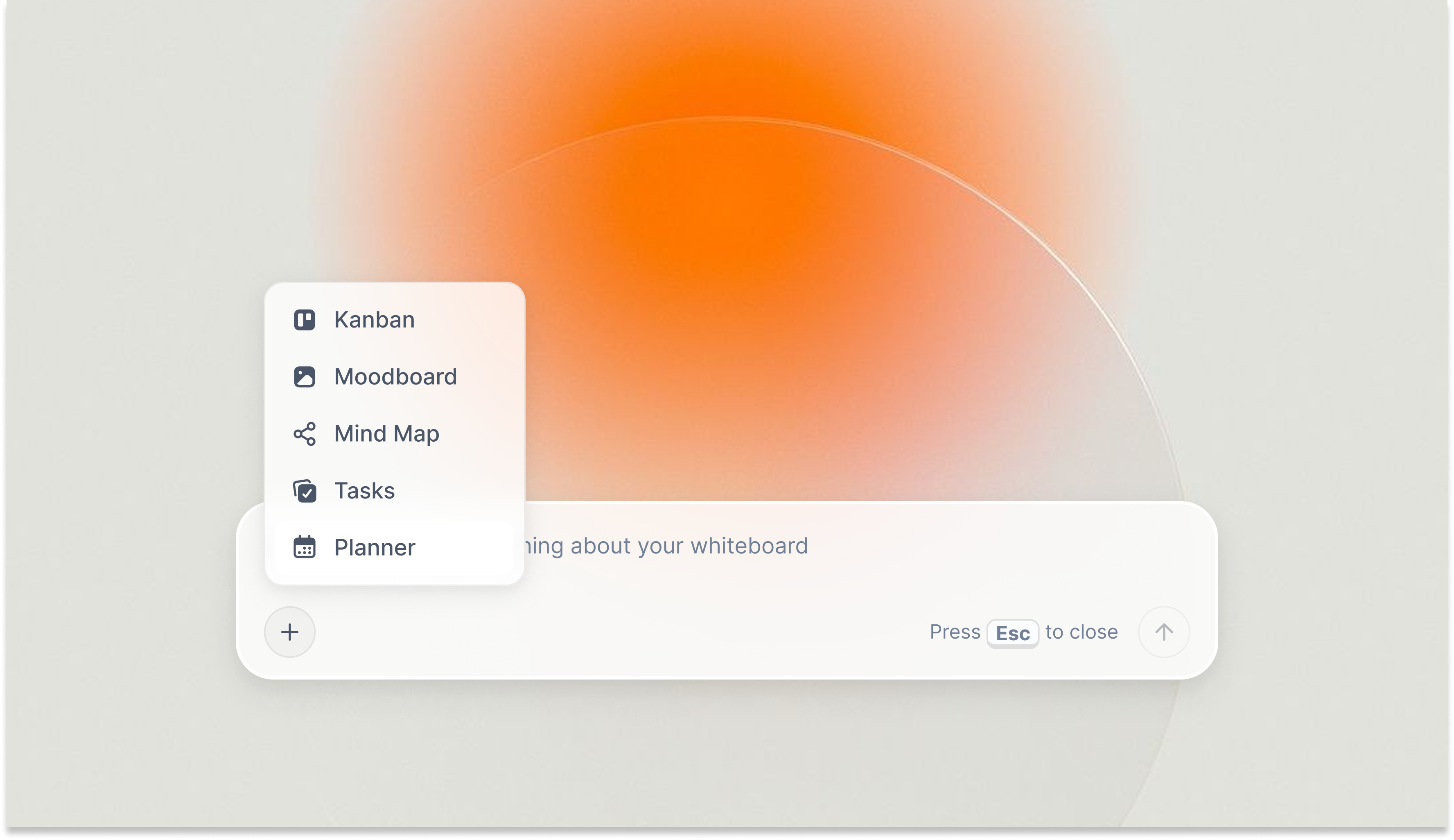
An AI second brain in Storyflow: the AI assistant reads your full canvas context (notes, references, mind maps, and project cards) before it answers.
2) AI Second Brain vs Traditional Second Brain: Key Differences
The terms get used interchangeably, but the systems behave differently in ways that matter for daily use.
The most consequential difference is the organization burden. Traditional second brain systems live or die by your discipline: if you stop tagging, the system collapses into an unsearchable archive. An AI second brain is more tolerant of messy structure because the AI is doing the retrieval work that tags and folders used to do. That tolerance is not unlimited (an AI cannot read what you never captured), but it removes the brittle dependency on perfect organization that caused most traditional second brains to be abandoned within a year.
The second consequential difference is output. A traditional second brain returns notes. An AI second brain returns drafts, summaries, comparisons, and structured analyses derived from your notes. That changes the system's role in your work: it stops being a reference library and starts being a thinking partner that has read your library.
For a deeper comparison of how Storyflow handles this versus Notion specifically, see Storyflow vs Notion: Complete Comparison for 2026.
Pros and Cons of an AI Second Brain
The shift from traditional to AI-native is not pure upside. Here is the honest accounting.
Pros of an AI Second Brain
- Retrieval becomes conversational: you describe what you want and the AI surfaces it, removing the cognitive overhead of remembering where you put things.
- Generation is grounded in your captured material, not training-data generic, which produces drafts you can actually use.
- Organization tolerates messy structure because the AI compensates for what tagging and folders used to do.
- Time to first value drops from weeks (setting up a system) to days (the AI works on whatever you capture).
- Cross-context synthesis (drafting a proposal that pulls from interview notes, prior briefs, and competitive research simultaneously) becomes a single AI request rather than hours of manual cross-referencing.
Cons of an AI Second Brain
- Hallucination risk: when context is thin, the AI fills gaps with fabricated specifics that look authoritative.
- Capture becomes the only bottleneck, but it is a real one: practitioners who skip capture get generic AI output dressed up to look personal.
- Privacy is harder than with local-first systems like Obsidian: your captured material lives on someone else's servers.
- Subscription costs versus traditional second brains where the base tool is often free.
- Tool lock-in: AI second brains are harder to migrate from than plain-text markdown systems, because their value comes partly from accumulated AI context patterns.
The honest summary: an AI second brain is the right architecture for active knowledge work, but it does not eliminate the discipline of capture, and it does carry tradeoffs in privacy and lock-in that local-first systems do not.
AI Second Brain vs ChatGPT
ChatGPT is a general-purpose AI without persistent memory of your work. An AI second brain is a system in which an AI is given continuous context on your captured material. The functional difference is what each can answer from. ChatGPT answers from training data plus whatever you paste into the current conversation. An AI second brain answers from your accumulated workspace, including notes you wrote months ago, references you saved last quarter, and project boards you updated this morning.
The practical implication is recurrence. ChatGPT is fast for one-off questions where context does not matter ("explain the Pareto principle", "translate this paragraph"). An AI second brain compounds value across recurring work where your prior thinking is the most relevant context (returning to a campaign, refining a script across drafts, writing chapter four after the literature review of chapters one to three).
The two are not exclusive; many practitioners use both for different purposes. The mistake is using ChatGPT where an AI second brain belongs (treating the chatbot as if it remembers you, which it does not) or using an AI second brain where ChatGPT belongs (loading project context for a question that has nothing to do with your work). For the deeper comparison specifically about organizing accumulated thinking, see ChatGPT vs Storyflow for Organizing Ideas.
3) Why an AI Second Brain Works
The cognitive case for any second brain rests on a well-established finding in psychology: human working memory holds roughly four chunks of information at once (research by Cowan, *Behavioral and Brain Sciences*, 2001), and long-term memory retrieval is unreliable for material captured weeks or months earlier. Externalizing thinking into a stable medium frees working memory for the harder cognitive work of synthesis and judgment.
An AI second brain extends that argument with a second mechanism: associative retrieval. Studies of how human memory actually functions (Tulving's classic work on encoding specificity, and more recent fMRI research on associative recall) consistently show that we retrieve information by association, not by query. We remember a thought because something else triggered it. A traditional digital archive cannot replicate that, because it requires you to formulate a query before you find anything. An AI assistant with read access to your full context can perform associative retrieval on your behalf: you describe a current problem, and the AI surfaces a note from three months ago that you had forgotten was relevant.
This is also where the AI second brain runs into its real limitation. The AI can only associate across material you have actually captured. If your notes are sparse, the AI's "associations" will be generic outputs from training data, dressed up to look personal. The system rewards consistent capture and punishes the assumption that AI compensates for an empty workspace.
The third mechanism is generation as a thinking aid. When the AI drafts a summary or strategy from your notes, the draft becomes a target you can react to. Reacting to a draft is faster than starting from a blank page, even when (especially when) the draft is wrong. That is true for human collaborators and it is true for AI: a flawed first draft surfaces what you actually believe by giving you something concrete to disagree with.
The failure mode that follows from misunderstanding why it works: people use AI second brains to skip the capture phase, treating the AI as if it knows them. It does not. The AI is competent only to the extent that it has been given material to work with. Capture is still the bottleneck; the AI just lowers the cost of every other step.
4) The Five Functions of an AI Second Brain
A complete AI second brain performs five distinct functions. Tools that perform fewer than four are usually best understood as a subset (an AI notebook, an AI search interface) rather than a full second brain.
Capture
Capture is the entry point. A working second brain has low-friction capture across the formats you actually work in: text notes, web clippings, screenshots, images, voice memos, and references. The defining property of capture is speed: anything that takes more than ten seconds to save is a capture method that will be abandoned. AI second brains tend to support capture across multiple modalities and rely less on the user choosing the "right" location, because the AI can find the material later regardless.
Organization
Organization is how captured material is structured for later retrieval. In a traditional second brain, organization is human-driven and labor-intensive (the PARA method, MOCs, structured tags). In an AI second brain, organization is lighter, because the AI handles much of the retrieval that organization used to enable. Spatial organization (canvases, mind maps, infinite whiteboards) is increasingly common because it lets the human see context at a glance, even when the AI is doing most of the lookup work. A branch-based board like the Mindmap template is the simplest working example: the hierarchy you see is the structure the AI reads.
Retrieval
Retrieval is the heart of the system. A second brain that you cannot retrieve from is a graveyard. Traditional retrieval uses search, links, and traversal. AI retrieval uses natural language: you ask "what did I write about audience research for the campaign last month?" and the AI returns the relevant material plus a summary. The strongest AI retrieval works across multiple modalities (it finds an image you sketched, a note you wrote, and a document you uploaded) without you specifying which.
Generation
Generation is what distinguishes an AI second brain from a traditional one. The AI does not just retrieve, it produces: drafts, structured analyses, summaries, comparisons, plans. The crucial property is that generation must be grounded in your captured material, not just in the AI's training data. Generation that ignores your context is just AI in general. Generation that uses your context is what makes it a second brain.
Connection
Connection is the function that elevates a second brain from a personal database to a thinking system. It surfaces relationships between captured material that you did not consciously create: a note from a research session that connects to a project you are starting now; an image reference that matches the mood of a brief you wrote weeks ago. The five functions form a sequence: capture, organization, retrieval, generation, connection. Tools that excel at the last three (where AI is genuinely additive) are the AI second brains worth using.
5) AI Second Brain Methodologies: PARA, Zettelkasten, BASB
The dominant methodologies for personal knowledge management predate AI. They still apply, but they translate differently in an AI second brain. Understanding the translation is the difference between using AI to enhance a proven method and using AI to create a fragile, novel system that fails the first time you cannot find something.
PARA Method with AI
The original method (Tiago Forte, 2017): Organize all digital information into four categories. Projects (active work with a deadline), Areas (ongoing responsibilities), Resources (topics of interest), and Archives (inactive material). Each piece of information lives in exactly one of the four buckets, and the bucket changes as the material's relevance changes.
The AI translation: PARA still works as a top-level structure, because Projects and Areas correspond to active retrieval contexts the AI uses to scope its responses. The change is that you no longer need to enforce strict categorization across every note. Resources and Archives can be loose, because AI retrieval is forgiving of structure. Projects and Areas should remain clean, because the AI uses them as context boundaries when you ask project-scoped questions.
Practical rule: Keep Projects and Areas tightly organized. Let Resources and Archives be messy.
Zettelkasten with AI
The original method (Niklas Luhmann, mid-20th century): Each note is atomic (one idea per note), uniquely identified, and explicitly linked to other notes. The slip-box (Zettelkasten) becomes a network of connected ideas that can be traversed by following links. The method is famous for its claim that the network develops emergent intelligence as it grows.
The AI translation: Atomicity still matters, because atomic notes are easier for AI to retrieve and recombine than long compound notes. Explicit linking matters less, because the AI can perform implicit associative retrieval that previously required hand-curated links. The Zettelkasten purist will lose something (the meditative quality of building the link network) and gain something (the ability to surface connections you would have missed). For most knowledge workers, the gain outweighs the loss.
Practical rule: Keep notes atomic. Stop manually linking everything; let the AI surface connections.
Building a Second Brain (BASB) with AI
The original method (Tiago Forte, 2022): The CODE framework. Capture (save what resonates), Organize (file by actionability using PARA), Distill (progressive summarization to surface key points), Express (turn captured material into creative output).
The AI translation: Capture and Organize remain central. Distillation, however, is now largely an AI function: rather than progressively highlighting a document over multiple readings, you ask the AI for a layered summary on demand. Express is amplified, because the AI can produce first drafts from your captured material in minutes. The human role shifts toward judgment: deciding what to capture, deciding what to distill into, deciding what to publish.
Practical rule: The AI takes over distillation. Your job becomes capture quality and judgment on output.
The methodologies are complementary, not competing. Most working AI second brains use PARA at the top level for project scope, atomic notes within (a Zettelkasten influence), and the BASB CODE flow for moving captured material into creative output.
6) How to Build an AI Second Brain
Building an AI second brain takes about a week of light work to set up and several months to develop into a system you trust. These steps assume you are starting fresh; if you have an existing knowledge system, the same logic applies, but with a one-time migration step.
Step 1: Pick a tool that performs all five functions. Capture, organization, retrieval, generation, and connection. If the tool is missing two of the five, you will end up stitching multiple tools together, which defeats the purpose of having a single knowledge home. (See section 7 for tool comparisons.)
Step 2: Set up PARA at the top level. Create four sections: Projects, Areas, Resources, Archives. In Storyflow, the Second Brain template opens with this capture-and-retrieval structure already on the board, which removes the blank-canvas step entirely. Resist the urge to invent a more elaborate structure. The simplicity is the feature. You can always add nested folders inside each section later, but the four top-level buckets are non-negotiable.
Step 3: Define your active Projects. A Project has a clear deliverable and a deadline. "Launch Q3 campaign" is a Project. "Marketing" is not (it is an Area). Most working knowledge workers have three to seven Projects active at once. If you have fifteen, you are calling Areas Projects, and the AI will get confused about scope when you ask project-specific questions.
Step 4: Build a capture habit. Set yourself a one-week minimum of capturing every meeting note, idea, useful article, and reference into the system. Do not worry about organization yet. The goal is to give the AI material to work with. A second brain with empty Projects cannot help you.
Step 5: Test retrieval after one week. Ask the AI three project-specific questions: "what did I capture about X?", "what is the current state of Y?", "what am I missing on Z?". If the answers feel useful, the system is working. If they feel generic, your capture is too thin and step 4 needs more time.
Step 6: Start generating. Ask the AI to draft a summary of a project, a comparison between two captured options, or a list of risks based on what you have written. The first generation will probably be wrong in interesting ways. That is the point: the wrongness shows you what you actually believe and what is missing from your context.
Step 7: Refine through iteration. Over the next month, watch for the same retrieval question failing repeatedly. That signals a capture gap. Watch for the same generation pattern producing the wrong shape. That signals a context boundary the AI does not see. Adjust by capturing more or by reorganizing the active Project, not by abandoning the system.
Step 8: Develop your own retrieval and generation patterns. The most experienced practitioners have a small set of repeated questions they ask the AI ("what assumptions am I making here?", "what is missing from this brief?") and a small set of generation prompts ("turn this into a one-page summary for stakeholders"). These become your personal interface to your second brain.
For the practical companion on the capture-to-output flow specifically, see How to Create a Mind Map with AI: A Step-by-Step Guide (2026).
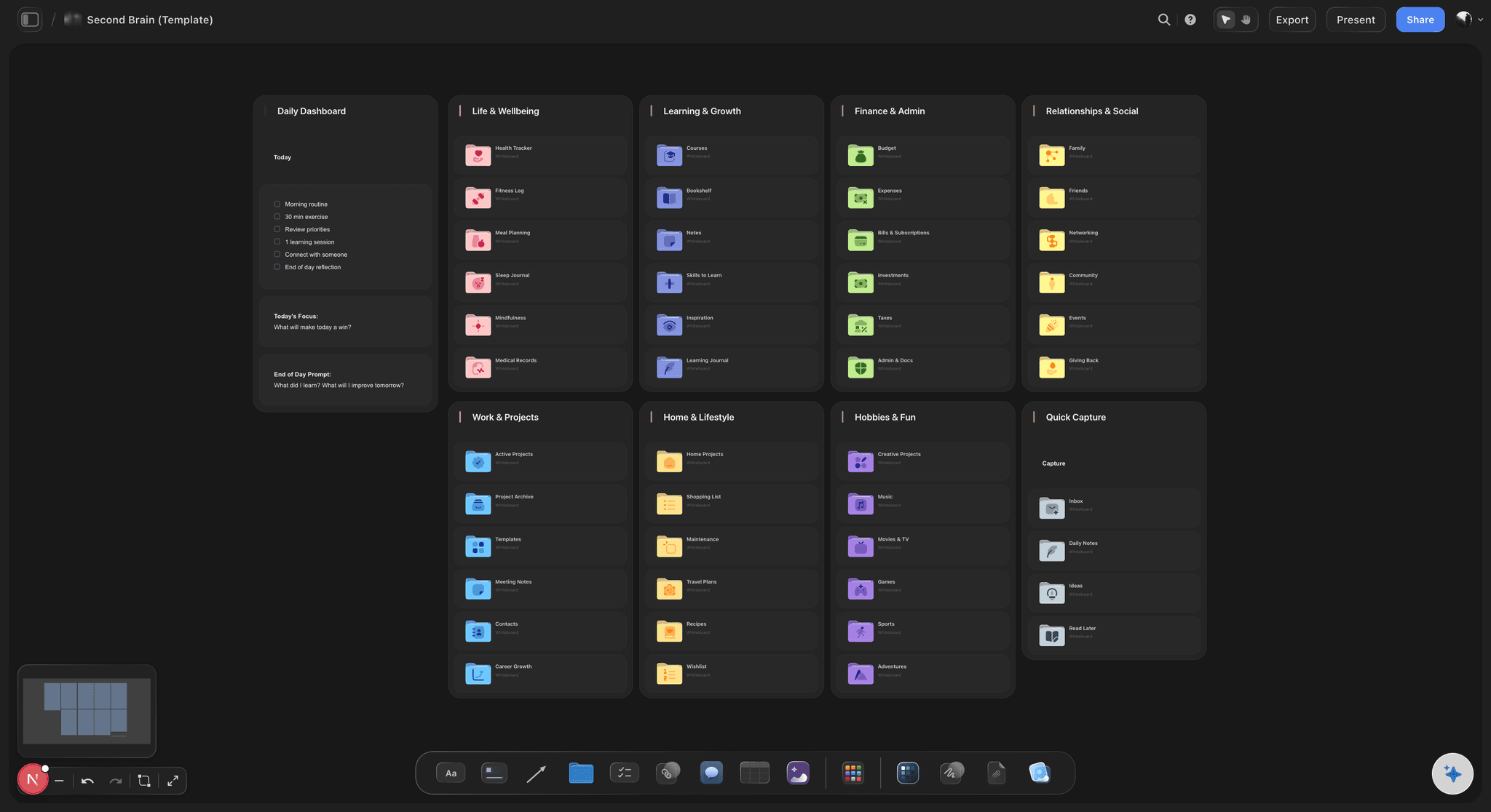
A working AI second brain in Storyflow: a single canvas board holding notes, references, and research, all readable by the AI before it answers.
Build the second brain your AI can actually read
Start with one active project: put the notes, references, and briefs on a canvas, capture into it for a week, then ask the AI three project-specific questions. If the answers come back grounded in your own material, the system is working.

7) AI Second Brain Tools Compared
The category is split into two architectures. AI-bolted-on tools layer AI features on top of an existing knowledge platform (Notion AI, Obsidian plugins, Roam community AI). AI-first tools are designed around AI having continuous context on your material as the core architecture (Storyflow, Mem, Reflect). The distinction matters because in 2026, what most people mean by "AI second brain" is the second category: a tool where the AI's context window covers your full active workspace by default, not page-by-page.
The seven tools below represent the dominant options. They differ along three axes: how the AI accesses your context (per-page, per-database, or full-workspace), how knowledge is structured (linear, graph, or canvas), and which of the five functions they perform genuinely versus superficially.
Storyflow is the canvas-first AI second brain. The category-defining feature is that your notes, references, mind maps, and project cards all live on the same infinite board, and the AI assistant reads the full board context before responding. Linear notes lose the spatial relationships between ideas; database tools lose the visual at-a-glance overview; Storyflow keeps both, so the AI can read the structure of your thinking, not just its contents. Methodology is supported through Blueprint Tactics: structured frameworks (such as the Hero's Journey for narrative work, AIDA for marketing copy, or Retention Hooks for video) that you @-mention in the AI chat to give the assistant a specific theoretical scaffold for the question you are asking. Storyflow is paid-only during early access; a Free plan with unlimited projects, unlimited shared boards, basic AI usage, and 20 file uploads launches before the end of 2026. The Plus plan is $7.99/month (annual) or $9.99/month (monthly) and includes the full 200+ Blueprint Tactics library; Pro at $14/month (annual) or $19/month (monthly) adds AI image generation and 20× more AI than Plus. Collaboration is available on every paid plan (unlimited shared boards); the Max plan ($39/month annual) adds a team workspace with roles and permissions. Try Storyflow and see your full project context in one canvas.
Notion is the most widely adopted second brain platform, with strong databases and a mature ecosystem of templates. Notion AI was added to an existing structure, which means it works well within a single page or database but requires careful structuring to perform well across an entire workspace. Best for users who want a comprehensive knowledge platform and are willing to maintain organization.
Obsidian is the strongest choice for users who care about local-first storage, longevity, and plugin extensibility. AI integration depends on plugins (some excellent, none uniform). Best for the technical user who treats their knowledge base as a long-term asset and is willing to assemble the AI layer themselves.
Mem is genuinely AI-first: every note is automatically embedded and retrievable by AI conversation. The tradeoff is that Mem is mostly linear and text-focused, with limited spatial or visual structure. Best for users whose work is primarily text and who want minimum-friction AI retrieval.
Reflect combines bidirectional linking with AI, which preserves the Roam Research-style graph thinking while adding modern AI capabilities. Best for users who already think in linked notes and want to keep that mental model with AI augmentation.
For a deeper comparison of visual second brain tools specifically, see The 12 Best Note-Taking Apps for Visual Thinkers in 2026. For Notion alternatives specifically, see Best Notion Alternatives for Visual Thinkers (2025).

Storyflow Blueprint Tactics in action: methodology becomes the AI's scaffold so generation is grounded in expert frameworks, not generic suggestions.
8) Real-World Examples
Documentary Filmmaking
A documentary director uses an AI second brain to manage research across a year-long project. Captured material includes 40 hours of interview transcripts, three project boards (subjects, locations, archival sources), and a running notes canvas with the director's own questions and interpretations. When the director asks the AI "which of my interviews touch on the central conflict?", the system surfaces the four most relevant transcripts with quoted excerpts. The director then asks "draft a treatment based on those four interviews and the central conflict notes". The first draft is wrong in instructive ways: it overweights one interview because of its emotional intensity. The director responds by adjusting the prompt and the captured material, and the second draft is structurally sound. The traditional second brain alternative (manually re-reading transcripts) would have taken three days. The AI second brain version takes two hours, including the iteration.
Brand Strategy
A brand strategist building a campaign uses an AI second brain to hold competitive research, audience interviews, prior campaign retrospectives, and a working canvas of message territories. When stuck on the message direction, the strategist asks "what are the contradictions between what the audience said in interviews and what we are saying in current draft messaging?". The AI surfaces three contradictions, two of which the strategist had not consciously noticed. The campaign brief that follows is shorter and more pointed than the strategist's previous work, because the AI did the cross-referencing that previously required the strategist to hold all the material in memory simultaneously.
Academic Research
A PhD student in cognitive psychology uses an AI second brain to manage a literature review of 200 papers. Each paper is captured as a structured note (citation, key findings, methodology, limitations), and the entire literature lives in a single connected workspace. When writing a chapter, the student asks "which papers in my review address the limitations of working memory measurement?". The AI returns the 12 relevant papers grouped by methodology. The student's bibliography work that used to take a full day per chapter now takes thirty minutes. The AI did not replace the student's analytical work; it removed the search overhead that was crowding it out.
Product Strategy
A product manager uses an AI second brain to manage user research, roadmap exploration, and stakeholder context across three competing initiatives. The captured material includes 30 customer interview summaries, six competitor analyses, and an active roadmap canvas. When asked by leadership "why are we deprioritizing initiative B?", the PM asks the AI to "summarize the customer signal that supports deprioritizing B based on my interview notes". The AI returns a structured argument with three supporting points and quoted interview excerpts. The PM uses that as a starting draft, edits it for tone and emphasis, and sends it within twenty minutes. Without the AI, the same answer would have required re-reading transcripts (three hours) or producing a generic response (low quality). The middle option, an answer that is fast and grounded in actual research, is what the AI second brain enables.
An AI second brain at work: the canvas holds research, references, and active project material; the AI reads all of it before responding to any question.
9) Common Misconceptions
Misconception: "An AI second brain remembers everything for me"
Reality: It remembers only what you capture. The AI is operating on the material you have given it, plus its training data. If your capture is sparse, the AI's responses will be generic outputs from training data dressed up to look personal. Capture is still the bottleneck. The AI just lowers the cost of every other step. Practitioners who treat the AI as if it knows them without consistent capture get the same result as practitioners who never used the system in the first place.
Misconception: "AI replaces the need for organization"
Reality: AI tolerates messy organization, but tolerance is not the same as elimination. Active Projects still need clean structure, because the AI uses Project scope as a context boundary when you ask project-specific questions. If your Projects are mislabeled or overlap, the AI will return material from the wrong scope. Resources and Archives can be messy because they are retrieval-only contexts. The mental model is: be loose where the AI does the work, be tight where the AI relies on your structure.
Misconception: "An AI second brain is just a chatbot with my notes"
Reality: A chatbot with notes is a subset, not a full second brain. The five functions (capture, organization, retrieval, generation, connection) all need to be present. Tools that perform only retrieval are AI search interfaces. Tools that perform only generation are AI writing assistants. A genuine AI second brain integrates all five so that capture flows into generation without you stitching tools together.
Misconception: "You should let AI organize your notes for you"
Reality: AI auto-organization sounds appealing, but most implementations produce structures that look reasonable and behave unpredictably (notes vanish into auto-generated categories that seemed obvious to the AI but not to you). Manual top-level organization (PARA) plus AI-assisted retrieval is the more reliable pattern. Let the AI find things; let yourself decide where they live.
Misconception: "Bigger second brains are better"
Reality: Capture without judgment produces noise that degrades AI performance. A focused second brain with 200 high-quality captured items consistently produces better AI responses than a hoarder's archive of 2,000 items. The AI cannot tell the difference between an article you saved because it was important and one you saved because the title caught your eye. Quality of capture matters more than volume.
Misconception: "AI second brains make traditional second brain methodologies obsolete"
Reality: PARA, Zettelkasten, and BASB are not obsolete; they translate. The cognitive principles behind them (atomic notes, project scope, progressive summarization) still hold. What changes is which steps the human does and which steps the AI does. Practitioners who throw out the methodology and freelance with AI usually rebuild a worse version of the same methodology within six months, because the methodology was solving real problems that AI alone does not solve.
11) The Bottom Line on AI Second Brains
An AI second brain is a personal knowledge system where an AI assistant reads your captured material continuously and uses it to answer questions, surface forgotten work, and generate new output. It is not a marketing rebrand of the traditional second brain. It is a structural shift in how personal knowledge systems work. The original second brain promised that you could trust a digital archive to remember on your behalf; the practical reality was that retrieval was harder than the methodology suggested, and most users abandoned their systems within a year. The AI second brain dissolves the retrieval bottleneck, which is the single most common reason traditional systems were abandoned.
The risk in the AI version is the opposite failure mode. Because retrieval feels effortless, practitioners stop being intentional about capture, and the system silently degrades into a noisy archive that produces increasingly generic AI outputs. The discipline that traditional second brains required at the organization stage now lives at the capture stage: be selective about what you save, be consistent about saving, and trust the AI for everything that comes after.
The methodologies (PARA, Zettelkasten, BASB) still apply, but their distribution of human work changes. Capture and judgment are still human. Retrieval, distillation, and first-draft generation are increasingly AI. The skill that separates effective practitioners from frustrated ones is knowing which steps to delegate and which to keep.
Where Storyflow fits: Storyflow was built for a specific kind of AI second brain user. The user whose work is creative, strategic, or research-driven, where the most valuable material is rarely a single linear document but rather a connected web of references, mind maps, briefs, and active project boards. Storyflow's infinite canvas holds all of that on a single board, and the AI assistant reads the full active canvas (plus up to 1 Tactic and up to 3 Documents you @-mention) before responding. Methodology is supported through Blueprint Tactics, so the AI can scaffold its responses on expert frameworks like the Hero's Journey, AIDA, or Retention Hooks. If your work involves multiple parallel threads of thinking that need to stay visible to each other, the canvas-first AI second brain is the right architecture.
Where Storyflow loses: if your second brain is a deep, text-only knowledge base you intend to keep for a decade with full local-first control, a dedicated PKM tool wins. Obsidian stores your notes as plain markdown on your own machine, survives any company, and has a plugin ecosystem Storyflow does not match. Storyflow is cloud-first and canvas-shaped, which is the wrong fit for archival, privacy-regulated, or pure long-form-writing work. Pick the tool by the shape of the work, not the marketing.
If your work is project-shaped and visual, the fastest way to know is to run the experiment: take your most active project, rebuild it as one Storyflow canvas this week, capture into it daily, and ask the AI three project-specific questions on day seven. If the answers are grounded in your own material rather than generic, you have your answer. Start that project in Storyflow.
10) FAQ: AI Second Brain
What is an AI second brain in simple terms?
An AI second brain is a personal knowledge system where your notes, references, and project material are read by an AI assistant before it answers questions. Instead of searching for what you saved, you ask in plain language and the AI surfaces it, summarizes it, or generates new work from it. The traditional second brain (Notion, Obsidian, Roam) made you remember where things were. An AI second brain dissolves that bottleneck.
What is the difference between an AI second brain and Notion?
Notion is a database and document platform with AI features added on top. An AI second brain is built around AI having continuous context on your full body of thinking. Notion AI works well within a single page or database but requires careful structuring to perform well across a workspace. Tools designed AI-first (Storyflow, Mem, Reflect) treat AI context as the core architecture rather than a layered feature. For a full breakdown, see Storyflow vs Notion: Complete Comparison for 2026.
What is the best AI second brain app?
There is no single best app, because the right choice depends on the work. For visual and canvas-based knowledge work (filmmakers, marketers, creative directors, product strategists), Storyflow is the strongest fit because it reads your full canvas including mind maps, references, and project cards as one connected context. For text-heavy linear knowledge work, Mem and Reflect are strong AI-first choices. For users invested in databases and team workflows, Notion with AI is the most mature option. For privacy-first local users, Obsidian with AI plugins.
How does an AI second brain work?
You capture material into a single knowledge workspace (notes, references, web clippings, images, project boards). The AI assistant has continuous read access to that workspace. When you ask a question, the AI retrieves the relevant material from your workspace and responds using it as context, rather than relying solely on training data. When you ask the AI to generate something (a draft, summary, or analysis), the output is grounded in your captured material. The five core functions are capture, organization, retrieval, generation, and connection.
Is an AI second brain worth setting up?
For knowledge workers who deal with multiple ongoing projects, recurring research, and creative or strategic synthesis, the answer is yes: the time saved on retrieval and first drafts compounds quickly. For users with simple, low-volume note-taking needs, the overhead of setting up a second brain may exceed the gains. The threshold is roughly: if you have three or more active projects with overlapping context, an AI second brain pays back the setup cost within a month.
How do you build an AI second brain?
The eight-step process: pick a tool that performs all five functions, set up PARA at the top level, define active Projects clearly, build a one-week minimum capture habit, test retrieval with three project-specific questions, start generating drafts from captured material, refine through iteration based on what fails, and develop your own retrieval and generation patterns. The full setup takes about a week of light work; the system becomes reliable over two to three months of daily use.
What is the PARA method with AI?
PARA (Tiago Forte, 2017) is a four-bucket organizing system: Projects, Areas, Resources, Archives. Every captured item lives in exactly one bucket, and the bucket changes as relevance changes. With AI, the practical translation is: keep Projects and Areas tightly organized (because the AI uses them as context boundaries), but let Resources and Archives be messy (because AI retrieval forgives loose structure). The methodology is not obsolete; it shifts from being a retrieval system to being a context system.
Can AI replace a second brain?
No. The AI is a retrieval, generation, and connection layer; it cannot replace capture. If you do not capture material, the AI has nothing to work with and produces generic outputs from training data. The role of AI is to remove friction from the steps that come after capture, not to replace capture itself. Practitioners who try to skip the capture phase consistently rebuild a thin and unreliable system.
What are the limitations of an AI second brain?
Three main limitations. First, hallucination: when context is thin, the AI fills gaps with fabricated specifics that look authoritative. Second, scope drift: the AI sometimes pulls material from outside the active Project, producing answers that mix contexts inappropriately. Third, latency on large workspaces: retrieval over very large captured archives can slow down or miss material entirely. The mitigations are: capture consistently to reduce hallucination, keep Projects and Areas clean to prevent scope drift, and split very large workspaces into focused contexts.
AI second brain vs Zettelkasten: which is better?
They are not exclusive; an AI second brain can be a Zettelkasten with AI on top. The original Zettelkasten (Niklas Luhmann) emphasized atomic notes and explicit linking to build emergent intelligence in the network. An AI second brain preserves atomicity (still a strong principle) but reduces the need for manual linking, because the AI can perform implicit associative retrieval. Zettelkasten purists will lose some of the meditative value of building the link network; most practitioners will gain time and surface connections they would have missed.
How do creators use an AI second brain?
Creators use AI second brains for project research, idea development, and draft generation. A documentary filmmaker captures interview transcripts, research notes, and visual references into a single project canvas, then asks the AI for thematic connections and treatment drafts. A marketing strategist captures campaign retrospectives, audience interviews, and competitive research, then asks the AI to surface contradictions and message territories. A product manager captures user research and competitor analyses, then asks the AI for structured arguments with quoted evidence. The pattern is consistent: capture is project-scoped, retrieval is conversational, and generation is grounded in real captured material.
What makes an AI second brain effective?
Three properties. First, AI context that covers your full active workspace, not just the current page. Second, methodology awareness, so the AI understands frameworks (campaign strategy, narrative structure, research synthesis) rather than producing generic outputs. Third, generation that is genuinely grounded in your captured material, not generic AI writing dressed up to look personal. Tools that have all three become thinking partners; tools that have only one become reference libraries with a chatbot bolted on.
Table of Contents
- What is an AI Second Brain? The Definition
- AI Second Brain vs Traditional Second Brain: Key Differences
- Why an AI Second Brain Works
- The Five Functions of an AI Second Brain
- AI Second Brain Methodologies: PARA, Zettelkasten, BASB
- How to Build an AI Second Brain
- AI Second Brain Tools Compared
- Real-World Examples
- Common Misconceptions
- FAQ: AI Second Brain
- The Bottom Line on AI Second Brains
- Author
- Related Reading
Templates to check out for this topic


Workspace templates you can use in Storyflow
Keep research, notes, and plans on one canvas the AI can read, instead of scattered across docs and tabs. Open a template and make it your second brain.


See Storyflow in Action
A visual AI workspace where every feature lives inside one canvas. No tab-switching, no context lost.
Build your entire board from a single message
Type what you need in the AI chat at the bottom of your canvas. The AI adds cards, headings, and structure directly onto your board.
Use expert frameworks as AI context
Type @ in the AI chat and choose any Tactic. The AI tailors every response to that framework instead of giving generic advice.
Turn your board into a mind map in seconds
Ask the AI to restructure your canvas as a mindmap. It connects your ideas into a visual hierarchy so you can see how everything relates.
Why Storyflow Exists
Storyflow actually began as a personal tool while working on creative and research projects.
We kept running into the same problem: ideas were scattered everywhere: notes, documents, and whiteboards.
Nothing helped us see how everything connected.
So we started building a workspace designed around how ideas actually grow.
→ Read how Storyflow was createdJustkay
Documentary Filmmaker & Founder at Storyflow
Published: 2026-05-04
Extremely simple, seriously capable


See how easy it is to get started
Watch a real project come together, from a blank board to a finished plan, clicked through step by step.
Start creating with AI and become more productive
Transform your creative workflow with AI-powered tools. Generate ideas, create content, and boost your productivity in minutes instead of hours.