AI Visual Workspace vs Project Management Software (2026)
Visual workspaces and project management software solve different halves of a project. One holds work that is not decided yet, the other tracks work that is. Here is how they compare and which you need.

Category
Project Management
Author

Justkay
Documentary Filmmaker & Founder at Storyflow
Topics
2026-07-26
•
14 min read
•
Project Management- visual workspace vs project management software
- AI visual workspace
- creative project management
- canvas vs task tracker
- visual workspace for teams
- project management software for creative teams
What is the difference between a visual workspace and project management software?
A visual workspace and project management software solve different halves of a project. Project management software (Asana, Monday, Jira, ClickUp, Trello) tracks work that has already been decided: who does what, by when, in what order, with what dependencies. A visual workspace (Storyflow, Miro, Milanote, FigJam) holds work that is not decided yet: the research, the options, the argument about what the thing should even be. Most creative teams need both, and the common failure is running undecided work through an execution tool, where every task demands an owner and a due date it cannot yet have. The distinction is worth stating plainly. Project management software assumes the work is already decided. Most creative work fails in the part where it is not. A ticket titled "figure out the campaign concept," assigned to a person, due Friday, is a category error. It has no definition of done, because the work is discovery, and discovery does not fit in a row. I have run production on documentary and branded projects for years, and the pattern repeats regardless of team size. The Gantt chart is never what goes wrong. What goes wrong is the six weeks before the Gantt chart, where nobody could see the whole problem at once and the team committed to a plan built on an idea that had not been pressure-tested.

Full disclosure: Storyflow is our own product, so weigh its placement here with the skepticism you would apply to any tool a company recommends on its own blog. We deliberately do not rank it first, because for the job most people mean by project management it is the wrong purchase: it has no Gantt view, no dependency logic, no capacity planning, and no workload reporting. Asana, Monday, and Jira win that half outright, and this piece says so before it makes any case for the other half.
Quick Comparison
These are not competitors. Most creative teams need one from each column, with a clear moment where a project moves from the first to the second.
| Tool | Best For | AI Features | Price |
|---|---|---|---|
| Asana | Dependencies and capacity | Status summaries | Free / ~$11 user mo |
| Monday | Workload and reporting | Task automation | ~$9 user mo |
| Storyflow | Deciding what to make | Reads the whole board | $7.99 mo annual (free plan late 2026) |
| Miro | Live workshops | Miro AI | Free / ~$8 user mo |
Key Takeaways
- They are not competitors, they are sequential. The workspace is where a project is decided; the PM tool is where it is delivered.
- PM software is genuinely better at anything with a date. Dependencies, capacity, deadlines, status reporting, and accountability are solved problems there and badly served on a canvas.
- A canvas is genuinely better at anything without a shape yet. Research, options, references, and structure benefit from being visible simultaneously.
- The category error costs more than the wrong brand. Running discovery through a task tracker produces tasks nobody can close and a plan built on unexamined assumptions.
- AI has widened the gap, not closed it. AI in a PM tool summarizes status. AI on a canvas can reason about the actual material, because the material is there.
- Most teams under 20 people need one of each, and the integration between them matters less than people expect.
- A canvas cannot report. If a stakeholder needs weekly status, that is a PM tool's job and no amount of board tidiness substitutes.
- Choose by where your projects actually fail. Missed deadlines point to a PM problem. Rework and drift point to a decision problem.
Decided and Undecided Work
Every project contains two kinds of work, and almost every tooling argument is really a disagreement about which kind dominates.
Decided work has a known output. Someone can own it, estimate it, and finish it. "Edit the 90-second cut." "Ship the pricing page." "Book the location." It has a definition of done, which is what makes it trackable, and tracking is exactly what project management software is for.
Undecided work has no known output yet, because producing the output *is* deciding what the output should be. "Work out what this campaign is arguing." "Decide whether we lead with the founder story or the customer data." "Find the structure this documentary actually has." You cannot estimate it honestly, you cannot define done in advance, and you frequently cannot say who owns it, because it is a conversation rather than a task.
| Project management software | Visual workspace | |
|---|---|---|
Built for | Decided work | Undecided work |
Core unit | Task with owner and date | Object on a surface |
Optimizes for | Accountability and sequence | Seeing everything at once |
Strong at | Dependencies, capacity, status, deadlines | Research, options, structure, argument |
Weak at | Anything with no definition of done | Reporting, dates, accountability |
Question it answers | Are we on track? | Is this the right thing to make? |
Examples | Asana, Monday, Jira, ClickUp, Trello | Storyflow, Miro, Milanote, FigJam |
The reason this framing matters more than a feature comparison: a team using the wrong category does not experience it as a tool problem. They experience it as a discipline problem. Tasks sit open for weeks and get re-scoped repeatedly, and everyone assumes people are procrastinating. Usually the work was never decided enough to be a task.
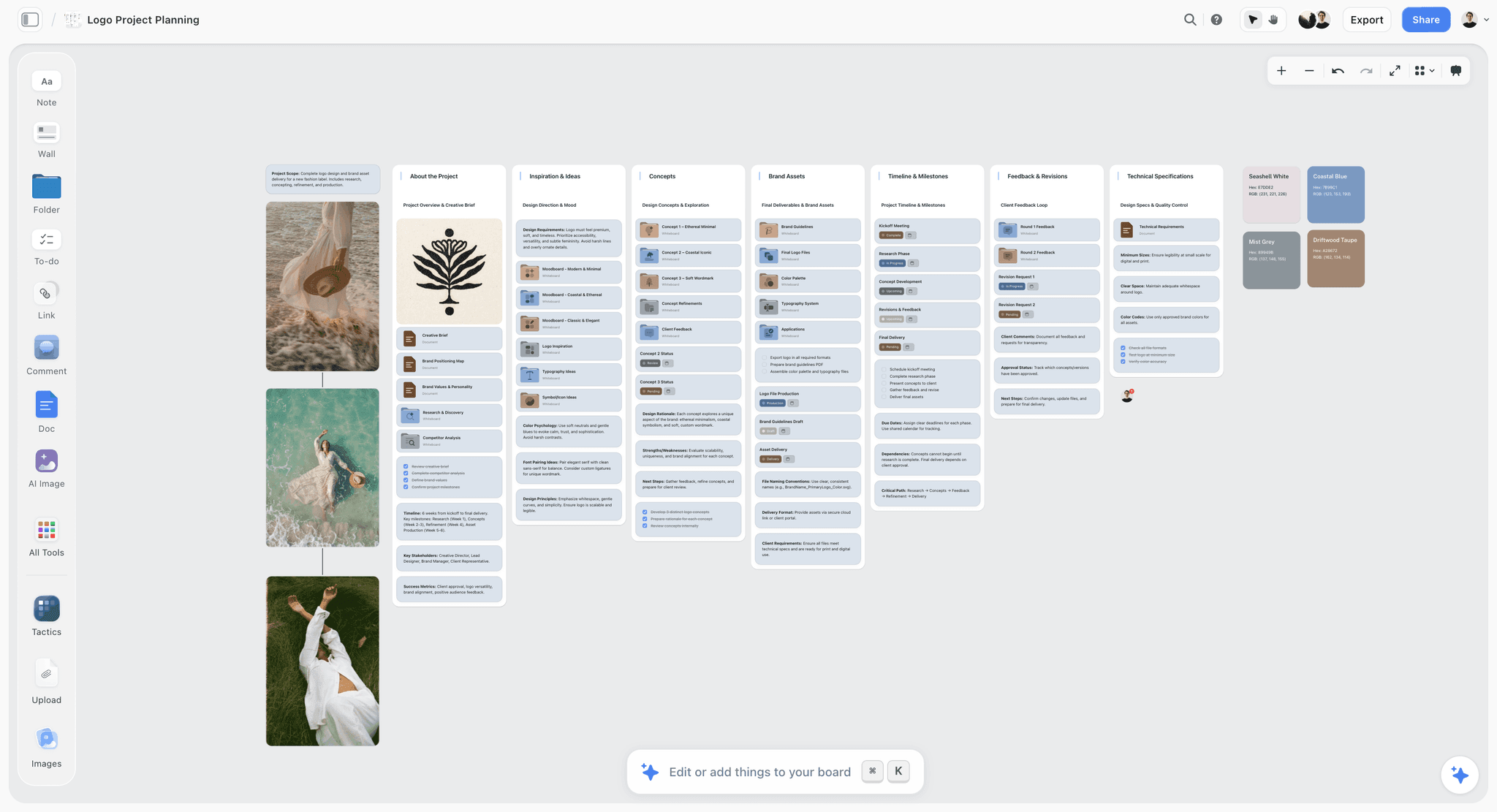
An undecided project laid out on the Storyflow canvas, with research and three competing directions side by side before anything becomes a task
Decide the project before you schedule it
Put the research, the brief, and the competing directions on one board, and ask the AI which direction actually answers the brief while it can read all of it. Then move the decided work into your tracker as tasks that can genuinely be finished.

Where Project Management Software Genuinely Wins
Being honest about this is the point, because a canvas is a poor substitute for a real PM tool in every one of these cases.
Anything involving dates and dependencies. If the shoot moves, the edit moves, and the delivery moves. PM tools model that. A canvas does not, and pretending otherwise gets projects delivered late.
Capacity and workload. Seeing that one person is assigned eleven things this week and another has two is a solved problem in Asana or Monday, and unsolvable on a board.
Accountability. A task with one owner and one date creates a clear expectation. Canvas objects do not, which is exactly why canvases feel more comfortable and produce less follow-through.
Status reporting. When a client or executive needs a weekly view, PM software generates it. On a canvas, someone writes it by hand every week until they stop.
Repeatable process. Work that runs the same way every time (onboarding, publishing, QA) belongs in a template with automation, not on a fresh canvas each round.
Scale. Past roughly twenty or thirty people, informal coordination stops working and the structure a PM tool imposes becomes the point rather than the overhead.
If your projects fail because things are late, you have a PM problem, and no visual workspace will fix it.
Where a Visual Workspace Genuinely Wins
Seeing the whole problem simultaneously. Documents and task lists show one screen at a time. A campaign's research, references, audience notes, and three competing directions do not fit in one screen, and the relationships between them are the thing you need to see.
Holding options open. PM tools are built to close things. Early creative work needs several live possibilities held side by side, and a tool whose main verb is "complete" fights that.
Structure that is spatial rather than sequential. A story's shape, a campaign's argument, a product's information architecture are all spatial facts. Act two sagging, two chapters making the same point, a thin stretch in the middle: visible on a canvas, invisible in a list.
Work that is mostly reference. Images, clips, links, quotes, and screenshots are first-class citizens on a canvas and awkward attachments in a task tracker.
The conversation before the plan. Kickoffs, concept reviews, and retrospectives are all better on a shared surface than in a status view.
If your projects fail because you build the wrong thing, or because scope thrashes and work gets redone, you have a decision problem, and a better PM tool will not fix it either.
How AI Changed the Comparison
Both categories added AI, and they did not add the same thing.
AI in project management software mostly summarizes and administers: draft a status update, catch overdue items, suggest an assignee, turn a meeting note into tasks. Real value, genuinely time-saving, and it operates on metadata. It knows a task is late; it has no view on whether the task was worth doing.
AI in a visual workspace can operate on the actual material, because the actual material is what is on the surface. The research, the options, the structure, and the argument are all present as content rather than as a title and a due date.
This is where Storyflow's specific behaviour is worth naming: its AI reads the whole board you are working on, plus up to one Tactic and three Documents you `@`-mention. In practice that means asking which of three directions actually answers the brief while the brief and all three directions are on the board being read, rather than pasting a summary into a chat window that cannot see the work. Its Story blueprints library adds structural scaffolds (Hero's Journey and AIDA among them) for teams that want a starting frame.
The comparison has therefore widened rather than converged. PM tools got better at running the plan. Canvases got better at interrogating the thinking behind it.
Where Storyflow is the wrong purchase: it is not a project management tool, so it has no Gantt view, no dependency logic, no capacity planning, and no workload reporting. If you need to know who is overloaded next week, buy Asana or Monday. It is cloud-only, ruling it out where data must stay local. Its team administration is lighter than the enterprise PM platforms, which matters at scale. And a team whose work is genuinely repeatable rather than creative will get more from a good template in ClickUp than from any canvas.
Most Teams Need Both
The honest answer for most creative teams under about twenty people is one of each, with a deliberate handoff. The workspace holds the project until it is decided. Once decided, the committed work moves into the PM tool as tasks with owners and dates. The board stays open, because projects raise new questions mid-delivery and those questions belong back on the surface rather than thrashing inside the tracker.
Teams worry about integration between the two more than they should. In practice the handoff is a human decision, not a sync problem, and automatic two-way syncing between a canvas and a task list mostly produces noise. What matters is that the team agrees when a thing has been decided.
The genuine exceptions: a solo creator can often run everything on a canvas plus a simple list, and a team doing purely execution work with no discovery phase (agencies delivering a fixed, repeated service) may reasonably need only the PM tool.
Choosing
Choose project management software first if: you miss deadlines, work is repeatable, you have more than twenty people, stakeholders need regular status, or you have complex dependencies. Start with Asana or Monday for general work, Jira for software, Trello for something small and simple.
Choose a visual workspace first if: your projects get redone, scope thrashes because the concept was never settled, your work is reference-heavy, or the hardest part of a project happens before anyone can write a task. Start with Storyflow if you want AI that reads the whole board, Miro for workshops with heavy live facilitation, Milanote for simple freeform boards.
A useful diagnostic: look at your last three projects that went badly and name the failure. If the answer is "we were late," buy PM software. If the answer is "we made the wrong thing," or "we redid it three times," a tracker was never the missing piece.
Cost
Both categories price similarly at the low end, which makes cost a weak tiebreaker.
| Tool | Category | Entry price |
|---|---|---|
Trello | PM | Free, paid from around $5 per user monthly |
Asana | PM | Free, paid from around $11 per user monthly |
Monday | PM | Paid from around $9 per user monthly |
Miro | Workspace | Free, paid from around $8 per user monthly |
Storyflow | Workspace | Paid early access, Plus $7.99 monthly billed annually or $9.99 monthly |
Milanote | Workspace | Free, paid from around $12.50 monthly |
The pricing structure differs in a way that matters at team size: most PM tools and Miro charge per user, so cost scales with headcount, while Storyflow is flat per account. For a small team that difference is minor; for a growing one it is not.
The Bottom Line
This is not a contest between two products competing for the same job. Project management software runs decided work and does it far better than any canvas will. A visual workspace holds undecided work and does it far better than any tracker will. Most creative teams need both, sequenced, with a clear moment where a project moves from one to the other.
Project management software assumes the work is already decided. Most creative work fails in the part where it is not. Diagnose which half your projects actually break in, then buy for that half. Teams that buy a better tracker to fix a decision problem end up with excellent visibility into the wrong work being built on time.
FAQ: Visual Workspace vs Project Management Software
What is the difference between a visual workspace and project management software?
Project management software tracks work that has already been decided, using tasks with owners, dates, and dependencies. A visual workspace holds work that is not decided yet: research, references, competing options, and structure, arranged on an open surface so you can see everything at once. One answers whether you are on track; the other answers whether you are building the right thing.
Can a visual workspace replace project management software?
Not for anything involving dates, dependencies, capacity, or status reporting. Those are solved problems in a PM tool and genuinely poor on a canvas. A solo creator or a very small team can often manage with a canvas plus a simple list, but once several people depend on each other's timing, you need real project management software.
Do I need both a visual workspace and a project management tool?
Most creative teams under about twenty people do, and they use them sequentially: the workspace holds the project until it is decided, then committed work moves into the tracker as tasks. Teams doing purely repeatable execution work may only need the PM tool, and solo creators can often skip it. Buy the second one when you can name the failure it is meant to fix.
Is Notion a visual workspace or project management software?
Notion is primarily a document and database tool that can do lightweight project management, and it is not a visual workspace in the canvas sense. Its strength is structured, linked information, and it works well for teams that think in documents and databases. Teams whose work is spatial or reference-heavy usually find the canvas category fits better.
Which is better for creative teams?
It depends on where your projects fail. If they fail on timing, project management software is the priority. If they fail because the concept was never settled, or because work gets redone after a late change of direction, a visual workspace addresses the actual cause. Creative teams tend to have the second problem and buy for the first.
How does AI differ between the two categories?
AI in project management software works on metadata: drafting status updates, flagging overdue items, converting notes to tasks. AI in a visual workspace can work on the material itself, since the research and options are present as content rather than as a task title. That means it can reason about whether a direction answers the brief, which a tracker's AI has no access to.
Is Miro a project management tool?
Miro is a visual collaboration and whiteboard platform, not a project management tool. It has added some planning features, but it does not do dependency management, capacity planning, or workload reporting the way Asana, Monday, or Jira do. Most teams use Miro alongside a PM tool rather than instead of one.
What is an AI visual workspace?
It is a canvas-based workspace where AI can read the content on the board rather than just responding to a typed prompt. The practical difference is that you can ask a question about the actual project material while it is visible, instead of summarizing your project into a chat window first. Storyflow reads the whole active board plus up to one Tactic and three Documents you mention.
When should a project move from the workspace to the tracker?
When the output is defined well enough that a task can have a clear definition of done, an owner, and a realistic date. If you cannot write those three things honestly, the work is still undecided and moving it into a tracker will produce a ticket that sits open and gets re-scoped. Keep the board open afterwards, because delivery raises new questions that belong back on the surface.
Are visual workspaces cheaper than project management software?
Entry pricing is broadly similar, so cost is a weak tiebreaker. The structural difference matters more: most PM tools and Miro charge per user, so cost scales with headcount, while some workspaces including Storyflow price flat per account. For a small team the difference is minor; for a growing team it compounds.
Can I use a visual workspace for client projects?
Yes, and it works well for the parts clients should see: concepts, references, and direction. Keep delivery tracking in a PM tool, since clients asking about timelines and status are asking a question a tracker answers properly and a canvas does not. A common setup is a read-only board for the thinking and a status view for the schedule.
What happens if a team uses only project management software?
Discovery work gets forced into task shape, which produces tickets with no definition of done that stay open and get re-scoped repeatedly. Teams usually read this as a discipline problem rather than a tooling one. The visible symptoms are rework, late changes of direction, and plans built on assumptions nobody examined because there was never a place to lay them out.
Table of Contents
Templates to check out for this topic


Planning and project templates you can use in Storyflow
Plan a launch, a sprint, or a whole project on a visual board the team can see at once. Open one of these templates and start from real structure.


See Storyflow in Action
A visual AI workspace where every feature lives inside one canvas. No tab-switching, no context lost.
Build your entire board from a single message
Type what you need in the AI chat at the bottom of your canvas. The AI adds cards, headings, and structure directly onto your board.
Use expert frameworks as AI context
Type @ in the AI chat and choose any Tactic. The AI tailors every response to that framework instead of giving generic advice.
Turn your board into a mind map in seconds
Ask the AI to restructure your canvas as a mindmap. It connects your ideas into a visual hierarchy so you can see how everything relates.
Why Storyflow Exists
Storyflow actually began as a personal tool while working on creative and research projects.
We kept running into the same problem: ideas were scattered everywhere: notes, documents, and whiteboards.
Nothing helped us see how everything connected.
So we started building a workspace designed around how ideas actually grow.
→ Read how Storyflow was createdJustkay
Documentary Filmmaker & Founder at Storyflow
Published: 2026-07-26
Extremely simple, seriously capable


See how easy it is to get started
Watch a real project come together, from a blank board to a finished plan, clicked through step by step.
Start creating with AI and become more productive
Transform your creative workflow with AI-powered tools. Generate ideas, create content, and boost your productivity in minutes instead of hours.