Mind Map vs Whiteboard: Which Should You Use? (2026)
A mind map has a center and enforces hierarchy. A whiteboard has neither. That single structural difference decides which one fits your thinking, and this guide shows when each wins.

Category
Visual Thinking
Author

Justkay
Documentary Filmmaker & Founder at Storyflow
Topics
2026-07-26
•
12 min read
•
Visual Thinking- mind map vs whiteboard
- mind map or whiteboard
- difference between mind map and whiteboard
- best mind mapping app
- best online whiteboard
- visual thinking tools
What is the difference between a mind map and a whiteboard?
Use a mind map when you have one clear topic and need to break it into parts: it forces a single center and a strict hierarchy, so every idea must connect back to the root. Use a whiteboard when you have several things that need to sit together, when the relationships are not hierarchical, or when you do not yet know what the central topic is: it imposes no structure at all. Mind maps are best for decomposing one known thing (MindMeister, XMind, Coggle); whiteboards and canvases are best for holding an unsettled problem (Miro, FigJam, Storyflow, Milanote). The structural difference is the whole answer. A mind map assumes you already know what the middle is. A whiteboard is what you use when you do not. Everything else, the branches and the colors and the sticky notes, follows from that one fact. I have spent years structuring documentary material, which is a long argument with exactly this question. Some projects have an obvious center and a mind map cracks them in an afternoon. Others have four subjects, three timelines, and no center at all, and forcing them onto a radial map produces something tidy and wrong. Choosing badly here does not just slow you down; it changes the conclusion you reach.

Full disclosure: Storyflow is our own product, so weigh its placement here with the skepticism you would apply to any tool a company recommends on its own blog. We deliberately do not rank it first. If you specifically want a classic mind map, MindMeister, XMind, and MindNode make better ones, with auto-layout, keyboard branching, and export formats a general canvas does not match. For live facilitated workshops, Miro's timers, voting, and frameworks are stronger. Storyflow earns a place only for the unsettled-project job described in this piece.
Quick Comparison
These are two different constraints, not two brands of the same thing. Pick by whether you can name the center of your topic.
| Tool | Best For | AI Features | Price |
|---|---|---|---|
| MindMeister | Structured mind maps | Branch generation | Free / ~$4.50 mo |
| XMind | Offline structured maps | Limited | Free / ~$6 mo |
| Miro | Group workshops | Miro AI | Free / ~$8 user mo |
| Storyflow | Unsettled projects | Reads the whole board | $7.99 mo annual (free plan late 2026) |
Key Takeaways
- The difference is constraint, not features. A mind map enforces one center and a hierarchy. A whiteboard enforces nothing.
- Constraint is genuinely valuable when the topic is known. It prevents sprawl and forces you to state how every idea relates to the whole.
- Constraint is actively harmful when the topic is not known. You will invent a center that does not exist, and the map will look correct.
- Mind maps handle one-to-many well and many-to-many badly. If two branches relate to each other, a mind map has nowhere to put that.
- Whiteboards handle mixed media and mixed structure. Images, clips, notes, and tables can share a surface; mind map nodes are mostly text.
- A whiteboard can contain a mind map. A mind map cannot contain a whiteboard. The canvas is the superset, which is why hybrids go in that direction.
- The tradeoff for freedom is entropy. Whiteboards sprawl and go stale without deliberate tidying, which mind maps prevent by design.
- Pick by the shape of the problem, not by preference. One subject to decompose means a mind map. Several things to reconcile means a whiteboard.
The Center and the Open Field
A mind map is a radial hierarchy. One root sits in the middle, main branches come off it, sub-branches come off those. The format carries a rule: everything must connect back to the center, through exactly one path. That rule is not a limitation the tools failed to remove. It is the product.
A whiteboard is an open field. You can put anything anywhere, connect what you want, leave things unconnected, mix text and images and tables, and cluster by proximity rather than by line. There is no root and no required relationship.
| Mind map | Whiteboard / canvas | |
|---|---|---|
Structure | One center, strict hierarchy | None imposed |
Relationship model | One-to-many, single path to root | Anything to anything, or nothing |
Content | Mostly text nodes | Text, images, video, tables, embeds |
Best when | The topic is known and needs breaking down | The topic is unsettled or plural |
Main strength | Constraint prevents sprawl | Freedom accommodates reality |
Main weakness | Distorts anything non-hierarchical | Entropy, sprawl, staleness |
Typical tools | MindMeister, XMind, Coggle, MindNode | Miro, FigJam, Storyflow, Milanote |
The practical test is a single question: can you name the thing in the middle, honestly, in one phrase? If you can, a mind map will help. If you find yourself inventing something vague to sit in the center ("the project," "Q3," "strategy") so that the format works, that is the format telling you it is the wrong tool.
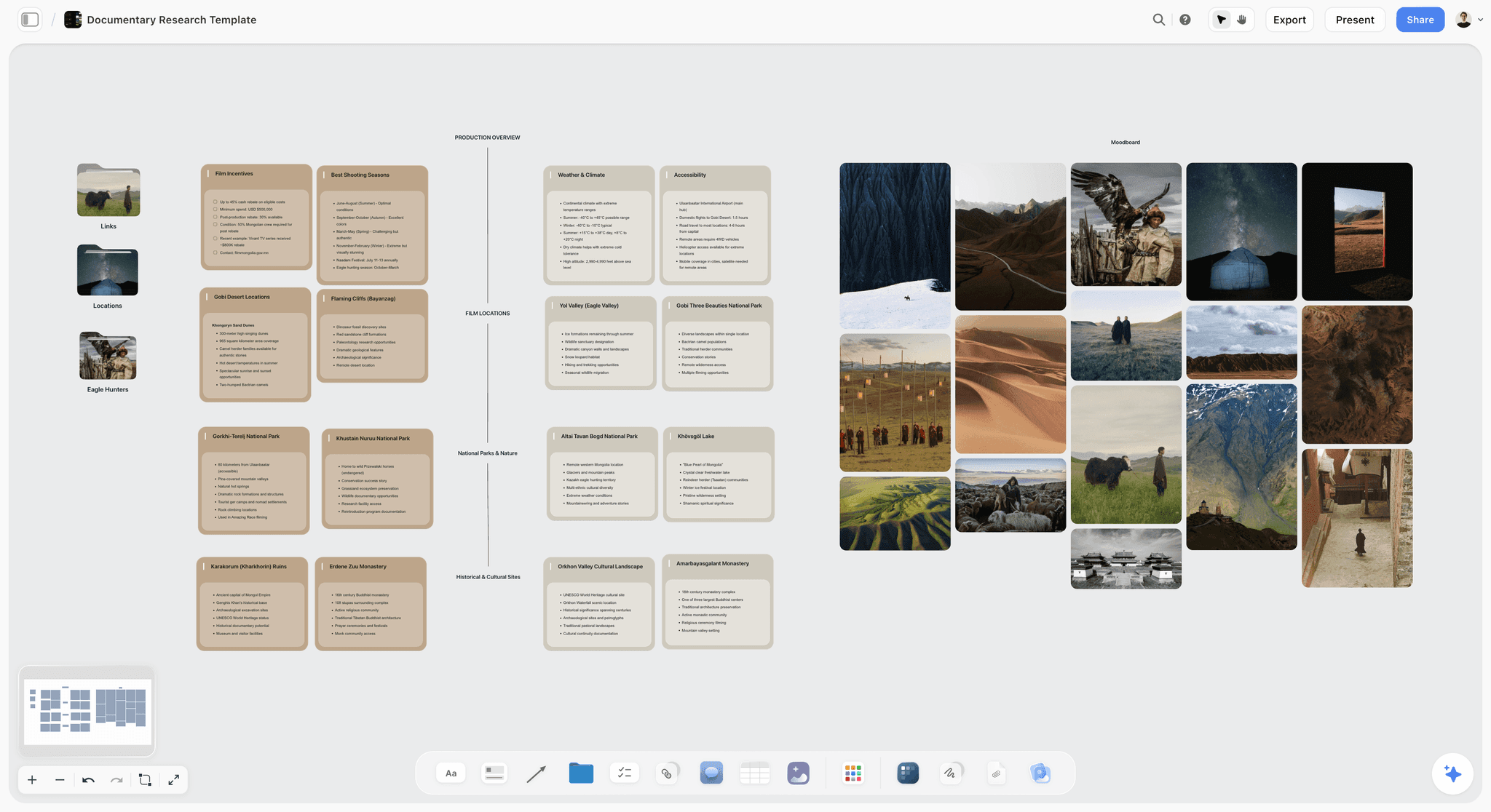
A documentary research board in Storyflow with film incentives, shooting seasons, locations and access notes beside a moodboard of location photos
When you cannot name the middle yet
Put the material on an open canvas, move it until the shape appears, and ask the AI what structure it sees while it can read the whole board. Build the tidy map afterwards, once you know what the center actually is.

When a Mind Map Wins
Decomposing one known subject. A chapter, a product, a syllabus, a topic you must revise for. There is a whole, it has parts, the parts have parts. This is exactly what the format models.
Fast solo divergence. Starting from one word and branching outward is quicker in a mind map than anywhere else, because the tool handles layout and you only supply the ideas. Keyboard-driven mind mapping is genuinely fast.
Study and recall. The hierarchy aids memory, which is why mind maps persist in education. Seeing the shape of a topic helps you remember its parts.
Anything you must present as a structure. Org charts, taxonomies, breakdowns for a client. The visual grammar reads instantly.
Forcing completeness. Because every branch invites siblings, a mind map surfaces gaps well. An empty area under a branch is visible in a way an empty area on a whiteboard is not.
When a Whiteboard Wins
Several subjects that must be reconciled. Three campaign directions, four interview subjects, a product with two audiences. There is no single root, and inventing one hides the actual problem.
Non-hierarchical relationships. When idea A relates to idea F across the map, a mind map cannot express it without breaking its own grammar. Whiteboards draw the line and move on.
Mixed media. Research is images, clips, screenshots, links, and quotes. Whiteboards treat those as first-class content. Mind map nodes are text with an occasional attached icon.
Group work. Workshops, retros, and kickoffs need many hands placing things simultaneously without fighting over one hierarchy. Live whiteboards are built for that; live mind mapping tends to produce one driver and several spectators.
Work whose shape is the question. Story structure, information architecture, a campaign's argument. You need to move things around to discover the shape, which requires a surface with no shape built in.
Holding unresolved material. A whiteboard tolerates a pile of things that do not fit yet. A mind map demands you attach them to something, and premature attachment is how you lock in a wrong structure.
The Failure That Only Mind Maps Produce
There is one failure mode worth naming on its own, because it is invisible while it happens and expensive afterwards.
When you put a topic at the center of a mind map, you have made a claim: *this is the thing, and everything else is a part of it.* Often that claim is true and the map is a good model. Sometimes the claim is false, and here is the problem: the map will look exactly as convincing either way. A well-formed mind map about a badly-framed center is a tidy, symmetrical, entirely persuasive picture of the wrong problem.
A concrete version. A team maps "our onboarding problem" with onboarding in the middle, branching into email, first-run experience, documentation, and support. The map is clean and the team works through it for three weeks. What the format could not show is that onboarding was fine and the real issue was that the wrong people were signing up, which is a marketing question sitting entirely outside the root. Nothing about the map would ever surface that, because the format's first move was to accept the center as given.
Whiteboards fail differently and more visibly. A board with four unconnected clusters and no obvious relationship between them is uncomfortable to look at, and the discomfort is accurate information: you do not yet understand how these things relate. The mess is the honest state of your knowledge, and it keeps pressing on you until you resolve it.
This is the strongest practical argument for starting on an open surface when a problem is new. A mind map is a good way to test a structure you already suspect, and a poor way to find one you do not have. Start where the format cannot smuggle in an assumption, then move to a map once you can defend what belongs in the middle.
A Worked Example
Take one project and run it through both formats to see where each stops helping.
The project: a company wants a video series and has three audiences, a limited budget, and no agreement on what the series is for.
As a mind map. Put "video series" in the center. Branches appear: audiences, budget, formats, distribution, timeline. Each breaks down neatly. Within twenty minutes you have a comprehensive, well-organized document. The trouble is that the actual conflict, that the three audiences want incompatible things and the budget only supports serving one properly, lives *between* the audiences branch and the budget branch. A mind map has no notation for a tension between two siblings. The single most important fact about the project has nowhere to sit.
As a whiteboard. The three audiences go up as three clusters, with what each wants underneath. The budget goes beside them as a constraint. Within twenty minutes it is visually obvious that two clusters are pulling against the constraint, because they are physically next to it and the crowding is legible. The board is messier and less presentable, and it shows you the actual decision.
What most teams should do: whiteboard until the decision is made (serve audience one properly, park the others), then mind map the chosen series to break it into episodes, formats, and tasks. The whiteboard found the problem. The mind map decomposed the solution.
That sequence, open surface to find the shape then structured map to break it down, is the pattern underneath almost every good answer to this question.
The Entropy Problem
The honest cost of the open field is that it goes bad without maintenance. Whiteboards accumulate. Six months in, a board holds three overlapping versions of a plan, a cluster nobody remembers making, and sticky notes referring to a decision that was reversed. Nothing in the tool prevents this, because preventing it would require the structure the format deliberately lacks.
Mind maps resist this by construction. Every node has a place; orphans are visually obvious; the format prunes itself.
Teams that live on whiteboards need a habit to compensate: archive finished boards, name them properly, and periodically delete rather than accumulate. If your team will not do that, the constraint of a more structured tool may genuinely serve you better, and that is a legitimate reason to choose one.
Hybrids and What AI Changed
The interesting development is that the two are converging in one direction only. Whiteboards and canvases increasingly ship mind mapping as a mode, because a canvas can contain a mind map while a mind map cannot contain a canvas. The superset absorbs the subset.
AI shifted the comparison too, and unevenly. AI in a mind mapping tool typically generates branches from a topic, which is useful for beating the blank page and rarely more, because the tool has little context beyond the node you are on.
AI on a canvas can read a great deal more, because there is more there to read. Storyflow's behaviour here is worth stating precisely: its AI reads the whole board you are working on, plus up to one Tactic and three Documents you `@`-mention. In practice that means it can respond to the research, the notes, and the emerging structure together, and it can build a map from material that is already on the board rather than from a prompt describing it.
Where Storyflow is the wrong tool: if you specifically want a classic mind map, a dedicated tool makes better ones. MindMeister and XMind have proper auto-layout, keyboard-driven branching, and export formats that a general canvas does not match, and MindNode is better still on Apple platforms. For live facilitated workshops with a large group, Miro's facilitation features (timers, voting, frameworks) are stronger. Storyflow is also cloud-only, which rules it out where work must stay local. Choose it when the job is holding an unsettled project with AI that can read it, not when the job is producing a tidy radial diagram.
How to Choose
Use a mind map when: you can name the center in one honest phrase, the relationships are genuinely hierarchical, the content is mostly text, you are working alone, and the goal is to break one thing into its parts.
Use a whiteboard when: there is no single center, relationships cross between branches, the material includes images or clips, several people are contributing at once, or the shape of the problem is the thing you are trying to find.
Use both when: the project is large. Whiteboard for the messy phase, then a mind map for any single sub-topic that turns out to have a clean hierarchy. This is more common than picking one for everything, and it costs nothing.
A shortcut that works: if you already know the structure and want to fill it in, mind map. If you are trying to discover the structure, whiteboard.
The Bottom Line
This is a choice about constraint. A mind map gives you one center and a hierarchy, and that restriction is what makes it fast and clarifying when the topic is genuinely one thing with parts. A whiteboard gives you nothing, and that emptiness is what lets it hold a problem whose shape you have not worked out yet, at the cost of entropy you have to manage.
A mind map assumes you already know what the middle is. A whiteboard is what you use when you do not. Ask which of those is true before you open a tool, and the answer is usually obvious. The expensive mistake is forcing a plural, tangled problem onto a radial map, because the result looks organized and quietly hides the part you had not solved.
FAQ: Mind Map vs Whiteboard
What is the difference between a mind map and a whiteboard?
A mind map is a radial hierarchy with one central topic where every idea connects back to the root through a single path. A whiteboard is an open surface with no imposed structure, where you can place anything anywhere and connect what you choose. The difference is constraint: a mind map enforces one center and a hierarchy, a whiteboard enforces nothing.
Which is better for brainstorming, a mind map or a whiteboard?
For solo brainstorming on one defined topic, a mind map is faster because the tool handles layout while you supply ideas. For group brainstorming, or when the topic is not yet settled, a whiteboard works better because several people can contribute simultaneously without competing over a single hierarchy. Match it to whether you have one topic or several.
Can you make a mind map on a whiteboard?
Yes, and many canvas tools now include a mind map mode. A canvas can contain a mind map because it is the less constrained format, while a mind mapping tool cannot contain a free canvas. The tradeoff is that a general canvas usually has weaker auto-layout and keyboard branching than a dedicated mind mapping tool.
When should I not use a mind map?
Avoid a mind map when there is no single central topic, when ideas relate to each other across branches rather than only to the root, when your material is mostly images or clips, or when several people need to contribute at once. The warning sign is inventing a vague center like "the project" so the format works, which means the format is wrong for what you have.
Are mind maps good for project planning?
They are good for breaking a project into its component parts and spotting gaps. They are poor at the parts of planning that involve time, dependencies, and ownership, since a radial hierarchy cannot express sequence or a due date. Most teams use a mind map for the decomposition and a project management tool for the schedule.
What is the best mind mapping tool?
For classic mind mapping, MindMeister and XMind are the strongest all-rounders, Coggle is the most generous free option with real-time collaboration, and MindNode is excellent on Apple devices. If you want AI that can read a whole board of research rather than just branch from a prompt, a canvas tool such as Storyflow fits better, though it produces a less conventional map.
What is the best online whiteboard?
Miro is the strongest general choice, particularly for facilitated workshops, with FigJam close behind for teams already working in Figma. Milanote suits freeform creative boards, and Storyflow suits project work where you want AI that reads the entire board. Pick based on whether your main need is live facilitation, design adjacency, or AI that understands the content.
Do mind maps help with memory and studying?
The hierarchy does aid recall, because seeing a topic's shape helps you retain its parts, which is why mind maps remain common in education. They work best for subjects that are genuinely hierarchical, such as a syllabus broken into topics. For subjects where concepts interlink heavily, a concept map allowing cross-links is usually the better fit.
What is the difference between a mind map and a concept map?
A mind map has one central topic and a strict hierarchy radiating outward. A concept map allows links between any two concepts and labels the relationships, so it can express that A causes B while B contradicts C. Concept maps handle interconnected knowledge better; mind maps are faster and cleaner for straightforward breakdowns.
Can AI create a mind map or a whiteboard for me?
AI can generate a starter mind map from a topic, which helps with the blank page though the output is usually generic. The bigger gain comes from AI that reads material already on a board and builds structure from it, since it is responding to your actual project rather than to a prompt. Treat generated structure as a first draft to argue with, not an answer.
Which is better for team collaboration?
Whiteboards, clearly. They are built for a whole group placing things at once, and they support the mixed media and unresolved clusters that real group work produces. Collaborative mind mapping tends to produce one person driving the hierarchy while everyone else watches, because a single tree is hard to edit in parallel.
How do I stop my whiteboards becoming a mess?
Archive boards when the work they supported is finished, name them so their purpose is obvious months later, and delete rather than accumulate versions. The entropy is structural, not a discipline failure: the format removes the constraint that would prevent it. If your team will not maintain that habit, a more structured tool may genuinely suit you better.
Table of Contents
Templates to check out for this topic


Mind mapping and ideation templates you can use in Storyflow
Map ideas in space, then ask the AI to restructure, expand, or connect them. Open any of these boards and start thinking visually instead of in lists.


See Storyflow in Action
A visual AI workspace where every feature lives inside one canvas. No tab-switching, no context lost.
Build your entire board from a single message
Type what you need in the AI chat at the bottom of your canvas. The AI adds cards, headings, and structure directly onto your board.
Use expert frameworks as AI context
Type @ in the AI chat and choose any Tactic. The AI tailors every response to that framework instead of giving generic advice.
Turn your board into a mind map in seconds
Ask the AI to restructure your canvas as a mindmap. It connects your ideas into a visual hierarchy so you can see how everything relates.
Why Storyflow Exists
Storyflow actually began as a personal tool while working on creative and research projects.
We kept running into the same problem: ideas were scattered everywhere: notes, documents, and whiteboards.
Nothing helped us see how everything connected.
So we started building a workspace designed around how ideas actually grow.
→ Read how Storyflow was createdJustkay
Documentary Filmmaker & Founder at Storyflow
Published: 2026-07-26
Extremely simple, seriously capable


See how easy it is to get started
Watch a real project come together, from a blank board to a finished plan, clicked through step by step.
Start creating with AI and become more productive
Transform your creative workflow with AI-powered tools. Generate ideas, create content, and boost your productivity in minutes instead of hours.