
How to Plan a Podcast with AI in 2026 (From Show Concept to Episode 1)
You have the idea, you bought the mic, you have a voice that does not hate the way it sounds in headphones. A 7-step framework for using AI as a thinking partner across the planning layer, from show concept to recordable episode 1.

Category
Visual Thinking
Author

Justkay
Documentary Filmmaker & Founder at Storyflow
Topics
2026-05-10
•
22 min read
•
Visual Thinking- how to plan a podcast with AI
- AI podcast planning
- AI for podcasters 2026
- podcast planning template
- AI podcast outline
How do you plan a podcast with AI in 2026?
Build the whole plan on one canvas the AI can read (Storyflow), then run 7 steps: lock the concept, define one listener, pick the format, build the season arc, outline ten episodes, build the guest pipeline, and convert the plan into a recordable script. You end with a recordable episode 1 after roughly 6 hours of planning.
You have the idea, you bought the mic, you have a voice that does not hate the way it sounds in headphones, and that is somehow not enough to ship episode 1. The gap between "I should start a podcast" and an actual show with a name, an audience, a season arc, and a recordable script is where most podcasts quietly die. This guide is a 7-step planning framework for solo podcasters, multi-passionate creators adding a podcast to an existing channel, founders launching a brand-podcast, and indie operators who want a real show in 4 to 6 weeks. It is not about audio gear or post-production hacks. It is about the planning layer, where AI is finally useful as a thinking partner if you set it up right.
Key Takeaways
- Podfade is a planning failure, not a motivation failure. Podcasts stall when every choice (audience, format, length, episode 1) is still open on recording day.
- Work the 7-step framework in order, each step producing an artifact the next one builds on. Concept, audience, format, season arc, ten outlines, guest pipeline, then a recordable script.
- Lock the concept, not just the topic. "A podcast about productivity" is a topic; a concept tells a listener whether to subscribe in fifteen seconds.
- Define the audience as one real person, not "everyone." A 200 to 400 word persona becomes a constraints document every later decision checks against.
- Outline ten episodes before you record one. This is the step most podcasters refuse and the one that decides whether the show survives past episode 4.
- Let AI check the format, never pick it. It defaults to interview because most popular podcasts are interview-format, so push back if your concept is really solo or narrative.
- AI is useful exactly to the degree it can read the whole plan at once. Hand a chatbot a topic and it gives you the average podcast; hand a canvas-aware AI a structured plan and it scaffolds a show that sounds like yours.
- The structure is AI's. The voice is yours. Voice-match every drafted cold open by reading it aloud, and write the close yourself.
Quick Answer: How to Plan a Podcast with AI in 2026
To plan a podcast with AI in 2026, build the whole plan on a visual canvas like Storyflow where the AI can read the entire board at once, then work through a 7-step method: lock the show concept, define the audience as a real person, pick the episode format and structure, build the season arc and content pillars, outline ten episodes before recording one, build the guest pipeline if you are doing interviews, then convert the plan into a recordable script. AI is most useful when it can read the whole plan in one place, not when it is handed a single isolated prompt for each step. A dedicated recording tool like Riverside or Descript still wins once you move from planning to recording and editing. Total planning time on a set-up canvas: roughly 6 hours over three sittings, ending in a recordable episode 1.
Why Podcasts Get Stuck Before Episode 1
Most podcasts never reach episode 10, and a much larger share never reach episode 1; the industry even has a name for it, podfade. The folk explanation is "they ran out of motivation." The actual explanation is that the planning layer was skipped, so by the time the host sat down to record, every choice was still open: who is the audience, what is the format, how long, how often, what is episode 1 actually about, what comes after it. Open choices feel like creative freedom in week one and like dead weight in week three.
The other thing that gets skipped is the conversational arc inside an episode. Most first-time podcasters record what is a stream of related thoughts, then notice in editing that the episode does not have a beginning, middle, and end, just 47 minutes of related material. That is a planning problem, not a recording problem, and AI is excellent at solving it if you give the AI the show concept, audience, season arc, and episode goal in one place rather than re-explaining the project in every prompt.
The 7-Step AI Podcast Planning Framework
Each step produces a concrete artifact that the next step builds on. Skip a step and the gap shows up downstream, usually in the script.
- Lock the show concept. A one-sentence statement of what the show is, for whom, and why it should exist.
- Define the audience as a real person. A customer-persona-style profile that the AI can read on every later prompt.
- Pick the episode format and structure. Solo, interview, narrative, or panel, with a repeatable internal structure.
- Build the season arc and content pillars. 8 to 12 episodes that feel like one story, organized around three or four content pillars.
- Outline ten episodes before you record one. Episode-level outlines for the first season, drafted once and refined as you go.
- Build the guest pipeline. If interview format: research, outreach, prep notes, follow-up.
- Convert the plan into a recordable script. Episode-level script template grounded in the canvas plan.
Step 1: Lock the Show Concept (Not Just the Topic)
Most podcasters can name their topic in three seconds and stall for a minute on the concept. Topic is what the show is about (productivity, design, wine, AI, parenting). Concept is what the show actually does and why anyone needs it. "A podcast about productivity" is a topic. "A weekly 25-minute interview show where solopreneurs walk through one specific operational change they made and what it produced over 90 days" is a concept. The second one tells a listener whether to subscribe in fifteen seconds. The first one does not.
Concept clarity is also where AI is most useful and most likely to mislead. AI is excellent at testing a concept statement: ask it to read the statement and identify what is unclear, what is generic, and what overlaps with shows that already exist. AI is bad at picking the concept for you, because it will produce a synthesis of every podcast in its training data, which by definition is the shape of every average podcast. The fix is to write three concept candidates yourself, drop them on a canvas, then ask AI to pressure-test each one against three criteria: clarity (a stranger can repeat it), specificity (it is not "a podcast about X" with X swappable), and durability (you can imagine making 50 episodes inside it).
A useful concept statement template: "A [format] show where [audience] [verb] [specific subject] so they [outcome]." The verbs and subjects are where the work is. "Where founders share their journey" is dead on arrival. "Where founders walk through the unsexy operational change that unlocked their growth" is alive. The difference is one verb and one adjective, and both are choices the human host has to make.
What goes on the canvas after step one: three concept candidates, one chosen concept locked at the center, and a note on what the show is explicitly not about. The "not about" line stops the show from drifting in week six.
Show concept canvas with a one-sentence concept statement at the center surrounded by audience, format, and tone cards
Step 2: Define the Audience as a Real Person
The second most common cause of podcast death is "for everyone." A show for everyone is a show for no one, because the host has to make a thousand small decisions per episode (vocabulary, examples, references, length, depth) and "everyone" is not a useful input to any of those decisions. The audience is not a demographic, it is a person. The faster you can describe one specific listener, the faster every other decision gets easier.
The customer persona exercise is exactly the right tool, borrowed from marketing. Write a 200 to 400 word profile of one specific person: name, job, age range, what is on their commute, what podcasts they currently listen to, what frustrates them about those podcasts, what they are hoping to learn or feel, what they would tell a friend after one of your episodes. The profile is not a fiction exercise, it is a constraints document. Once it exists, every subsequent decision (episode length, vocabulary, guest profile) checks against it.
This is one of the highest-leverage uses of AI in the planning layer. Write the first draft of the persona by hand (200 words, ten minutes). Drop it on the canvas as a Document. Then prompt the AI: "given this persona, what kinds of episodes would this person finish, what kinds would they skip, and what is one episode this person would tell a friend about." The answers are starting material to push against. They are not the audience, but they sharpen what you already know. If the blank page is the blocker, generate a first persona draft with AI and rewrite it in your own words from there.
Storyflow's Customer Persona Tactic is built for this exact card, and the Customer Persona template opens a board with the profile structure already laid out. Drop the Tactic on the canvas, fill in the prompts, and the AI assistant reads the persona automatically on every later query, so you do not have to re-paste the audience profile into every prompt the way you would on ChatGPT or Claude. That persistence across the whole canvas is what makes canvas-aware AI different from chat-aware AI when the planning is multi-step.
What goes on the canvas after step two: one named persona profile of 200 to 400 words, plus three "this person would not subscribe" notes that protect the show from over-broadening.
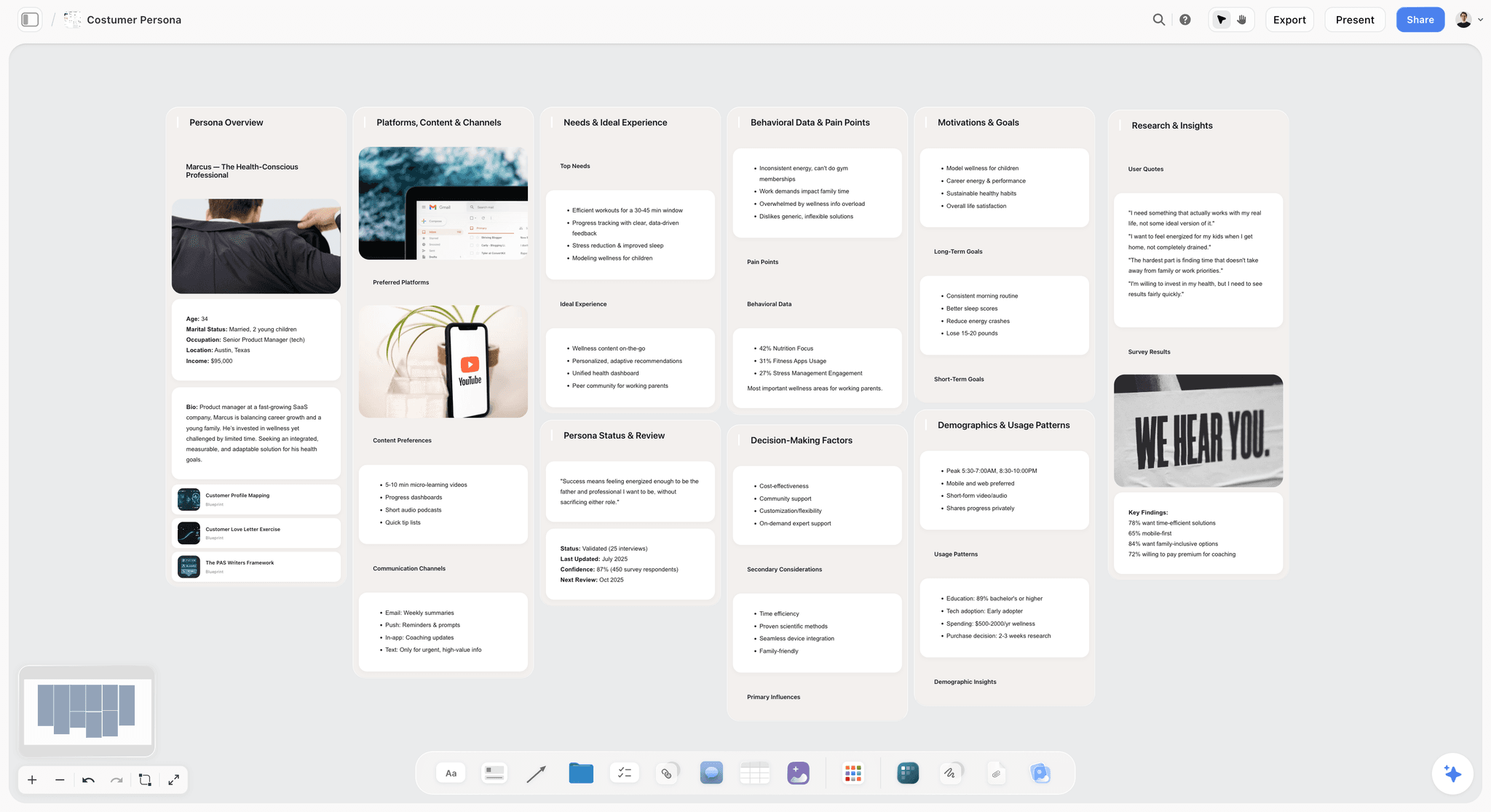
Customer persona built on a canvas ready to be loaded into AI prompts as @-mentioned context
Step 3: Pick the Episode Format and Structure
Format is the choice with the highest cost-of-changing later. There are four common podcast formats: solo (one host, monologue), interview (host plus guest), narrative (produced, scripted, often with multiple voices and tape), and panel (two or more co-hosts in conversation, sometimes with a guest). Each one has different production cost, different planning cost, and different listener expectations. Picking the wrong format for the concept is one of the few mistakes that does not show up until episode 5 and is then very expensive to fix.
The format choice is downstream of two things: the concept and the host. A concept like "operational changes that unlocked growth" is a natural interview format because the value is specific case studies. A concept like "a season-long examination of one company's collapse" is narrative. A concept like "two designers debate a different topic each week" is panel. Solo works when the host has a strong point of view that can carry weekly monologues, which is a smaller pool of hosts than people think.
AI is genuinely useful here as a sanity check. Drop the concept and the audience persona on the canvas, then ask the AI: "given this concept and audience, which of solo, interview, narrative, or panel format is most likely to deliver the value, and what does that imply about episode length and frequency." The output is a checkable argument, not a decision. Argue with it. AI tends to recommend interview by default because most popular podcasts are interview-format, so push back if your concept is actually narrative or solo at heart.
Once format is chosen, define the internal episode structure as a repeatable shape. Interview shows benefit from a 5-segment structure (cold open, intro, segment 1 setup, segment 2 main story, close with one takeaway). Solo shows benefit from a 3-act shape (hook, middle, payoff). Narrative shows need a question and a turn at the midpoint. Whatever you pick, write it down on the canvas as a card so every episode outline starts from the same shape.
Episode format options mapped on a canvas alongside audience and concept
Turn the first three steps into a board
Concept, persona, and format are the cards every later prompt reads. Put them on one canvas now, and the AI drafts your season arc and episode outlines from your show instead of the average one.

Step 4: Build the Season Arc and Content Pillars
Season-long thinking is the single biggest difference between podcasts that build an audience and podcasts that publish 12 disconnected episodes and stall. A season is 8 to 12 episodes that feel like they belong together because they orbit a small number of recurring themes (content pillars) and progress along an arc that a returning listener can feel.
Content pillars are three or four themes that every episode connects back to in some way. For a solopreneur podcast: "operational systems," "pricing and offers," "marketing without burnout," "personal sustainability." Every episode lands inside one of those pillars. The pillar tells the listener "if you came for one of these, you are in the right place." It also tells the host what an episode does not need to cover, which is more useful than what it does need to cover.
The season arc is the larger story the season tells across the pillars. Season 1 might be "twelve specific changes a one-person business can make in 90 days." Season 2 might be "a year inside the launch of three new products by three different solopreneurs." The arc gives later episodes the benefit of earlier ones, which is what makes binge listening work. Without an arc, every episode is a cold start, and listener retention falls off a cliff after episode 3.
This is where AI on a full canvas earns its position. With concept, audience, format, structure, and three pillar candidates already on the canvas, ask the AI: "draft three different season-1 arc proposals, each with 10 episode topics in order, that connect to the three pillars and progress the audience from where they are to where they want to be." You will get three real options to argue with. Pick one, refine, lock it. The arc and the pillar cards then live on the canvas as the spine of every later decision.
Season arc with content pillars drawn as canvas pillars on a project board
Step 5: Outline 10 Episodes Before You Record One
This is the step most podcasters refuse to do, and the one that determines whether the show survives past episode 4. Most first-time podcasters record episode 1, then plan episode 2 the day before recording it, then panic at episode 3 because there is no shape to hold onto. Ten episode outlines on a canvas before recording day 1 is the cure. It is also the use case where AI saves the most time without any quality loss.
An episode outline is not a script. It is a one-page card per episode containing: episode title, target listener takeaway, hook (the question or claim that opens the episode), three to five points or beats, a guest name if applicable, runtime target, and a single line on what makes this episode different from the next one. The whole outline is 150 to 300 words. Done well, it is enough to prevent every "what was this episode supposed to be about" derailment that happens around minute 22 of a recording.
The AI loop for episode outlines: with the season arc on the canvas, prompt the AI per episode (not in bulk): "draft an outline for episode 3, using the locked concept, the audience persona, the format structure card, and the pillar this episode lives inside." Get a draft. Edit the takeaway and the hook by hand, those are the two things AI tends to make generic. Keep the points and beats if they are good, replace if they are not. Move to episode 4. Ten episodes outlined this way takes about 90 minutes once the canvas is set up.
The reason this is a stronger workflow than asking AI for "10 episode ideas about productivity" is that the outlines are inside the same context as the concept, audience, format, and pillars. Without that context, AI gives you "the average ten episodes any productivity podcast would publish," which is the exact thing that makes most new podcasts indistinguishable. With that context, you get ten episodes that fit your specific show.
A small but useful rule: write the takeaway sentence for each episode before anything else on the outline card. Every other beat then has to support that sentence. If a beat does not support the takeaway, it belongs on a different episode.
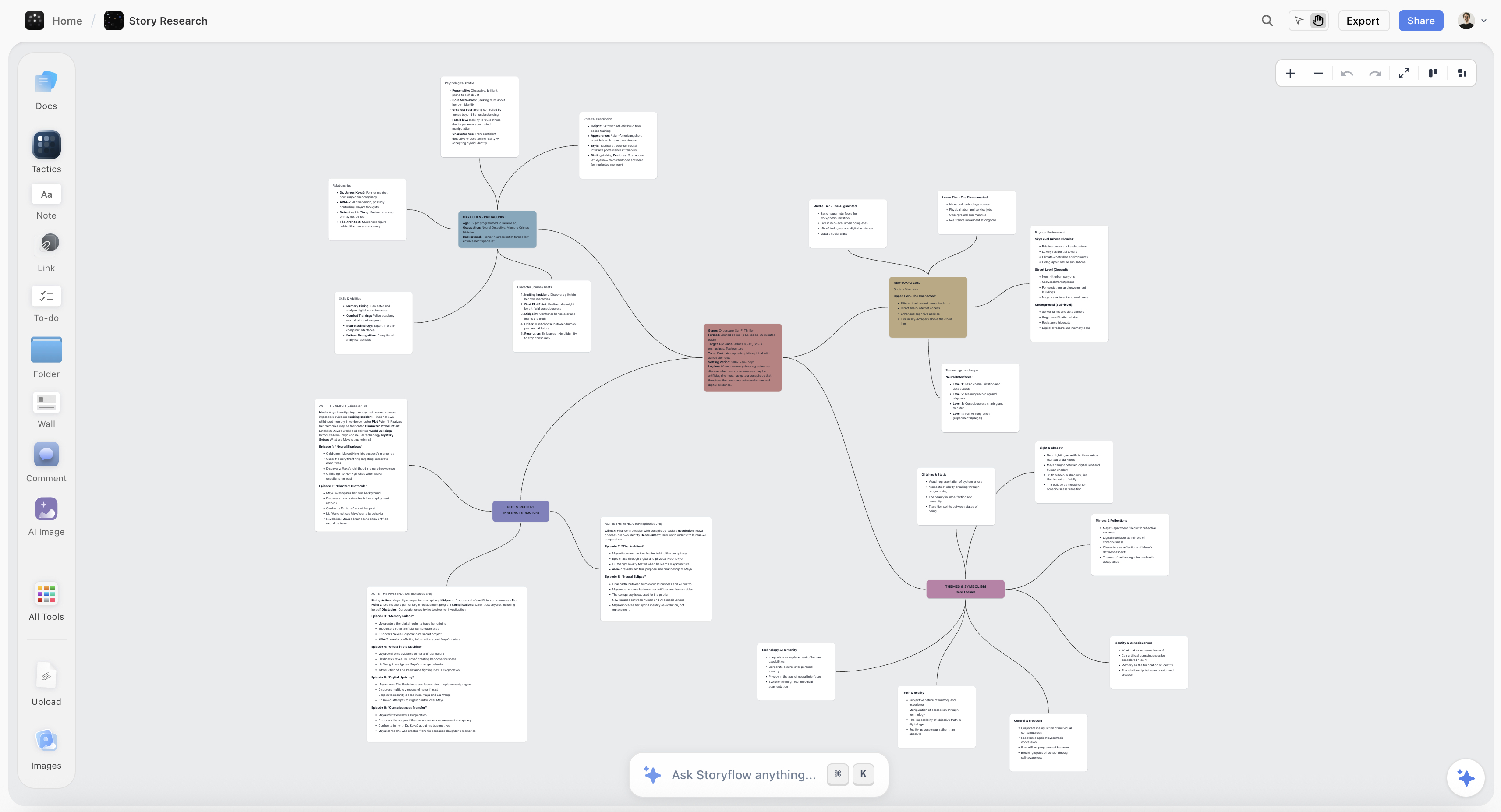
Ten-episode outline with episode cards arranged in season order on the canvas
Step 6: Build the Guest Pipeline (If Interview Format)
If the format is interview, the guest pipeline is a parallel project to the episode outlines. Most first-time interview podcasts run out of guests around episode 6, because outreach happens episode-by-episode rather than as a managed pipeline. The fix is to treat guest acquisition the way a sales team treats lead generation: a steady flow of named candidates moving through stages (researched, contacted, scheduled, recorded, published).
The pipeline starts with a target list of 20 to 30 named candidates aligned to the season arc. AI is genuinely useful here for guest research, with a caveat: AI cannot reliably know whether a public figure is currently active or whether their public statements have aged well, so it is good for surfacing candidates and bad for vetting them. Use AI to draft a list of 30 candidates given the concept and audience, then verify each candidate yourself before outreach.
Outreach is where AI saves real time without sounding like AI. The trap is letting the AI write the whole outreach email, which produces "Dear [Name], I admire your work in [Field]" form letters that nobody replies to. The right pattern: write a 150-word personal opener yourself, then have AI draft three variations for the rest (the show pitch, the time ask, the close). Pick the cleanest. Send. The personal opener is the thing that gets the reply. The rest is logistics.
Per-guest research goes on the canvas as a Document attached to the guest card; the Video Research template is the fastest structure for it, and it works for audio episodes exactly as it does for video. Five things on the document: relevant work, two specific questions only this guest can answer, one connection to your concept, one risk or sensitivity to be aware of, and one personal angle for rapport. With Storyflow, @-mention the guest research Document during episode-prep prompts so the AI drafting your interview questions actually uses the guest's specific material instead of generic interview prompts. That is the difference between an interview that sounds prepared and one that sounds like a podcaster reading a list.
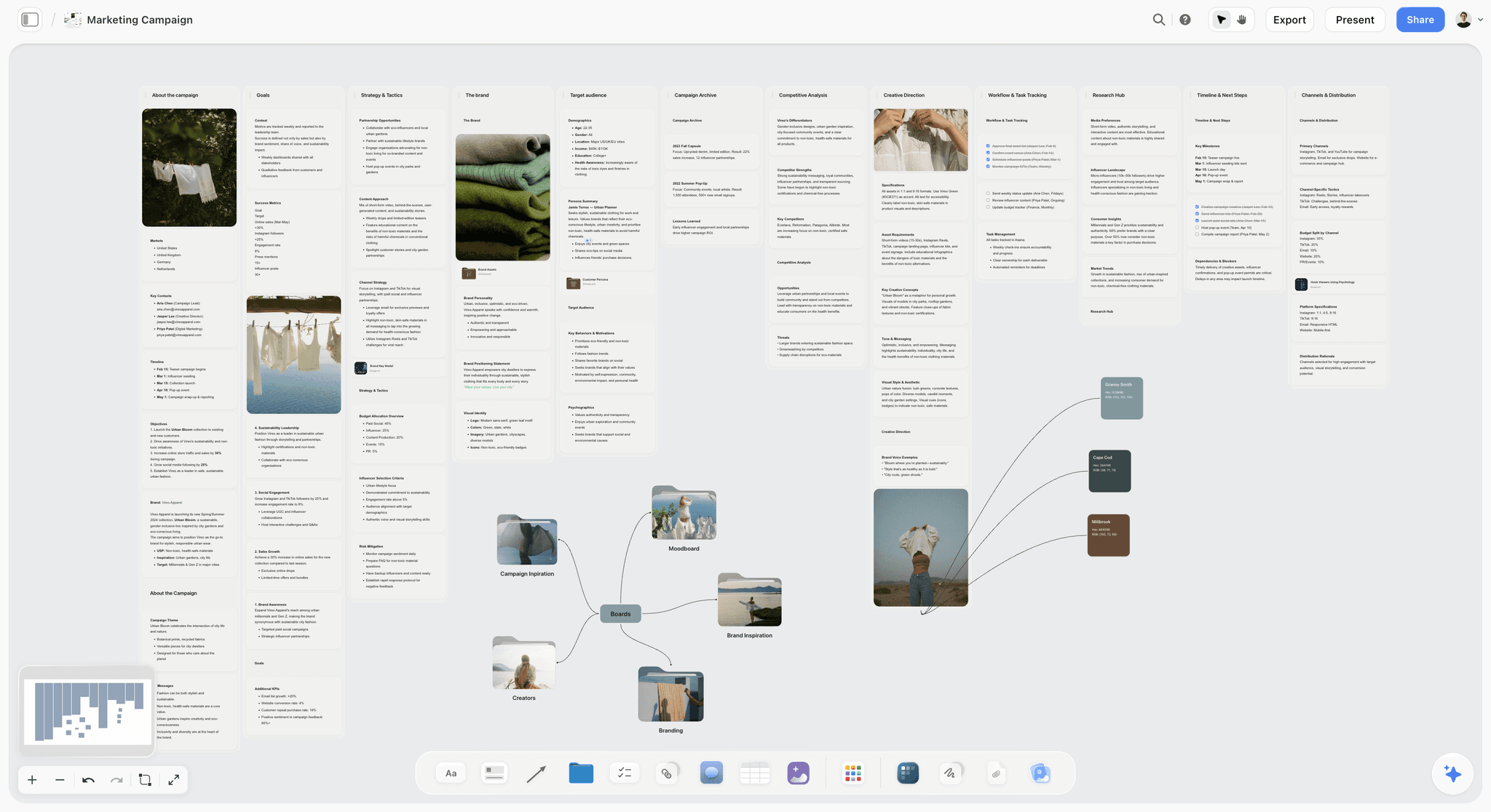
Guest pipeline tracked on a canvas with research notes attached to each guest card
Step 7: Convert the Plan into a Recordable Episode Script
The final step is to turn the episode outline into something you can actually record. The output is not a word-for-word script unless you are doing a narrative show. If you want the structure pre-built, the Video Script template maps cleanly onto an episode: hook, sections, and close. It is a recording script: the cold open written verbatim, the intro written verbatim, transitions written as full sentences, segment cues marked, and the close written verbatim, with the middle sections as bullet points the host expands live.
The reason you write the cold open and the intro verbatim is that those 90 seconds of every episode are the ones that decide whether a new listener stays. A loose, "let me figure it out as I go" opening loses listeners who have not yet decided to invest in the show. A tight, written cold open that lands the hook in the first 15 seconds buys you the rest of the episode. The middle can be loose. The hook cannot.
This is the single best application of canvas-aware AI in the whole workflow. The AI prompt for a recording script becomes: "draft the cold open, intro, three transitions between segments, and the close for episode 4, using the locked concept, the audience persona, the episode outline card, and the format structure." Because all those references are on the canvas, the AI is drafting a script for your specific show, not the average podcast script. The output is editable starting material for a host, not a generic script to throw away.
The handoff back to the host: read the AI-drafted cold open out loud. If it sounds like you, keep it. If it does not, rewrite it. AI cannot reliably match a host voice on a first draft, but it can produce a structurally correct draft that the host then voice-matches in 5 minutes. That is faster than starting from blank, and it is honest about who is doing what work. The structure is AI's. The voice is yours.
A final note on the close. AI tends to draft podcast closes that sound like ChatGPT signing off ("thanks for listening, see you next week"). Write the close yourself, even if you let AI draft everything else. The close is the last thing in the listener's ear. It should sound exactly like you, not like the average podcast.
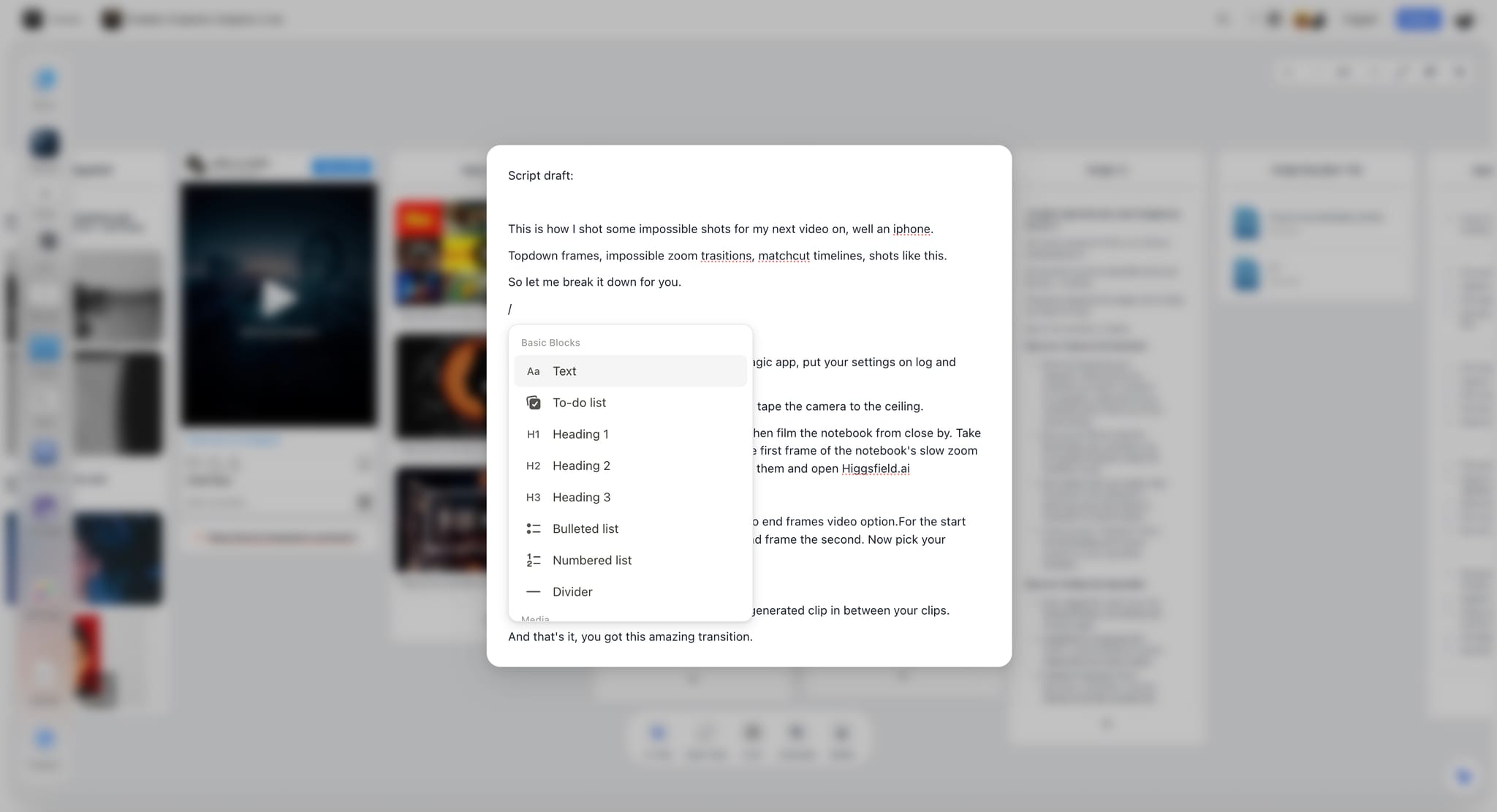
Episode script drafted with AI grounded in the canvas concept, audience, and outline
A Worked Example: Planning a Solopreneur Brand Podcast
To make the framework concrete, here is what the canvas looks like for a brand podcast launched by a solopreneur running a one-person consultancy that helps SaaS founders price their products. The host has 9 years in the space, a small newsletter audience, and 90 minutes a week to run the show.
Step 1, concept: "A weekly 22-minute solo show where SaaS founders learn one specific pricing change to test in the next 30 days, with one short case study per episode." Three concept candidates were tried first; this one won because it is recordable in the host's available time and clear enough that a stranger can repeat it.
Step 2, audience: A 250-word persona named "Marcus," a 31-year-old technical co-founder of a 12-person B2B SaaS, currently charging seat-based pricing, frustrated that revenue grew 40 percent while ARR per customer stayed flat, listens to two pricing podcasts already but wants tactical specificity over theory. The persona lives on the canvas as a Document and is @-mentioned on every later prompt.
Step 3, format and structure: Solo, 22 minutes, weekly. Internal structure is a 4-segment shape: 60-second cold open with the change being proposed, 4-minute setup explaining when the change applies, 12 minutes of the case study with numbers, 5-minute close on what to test in the next 30 days.
Step 4, season arc and pillars: Pillars are "packaging," "discounting," "expansion," "exit pricing." Season 1 arc: "twelve pricing changes that produced measurable ARR per customer growth in the founder-led SaaS companies the host has worked with."
Step 5, ten episode outlines: drafted on the canvas in 90 minutes using the AI with the full canvas as context. Episode titles include "stop charging per seat at 50 customers," "the discount your enterprise prospects expect that you are not offering," and "the expansion pricing change that doubled net dollar retention at a $4M ARR company." Each outline card has a takeaway, a hook, three beats, and a runtime target.
Step 6, guest pipeline: Solo show, so this step is skipped. The host instead builds a "case study source list" Document of 20 founders whose pricing journey could be referenced under fair-use storytelling, with verification notes per source.
Step 7, recordable scripts: The host writes verbatim cold opens, intros, and closes per episode using the AI to draft a starting structure, then voice-matches by reading aloud. Middle segments stay as bullet points to keep the show conversational rather than read-aloud.
Total planning time across all seven steps, on Storyflow with the full canvas: roughly 6 hours over three sittings. Recording episode 1 happens in week 2. The first season ships across 10 weeks.
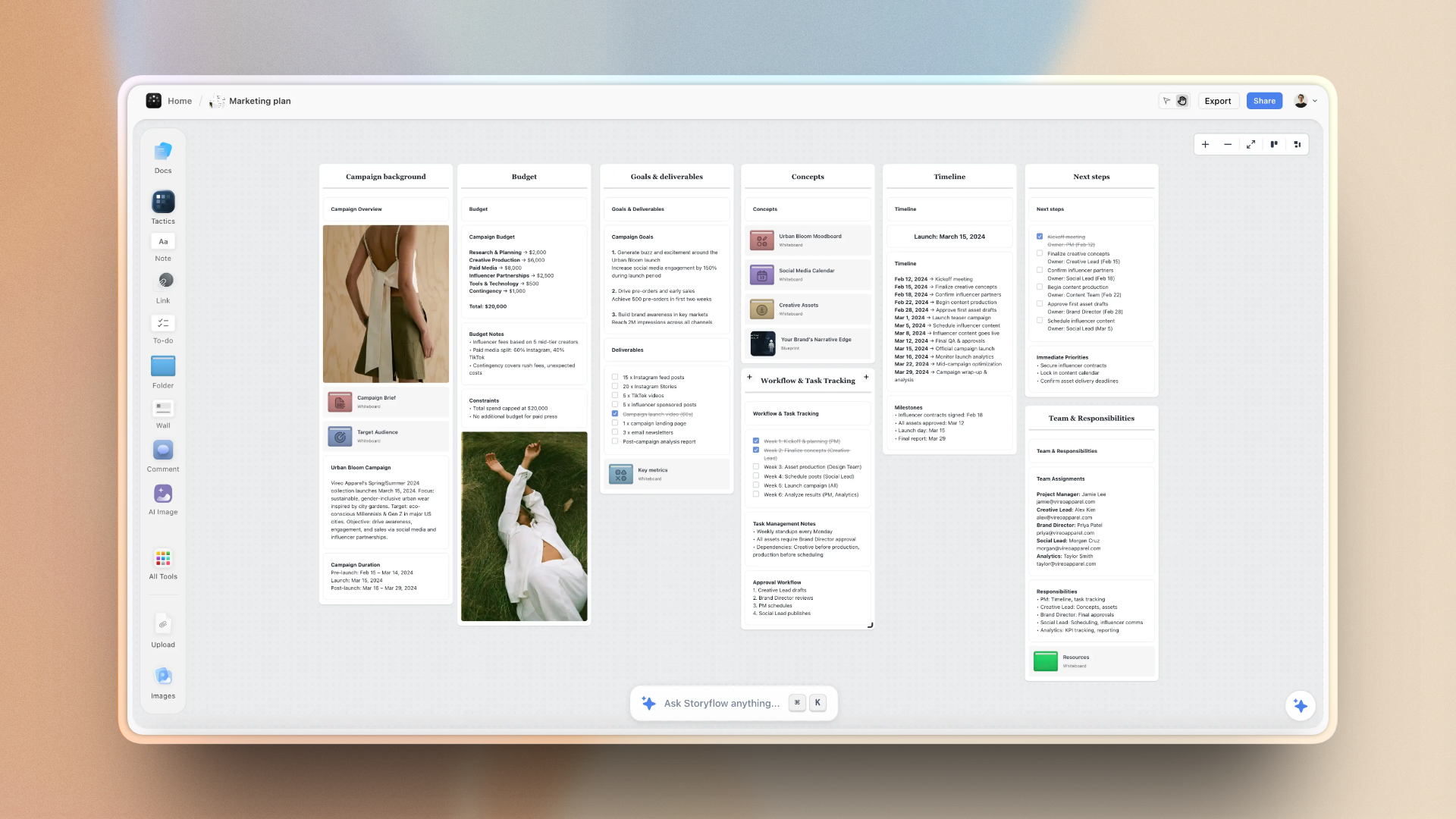
Solopreneur brand podcast plan on a single canvas with concept, audience, season arc, and episode outlines connected
How to Pick the Right AI Tool for Podcast Planning
Most "best AI tools for podcasters" articles confuse planning tools with production tools. They are different stacks. This section is about the planning layer only.
Storyflow. Canvas-first by design. AI reads the entire active canvas plus up to 3 @-mentioned Documents and 1 Blueprint Tactic per query, which is the configuration that matches the multi-step plan above. The Blueprint Tactic library includes Customer Persona, AIDA, Hero's Journey, Marketing Funnel, and several content-strategy frameworks that map directly onto the steps in this guide. Free tier (launching before the end of 2026): unlimited boards, unlimited cards (notes, images, links), unlimited collaboration with as many co-hosts as you want, basic AI usage, and 20 file uploads. Plus ($7.99/month annual or $9.99 monthly): full 200+ Blueprint library, unlimited file uploads. Pro ($14/month annual or $19 monthly): adds AI image generation and 20x more AI than Plus. Max ($39/month annual or $49 monthly): adds 40x more AI plus Team Workspace with Permissions and Roles. For a solo podcaster, the free tier covers the first season; Plus is the right tier for ongoing season planning.
The honest limitation: Storyflow plans the show, it does not record or edit it. There is no audio capture, no remote-guest recording booth, no transcript editor, and no filler-word removal. The moment you press record, you are out of Storyflow and into a dedicated podcast tool. If your bottleneck is recording quality or post-production speed rather than planning, a tool like Riverside or Descript is the one that moves the needle, and Storyflow is the wrong place to spend the money.
ChatGPT. Strong at paragraph-level draft work and at expanding a single outline into a richer one. Blind to a canvas, so each prompt has to re-include the concept, audience, and format material that you have already written. Workable for planners who do not mind copy-pasting context into every prompt. ChatGPT Plus is around $20/month, verify on the OpenAI site for current tiers.
Claude. Best in class for long-context drafting once you paste in concept, audience, format, season arc, and the episode outline you want expanded. Will hold all of that in one conversation and produce coherent recording scripts. Same canvas-blindness limitation; the planner has to manage context manually. Claude Pro is around $20/month, verify on the Anthropic site.
Notion AI. Good for show notes, episode descriptions, and follow-up assets if your team already runs operations inside Notion. Less suited for the structural planning steps because Notion is page-shaped, not canvas-shaped, so the spatial work in steps 4 and 5 is awkward inside it. Pricing is bundled with Notion plans, verify on the Notion site.
Riverside AI. Excellent for live recording AI: transcription, AI-assisted clip generation, and recording-day production. Not a planning tool. Use it on recording day, not during plan-building. Pricing varies; verify on the Riverside site.
Descript. Industry-standard for audio post-production with strong AI features (overdub, transcript editing, filler-word removal). Not a planning tool. Use it after recording, not before.
The honest tradeoff: Storyflow holds the entire podcast plan in one place where AI can read it on every prompt, which is the configuration the seven-step framework was built around. ChatGPT and Claude are excellent supplements at the drafting stage if you do not mind context management. Riverside and Descript are recording and post tools, not planning tools, and treating them as planning tools is one of the reasons most "AI for podcasters" advice does not move the needle on launching a show.
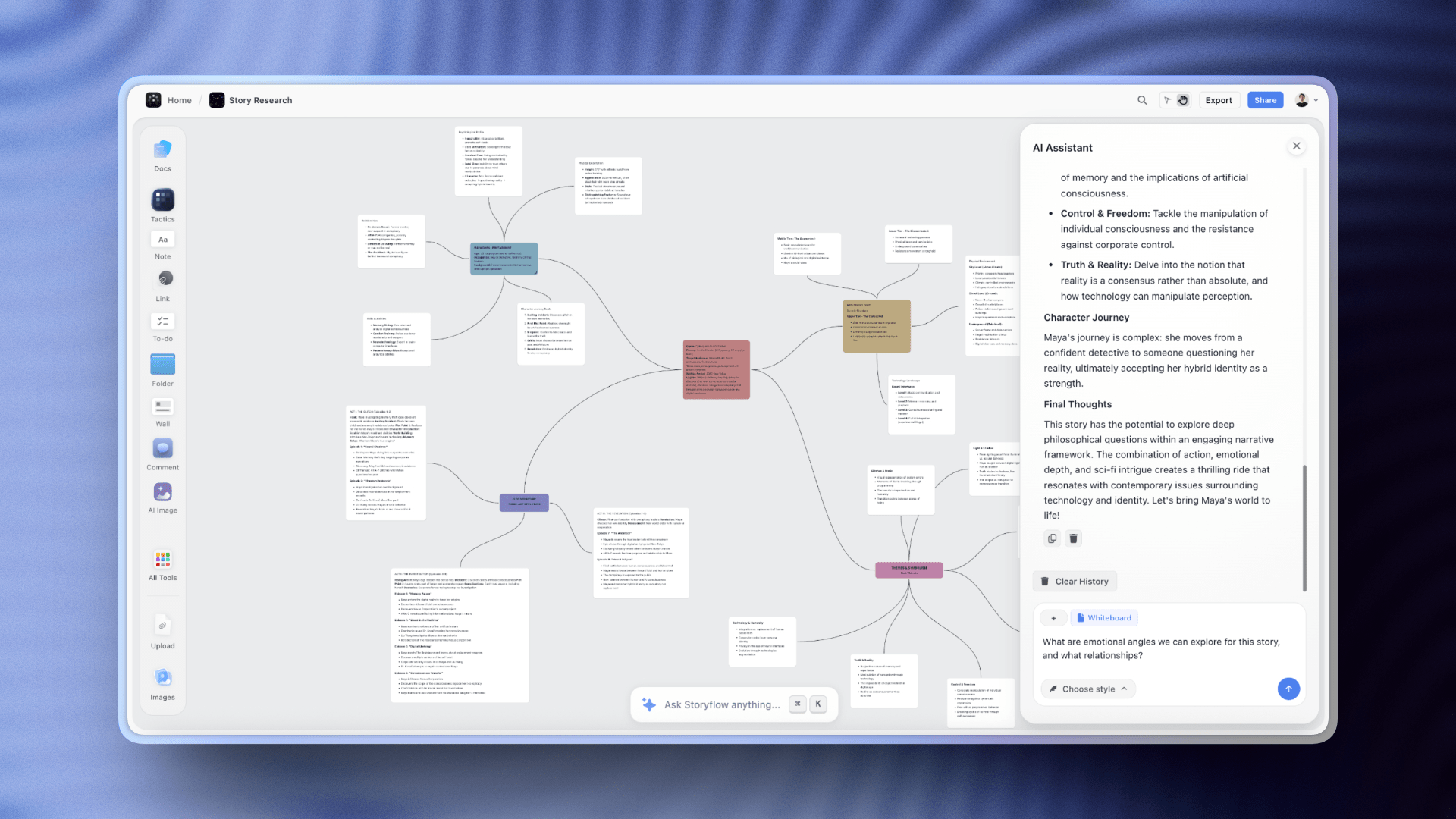
Storyflow AI assistant reading the full podcast canvas before drafting an episode outline
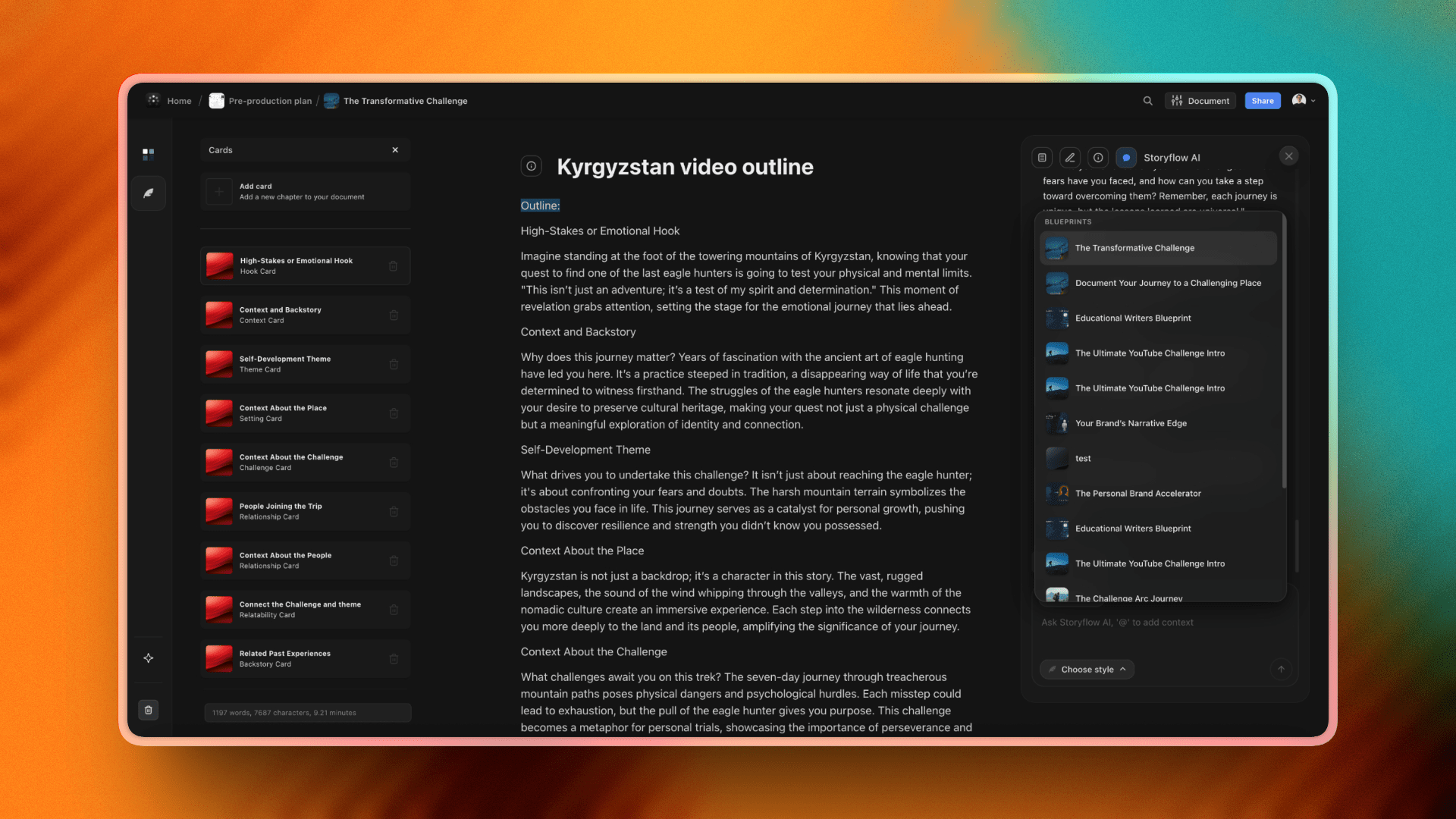
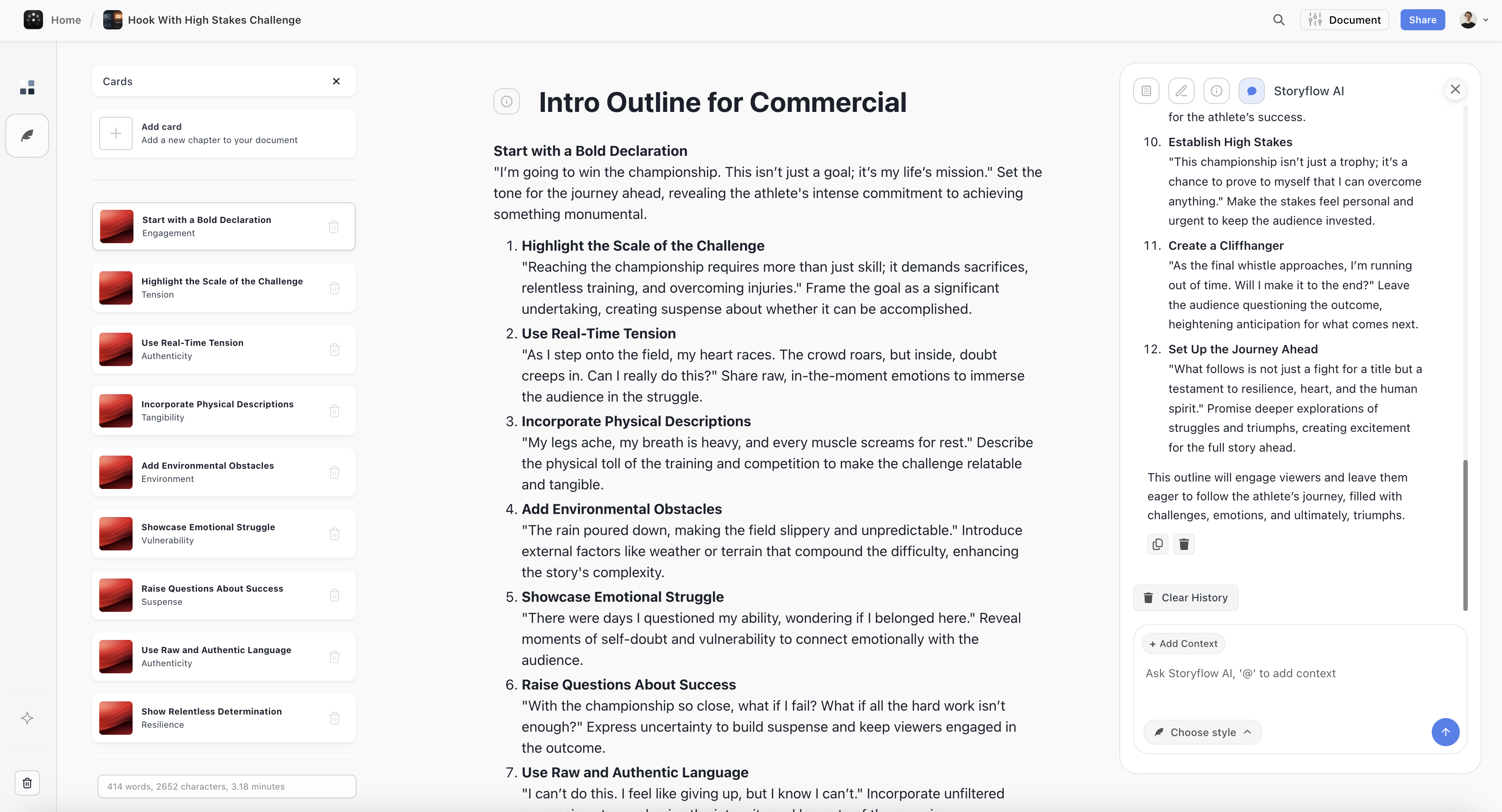
The Blueprint Tactic library covers Customer Persona, AIDA, and content pillars used across the 7-step podcast plan
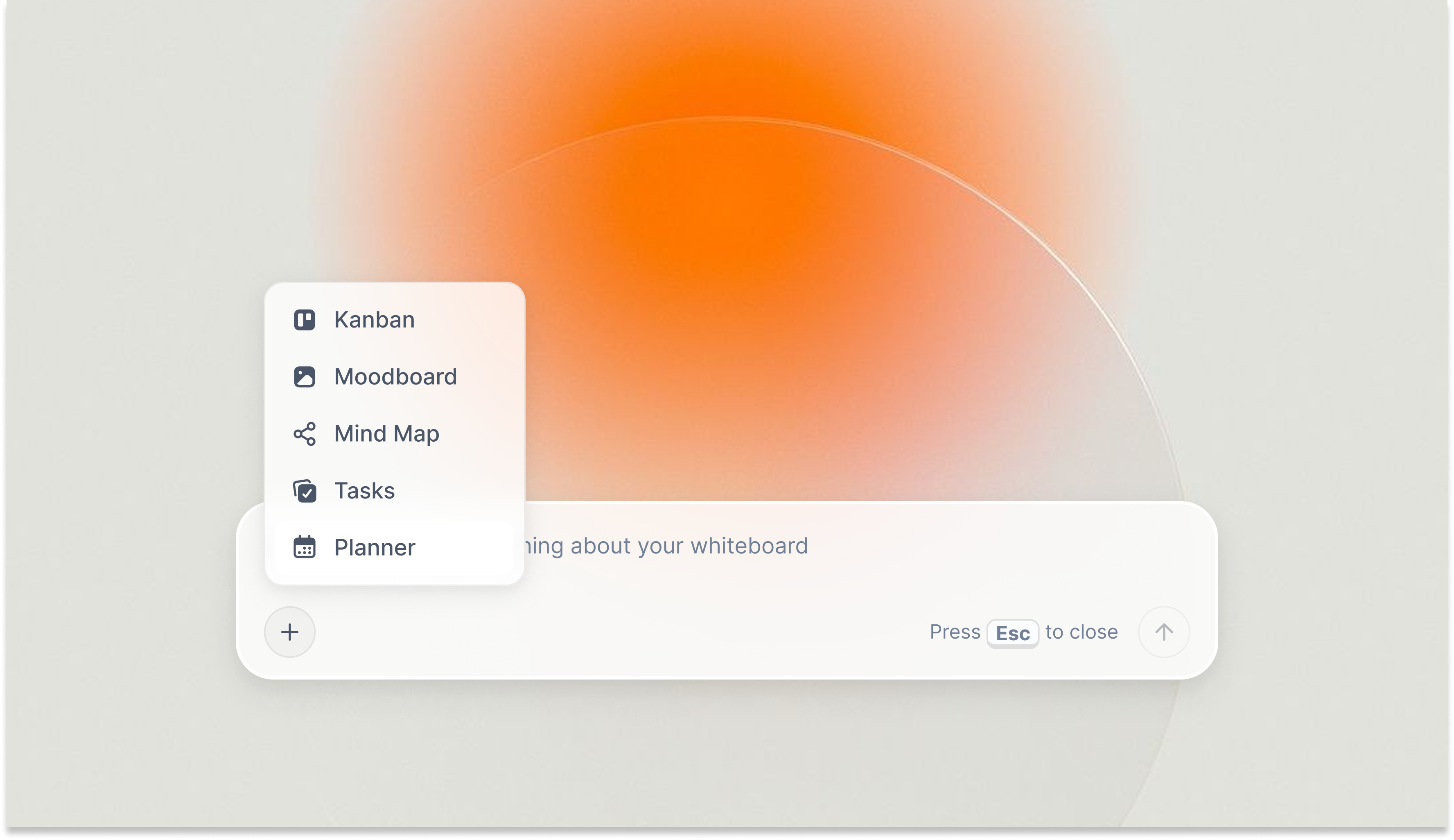
AI Planner turns the locked season arc into a 10-episode outline grounded in the canvas concept and persona
Common Mistakes Podcasters Make with AI Planning
These show up over and over and they all kill shows.
Mistake: Asking AI for "podcast ideas" without a concept. AI hands back the average ten podcasts in your topic area, which is exactly the pile your show needs to escape. Do step 1 first. Always.
Mistake: Skipping the audience persona because "it's just for me to start." Every later step gets harder without the persona because every prompt has to re-explain who the show is for. Twenty minutes on the persona saves three hours later.
Mistake: Letting AI pick the format. AI defaults to interview format because most popular podcasts are interview-format. The right format is downstream of your specific concept, your specific host, and your available time. AI is a checker here, not a decider.
Mistake: Outlining only one episode at a time. This is how shows run out of momentum at episode 4. Outline ten before recording one. The marginal cost of outlining episode 8 right now is small; the cost of running out of plan in week 5 is the show.
Mistake: Treating AI as a script writer. AI as a structure writer for cold opens, intros, transitions, and closes is great. AI as a host voice is bad. Voice-match every AI draft by reading it aloud, and rewrite the close yourself.
Mistake: Building the plan in chat and the show in a doc. Context drifts between tools. AI in chat does not know what you wrote in your doc. The fix is a single canvas where plan and AI live together, so step 5's outline is in the same place as step 1's concept.
Mistake: Booking guests before locking the season arc. Guests booked early constrain the arc to whoever said yes first. Lock the arc, then build the pipeline. Outreach is faster when you can tell guests exactly which pillar and arc position they fit into.
Storyflow Podcast Workflow: A 6-Hour Process for Episode 1
For podcasters who want a tight, repeatable process on Storyflow specifically, here is the typical 6-hour sequence from blank canvas to first recordable episode 1.
Hour 1: Concept and audience. Open a new project. Drop three concept candidates on the canvas. Use the AI assistant to pressure-test each one against clarity, specificity, and durability. Lock one. Add the Customer Persona Tactic from the Blueprint library (free tier includes three starter Tactics; Customer Persona is one of the most-used). Fill it in. Save as a Document so it is @-mentionable in every later prompt.
Hour 2: Format and structure. Drop a card on the canvas with the format choice and the internal episode structure (cold open, intro, segments, close). Argue with the AI's recommendation if needed. Lock the structure. Add a runtime target.
Hour 3: Season arc and pillars. Add three to four pillar cards on the canvas. Use the AI assistant with the full canvas as context to draft three season arc proposals. Pick one. Lock the 10 episode topics on the canvas as cards in season order.
Hour 4: Episode outlines, part 1. For episodes 1 through 5, generate outlines using the AI with the canvas as context. Edit each outline by hand: rewrite the takeaway, sharpen the hook, replace generic beats. Each episode card lands at 150 to 300 words.
Hour 5: Episode outlines, part 2, plus guest pipeline (if interview format). For episodes 6 through 10, repeat the outline pattern. If interview format, build a 20-name guest list using AI for surfacing and your own knowledge for vetting. Add a Document per guest with research notes.
Hour 6: Episode 1 recording script. Open a Document for episode 1. Use the AI assistant with the canvas + episode 1 outline + persona Document @-mentioned to draft the cold open, intro, three transitions, and close. Voice-match by reading aloud. Rewrite the close in your own words. The middle stays as bullet points.
For solo podcasters and brand-podcast indie operators, the free tier ($0) is enough to ship the first season's planning; the basic AI usage covers the structural prompts that matter. Plus ($7.99/month annual) is the right tier from season 2 onwards because the unlimited file uploads remove the rationing pressure when guest research and per-episode scripting both compete for AI. Pro ($14/month annual) becomes worth it if you also want AI-generated cover art per episode and 20× more AI for sustained production. Max is mainly for podcasting teams who plan together in real time. Start a Storyflow canvas and run the 6-hour sequence end to end before recording day.

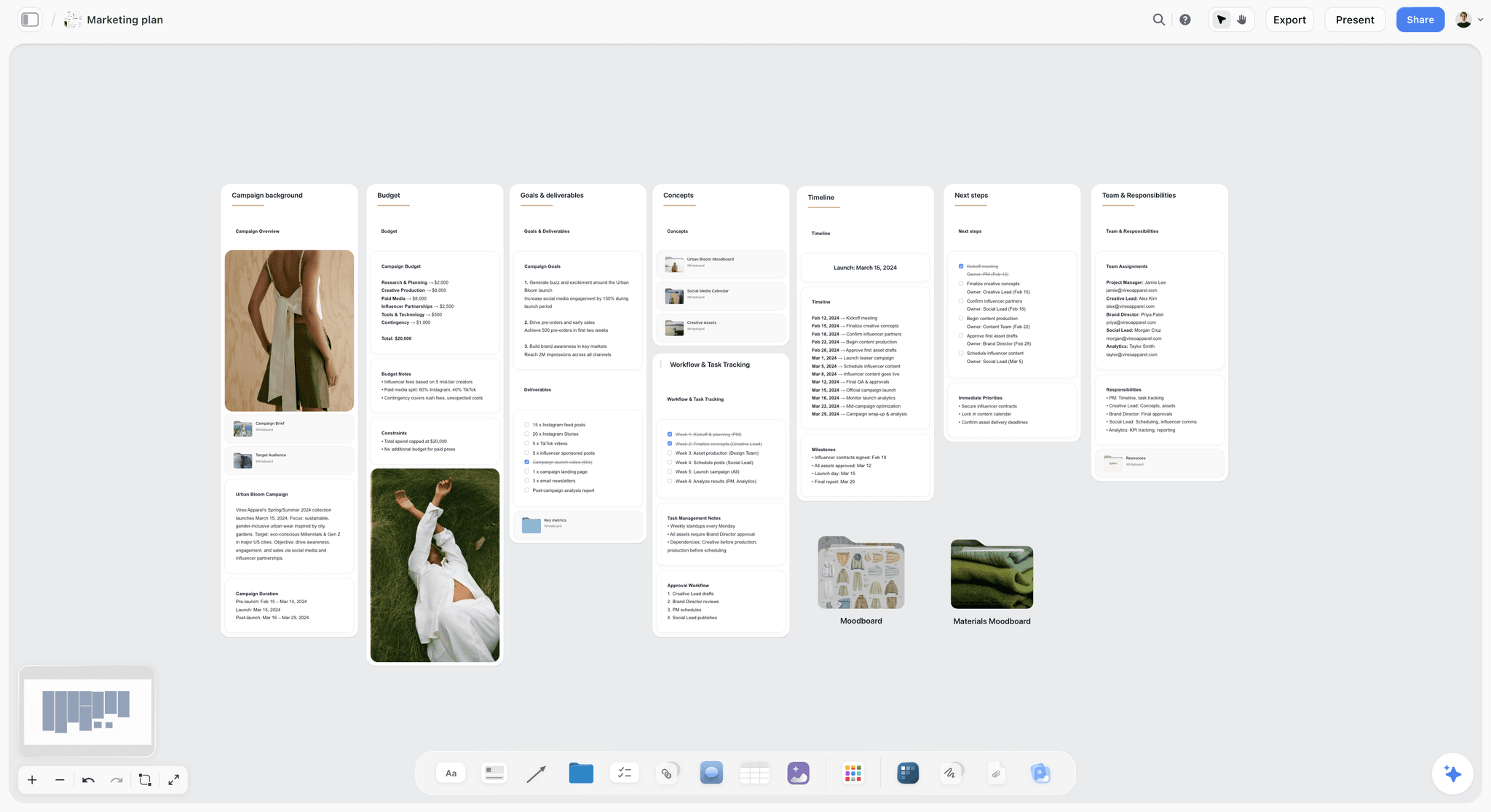
A founder-interview YouTube channel plan in Storyflow with walls for the concept, audience, guest strategy, production workflow, content amplification and monetization
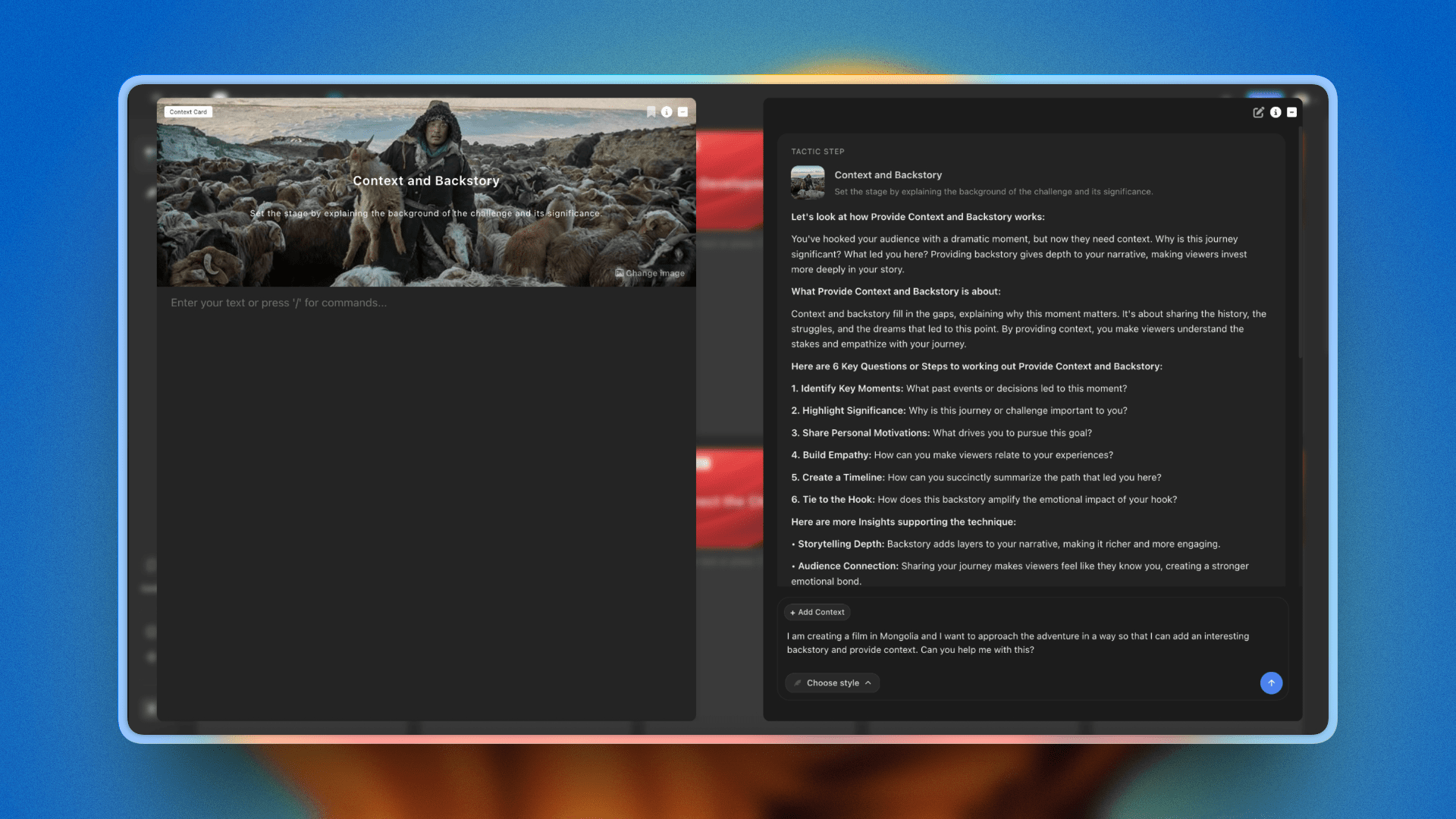
Customer Persona, AIDA, and content frameworks open on the canvas, the strategic Tactics that drive the 6-hour podcast workflow
Final Verdict: Planning a Podcast with AI in 2026
The 7-step framework holds whether the show is a solo brand podcast, an interview-driven solopreneur show, or a narrative season produced over a quarter: lock the show concept, define the audience as a real person, pick the format and structure, build the season arc and content pillars, outline ten episodes before recording one, build the guest pipeline if applicable, then convert the plan into a recordable script. AI is useful in this process exactly to the degree that it can read the whole plan at once, which is the configuration a canvas tool gives you and a chat tool does not. Hand a chatbot a topic and it gives you the average podcast. Hand a canvas-aware AI a structured plan and it scaffolds a show that sounds like yours.
Here is the experiment that settles it. Take the podcast idea you have been sitting on, open a Storyflow canvas, and run steps 1 through 5 in one sitting: concept, persona, format, season arc, and ten episode outlines. By the time the tenth outline is on the board, you will know whether you have a show worth recording or an idea that needed one more pass. That answer, before you ever touch the mic, is the whole point.
A podcast plan as a mind map: concept at center, season arc and episodes branching out, all readable by the AI on every prompt
FAQ: Planning a Podcast with AI
Can AI write a podcast script?
AI can draft the structurally fixed parts of an episode well: the cold open, the intro, transitions between segments, and a starting version of the close. AI struggles with the host's voice on a first pass, so every drafted line should be read aloud and voice-matched by the host. Treat AI as a structure writer, not a voice writer, and the output is usable. Treat it as a voice writer and the show sounds like every other AI-assisted podcast.
What's the best AI tool for podcast planning?
For the planning layer (concept, audience, format, season arc, episode outlines, scripts), a canvas tool with AI that reads the whole canvas is the strongest fit because the plan is multi-step and context-heavy. Storyflow is built for this exact configuration. ChatGPT and Claude are excellent supplements for paragraph-level drafting once the structural work is done. Riverside and Descript are recording and post-production tools, not planning tools.
How long does it take to plan a podcast with AI?
A first-season plan from blank canvas to recordable episode 1 takes about 6 hours on a canvas-first workflow with AI doing the structural drafting. Without AI, the same plan is closer to 12 to 16 hours because episode outlining and script drafting are slower. The 6-hour estimate assumes the host is making the structural decisions (concept, format, arc) and using AI for the interpolative work (drafting outlines, expanding structures, suggesting transitions).
Should I use AI to outline every episode?
Yes, but with a hand-edited takeaway and hook per outline. AI is excellent at producing the structural shape of an outline (three to five beats, runtime target, suggested guest if applicable) when it can read the season arc and audience persona. AI is generic at the takeaway sentence and the hook, which are the two parts of an outline that decide whether the episode lands. Have AI draft all ten, then rewrite the takeaway and hook for each by hand.
What AI tool is best for solo podcasters?
For solo podcasters running a one-person show, the bottleneck is planning capacity, not production capacity. A canvas tool with AI that holds the whole show context is the highest-leverage choice because it removes the cost of re-explaining the project on every prompt. Storyflow's free tier is enough to plan a first season; ChatGPT or Claude work as supplements for drafting once the canvas plan exists. Avoid stacking too many tools, since solo podcasters do not have time to manage tool sprawl.
Can I use AI to find and research guests?
Yes for surfacing candidates, no for vetting them. AI is good at producing a list of 30 named candidates that fit a concept and audience, including people you may not have heard of. AI is unreliable for whether a public figure is currently active, available, or appropriate for the show, since training data is dated and incomplete. Use AI to draft the candidate list, then verify each candidate yourself before outreach.
Will listeners notice AI-assisted scripts?
Listeners notice AI-written scripts that sound like AI: uniform tone, generic adjectives ("engaging, insightful, valuable"), and over-explained transitions. They do not notice AI-assisted scripts where the host voice-matched the cold open, rewrote the close, and let AI handle structural transitions and outline shaping. The seven-step workflow above produces the second kind, because the structural work is canvas-grounded and the voice work is host-driven. Most professional podcasters are already using AI this way; the listener never knows.
Table of Contents
- Key Takeaways
- Quick Answer: How to Plan a Podcast with AI in 2026
- Why Podcasts Get Stuck Before Episode 1
- The 7-Step AI Podcast Planning Framework
- Step 1: Lock the Show Concept (Not Just the Topic)
- Step 2: Define the Audience as a Real Person
- Step 3: Pick the Episode Format and Structure
- Step 4: Build the Season Arc and Content Pillars
- Step 5: Outline 10 Episodes Before You Record One
- Step 6: Build the Guest Pipeline (If Interview Format)
- Step 7: Convert the Plan into a Recordable Episode Script
- A Worked Example: Planning a Solopreneur Brand Podcast
- How to Pick the Right AI Tool for Podcast Planning
- Common Mistakes Podcasters Make with AI Planning
- Storyflow Podcast Workflow: A 6-Hour Process for Episode 1
- Final Verdict: Planning a Podcast with AI in 2026
- FAQ: Planning a Podcast with AI
- Related Reading
Templates to check out for this topic


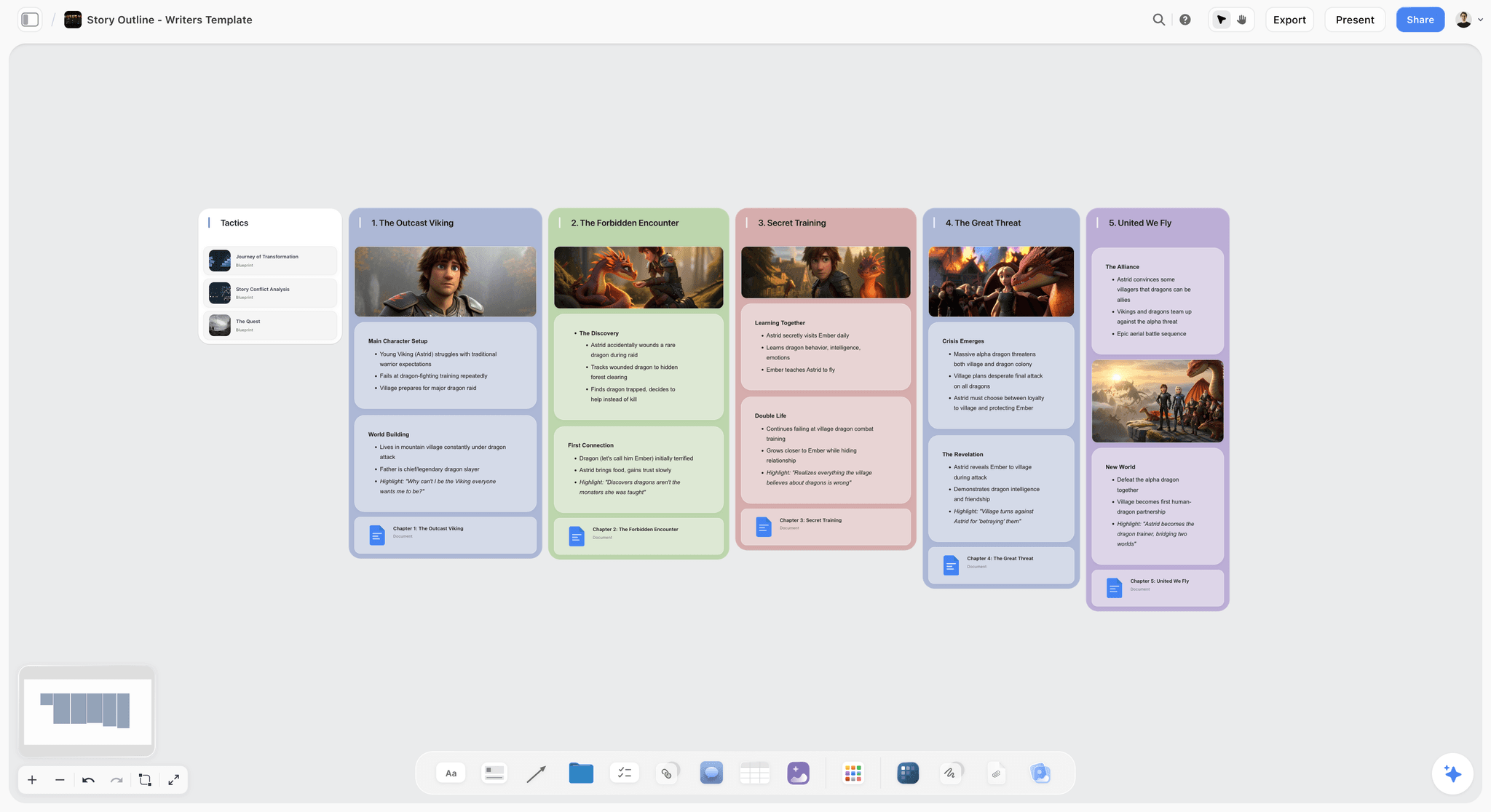
Content and video templates you can use in Storyflow
Plan a channel, a script, and a content pipeline on the same board. Open one of these templates and let the AI build on the structure instead of starting from a blank doc.


See Storyflow in Action
A visual AI workspace where every feature lives inside one canvas. No tab-switching, no context lost.
Build your entire board from a single message
Type what you need in the AI chat at the bottom of your canvas. The AI adds cards, headings, and structure directly onto your board.
Use expert frameworks as AI context
Type @ in the AI chat and choose any Tactic. The AI tailors every response to that framework instead of giving generic advice.
Turn your board into a mind map in seconds
Ask the AI to restructure your canvas as a mindmap. It connects your ideas into a visual hierarchy so you can see how everything relates.
Why Storyflow Exists
Storyflow actually began as a personal tool while working on creative and research projects.
We kept running into the same problem: ideas were scattered everywhere: notes, documents, and whiteboards.
Nothing helped us see how everything connected.
So we started building a workspace designed around how ideas actually grow.
→ Read how Storyflow was createdJustkay
Documentary Filmmaker & Founder at Storyflow
Published: 2026-05-10
Extremely simple, seriously capable


See how easy it is to get started
Watch a real project come together, from a blank board to a finished plan, clicked through step by step.
Start creating with AI and become more productive
Transform your creative workflow with AI-powered tools. Generate ideas, create content, and boost your productivity in minutes instead of hours.