How to Write a Script (Step-by-Step Structure That Actually Works)
Most scriptwriting advice tells you what to include without showing you how to structure it. This guide is different: a step-by-step framework for hook, setup, confrontation, and resolution that works for any format - films, videos, commercials, or presentations.

Category
Storytelling
Author

Sara de Klein
Head of Product at Storyflow
Topics
January 11, 2026
•
20 min read
•
Storytelling- script writing
- story structure
- video scripts
- content creation
How do you write a script step by step?
Write a script in four parts: (1) Hook, grab attention in 5-15 seconds, (2) Setup, establish context and the problem, (3) Confrontation, build tension through escalating stakes, (4) Resolution, deliver the payoff and call to action. You end up with a structured outline you can draft from in one sitting.

Structure the script on a board you can rearrange
Storyflow lays your acts and beats on an infinite canvas so you can see the whole structure and move it around, and the AI drafts an outline from your premise to start.

You've read the advice: "Write a strong opening." "Create conflict." "End with impact." It sounds simple enough. Then you sit down to write and realize you have no idea how these pieces fit together.
Most scriptwriting advice tells you what to include without showing you how to structure it. The result? You know the ingredients but not the recipe.
This guide is different. You'll learn a step-by-step structure that works for any script - films, YouTube videos, commercials, presentations, or documentaries. Not vague principles, but a concrete framework you can apply immediately.
The best script structure follows four parts: Hook (grab attention), Setup (introduce the world and problem), Confrontation (rising stakes), and Resolution (climax and transformation). This framework works for any format because it matches how humans process stories.
By the end of this guide, you'll understand exactly how to structure a script from blank page to finished draft. Let's start with why structure matters more than you think.
Why Script Structure Matters
Structure isn't a creative limitation. It's why some scripts hold attention and others lose it.
Human brains are wired to process information in patterns. When those patterns are disrupted or missing, we disengage. Structure provides the psychological scaffolding that keeps viewers watching.
What structure actually does:
- Creates expectations: Viewers unconsciously anticipate where the story is going. Structure lets you meet or subvert those expectations strategically.
- Builds investment: Proper setup makes viewers care before the stakes rise. Without it, conflict feels arbitrary.
- Maintains momentum: Structure prevents the "sagging middle" where audiences lose interest. Each section has a purpose.
- Delivers satisfaction: A well-structured resolution feels earned. Viewers leave feeling complete, not confused.
Professional scriptwriters don't reinvent structure for every project. They use proven frameworks - the Hero's Journey, Story Arc Structure, retention architecture - because these frameworks are built on psychological principles that work.
The Universal Script Structure Framework
Every script - regardless of length or format - needs four structural components. Master these, and you can write anything.
The Four-Part Script Structure:
- Hook - Grab attention and create urgency
- Setup - Introduce the world, characters, and central problem
- Confrontation - Rising stakes, obstacles, and turning points
- Resolution - Climax, answer, and transformation
This maps to the classic three-act structure, but with the hook separated because it's the single most important element for modern content. Fail the hook, and nothing else matters.
Professional scriptwriters use frameworks like the Hero's Journey and three-act structure not because they lack creativity, but because these frameworks are built on psychological principles that keep audiences engaged.
Let's break down each step with specific techniques and examples.
Step 1: Write the Hook
Goal: Capture attention and create a reason to keep watching in the first 5-30 seconds.
The hook is where most scripts fail. You have seconds - not minutes - to convince someone to invest their time. A weak hook means viewers never see your brilliant middle and end.
Three hook techniques that work:
1. The Curiosity Gap
Create a question that demands an answer. The viewer can't leave without knowing.
Example: "In 1985, a single phone call destroyed the largest company in Japan. But the person who made that call... was the company's own CEO. Here's what happened."
2. Stakes Establishment
Immediately show what the viewer gains or loses by watching.
Example: "There's a 90% chance you're making this mistake in every presentation you give. It's costing you promotions, clients, and opportunities - and most people never realize it."
3. Pattern Interrupt
Start with something unexpected that breaks the viewer's assumptions.
Example: "I'm going to tell you why everything you've learned about storytelling is wrong. And I'm a screenwriter who's worked on three Oscar-nominated films."
Hook writing checklist:
- Does it communicate value in under 10 seconds?
- Does it create urgency (why watch now)?
- Does it promise something specific?
- Would you keep watching if you saw this hook?
Step 2: Establish the Setup
Goal: Introduce the world, characters, and central problem so viewers understand and care about what follows.
The setup answers three questions: Who? Where? What's wrong? Skip any of these, and viewers feel lost when the conflict begins.
Elements of effective setup:
1. Establish the World
Give context. What's the normal state before conflict? For a business video, this might be the common approach. For a narrative, it's the character's ordinary world.
2. Introduce the Character/Protagonist
Who are we following? In educational content, this might be "you, the viewer." In narrative, it's your main character. Give viewers someone to root for.
3. Present the Central Problem
What's wrong? What challenge needs solving? This is the question your entire script exists to answer. Make it clear and compelling.
4. Plant the Open Loop
Create a question during setup that won't be answered until later. This keeps viewers watching through the middle sections.
Setup example (educational video on productivity):
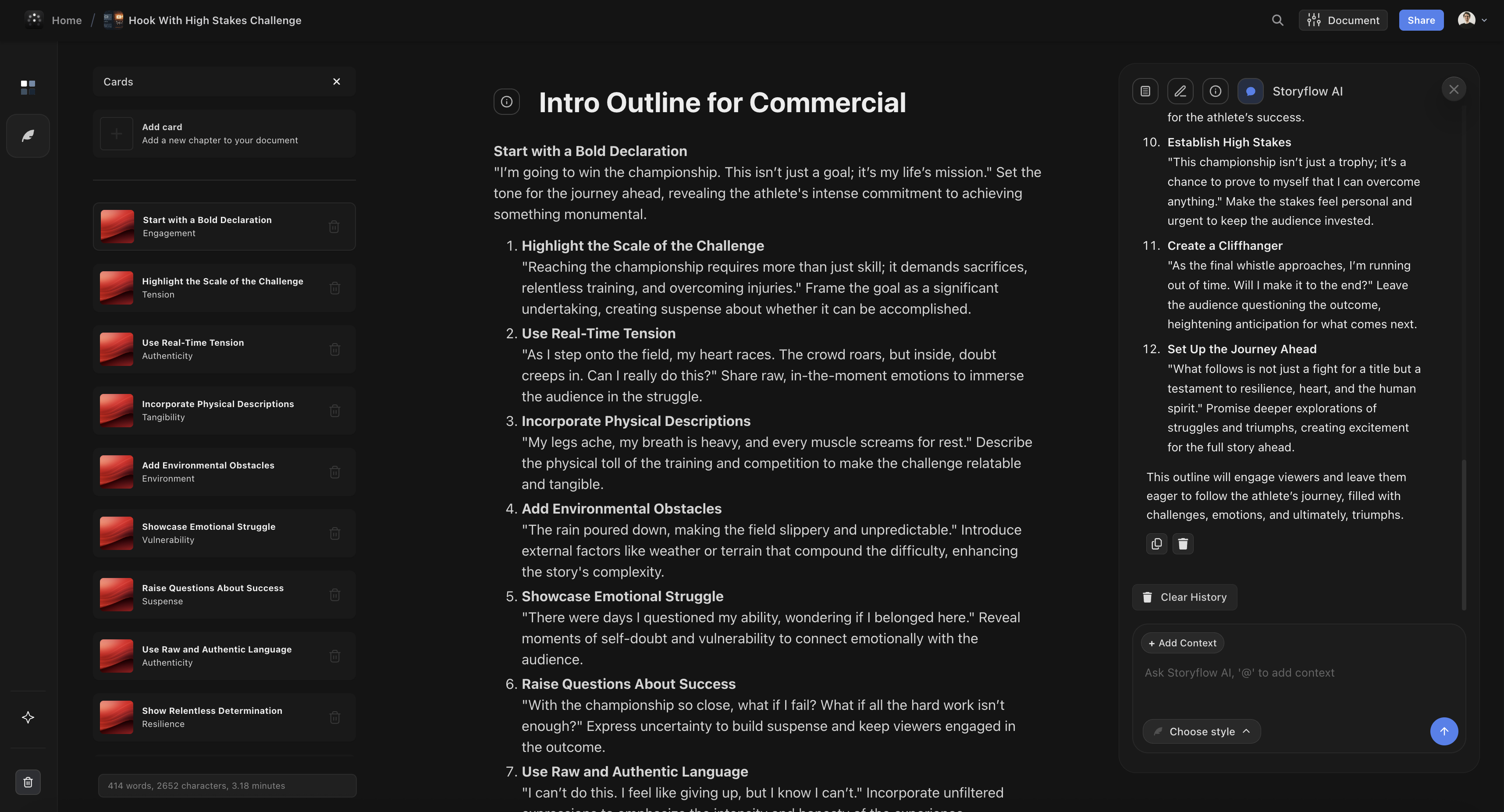
"Most people approach their workday the same way: wake up, check email, react to whatever's urgent. [World established] You've probably tried to-do lists, time blocking, even productivity apps. [Character = you] But nothing sticks - and every night you feel like you didn't actually accomplish anything important. [Problem defined] The issue isn't discipline. It's something most productivity advice completely ignores - and I'll explain exactly what it is in a moment. [Open loop planted]"
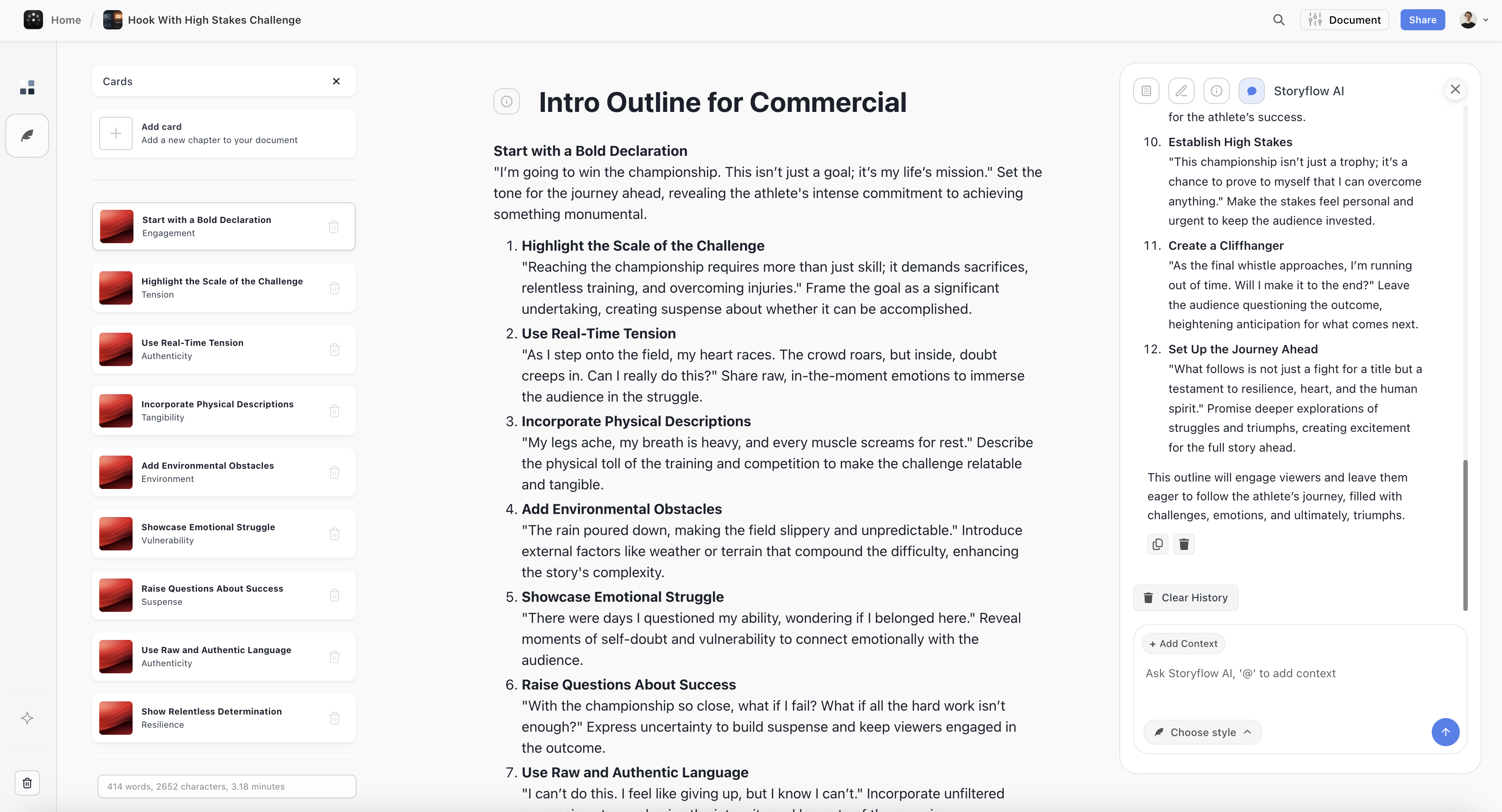
Mapping a script's opening structure in Storyflow, hook, world, problem, and open loop all planned before writing
Outline your script before you write a line.
Describe your topic and get a hook, setup, confrontation, and resolution mapped out as a working draft you can rewrite in your own voice.
Step 3: Build the Confrontation
Goal: Escalate the problem through obstacles, complications, and turning points that maintain engagement.
The confrontation is your longest section - roughly 50% of total script length. This is where most scripts fail, creating the "sagging middle" that loses viewers.
The confrontation section is where most scripts fail. Without rising stakes and strategic turning points, you get the "sagging middle" that loses viewers no matter how strong your hook and resolution are.
Keys to strong confrontation:
1. Rising Stakes
Each new section should raise the stakes. Things get harder, more complex, more urgent. If stakes stay flat, engagement drops.
2. Obstacles and Complications
Don't just present solutions - show why the obvious approaches don't work. Complications make eventual solutions more satisfying.
3. Turning Points
Include moments that shift understanding. "Everything I thought I knew was wrong" moments reset attention and create forward momentum.
4. Strategic Information Release
Don't reveal everything at once. Dole out key insights at strategic points. Close some open loops while opening others.
Confrontation structure for a 3-section middle:
- Section 1: Present the first approach/explanation. Show why it's incomplete. Close setup open loop. Open new loop.
- Section 2: Go deeper. Reveal the complication most people miss. Raise stakes. Pattern interrupt to reset attention.
- Section 3: The turning point. Present the insight that changes everything. Build to the resolution.
Step 4: Deliver the Resolution
Goal: Provide the climax, deliver the answer, and show the transformation.
The resolution is where everything pays off. Every open loop closes. Every question gets answered. The viewer should feel satisfied and transformed.
Elements of effective resolution:
1. The Climax
The moment of highest intensity. In educational content, this is your key insight or solution. In narrative, it's the final confrontation.
2. Close All Loops
Answer every question you raised. Unresolved loops leave viewers feeling unsatisfied and cheated.
3. Show the Transformation
What changed? How is the viewer/character different now? This is the "so what" of your entire script.
4. The Call to Action
What should the viewer do next? This could be a practical next step, a mindset shift, or a direct CTA. Don't end without direction.
Resolution example:
"So here's what this means for you: [Climax - the key insight synthesized] Stop organizing your tasks by urgency. Start organizing them by leverage - which tasks create compound returns over time. [Transformation - what changed] That question from the beginning? The thing productivity advice ignores? It's this: most systems optimize for feeling busy, not for creating outcomes. [Loop closed] Tomorrow morning, before you check email, ask yourself one question: What's the single highest-leverage thing I could do today? [Call to action] Do that first. Everything else is negotiable."
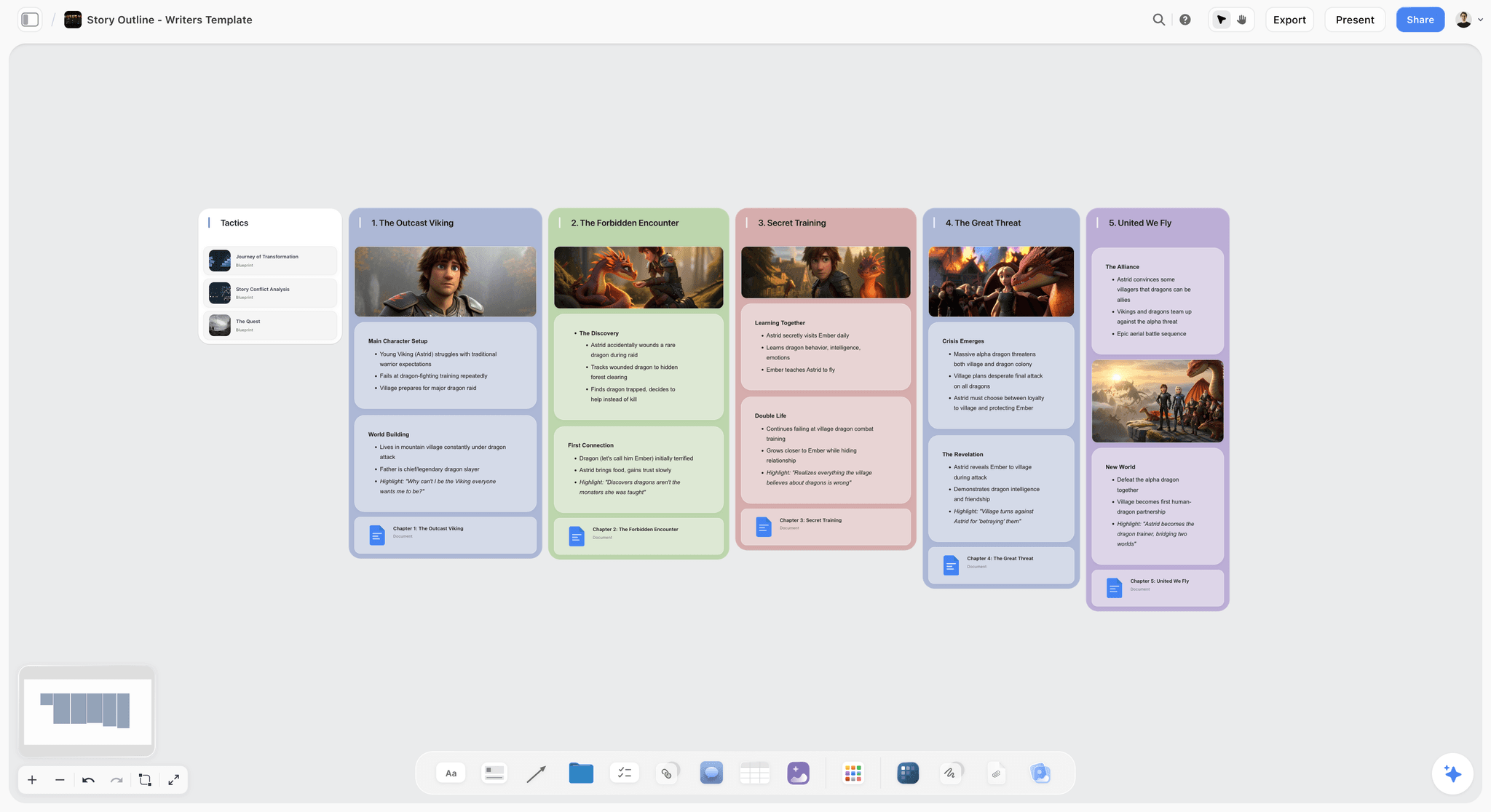
A complete script outline in Storyflow, hook, setup, confrontation, and resolution visible at once on the canvas
Adding Retention Architecture
Structure gets viewers started. Retention architecture keeps them watching. These techniques layer on top of your four-part structure.

Open Loops
Create questions that demand answers. "But there's something most people miss - which I'll explain after we cover X." The viewer can't leave without closure.
Pattern Interrupts
Attention naturally fades around the 3-4 minute mark. Insert something unexpected: a story, a visual change, a surprising statement. Reset the attention clock.
Strategic Payoffs
Don't front-load all your value. Distribute insights throughout the script. Give viewers small wins that encourage them to stay for bigger ones.
Callbacks
Reference earlier points later in the script. "Remember when I said X? Here's why that matters." Callbacks create cohesion and reward attentive viewers.
Open loops create questions that demand answers. Pattern interrupts reset attention when it fades. Strategic payoffs reward viewers for staying. Layer these techniques throughout your script structure to maximize retention.
Adapting Structure for Different Formats
The four-part structure works for any script, but proportions and emphasis change based on format.
| Format | Hook | Setup | Confrontation | Resolution |
|---|---|---|---|---|
| YouTube Video (10 min) | 30 sec | 2 min | 5 min | 2.5 min |
| Short-form (60 sec) | 3-5 sec | 10 sec | 35 sec | 10 sec |
| Feature Film (120 min) | 5-10 min | 25 min | 60 min | 25 min |
| Presentation (15 min) | 1 min | 3 min | 8 min | 3 min |
| Commercial (30 sec) | 2-3 sec | 5 sec | 15 sec | 7 sec |
If you write for video, the fastest way to apply these proportions is to start from the Video Script template, which opens with hook, setup, confrontation, and resolution sections already laid out on the board.
Format-specific adjustments:
- Short-form content: Hook is everything. Setup must be implicit. Confrontation compressed to one key point.
- Long-form content: More room for nuance in setup. Multiple turning points in confrontation. Extended resolution with implications.
- Educational content: Setup establishes the problem to solve. Confrontation teaches the methodology. Resolution shows application.
- Narrative content: Setup introduces character and world. Confrontation is the journey. Resolution is transformation.
Common Script Structure Mistakes
1. Starting Without a Hook
"Hey everyone, today we're going to talk about..." is not a hook. If your first 10 seconds sound like every other video, viewers assume the rest will too.
2. Rushing Setup
If viewers don't understand the context or care about the problem, nothing in the confrontation matters. Invest in setup. It pays dividends.
3. Flat Middle (No Rising Stakes)
Each section of your confrontation should escalate. If Section 3 feels like Section 1, viewers lose momentum. Ask: "Why does this matter more now?"
4. Unresolved Loops
If you promise to explain something later and then don't, viewers feel cheated. Track every loop you open. Close them all.
5. No Clear Transformation
"So, that's how to write a script." is not a resolution. Show what changed. Give viewers something to do with what they learned.
Tools That Help You Learn Script Structure
You can learn structure from this guide. But applying it consistently requires practice - and the right tools make that practice more effective.
The problem:
You read about script structure. You understand hook-setup-confrontation-resolution. But when you sit down to write, you're back to the blank page. The learning and the doing are disconnected.
The solution:
Storyflow's Tactics are interactive frameworks that teach professional script structure while you write your actual script. Each card reveals theory (why this step matters), examples (how professionals do it), and guidance (how to apply it to your project).
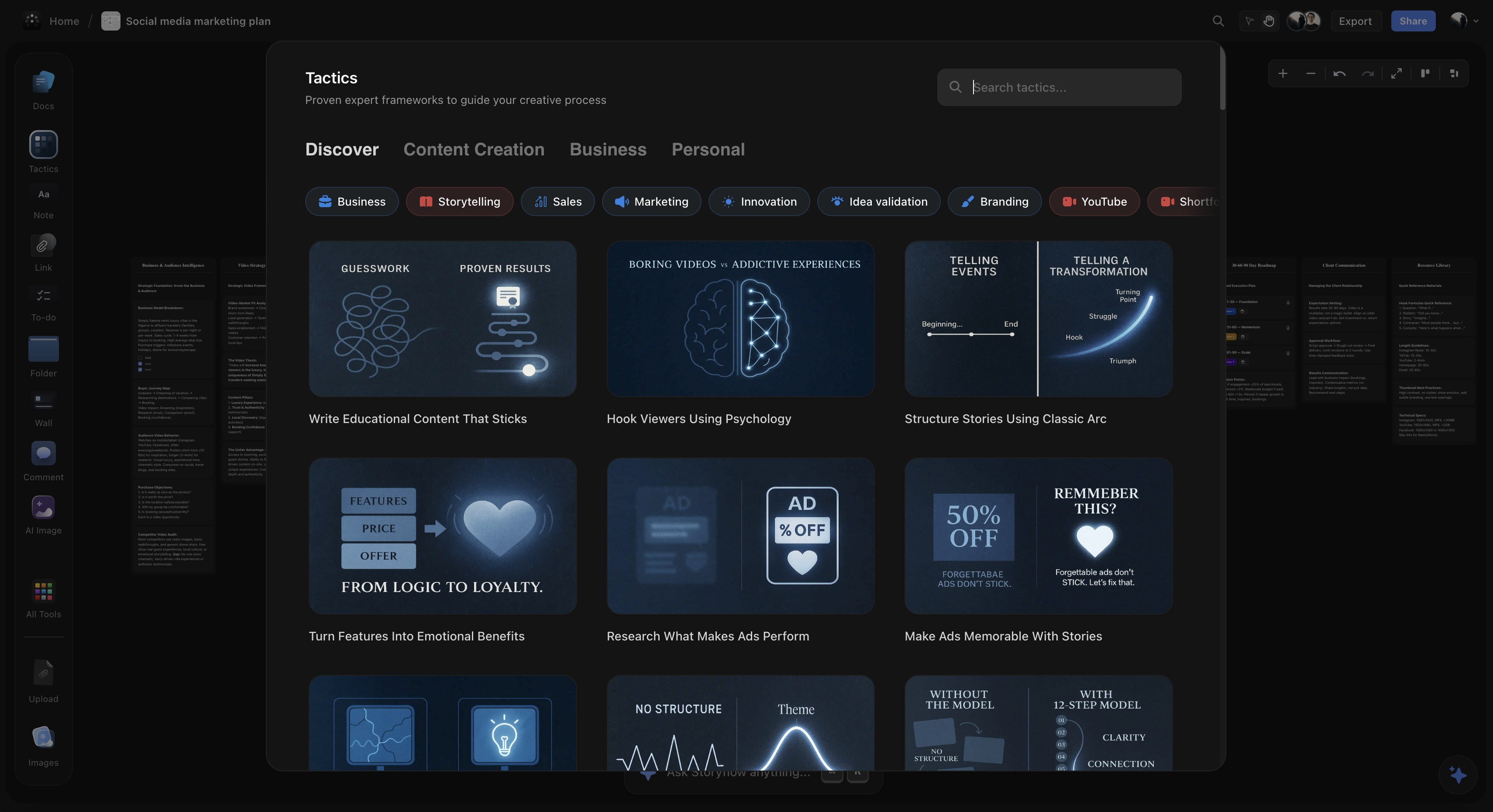
Storyflow's Tactics are interactive frameworks that teach professional methodologies - like the Hero's Journey or script structure - through cards that reveal theory, examples, and step-by-step guidance as you write your actual script.
How Storyflow helps with script structure:
- Story Structure Tactics: The Hero's Journey, Story Arc Structure, Structure Stories in Three Acts - learn while you build.
- Hook Engineering: Hook Viewers Using Psychology with 15+ proven hook techniques like curiosity gaps and pattern interrupts.
- Retention Architecture: Maximize YouTube Retention Tactic teaches where to place open loops, tension points, and payoffs.
- Format-specific guidance: Film Transformation Journeys, Document Your Journey to a Challenging Place - tailored methodology for each format.
- Context-aware AI: The AI understands your script structure and gives suggestions that fit your framework.
The result: You don't just finish a script - you internalize the structure. After a few scripts using Storyflow's Tactics, you'll naturally think in hooks, setups, confrontations, and resolutions. For narrative work, the Story Outline template and the Beat Sheet Filmmaking template give the four-part structure a spatial home the AI can read while you draft.
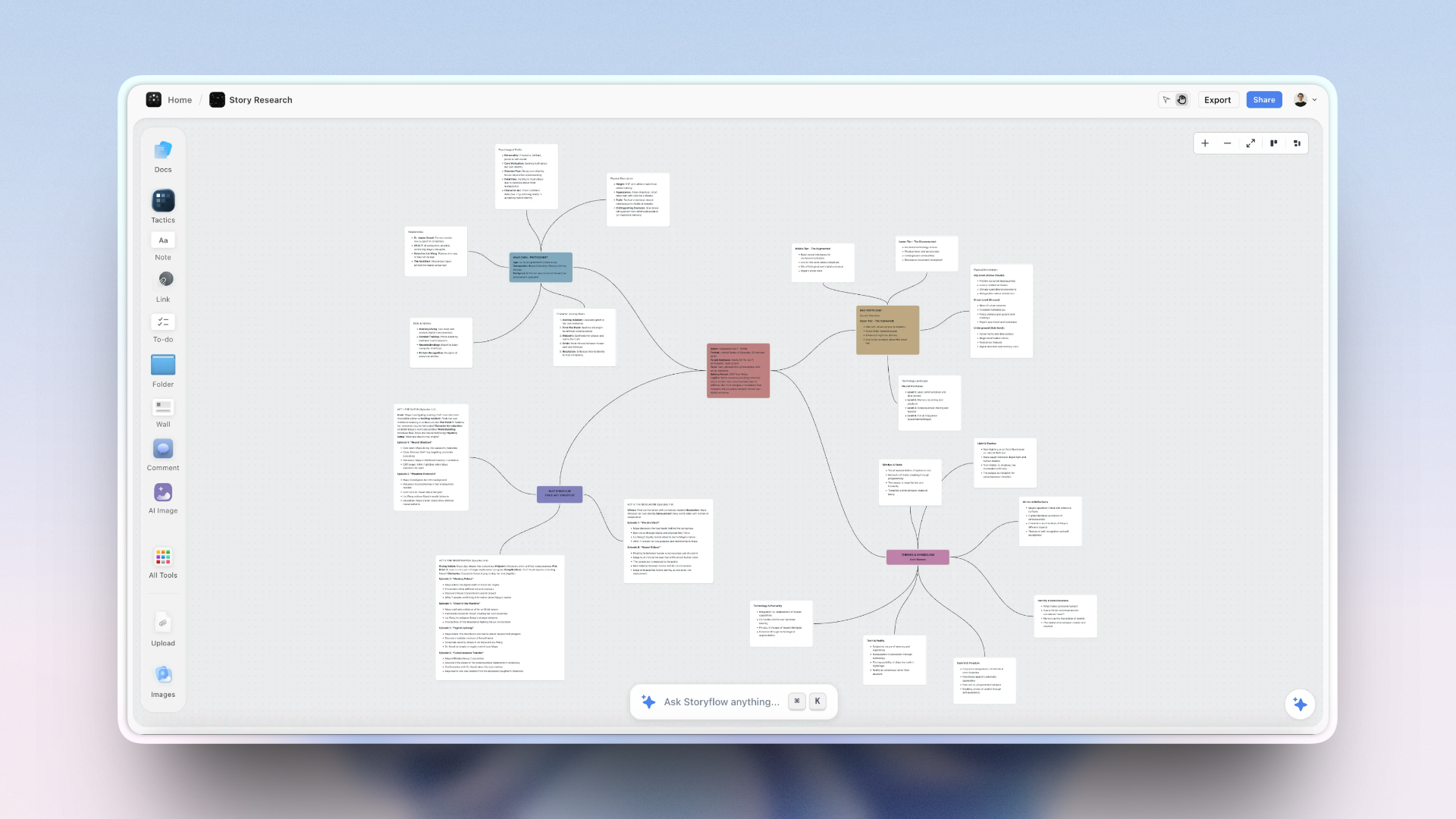
How writers use Storyflow to structure scripts, Tactics guide every decision from hook to resolution
Why Storyflow vs. other tools:
| Tool | What It Gives You | Best For |
|---|---|---|
| ChatGPT | Raw text output | Quick drafts, editing |
| Final Draft / Celtx | Formatting tools | Industry-standard screenplay format |
| Miro / FigJam | Blank canvas | Team brainstorming |
| Storyflow | Framework-guided structure + AI + learning | Learning methodology while writing |
Complete Example: Structuring a 10-Minute Script
Let's apply everything to a real example: a 10-minute educational video about "Why Most People Never Finish Projects."
HOOK (0:00 - 0:30)
"There are 47 unfinished projects on my hard drive. Novels, videos, business ideas, apps - all abandoned somewhere between 'this is exciting' and 'this is impossible.' Sound familiar? I finally figured out why this happens - and it's not what productivity YouTubers tell you. It's not about discipline, time management, or motivation. It's about something nobody talks about: the finish line fallacy."
SETUP (0:30 - 2:30)
"Let me tell you about Project 23. It was supposed to be a mobile app - simple, useful, could've changed my career. I worked on it for three months. Got 70% done. Then... nothing. I didn't quit. I just stopped. And I didn't understand why until I discovered something called the finish line fallacy. [Open loop: What is the finish line fallacy?] Before I explain it, let me show you why the common advice doesn't work. 'Just push through.' 'Break it into smaller tasks.' 'Find accountability.' I tried all of it. Here's what actually happens when you try to force yourself to finish..."
CONFRONTATION SECTION 1 (2:30 - 4:30)
"The problem isn't motivation. When you start a project, you have plenty of motivation. The problem is what happens at 70%. [Rising stakes: This affects most projects] At the beginning, every hour of work creates visible progress. You go from nothing to something. That feels incredible. But around 70%, something changes. The easy parts are done. What's left is the hard, invisible work - debugging, polishing, handling edge cases. Progress slows down. Your brain starts calculating: 'This is taking forever.' And here's the trap... [Pattern interrupt with visual]"
CONFRONTATION SECTION 2 (4:30 - 6:30)
"Your brain starts a new project. Not consciously - your subconscious does this automatically. A new project means easy progress again. Quick wins. Visible results. The dopamine you stopped getting from Project 23. [Close first loop: This is the finish line fallacy - the belief that finishing requires the same type of motivation as starting.] But here's what makes this worse than simple procrastination... [Open new loop] The finish line fallacy compounds. Each abandoned project makes the next abandonment more likely. You're training your brain that stopping at 70% is normal."
CONFRONTATION SECTION 3 (6:30 - 8:00)
"So how do you break the pattern? Not with willpower - that's fighting your brain's wiring. Instead, you change the game. [Turning point] There are three techniques that actually work: [Strategic info release] First: Shrink the finish line. Don't try to 'finish the app.' Finish one feature. Ship incomplete. Get feedback. Make 'done' smaller than your brain thinks. Second: Front-load the hard work. Do the ugly 30% first, when motivation is high. Save easy wins for when you need them. Third: Create external structure. The accountability your brain won't give itself."
RESOLUTION (8:00 - 10:00)
"Project 24 was different. I used these techniques. Defined 'done' as 'working prototype with three features.' Did the hard integrations first. Told people I'd ship by Friday. I finished it. And something changed. [Close compound loop] Once you finish one project using this framework, the finish line fallacy loses its power. You've proven to your brain that finishing is possible. [Transformation: The shift in identity] Here's what I want you to do: Pick one abandoned project. Define a tiny finish line - something you could complete this week. Do the hardest remaining task tomorrow, not when you 'have time.' Tell someone your deadline. [Call to action] That's how you break the pattern. One finished project changes everything that comes after. [Callback to opening] Those 47 projects? I've finished 12 of them now. Turns out finishing is a skill. You just have to practice it differently than you practice starting."
FAQ: How to Write a Script
What is the best structure for writing a script?
The best structure follows four parts: Hook (grab attention in the first 5-30 seconds), Setup (introduce the world, characters, and central problem), Confrontation (rising stakes with obstacles and turning points), and Resolution (climax and transformation). This framework works for films, videos, commercials, and presentations because it matches how humans psychologically process stories.
How do I write a script step by step?
Start with your hook - create curiosity or establish stakes in the first few seconds. Then write your setup to introduce context and the central problem. Build your confrontation with rising stakes and strategic turning points. Deliver your resolution by closing all open loops and showing transformation. Finally, layer in retention architecture: open loops, pattern interrupts, and strategic payoffs throughout.
How long should a script be?
Script length depends on format and delivery medium. For video, plan roughly 150 words per minute of final content. A 10-minute video needs a 1,500-word script. For film, one page of screenplay typically equals one minute of screen time. Use the 25-50-25 rule for proportions: 25% setup, 50% confrontation, 25% resolution.
What tools help with script structure?
For learning structure while writing, Storyflow's Tactics provide interactive frameworks with theory, examples, and guidance. For screenplay formatting, Final Draft and Celtx are industry standards. For quick text generation, ChatGPT helps with drafting. For visual planning, Miro offers blank canvases. Choose based on whether you need formatting, learning methodology, or raw output.
How do I write a good hook for my script?
Good hooks use one of three techniques: curiosity gap (create a question that demands an answer), stakes establishment (show what viewers gain or lose), or pattern interrupt (start with something unexpected). The hook must communicate specific value and create urgency in the first 5-30 seconds. Test by asking: "Would I keep watching if I saw this hook?"
What's the difference between a script and a screenplay?
A screenplay is a specific type of script for films or TV with standardized formatting (scene headings, action lines, dialogue). A script is a broader term for any written content intended to be performed or produced - including video scripts, presentation scripts, commercial scripts, and podcast scripts. The structural principles (hook, setup, confrontation, resolution) apply to both.
Your Next Steps
You now understand script structure that works. Here's how to apply it:
- Choose your next script. Pick something with deadline pressure - real projects teach faster than practice exercises.
- Structure before writing. Outline your hook, setup, confrontation, and resolution before you write a single line of dialogue or narration.
- Layer retention architecture. Mark where you'll place open loops, pattern interrupts, and payoffs. Plan them intentionally.
- Write the hook last. Counterintuitively, your hook is easier to write when you know exactly what it's promising.
- Review against the checklist. After drafting, verify each structural element is working.
Want framework-guided help?
Storyflow's scriptwriting Tactics walk you through each structural element with theory, examples, and AI assistance. You learn professional methodology while writing your actual script - finishing with both a completed project and internalized skills.
After using Storyflow's scriptwriting Tactics for a few months, creators don't just write better scripts - they think about structure differently. The frameworks become instinctive. You become a better scriptwriter with or without the tool.
Script structure isn't creative limitation - it's creative leverage. It's the scaffolding that lets your ideas stand. Master these four parts, and you can write anything.
Start with your next script. Apply the structure. See the difference for yourself.
Related Reading
Master hook techniques
Proven retention framework
Turn ideas into action plans
The AI-assisted scriptwriting workflow
Table of Contents
- Why Script Structure Matters
- The Universal Script Structure Framework
- Step 1: Write the Hook
- Step 2: Establish the Setup
- Step 3: Build the Confrontation
- Step 4: Deliver the Resolution
- Adding Retention Architecture
- Adapting Structure for Different Formats
- Common Script Structure Mistakes
- Tools That Help You Learn Script Structure
- Complete Example: Structuring a 10-Minute Script
- FAQ: How to Write a Script
- Your Next Steps
Templates to check out for this topic


Templates you can use in Storyflow
Every Storyflow board starts from real structure and an AI that reads the whole canvas. Open one of these templates and make it yours.


See Storyflow in Action
A visual AI workspace where every feature lives inside one canvas. No tab-switching, no context lost.
Build your entire board from a single message
Type what you need in the AI chat at the bottom of your canvas. The AI adds cards, headings, and structure directly onto your board.
Use expert frameworks as AI context
Type @ in the AI chat and choose any Tactic. The AI tailors every response to that framework instead of giving generic advice.
Turn your board into a mind map in seconds
Ask the AI to restructure your canvas as a mindmap. It connects your ideas into a visual hierarchy so you can see how everything relates.
Why Storyflow Exists
Storyflow actually began as a personal tool while working on creative and research projects.
We kept running into the same problem: ideas were scattered everywhere: notes, documents, and whiteboards.
Nothing helped us see how everything connected.
So we started building a workspace designed around how ideas actually grow.
→ Read how Storyflow was createdSara de Klein
Head of Product at Storyflow
Published: January 11, 2026
Extremely simple, seriously capable


See how easy it is to get started
Watch a real project come together, from a blank board to a finished plan, clicked through step by step.
Start creating with AI and become more productive
Transform your creative workflow with AI-powered tools. Generate ideas, create content, and boost your productivity in minutes instead of hours.