
What Is Integrated Marketing Communications (IMC)? The Complete Guide (2026)
Integrated marketing communications (IMC) unifies one message and identity across every channel. A practitioner guide to the paid, owned, earned, and shared model, the benefits, and how to build an IMC plan that holds.

Category
Marketing Strategy
Author

Sara de Klein
Head of Product at Storyflow
Topics
2026-07-15
•
13 min read
•
Marketing Strategy- integrated marketing communications
- what is IMC
- IMC marketing
- IMC strategy
What is integrated marketing communications (IMC)?
Integrated marketing communications (IMC) is the practice of unifying one message, one identity, and one voice across every channel and touchpoint a customer meets, from a paid ad to your website to a customer review to a sales call. Instead of planning each channel in isolation, IMC treats paid, owned, earned, and shared media as one campaign telling one story. The approach was formalized by Don Schultz at Northwestern University in the early 1990s, and it has only grown more urgent as channels have multiplied. The goal is simple to state and hard to do: sound like a single company everywhere your audience already is. This guide covers what IMC is, why marketing fragments, the four channel types, the benefits, and how to build an IMC plan that actually holds together.
Key Takeaways
- Integrated marketing communications coordinates every channel so they deliver one consistent message toward one goal. It treats paid, owned, earned, and shared media as one campaign telling one story.
- The whole discipline fits one line: IMC is not saying more things, it is saying one thing in more rooms. A brand that changes its story room to room is just inconsistent in more places.
- The four rooms are paid, owned, earned, and shared media (the PESO model). Your control drops sharply as you move from owned to shared to earned.
- A message architecture separates what stays fixed from what flexes. Core promise, proof points, and voice stay fixed everywhere; hook, format, and call to action flex by room.
- Consistency compounds where scattered marketing cancels out. Seven exposures to one message build a memory; seven exposures to seven messages build nothing.
- Marketing fragments by default, not through bad decisions. More channels, more tools, more teams, and more AI speed each add a place the message can drift unnoticed.
- IMC is not the same as omnichannel. Omnichannel is a seamless experience across channels; IMC is a consistent message across them.
- The 4 Cs reframe the old 4 Ps from the customer's side. Consumer, cost, convenience, and communication force you to plan from what the customer needs to hear, not what each department wants to say.
Why Your Brand Sounds Like Five Different Companies
Open your own brand in five tabs. The social bio, the homepage hero, the last email you sent, a Google ad, and a review-site listing. Read the first line of each out loud. If they sound like five different companies making five different promises, you have found the exact problem integrated marketing communications exists to solve. Most brands do not have a messaging problem inside any single channel. They have a continuity problem between channels.
I build and market Storyflow, an AI visual workspace, and I run its message across the same channels you do: paid ads, a blog, an email list, landing pages, partner sites, and social. I am a documentary filmmaker by training, not a career CMO, which means I think about a brand the way I think about a film. Every scene has to feel like it belongs to the same story or the audience stops believing it. The first time we launched a feature across six channels planned in six different tools, the core promise drifted in all six. Nobody decided to change it. It changed because no single surface showed all six at once.
That is the quiet failure IMC addresses. The problem is not that teams lack creativity. It is that creativity without a shared center produces five good campaigns instead of one that compounds. Every channel you add multiplies the places the story can slip, and the slip is rarely loud enough to notice until a customer notices it for you.
What Integrated Marketing Communications Actually Is
Integrated marketing communications is the discipline of coordinating every promotional channel so they deliver one consistent message toward one goal. The classic definition comes from Don Schultz and his colleagues at Northwestern University, whose 1993 book made IMC a formal field rather than a slogan. Their insight was that customers do not experience your ad budget, your PR, and your email program as separate departments. They experience one brand, and they notice immediately when it contradicts itself.
A few years earlier, Robert Lauterborn had argued in Advertising Age (1990) that the old 4 Ps of marketing (product, price, place, promotion) should be rewritten from the customer's side as the 4 Cs: consumer, cost, convenience, and communication. IMC is what happens when you take that seriously. You stop asking "what do we want to say on each channel" and start asking "what one thing does the customer need to hear, and how does each channel say it in its own accent."
The simplest way to hold that idea in your head is a model I use on every campaign: One Voice, Many Rooms. Picture your brand as one person walking through a house, where each channel is a different room. Some rooms are loud and rented by the hour. Some are your own living room, where you control everything. One Voice, Many Rooms means the person does not change their story as they move between rooms. They adjust their volume and phrasing to fit the room, but the thing they are saying stays the same.
That distinction is the whole discipline. IMC is not saying more things. It is saying one thing in more rooms. A brand that changes its story room to room is not omnichannel. It is just inconsistent in more places.
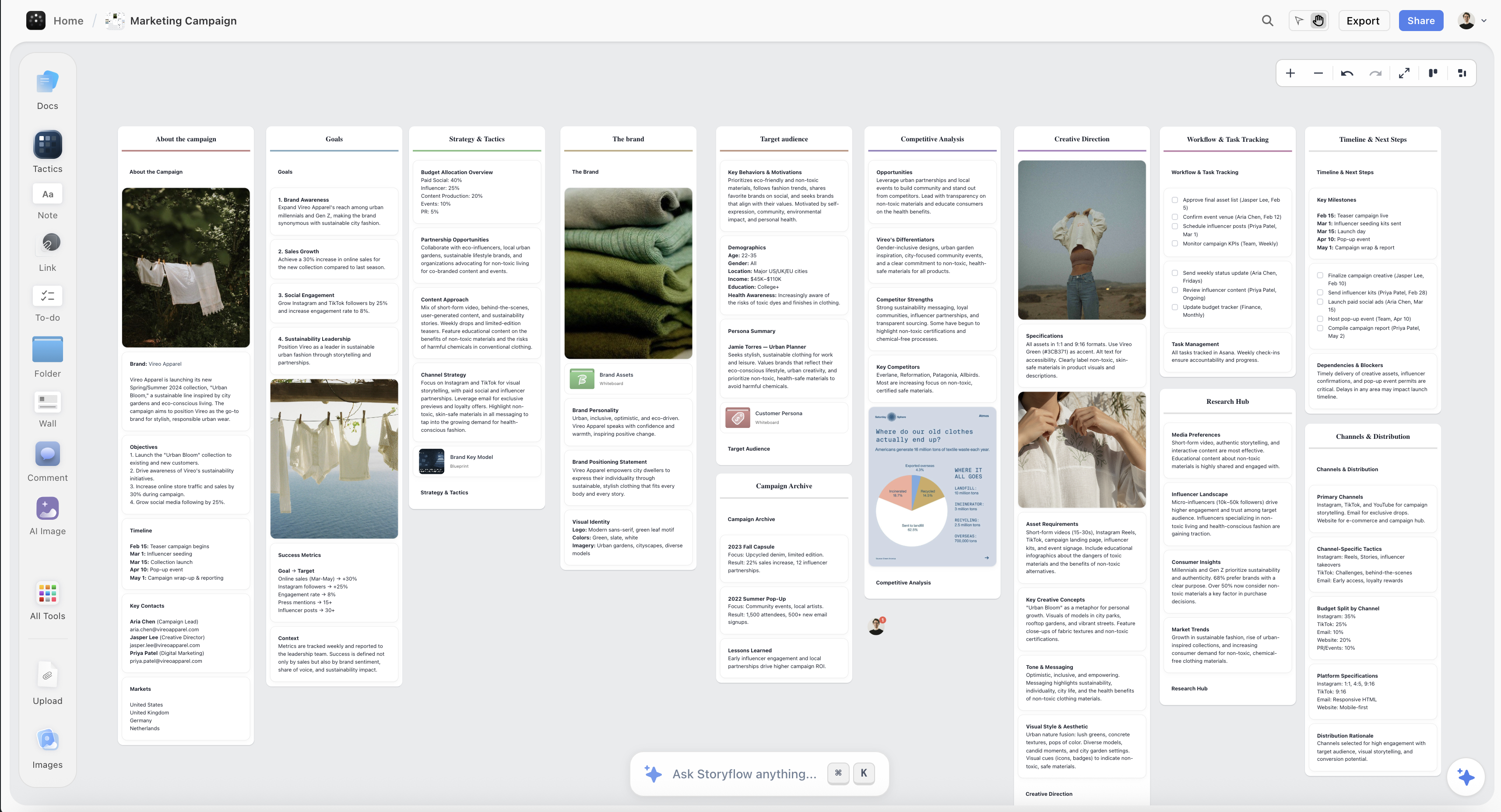
A Storyflow canvas aligning one message across paid, owned, and earned channels
Why Marketing Fragments in the First Place
If consistency is so obviously valuable, why is it so rare. Fragmentation is not a failure of effort. It is the default state every modern marketing setup drifts toward, for four structural reasons.
- More channels. A brand in 2005 ran a handful of channels. A brand in 2026 juggles paid search, several social platforms, email, SMS, a blog, a podcast, a community, and app notifications. Every one is another room the message can slip in.
- More tools. Each channel comes with its own software: the ad in the ad platform, the email in the ESP, the blog in the CMS, the calendar in a spreadsheet, the brief in a doc nobody reopens. No single surface shows the whole campaign, so no one sees the drift.
- More teams. Paid, content, PR, social, and lifecycle are often different people or even different agencies. Each optimizes its own room. Nobody is paid to protect the through-line between rooms.
- More speed. AI now generates a month of posts in an afternoon, so the constraint has moved. The hard part is no longer producing content. It is keeping a hundred pieces of it all saying the same true thing.
Left alone, marketing fragments the way a desk gets messy, not through any single bad decision but through the accumulation of reasonable ones.
What Consistency Buys You: The Benefits of IMC
Naming the discipline is easy. The reason to do it is that consistency compounds in ways scattered marketing never does. Four benefits carry most of the weight.
Recognition through repetition. The long-standing marketing heuristic known as the Rule of 7 holds that a prospect needs to encounter a message roughly seven times before it registers enough to act on. Whether the exact number is seven is beside the point. The mechanism is real: memory is built by repetition. Seven exposures to one message build a memory. Seven exposures to seven different messages build nothing. IMC is how you make every impression count toward the same memory.
Trust through consistency. People trust brands that are the same brand everywhere. A widely cited Lucidpress (now Marq) report put the revenue lift from consistent brand presentation across channels at up to 23%. Treat the exact figure as a vendor estimate, but the direction is not controversial: contradiction erodes trust, and trust is what turns attention into revenue.
Efficiency through reuse. When every channel starts from one core message, you write the hard part once. Scattered marketing pays the strategy cost on every channel. IMC pays it once and reuses the answer everywhere.
Measurement that means something. When all channels point at one goal, you can actually read the results. If every room runs its own message toward its own metric, you cannot tell whether the campaign worked or whether just a couple of rooms did.
IMC is not saying more things. It is saying one thing in more rooms. The brand that repeats one clear promise across paid, owned, earned, and shared media out-compounds the brand running five clever campaigns that never point the same way.
How to Build an Integrated Marketing Communications Plan
An IMC plan is not a bigger version of a channel plan. It is the layer above it. Here is the sequence I run, from the one true thing down to the individual post.
- Define the one true thing. Write the single core promise the whole campaign exists to land, in one sentence. If you cannot, the campaign has no center yet, and every room will invent its own.
- Fix the identity. Decide what stays constant everywhere: voice, key phrases, visual identity, proof points. This is the part that must not flex from room to room.
- Assign each room its job. Map the campaign across paid, owned, earned, and shared, and give each channel one role in service of the core promise, not its own separate goal.
- Adapt, do not reinvent. Decide how the one message is said in each room's accent. The format and the hook flex. The promise does not.
- Sequence the rooms. Owned assets usually come first (you control them), paid amplifies, shared spreads it, and earned follows if the story is clear enough to repeat.
- Review for drift. Before launch, put every channel's headline side by side and read them together. Fix any that contradict the core promise before it ships.
The heart of the plan is a message architecture: a simple map of what stays fixed and what is allowed to flex. It is the practical form of consistency before creativity, and it is One Voice, Many Rooms written down.
| Layer | What It Is | Fixed or Flexes |
|---|---|---|
Core promise | The one true thing the campaign must land | Fixed everywhere |
Proof points | The evidence that makes the promise believable | Mostly fixed |
Voice and identity | Tone, key phrases, logo, color, type | Fixed everywhere |
Hook and format | How the promise is opened in each room | Flexes by channel |
Call to action | The next step you ask for | Flexes by funnel stage |
This is also where AI earns its place, if you point it at the right job. Used well, AI does not write more posts. It checks that the posts you already have still point at the core promise. The familiar approach is to paste one channel's copy into a chatbot and ask it to improve that copy in isolation, which polishes the room and ignores the house. The better approach is to give the AI the whole campaign at once and ask whether each room still says the one true thing. That only works if the AI can see the whole plan, not one pasted fragment.
Which IMC Approach Fits Your Team?
IMC is a discipline, not a product, so the real question is which surface is light enough that your team will actually keep it current. One Voice, Many Rooms only works if the room map stays alive. Match the setup to your situation.
- Solo founder or one-person marketing team. You are the consistency mechanism. A single message doc or a one-board canvas is enough, because the whole campaign already passes through one head. Do not buy enterprise software to solve a problem you do not have yet.
- Small team, several channels, no single source of truth. This is where drift does the most damage and where a shared planning canvas earns its place. Hold the message architecture on one surface (Storyflow or a comparable canvas) and keep executing in the channel tools you already use.
- Large organization with brand governance at scale. You need asset versioning, approval workflows, and permissions across departments, which calls for a brand-management or DAM platform (Bynder, Frontify) paired with a marketing suite such as HubSpot. A lightweight canvas is too light for this job.
- Agency running campaigns for clients. Keep the campaign brief and message map on a shared canvas the client can see, and plug into each client's existing channel stack.
The Bottom Line. Integrated marketing communications is the difference between a brand that repeats and a brand that just makes noise. You do not need a bigger budget or more channels. You need one message the whole team can see and the discipline to keep every room pointed at it. IMC is not saying more things. It is saying one thing in more rooms. Pick the lightest surface that keeps all four rooms visible at once, and protect the one true thing from drift as it moves through paid, owned, earned, and shared media. If your campaigns live across five tools and the message keeps slipping, map your next campaign's core promise and all four rooms on a single Storyflow board for one launch. By the end you will know whether your drift was a strategy problem or a surface problem. Map your next campaign on a Storyflow canvas.
FAQ: Integrated Marketing Communications
What is integrated marketing communications in simple terms?
Integrated marketing communications is making sure your brand says one consistent thing across every channel, from ads to email to social to customer reviews. Instead of each channel running its own message, they all reinforce a single promise and identity. The simplest test is to read the first line of five of your channels side by side and ask whether they sound like the same company.
What is the difference between IMC and marketing?
Marketing is the whole discipline of understanding and reaching customers; IMC is specifically the coordination layer that keeps all your marketing communication consistent. You can do marketing without integration (each channel doing its own thing), but you cannot do IMC without a single unifying message. Marketing is the activity; IMC is the through-line that makes the activity add up.
What are the components of integrated marketing communications?
The classic components are the promotional mix: advertising, public relations, direct marketing, sales promotion, personal selling, and digital or social media. IMC does not add new channels; it coordinates these existing ones so they deliver one message, which is why marketers often sort them into the paid, owned, earned, and shared model.
What is the difference between IMC and the PESO model?
IMC is the goal (one consistent message everywhere); the PESO model is one way to organize the channels you deliver it through. PESO, coined by Gini Dietrich in 2014, sorts media into paid, earned, shared, and owned. You use PESO to map your channels, then apply IMC discipline so the message stays consistent across all four.
Why is integrated marketing communications important?
IMC is important because customers experience your brand as one entity, and contradiction between channels erodes trust and wastes spend. Consistent messaging compounds: repeated exposure to one message builds recognition, while scattered messages cancel out. The result is stronger recall, more trust, and marketing spend that reinforces itself rather than competing with itself.
What are the 4 Cs of integrated marketing communications?
The 4 Cs are consumer, cost, convenience, and communication, proposed by Robert Lauterborn in 1990 as a customer-centered rewrite of the traditional 4 Ps (product, price, place, promotion). They matter to IMC because they force the same shift IMC requires: plan from what the customer needs to hear, not what each department wants to say.
What is an example of integrated marketing communications?
A clean example is a product launch where the paid ad, the landing page, the launch email, the PR pitch, and the social posts all lead with the exact same core promise and visual identity. A customer who sees the ad, clicks to the page, opens the email, and later reads a review encounters one coherent story every time. The opposite (a different promise in each place) is what IMC exists to prevent.
Is IMC the same as omnichannel marketing?
No, though they overlap. Omnichannel marketing is about a seamless customer experience across channels (a cart that follows you from app to desktop), while IMC is about a consistent message across channels. Strong brands do both: one message (IMC) delivered through one seamless experience (omnichannel).
What tools do you need for integrated marketing communications?
You need three layers: a place to define the message (a campaign brief or a shared planning canvas), execution tools for each channel (ad platform, email service, CMS, social scheduler), and something to keep them aligned. Most teams already own the execution tools; the missing layer is usually the shared surface that holds the one message where every channel owner can see it. A planning canvas like Storyflow fills that alignment gap but does not replace the execution tools.
Table of Contents
- Key Takeaways
- Why Your Brand Sounds Like Five Different Companies
- What Integrated Marketing Communications Actually Is
- The Four Rooms: Paid, Owned, Earned, and Shared Channels
- Why Marketing Fragments in the First Place
- What Consistency Buys You: The Benefits of IMC
- How to Build an Integrated Marketing Communications Plan
- Where a Shared Planning Canvas Fits (and Where It Doesn't)
- Which IMC Approach Fits Your Team?
- FAQ: Integrated Marketing Communications
- Related Reading
Templates to check out for this topic


Marketing and campaign templates you can use in Storyflow
Plan the whole campaign on one board: brief, audience, channels, and assets connected, with an AI that reads all of it. Open a template and start from real structure.


See Storyflow in Action
A visual AI workspace where every feature lives inside one canvas. No tab-switching, no context lost.
Build your entire board from a single message
Type what you need in the AI chat at the bottom of your canvas. The AI adds cards, headings, and structure directly onto your board.
Use expert frameworks as AI context
Type @ in the AI chat and choose any Tactic. The AI tailors every response to that framework instead of giving generic advice.
Turn your board into a mind map in seconds
Ask the AI to restructure your canvas as a mindmap. It connects your ideas into a visual hierarchy so you can see how everything relates.
Why Storyflow Exists
Storyflow actually began as a personal tool while working on creative and research projects.
We kept running into the same problem: ideas were scattered everywhere: notes, documents, and whiteboards.
Nothing helped us see how everything connected.
So we started building a workspace designed around how ideas actually grow.
→ Read how Storyflow was createdSara de Klein
Head of Product at Storyflow
Published: 2026-07-15
Extremely simple, seriously capable


See how easy it is to get started
Watch a real project come together, from a blank board to a finished plan, clicked through step by step.
Start creating with AI and become more productive
Transform your creative workflow with AI-powered tools. Generate ideas, create content, and boost your productivity in minutes instead of hours.