The 12 Best Client Gallery and Delivery Tools for Photographers in 2026 (We Tested Them All)
A client remembers two moments: the shoot and the gallery. Most photographers put their whole craft into the first and treat the second as file transfer, which is backwards, because the gallery is the only artifact the client controls and shares.

Category
Photography
Author

Storyflow Team
Product & Research Team
Topics
2026-09-22
•
19 min read
•
PhotographyFull disclosure: Storyflow is our own product and it is deliberately NOT in the twelve on this page, because it hosts no images, delivers no files, sells no prints and has no gallery of any kind. Every tool in this ranking does something it cannot. It is named once, in section 8, for the pre-shoot half of the client experience: the moodboard, shot list and call sheet the gallery is eventually the output of. That section also gives the free version of the same fix, a Pinterest board plus a spreadsheet, and says what you lose by taking it. Storyflow is paid-only during early access; the Free plan launches before the end of 2026.
Quick Comparison
These four split the market honestly: three consumer-facing galleries at different points on presentation, sales and business coverage, and one plain file transfer that is the more professional answer for an art director. Storyflow is deliberately absent because it hosts no images.
| Tool | Best For | AI Features | Price |
|---|---|---|---|
| Pic-Time | Galleries that sell prints unattended | Automated marketing campaigns | From about $10 mo |
| Pixieset | One tool for gallery, store and portfolio | Light AI tagging | Free tier / from about $10 mo |
| ShootProof | Contracts and invoices beside the gallery | Workflow automation | Free tier / from about $10 mo |
| Dropbox | Full-resolution files for agencies | AI search on higher tiers | Free tier / about $12 mo |
Article Metadata
By the Storyflow Team, Product & Research Published September 22, 2026 · 19 min read · Photography
The gallery was beautiful and the one shot they asked for is missing
No delivery platform can fix a shot nobody wrote down. Keep the moodboard, the shot list and the call sheet on one canvas the client can see before the day, and check the list against the brief while there is still time. Paid-only during early access, from $7.99 a month billed annually.

Table of Contents
- Quick Answer: The Best Client Gallery Tools in 2026
- Comparison Table: 12 Gallery Tools at a Glance
- The Delivery Is the Last Impression
- How We Evaluated These Tools
- Quick Picks by Photography Business
- Detailed Reviews: 12 Client Gallery Tools
- Gallery Sales: What Actually Makes Clients Buy
- The Half of the Client Experience Galleries Do Not Cover
- Recommended Delivery Stacks
- What Gallery Delivery Actually Costs
- Honorable Mentions
- Delivery Methods to Avoid
- FAQ: Client Gallery and Delivery Tools
- The Bottom Line
- Author
- Related Reading
1) Quick Answer: The Best Client Gallery Tools in 2026
Pic-Time is the best client gallery tool in 2026 for photographers who want the gallery to sell: the presentation is the most cinematic in the category and its automated marketing campaigns turn a delivery into print revenue without you sending a single email. Pixieset is the best all-round choice and the one most photographers land on, with a clean gallery, a store and a straightforward price. ShootProof is the strongest if you want galleries, contracts and invoicing in one system. CloudSpot is the best modern client experience if print sales are not your priority.
A client remembers two moments: the shoot and the gallery. Almost every photographer puts their whole craft into the first and treats the second as file transfer. That is a real commercial mistake, because the gallery is the only thing the client shares, and what they share is what brings you the next booking.
A download link produces a download. A gallery produces a share, a print order and a referral. The Delivery Is the Last Impression framework in section 3 ranks all 12 tools on that difference, and section 7 covers what actually makes a client buy.
One note up front, because we make a planning tool. Storyflow is our own product and it is not a gallery tool. It does not host images, sell prints or deliver files, so it is not among the 12 below. It appears once, in section 8, on the half of the client experience galleries do not cover, at its real price.
For planning the shoot itself, see The 12 Best Photoshoot Planning Tools in 2026.
All 12 Client Gallery Tools, Ranked
- Pic-Time: best gallery presentation and automated print sales
- Pixieset: best all-round gallery, store and portfolio
- ShootProof: best galleries plus contracts and invoicing in one place
- CloudSpot: best modern client experience and fastest setup
- SmugMug: best long-term archive with unlimited storage
- Zenfolio: best all-in-one photography business platform
- Format: best portfolio-first with client galleries attached
- Pass: best simple, fast delivery for volume shooters
- Adobe Lightroom: best if the edit already lives there
- Dropbox: best plain file transfer, honest about what it is
- Google Drive: best free baseline
- WeTransfer: best one-off send to a non-client
Best Client Gallery Tool by Job
- Best for selling prints without chasing anyone: Pic-Time. Its automated campaigns are the closest thing in this category to revenue that arrives while you sleep.
- Best first paid gallery tool: Pixieset. Clean, well priced, and covers gallery, store and a portfolio site.
- Best for running the business from one place: ShootProof or Zenfolio. Contracts, invoices and galleries together.
- Best for a commercial or editorial client who wants files and nothing else: Dropbox. Do not build a print store for an art director.
- Best for an archive clients come back to years later: SmugMug. Unlimited storage is the whole pitch and it is a real one.
- Best free option: Google Drive. It is not a gallery, it works, and this article says plainly when that is the right answer.
2) Comparison Table: 12 Gallery Tools at a Glance
| Tool | Best For | Print Sales | Client Experience | Starting Price | Rating (/10) |
|---|---|---|---|---|---|
Pic-Time | Gallery presentation and automated sales | Yes, strongest automation | Excellent | From about $10 mo | 9.3/10 |
Pixieset | All-round gallery, store and portfolio | Yes | Very good | Free tier / from about $10 mo | 9.0/10 |
ShootProof | Galleries plus contracts and invoicing | Yes | Good | Free tier / from about $10 mo | 8.6/10 |
CloudSpot | Modern experience, fast setup | Yes, lighter | Excellent | Free tier / from about $20 mo | 8.4/10 |
SmugMug | Long-term archive and portfolio | Yes | Good | From about $13 mo | 8.1/10 |
Zenfolio | All-in-one photography business | Yes | Good | From about $20 mo | 7.9/10 |
Format | Portfolio-first with galleries | Limited | Very good | From about $12 mo | 7.5/10 |
Pass | Fast delivery for volume shooters | Limited | Good | From about $8 mo | 7.2/10 |
Adobe Lightroom | Sharing from where you edit | No | Basic | Included with a photography plan | 6.8/10 |
Dropbox | Plain file transfer | No | Poor as a gallery | Free tier / about $12 mo | 6.0/10 |
Google Drive | Free baseline | No | Poor as a gallery | Free | 5.2/10 |
WeTransfer | One-off sends | No | Poor as a gallery | Free tier / about $12 mo | 4.8/10 |
Pricing reflects publicly listed plans in 2026, changes often, and several of these tools price on storage tiers, so verify before you commit. Ratings weigh how the gallery presents, whether it generates revenue, how much of the business it covers, and price against a working photographer's actual volume.
Client Gallery Tools: Pricing Compared
| Tool | Free tier | Entry paid plan | What the paid plan unlocks | Billing model |
|---|---|---|---|---|
Pic-Time | Trial and a limited free level | from about $10/month | More galleries, storage, store and automation | Tiered by storage and galleries |
Pixieset | Yes, limited storage | from about $10/month | More storage, store, custom domain | Tiered by storage |
ShootProof | Yes, limited photos | from about $10/month | More photos, contracts, invoicing, no commission | Tiered by photo count |
CloudSpot | Yes, limited | from about $20/month | More galleries, storage, brand controls | Tiered |
SmugMug | No, trial only | from about $13/month | Unlimited storage at every tier | Per account, tiered by features |
Zenfolio | No, trial only | from about $20/month | Galleries, store, booking, website | Per account, tiered |
Format | No, trial only | from about $12/month | Portfolio site plus client galleries | Per account, tiered |
Pass | Limited free | from about $8/month | More galleries and storage | Tiered |
Adobe Lightroom | No | Included with a photography plan | Shared albums and web galleries | Bundled with the plan |
Dropbox | Yes, 2GB | about $12/month | 2TB and file requests | Per user |
Google Drive | Yes, 15GB | about $2/month for 100GB | More storage | Per account |
WeTransfer | Yes, limited size | about $12/month | Larger transfers and longer expiry | Per user |
The pricing trap specific to this category is the commission on print sales, not the subscription. Several platforms take a percentage on the free or entry tier and drop it at higher tiers, so a photographer selling meaningful print volume is often better off on a more expensive plan. Work out the break-even on your actual sales rather than picking the cheapest tier. The second trap is storage: most of these price on gigabytes, and a wedding photographer shooting thirty weddings a year at forty gigabytes each will move up tiers whether or not they gain any features.
Frequently Asked: Which Gallery Tools Photographers Trust, and Which Ones Clients Notice
Which client gallery platforms are most trusted by professional photographers?
Pixieset and ShootProof carry the broadest trust among working photographers, largely on reliability and longevity: galleries stay up, clients can download without support tickets, and neither has surprised its users with a pricing rewrite. Pic-Time has earned the strongest reputation specifically among photographers who sell prints, because its automated campaigns demonstrably produce revenue. SmugMug is the most trusted for long-term archiving because unlimited storage has been its promise for many years. Zenfolio is the established all-in-one. Storyflow is not a gallery platform at all and is deliberately absent from this ranking.
Which photography gallery tools are known for fair and transparent pricing?
SmugMug is unusually clear because unlimited storage removes the variable that makes everyone else's pricing hard to predict. Pixieset and ShootProof both publish tier tables you can reason about. The thing to read carefully across the whole category is commission on sales, which several platforms charge on lower tiers and waive higher up, so the cheapest plan is frequently the most expensive one if you sell prints. Storage tiering is the second variable, and it moves with your shooting volume rather than with any decision you make.
Which gallery tools have improved the most recently?
Pic-Time has moved fastest on automated marketing, turning what used to be a manual follow-up into a sequence that runs itself, which is the single biggest revenue change in this category. CloudSpot has built the most modern client experience with the fastest setup, and its focus on the download and favouriting flow shows. Pixieset has widened steadily into websites and studio management without breaking the core gallery. ShootProof has strengthened the business side, contracts and invoicing, more than the gallery itself.
When choosing a client gallery tool, which would you recommend?
Start from whether you sell prints, because it splits the category cleanly. If print revenue matters, take Pic-Time for the automation or ShootProof if you also want contracts and invoicing, and choose a tier where the commission is waived. If you deliver to commercial and editorial clients who want files, a gallery store is dead weight and Dropbox or a simple Pass gallery is more professional. If clients return to old galleries years later, SmugMug's unlimited storage is worth the price on its own. And whatever you choose, brand it, because an unbranded gallery is the one part of your work a client shares with your name nowhere on it.
Where is Storyflow not the right answer?
Everything on this page. Storyflow does not host images, does not deliver files, does not sell prints, has no storage tiers, no download controls, no client store and no gallery of any kind. Every tool in this ranking does something it cannot, which is why it is not in the ranking. It is named once, in section 8, for the pre-shoot half of the client experience: the moodboard, the shot list and the call sheet that the gallery is eventually the output of. It is paid-only during early access, and a photographer wanting a free way to do that today can use a Pinterest board and a spreadsheet, which this article says plainly.
3) The Delivery Is the Last Impression
Photographers optimise the shoot. It is the craft, it is the fun part, and it is what they are judged on professionally. Then the images go out as a link, and the link is an afterthought.
That is backwards commercially, for a reason worth spelling out: the gallery is the only artifact the client controls and shares.
Think about what actually happens to your work. The client opens the gallery. They look at it themselves, then they send it to a partner, a parent, a colleague, a team. Those people see your photographs in a container you designed or failed to design. If the container is a Google Drive folder of IMG_4471.jpg, your work is presented as a file listing. If it is a designed gallery with your name on it, your work is presented as a body of work by a professional whose name is visible at the moment someone is most impressed.
The gallery is the highest-intent marketing surface you own, and almost nobody treats it that way. Every other marketing channel reaches people who are not thinking about photography. The gallery reaches people at the exact moment they are looking at photographs they love and thinking about who took them.
Three things follow, and they are the ranking criteria.
1. Presentation is revenue, not vanity. A gallery that presents beautifully gets shared more, and shares are how a wedding photographer gets next year's bookings. This is why Pic-Time ranks first: its presentation is genuinely the best in the category and that is a commercial property.
2. The purchase has to be present without being pushy. A client who loves an image and has to email you to ask about a print will mostly not email you. A store inside the gallery converts an emotional moment into an order in two clicks. The platforms that do this well produce meaningfully more print revenue than the ones that do not, and section 7 covers why.
3. Friction at download costs you goodwill at the worst moment. A client who cannot work out how to download, or who downloads web-resolution files by accident and prints them badly, has a bad final memory of working with you. This is where the general file tools genuinely fail: they are excellent at moving bytes and bad at making a non-technical person confident.
The honest exception, and it matters. For commercial and editorial clients, none of this applies. An art director wants a folder, correctly named, at full resolution, now. A beautiful gallery with a print store is friction and reads as consumer-shaped. That is why Dropbox is in this ranking rather than dismissed: for part of the market it is the right professional answer, and photographers who shoot both kinds of work should run both.
4) How We Evaluated These Tools
Five criteria, weighted in this order:
- How the gallery presents, because presentation drives sharing and sharing drives bookings.
- Whether it converts emotion into revenue, through a store that is present without being pushy.
- Download experience for a non-technical client, including whether they can get the wrong resolution by accident.
- How much of the business it covers, from contracts and invoices to the portfolio site.
- True cost at real volume, counting storage tiers and sales commission rather than the headline price.
Testing covered three photography businesses over a quarter: a wedding photographer delivering twenty galleries, a portrait studio selling prints, and a commercial photographer delivering to agencies and art directors.
5) Quick Picks by Photography Business
Best overall: Pic-Time, if you sell prints. Pixieset, if you want one well-priced tool that does everything adequately.
Best for weddings: Pic-Time for sales automation, or Pixieset for the balance of price and features.
Best for portrait and family studios: ShootProof, because contracts, invoicing and print sales in one place matches how the business actually runs.
Best for commercial and editorial: Dropbox. A clean folder at full resolution, named properly. No store, no fuss.
Best for a long archive: SmugMug. Unlimited storage at every tier.
Best free option: Google Drive, honestly. It is not a gallery and it works. Pixieset, ShootProof and CloudSpot all have limited free tiers worth trying first. Storyflow is paid-only during early access and is not a gallery tool in any case.
Best cheapest working setup: Pixieset's entry tier at about $10/month, which covers galleries, a store and a portfolio site.
6) Detailed Reviews: 12 Client Gallery Tools
1. Pic-Time
Pic-Time has the most cinematic gallery presentation in the category, with themed layouts and transitions that make a set of images feel like a body of work rather than a folder. Its real differentiator is automated marketing: campaigns that follow up after delivery, at anniversaries, and around holidays, generating print orders without you writing an email.
Best for: Photographers who want the gallery to produce revenue on its own.
Verdict: The best gallery in the category and the strongest sales automation. Overkill if you never sell prints.
Key features
- Cinematic gallery themes and transitions.
- Automated marketing campaigns driving print sales.
- Integrated store with lab fulfilment.
Pricing
Trial and a limited free level. Paid from about $10/month, tiered by storage and galleries.
Pros
- The best-presenting gallery here, which drives sharing.
- Sales automation genuinely produces orders unattended.
- Clients consistently comment on the experience.
Cons
- Sales features are wasted if you deliver files only.
- Storage tiers climb with volume.
- More setup than a simple delivery tool.
2. Pixieset
Pixieset is where most photographers end up, and for good reason: a clean, fast gallery, a working store, a portfolio website and studio management, at a price that does not require a spreadsheet to evaluate. It is rarely the best at any single thing and it is the best balance.
Best for: Photographers wanting one well-priced tool covering gallery, store and website.
Verdict: The best all-round choice. Pic-Time presents better and ShootProof handles the business side better.
Key features
- Clean, fast client galleries with favouriting.
- Store with print fulfilment.
- Portfolio website and studio management modules.
Pricing
Free tier with limited storage. Paid from about $10/month, tiered by storage.
Pros
- Excellent balance of features and price.
- Clients find downloads easy without support.
- Covers the portfolio site too, removing a subscription.
Cons
- Presentation is good rather than exceptional.
- Storage tiers rise quickly for wedding volume.
- Commission applies on lower tiers.
3. ShootProof
ShootProof pairs galleries with the business layer most photographers otherwise cobble together: contracts, invoices, payment plans and questionnaires. For a portrait or family studio running repeat clients, having the paperwork attached to the gallery is worth more than a prettier gallery.
Best for: Studios that want galleries, contracts and invoicing in one system.
Verdict: The best business coverage here. The gallery itself is behind Pic-Time and Pixieset.
Key features
- Galleries with a print store and no commission on higher tiers.
- Contracts, invoices and payment plans.
- Client questionnaires and workflow automation.
Pricing
Free tier with limited photos. Paid from about $10/month, tiered by photo count.
Pros
- Business paperwork and galleries in one place.
- Commission-free selling on higher tiers.
- Strong automation around client communication.
Cons
- Gallery presentation is plainer than rivals.
- Photo-count tiers are easy to misjudge.
- Interface feels more utilitarian.
4. CloudSpot
CloudSpot has the most modern client experience in the category and the fastest setup: upload, brand, send, and the client flow is genuinely well designed. It leans on experience rather than on sales machinery.
Best for: Photographers who want a beautiful delivery without building a print business.
Verdict: The best client experience per minute of setup. Lighter on sales than Pic-Time or ShootProof.
Key features
- Fast, modern galleries with strong branding controls.
- Client download and favouriting flow designed carefully.
- Lightweight store and studio features.
Pricing
Limited free tier. Paid from about $20/month.
Pros
- Fastest from upload to a branded gallery.
- The client-side flow is the most considered here.
- Clean, modern interface.
Cons
- Higher entry price than Pixieset or ShootProof.
- Sales features are lighter.
- Smaller ecosystem and community.
5. SmugMug
SmugMug's pitch is unlimited storage at every tier, which removes the variable that makes every rival's pricing unpredictable. For a photographer with a decade of work and clients who return to old galleries, that is the whole decision.
Best for: Long-term archiving alongside client delivery.
Verdict: The best archive here, and unlimited storage is a genuine differentiator. Slower and less modern than the newer gallery tools.
Key features
- Unlimited storage at every plan level.
- Portfolio site and client galleries together.
- Print store with lab fulfilment.
Pricing
Trial only, then from about $13/month.
Pros
- Unlimited storage removes tier anxiety entirely.
- Long-established and stable.
- Doubles as a portfolio site.
Cons
- Interface feels dated next to Pic-Time or CloudSpot.
- Client gallery experience is good rather than special.
- Customisation has a learning curve.
6. Zenfolio
Zenfolio is an all-in-one photography business platform: website, galleries, store, booking and client management. For a photographer who wants one subscription and one login for the whole business, that breadth is the point.
Best for: Photographers wanting website, booking and galleries in a single platform.
Verdict: The broadest all-in-one here. Each individual piece is beaten by a specialist.
Key features
- Website builder with client galleries.
- Online booking and scheduling.
- Store with lab fulfilment and AI tagging.
Pricing
Trial only, then from about $20/month.
Pros
- One platform covers most of the business.
- Booking built in, which rivals lack.
- Established and reliable.
Cons
- Higher entry price.
- No single component is best in class.
- Migrating away later is a real project.
7. Format
Format is a portfolio platform first, with client galleries attached. For photographers whose priority is a beautiful public site and whose delivery volume is modest, that ordering is right and the portfolio templates are among the best available.
Best for: Photographers whose portfolio site matters more than their delivery volume.
Verdict: The best portfolio here with competent galleries. Not a print-sales platform.
Key features
- Strong portfolio templates aimed at photographers.
- Client galleries with proofing.
- Store for prints and digital sales.
Pricing
Trial only, then from about $12/month.
Pros
- The best portfolio templates in this comparison.
- Galleries and portfolio in one subscription.
- Clean, design-led output.
Cons
- Gallery features behind the dedicated tools.
- Limited print-sales machinery.
- Storage is modest on lower tiers.
8. Pass
Pass focuses on fast, simple delivery with a desktop app that makes uploading large volumes painless. For a volume shooter delivering many galleries a month, upload speed and simplicity beat presentation features you never use.
Best for: High-volume shooters who deliver frequently and sell rarely.
Verdict: The most efficient plain delivery here. Lighter on sales and presentation than the leaders.
Key features
- Desktop app for fast bulk uploads.
- Simple, quick client galleries.
- Straightforward sharing and download.
Pricing
Limited free tier. Paid from about $8/month.
Pros
- Fast uploads at volume, which is the real bottleneck.
- Cheap entry tier.
- Simple enough that clients never need help.
Cons
- Presentation is basic.
- Limited sales features.
- Smaller feature set overall.
9. Adobe Lightroom
Lightroom's shared albums and web galleries let you deliver from where the edit already lives, with no export and no second upload. For a photographer already paying for a photography plan, it costs nothing extra.
Best for: Delivering quickly from inside an existing Lightroom workflow.
Verdict: The most convenient option if you are already in Lightroom. Not a client gallery product and it does not pretend to be.
Key features
- Shared albums straight from the catalogue.
- Web galleries with commenting.
- No separate upload step.
Pricing
Included with an Adobe photography plan.
Pros
- No extra cost or extra upload.
- Client comments land next to the edit.
- Always in sync with your catalogue.
Cons
- No store, branding or download controls worth the name.
- Presentation is plain.
- Ties delivery to an Adobe subscription.
10. Dropbox
Dropbox is plain file transfer and it is genuinely the right answer for commercial and editorial work. An art director wants full-resolution files in a correctly named folder, immediately, and every gallery feature is friction between them and that.
Best for: Commercial, editorial and agency clients who want files.
Verdict: The most professional choice for commercial delivery and the wrong one for consumer work.
Key features
- Reliable large-file transfer and sync.
- Shared folders with permissions and expiry.
- File requests for receiving material.
Pricing
Free 2GB tier. Paid about $12/month for 2TB.
Pros
- Exactly what a commercial client expects.
- Fast, reliable, no learning curve.
- Doubles as your working backup.
Cons
- Presents your work as a file listing.
- No branding, store or client experience.
- Consumer clients find folders confusing.
11. Google Drive
Google Drive is the free baseline and a great many photographers start here. It moves the files, it costs nothing, and it presents your work with all the craft of a filing cabinet.
Best for: Photographers with no budget, and internal sharing.
Verdict: Free and functional. The weakest client experience here by a distance.
Key features
- 15GB free, cheap paid storage.
- Universal access and sharing.
- Works everywhere with no account friction for viewers.
Pricing
Free to 15GB. About $2/month for 100GB.
Pros
- Genuinely free at useful capacity.
- Everyone already knows how to use it.
- No storage anxiety at a low price.
Cons
- Presents images as a file list.
- Clients routinely struggle with bulk download.
- Nothing branded; your name appears nowhere.
12. WeTransfer
WeTransfer is built for one-off sends and is excellent at exactly that. As a client gallery it fails on the property that matters most: the link expires, so the artifact the client would have shared and returned to is gone.
Best for: A single send to someone who is not an ongoing client.
Verdict: Fine for a one-off transfer. The expiry alone disqualifies it as a delivery method.
Key features
- Send large files with no account required.
- Simple, fast, universally understood.
- Free tier for modest sizes.
Pricing
Free tier with size limits. Paid about $12/month.
Pros
- Zero friction for a one-off send.
- No account needed by the recipient.
- Fast and dependable.
Cons
- Links expire, so the delivery disappears.
- No gallery, branding or store.
- Clients who miss the window come back to you.
7) Gallery Sales: What Actually Makes Clients Buy
Print revenue is the largest difference between two photographers charging the same shoot fee, and most of it is decided by the gallery rather than by salesmanship.
Timing beats persuasion. The window where a client is most likely to order is the first few days after delivery, while the emotional response is live. A store that is present in the gallery at that moment converts far better than an email sent three weeks later asking whether they would like prints. This is the mechanism behind Pic-Time's automation and it is why that automation is worth more than any feature comparison suggests.
Fewer choices sell more. A gallery of six hundred images with a store attached produces paralysis. Curated sets, favourites, and suggested products against specific images all reduce the decision to something a person can actually make. Photographers who cut the gallery down consistently report higher order values, which is counterintuitive and well established.
Show the product, not the price list. A print is an object with a size, a paper and a place on a wall. Platforms that render the image as a framed product on a wall sell more than platforms that offer a dropdown of dimensions, because the client is buying a thing for a room rather than a transaction.
Do not make them ask. Any step that requires the client to contact you removes most of the orders. The ones who would have emailed are a small fraction of the ones who would have clicked.
And the honest counterweight: none of this applies to commercial work, and applying it there damages you. An agency client presented with a print store reads it as consumer-shaped and slightly unserious. Know which half of the market a given delivery is for, and if you shoot both, run both setups rather than compromising on one.
8) The Half of the Client Experience Galleries Do Not Cover
Everything on this page happens after the shutter. The client experience starts considerably earlier, and the tools in this ranking have nothing to do with that half.
Before the shoot there is a different set of artifacts: the moodboard that agrees the look, the shot list that makes sure the pictures the client actually needs get taken, the call sheet that gets everyone to the right place, and the wardrobe or location notes. Those artifacts are what decide whether the gallery is any good, and they usually live in a Pinterest board, a text thread and the photographer's head.
The specific failure this produces is familiar: the gallery is delivered, the client says it is beautiful, and then asks where the shots of the thing they mentioned once in a phone call six weeks ago. Nobody wrote it down. That is not a delivery problem and no gallery tool can fix it.
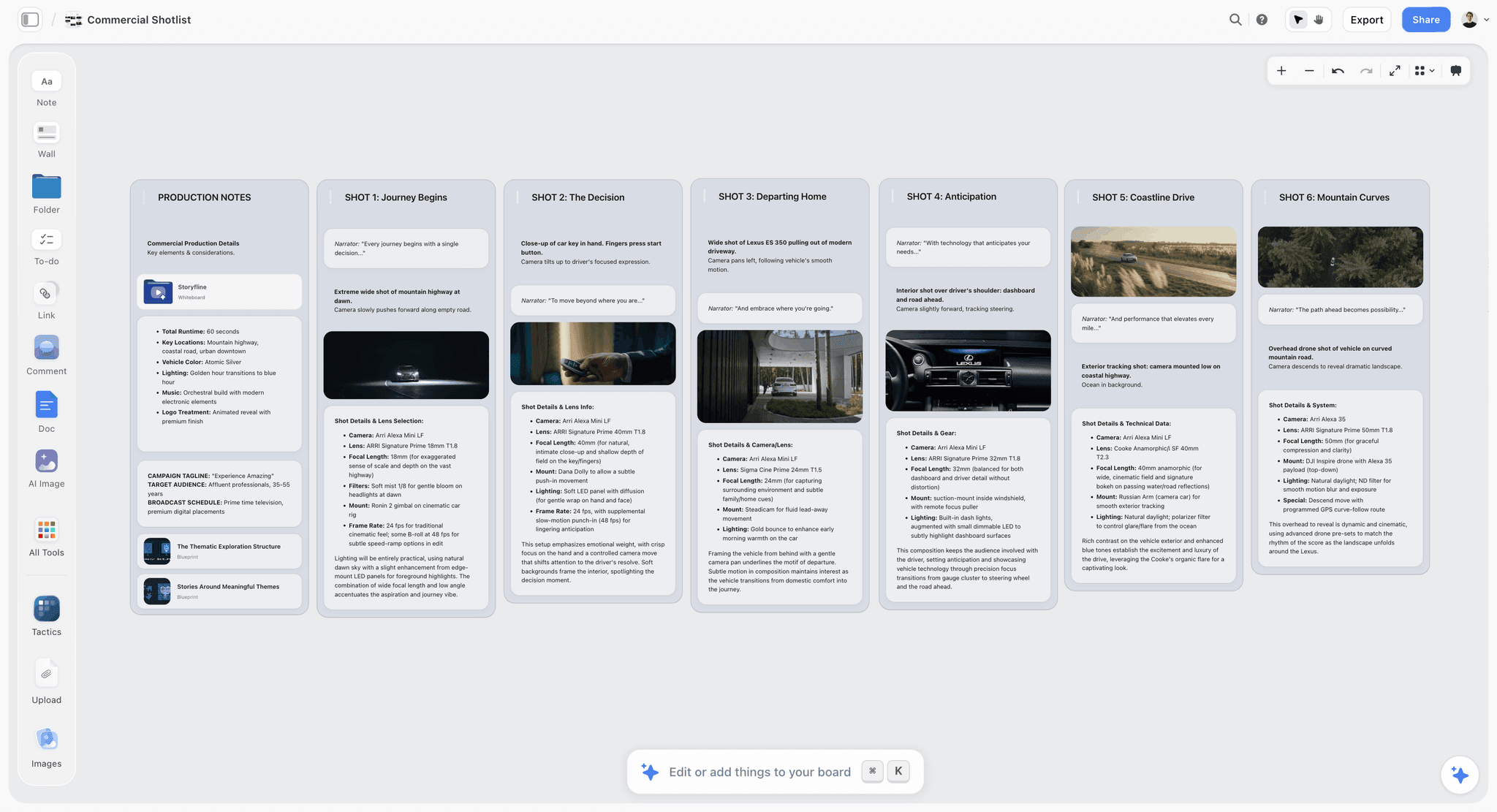
Storyflow is our own product and this is the one place on this page it belongs. It is an infinite canvas where the moodboard, the shot list, the call sheet and the client's notes sit together, and because the AI reads the whole board you can ask whether the shot list covers everything the brief asked for before the shoot day rather than after. It does not host images, deliver files or sell prints, which is why it is deliberately absent from the ranking above. It is $7.99/month billed annually, priced per account rather than per seat, and anyone a paid member invites to a board joins free, so the client or the stylist can see the plan without buying anything. It is paid-only during early access; the Free plan launches before the end of 2026.
If you would rather not pay for this, the honest free version is a Pinterest board for the look plus a spreadsheet for the shot list. You lose the AI checking the list against the brief and keep most of the benefit, which is simply that these things were written down at all.
| Stage | Artifact | Where it usually lives | Where it should live |
|---|---|---|---|
Before | Moodboard, shot list, call sheet | Pinterest, a text thread, memory | One place the client can see |
During | The shoot | The camera | n/a |
After | The gallery | A delivery platform | Pic-Time, Pixieset, ShootProof |
The two halves are genuinely separate purchases, and most photographers have bought only the second.
9) Recommended Delivery Stacks
Stack 1: Wedding photographer selling prints. Pic-Time (galleries and automated sales) + Dropbox (working backup) + Storyflow (pre-shoot planning). About $30/month.
Stack 2: Portrait or family studio. ShootProof (galleries, contracts, invoicing) + Pixieset or Format (portfolio site) + Storyflow. About $30/month.
Stack 3: Commercial and editorial photographer. Dropbox (delivery) + Format (portfolio) + Storyflow (pre-production). About $32/month, and deliberately no print store.
Stack 4: High-volume shooter. Pass (fast delivery) + SmugMug (archive) + Storyflow. About $29/month.
Stack 5: Starting out, minimum spend. Pixieset free or entry tier + Google Drive for backup + a Pinterest board and a spreadsheet for planning. Zero to about $10/month.
| Photographer shape | Delivers with | Archives with | Plans the shoot in | Monthly cost |
|---|---|---|---|---|
Wedding, sells prints | Pic-Time | Dropbox | Storyflow | about $30 |
Portrait studio | ShootProof | ShootProof | Storyflow | about $30 |
Commercial and editorial | Dropbox | Dropbox | Storyflow | about $32 |
High volume | Pass | SmugMug | Storyflow | about $29 |
Starting out | Pixieset free | Google Drive | Pinterest and a spreadsheet | $0 to $10 |
The pattern: one delivery tool matched to whether you sell prints, one archive you trust, and somewhere the pre-shoot plan lives. Most photographers have the first two and improvise the third.
10) What Gallery Delivery Actually Costs
Three costs, and the subscription is the smallest.
Storage tiers that move with your shooting. A wedding photographer shooting thirty weddings at forty gigabytes each generates over a terabyte a year, and most platforms price on storage, so the bill climbs with success rather than with any decision. SmugMug's unlimited storage is the one structural answer to this, and it is worth modelling against three years of shooting rather than one.
Commission on print sales. Several platforms take a percentage on lower tiers and waive it higher up, which means the cheapest plan is often the most expensive one once you sell. Work out the crossover point from your actual print revenue; photographers routinely stay on a cheap tier for years while paying more in commission than the upgrade would cost.
The revenue you never see. The largest number here and the one nobody itemises. A gallery with no store, or a store the client has to ask about, forgoes orders that would have happened at the moment of delivery. Photographers who move from plain file delivery to a gallery with an integrated store generally see print revenue appear where there was none, which makes the subscription irrelevant by comparison.
| Cost driver | Tools affected | What it does | The move |
|---|---|---|---|
Storage tiers | Pixieset, Pic-Time, CloudSpot, Format | Climbs with shooting volume | Model three years, or take SmugMug |
Sales commission | Most platforms on low tiers | Cheap plan costs more than the upgrade | Find the crossover from real revenue |
Forgone print sales | Dropbox, Drive, WeTransfer | Orders that never happen | Put the store in the gallery |
Unwritten pre-shoot plan | None of them | Missed shots, reshoots, awkward calls | Write the shot list down somewhere shared |
11) Honorable Mentions
- Picsello. Business platform with galleries aimed at photographers running the whole operation solo.
- Shootzilla and Studio Ninja. Studio management with delivery attached, strongest on the business workflow.
- Backblaze B2 and Amazon S3. Cheap cold archive behind whatever you deliver with.
- Frame.io. Genuinely the right answer when the deliverable is video rather than stills.
- Squarespace. Portfolio plus basic galleries if you want one website subscription.
- Lightroom web galleries. Covered above, and worth remembering it is included rather than extra.
- A physical print or an album. Still the single highest-impact delivery, and nothing online competes with it for referrals.
12) Delivery Methods to Avoid
- WeTransfer as a client gallery. The link expires, taking your delivery with it, and the client comes back to you months later.
- Email attachments. Compressed, size-limited, and unprofessional in a way clients notice.
- An unbranded folder for a consumer client. Your name appears nowhere on the one thing they will share.
- A print store shown to a commercial client. It reads as consumer-shaped and slightly unserious to an art director.
- A gallery of six hundred unedited images. Choice paralysis reduces both sales and perceived quality.
- Web-resolution files with no full-resolution option. The client prints them, the print looks bad, and they blame the photography.
- Any platform you have not tested downloading from on a phone. Most clients open the gallery on a phone first.
14) The Bottom Line
The best client gallery tools in 2026 are the ones that treat delivery as the last impression rather than as file transfer. Pic-Time is the best if you sell prints, on presentation and automated sales. Pixieset is the best all-round at the price. ShootProof is the best if you want the paperwork attached. Dropbox is the right professional answer for commercial and editorial clients, and this page ranks it rather than dismissing it.
The gallery is the only artifact your client controls and shares, and it reaches people at the exact moment they are looking at photographs they love. Brand it, curate it, put the store inside it, and test the download on a phone before you send the first one.
And write the shot list down before the shoot, because the most common complaint about a beautiful gallery is that it is missing the one picture somebody mentioned on a call six weeks earlier.
FAQ: Client Gallery and Delivery Tools
What is the best client gallery tool for photographers in 2026?
Pic-Time is the best client gallery tool for photographers who sell prints, because its presentation is the most cinematic in the category and its automated campaigns generate orders without you sending emails. Pixieset is the best all-round choice and where most photographers land, covering gallery, store and portfolio at about $10/month. ShootProof is the strongest if you want contracts and invoicing attached, and CloudSpot has the best modern client experience. For commercial and editorial clients, Dropbox is the more professional answer, because an art director wants files rather than a gallery.
How should photographers deliver photos to clients?
Through a branded gallery for consumer clients, and through a clean full-resolution folder for commercial clients. The distinction matters: a gallery with a print store is exactly right for a wedding couple and reads as unserious to an agency. Whatever you use, make sure a non-technical client can download on a phone without asking you how, because most clients open the gallery on a phone first.
Is Pixieset or Pic-Time better?
Pic-Time if print sales matter, because its presentation is better and its automated marketing campaigns produce orders unattended, which is the largest revenue difference in this category. Pixieset if you want one well-priced tool that covers galleries, a store and a portfolio website adequately without you managing sales machinery. Both are reliable and both have storage-tiered pricing, so model your annual volume before choosing a tier.
Is there a free client gallery tool?
Pixieset, ShootProof and CloudSpot all have limited free tiers that are genuinely usable for a small number of galleries, and they are the right place to start. Google Drive is free at 15GB and works, though it presents your images as a file list rather than a gallery. Storyflow is paid-only during early access and is not a gallery tool in any case, so it is not an answer to this question.
How long should I keep client galleries online?
Long enough that the client can come back, which in practice means at least a year for consumer work and often much longer for weddings. Set an archive policy and tell clients about it in writing at delivery, because the alternative is an awkward request three years later for files you deleted. Platforms with unlimited storage such as SmugMug make a generous policy cheap; storage-tiered platforms make it a real cost you should plan for.
Do photographers make money from print sales through galleries?
Many do, and the difference between those who do and those who do not is mostly structural rather than about salesmanship. A store present in the gallery during the first days after delivery, while the emotional response is live, converts far better than a follow-up email weeks later. Curating the gallery down and showing prints as products in a room rather than as a size dropdown both raise order values.
What is the best way to deliver photos to a commercial client?
A clean folder of correctly named, full-resolution files, delivered now, usually through Dropbox. Skip the gallery, skip the store, and match whatever naming convention the client uses. Every consumer-gallery feature is friction between an art director and the files they need, and it costs you credibility rather than earning it.
How do I stop clients downloading the wrong resolution?
Choose a platform with explicit download options labelled in plain language rather than in pixel dimensions, and set the default to full resolution if the client has print rights. The failure to avoid is a client downloading web-sized files, printing them, and concluding that your photography is soft. Test the download flow yourself on a phone before you send the first gallery.
Should my gallery tool also host my portfolio?
It is convenient and usually a little worse. Pixieset, SmugMug, Zenfolio and Format all combine both, which saves a subscription and a login. A dedicated portfolio platform generally offers better templates and more control. If your portfolio is your main source of enquiries, treat it as a separate decision; if it is a formality, the combined tools are fine.
How much do photographers spend on delivery tools?
Between about $10 and $30 a month for the delivery platform, plus storage costs that rise with shooting volume. The number most photographers get wrong is commission: staying on a cheap tier while selling prints frequently costs more in percentage than upgrading would. Work the crossover from your real print revenue rather than from the headline price.
What should I plan before the shoot so the gallery is good?
A moodboard the client has agreed to, a shot list covering everything the brief asked for, and a call sheet. The common failure is a beautiful gallery that is missing the one shot the client mentioned once on a call, which is a planning failure rather than a delivery one and no gallery tool can fix it. Keep those three where the client can see them before the day.
Can I use Dropbox as a client gallery?
For commercial and editorial clients, yes, and it is often the more professional choice. For consumer clients, no: a folder of IMG_4471.jpg presents your work as a file listing at the exact moment the client is most impressed and most likely to share. That share is where your next booking comes from, so it is worth a branded gallery.
What happens to my galleries if I stop paying?
This varies significantly and it is the question to ask before you commit, not after. Most platforms take galleries offline rather than deleting immediately, but the grace periods differ and a few are short. Keep your own full-resolution archive independently of any delivery platform, on your own drives or on cheap cold storage, so a subscription lapse is an inconvenience rather than a loss.
Table of Contents
- Article Metadata
- Breadcrumb
- Table of Contents
- 1) Quick Answer: The Best Client Gallery Tools in 2026
- All 12 Client Gallery Tools, Ranked
- 2) Comparison Table: 12 Gallery Tools at a Glance
- Frequently Asked: Which Gallery Tools Photographers Trust, and Which Ones Clients Notice
- 3) The Delivery Is the Last Impression
- 4) How We Evaluated These Tools
- 5) Quick Picks by Photography Business
- 6) Detailed Reviews: 12 Client Gallery Tools
- 7) Gallery Sales: What Actually Makes Clients Buy
- 8) The Half of the Client Experience Galleries Do Not Cover
- 9) Recommended Delivery Stacks
- 10) What Gallery Delivery Actually Costs
- 11) Honorable Mentions
- 12) Delivery Methods to Avoid
- 14) The Bottom Line
- 15) Author
- 16) Related Reading
- FAQ: Client Gallery and Delivery Tools
Templates to check out for this topic


Templates you can use in Storyflow
Every Storyflow board starts from real structure and an AI that reads the whole canvas. Open one of these templates and make it yours.


See Storyflow in Action
A visual AI workspace where every feature lives inside one canvas. No tab-switching, no context lost.
Build your entire board from a single message
Type what you need in the AI chat at the bottom of your canvas. The AI adds cards, headings, and structure directly onto your board.
Use expert frameworks as AI context
Type @ in the AI chat and choose any Tactic. The AI tailors every response to that framework instead of giving generic advice.
Turn your board into a mind map in seconds
Ask the AI to restructure your canvas as a mindmap. It connects your ideas into a visual hierarchy so you can see how everything relates.
Why Storyflow Exists
Storyflow actually began as a personal tool while working on creative and research projects.
We kept running into the same problem: ideas were scattered everywhere: notes, documents, and whiteboards.
Nothing helped us see how everything connected.
So we started building a workspace designed around how ideas actually grow.
→ Read how Storyflow was createdStoryflow Team
Product & Research Team
Published: 2026-09-22
Extremely simple, seriously capable


See how easy it is to get started
Watch a real project come together, from a blank board to a finished plan, clicked through step by step.
Start creating with AI and become more productive
Transform your creative workflow with AI-powered tools. Generate ideas, create content, and boost your productivity in minutes instead of hours.