The 11 Best AI Tools for Video Agencies in 2026
An agency makes many things, for clients who were not in the room, on parallel timelines. That is a different problem from a single production, and it rewards different tools. The 11 best options compared for agency work.

Category
Video Production
Author

Justkay
Documentary Filmmaker & Founder at Storyflow
Topics
2026-07-04
•
19 min read
•
Video Production- best AI tools for video agencies
- video agency software
- agency video production tools
- AI tools for creative agencies
- video agency workflow tools
What are the best AI tools for video agencies?
The best AI tools for video agencies in 2026 are Storyflow for client-facing concept and storyboard planning on one AI canvas, Frame.io for review and approval, Framekit for the client-facing surface of a small studio (site, pitch pages, galleries and timecoded review on one account), Monday.com for resourcing across parallel jobs, and Milanote for pure visual boards. An agency does not have a production problem, it has a repeat-it-across-ten-clients problem, so rank tools by how well they carry a concept to client sign-off.

Full disclosure: Two tools here are ours. Storyflow is our visual workspace and Framekit is our all-in-one toolkit for freelancers and small studios. We rank Storyflow first for the planning layer only, and are explicit that it does not run client review rounds, does not give you a cross-project portfolio dashboard and does not schedule crew. Framekit is ranked third rather than second on purpose: Frame.io beats it for agency review because it puts notes inside Premiere and After Effects and ingests camera to cloud, neither of which Framekit does. Framekit earns its slot on consolidation, which is a cost argument for a small studio and stops being one at roughly ten people. Monday.com and StudioBinder own their layers outright.
Quick Comparison
An agency needs five different things at once. These five cover them.
| Tool | Best For | AI Features | Price |
|---|---|---|---|
| Storyflow | Per-client creative planning | Reads the whole board | $7.99 mo annual (free plan late 2026) |
| Frame.io | Client review and approvals | Limited | Free / ~$15 user mo |
| Framekit | Site, pitch pages, galleries, review | AI site builder | Free / $9 to $39 mo |
| Monday.com | Parallel project visibility | Monday AI | ~$9 user mo |
| StudioBinder | Shoot logistics | Light automation | Free / ~$29 mo |
What an agency actually needs from its tools
A video agency has a different problem from a single production. A production makes one thing well. An agency makes many things, for clients who were not in the room, on parallel deadlines, with sign-off required at concept, storyboard, and final cut. The tool that wins for an agency is not the one that plans one shoot best. It is the one that survives being run ten times at once, in front of clients.
That reframes the whole list. A video agency does not have a production problem. It has a repeat-it-across-ten-clients problem. Client-facing planning matters more than internal depth, because the client sees and approves the concept and the storyboard. Review and approval loops matter more than editing features, because a stalled approval is a stalled invoice. And a way to see every client project at once matters more than any single project's detail, because the thing that sinks agencies is losing track, not making a bad video.
The AI angle is real but specific. The useful AI for an agency speeds the repeatable parts: expanding a brief into concepts, drafting storyboards, and pressure-testing an idea before it goes to a client. AI does not replace the client relationship or the craft. It removes hours from the parts you do the same way every time.
Give every client project its own board
Keep each client's concept, references and plan on its own canvas the AI can read, so parallel projects do not blur into one another.

How I ranked these tools
I have run branded video pipelines and worked with agencies on both sides of the brief. I ranked on five criteria that reflect the agency job:
- Client-facing planning: concepts and storyboards a client can see and approve.
- Review and approval: how cleanly feedback and sign-off flow.
- Portfolio management: running many client projects without losing the thread.
- Collaboration: internal team plus external clients in the same loop.
- Price and value: verified against each tool's own 2026 pricing where public, hedged where not.
No tool wins all five. An agency stack is normally three tools: one for planning, one for review, one for project management.
The Four Gates a Concept Passes Through
Every piece of agency video passes four gates, and each gate is a place a project can stall for a week without anyone noticing. Naming them is what turns a vague tooling question into a specific one.
Gate one is the concept. The client has a brief, you have an idea, and somebody has to agree this is the direction before anyone builds anything. It fails when the idea is described in prose rather than shown, because a client cannot approve a paragraph with confidence and will hedge instead.
Gate two is the storyboard or treatment. The idea becomes specific enough to cost. This gate fails when it is skipped, which happens on fast-turnaround social work and is why so much of it gets reshot.
Gate three is the cut. The structural review, then the refinement review. This is the gate everyone equips properly, because a stalled cut is visible.
Gate four is delivery and acceptance. The files land, the client confirms the deliverables list is complete, and the invoice becomes payable. This gate fails silently and expensively: the work is done, nobody has said the word, and the invoice sits unraised for three weeks.
The reason this matters for tooling is that agencies buy heavily for gate three and almost nothing for gates one, two and four. Gate three is where the drama is. Gates one and four are where the money is.
| Gate | What has to happen | Where it stalls | Tool layer |
|---|---|---|---|
Concept | The client sees the idea and picks a direction | The idea was described, not shown | Planning canvas |
Storyboard | The idea gets specific enough to cost | Skipped on fast turnarounds | Storyboard or canvas |
Cut | Structural then refinement review | Version sprawl, no named approver | Review platform |
Delivery | Files land and acceptance is explicit | Nobody says the word, invoice waits | Galleries and delivery pages |
The 11 best AI tools for video agencies
1. Storyflow
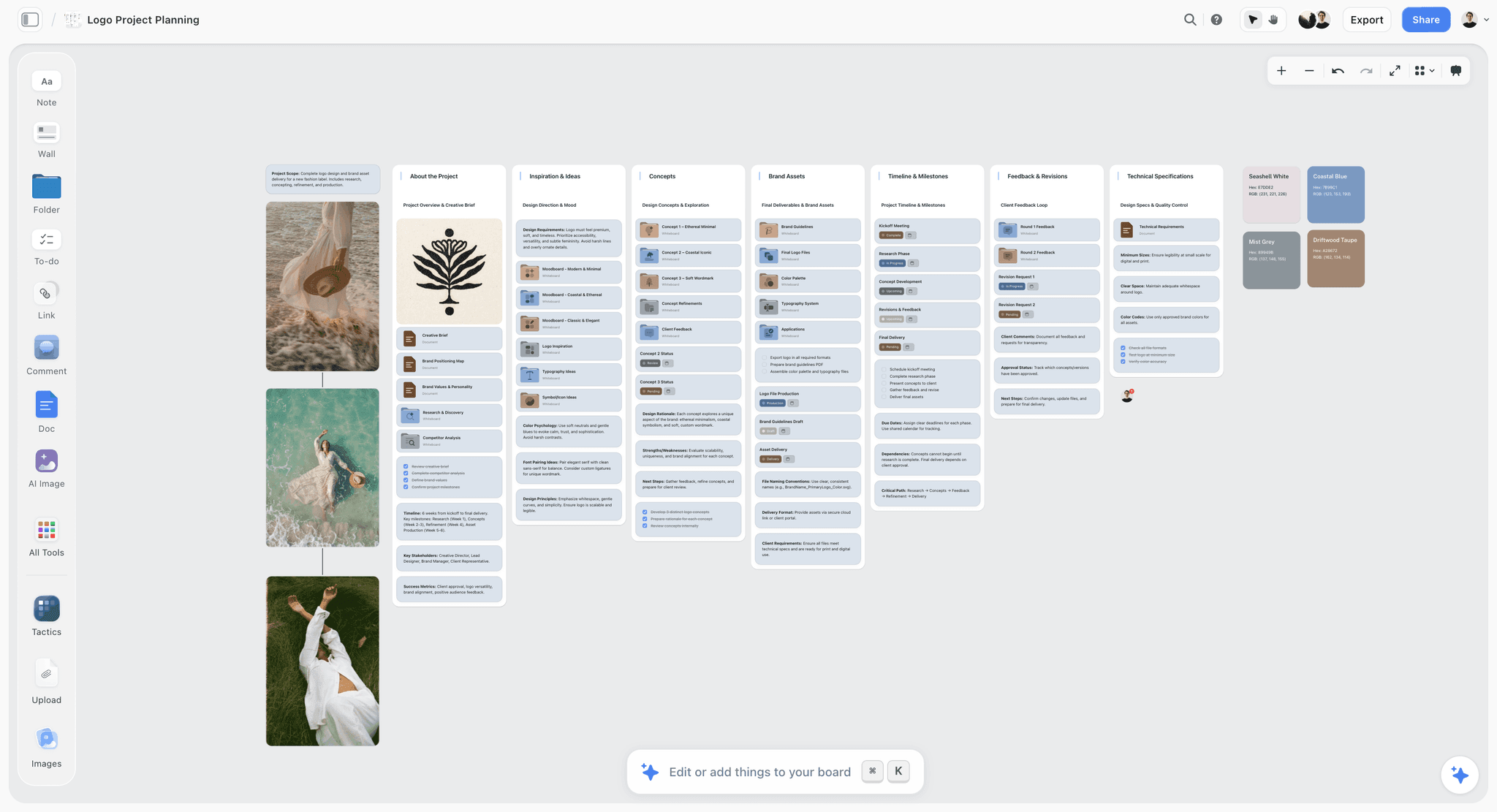
Storyflow is a visual canvas where the client-facing planning happens: brief, concept, and storyboard on one board, with an AI that reads the whole thing. For an agency, the value is the front of the pipeline, which is also the client-facing part. You expand a client brief into concept directions, build a rough storyboard, and share the board for feedback, then reuse the structure for the next client. Because the AI reads the full canvas plus any Tactic or documents you bring in, you can pressure-test a concept or draft shot ideas grounded in the actual brief before it reaches the client.
Storyflow's Story Blueprints library (200+ expert frameworks, including AIDA, StoryBrand, and the Marketing Campaign layout) gives agencies a starting structure for the strategic side of a pitch, not just the visual one, which matters when the deliverable is a concept a client has to buy.
Where Storyflow loses: it is not an agency project-management system. There is no time tracking, resourcing, or invoicing, so a busy agency pairs it with Monday.com or Asana for the portfolio layer. It is also not a footage-review tool, so client review of cuts goes to Frame.io. It is cloud-only and newer than the incumbents, with a smaller template library. It is paid-only during early access, with the Free plan landing before the end of 2026 and anyone a paid member invites to a board joining free now. Plus is $7.99/month annual for the full blueprint library; Pro is $14/month annual for AI image generation; Max is $39/month annual for the team workspace with roles and permissions.
2. Frame.io
Frame.io is the client review and approval layer, and for an agency that is close to essential. Clients comment frame by frame, approvals are tracked, and versions stack so nobody edits against the wrong cut. The approval loop is where agency time leaks, and Frame.io is the cleanest way to seal it.
Key features: video review with frame-accurate comments, version stacking, approval tracking, shareable links. Strength: the standard for client video review, which clients often already know. Weakness: it is a review tool, not a planning or management system, so it covers one stage, not the pipeline. Pricing starts at around $15 per user per month.
3. Framekit
Framekit is an all-in-one creative toolkit built for freelancers and small studios, and for a video agency it covers the surface the client actually touches. Four things live on one account: an AI website builder for the agency's own site and per-campaign landing pages, presentation pages for pitching a concept, client galleries for stills and deliverables, and timecoded video review with drawing on the frame, version stacks and an approval state per version.
The reason it earns a high slot on an agency list is the same reason it earns one on a photographer's: the client-facing layer is normally three or four separate subscriptions, and it is the one part of the stack that is pure overhead rather than craft. A two-person studio paying for a website builder, a gallery service and a review tool is paying three bills to be presentable.
Key features: AI site builder with hosting, SSL and a custom domain; unlimited client galleries with favorites and PIN-gated downloads; timecoded review with freehand, arrow, line, rectangle and ellipse annotation; version stacks with one current version; per-version approval status (needs review, in progress, changes requested, approved); a store for selling digital products such as presets, templates or course material.
Where Framekit loses: it is not built for a large agency. There is no Premiere or After Effects panel and no camera-to-cloud, so notes are read in a browser rather than pushed to the editor's timeline, which is exactly why Frame.io ranks above it here. It does no resourcing, time tracking or invoicing, so it does not touch the portfolio layer. Storage is capped per tier, and long-form work at high bitrates hits those ceilings before any page count does. Pricing: Free includes video review with 2GB of video storage and unlimited galleries with 3GB of photo storage; Starter is $9/month, or $7 annually; Pro is $19/month, or $15 annually, with 100GB of each; Business is $39/month, or $31 annually, with zero transaction fees on the store.
4. Monday.com
Monday.com is the portfolio layer many agencies use to see every client project at once: status, owner, deadline, and stage across the whole book of business. When the risk is losing track of a project rather than making a bad one, this is the fix.
Key features: customizable boards, timelines, automations, dashboards, and client views. Strength: strong cross-project visibility and automation for an agency running many jobs. Weakness: it manages projects, not the creative work itself, so it sits alongside your planning and review tools. Pricing runs from around $9 per seat per month for Basic to about $19 for Pro, billed annually with a seat minimum.
5. Milanote
Milanote is the moodboard and concept space agencies use for the look-and-feel stage of a pitch: references, tone boards, and visual directions a client can react to. It is strong for the visual part of selling a concept.
Key features: freeform boards, drag-in clippings, image and note cards, sharing. Strength: the tactile feel of assembling client-facing visual references. Weakness: it holds references but does less on strategy, project tracking, or review, and it has no AI that reads your board. Free plan covers 100 notes and 10 uploads; paid is around $9.99/month.
6. StudioBinder
StudioBinder is the production-logistics layer for agency shoots with real crews: call sheets, shot lists, scheduling, and contacts, plus client-facing shoot documents that look professional. When an agency shoot graduates to a crew, this removes the coordination pain.
Key features: digital call sheets with tracking, scheduling, shot lists, contacts. Strength: polished, client-ready production documents and proven logistics. Weakness: heavier than the planning and pitch stages need, and not built for managing many clients at once. Pricing starts around $29/month for the Indie plan.
7. Notion
Notion is the flexible workspace many agencies bend into a client and project hub: a database of clients, a page per project, briefs and notes in one place. If your team thinks in docs and databases, it is a cheap, adaptable backbone.
Key features: databases with multiple views, docs, wikis, templates, and Notion AI. Strength: flexibility and low cost for the knowledge and tracking layer. Weakness: not visual or spatial, so client-facing concept and storyboard work is weak, and you build every workflow yourself. Free for personal use; paid plans start around $10 per member per month annually.
8. Boords
Boords is a storyboard-first tool built for exactly the agency moment where a client signs off on a storyboard before the shoot. Numbered panels, animatic previews, and a clear approval workflow make that sign-off clean.
Key features: storyboard panels, animatic playback, client approval workflows. Strength: a purpose-built storyboard approval experience. Weakness: it does storyboards and little else, so it is one stage of the pipeline. Pricing is around $16.99/month billed annually.
9. Asana
Asana is an alternative portfolio layer to Monday.com, strong for agencies that run structured task workflows across clients: intake, production, review, delivery, each as a repeatable process. Its automation and templates suit agencies with a defined pipeline.
Key features: tasks, projects, timelines, workflow automation, and portfolio views. Strength: clean task and workflow management with strong templates. Weakness: like Monday.com, it manages the work but does not do the creative work, so it complements your planning and review tools. Pricing runs from a free tier to around $10.99 per user per month for Starter, billed annually.
10. Trello
Trello is the lightweight option for smaller agencies that want project visibility without the weight of Monday.com or Asana. A board per client, cards moving through stages, and almost no setup.
Key features: boards, lists, cards, checklists, Butler automation. Strength: dead-simple stage tracking a small agency adopts in minutes. Weakness: limited reporting and portfolio views, so it strains as the client count grows. Free for up to 10 collaborators; Standard is $5 per user per month annually.
11. Celtx
Celtx is the scripted-production layer for agencies making explainers, ads, and any video built from a script. The script-to-shot-list-to-breakdown pipeline saves steps when the work starts as words.
Key features: scriptwriting, shot lists, breakdowns, light scheduling. Strength: an integrated pipeline for scripted agency work. Weakness: unscripted and fast-turnaround social content get less from it, and it does not manage clients or review. Pricing starts around $15/month.
Comparison table
| Tool | Best for | Agency layer | Free tier | Starting price |
|---|---|---|---|---|
Storyflow | Client-facing concept and storyboard | Planning and pitch | Coming late 2026 (invited collaborators join free now) | $7.99/mo annual (Plus) |
Frame.io | Client review and approval | Review | Yes (limited) | ~$15/user/mo |
Framekit | Site, pitch pages, galleries and review in one account | Client-facing surface | Yes (2GB review, 3GB galleries) | $9/mo ($7 annual) |
Monday.com | Cross-client visibility | Project management | Limited | ~$9/seat/mo |
Milanote | Visual concept for pitches | Concept | Yes (100 notes) | ~$9.99/mo |
StudioBinder | Crewed shoot logistics | Production | Yes (1 project) | ~$29/mo (Indie) |
Notion | Client and project hub | Knowledge and tracking | Yes | ~$10/member/mo |
Boords | Storyboard sign-off | Storyboard | 14-day trial | ~$16.99/mo |
Asana | Structured client workflows | Project management | Yes | ~$10.99/user/mo |
Trello | Lightweight tracking | Project management | Yes (10 collaborators) | $5/user/mo |
Celtx | Scripted agency video | Script to shot list | Yes (limited) | ~$15/mo |
What Breaks at Each Agency Size
The right stack is a function of headcount more than of craft, because what breaks is coordination rather than quality.
One to two people. Nothing breaks except your evenings. There is no coordination cost, because the coordination happens inside one head. What costs you here is subscriptions and presentability: you need to look like a company to win work, and the client-facing surface is the whole bill. Buy the planning layer and consolidate everything client-facing. Skip project management entirely and use a list.
Three to six people. The first real break is that two people now hold different versions of the same client's status. Project management stops being optional here, not because the work is complex but because the answer to "where is the Henderson cut" now lives in someone else's head. This is also where review discipline has to become a rule rather than a habit, because there is more than one person sending links.
Seven to fifteen people. Specialisation arrives. Someone edits full time, someone else runs client relationships, and the handoff between them is now a documented thing rather than a conversation. This is the size at which Frame.io stops being a nice-to-have: an editor working in Premiere all day should not be reading notes in a browser tab. Consolidation arguments weaken here, because each surface has an owner who wants depth in their own tool.
Fifteen and up. Resourcing becomes the binding constraint, not creative capacity. The question stops being "can we make this" and becomes "who is free in week 34". At that point the portfolio layer is the most important tool you own and the creative tools are commodities.
| Agency size | What actually breaks | Buy first | Skip for now |
|---|---|---|---|
1 to 2 | Nothing but your evenings and your bills | Planning, plus a consolidated client-facing surface | Project management |
3 to 6 | Two people hold different versions of the truth | Project management | Resourcing and time tracking |
7 to 15 | Handoffs between specialists | A deep review platform with NLE panels | Consolidation for its own sake |
15 plus | Resourcing, not creative capacity | Portfolio and resourcing dashboards | Nothing, you need all of it |
The Client-Facing Surface Audit
Do this once and it usually pays for a tool. List every thing a client sees and what it costs per month.
The typical small studio list: a website (a builder subscription), a pitch or case-study page (often the same builder, sometimes a separate deck tool), a gallery or delivery page for stills and assets (a gallery service), a review link for cuts (a review platform, usually per seat), and a checkout if you sell anything like templates or presets (a storefront plus its transaction fee).
That is four to five bills before a single frame is delivered, and none of them make the work better. They make it presentable and deliverable, which is not the same thing, and it is the reason this list has a tool at number three that does no planning and no project management at all.
Two honest caveats on consolidation. First, one account means one point of failure, and it means a migration if you outgrow it. Second, consolidated tools are almost never the deepest tool in any single category, which is exactly why Frame.io ranks above Framekit here rather than below it. Consolidation is a cost and admin argument. It is not a capability argument, and any list that pretends otherwise is selling you something.
How to build an agency stack
Do not buy ten tools. Buy one per layer, and add layers as you grow.
Every agency needs three layers. A planning layer for client-facing concepts and storyboards, where Storyflow leads because the AI speeds the repeatable brief-to-concept work and the boards are client-shareable. A review layer for approvals, where Frame.io is close to standard. And a project-management layer to see every client at once, where Monday.com and Asana lead, or Trello for a small shop.
Add a production layer only when you run crewed shoots. StudioBinder for call sheets and scheduling earns its place the moment coordination becomes the bottleneck, and not before. Buying a heavy production tool before you have crewed shoots is the most common overspend for a young agency.
There is a fourth layer most agency stack advice skips, and at small scale it is the most expensive one: the client-facing surface. The agency site, the pitch page for a specific campaign, the gallery you deliver stills through, and the review link the client comments on are four things a client sees and four things a two-person studio usually pays for separately. Framekit collapses them into one account, which is why it sits third on this list despite doing none of the planning and none of the project management. At ten people with an in-house post team the calculus flips and you want Frame.io plus a real CMS, because depth beats consolidation once someone is employed to run each surface.
Match the AI investment to the repeatable work. The hours an agency loses are in the parts done the same way every time: expanding briefs, drafting concepts and storyboards, chasing approvals. Put AI where the repetition is, and keep the client relationship and the craft human.
The Bottom Line
An agency's tool problem is repetition and clients, not a single production. The stack that wins has three layers: client-facing planning, review and approval, and cross-client project management, with a production layer added only when crewed shoots demand it. Storyflow leads the planning layer because its canvas and AI speed the brief-to-concept-to-storyboard work that agencies repeat for every client, and the boards are built to share. It loses the project-management and review layers cleanly to Monday.com, Asana, and Frame.io, which is exactly why an agency runs a small stack rather than one tool.
To plan your next client concept and storyboard on one shareable board, start a Storyflow board and drop the brief onto it.
FAQ: AI Tools for Video Agencies
What tools do video agencies use?
Most video agencies run a three-layer stack: a planning tool like Storyflow for client-facing concepts and storyboards, a review tool like Frame.io for client approvals, and a project-management tool like Monday.com or Asana to track many client projects at once. Agencies with crewed shoots add StudioBinder for call sheets and scheduling.
What is the best AI tool for a video agency?
There is no single best tool, because an agency has several layers. For client-facing concept and storyboard planning, Storyflow leads because its AI speeds the repeatable brief-to-concept work. For review and approval, Frame.io leads. For cross-client project management, Monday.com and Asana lead. The best stack combines one tool per layer.
How do agencies manage many video projects at once?
With a project-management layer that shows every client project's stage, owner, and deadline in one view, using Monday.com, Asana, or Trello for smaller shops. The planning and review happen in dedicated tools, and the project-management tool ties them together so nothing is lost. Losing track of projects, not making bad ones, is what sinks agencies.
How does AI help a video agency?
AI speeds the repeatable parts of agency work: expanding a client brief into concept directions, drafting storyboards, and pressure-testing an idea before it reaches the client. On a canvas where the AI reads the whole board, it can ground those drafts in the actual brief. AI does not replace the client relationship or the craft, it removes hours from the parts done the same way every time.
What is the best tool for client video review and approval?
Frame.io is the standard for client video review, with frame-accurate comments, version stacking, and approval tracking. Clients often already know it, which reduces friction. The approval loop is where agency time and invoices stall, so a dedicated review tool usually pays for itself quickly compared with chasing feedback over email.
Do video agencies need project management software?
Yes, once they run more than a couple of clients at a time. A project-management tool like Monday.com, Asana, or Trello gives cross-client visibility so no project falls through the cracks. Below that scale, a shared planning board and a simple task list can cover it, but the need grows quickly as client count rises.
What is the cheapest tool stack for a small video agency?
Trello's free plan for project tracking and Framekit's free tier for the client-facing surface (unlimited galleries with 3GB of photo storage, video review with 2GB of video storage) covers two layers at no cost. Storyflow is paid-only during early access at $7.99/month annual, so the planning layer is the one you pay for first, though anyone a paid member invites to a board joins free, which covers collaborators and clients. Add paid management or production tools as the client load and shoot complexity grow.
Is Storyflow good for a video agency?
Storyflow is strong for the client-facing planning layer: turning briefs into concepts and storyboards quickly and reusing that structure across clients, with boards you can share for feedback. It is weak on project management and footage review, which it has no native features for, so agencies pair it with Monday.com or Asana and Frame.io for those layers.
What is Framekit and does it fit an agency?
Framekit is an all-in-one creative toolkit for freelancers and small studios: an AI website builder, presentation pages, unlimited client galleries, timecoded video review and a store for digital products, all on one account. It fits a small agency well, because at that size the client-facing surface is three or four subscriptions and none of them are craft tools. It fits a large agency poorly, because it has no Premiere or After Effects panel, no camera-to-cloud and no resourcing layer.
Framekit or Frame.io for agency client review?
Frame.io if the notes have to reach an editor working in Premiere or After Effects, or if you ingest from camera to cloud. That is most agencies with an in-house post team, and it is why Frame.io ranks second here and Framekit third. Framekit if the reviewer is the client, the reviewing happens in a browser anyway, and you would rather have review sitting on the same account as the site and galleries than pay per seat for depth you are not using.
Monday.com vs Asana for a video agency: which is better?
Both manage cross-client projects well. Monday.com leans visual and flexible with strong dashboards, which suits agencies that want a customizable board view. Asana leans toward structured, repeatable workflows with strong templates, which suits agencies with a defined intake-to-delivery process. Try both on a real client pipeline before committing, since the fit depends on how your team works.
How do agencies handle client feedback on video?
Through a dedicated review tool like Frame.io, where clients leave frame-accurate comments and approvals are tracked against specific versions. Centralizing feedback in one place, rather than scattered emails and calls, prevents the confusion and rework that eat agency margins. Clear version control also stops the team from editing against an outdated cut.
What tools do agencies use to pitch video concepts?
Agencies pitch with visual, client-facing tools: Storyflow for concept boards and rough storyboards backed by strategy frameworks, and Milanote for moodboards and tone directions. The goal is to let a client see and react to the idea before production, so tools that make a concept tangible and shareable win the pitch stage.
Can one tool run an entire video agency?
Not well. An agency has distinct layers, planning, review, and project management, and no single tool leads all three. A tool strong at planning is weak at review, and a project-management tool does not do the creative work. The honest answer is a small stack of one tool per layer, which beats stretching one tool across jobs it was not built for.
Table of Contents
- What an agency actually needs from its tools
- How I ranked these tools
- The Four Gates a Concept Passes Through
- The 11 best AI tools for video agencies
- Comparison table
- What Breaks at Each Agency Size
- The Client-Facing Surface Audit
- How to build an agency stack
- The Bottom Line
- FAQ: AI Tools for Video Agencies
- Related Reading
Templates to check out for this topic


Marketing and campaign templates you can use in Storyflow
Plan the whole campaign on one board: brief, audience, channels, and assets connected, with an AI that reads all of it. Open a template and start from real structure.


See Storyflow in Action
A visual AI workspace where every feature lives inside one canvas. No tab-switching, no context lost.
Build your entire board from a single message
Type what you need in the AI chat at the bottom of your canvas. The AI adds cards, headings, and structure directly onto your board.
Use expert frameworks as AI context
Type @ in the AI chat and choose any Tactic. The AI tailors every response to that framework instead of giving generic advice.
Turn your board into a mind map in seconds
Ask the AI to restructure your canvas as a mindmap. It connects your ideas into a visual hierarchy so you can see how everything relates.
Why Storyflow Exists
Storyflow actually began as a personal tool while working on creative and research projects.
We kept running into the same problem: ideas were scattered everywhere: notes, documents, and whiteboards.
Nothing helped us see how everything connected.
So we started building a workspace designed around how ideas actually grow.
→ Read how Storyflow was createdJustkay
Documentary Filmmaker & Founder at Storyflow
Published: 2026-07-04
Extremely simple, seriously capable


See how easy it is to get started
Watch a real project come together, from a blank board to a finished plan, clicked through step by step.
Start creating with AI and become more productive
Transform your creative workflow with AI-powered tools. Generate ideas, create content, and boost your productivity in minutes instead of hours.