
Category
Marketing Tools
Author

Justkay
Documentary Filmmaker & Founder at Storyflow
Topics
2026-05-17
•
Updated May 17, 2026
•
13 min read
•
Marketing Tools- best customer persona tools 2026
- customer persona software
- persona creation tools
- buyer persona tool
- Xtensio alternative
- Storyflow customer persona
What are the best customer persona tools in 2026?
Storyflow is the best customer persona tool in 2026 for keeping the persona next to its evidence: the interview notes, the survey quotes and the analytics sit on the same canvas as the persona itself, and the AI reads all of it. Milanote is the best purely visual canvas for evidence-based personas, Xtensio the best dedicated persona template tool, and Delve AI the best for generating personas from analytics data. A persona should be evidence, not fiction.

All 12 Customer Persona Tools, Ranked
- Storyflow: best AI canvas that keeps the persona next to its research
- Milanote: best visual canvas where the persona sits next to its evidence
- Xtensio: best dedicated, polished persona one-pager templates
- Miro: best for collaborative persona workshops with research on the board
- Notion: best for a structured persona database linked to research
- UXPressia: best for personas connected to customer journey maps
- Delve AI: best for personas generated automatically from analytics
- HubSpot: best free guided persona builder for a first draft
- Smaply: best for personas inside a service design suite
- FigJam: best for design-team persona boards in Figma
- Canva: best for polished persona one-pagers to present
- Userforge: best for simple, no-frills collaborative personas
Full disclosure: Storyflow is our own product, so we kept it out of the #1 spot here. For evidence-based personas Milanote is the stronger pick, since its visual canvas puts the persona next to its research with less setup, and Xtensio produces a polished one-pager faster. What Storyflow adds is narrower: an AI that reads the whole canvas and checks whether a persona trait is actually supported by the research below it. It has no analytics integration for auto-generated personas and no dedicated one-pager export. We link to every tool so you can judge the fit.
Quick Comparison: Best Customer Persona Tools
These four cover the jobs people choose between: a visual evidence canvas, an AI canvas that keeps the persona next to its research, fast polished one-pagers, and personas generated from analytics.
| Tool | Best For | AI Features | Price |
|---|---|---|---|
| Storyflow | Persona kept next to its research | Reads full canvas + @-docs and Tactics | $7.99 mo annual (free plan late 2026) |
| Milanote | Visual canvas for evidence-based personas | Light AI, research beside the persona | Free / $9.99 mo |
| Xtensio | Dedicated persona one-pagers | AI assistant for persona drafts | Free / from $10 mo |
| Delve AI | Personas from analytics data | Generates personas from analytics | Free / from $19 mo |
1) Quick Answer: The Best Customer Persona Tools in 2026
The best customer persona tools in 2026 are Milanote (best visual canvas for evidence-based personas), Storyflow (best AI canvas that keeps the persona next to its research), Xtensio (best dedicated persona template tool), and Delve AI (best for generating personas from analytics data). The right pick depends on whether your personas are built from research or invented at a desk.
Marketing Mary is not a customer. She is a character someone invented and pinned to a wall. Most personas are fiction with a stock photo: a name, an age, a hobby, a quote nobody said. They look professional and they change no decisions, because everyone knows, somewhere, that Mary was made up. A persona should be evidence, not fiction. It should be a compressed summary of what real customers actually want, struggle with, and decide on.
I have built audience profiles for documentary and creator projects, and the rule held every time: a persona that came from interviews and data got used, and a persona that came from a brainstorm got ignored. The Evidence, Not a Character framework in section 3 ranks all 12 tools by whether they build personas from evidence.
For audience research, see The 12 Best AI Tools for UX Researchers in 2026. For brand context, see The 12 Best Brand Strategy Tools in 2026.
2) Comparison Table: 12 Customer Persona Tools at a Glance
Pricing reflects publicly listed plans as of early 2026 and changes often. Ratings weigh whether the tool builds personas from evidence, research connection, collaboration, AI support, and pricing for marketers and product teams.
3) Evidence, Not a Character
A customer persona can be one of two things, and the difference decides whether anyone ever uses it.
A persona as a character. Someone names her Marketing Mary, gives her an age, a job, a stock photo, and a few invented traits, "loves brunch, hates spreadsheets." It is built in an afternoon, from imagination, and it looks polished. It gets pinned to a wall or dropped into a deck. And it changes nothing, because every person on the team knows, even if they never say it, that Mary is fiction. You cannot build a real decision on a character someone made up.
A persona as evidence. It is a compressed summary of what real customers actually do: the goals that came up in interviews, the objections that appear in sales calls, the language customers use, the jobs they are hiring the product for. It is built from research, it cites where each claim came from, and it gets updated as new evidence arrives. It changes decisions because the team trusts it, and the team trusts it because it is not made up.
Here is the rule that decides tool choice. A persona is only useful if it is evidence, not fiction. The danger of most persona tools is that they make the character version easy: pick a template, type traits into fields, add a stock photo, export a beautiful one-pager. The tool optimizes for a finished-looking document, and a finished-looking fictional persona is worse than no persona, because it gives invented assumptions the authority of a deliverable.
A persona tool that works does the opposite: it keeps the persona connected to the research it came from, so every claim is traceable, and it makes the persona easy to update as evidence changes. The persona is not a poster; it is the current best summary of the evidence. The 12 tools below are ranked by whether they build personas from evidence or make fiction look professional.
4) How We Evaluated These Tools
Five criteria, weighted in this order:
- Built from evidence. Does the tool connect the persona to research, interviews, and data, or just provide fields to type invented traits into?
- Traceability. Can a claim on the persona be traced back to where it came from, so the team can trust it?
- Stays current. Can the persona be updated easily as new evidence arrives, or is it a finished document?
- Collaboration. Personas are used across marketing, product, and sales. Tools that keep the persona shared and visible rank higher.
- Pricing for marketers and product teams. Persona work spans solo founders to teams. Per-seat pricing that punishes a small team is marked down.
Testing covered a startup's first persona, a marketing team's audience refresh, and a product team's persona set, each built from real research.
5) Quick Picks by Customer Persona Need
Best visual canvas for evidence-based personas: Milanote. The persona and the research references on one board.
Best AI canvas keeping the persona next to its research: Storyflow. The persona, the interviews, and the data on one canvas the AI reads.
Best dedicated persona template tool: Xtensio. Purpose-built persona one-pagers, fast.
Best for personas generated from analytics: Delve AI. Builds data-driven personas from your site analytics.
Best for personas linked to journey maps: UXPressia. Personas connected to customer journeys.
Best free guided persona builder: HubSpot's Make My Persona. A free, structured starting point.
Best cheapest working stack: HubSpot's free builder for a guided start. Total: $0. Add Storyflow (Plus, $7.99/month billed annually) once you want the persona built next to its research on one canvas.
6) Detailed Reviews: 12 Customer Persona Tools
1. Storyflow
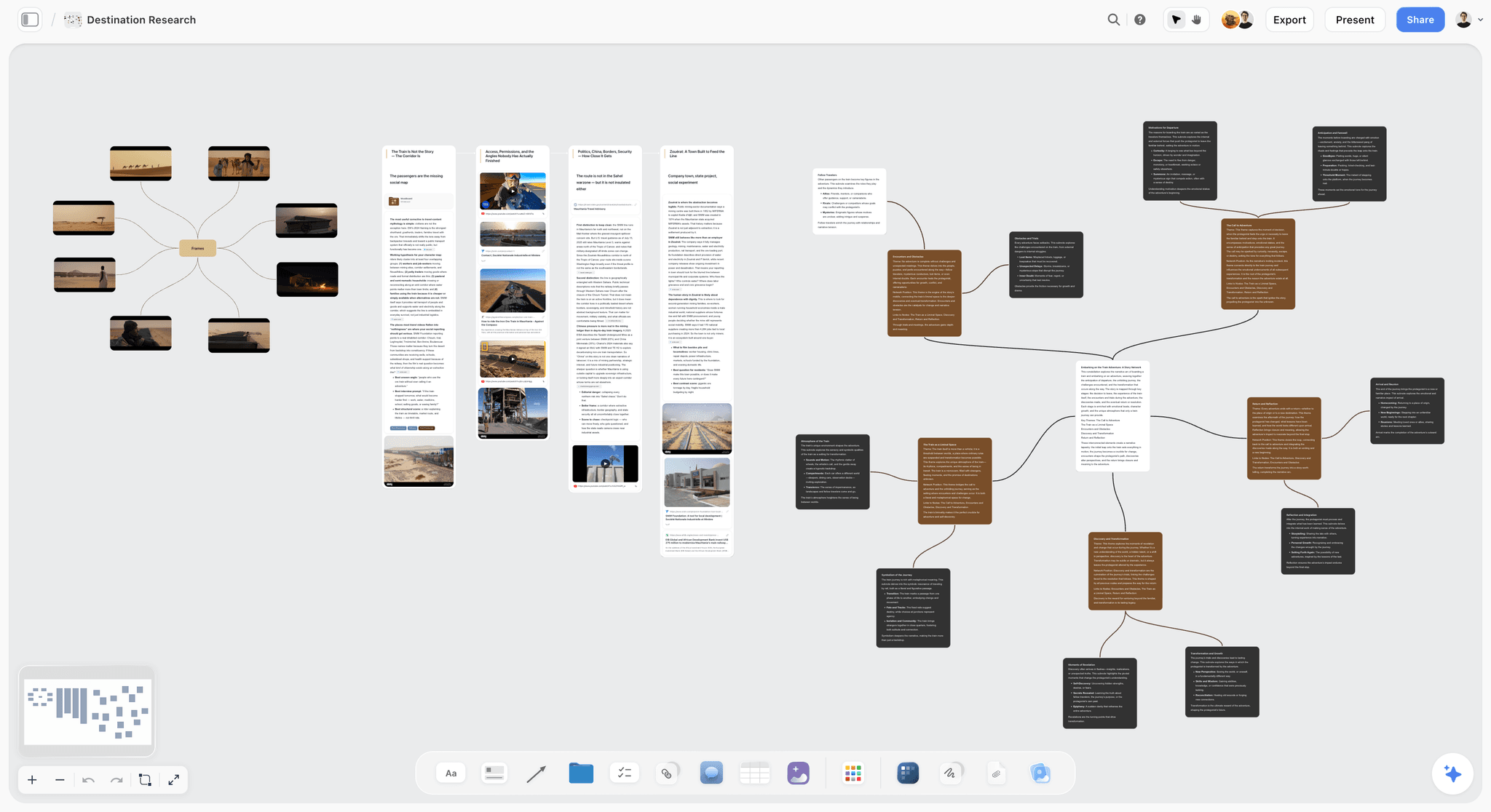
Storyflow builds the persona on a canvas alongside the research it came from: interview transcripts, survey results, sales-call notes, and data, all connected. The AI reads the full canvas, so you can ask whether a trait on the persona is actually supported by the research below it, or have the AI draft the persona from the evidence on the board. The persona stays evidence because the evidence never leaves the canvas.
Best for: Teams who want the persona built from research and kept traceable to it.
Verdict: The strongest AI canvas for evidence-based personas. For automatic data-generated personas, Delve AI is the specialist.
Key features
- Canvas holding the persona and its research together.
- AI reads the full canvas plus up to 1 Tactic and 3 Documents you @-mention.
- AI checks whether persona traits are supported by the research.
- Story Blueprints library with persona and audience frameworks.
- Unlimited collaboration for marketing and product teams, including on the Free plan once it launches before the end of 2026.
Pricing
Free: launches before the end of 2026. Storyflow is paid-only during early access; once live, Free covers unlimited boards and cards, unlimited collaboration, basic AI, and 20 file uploads. Plus: $7.99/mo annual. Full Story Blueprints, unlimited uploads. Pro: $14/mo annual. AI image generation, 20x AI usage. Max: $39/mo annual. 40x more AI, team workspace with roles.
Pros
- The persona stays connected to its evidence.
- AI checks traits against the research.
- Unlimited free collaboration across teams.
Cons
- No analytics integration for auto-generated personas.
- No dedicated persona one-pager export format.
- Newer platform with a smaller template library than Xtensio.
2. Milanote
Milanote builds personas on a visual canvas where the persona sits next to its evidence: interview quotes, survey screenshots, sales-call notes, and data all on the same board as the persona itself. Because the research is visible beside the persona, every claim is traceable, and the persona reads as a summary of evidence rather than a character sheet.
Best for: Marketers and teams who want the persona built and visible alongside its research.
Verdict: The strongest visual canvas for evidence-based personas. Pair it with an analytics tool for data-driven inputs.
Key features
- Freeform canvas for personas and research.
- Interview quotes, data, and references beside the persona.
- Templates for customer personas.
- Shareable boards with comments.
- Web clipper for research capture.
Pricing
Free with 100 cards. Individual: $9.99/mo. Team: $49/mo flat.
Pros
- The persona sits next to its evidence.
- Claims are traceable to research.
- Persona templates.
Cons
- No analytics integration for data-driven personas.
- The 100-card free limit fills with heavy research.
- Light AI.
3. Xtensio
Xtensio is the dedicated persona tool: polished, editable persona one-pagers built from strong templates. It is the fastest way to produce a professional-looking persona. That speed is its risk too, since a template fills just as fast with invented traits as with researched ones. Used with real research, it is excellent.
Best for: Teams who want fast, polished, professional persona one-pagers.
Verdict: The strongest dedicated persona template tool. Bring real research, or it produces a polished character.
Key features
- Editable persona templates and one-pagers.
- Drag-and-drop persona builder.
- Collaboration and sharing.
- AI assistant.
Pricing
Free tier. Paid plans from roughly $10/mo.
Pros
- Fast, polished persona one-pagers.
- Strong template library.
- Easy to share.
Cons
- Templates fill as easily with fiction as with evidence.
- No research connection built in.
- Best used with research done elsewhere.
4. Miro
Miro builds personas through collaborative workshops: the team gathers research on a board, clusters it, and shapes personas together. Done with real research on the board, it produces evidence-based personas. Done as a brainstorm, it produces characters. The canvas supports either; the team decides which.
Best for: Teams who build personas collaboratively in research-backed workshops.
Verdict: Strong for collaborative persona-building. Evidence-based only if the research is on the board.
Key features
- Infinite canvas for persona workshops.
- Persona and empathy-map templates.
- Real-time collaboration.
- Standard AI features.
Pricing
Free for 3 boards. Starter: $8/mo annual. Business: $16/mo.
Pros
- Strong collaborative persona-building.
- Persona and empathy-map templates.
- Familiar to most teams.
Cons
- Evidence-based only if research is brought in.
- The 3-board free limit is tight.
- Easy to default to a brainstorm.
5. Notion
Notion holds personas as database entries with linked research pages. The structure can keep a persona traceable: each persona links to the interviews and data behind it. It covers the evidence connection moderately well, with the usual setup cost and non-visual feel.
Best for: Teams who want a structured persona database linked to research.
Verdict: A capable structured persona tool. Traceable with discipline; non-visual.
Key features
- Persona database with linked research.
- Pages for interviews and data.
- Templates for personas.
- Standard AI features.
Pricing
Free for personal use. Plus: $10/mo. Business: $18/mo.
Pros
- Personas can link to their research.
- Structured and filterable.
- Large template community.
Cons
- Non-visual for persona work.
- Setup-heavy.
- Traceability depends on disciplined linking.
6. UXPressia
UXPressia is a dedicated persona and customer-journey tool. Its strength is connecting personas to journey maps, so a persona is not a standalone poster but a character moving through a real, researched journey. That connection pushes it toward evidence-based work.
Best for: Teams who want personas connected to customer journey maps.
Verdict: A strong persona-and-journey tool. The journey connection keeps personas grounded.
Key features
- Dedicated persona builder.
- Customer journey mapping.
- Personas linked to journeys.
- AI assistant.
Pricing
Free tier. Paid plans from roughly $16/mo.
Pros
- Personas connected to journeys.
- Purpose-built for the job.
- The journey grounds the persona.
Cons
- Subscription climbs for teams.
- Persona-and-journey focus is narrower than a canvas.
- Smaller community than general tools.
7. Delve AI
Delve AI generates personas automatically from your website analytics, social data, and competitor data. It is the most directly evidence-based tool here, since the persona is built from real behavioral data rather than a workshop. The trade-off is that analytics describe behavior, not motivation, so the personas need interview research to add the why.
Best for: Teams who want data-driven personas generated from analytics.
Verdict: The strongest tool for data-generated personas. Add interview research for the motivations behind the data.
Key features
- Personas generated from website and social analytics.
- Competitor persona analysis.
- Data-driven segmentation.
- Native AI generation.
Pricing
Free tier. Paid plans from roughly $19/mo.
Pros
- Personas built from real behavioral data.
- Removes the guesswork of a workshop.
- Competitor persona insight.
Cons
- Analytics describe behavior, not motivation.
- Needs interview research for the why.
- Output still needs human interpretation.
8. HubSpot
HubSpot's Make My Persona is a free, guided persona builder: a step-by-step questionnaire that produces a structured persona. It is a friendly, free starting point. It is guided imagination, not evidence, so its output is a first draft to validate against research, not a finished persona.
Best for: Beginners who want a free, guided starting point for a persona.
Verdict: A friendly free starting point. Guided imagination; validate the output against real research.
Key features
- Step-by-step guided persona builder.
- Structured questionnaire.
- Free to use.
- Shareable output.
Pricing
Free.
Pros
- Genuinely free.
- Guided, structured, beginner-friendly.
- Good first-draft starting point.
Cons
- Guided imagination, not evidence.
- Output needs validation against research.
- Light on traceability.
9. Smaply
Smaply is a service design suite with strong persona tools alongside journey maps and stakeholder maps. Its service-design heritage means personas are built to connect to journeys and systems, which keeps them grounded in real customer experience.
Best for: Service design teams who want personas inside a journey and stakeholder toolset.
Verdict: A solid persona tool inside a service design suite. Best when journeys matter as much as personas.
Key features
- Persona builder.
- Journey and stakeholder mapping.
- Service design toolset.
- Light AI.
Pricing
Subscription from roughly $19/mo.
Pros
- Personas connected to journeys and systems.
- Service design depth.
- Grounded in customer experience.
Cons
- Subscription only.
- Service design framing is heavier than some teams need.
- Smaller community.
10. FigJam
FigJam, Figma's whiteboard, builds personas on a collaborative canvas, suited to design teams already in Figma. Like Miro, it produces evidence-based personas only if the research is brought onto the board. It is convenient for design-led teams.
Best for: Design teams already in Figma who want persona boards nearby.
Verdict: A reasonable persona canvas for Figma teams. Evidence-based only if research is on the board.
Key features
- Whiteboard for persona boards.
- Real-time collaboration.
- Persona templates.
- Bridges into Figma.
Pricing
Free for 3 files. Paid plans from roughly $5/mo.
Pros
- Convenient for Figma teams.
- Strong collaboration.
- Persona templates.
Cons
- Evidence-based only with research on the board.
- 3-file free cap.
- Generic, not persona-specific.
11. Canva
Canva produces polished persona one-pagers from templates. It is the most design-forward option, and the most at risk of the character trap: a Canva persona looks beautiful, which makes an invented one even more convincing than it should be. With real research behind it, it presents personas well.
Best for: Teams who want a visually polished persona one-pager.
Verdict: Strong for presenting a persona. Highest character-trap risk; bring evidence.
Key features
- Persona one-pager templates.
- Generative AI.
- Large asset library.
- Easy export and sharing.
Pricing
Free tier. Pro: roughly $15/mo.
Pros
- Polished, presentation-ready personas.
- Easy for non-designers.
- Strong templates.
Cons
- Highest risk of polished fiction.
- No research connection.
- A presentation tool, not a research tool.
12. Userforge
Userforge is a simple, focused tool for creating and collaborating on personas. It does one thing without clutter. It is light on research connection, so like most simple persona tools it depends on the team bringing evidence to it.
Best for: Small teams who want a simple, no-frills persona tool.
Verdict: A clean, simple persona tool. Light on evidence connection.
Key features
- Simple persona creation.
- Collaboration on personas.
- Clean interface.
- Shareable personas.
Pricing
Free tier. Paid plans from roughly $9/mo.
Pros
- Simple and focused.
- Easy collaboration.
- Low learning curve.
Cons
- Light on research connection.
- Thin for deeper persona work.
- Depends on evidence brought from elsewhere.
7) Recommended Customer Persona Stacks
Stack 1: Startup or Solo Founder. Storyflow (build the persona from interviews and data on one canvas) + HubSpot's free builder for a guided first draft. HubSpot's builder is free; Storyflow is paid during early access, with Plus at $7.99/month billed annually.
Stack 2: Marketing Team. Delve AI (data-driven personas from analytics) + Storyflow or Milanote (add interview research and the motivations behind the data) + Canva (present the final personas).
Stack 3: Product / UX Team. UXPressia or Smaply (personas connected to journey maps) + Storyflow (keep the personas next to the research) + FigJam for collaborative sessions.
Stack 4: Cheapest Working Stack. HubSpot's free builder for a guided persona draft. Total: $0. Add Storyflow (Plus, $7.99/month billed annually) once you want the persona linked to its research on one canvas.
The pattern across every stack: build the persona from evidence, keep it connected to the research, and update it as new evidence arrives. The personas that change decisions are the ones the team trusts, and the team trusts the ones that were never invented.
8) Honorable Mentions
- Make My Persona by HubSpot. Covered above; also a useful standalone resource.
- SEMrush Persona. A free persona tool from SEMrush.
- Userpilot and product analytics tools. Behavioral data that feeds evidence-based personas.
- Dovetail. Research repository software that grounds personas in interviews.
- Google Docs. A free fallback for a written, research-cited persona.
9) Tools to Avoid for Customer Personas
- A persona built in a single brainstorm. A persona invented at a desk in an afternoon is a character, and the team will know.
- A stock photo and a cute name as the deliverable. The photo and the name are the least useful parts. The evidence is the persona.
- A polished one-pager with no research behind it. A beautiful fictional persona is worse than none, because it gives invented assumptions authority.
- A persona made once and never updated. Customers change. A persona from three years ago is a character now, whatever it was then.
11) The Bottom Line
The best customer persona tools in 2026 are the ones that build personas from evidence. Milanote is the strongest visual canvas for evidence-based personas. Storyflow is the best AI canvas for keeping the persona next to its research. Xtensio is the best dedicated template tool. Delve AI is the best for data-generated personas.
Marketing Mary is not a customer. She is a character someone invented. Build the persona from research, keep it traceable to the evidence, and update it as the evidence changes. The personas that change decisions are the ones the team trusts, and the team only trusts the ones that were never made up.
For your next persona, generate a customer persona with AI to get a first draft, then build it out from research on a Storyflow canvas and keep the interviews and data right beside it, so every claim stays evidence.
10) FAQ: Customer Persona Tools
What is the best customer persona tool in 2026?
Milanote is the strongest visual canvas for evidence-based personas. Storyflow is the best AI canvas for keeping the persona next to its research. Xtensio is the best dedicated persona template tool. Delve AI is the best for generating personas from analytics. The right pick depends on whether your personas come from research or imagination.
What makes a good customer persona?
A good customer persona is evidence, not fiction. It is a compressed summary of what real customers do: goals from interviews, objections from sales calls, the language customers use, the jobs they hire the product for. Each claim should be traceable to research. The name and the stock photo are the least important parts.
Why do most customer personas get ignored?
Because they are characters, not evidence. When a persona is invented in a brainstorm, given a cute name and a stock photo, everyone on the team knows, even unconsciously, that it was made up. You cannot build a real decision on a fictional character, so the persona gets pinned to a wall and ignored.
How do I build a persona from evidence?
Start with research: customer interviews, sales-call notes, survey data, support tickets, analytics. Find the patterns: recurring goals, objections, and language. Compress those patterns into a persona, citing where each claim came from. Keep the research connected to the persona so every claim stays traceable.
What is the cheapest customer persona tool?
HubSpot's Make My Persona is free for a guided first draft, and Delve AI has a free tier for data-driven personas, so a complete evidence-based persona workflow can cost nothing today. Storyflow adds the research-linked canvas but is paid-only during early access, with Plus at $7.99/month billed annually; its Free plan launches before the end of 2026.
Can AI create customer personas?
Yes, two ways. Delve AI generates personas from real analytics data. General AI can draft a persona from research you provide, and Storyflow's canvas AI checks whether persona traits are actually supported by the research on the board. AI is most useful when it works from evidence, not imagination.
What is the difference between a customer persona and a target audience?
A target audience is a broad segment: "small business owners." A customer persona is a detailed, evidence-based profile of a representative member of that audience: their goals, objections, language, and the job they hire the product for. The audience is the segment; the persona is the compressed evidence about it.
How many personas should a business have?
Most businesses need a small number, often two to four, each representing a genuinely distinct customer with different goals and objections. More than that and they stop being used. The number should come from the evidence: how many genuinely different customer types the research reveals, not how many feel tidy.
How often should customer personas be updated?
Whenever new evidence meaningfully changes the picture, and at least once a year. Customers, markets, and products change. A persona connected to its research is easy to update; a finished one-pager is not. Treat the persona as the current best summary of evidence, not a finished artifact.
Is Xtensio or Milanote better for customer personas?
Xtensio is faster for producing a polished persona one-pager from templates. Milanote is better for building the persona from evidence, with the research visible beside it. Xtensio presents personas well; Milanote keeps them grounded. The safest workflow builds from evidence, then presents.
How do I make a persona that the team actually uses?
Build it from evidence so the team trusts it, keep the research visible so every claim is traceable, and put it somewhere the team sees it when making decisions. A persona gets used when people believe it, and they believe the one that was never invented.
What research goes into a customer persona?
Customer interviews are the richest source. Add sales-call notes, support tickets, survey responses, win-loss analysis, and behavioral analytics. Interviews and calls supply the motivations and language; analytics supply the behavior. A strong persona combines the why from conversations and the what from data.
Table of Contents
- Quick Answer: The Best Customer Persona Tools in 2026
- Comparison Table: 12 Customer Persona Tools at a Glance
- Evidence, Not a Character
- How We Evaluated These Tools
- Quick Picks by Customer Persona Need
- Detailed Reviews: 12 Customer Persona Tools
- Recommended Customer Persona Stacks
- Honorable Mentions
- Tools to Avoid for Customer Personas
- FAQ: Customer Persona Tools
- The Bottom Line
- Author
- Related Reading
Templates to check out for this topic


Research templates you can use in Storyflow
Gather sources, personas, and findings on one canvas, then let the AI read across all of it. Open any of these research boards to start.


See Storyflow in Action
A visual AI workspace where every feature lives inside one canvas. No tab-switching, no context lost.
Build your entire board from a single message
Type what you need in the AI chat at the bottom of your canvas. The AI adds cards, headings, and structure directly onto your board.
Use expert frameworks as AI context
Type @ in the AI chat and choose any Tactic. The AI tailors every response to that framework instead of giving generic advice.
Turn your board into a mind map in seconds
Ask the AI to restructure your canvas as a mindmap. It connects your ideas into a visual hierarchy so you can see how everything relates.
Why Storyflow Exists
Storyflow actually began as a personal tool while working on creative and research projects.
We kept running into the same problem: ideas were scattered everywhere: notes, documents, and whiteboards.
Nothing helped us see how everything connected.
So we started building a workspace designed around how ideas actually grow.
→ Read how Storyflow was createdJustkay
Documentary Filmmaker & Founder at Storyflow
Published: 2026-05-17
Extremely simple, seriously capable


See how easy it is to get started
Watch a real project come together, from a blank board to a finished plan, clicked through step by step.
Start creating with AI and become more productive
Transform your creative workflow with AI-powered tools. Generate ideas, create content, and boost your productivity in minutes instead of hours.