What to Put on the Wall During a Design Sprint
The wall during a design sprint should carry four things and nothing else: the sprint question, the constraints, the current day's output, and the decisions already made.

Category
Design
Author

Justkay
Documentary Filmmaker & Founder at Storyflow
Topics
2026-08-29
•
12 min read
•
Design- what to put on the wall during a design sprint
- design sprints
- workshops
- ux process
- facilitation
- visual collaboration
- Storyflow
What should go on the wall during a design sprint?
The wall during a design sprint should carry four things and nothing else: the sprint question, the constraints, the current day's output, and the decisions already made. Everything else (research dumps, parked ideas, the map from Monday that nobody has read since) belongs in an archive area outside the working wall, because a wall that accumulates becomes unreadable by Wednesday and the team stops looking at it. The failure mode is not too little information, it is too much undifferentiated information. Storyflow is what I use because the question and the decisions can stay pinned in one region while the day's work fills another, so the wall stays legible for five days instead of two.
Key Takeaways
- Four zones: the question, the constraints, today's work, decisions made. Anything else goes to archive.
- The sprint question stays visible for all five days. It is the thing that drifts fastest and costs the most when it does.
- Decisions get written when made, in a permanent zone. Otherwise Thursday reopens Tuesday.
- Archive rather than delete. Yesterday's divergence is context, and it should not be in the working field of view.
- Constraints belong on the wall from Monday. A sprint that discovers a constraint on Thursday has wasted two days.
- One person owns the wall. Shared editing with nobody responsible produces a wall nobody trusts.
Keep the question on the wall
Sprints drift because the question the week was meant to answer disappears under sticky notes by Wednesday. Storyflow keeps the question, the constraints and the day's output in one canvas that stays readable to the end.

Why Walls Fail by Wednesday
A design sprint generates a large amount of material fast, and a wall is the only artifact everyone shares. The default behaviour is additive: everything produced gets put up and nothing comes down.
By Wednesday the wall holds Monday's map, Monday's expert notes, Tuesday's lightning demos, Tuesday's sketches, Wednesday's storyboard in progress, and a scattering of parked ideas. It is a complete record and a useless working surface.
What breaks first is the question. It went up on Monday, at the top, and by Wednesday it is buried under three days of output or scrolled off screen. The team is now solving whatever the current activity is about, which correlates only loosely with what the week was for.
What breaks second is decisions. A sprint makes dozens of small decisions, and unless they are written somewhere permanent they exist only in the memory of whoever was in the room at the time. Thursday's prototyping then reopens a Tuesday decision, not out of stubbornness but because nobody can point to it.
What breaks third is attention. A wall with two hundred elements gets skimmed rather than read. The team defaults to looking only at whatever was made in the last hour, which is exactly the material that needs the least reference.
A useful diagnostic: on Wednesday afternoon, ask someone to point at the sprint question without scrolling. If they cannot, the wall has stopped working.
The Four Zones
Zone 1: The question
One sentence. Top of the wall. It does not move for five days.
A good sprint question is specific enough to be answerable in a week and big enough to matter. "How might we make onboarding better" fails both tests. "Can a new user get to their first published page without talking to us?" passes.
Next to it, the success criterion: what Friday's test would have to show for the answer to be yes. Written Monday, before anyone has an opinion about the solution.
This zone is roughly two elements and it earns more wall space per element than anything else on the board.
Zone 2: The constraints
Three to six lines, also permanent, also from Monday.
What cannot change: the platforms you must support, the brand rules, the technical realities, the launch date, the thing legal has already said no to.
Constraints on the wall from day one prevent the most demoralising sprint failure, which is a team spending Tuesday and Wednesday on a direction that Thursday reveals to be impossible. Someone in the room usually knew on Monday and did not think to say, because nobody asked.
Add to this zone during the week when a new constraint surfaces, and mark it with the day, so it is obvious that work before that point did not know about it.
Zone 3: Today's work
The largest zone and the only one that changes shape daily.
Monday it holds the map and the expert notes. Tuesday the demos and sketches. Wednesday the storyboard. Thursday the prototype plan. Friday the test observations.
At the end of each day this zone is cleared into archive, except for anything that feeds directly into tomorrow. That clearing is the discipline that keeps the wall usable, and it takes about five minutes.
Zone 4: Decisions made

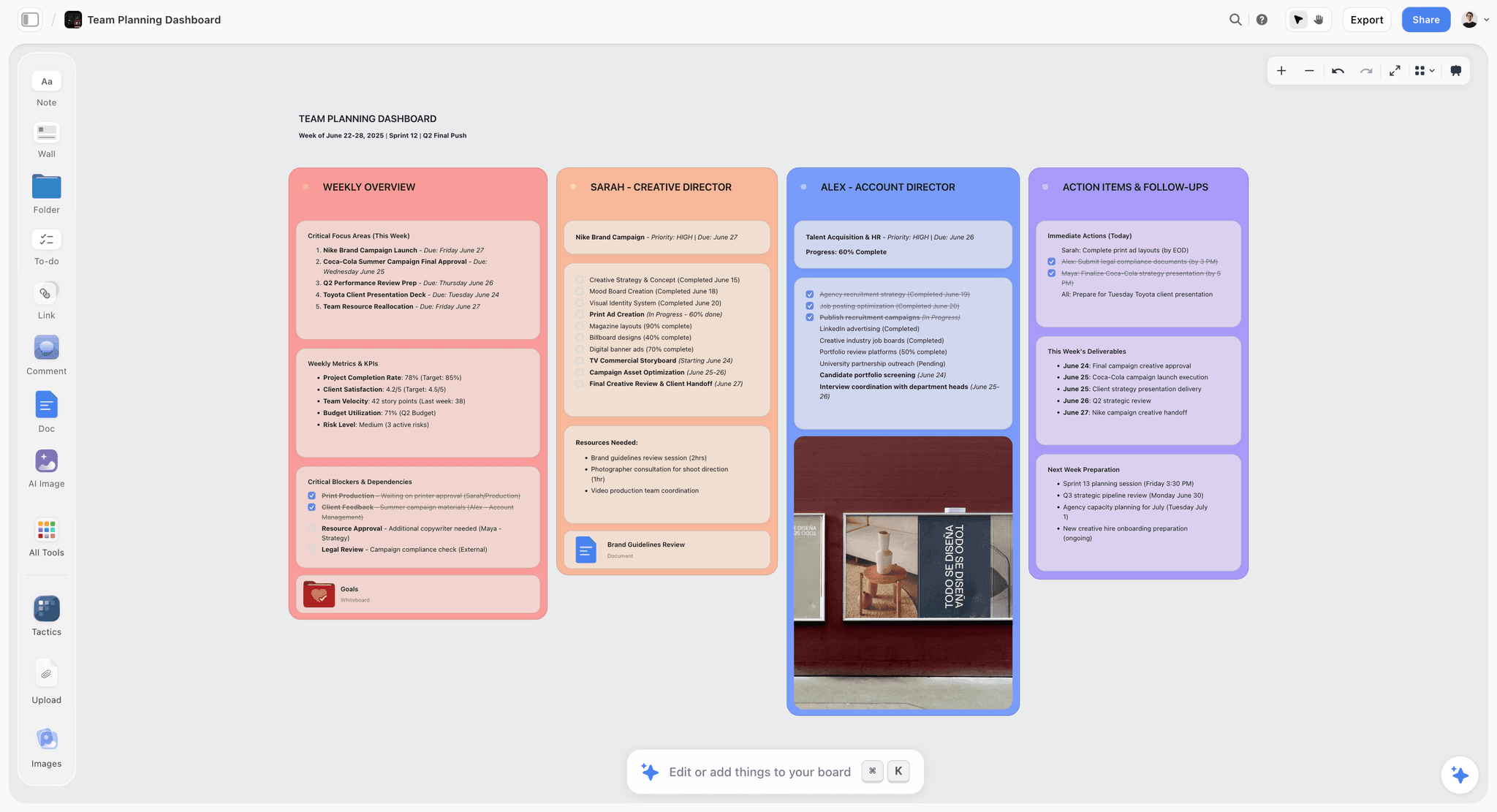
A running list, permanent, added to as decisions happen.
Each entry is one line: what was decided, and what it rules out. "We are testing the no-account flow. This rules out the social-login variant and the email-first variant."
Write it in the moment. A decision recorded at the end of the day is recorded from memory and loses the ruling-out clause, which is the half that stops it being reopened.
This zone is what makes the sprint's output survive the week. Everything else on the wall is working material; this is the record.
Keeping four zones stable while one of them churns daily is where the tool matters. On a Storyflow canvas the permanent zones stay pinned in their region while the working zone fills and empties, and because its AI reads the whole board you can ask it at the end of a day what decisions were made that are not yet in zone four, which reliably catches two or three.
FigJam and Miro both run sprints well and are the conventional choice; the discipline described here works on either, it just has to be maintained by hand.
| Zone | Changes | Size | Purpose |
|---|---|---|---|
Question and success criterion | Never | Small, prominent | Stops drift |
Constraints | Additive only | Small | Prevents impossible directions |
Today's work | Daily, cleared each evening | Large | The actual working surface |
Decisions made | Additive only | Medium, growing | The record that survives |
Archive | Grows, not in view | Unlimited | Context on demand |
Day by Day
Monday. Question and success criterion go up first, before the map. Constraints next, gathered by asking every person in the room what they know that would make a direction impossible. Then the map and expert interviews in zone three.
Monday's specific risk is that the map expands to fill the wall. It is a means, not an output. Clear it into archive on Monday evening and keep only the target area chosen at the end of the day.
Tuesday. Lightning demos and sketching. High volume, and almost all of it is intermediate. Keep the sketches, archive the demos.
Wednesday. Decisions day, and the day zone four earns its existence. Every choice that narrows the prototype goes in as it happens. By Wednesday evening the storyboard is the only thing in zone three.
Thursday. Prototype build. The wall gets quiet because people are working in other tools. What belongs on it is the build plan and the list of what is being faked, since the test on Friday will produce confusing results if nobody remembers which parts were not real.
Friday. Test observations in zone three, grouped by participant. Patterns pulled out into zone four as findings.
Friday evening. The wall is converted: question, constraints, decisions and findings become the record. Zone three archives entirely. This takes half an hour and it is the difference between a sprint that produced a decision and a sprint that produced a nice week.
Remote Walls
Remote sprints make the accumulation problem worse, because infinite canvas removes the natural limit a physical wall imposes. A physical wall runs out of space and forces a decision about what stays; a digital one never does.
The compensation is to define the zones spatially and hold them. Draw the regions on Monday, label them, and do not let zone three spill into the others. It sounds pedantic and it is what keeps a remote wall readable on Thursday.
Name one wall owner. On a physical wall, whoever is standing at it does the tidying and everyone sees it happen. Remotely, nobody owns it and it degrades invisibly. One person clears zone three each evening and keeps zone four current.
Zoom level is a real constraint. If the team has to zoom out past readability to see the whole wall, it is too big, regardless of how well organised it is. That is the signal to archive.
What Goes Wrong
The question scrolls out of view. The single most common failure. Pin it and check on Wednesday that someone can find it in two seconds.
Nothing is ever archived. By Thursday the wall is a museum. Clear zone three nightly.
Decisions are not written down. Thursday reopens Tuesday, and the team loses half a day relitigating something it already settled.
Constraints arrive on Thursday. Somebody knew on Monday. Ask explicitly on Monday and keep asking.
The wall has no owner. It degrades and nobody notices because degradation is gradual.
Everything is kept for the record. Confuses the working surface with the archive. Both are needed and they are not the same surface.
The Bottom Line
Four zones: the question, the constraints, today's work, and the decisions made. Everything else archives.
Pin the question for five days, put the constraints up on Monday by asking the room directly, clear the working zone every evening, and write each decision with what it rules out at the moment it is made. Give one person the job of maintaining it. That is what separates a wall the team uses on Thursday from a wall they stopped reading on Tuesday.
FAQ: Design Sprint Walls
How much should be on a sprint wall at once?
Little enough that the whole thing is readable without zooming past the point where text disappears. In practice that is the question, the constraints, one day of work and the decisions list. If you need to zoom out further than that, archive something.
Should the wall be cleared every day?
Zone three should be, into an archive that stays accessible. The question, constraints and decisions zones are permanent and grow only by addition. Clearing takes five minutes at the end of the day and is what keeps the wall usable on Thursday.
Who owns the sprint wall?
One named person, usually the facilitator. Shared responsibility for a wall means nobody clears it, and the degradation is gradual enough that no single person notices it happening.
What if the team disagrees with a decision on the wall?
Reopening a written decision is legitimate and should be explicit: strike it, write the new one, and note what changed. The problem is not reopening decisions, it is reopening them without knowing you are, which is what happens when they were never written down.
Is Storyflow free for running sprints?
Not during early access. Storyflow is paid-only right now, with Plus at $7.99 per month billed annually, and the Free plan launches before the end of 2026. Anyone a paid member invites to a board joins free, which covers sprint participants who only need to add to the wall and comment. FigJam and Miro both have free tiers if you need one this week.
Does this work for sprints shorter than five days?
Yes, and the zones matter more, not less. A three-day sprint has the same accumulation problem compressed, so the nightly clear becomes a per-session clear, and the decisions zone becomes the main output because there is less time to rediscover anything you failed to record.
Table of Contents
Templates to check out for this topic


Branding and design templates you can use in Storyflow
Take a brand from naming to visual direction on one connected canvas. Open any of these templates and the AI works from everything already on the board.


See Storyflow in Action
A visual AI workspace where every feature lives inside one canvas. No tab-switching, no context lost.
Build your entire board from a single message
Type what you need in the AI chat at the bottom of your canvas. The AI adds cards, headings, and structure directly onto your board.
Use expert frameworks as AI context
Type @ in the AI chat and choose any Tactic. The AI tailors every response to that framework instead of giving generic advice.
Turn your board into a mind map in seconds
Ask the AI to restructure your canvas as a mindmap. It connects your ideas into a visual hierarchy so you can see how everything relates.
Why Storyflow Exists
Storyflow actually began as a personal tool while working on creative and research projects.
We kept running into the same problem: ideas were scattered everywhere: notes, documents, and whiteboards.
Nothing helped us see how everything connected.
So we started building a workspace designed around how ideas actually grow.
→ Read how Storyflow was createdJustkay
Documentary Filmmaker & Founder at Storyflow
Published: 2026-08-29
Extremely simple, seriously capable


See how easy it is to get started
Watch a real project come together, from a blank board to a finished plan, clicked through step by step.
Start creating with AI and become more productive
Transform your creative workflow with AI-powered tools. Generate ideas, create content, and boost your productivity in minutes instead of hours.