
Category
Visual Thinking
Author

Justkay
Documentary Filmmaker & Founder at Storyflow
Topics
2026-07-01
•
Updated July 1, 2026
•
12 min read
•
Visual Thinking- storyflow vs excalidraw
- excalidraw alternative
- excalidraw vs storyflow
- best whiteboard tool 2026
- ai whiteboard
- visual thinking tools
Is Storyflow or Excalidraw better for visual thinking in 2026?
Excalidraw is the better tool if you want a fast, hand-drawn diagram and nothing more has to happen to it: it opens instantly, needs no account, saves a local file, works offline, and is free and open-source, with zero AI by design. Storyflow is the better tool if the sketch is the start of a project: the drawing lives on an infinite multi-format canvas next to your plan, research, and draft, with an AI that reads the whole board. Excalidraw is the fastest way to sketch an idea; Storyflow is the fastest way to do something with it.
When the sketch is done but the work is not.
Excalidraw gets the rough idea out fast. Storyflow keeps the sketch on an infinite canvas next to the plan, the research, and the draft, with an AI that reads all of it, so a box becomes the next artifact without a rebuild.

1) Quick Answer: Storyflow vs Excalidraw
You already sketch on Excalidraw. The question is whether to keep sketching there, switch, or add a second canvas that does the part Excalidraw was never built for. Here is the direct answer. Excalidraw is the better tool if you want a fast, hand-drawn diagram and nothing else has to happen to it. It opens instantly, needs no account, saves a local file, and gets a rough sketch out of your head in seconds with zero friction and zero AI. Storyflow is the better tool if the sketch is the beginning of a project, not the end of a thought: the drawing lives on an infinite canvas next to your plan, your research, your references, and your writing, and an AI reads the whole board before it answers.
The line that decides your choice is this. Excalidraw is the fastest way to sketch an idea. Storyflow is the fastest way to do something with it. In Excalidraw, the finished sketch is the output. You screenshot it, drop it in a doc, or send the link. In Storyflow, the sketch is an input: you keep going on the same canvas, turning boxes and arrows into a shot list, a beat sheet, a campaign board, or a draft, with the AI building on everything already there.
I have sketched documentary structures on hand-drawn whiteboards for years, and the pattern always held: the sketch was never the point. The sketch was how I found the shape, and then I had to rebuild that shape somewhere I could actually produce. This piece is the honest split between a tool that gives you the fastest possible sketch and a system that lets you keep working past it.
For the wider field, see The 12 Best Excalidraw Alternatives in 2026 and the flagship Best Online Whiteboard Tools.
2) Comparison Table: Storyflow vs Excalidraw at a Glance
The load-bearing row is "beyond the sketch." Excalidraw is built to make one sketch fast and frictionless. Storyflow is built so the sketch is step one of a longer job. Read the rest of the table by your own work: if your rows are mostly about the drawing itself, Excalidraw wins them; if they are mostly about what the drawing becomes next, Storyflow does.
3) The Sketch vs The System
There are two honest philosophies of visual thinking, and most arguments about whiteboard tools are really arguments about which one you are living in.
The Sketch. A drawing is a quick externalization of a thought. You open a blank surface, dump boxes and arrows and scribbles, look at the shape, and either keep it or throw it away. The value is speed and freedom: no setup, no structure, no commitment. Excalidraw is the best expression of the Sketch in 2026. It loads instantly, it never asks who you are, and its hand-drawn strokes make everything feel provisional and cheap to change, which is exactly what a first sketch should feel like.
The System. A drawing is the first move in a project that has more moves. The sketch is how you find the shape, and the moment you have it, you want to keep going in the same place: expand a box into a real plan, pull in references, start writing, hand it to a collaborator, ask an AI to build on it. Storyflow is built for the System. The sketch lives on an infinite canvas next to everything else the project needs, and nothing has to be rebuilt to move forward.
Here is the rule that decides the tool. If your sketch ends at the sketch, use the sketch tool. If your sketch starts the work, use the system. A quick architecture diagram for a pull request, a seating chart, a five-minute flow you will screenshot and forget, those are Sketch jobs, and Excalidraw wins them clean. A filmmaker sketching a documentary that then needs a research board, a shot list, and a treatment, or a marketer sketching a funnel that then needs a brief and a calendar, those are System jobs, and Storyflow wins them.
The reason this matters is the rebuild tax. When the sketch is finished in a pure sketch tool, the next step almost always happens somewhere else: a doc, a spreadsheet, a project tool. You rebuild the structure you just made, by hand, in a new shape, and you lose the context that made it make sense. A sketch the AI can read and build on is not a drawing. It is a workspace. That is the difference this comparison keeps returning to. Excalidraw is the fastest way to sketch an idea. Storyflow is the fastest way to do something with it.
4) How We Compared Them
Comparing a free hand-drawn whiteboard to an AI workspace is only fair if the criteria are named up front. I ran both against the same four questions, using real project work, not a synthetic benchmark.
- Time to first mark. How fast can you go from wanting to sketch to actually sketching? This is Excalidraw's home turf: no account, no load, no setup. Any tool that adds friction here loses the pure-sketch job on principle.
- What happens after the sketch. Once the shape exists, can you keep working in the same place, or do you export and rebuild elsewhere? This is the single question that separates a sketch from a system, and it is where most whiteboards quietly stop.
- AI context scope. Does the tool have AI at all, and if so, does it read the whole board or just react to one element? Excalidraw has none by design. Storyflow's reads the full active canvas plus a bounded set of extra context.
- Ownership and portability. Local files, offline use, open formats, and self-hosting versus a cloud account. This is where an open-source local-first tool has a real, structural advantage that no amount of AI erases.
Two rules for the rest of the piece. First, every claim about Excalidraw's speed and openness is a genuine win, not a setup for a pivot. Second, every claim about Storyflow includes where it loses, because a comparison with no honest negatives is marketing, not analysis.
5) Where Excalidraw Wins
An honest accounting of what Excalidraw does better. These are real, decisive wins, and for a large set of jobs they end the argument before Storyflow even enters it.
Instant and frictionless. Excalidraw opens to a blank canvas in the time it takes the page to load, with no account, no onboarding, and no menus to learn. You think "I need to sketch this," and two seconds later you are drawing. It is the closest a digital tool gets to grabbing the nearest napkin.
Free and open-source. Excalidraw is genuinely free and open-source, with the code on GitHub under a permissive license. There is no paid tier gating the core drawing experience, no seat limit, and no vendor deciding tomorrow that your favorite feature now costs money. For individuals, students, and teams that care about open tooling, that alone is a reason to stay.
Local files, offline, and self-hostable. Excalidraw saves real .excalidraw files you own, works with no internet, and can be self-hosted on your own infrastructure. If you have privacy constraints, IT policy against cloud tools, or you simply want your drawings to live on your machine and not someone's server, this is decisive. Storyflow is cloud-only, and for these users that single fact settles it.
The hand-drawn aesthetic. Excalidraw's signature rough, sketchy strokes are not a gimmick. A hand-drawn look signals "this is a draft, nothing here is final," which lowers the stakes and keeps you in exploration mode instead of polishing a diagram nobody asked you to polish. For brainstorming and rough architecture, that aesthetic does real psychological work.
Zero learning curve. There is almost nothing to learn. Rectangle, arrow, text, done. A first-time user is productive in under a minute, and you can drop an Excalidraw link into any team without a training session. Simplicity is a feature, and Excalidraw treats it as the main one.
Developer-friendly. Excalidraw is embeddable as a component, has a documented .excalidraw format, and slots into developer workflows: architecture sketches in a pull request, a diagram in the docs, a shape library shared across a repo. That makes it a natural default for engineering teams. For that audience, it is not just a whiteboard, it is a building block.
If your job is any of the above, and the sketch really is the deliverable, you do not need this comparison. Stay on Excalidraw. The rest of this piece is for the reader whose sketch keeps turning into something bigger.
6) Where Storyflow Wins

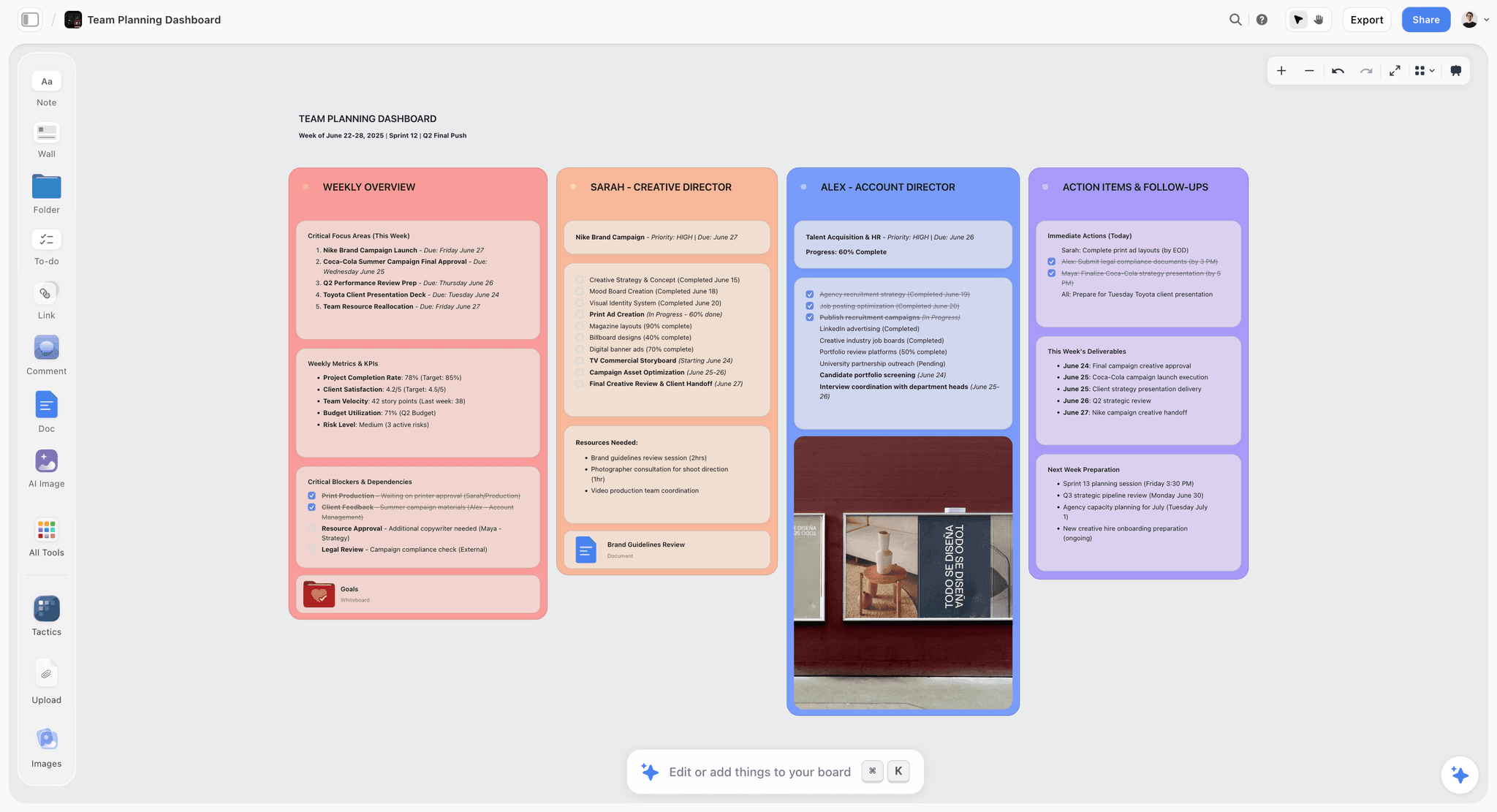
Where Storyflow pulls ahead is everything that happens after the sketch exists. Excalidraw gives you the shape fast. Storyflow lets you do the work the shape was for, without leaving the board.
The sketch is one region of an infinite, multi-format canvas. In Storyflow the drawing sits next to a kanban board, a storyboard, a mood board, a beat sheet, and real documents, all on the same infinite canvas. You do not screenshot the sketch to keep working. You keep working beside it. The box you just drew becomes a column, a scene, a card, a paragraph, in the same place, with the same context intact.
Full-board AI context. Storyflow's AI reads your entire active canvas board by default, plus up to 1 Tactic and up to 3 Documents you @-mention in the chat. So you can ask it to turn a rough sketch into a plan, find the weak spot in your structure, or draft from a cluster of nodes, and it answers with the whole board as context. Excalidraw has no AI at all, which is the right call for a pure sketch tool and the exact ceiling you hit the moment you want the sketch to do more. Excalidraw is the fastest way to sketch an idea. Storyflow is the fastest way to do something with it.
Multi-format output. The honest test of a system is whether the sketch turns into the deliverable without a rebuild. In Storyflow it does, because the deliverable formats live on the same canvas: mind maps, kanban, storyboards, mood boards, and documents, not just drawn shapes. A sketch does not stay a sketch. It becomes the next artifact in place.
200+ Story Blueprints. On the Plus, Pro, and Max tiers, Storyflow's Story Blueprints library gives you 200+ ready-made boards, from beat sheets to campaign plans to mood boards. So when a rough sketch is ready to become structured work, the structure is already there to drop it into, instead of a blank second tool.
Unlimited real-time collaboration on Free. Storyflow's Free plan, which launches before the end of 2026, will include unlimited collaboration on shared boards, so a writing partner, an editor, or a teammate can be in the same canvas with you at no cost. Excalidraw also has live collaboration via a shared link, and it is good; the difference is that in Storyflow you are collaborating on a whole project surface, not only on the sketch.
Storyflow for the Excalidraw user who plans real projects
Here is the concrete version, for the exact reader deciding whether to switch or add a second canvas. Say you are a filmmaker and you would normally sketch a documentary's structure in Excalidraw: three acts, a few arrows, the central tension in the middle. In Excalidraw, that is where it stops, and the treatment, the research, and the shot list happen in three other apps.
In Storyflow, you sketch the same three-act shape, then keep going on the same board. You drop a research cluster beside it and pull in links and images. You @-mention the AI and ask it to turn the middle act into a beat-by-beat outline, and it answers using the structure you drew plus the research next to it. You open a Story Blueprint for a shot list and fill it from the beats. When a producer joins the board, they see the whole project, not a screenshot of a sketch. The drawing did not become a dead diagram you rebuild elsewhere; it became the spine of a project in one place. That is the switch: not a prettier whiteboard, a canvas where the sketch is step one instead of the end.
To be clear about the trade, Storyflow is not the tool for a five-second doodle you will throw away, and it does not run offline on a local file the way Excalidraw does. The next section is the honest accounting of where it loses.
7) Feature-by-Feature Comparison
Read the table by your job. If most of your rows are about making one sketch fast, free, and yours, Excalidraw wins them and it is not close. If most are about what the sketch becomes next and whether an AI can build on it, Storyflow wins them. The tools are not competing on the same axis, which is why the honest answer is "it depends on the job."
8) Pricing Comparison
Storyflow (verified at storyflow.so/pricing, as of July 2026):
- Free: launching before the end of 2026; invited collaborators of paid members join free today. Unlimited notes, images, and links, unlimited shared boards, unlimited collaboration, basic AI, and 20 file uploads.
- Plus: $7.99/mo annual ($9.99 monthly). 200+ Story Blueprints, unlimited file uploads.
- Pro: $14/mo annual ($19 monthly). AI image generation, 20x more AI usage.
- Max: $39/mo annual ($49 monthly). 40x more AI and a team workspace with permissions and roles.
Excalidraw: the core Excalidraw whiteboard is free and open-source, with no paid tier required to draw, collaborate via a link, or export. Excalidraw also offers Excalidraw Plus, a hosted paid product that adds accounts, cloud storage, and team features on top of the open-source editor; verify its current pricing on the Excalidraw site, since it changes. For most individual users, the free open-source version is the whole product.
The honest read: on raw price, Excalidraw wins, because free and open-source is hard to beat. Storyflow's Free tier is genuinely free too, with unlimited collaboration and basic AI, and its paid tiers do not buy a better whiteboard, they buy a system: full-board AI, 200+ Story Blueprints, and a multi-format canvas. You are not paying Storyflow to draw. You are paying it to do the work the drawing points to.
9) Where Storyflow Loses: The Honest Cons
A comparison with no honest negatives is a sales page. Here is where Storyflow is the wrong choice, plainly.
It is not a quick-doodle sketchpad. Excalidraw's entire reason to exist is the two-second sketch: open, draw, done, forget. Storyflow is a project canvas, and for a throwaway doodle in the middle of another task, it is more than you need. If the job is a single rough diagram you will screenshot and never touch again, Excalidraw is faster and lighter, and reaching for Storyflow is overkill.
It is cloud-only, with no offline or local files. Excalidraw runs locally, works with no internet, saves .excalidraw files you own, and can be self-hosted. Storyflow is cloud-based and needs a connection. For users with strict privacy or IT constraints, for people who work on planes and in dead zones, or for anyone who wants local-first ownership of their drawings, Excalidraw is the correct tool and Storyflow is not.
It is more structured and heavier for a 30-second diagram. The multi-format canvas, the AI, the blueprints, and the collaboration are the point when you are running a project, and they are weight you do not want when all you need is a box and an arrow. Storyflow rewards work that keeps going, not work that ends at the first sketch, and Excalidraw simply feels lighter for that.
It is a newer platform than Excalidraw's established open-source project. Excalidraw has a mature ecosystem, a huge open-source community, and an embeddable component developers already trust. Storyflow is younger. If you want a battle-tested, self-hostable open standard for diagrams, that is Excalidraw, not Storyflow.
If any of these describe your work, stay on Excalidraw with a clear conscience. Storyflow earns the switch only when your sketches keep turning into projects.
11) The Bottom Line
Storyflow and Excalidraw are both good at what they are for, and they are for different things. Excalidraw is the Sketch: an instant, free, hand-drawn whiteboard that gets a rough idea out of your head with zero friction and zero AI, and it is genuinely the best tool in the world for that. Storyflow is the System: an AI canvas where the sketch is the first move in a longer job, and the AI reads the whole board as you keep going into plans, boards, and drafts.
Choose by the question this whole comparison turns on. If your sketch ends at the sketch, Excalidraw is the better, faster, and freer tool, and you should keep it. If your sketch is the start of the work, Storyflow is built for what comes next. Excalidraw is the fastest way to sketch an idea. Storyflow is the fastest way to do something with it.
If your sketches keep turning into real projects, open a free canvas in Storyflow and, instead of screenshotting the drawing, keep going on the same board with the AI reading all of it.
10) FAQ: Storyflow vs Excalidraw
Is Storyflow or Excalidraw better for visual thinking?
It depends on what happens after the sketch. Excalidraw is better for a fast, hand-drawn diagram that is the deliverable: instant, free, local, and frictionless. Storyflow is better when the sketch is the start of a project, because it lives on a multi-format canvas with an AI that reads the whole board. Excalidraw perfects the sketch; Storyflow lets you keep working past it.
Does Excalidraw have AI?
No, and that is by design. Excalidraw is a deliberately simple, hand-drawn whiteboard with no built-in AI, which keeps it fast and free of clutter. Storyflow's AI reads the entire active canvas board plus up to 1 Tactic and 3 Documents you @-mention, so it can act on the whole sketch and everything around it. If you want AI on your canvas, that is the gap between the two tools.
Is Excalidraw really free?
Yes. The core Excalidraw whiteboard is free and open-source, with the code on GitHub and no paywall on drawing, exporting, or collaborating via a shared link. There is a separate hosted product, Excalidraw Plus, that adds accounts and team features for a subscription, but you never have to pay to use the open-source editor. For most individuals, the free version is the entire product.
Can Storyflow replace Excalidraw?
For work where the sketch is the start of a project, yes. Storyflow gives you a canvas plus AI, blueprints, and multi-format output that Excalidraw does not have. For a quick throwaway diagram, offline work, or local file ownership, Excalidraw is still the better fit. A common setup is to keep Excalidraw for fast sketches and use Storyflow for projects that need to go further.
Does Storyflow work offline?
No. Storyflow is cloud-based and needs an internet connection. Excalidraw saves local files, works offline, and can be self-hosted, which is a real advantage for users who travel, have privacy constraints, or want local-first ownership. If offline use is a hard requirement, Excalidraw is the safer pick and Storyflow is the wrong tool.
Which is better for developers?
Excalidraw, for pure diagramming. It is open-source, embeddable, has a documented .excalidraw format, and drops cleanly into pull requests and docs. Storyflow is the better choice when a developer is planning a whole initiative, not just drawing one diagram, and wants an AI reading the board plus documents and a roadmap in one place.
Can I import my Excalidraw drawings into Storyflow?
There is no one-click .excalidraw import, but you can bring your sketches in as reference by exporting them as images and dropping them onto a Storyflow board, then rebuilding the structure natively. Treat the move as a chance to keep going past the sketch rather than a pure copy of the diagram. The value is not the imported drawing; it is what you build around it next.
Is Storyflow good for quick sketching?
It is fast, but a quick throwaway sketch is not what it is for. Excalidraw is unbeatable for the two-second diagram you will screenshot and forget. Storyflow is built for the sketch that becomes a plan, a board, or a draft, with an AI and collaborators building on it. If the sketch is genuinely the whole job, Excalidraw is lighter and quicker.
Which has better collaboration?
Both are strong, in different ways. Excalidraw offers live collaboration on a drawing via a shared link, free and simple. Storyflow includes unlimited real-time collaboration on its Free plan and adds a team workspace with permissions and roles on Max, and you collaborate on a whole project surface, not only the sketch. For a shared drawing, Excalidraw is enough; for a shared project, Storyflow does more.
What is the hand-drawn look in Excalidraw for?
The rough, sketchy strokes are a deliberate signal that nothing on the board is final, which keeps you exploring instead of polishing. It is genuinely useful for brainstorming and rough architecture. Storyflow uses clean canvas elements because its drawings are meant to become structured work, not stay as sketches. Neither look is better; they serve different stages of thinking.
Is Storyflow a real Excalidraw alternative?
Yes, for people whose sketching is the start of a larger job. If you only ever want a single hand-drawn diagram, a dedicated whiteboard like Excalidraw is the closer fit. If you keep hitting the wall where the sketch is done but the work is not, Storyflow is the alternative built for exactly that moment, with an AI that reads the whole board.
What is the main difference in one sentence?
Excalidraw is the fastest way to sketch an idea, and Storyflow is the fastest way to do something with it.
Table of Contents
- Quick Answer: Storyflow vs Excalidraw
- Comparison Table: Storyflow vs Excalidraw at a Glance
- The Sketch vs The System
- How We Compared Them
- Where Excalidraw Wins
- Where Storyflow Wins
- Feature-by-Feature Comparison
- Pricing Comparison
- Where Storyflow Loses: The Honest Cons
- FAQ: Storyflow vs Excalidraw
- The Bottom Line
- Author
- Related Reading
Templates to check out for this topic


Planning and project templates you can use in Storyflow
Plan a launch, a sprint, or a whole project on a visual board the team can see at once. Open one of these templates and start from real structure.


See Storyflow in Action
A visual AI workspace where every feature lives inside one canvas. No tab-switching, no context lost.
Build your entire board from a single message
Type what you need in the AI chat at the bottom of your canvas. The AI adds cards, headings, and structure directly onto your board.
Use expert frameworks as AI context
Type @ in the AI chat and choose any Tactic. The AI tailors every response to that framework instead of giving generic advice.
Turn your board into a mind map in seconds
Ask the AI to restructure your canvas as a mindmap. It connects your ideas into a visual hierarchy so you can see how everything relates.
Why Storyflow Exists
Storyflow actually began as a personal tool while working on creative and research projects.
We kept running into the same problem: ideas were scattered everywhere: notes, documents, and whiteboards.
Nothing helped us see how everything connected.
So we started building a workspace designed around how ideas actually grow.
→ Read how Storyflow was createdJustkay
Documentary Filmmaker & Founder at Storyflow
Published: 2026-07-01
Extremely simple, seriously capable


See how easy it is to get started
Watch a real project come together, from a blank board to a finished plan, clicked through step by step.
Start creating with AI and become more productive
Transform your creative workflow with AI-powered tools. Generate ideas, create content, and boost your productivity in minutes instead of hours.