How to Plot a Novel Visually in 2026 (7 Structures, and Which One Fits Your Book)
There are seven visual structures for plotting a novel and they answer seven different questions, which is why writers who try one and find it useless usually tried the wrong one. Choose by symptom rather than by preference.

Category
Writing
Author

Justkay
Documentary Filmmaker & Founder at Storyflow
Topics
2026-09-06
•
19 min read
•
Writing- best app to visually plot a novel
- how to plot a novel visually
- what is a chapter grid
- why does the middle of my novel sag
- plottr vs scrivener for plotting
What is the best app to visually plot a novel?
There are seven visual structures for plotting a novel and they answer seven different questions, which is why writers who try one and find it useless usually tried the wrong one. A beat board answers what happens next. A chapter grid catches a subplot that vanishes for a hundred pages. A timeline resolves chronology when the telling order differs from the story order. A tension graph shows why the middle sags. Choose by symptom rather than by preference: the structure you need is determined by what is currently going wrong with the manuscript, and using a beat board on a pacing problem produces a tidier version of the same problem.
Full disclosure: Storyflow is our product. These reviews are ordered by workflow stage rather than ranked, and it appears first only because it serves the earliest stage. It has no timeline with real durations, no chapter grid view, no character arc lanes, no conflict detection and it does not write the novel, so on four of the seven structures a dedicated tool is better. The article recommends Plottr, Aeon Timeline and Scrivener.
Quick Comparison
Seven structures, seven questions. The symptom decides which one you need.
| Tool | Best For | AI Features | Price |
|---|---|---|---|
| Beat board | I do not know what happens next | Reordering is free | Cards or canvas |
| Chapter grid | Something keeps disappearing | The empty cells are the point | Two hours |
| Tension graph | The middle drags | Draw it by instinct | Ten minutes |
| Timeline | Chronology differs from telling order | Aeon Timeline | Essential or optional |
Key Takeaways
- Choose the structure by symptom, not by preference. A beat board will not fix a sagging middle and a tension graph will not tell you what happens next.
- The chapter grid, chapters across and subplots down, is the most underused and catches the failure writers find hardest to see: a strand that disappears.
- Physical index cards still beat every digital corkboard for the reordering pass, because a wall is bigger than a monitor.
- A timeline is essential the moment your telling order differs from your chronological order, and optional otherwise.
- Plottr is the strongest dedicated visual plotting tool; Scrivener remains the best drafting environment and a mediocre plotting one.
- Aeon Timeline is the specialist worth knowing about for anything with complex chronology or many characters moving independently.
- Do not build the structure before you have material. Visual plotting is a diagnostic and reorganising tool, not a substitute for having something to arrange.
Seven Structures, Seven Questions
1. Storyflow

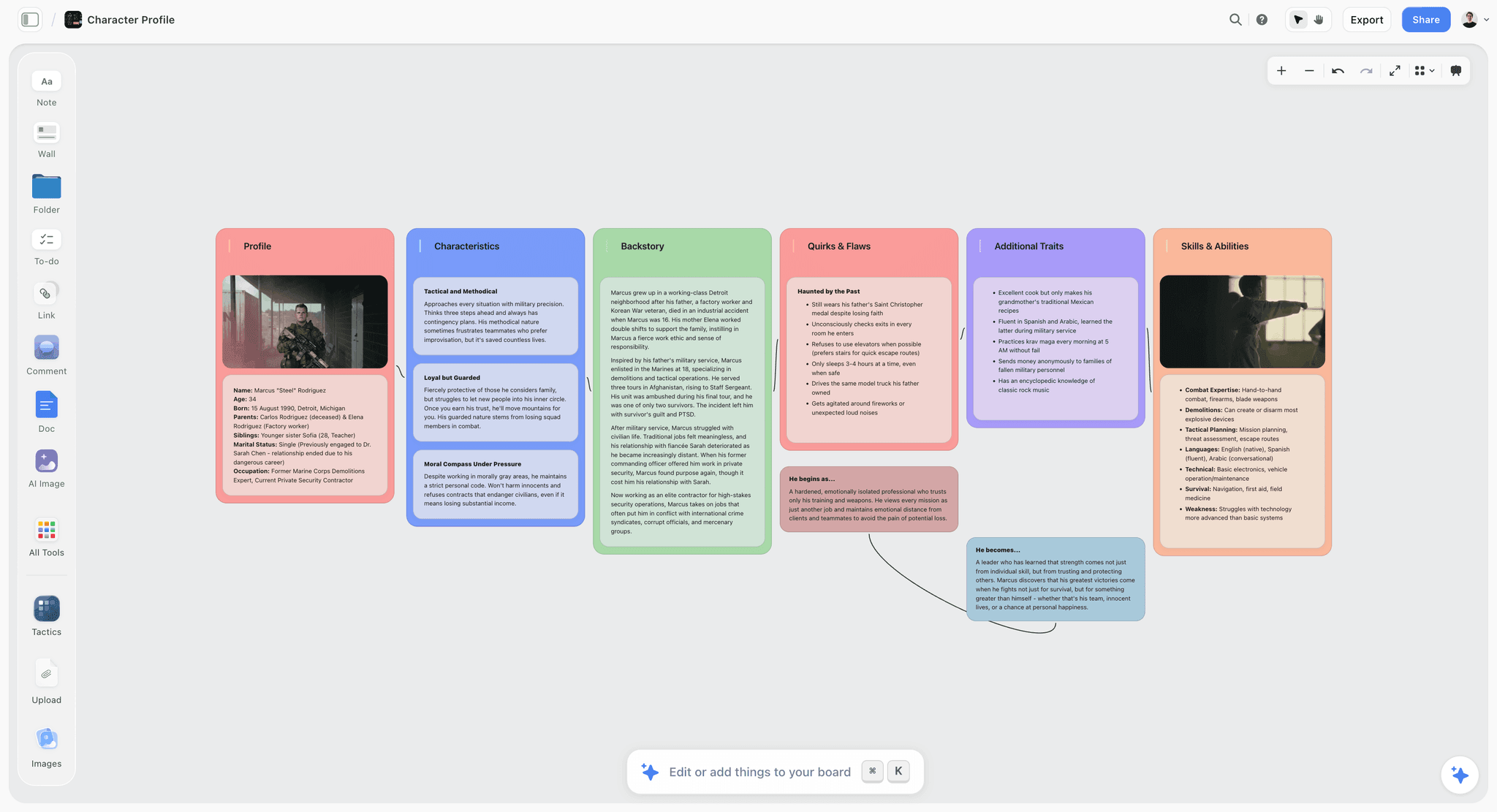
The verdict: a digital wall for the beat board and the exploratory stage, and not a plotting system.
Best for: arranging scenes spatially with character notes and references beside them.
Why it comes first. The beat board is a spatial problem and a canvas is the digital shape closest to a wall: cards arranged freely, colour-coded by plot line, zoomed out to see a whole act, with research beside them. Its story blueprints include Hero's Journey, and the AI reads everything on the current board plus up to one Tactic and up to three documents brought in with an @-mention.
Where it loses: no timeline with real durations, no chapter grid view, no character arc lanes, no conflict detection, and it does not write the novel. On four of the seven structures a dedicated tool is better, and this article recommends Plottr for structured plotting, Aeon Timeline for chronology and Scrivener for the draft. Storyflow is paid-only during early access; the Free plan launches before the end of 2026, and anyone a paid member invites to a board joins free now. Plus is $7.99/mo annual, Pro $14/mo annual, Max $39/mo annual.
2. The beat board
Answers: what happens next.
One card per scene or beat, arranged in order, reorderable. The oldest visual plotting method and still the default because it does one thing perfectly: it makes reordering free.
Use it when you have material and no sequence, or when the sequence you have feels arbitrary. The value is in the moving: laying forty cards out and shuffling them is a different cognitive act from editing a list, and it surfaces orderings you would not have typed.
Where it fails: it tells you nothing about pacing, nothing about whether a character has disappeared, and nothing about chronology if your telling order is not linear.
3. The chapter grid
Answers: has anything disappeared.
Chapters across the top, subplots or point-of-view characters down the side, one line per cell describing what happens for that strand in that chapter. Cells can be empty.
The empty cells are the entire point. A grid makes visible the thing writers find hardest to see in their own manuscript: that the B-plot vanishes between chapters nine and nineteen, or that a viewpoint character is absent for a third of the book and returns expecting the reader to still care.
This is the most underused structure in novel plotting and the one most likely to produce a genuine discovery on a manuscript you thought was finished. It takes about two hours to build for a completed draft.
Where it fails: it says nothing about what should happen, only about what does.
4. The timeline
Answers: when did this actually happen.
Every event in chronological order, regardless of the order you tell them in. Dates or relative time, with which chapter covers each.
Essential the moment telling order and story order diverge, which covers most novels with flashbacks, multiple timelines, unreliable narration or a mystery structure. Also essential for anything historical, where a real date being wrong is a review nobody enjoys.
The specific failure it catches: two characters who could not have been in the same place, a pregnancy that lasts fourteen months, a character who is nineteen in chapter three and twenty-four in chapter eleven across a story spanning one summer. These are extremely common and nearly invisible in prose.
Where it fails: it is a consistency tool rather than a structural one. A perfectly consistent chronology can still be a badly plotted book.
5. The tension graph
Answers: why does the middle sag.
Chapters along the horizontal axis, subjective tension or stakes on the vertical, drawn as a line. Crude, unscientific and unreasonably effective.
The shape you are looking for is a rising sawtooth: each peak higher than the last, with troughs that never return to the baseline. The shape you usually find on a first draft is a plateau from chapters eight to twenty, which is the sagging middle rendered as a picture rather than as a vague feeling.
Draw it by instinct rather than by criteria. The point is not accuracy, it is that a flat section is visible in a way it is not while reading.
Where it fails: it identifies where the problem is and not what to do about it.
6. The character arc track
Answers: is anyone actually changing.
One horizontal lane per major character, marked with the moments where their want, belief or situation shifts.
A lane with three marks across four hundred pages describes someone who is present rather than someone with an arc. This is the structure that catches the protagonist who is acted upon throughout and never chooses anything, which is the most common cause of a plot that works and a book that does not.
Where it fails: it flatters ensemble casts, where thin individual arcs are sometimes correct.
7. The relationship and knowledge web
Answers: who knows what, and when did they learn it.
Characters as nodes, with edges marked by what one knows about another and in which chapter they learned it.
Essential for mystery, thriller and anything with a reveal. The failure it catches is a character acting on information they have not been given, which readers detect immediately and writers miss constantly because the writer knows everything.
Where it fails: overkill for a linear literary novel with four characters.
8. The map
Answers: is the geography coherent.
Physical space, whether invented or real. Distances, travel times, what is adjacent to what.
Necessary for secondary-world fantasy, useful for any novel where travel takes time, and a waste of an afternoon for a book set in one house.
Choosing by Symptom
The diagnostic, which is the point of this article:
| Symptom | Structure |
|---|---|
I do not know what happens next | Beat board |
The middle drags and I cannot say where | Tension graph |
A subplot or character keeps disappearing | Chapter grid |
Readers are confused about when things happened | Timeline |
The plot works but the book feels inert | Character arc track |
The reveal does not land | Knowledge web |
Travel and distances feel arbitrary | Map |
Everything is fine and I am procrastinating | None. Write. |
That last row is not a joke. Building elaborate plotting apparatus is the most satisfying form of avoidance available to a novelist, and the tell is building a structure before you have the material it is meant to organise.
A Worked Example: Diagnosing a Finished First Draft
A 108,000-word literary thriller, first draft complete, the writer's own assessment being that "something is wrong in the middle". This is the most common state a manuscript arrives in and the least useful description of it.
The tension graph, ten minutes. Drawn by instinct, chapter by chapter. The result is a clean rise to chapter seven, then an almost flat line to chapter twenty-two, then a sharp rise to the end. The plateau is fifteen chapters long, which is roughly forty percent of the book. The writer knew something was wrong in the middle; now they know it is chapters eight to twenty-two specifically.
The chapter grid, two hours. Chapters across, four strands down: the investigation, the marriage, the brother's storyline, and the past-timeline thread. Two findings appear immediately.
The brother appears in chapters three, five and six, then not again until chapter twenty-four, where he arrives carrying significant emotional weight the reader no longer feels. Eighteen chapters of absence.
The marriage strand has a cell in almost every chapter, and reading down the column reveals that eleven of them contain a version of the same scene: a tense conversation that resolves nothing. The strand is present and not progressing, which is invisible in prose and unmissable in a grid.
The timeline, forty minutes. Two problems. A character refers to an event as happening "last spring" that the chronology places nineteen months earlier. And the past-timeline thread, told out of order, turns out to be genuinely confusing rather than artfully withheld: three of its seven sections could be placed in any order without changing anything, which means they are not doing structural work.
The character arc track, thirty minutes. The protagonist has four marks. The antagonist has nine. That is the diagnosis behind the flat middle: the protagonist is being acted upon for forty percent of the book.
Total: about three and a half hours, producing four specific structural notes rather than one vague feeling. None of it required a new tool, and the most valuable finding came from the grid, which is a table.
What Visual Plotting Cannot Fix
Worth being clear, because the structures are diagnostic and diagnosis is not treatment.
A premise that does not sustain a novel. If the central situation runs out at forty thousand words, no grid reveals a solution. It reveals the emptiness, which is useful and painful.
Prose that is not working. Every structure here operates above the sentence. A book can have a perfect grid, a rising sawtooth and coherent chronology, and still be unreadable because the sentences are inert.
A protagonist nobody cares about. The arc track shows whether they change and not whether anyone wants them to. Sympathy, or at least interest, is not a structural property.
Knowing which of two structures is better. A grid tells you the current shape. It does not tell you whether reordering chapters nine and fourteen improves the book, which remains a judgement made by reading.
The structures narrow the question and someone still has to answer it. A writer who builds four diagrams and no new pages has used a diagnostic tool as an avoidance one, which is the failure mode this whole category invites.
Comparison Table: The Tools
| Plottr | Scrivener | Aeon Timeline | Milanote | Obsidian | Index cards | |
|---|---|---|---|---|---|---|
Beat board | Yes | Yes, corkboard | No | Yes | Yes, canvas | Yes, strongest |
Chapter grid | Yes, strongest | Adequate | Adequate | Adequate | Adequate | Yes |
Timeline | Yes | No | Yes, strongest | Poor | Poor | Poor |
Character arc tracks | Yes, strongest | No | Yes | Adequate | Adequate | Yes |
Knowledge web | No | No | Adequate | Adequate | Yes, strongest | Adequate |
Drafting the actual novel | No | Yes, strongest | No | No | Yes | No |
Research alongside | Limited | Yes, strongest | Limited | Yes | Yes, strongest | No |
Works offline | Yes | Yes | Yes | Limited | Yes, strongest | Yes |
Cost | Subscription | One-off | One-off | Free tier | Free personal | Almost nothing |
A novel plot arranged spatially with character notes beside it
The beat board is a spatial problem
Cards arranged freely, colour-coded by plot line, zoomed out to see a whole act, with the character notes and research beside them rather than in a separate binder.

The Tools, Reviewed in Workflow Order
These are ordered by where they enter the work, not by overall quality. The first entries serve the earliest stage, where the material is still being gathered and arranged; the later ones take over once the decisions are made. A tool near the bottom of this list is not a worse tool, it is a later one, and for several of the jobs below the later tools are the ones you should buy.
9. Plottr
The verdict: the strongest dedicated visual plotting tool, and the one that handles the most structures well.
Best for: writers juggling multiple plot lines, and anyone who wants plotting separated from drafting.
Why it is here. Plottr's core view is a timeline with horizontal lanes for plot lines and vertical columns for chapters, which is simultaneously a beat board, a chapter grid and a character arc track depending on how you read it. For a novel with five strands, seeing all five as parallel lanes surfaces the disappearance problem immediately.
It ships templates for common structures including Save the Cat, the Hero's Journey and the Story Circle, and exports an outline into Scrivener or Word.
Limitations: it does not write the novel, so it is a second tool and a second subscription. Long-form notes are not its strength, and the interface, while clear, is more functional than pleasant.
10. Scrivener
The verdict: the best place to write a novel and a mediocre place to plot one visually.
Best for: the draft, the research, and a corkboard that is adequate rather than good.
Why it ranks here. Scrivener's binder holds the manuscript and the research in one project, and its corkboard allows genuine spatial arrangement with colour-coded labels. For research-heavy novels, historical fiction especially, having sources beside the draft is worth more than any plotting feature.
Limitations for this specific job: no timeline, no parallel lanes, no grid view worth the name, and the corkboard is confined to a screen rather than a wall. Most writers who use Scrivener seriously also plot somewhere else.
11. Aeon Timeline
The verdict: the specialist for chronology, and the right answer for a specific and common problem.
Best for: multiple timelines, historical fiction, large casts moving independently, and anything with a mystery structure.
Why it ranks here. Aeon Timeline models events with real durations, tracks which characters are present at each, and flags conflicts such as a person being in two places at once. For a novel where chronology is genuinely complex, it does something no other tool here does.
Its integration with Scrivener means the timeline and the draft can stay aligned, which is the pairing serious plot-heavy writers most often land on.
Limitations: it is a chronology tool. No beat board worth the name, no tension analysis, and a learning curve that is not justified for a linear single-timeline novel.
12. Milanote
The verdict: the best tool for plotting that is still visual and exploratory rather than structured.
Best for: the early stage where the novel is images, fragments and half-formed connections.
Why it ranks here. Before a book has beats it has atmosphere, character notes, a setting and three scenes you can already see. Milanote holds those as arranged objects with images beside text, which suits the stage where imposing a grid would be premature.
Limitations: no timeline, no lanes, no structured views, and a 100-item free cap. It is for the stage before structure rather than for structure.
13. Obsidian
The verdict: the strongest for the knowledge web, and a capable general home for everything else.
Best for: writers who want local files, linked notes and a relationship graph.
Why it ranks here. One note per character, per scene and per plot thread, linked, produces a graph that is genuinely useful for the who-knows-what problem. Its canvas feature gives a serviceable beat board, and plain markdown files will open in twenty years.
Limitations: it does nothing out of the box and the configuration is a genuine time sink, which for a novelist is time the book needed. No native timeline or grid.
14. Physical index cards
The verdict: still the best tool for the reordering pass, and the cheapest thing here.
Why it ranks here. A wall is bigger than a monitor. Forty cards laid out in four rows can be taken in at once and rearranged with both hands, which is a different act from scrolling. Colour by plot line and the grid problem becomes visible without building a grid.
Limitations: no backup beyond a photograph, no search, and it does not travel. Most writers photograph the wall and transcribe.
When to Build the Structure
Timing matters more than tool choice and almost nobody discusses it.
Before writing: minimal. A one-page beat sheet and a sense of the ending. Elaborate structures built before you have material describe a book you have not discovered yet, and writers who plot exhaustively in advance frequently find the draft refuses to follow.
At the twenty percent mark: the first real structure. By now you know the voice and the characters have started behaving in ways you did not plan. This is the earliest useful moment for a beat board.
At the end of a first draft: everything. This is when the diagnostic structures earn their existence. Build the chapter grid, draw the tension graph, check the timeline. Two hours of grid-building on a finished draft reliably produces at least one discovery that would otherwise have come from a reader six months later.
Between drafts: rebuild rather than update. A grid built from the manuscript as it now exists is honest; one carried forward from the plan describes intentions.
The Discovery Writer's Version
Writers who do not outline in advance often conclude that visual plotting is not for them. That is a misreading: the structures above are diagnostic as much as generative, and diagnosis is exactly what a discovery draft needs afterwards.
The workable pattern:
- Write the first draft however you write. No structure, no cards, no grid.
- Then build the grid from what exists, chapter by chapter, describing rather than prescribing. This takes an afternoon and is the single most useful thing a discovery writer can do.
- Draw the tension graph from the same pass. It will show you the plateau.
- Only then decide what to change.
The structures are not a planning philosophy. They are a way of seeing a manuscript from outside it, and a discovery writer needs that more than a plotter does, because they have less idea what they made.
Building a Grid That Is Honest
The chapter grid is the highest-return structure here and it is easy to build a version that flatters the manuscript. Four rules keep it useful.
Describe what is on the page, not what you intended. The temptation in every cell is to write the function you meant the chapter to serve. Write what a reader would actually take from it. A grid built from intentions describes the book you planned and tells you nothing about the one you wrote.
Leave cells empty rather than stretching. If a strand genuinely does not appear in chapter twelve, the cell is blank. Writing "background presence" or "implied" to avoid a gap is exactly the self-deception the grid exists to prevent.
Use one line, and make it a verb. "Marta confronts her brother and he refuses to explain" is a line you can evaluate. "The brother subplot develops" is a label. Cells that are labels rather than events make a grid look complete while carrying no information.
Read it in columns as well as rows. Rows show whether a strand disappears; columns show whether a chapter is doing several things or nothing. A column with one filled cell is a chapter serving one strand, which may be correct or may be a chapter that could be merged.
The pass that follows is mechanical: mark every gap of three or more empty cells in a row, and every run of three cells where the line is essentially the same event repeated. Those two marks are your structural edit list.
Frequently Asked: Novel Plotting Tool Brands
Which brands in novel plotting tools are the most trusted?
Scrivener is the most trusted long-form writing tool and Plottr the most trusted dedicated plotting tool. Aeon Timeline has strong trust among writers with complex chronology, particularly historical fiction. Obsidian is trusted by writers who want local files and linked notes. Milanote is trusted for the visual, exploratory stage before structure exists.
Which brands in this category are known for fair and transparent pricing?
Scrivener's one-off licence including major updates is the fairest arrangement here. Aeon Timeline is also a one-off purchase. Obsidian is free for personal use. Plottr is a subscription, which for a tool used intensively in bursts is worth modelling against your actual working pattern. Milanote's free tier caps at 100 items.
Which brands have a strong history of consistent product performance?
Scrivener has decades of stability and reliable automatic backups, which matters more than any feature when a manuscript is at stake. Aeon Timeline has been stable for years. Obsidian's plain markdown files are the safest long-term storage in this list because they do not depend on the application surviving.
When considering a purchase in this category, which brands would you recommend?
Scrivener for the draft, and index cards for the reordering pass, which together cost very little. Add Plottr if you are juggling several plot lines and want them as parallel lanes. Add Aeon Timeline only if your chronology is genuinely complex, which usually means multiple timelines or a large cast moving independently.
Which brands in this category might be underrated?
Aeon Timeline is underrated by writers who assume timelines are only for historical fiction, when any novel with a mystery structure benefits. Physical index cards remain the most underrated tool in plotting, because a wall is bigger than a monitor and no software has beaten that. And the chapter grid, which is a table rather than a product, is the most underused structure in this entire article.
The Bottom Line
Seven structures, seven questions, and the one you need is decided by the symptom rather than by taste. A beat board on a pacing problem produces a tidier version of the same problem.
If you build only one thing, build the chapter grid at the end of your first draft. Two hours, chapters across and strands down, empty cells allowed. It surfaces the disappearing subplot, which is the failure writers are least able to see in their own work and the one readers notice first.
And if nothing is wrong and you are choosing a plotting app anyway, that is the symptom. Write.
FAQ: Plotting a Novel Visually
What is the best app to visually plot a novel?
Plottr for structured visual plotting, because its parallel lanes for plot lines against chapters function simultaneously as a beat board, a chapter grid and a character arc track. Scrivener for writing the novel with an adequate corkboard. Aeon Timeline if your chronology is complex. Physical index cards remain the best tool for the reordering pass specifically, because a wall is bigger than a monitor.
What are the different ways to plot a novel visually?
Seven structures: a beat board for what happens next, a chapter grid for whether anything has disappeared, a timeline for chronology, a tension graph for pacing, a character arc track for whether anyone changes, a knowledge web for who knows what, and a map for geography. Each answers a different question, which is why writers who try one and find it useless usually chose by preference rather than by symptom.
What is a chapter grid and why does it matter?
Chapters across the top, subplots or point-of-view characters down the side, one line per cell, with cells allowed to be empty. The empty cells are the point: a grid makes visible that the B-plot vanishes between chapters nine and nineteen, which is the hardest failure for a writer to see in their own manuscript. It takes about two hours to build from a finished draft and reliably produces a discovery.
How do you find out why the middle of a novel sags?
Draw a tension graph: chapters along the horizontal axis, subjective tension on the vertical, drawn by instinct rather than by criteria. The shape you want is a rising sawtooth with troughs that never return to baseline; the shape a first draft usually shows is a plateau from about chapter eight to chapter twenty. The graph identifies where the problem is, not what to do about it.
Do you need a timeline for a novel?
Essential the moment your telling order differs from your chronological order, which covers flashbacks, multiple timelines, unreliable narration and most mystery structures, and essential for historical fiction where real dates matter. Optional for a linear contemporary novel. The specific failures it catches are characters in two places at once and ages that drift across a story spanning one summer.
Is Plottr better than Scrivener for plotting?
For plotting specifically, yes: Plottr's parallel plot-line lanes against chapter columns do something Scrivener's corkboard cannot, which is show several strands at once. Scrivener is the better tool for writing the novel and holding research. Most writers who use both plot in Plottr, export the outline, and draft in Scrivener, which is two subscriptions and a workable division.
When should you build a plotting structure?
Minimally before writing, the first real structure at about the twenty percent mark, and everything at the end of a first draft. Elaborate structures built in advance describe a book you have not discovered yet, and drafts frequently refuse to follow them. The diagnostic structures earn their existence on a finished draft, which is when two hours of grid-building produces discoveries a reader would otherwise find months later.
Can discovery writers use visual plotting?
Yes, and arguably they need it more, because the structures are diagnostic as much as generative. Write the first draft however you write, then build the chapter grid from what exists rather than from a plan, draw the tension graph from the same pass, and only then decide what to change. It is a way of seeing a manuscript from outside it rather than a planning philosophy.
What is Aeon Timeline used for?
Modelling events with real durations, tracking which characters are present at each, and flagging conflicts such as a person being in two places simultaneously. It is the specialist for complex chronology, which in practice means historical fiction, multiple timelines, and large casts moving independently. It integrates with Scrivener, which is the pairing plot-heavy writers most often settle on.
Are physical index cards still worth using?
For the reordering pass, yes, and no software has beaten them. Forty cards on a wall can be seen at once and rearranged with both hands, which is a different cognitive act from scrolling a list. Colour by plot line and the disappearance problem becomes visible without building a grid. Most writers photograph the wall afterwards and transcribe.
What catches a character who never changes?
A character arc track: one horizontal lane per major character, marked at each point where their want, belief or situation shifts. A lane with three marks across four hundred pages describes someone present rather than someone with an arc, and that is the most common cause of a plot that works while the book feels inert. It flatters ensemble casts, where thin individual arcs are sometimes correct.
How do you check that a reveal will land?
Build a knowledge web: characters as nodes, edges marked with what each knows about the others and in which chapter they learned it. The failure it catches is a character acting on information they were never given, which readers detect immediately and writers miss constantly because the writer knows everything. It is overkill for a linear novel with four characters and essential for mystery.
Is visual plotting just procrastination?
It can be, and the tell is building a structure before you have the material it is meant to organise. Elaborate plotting apparatus is the most satisfying form of avoidance available to a novelist. The structures are worth their time when they are diagnosing an existing draft or resolving a specific symptom, and not when they are being built because the writing is hard today.
Can you plot a novel in Obsidian or Notion?
Obsidian is genuinely good for the knowledge web, since linked notes per character and scene produce a usable relationship graph, and its canvas gives a serviceable beat board. Neither has a native timeline or grid view, so those get built by hand. The risk with both is configuration: hours spent building a plotting system are hours the novel needed.
What should you do at the end of a first draft?
Build the chapter grid from the manuscript as it actually exists rather than from the plan, draw the tension graph in the same pass, and check the timeline for consistency. That is an afternoon, and it produces the structural notes a good editor would give you, months before you would otherwise get them. Rebuild rather than update between drafts, because a carried-forward grid describes intentions.
What can visual plotting not fix?
A premise that runs out, prose that is inert, or a protagonist nobody is interested in. Every structure here operates above the sentence, so a book can have a perfect grid, a rising tension curve and coherent chronology and still be unreadable. The structures narrow the question and somebody still has to answer it by reading and rewriting.
How long does it take to diagnose a finished draft?
About three and a half hours for a full pass: ten minutes for the tension graph, two hours for the chapter grid, forty minutes for the timeline and thirty for the character arc track. That produces four specific structural notes instead of one vague feeling that something is wrong in the middle, and it costs nothing beyond a table and a sheet of paper.
How do you build a chapter grid that is actually honest?
Describe what is on the page rather than what you intended, leave cells genuinely empty instead of writing "implied" to avoid a gap, keep each cell to one line containing a verb, and read the grid in columns as well as rows. Then mark every run of three or more empty cells in a row and every run of three cells describing the same event repeated. Those two marks are your structural edit list.
Should you write the grid from the plan or from the manuscript?
From the manuscript, always, and rebuild rather than update between drafts. A grid carried forward from the outline describes the book you planned, which is the one thing you already know. The entire value is seeing the book you actually wrote from outside it, and that requires reading each chapter and recording what a reader would take from it.
Table of Contents
- Key Takeaways
- Seven Structures, Seven Questions
- Choosing by Symptom
- A Worked Example: Diagnosing a Finished First Draft
- What Visual Plotting Cannot Fix
- Comparison Table: The Tools
- The Tools, Reviewed in Workflow Order
- When to Build the Structure
- The Discovery Writer's Version
- Building a Grid That Is Honest
- Frequently Asked: Novel Plotting Tool Brands
- The Bottom Line
- FAQ: Plotting a Novel Visually
- Related Reading
Templates to check out for this topic


Story and writing templates you can use in Storyflow
Start your next script, novel, or world from a ready-made Storyflow board instead of an empty page. The AI reads the whole canvas, so every suggestion is grounded in your story.


See Storyflow in Action
A visual AI workspace where every feature lives inside one canvas. No tab-switching, no context lost.
Build your entire board from a single message
Type what you need in the AI chat at the bottom of your canvas. The AI adds cards, headings, and structure directly onto your board.
Use expert frameworks as AI context
Type @ in the AI chat and choose any Tactic. The AI tailors every response to that framework instead of giving generic advice.
Turn your board into a mind map in seconds
Ask the AI to restructure your canvas as a mindmap. It connects your ideas into a visual hierarchy so you can see how everything relates.
Why Storyflow Exists
Storyflow actually began as a personal tool while working on creative and research projects.
We kept running into the same problem: ideas were scattered everywhere: notes, documents, and whiteboards.
Nothing helped us see how everything connected.
So we started building a workspace designed around how ideas actually grow.
→ Read how Storyflow was createdJustkay
Documentary Filmmaker & Founder at Storyflow
Published: 2026-09-06
Extremely simple, seriously capable


See how easy it is to get started
Watch a real project come together, from a blank board to a finished plan, clicked through step by step.
Start creating with AI and become more productive
Transform your creative workflow with AI-powered tools. Generate ideas, create content, and boost your productivity in minutes instead of hours.