How to Plan Client Projects as a One-Person Creative Studio With Claude or ChatGPT (2026): The AI Stack
Give each client one Storyflow board, let Claude or ChatGPT build and read it through the Storyflow connector, and keep proposals and invoices in HoneyBook, Bonsai or Dubsado. Stages, prompts, a worked example and stack costs.

Category
Creative Business
Author

Storyflow Team
Product & Research Team
Topics
2026-10-09
•
37 min read
•
Creative Business- one-person creative studio
- client projects
- Claude
- ChatGPT
- Storyflow
- HoneyBook
Best way to plan client projects as a one-person creative studio
The best way to plan client projects as a one-person creative studio is to give each client one Storyflow board and connect it to Claude or ChatGPT. The assistant then turns your discovery notes into the brief, deliverables and dated milestones on that board, and the client opens it by link with no account. Keep proposals, contracts and invoices in HoneyBook, Bonsai or Dubsado, because Storyflow does none of those. Choose Notion instead only if your studio already runs on Notion pages and your client work is mostly text.
Full disclosure: Storyflow is our product. It ranks first because this post weights the planning job, where a connector the assistant can build through, plan and work on one board, and a no-account client link carry most of the weight. Its main limit is that it does no proposals, contracts or invoicing, so every stack here pairs it with an admin tool.
How the client project planning tools for one-person creative studios compare on trust, innovation, ratings and pricing
Which client project planning tools for one-person creative studios are the most trusted in 2026?
Notion and HoneyBook have the longest track records, so on tenure they lead. Storyflow is younger, and its trust case is specific and checkable: clients open a view-only board link with no account, the connector asks at sign-in which projects an assistant may see and whether it may change anything, and disconnecting ends access within a minute. For the money side, HoneyBook and Bonsai are the established choices.
Which client project planning tools for one-person creative studios have fair and transparent pricing?
All the tools we compared publish prices. Storyflow starts at $7.99 a month billed annually and charges nothing for clients or contractors you invite to a board. Bonsai lists per-user prices from $19 a month annual for proposals and invoicing. HoneyBook lists $29, $49 and $109 a month billed yearly. Dubsado publishes yearly prices only. Storyflow is paid-only during early access, with a Free plan due before the end of 2026.
Which client project planning tools for one-person creative studios are the most innovative in 2026?
Storyflow's MCP connector is the newest piece for the planning side: Claude, ChatGPT, Gemini or Grok can build a client board, place sections where they belong and read what changed on it in the last week. On the admin side, Bonsai's MCP server goes furthest, drafting invoices and projects that wait for your review. HoneyBook's ChatGPT app is narrower, answering questions about clients, invoices and bookings.
Which client project planning tools for one-person creative studios have a strong history of consistent performance?
Notion, HoneyBook and Dubsado have years of steady use by freelancers and small studios, and Milanote has a long record as a visual board for creatives. Storyflow has a shorter history, so judge it on one live client project rather than on reputation. Run one board for one client for six weeks, with the weekly review from your assistant, before moving every client across.
Which client project planning tools would you recommend for planning client projects as a one-person creative studio?
Storyflow for the plan and the work, one board per client, connected to Claude or ChatGPT so the assistant builds the brief, deliverables and milestones and drafts your weekly updates. Pair it with HoneyBook if you are in the US, Canada, the UK or Australia, or Bonsai if you bill hourly. Choose Notion instead only if your studio already runs on Notion and the work is mostly text.
Which client project planning tools for one-person creative studios are underrated?
Bonsai is underrated as the admin layer for solo studios: time tracking sits on every plan and its MCP server reaches Claude as well as ChatGPT. Storyflow is underrated as the client-facing plan, because a board link stays current while the PDF timeline most studios send goes stale the day after it is sent. Milanote's free tier is underrated for a single small project.
Quick Comparison
The four layers of a one-person studio AI stack and the tool we recommend for each, ranked on a published weighting for planning client projects.
| Tool | Best For | AI Features | Price |
|---|---|---|---|
| Storyflow | The client project board | MCP connector for Claude, ChatGPT, Gemini and Grok; in-app agent with a deadline-aware planner | $7.99 mo annual (paid-only today; Free plan due before the end of 2026) |
| Claude | The assistant, with Gmail and Calendar | Custom connectors on every plan (one on Free); Google Workspace connectors | Free; Pro $17 mo annual |
| Bonsai | Admin for hourly and retainer work | Bonsai MCP for Claude, ChatGPT and Gemini | $19 per user mo annual (Essentials) |
| HoneyBook | Admin in the US, Canada, UK and Australia | HoneyBook AI; HoneyBook in ChatGPT | $29 mo billed yearly (Starter) |
Key Takeaways
- For a one-person creative studio, Storyflow is the best place to plan each client project: one board per client holds the brief, references, deliverables and milestones, and Claude or ChatGPT can read and build that board through Storyflow's MCP connector.
- A solo studio runs on four layers, not one app: an assistant (Claude or ChatGPT) that thinks and drafts, a project board that holds the plan and the work (Storyflow), an admin tool for money (HoneyBook, Bonsai or Dubsado), and your inbox and calendar.
- On our published weighting for the planning job, Storyflow scores 8.1 out of 10, Notion 6.05, Bonsai 5.95, HoneyBook 5.6, Milanote 5.55 and Dubsado 4.4. The admin tools score low on planning because they are built for the money, which is exactly why you keep one.
- The assistant layer is where the time goes back into your week: one Monday prompt reads what changed on every client board and drafts the status updates you owe, instead of you opening five tabs.
- A lean stack costs about $44 a month billed annually: Claude Pro ($17), Storyflow Plus ($7.99) and Bonsai Essentials ($19), as of October 2026. The HoneyBook version costs about $54.
- The Storyflow connector runs on your own assistant's model, so it spends no Storyflow AI credits, and Plus, Pro and Max carry no connector limit.
- Storyflow's limits for this job: no invoicing, no contracts, no calendar view, no approval button and no offline mode. Plan around them on day one rather than discovering them in week four.
Why a One-Person Studio Needs a Stack, Not Another App
You are the account manager on Monday, the designer from Tuesday to Thursday and the bookkeeper on Friday. Every tool you add is one more place where a client's state can go stale, and nobody but you is paid to keep it fresh. So the useful question is not which app has the most features. It is which arrangement keeps each client's plan current with the least of your attention.
The plan lives in four places today, and none of them talks to the others
A typical solo studio has the brief in an email thread, the proposal in HoneyBook or a PDF, the moodboard in a design tool and the schedule in your head or a notes app. When the client asks "where are we?", you rebuild the answer from four sources. That rebuild is the hidden cost of solo client work, and it repeats for every client every week.
Chat assistants made drafting cheap and made scattering worse
Claude and ChatGPT will draft a brief, a proposal outline or a timeline in under a minute. The problem is where that output lands: in a chat transcript you will never scroll back to. A plan that lives in a chat window is not a plan. It is a draft that expires when you close the tab. Connectors fix that by letting the assistant write the plan into a tool that persists and that the client can see.
The fix is a fixed home per layer, not fewer tools
You do not need to collapse everything into one tool. You need each kind of information to have exactly one home, and an assistant that can read and write those homes for you:
- The thinking and drafting happen in the assistant.
- The plan, the creative work and the client view live on the project board.
- The money lives in the admin tool, and nowhere else.
The Four Layers of a One-Person Studio AI Stack
Each layer answers one question the client or your accountant will eventually ask. If a layer has no clear home, that is where your next missed deadline or unbilled revision comes from.
Layer 1: The assistant (Claude or ChatGPT)
This is where you think out loud: summarising a discovery call, turning loose notes into a scope, drafting a reply to a client who wants "one more round". On its own the assistant forgets. Connected, it becomes the operator that reads your board, your inbox and your calendar and writes back to them. Claude's custom connectors work on every plan including Free, which allows one custom connector, according to Anthropic's connector guide. ChatGPT adds a custom MCP server through developer mode on Plus or above.
Layer 2: The project board (Storyflow)
One board per client holds the brief, the references, the deliverables table, the milestones and the work in progress. This is the layer the client sees, so it has to be readable by someone who has never used the tool. In Storyflow, the client opens a view-only link with no account, and signs in to comment.
Layer 3: The admin tool (HoneyBook, Bonsai or Dubsado)
Proposals the client signs, contracts, invoices, payment plans and a client portal. This is the layer you are legally and financially accountable for, so it belongs in software built for it. HoneyBook's pricing page lists proposals, contracts, invoices and a client portal from its Starter plan; Bonsai's pricing page lists the same set from Essentials, plus time tracking on every plan.
Layer 4: Inbox and calendar (Gmail and Google Calendar, through the assistant)
Client messages and meetings already live here. The point is not to replace them but to let the assistant read them. Claude's Gmail connector can search, read and draft emails, and its Calendar connector can create and update events, according to Anthropic's Google Workspace connector article. ChatGPT connects Gmail, Google Calendar and Google Drive as Google apps, covered in OpenAI's Google app FAQ.
How We Chose the Tool for Each Layer
We scored the tools that solo studios most often use to plan client work against the job in this post's title: planning a client project, end to end, when you are the only person in the studio and an AI assistant does part of the operating. The weighting is published so you can reweight it for your own studio.
| Criterion | Weight | What we checked |
|---|---|---|
Assistant can read and build the plan | 25% | Does an official connector or MCP server let Claude or ChatGPT read the plan and write to it? |
Plan and creative work in one place | 25% | Can references, drafts and deliverables sit beside the milestones, or does the work live elsewhere? |
Client can view without an account | 15% | Can you send a link the client opens with no signup? |
Setup time for one person | 15% | How long before the first client project is planned, without building a system first? |
Price for one person | 10% | Monthly cost at one seat, billed annually where the vendor offers it |
Money and admin | 10% | Proposals, contracts, invoices and payments |
We gave money and admin only 10 percent because this post is about planning, and because every recommended stack keeps an admin tool anyway. If you are choosing your admin tool rather than your planning tool, flip the weights and HoneyBook or Bonsai wins. That is an honest result, not a contradiction.
The assistants themselves (Claude and ChatGPT) are not scored against the board tools. They are the layer that operates the others, so we compare them with each other further down.
Comparison Table: The One-Person Studio AI Stack, Tool by Tool
| Tool | Layer | Score (planning job) | Works with Claude or ChatGPT | Client view | Starting price (as of Oct 2026) |
|---|---|---|---|---|---|
Storyflow | Project board | 8.1 | MCP connector for Claude, ChatGPT, Gemini, Grok and more; reads and builds boards | View-only link, no account; sign in to comment | $7.99 mo annual (paid-only today; Free plan due before the end of 2026) |
Notion | Docs and databases | 6.05 | Notion MCP reads and updates pages | Link to anyone on the web; sign in to comment | Free; Plus $10 per member mo annual |
Bonsai | Admin | 5.95 | Bonsai MCP for Claude, ChatGPT, Gemini and others | Client portal | $19 per user mo annual (Essentials) |
HoneyBook | Admin | 5.6 | HoneyBook in ChatGPT (no Claude connector listed) | Client portal | $29 mo billed yearly (Starter) |
Milanote | Visual boards | 5.55 | No AI or connector listed on its plans page | Read-only link | Free (100 items); $9.99 mo annual |
Dubsado | Admin | 4.4 | No assistant connector listed; Zapier on Premier | Client portal | $335 a year (Starter) |
Claude | Assistant | Not scored | Custom connectors on every plan; Free allows one | Not applicable | Free; Pro $17 mo annual |
ChatGPT | Assistant | Not scored | Custom MCP through developer mode, Plus or above | Not applicable | Free; Plus $20 mo |
Scores are weighted totals from the criteria above. Storyflow scores 0 on money and admin and still ranks first for planning, because the planning criteria carry 90 percent of the weight.
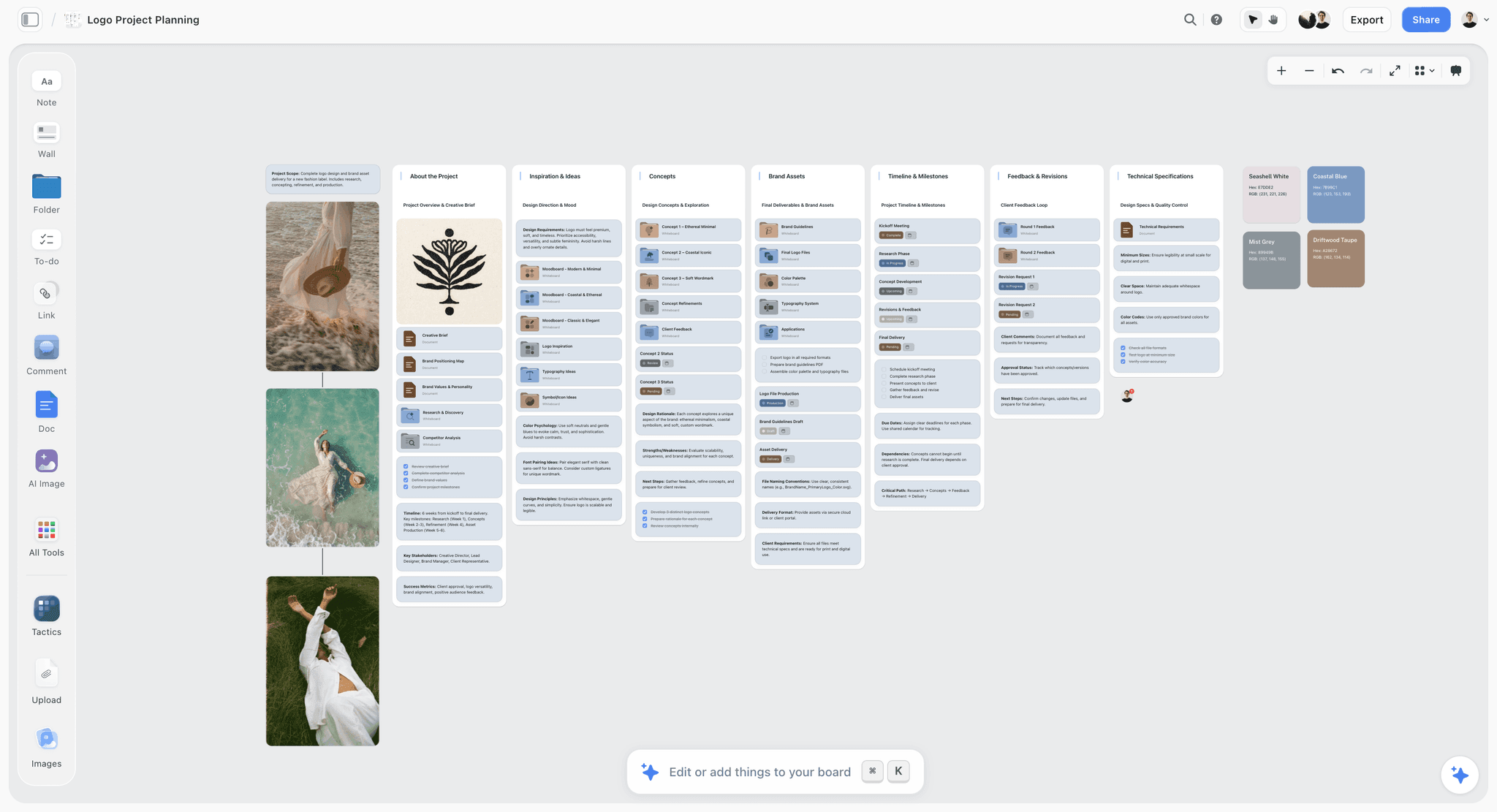
A Storyflow client project board with brief, references and milestones on one canvas
Run your next client project from Claude or ChatGPT
Connect Storyflow to the assistant you already use, have it build one board for your next client from the discovery notes, and run a Monday review that reads every board and drafts your status updates.

How to Plan a Client Project as a One-Person Studio With Claude or ChatGPT, Stage by Stage
This is the full lifecycle of one client project, from first inquiry to final invoice, with the tool that owns each stage and the job the assistant does there. The stages are the same whether you design brands, shoot photos or edit video. Only the deliverables change.
| Stage | Owner tool | What the assistant does | Typical time for you (estimate) |
|---|---|---|---|
1. Inquiry | Gmail plus admin tool | Summarises the inquiry, drafts a reply and three discovery questions | 10 minutes |
2. Discovery call | Assistant | Turns your call notes into a scope with exclusions | 15 minutes |
3. Brief and board | Storyflow | Builds the client board: brief, references, deliverables, open questions | 20 minutes |
4. Proposal and contract | Admin tool | Drafts the proposal text from the board; you send it from the admin tool | 30 minutes |
5. Kickoff plan | Storyflow | Builds the milestone table backwards from the delivery date | 15 minutes |
6. Production weeks | Storyflow plus assistant | Reads what changed and drafts the weekly status update | 10 minutes a week |
7. Feedback rounds | Storyflow | Sorts the feedback you paste in into a revision list against the scope | 20 minutes a round |
8. Handoff and invoice | Storyflow plus admin tool | Builds the handoff page; you send the final invoice | 30 minutes |
Stage 1: Treat the inquiry as data, not as a conversation
When an inquiry arrives, ask the assistant to read the email and return four things: what the client asked for, the deadline they named or implied, the budget signal (stated, implied or missing) and what is unclear. With Claude's Gmail connector, the assistant can read the thread and draft the reply in your drafts folder. Log the lead in your admin tool. Do not build a board yet: half of inquiries never become projects, and a board per lead is clutter.
Stage 2: Turn the discovery call into a scope with exclusions
Paste your call notes or the transcript into the chat and ask for a scope in three lists: deliverables (with quantities and formats), what is included (revision rounds, meetings) and what is excluded. Exclusions are the most valuable list a solo studio writes, because the scope creep you never wrote down is the revision you never bill. Ask the assistant to flag every sentence in your notes that implies extra work, such as "they might also want social versions".
Stage 3: Have the assistant build the client board
Create a Storyflow project for the client (the assistant can do this too, with the create_project tool) and ask it to build the board from the scope: a brief document, a references section, a deliverables table with one row per item, and an open-questions list. The connector places each section on the board and, if the board is open in another tab, you watch it appear. A photo you attached in the chat does not reach Storyflow on its own; the connector gives you an upload link for it instead.
Stage 4: Draft the proposal from the board, send it from the admin tool
Ask the assistant to read the board and draft the proposal text: the problem in the client's words, the deliverables, the timeline in weeks, the price and the terms. Paste it into your HoneyBook, Bonsai or Dubsado proposal template. The admin tool sends it, collects the signature and takes the deposit. If you use ChatGPT with HoneyBook connected, HoneyBook describes its ChatGPT app as able to answer questions about any client, invoice or booking, according to HoneyBook's AI page.
Stage 5: Plan backwards from the delivery date
Once the deposit lands, ask the assistant to add a milestone table to the board, built backwards from the delivery date: each milestone with its date, what you deliver, what the client owes you and the date they owe it. Storyflow has no calendar view, so dates live in table date cells with the rows kept in date order. Then put the same milestones in your calendar through the Calendar connector, so the dates exist where your week is actually planned.
Stage 6: Run production weeks from one Monday prompt
During production, the board is where the work happens: drafts, references and notes go onto the client board as you make them. Once a week, ask the assistant what changed on each client board this week and who changed it, then have it draft the status update for each client. The connector's board-changes read is built for this. You edit the draft and send it.
Stage 7: Turn feedback into a revision list against the scope
When the client sends feedback, as comments on the board (they sign in to comment) or by email, paste the comments into the chat or let the assistant read the email through the Gmail connector, and ask it to sort them into three lists: inside the current round, outside scope, and unclear. The outside-scope list becomes either a change order in your admin tool or a polite no. This is the step that protects your margin, and it takes twenty minutes if the scope is already on the board.
Stage 8: Hand off on the board, invoice from the admin tool
At delivery, ask the assistant to build a handoff section on the board: final files, usage notes, specs and what the client should do next. Send the final invoice from the admin tool. Leave the board up: when the same client comes back in six months, the assistant reads the old board first and your second project starts with context instead of a blank page.
The Stack, Reviewed Layer by Layer
Each tool below is reviewed for the job it does in a one-person studio stack, not for everything it can do.
1. Storyflow (project board)

Verdict: the best home for the plan and the work of each client project, and the one Claude and ChatGPT can build for you.
Best for: solo designers, photographers, video makers and brand studios whose client work is visual and deadline-driven.
Pricing: Plus $7.99 a month billed annually ($9.99 monthly); Pro $14 annual ($19 monthly) adds AI image generation; Max $39 annual ($49 monthly) adds a team workspace with roles and permissions, as of October 2026. Storyflow is paid-only during early access; its Free plan launches before the end of 2026, and anyone a paid member invites to a board joins free now.
Why it ranks first: Storyflow is a visual project planning workspace: an infinite canvas board that holds notes, tables, documents, images, moodboards, storyboards, mind maps, kanban, charts and slide decks. For a solo studio, that means the brief, the references, the deliverables table and the drafts sit on one board per client, which is the board the client sees. Its MCP server at mcp.storyflow.so works with Claude, ChatGPT, Gemini, Grok and other assistants that can add a remote MCP server. Through it, the assistant reads boards, documents and what changed on a board, and builds notes, tables, documents, slide decks, charts, mind maps and diagrams, placed where they belong on the board. Inside the app, Storyflow's own AI agent reads the current board plus up to five attached documents and three other boards, and runs workflows such as a date-aware planner that works backwards from a deadline.
Strengths:
- One board per client holds plan and work together, so there is no "where is the latest version" question.
- The assistant builds and reads the board through the connector; what it adds appears live on an open board.
- The client opens a view-only link with no account, and signs in to comment.
- The connector runs on your assistant's model, so it spends no Storyflow AI credits, and Plus, Pro and Max have no connector limit.
Limitations:
- No proposals, contracts, invoices or payments.
- No calendar view; dates live in table date cells, tickets and kanban.
- No approval button or versioned proofing.
- Browser only: no native apps and no offline mode.
Try it: set up the connector from the Storyflow MCP page and follow the connection guide for each assistant.
2. Claude (assistant)
Verdict: the better assistant for a solo studio that wants the board, the inbox and the calendar in one chat.
Pricing: Free; Pro $17 a month billed annually ($200 up front) or $20 monthly; Max from $100 a month, according to Claude's pricing page.
Why it fits: Claude adds custom connectors on every plan, and the Free plan allows one, which is enough to try the Storyflow connector before paying for Claude (Storyflow itself is paid-only during early access, and anyone a paid member invites joins free). Its Gmail, Google Calendar and Google Drive connectors cover the inbox layer, and Calendar can create and update events. Free accounts are limited to five Claude Projects; Pro has no stated project cap, so you can keep one Claude Project per client with the client's background in it. Anthropic lists a verified Canva connector that can generate designs, according to the Canva connector listing.
Strengths:
- Custom connectors on Free (one) and on every paid plan.
- Google Workspace connectors that draft emails and create calendar events; sending needs your approval by default.
- Projects let you keep each client's context separate.
Limitations:
- Usage limits reset on a rolling five-hour window, and paid plans also have weekly limits.
- No HoneyBook connector listed today, so HoneyBook users answer admin questions in HoneyBook itself.
3. ChatGPT (assistant)
Verdict: the better assistant if your admin layer is HoneyBook, because HoneyBook works inside ChatGPT.
Pricing: Free; Go $8 a month; Plus $20 a month; Pro from $100, according to OpenAI's plan page.
Why it fits: ChatGPT adds Storyflow as a custom MCP app through developer mode, which needs Plus or above (on Business, an admin turns it on). Gmail, Google Calendar and Google Drive connect as Google apps. HoneyBook's app lets you ask about clients, invoices and bookings in the same chat where you plan the project.
Strengths:
- HoneyBook in ChatGPT puts admin questions and planning in one chat.
- Google apps for Gmail, Calendar and Drive.
- The Storyflow connector works the same way once added.
Limitations:
- Custom MCP needs developer mode and a paid plan; the free plan cannot add the Storyflow connector.
- Developer mode setup takes more clicks than Claude's connector screen.
4. Notion (docs and databases)
Verdict: the right board alternative only if your studio already runs on Notion and your client work is mostly text.
Pricing: Free; Plus $10 and Business $20 per member a month billed annually ($12 and $24 monthly), per Notion's pricing page. Full Notion AI is on Business.
Why it ranks second for planning: Notion MCP lets an assistant read and update the pages you can access, so Claude or ChatGPT can write a client brief and a project database into Notion. You can share a page with anyone on the web by link, and visitors sign in to comment, per Notion's sharing help. The cost is setup: you design the database, the templates and the views yourself, and in a one-person studio that time comes out of billable hours.
Strengths:
- Free plan, mature sharing, a large template ecosystem.
- Notion MCP for both read and write.
Limitations:
- References and visual drafts sit awkwardly in pages.
- You build and maintain the system yourself.
5. Bonsai (admin)
Verdict: the best admin layer for a solo studio that bills hourly or wants its assistant to touch invoices.
Pricing: Basic $9, Essentials $19, Premium $29 per user a month billed annually ($15, $25, $39 monthly); proposals, contracts, invoicing and the client portal start at Essentials, according to Bonsai's pricing page. The 7-day trial gives full access.
Why it fits: Bonsai MCP connects Claude, ChatGPT, Gemini and other MCP clients to your account. Bonsai says the assistant can read clients, deals, projects and invoices, and can create invoices, log billable time and start projects, with changes waiting for your review. Usage requires a paid Bonsai plan.
Strengths:
- Time tracking on every plan, useful for hourly or retainer work.
- MCP server that reaches Claude, not only ChatGPT.
Limitations:
- No planning canvas or moodboard.
- Priced per user, which matters once you add contractors.
6. HoneyBook (admin)
Verdict: the most complete admin layer for solo studios in the four countries it serves, with the best fit for ChatGPT users.
Pricing: Starter $29, Essentials $49 and Premium $109 a month billed yearly, according to HoneyBook's pricing page. HoneyBook serves business owners in the US, Canada, the UK and Australia.
Why it fits: Starter already covers unlimited clients and projects, invoices and payments, proposals and contracts, a client portal and HoneyBook AI. Essentials adds automations, a scheduler and QuickBooks Online. HoneyBook says it is now in ChatGPT, where you connect your account and ask about any client, invoice or booking.
Strengths:
- Proposals, contracts, invoices and payments in one flow from the first plan.
- HoneyBook in ChatGPT.
Limitations:
- Not available outside the US, Canada, the UK and Australia.
- No Claude connector listed on its pricing or AI pages.
- No planning canvas; the creative work lives elsewhere.
7. Milanote (visual boards)
Verdict: a pleasant visual board for references, ranked below Storyflow for this job because nothing on its plans page connects it to an assistant.
Pricing: Free for 100 notes, images or links and 10 file uploads; $9.99 a month billed annually or $12.50 monthly, according to Milanote's plans page.
Why it ranks here: Milanote is good at the creative half: references, notes and layouts on a board. Its read-only link lets a client view without an account, per Milanote's sharing help, and commenting needs a Milanote account, the same as Storyflow. But its plans page lists no AI features and no connector, so Claude and ChatGPT cannot read or build the plan, which is a quarter of this post's weighting.
Strengths:
- A real free tier for small projects.
- Clean visual boards with a read-only client link.
Limitations:
- No AI or assistant connector listed.
- No tables or dated milestones on the level a client plan needs.
8. Dubsado (admin)
Verdict: a capable admin tool for studios that live on forms and automated workflows, with no assistant connector listed.
Pricing: Starter $335 a year and Premier $525 a year, with a 21-day trial of Premier and no card required, according to Dubsado's pricing page.
Why it ranks last here: Dubsado covers unlimited clients and projects, invoicing, payment plans and client portals from Starter, and Premier adds automated workflows, public proposals and Zapier. Its pricing page mentions no AI, ChatGPT, Claude or MCP. For a stack where the assistant does part of the operating, that leaves Dubsado outside the loop unless you build Zapier automations.
Strengths:
- Yearly pricing that works out lower per month than HoneyBook Starter.
- Strong forms and workflow automations on Premier.
Limitations:
- No assistant connector listed.
- Monthly pricing not shown; you commit for a year.
Worked Example: A Six-Week Brand Identity Alongside Two Other Clients
Here is the stack running one illustrative project; the hours, fee and dates are an example, not a measurement. We are a one-person brand studio. Today is Friday 9 October 2026. We have two clients in production and an inquiry from a coffee roaster that wants a new identity before a market launch on 1 December.
The numbers we start with
- Capacity: 45 working hours a week, of which we plan 30 for client production. The other 15 go to email, proposals, admin, marketing and the revision nobody scheduled.
- Current load: a website refresh at 12 hours a week and a monthly social retainer at 8 hours a week. That leaves 10 production hours a week.
- The new project: logo, palette, type system, packaging for two bag sizes and a one-page brand guide. Our estimate is 58 production hours over 6 weeks, about 9.7 hours a week, which fits inside the 10 free hours with almost no slack.
- Fee: $8,400, with a 50 percent deposit ($4,200) and two included revision rounds. Extra rounds are billed at $120 an hour.
Friday 9 October: inquiry to discovery questions in ten minutes
We ask Claude to read the roaster's email through the Gmail connector. It returns the ask (new identity plus packaging), the hard date (market launch 1 December, so files to the printer by Friday 20 November), the budget signal (none stated) and three discovery questions: who is the buyer, which competitors they want to stand apart from, and whether the packaging printer is already chosen. Claude drafts the reply in our Gmail drafts. We edit one line and send it. The lead goes into Bonsai.
Monday 12 October: discovery call to board in thirty-five minutes
After the call we paste our notes into Claude and ask for a scope with exclusions. Claude flags two scope risks in our own notes: "maybe a shop sign later" and "they mentioned an Instagram refresh". Both go on the exclusions list. Then we ask Claude to create a Storyflow project called "Roaster identity" and build the board: a brief document, a references section with six reference notes, a deliverables table (five rows, one per deliverable, with format and quantity) and an open-questions list holding the printer question.
Tuesday 13 October: proposal sent, deposit in by Thursday
Claude reads the board and drafts the proposal text. We paste it into the Bonsai proposal, attach the contract and send. The client signs Wednesday and pays the $4,200 deposit Thursday 15 October.
The milestone table Claude built backwards from 20 November
| Week of | Milestone | We deliver | Client owes us | Client date |
|---|---|---|---|---|
Mon 12 Oct | Discovery and brief | Brief on the board | Signed proposal, deposit | Thu 15 Oct |
Mon 19 Oct | Direction | Two moodboard directions | Pick one direction | Thu 22 Oct |
Mon 26 Oct | Concepts | Three logo concepts | Round 1 feedback | Thu 29 Oct |
Mon 2 Nov | Refinement | Refined logo, palette, type | Round 2 feedback | Thu 5 Nov |
Mon 9 Nov | Packaging | Two bag layouts | Dielines from printer, packaging sign-off | Tue 10 Nov, Thu 12 Nov |
Mon 16 Nov | Handoff | Final files, brand guide | Final invoice paid | Fri 20 Nov |
The "client owes us" column is the one most solo plans leave out. When the printer's dielines arrive late, the slip is visible on the board the client already looks at, and the conversation is about their date, not your delay.
Monday 26 October: the weekly hour
At 9:00 we ask Claude one question for all three clients: what changed on each board this week, who changed it, and what we owe each client this week. For the roaster, it reports the two concept drafts we added on Friday and that the concept milestone is due Thursday. For the website refresh, it reports that nothing changed in seven days, which is itself the news: the client has not supplied page copy, due last Thursday. Claude drafts three status updates. We edit and send them in 25 minutes, and add a calendar hold for the copy chase.
Thursday 5 November: round two produces one out-of-scope request
The client leaves nine comments on the board. We paste them into Claude, which reads the scope on the board and sorts them: seven inside round two, one unclear ("can it feel warmer?"), one outside scope (an Instagram highlight cover set). The out-of-scope item becomes a change order in Bonsai for 4 hours at $120, which is $480. Without the exclusions list written on 12 October, that request would have been absorbed into round two.
Friday 20 November: the result
We deliver on the date. Actual production time was 61 hours against 58 planned, a 5 percent overrun, all in packaging. The project billed $8,880 including the change order, an effective $145.57 an hour. The board stays up, with the handoff section on it, for the shop sign project the client already mentioned.
Prompts You Can Copy for Every Stage
Paste these into Claude or ChatGPT with the Storyflow connector added. Replace the parts in square brackets.
| Stage | Prompt |
|---|---|
Inquiry | Read the latest email from [client]. Give me: what they are asking for, the hard deadline, the budget signal, and three questions I should ask on the discovery call. Draft a short reply that proposes two call times. |
Discovery | Here are my call notes. Write a scope in three lists: deliverables with quantity and format, what is included, and what is excluded. Flag every sentence in my notes that implies extra work. |
Board | Create a Storyflow project called [client] and build the board: a brief document, a references section, a deliverables table with one row per deliverable, and an open-questions list. |
Proposal | Read the [client] board and draft proposal text: the problem in the client's words, deliverables, timeline in weeks, fee [amount] with a [percent] deposit, two revision rounds, and the exclusions. |
Kickoff | Add a milestone table to the [client] board, planned backwards from [delivery date]. Columns: week of, milestone, we deliver, client owes us, client date. Keep rows in date order. |
Weekly | For each of my client boards, tell me what changed this week and who changed it, what is overdue on either side, and draft a five-line status update per client. |
Feedback | Here is the client's feedback on round [number]. Read the scope on the [client] board and sort the feedback into: inside the current round, outside the scope on the board, and unclear. Draft a reply that confirms the first list and asks about the third. |
Handoff | Build a handoff section on the [client] board: final deliverables with formats, usage notes, what the client should do next, and the date we closed. |
Two rules make these prompts work. First, name the board, because the connector works per project and board. Second, ask for the client-owed column every time: the assistant will not invent your client's obligations unless you ask for them.
Claude or ChatGPT: Which Assistant for a Solo Studio
Both run the Storyflow connector the same way once it is added. The difference is what else each one reaches, and what the setup asks of you.
| Claude | ChatGPT | |
|---|---|---|
Add the Storyflow connector | Customize, Connectors, Add custom connector; works on Free (one connector) | Developer mode, then add an app; Plus or above |
Inbox and calendar | Gmail, Google Calendar, Google Drive connectors | Gmail, Google Calendar, Google Drive as Google apps |
Admin tool link | Bonsai MCP | HoneyBook app; Bonsai MCP |
Per-client context | Claude Projects (5 on Free, no stated cap on Pro) | Not compared for this post |
Entry price | Pro $17 mo annual, $20 monthly | Plus $20 mo |
Pick Claude if your admin tool is Bonsai or Dubsado
Claude's connector screen is the shortest route to a working stack, the free plan lets you test the Storyflow connector before paying, and Bonsai's MCP server reaches it. Dubsado has no assistant connector either way, so it does not change the choice.
Pick ChatGPT if your admin tool is HoneyBook
HoneyBook's app lives in ChatGPT, so you can ask "which invoices are overdue?" and "what changed on the roaster board?" in the same chat. That single-chat convenience is worth the extra developer mode setup if HoneyBook is where your money lives.
What the Stack Costs Per Month
Prices as of October 2026, monthly equivalents at one seat, billed annually where the vendor offers it. Dubsado shows yearly prices only, so we divided by twelve.
| Stack | Assistant | Project board | Admin | Total per month |
|---|---|---|---|---|
Lean, Claude plus Bonsai | Claude Pro $17 | Storyflow Plus $7.99 | Bonsai Essentials $19 | $43.99 |
Claude plus Dubsado | Claude Pro $17 | Storyflow Plus $7.99 | Dubsado Starter $27.92 | $52.91 |
Claude plus HoneyBook | Claude Pro $17 | Storyflow Plus $7.99 | HoneyBook Starter $29 | $53.99 |
ChatGPT plus HoneyBook | ChatGPT Plus $20 | Storyflow Plus $7.99 | HoneyBook Starter $29 | $56.99 |
Image-heavy studio | Claude Pro $17 | Storyflow Pro $14 | HoneyBook Essentials $49 | $80.00 |
Solo plus two contractors | Claude Pro $17 | Storyflow Max $39 | Bonsai Essentials, 3 users $57 | $113.00 |
Three things the table does not show. Contractors you invite to a Storyflow board join free, so you only need Max when you want a team workspace with roles. Clients never need a Storyflow seat to view. And on the roaster project above, the lean stack cost $43.99 a month against an $8,880 project, about half of one percent of one project's fee per month.
Decision Rules: Which Stack for Which Studio
- If your client work is visual (brand, photo, video, illustration): plan on Storyflow, one board per client, and connect it to the assistant you already pay for.
- If you are in the US, Canada, the UK or Australia and want the most complete admin flow: HoneyBook, and lean towards ChatGPT so the two share a chat.
- If you bill hourly or run retainers: Bonsai, for time tracking on every plan, and either assistant.
- If you are outside HoneyBook's four countries: Bonsai or Dubsado.
- If your studio already runs on Notion and the work is mostly words: keep Notion as the board, connect Notion MCP, and skip the switch.
- If you need a free tool today for one small project: Milanote's free tier or Notion's free plan. Storyflow is paid-only during early access.
- If you have never used a connector: start with Claude Free and the Storyflow connector on one client, then decide.
The Monday Hour: Running Three to Five Clients From One Chat
Most solo studios do not fail on a single project. They fail on the interaction between projects: the retainer that quietly eats the hours the identity project needed, the client whose silence nobody noticed for two weeks. The fix is one fixed hour a week where every client gets looked at, and the assistant does the looking.
Minute 0 to 15: read every board
Ask the assistant what changed on each client board in the last seven days and who changed it. A board with no changes is a signal, not an absence of one: either you did not work on it or the client did not respond. Both need a line in this week's plan.
Minute 15 to 30: check the dates both ways
Ask for every milestone due in the next 14 days, on your side and on the client's. The client side matters more. Late client inputs are the most common reason a solo studio's plan slips, and the only defence is chasing them before they are late.
Minute 30 to 45: balance the hours
List this week's committed production hours per client against your planned 30. If the total is over, move or renegotiate something now. A 36-hour week planned on Monday becomes a 50-hour week by Friday.
Minute 45 to 60: send the updates
Have the assistant draft one status update per client from what it just read: done, next, what we need from you and by when. Edit and send. The client gets a proactive update every week, and the whole round of updates fits in fifteen minutes.
Common Mistakes Solo Studios Make When Planning With AI
Letting the plan live in the chat
A timeline the assistant wrote in a chat window is gone the moment you start a new conversation. Always ask it to write the plan onto the client board, where you and the client can both find it next week.
One board for all clients
A single "Studio" board with every client on it turns every connector request into a search problem, and you cannot share it with a client without exposing the others. One board per client, in one project per client, keeps both the assistant and the client view clean.
Leaving the client's obligations off the plan
If the plan only lists what you deliver, every late approval looks like your slip. Put the client-owed column in the milestone table from day one.
Giving the connector more access than the job needs
At Storyflow connector sign-in you choose which projects the assistant can see and whether it may make changes. If you use the same assistant for personal projects or other businesses, pick only your studio's client projects. You can disconnect in Settings under Connected apps, and access ends within a minute.
Mixing money into the board
Do not track invoices, payment status or rates on the client board the client can see. Money lives in the admin tool. The board says what is being made and when.
Skipping the exclusions list
The exclusions list is where your margin lives. In the worked example, one written exclusion turned a request into a $480 change order. Without it, that work is free.
When Storyflow Is Not the Right Choice
Storyflow is the planning layer, and only the planning layer. Pick something else, or something additional, when:
- You need proposals, contracts, invoices or payments. Storyflow does none of these. Use HoneyBook, Bonsai or Dubsado.
- You need a month calendar view of every project. Storyflow has no calendar tool or calendar view. Keep the dates in Google Calendar as well, or use a tool with a calendar view.
- Your clients need a formal approval button with versioned proofs. Storyflow has comments, not a sign-off workflow. Use a dedicated proofing tool and link to it from the board.
- You work offline or want a native app. Storyflow is browser only.
- Your client work is mostly text and your studio already runs on Notion. Switching costs more than it saves. Connect Notion MCP instead.
- You need a free tool today. Storyflow is paid-only during early access; its Free plan launches before the end of 2026. Clients and contractors you invite to a board join free now.
- You track hours. Storyflow has no time tracking. Bonsai includes it on every plan.
Template: The Client Project Board and Stack Setup You Can Copy
Set this up once, in about an afternoon, and reuse it for every client.
The stack setup checklist
- Choose your assistant: Claude if your admin tool is Bonsai or Dubsado, ChatGPT if it is HoneyBook.
- Add the Storyflow connector at https://mcp.storyflow.so/mcp, following the connection guide. At sign-in, pick your client projects and allow changes.
- Connect Gmail and Google Calendar in the same assistant.
- Connect your admin tool: Bonsai MCP, or HoneyBook in ChatGPT.
- Save the eight prompts above as a note in your assistant's project or custom instructions.
- Book a recurring Monday hour in your calendar for the weekly review.
The client board layout
| Section | What it holds | Who sees it |
|---|---|---|
Brief | The client's goal in their words, the audience, the deadline, the scope with exclusions | Client and you |
References | Moodboard, competitor notes, brand inputs from the client | Client and you |
Deliverables | One row per deliverable: item, format, quantity, status | Client and you |
Milestones | Week of, milestone, we deliver, client owes us, client date | Client and you |
Open questions | Anything unclear, with who must answer and by when | Client and you |
Work in progress | Drafts, concepts, rounds, each labelled with its round number | Client and you |
Handoff | Final files, usage notes, next steps | Client and you |
Keep rates, invoices and internal notes out of this board. If you want private notes, keep them in a second board in the same project that you never share.
For more board starting points, see solo studio project planning, creative client onboarding, turning a brief into a project board and a client review board.
The Bottom Line
For a one-person creative studio, the best way to plan client projects in 2026 is one Storyflow board per client, built and read by Claude or ChatGPT through the Storyflow connector, with the money kept in HoneyBook, Bonsai or Dubsado. The assistant does the drafting and the weekly reading, the board holds the plan and the work, and the client sees the same board you do, by link, with no account. Start with one client: connect Storyflow from the MCP page, build that client's board with the prompts above, and run one Monday hour from the chat. If the update goes out in fifteen minutes instead of an hour, add the next client. Plans and prices are on the pricing page.
FAQ: Planning Client Projects as a One-Person Creative Studio With AI
What is the best way to plan client projects as a one-person creative studio?
Give each client one Storyflow board and connect it to Claude or ChatGPT. The assistant turns your discovery notes into the brief, deliverables and dated milestones on the board, and the client views it by link with no account. Keep proposals, contracts and invoices in HoneyBook, Bonsai or Dubsado, and run one weekly review where the assistant reads every board and drafts your status updates.
Can Claude or ChatGPT plan a client project for me?
Yes, they can draft most of it, but the plan only survives if it lands somewhere outside the chat. With the Storyflow connector, Claude or ChatGPT builds the brief, the deliverables table and the milestone table on a client board. You still decide the scope, the fee and the dates, and you check every client-owed date before the client sees it.
How do I connect Storyflow to Claude?
In Claude, open Customize, then Connectors, then Add and Add custom connector. Name it Storyflow, paste https://mcp.storyflow.so/mcp, choose Continue and Sign in now, then Add, and sign in to Storyflow. At sign-in you choose which projects Claude can see and whether it may make changes. Claude Free allows one custom connector, so you can test it before paying.
How do I connect Storyflow to ChatGPT?
In ChatGPT on the web, turn on developer mode under Settings, Security and login (on Business or Enterprise, an admin does this). Then add an app from chatgpt.com/plugins with the plus button, name it Storyflow, choose a public endpoint, paste https://mcp.storyflow.so/mcp, create it and sign in. It needs ChatGPT Plus or above.
Is Storyflow free for freelancers and solo studios?
Not during early access. Storyflow is paid-only for now, starting at $7.99 a month billed annually ($9.99 monthly). Its Free plan launches before the end of 2026. Anyone a paid member invites to a board joins free today, so your clients and contractors never need a paid seat to view or collaborate on a board you share.
Does the Storyflow connector cost extra or use AI credits?
No. The connector runs on your own assistant's model, so it does not spend Storyflow AI credits. Plus, Pro and Max have no connector limit. A free account, which today means someone a paid member invited, gets 25 connector actions a week, where every read and every change counts as one, resetting on Monday UTC.
Can my client see the project plan without making an account?
Yes. Share the board's view-only link and the client opens it with no account. If the client wants to leave comments, they sign in to comment. This is the same rule Milanote and Notion follow for commenting, so it is not a disadvantage against either. Keep rates and internal notes off any board you share.
Should I use HoneyBook, Bonsai or Dubsado with this stack?
Choose HoneyBook if you are in the US, Canada, the UK or Australia and use ChatGPT, since HoneyBook works inside ChatGPT. Choose Bonsai if you bill hourly or use Claude, because it has time tracking on every plan and an MCP server. Choose Dubsado if you want yearly pricing and form-driven automations and do not need an assistant connector.
Can Storyflow send invoices or contracts?
No. Storyflow does not do proposals, contracts, invoicing or payments. It is the planning layer: the brief, references, deliverables, milestones and the work itself. Keep the money in an admin tool and never on a board the client can see. The assistant can still read the board and draft the proposal text you paste into your admin tool.
How many clients can a one-person studio run at once?
Most solo studios run three to five active clients comfortably when production is planned at about 30 of 45 working hours a week. Count production hours per client per week, not projects. In our worked example, a website refresh at 12 hours and a retainer at 8 left exactly 10 hours for a new identity project, which is why its 58-hour estimate fit.
What should a client project board include?
A client project board needs seven sections: the brief with scope and exclusions, references, a deliverables table, a milestone table with a client-owed column, open questions, work in progress labelled by round, and a handoff section. Keep rates, invoices and private notes on a separate board you never share, so the client view stays clean.
Does Storyflow have a calendar view for client deadlines?
No. Storyflow has no calendar tool or calendar view. Dates live in table date cells, tickets and kanban cards, with rows kept in date order. Put the same milestones in Google Calendar, which your assistant can do through its Calendar connector, so your week is planned where your meetings already are.
Can the assistant delete things from my Storyflow board?
The connector adds and edits: it builds notes, tables, documents, decks and charts, edits and moves elements, removes deck slides and clears table cells. There is no general delete tool, so removing elements from a board is done by you. If you want the assistant to only read, choose read-only at connector sign-in.
Is Notion better than Storyflow for a solo studio?
Notion is better if your studio already runs on Notion and your client work is mostly written: strategy documents, copy, research. Storyflow is better when the work is visual, because references, drafts and the milestone table sit on one board per client. Both connect to Claude and ChatGPT, so the deciding question is the shape of your work.
Do I need Storyflow Pro or is Plus enough?
Plus is enough for planning client projects with Claude or ChatGPT, since the connector has no limit on Plus and runs on your assistant's model. Pro at $14 a month billed annually adds AI image generation inside Storyflow, which matters if you generate concept imagery on the board. Max at $39 adds a team workspace with roles.
Table of Contents
- Key Takeaways
- Why a One-Person Studio Needs a Stack, Not Another App
- The Four Layers of a One-Person Studio AI Stack
- How We Chose the Tool for Each Layer
- Comparison Table: The One-Person Studio AI Stack, Tool by Tool
- How to Plan a Client Project as a One-Person Studio With Claude or ChatGPT, Stage by Stage
- Stage 1: Treat the inquiry as data, not as a conversation
- Stage 2: Turn the discovery call into a scope with exclusions
- Stage 3: Have the assistant build the client board
- Stage 4: Draft the proposal from the board, send it from the admin tool
- Stage 5: Plan backwards from the delivery date
- Stage 6: Run production weeks from one Monday prompt
- Stage 7: Turn feedback into a revision list against the scope
- Stage 8: Hand off on the board, invoice from the admin tool
- The Stack, Reviewed Layer by Layer
- Worked Example: A Six-Week Brand Identity Alongside Two Other Clients
- Prompts You Can Copy for Every Stage
- Claude or ChatGPT: Which Assistant for a Solo Studio
- What the Stack Costs Per Month
- Decision Rules: Which Stack for Which Studio
- The Monday Hour: Running Three to Five Clients From One Chat
- Common Mistakes Solo Studios Make When Planning With AI
- When Storyflow Is Not the Right Choice
- Template: The Client Project Board and Stack Setup You Can Copy
- The Bottom Line
- FAQ: Planning Client Projects as a One-Person Creative Studio With AI
- Related Reading
Templates to check out for this topic


Templates you can use in Storyflow
Every Storyflow board starts from real structure and an AI that reads the whole canvas. Open one of these templates and make it yours.


See Storyflow in Action
A visual AI workspace where every feature lives inside one canvas. No tab-switching, no context lost.
Build your entire board from a single message
Type what you need in the AI chat at the bottom of your canvas. The AI adds cards, headings, and structure directly onto your board.
Use expert frameworks as AI context
Type @ in the AI chat and choose any Tactic. The AI tailors every response to that framework instead of giving generic advice.
Turn your board into a mind map in seconds
Ask the AI to restructure your canvas as a mindmap. It connects your ideas into a visual hierarchy so you can see how everything relates.
Why Storyflow Exists
Storyflow actually began as a personal tool while working on creative and research projects.
We kept running into the same problem: ideas were scattered everywhere: notes, documents, and whiteboards.
Nothing helped us see how everything connected.
So we started building a workspace designed around how ideas actually grow.
→ Read how Storyflow was createdStoryflow Team
Product & Research Team
Published: 2026-10-09
Extremely simple, seriously capable


See how easy it is to get started
Watch a real project come together, from a blank board to a finished plan, clicked through step by step.
Start creating with AI and become more productive
Transform your creative workflow with AI-powered tools. Generate ideas, create content, and boost your productivity in minutes instead of hours.