
How to Run a Creative Sprint (2026): A Step-by-Step Guide
A creative sprint moves a problem from a blank page to a decision-ready output inside a time box. This covers how it differs from a design sprint, the day-by-day shape, who to include, and the failure modes that waste the week.

Category
Creative Process
Author

Justkay
Documentary Filmmaker & Founder at Storyflow
Topics
2026-07-04
•
12 min read
•
Creative Process- how to run a creative sprint
- creative sprint
- creative sprint vs design sprint
- creative sprint agenda
- creative sprint template
- time-boxed creative process
How do you run a creative sprint?
A creative sprint is a time-boxed run at one problem, moving through five phases in a fixed sequence: frame the problem, diverge on ideas, converge on a direction, prototype it, and test it. Whether you compress it into a day or spread it across a week, the lengths change and the sequence does not.
What a creative sprint actually is
A creative sprint is a short, time-boxed burst of focused work that moves a creative problem from a blank page to a concrete, decision-ready output. That output is not a vague pile of ideas. It is something a stakeholder can approve or reject: three campaign directions, a batch of ten scripts, a chosen concept with a rationale.
The unit of value is the decision, not the activity. A team can brainstorm for a week and produce nothing anyone can act on. A sprint is designed so that at the end of a fixed window, a real choice exists: you know which direction won, why, and what gets produced next.
I run these with content teams, marketing teams, and agency pods. A good sprint starts with a clear problem statement and ends with a named deliverable and a decision-maker in the room. A bad one starts with "let's get creative" and ends with a document nobody opens again.
Run the sprint on one board
Keep the problem statement, the divergent output and the chosen direction on one canvas, so the decision at the end is traceable to the work that produced it.

Creative sprint vs design sprint
This is the confusion worth clearing first, because most sprint advice online is really design sprint advice in disguise.
The Design Sprint is a specific, named five-day process created by Jake Knapp at Google Ventures. It answers a hard product question by building a realistic prototype and testing it with five users before a team commits months of engineering: map on Monday, sketch on Tuesday, decide on Wednesday, prototype on Thursday, test on Friday. It is rigorous, it is about product design, and its end state is validated learning.
A creative sprint is lighter and points at a different target. Its job is output for content and campaigns: concepts, messaging, scripts, campaign directions. It borrows time-boxing from the Design Sprint but does not require a prototype or a user test, and it usually runs in one or two days rather than five.
| Dimension | Creative sprint | Design sprint (GV) |
|---|---|---|
Origin | General agile and creative-agency practice | Jake Knapp, Google Ventures, 2016 |
Primary output | Content, campaign, or concept ready to produce | A prototype tested with real users |
Typical length | 1 to 2 days (sometimes 5) | Fixed 5 days |
Core question | "What do we make, and which direction wins?" | "Will this product idea work before we build it?" |
Ends with | An approved deliverable and a decision | Validated learning from user tests |
Best for | Content teams, marketers, agencies | Product teams facing a high-stakes build |
If your problem is "we need three campaign concepts by Thursday," you want a creative sprint. If it is "should we build this feature at all," you want a design sprint. Using the wrong one wastes the format's whole point.
Why the deadline is the real mechanism
Here is the counterintuitive part, the part most guides skip because it is not flattering to the idea of a sprint as a creativity machine.
A creative sprint does not create more ideas. It creates a deadline that forces a decision.
Teams rarely fail creative work because they ran out of ideas. They fail because the ideas never resolve into a choice. There is always one more angle to consider, one more stakeholder to loop in, one more week to "let it breathe." Work expands to fill the time available, and open-ended creative work expands forever. A campaign that could have shipped in two days drifts for six weeks and arrives worse, rewritten by committee and stripped of its edge.
The sprint's power is the hard stop. When the room knows a decision must exist by 4pm Friday, people stop hedging and commit to a direction because there is no time to not commit. The constraint does the work that endless deliberation never does, which is why a sprint with a mediocre agenda and a real deadline beats a beautiful agenda with a soft one. So protect the deadline above everything else. The agenda and exercises are scaffolding; the immovable end point is the product you are buying.
The five phases of a creative sprint
Every effective creative sprint moves through the same five phases, whether compressed into one day or spread across five. The lengths change; the sequence does not.
Frame the problem
You cannot sprint toward a target you have not named. Before anyone generates, write a one-sentence problem statement and a one-sentence definition of the deliverable: "We need a hero concept for the fall product launch, delivered as three directions with a recommended pick." If the room cannot agree on that sentence, stop. A sprint aimed at a fuzzy problem produces fuzzy output, faster.
Diverge
Generate widely and quietly. This is the phase for volume and range, not debate. Individual generation beats group brainstorm here: people write ideas alone first, then share, so the loudest voice does not anchor the room. Bad ideas are cheap, and they map the edges of the space where the good ones usually hide.
Converge
Cluster, compare, and cut. Group similar ideas, name the themes, and narrow to a shortlist through a structured method rather than a shouting match. Silent dot-voting works well: everyone votes at once, the pattern emerges without a debate, and the decider breaks ties. The goal is a small set of directions worth producing.
Produce
Turn the chosen direction into the actual deliverable. This is where the sprint earns its keep, because a concept nobody built is not an output. Draft the scripts, mock the campaign, write the calendar, assemble the deck. Time-box it hard, because production is where perfectionism creeps back in.
Review
Put the deliverable in front of the decision-maker and get a real yes, no, or specific revision. Not "looks great, let's discuss." A decision. The review is what makes the whole thing a sprint rather than a workshop. If no one is empowered to approve at the end, you ran a meeting, not a sprint.
Roles: who does what in the room
A sprint without clear roles turns into a group chat. Four roles carry it, and one person can hold two on a small team.
- The facilitator. Owns the clock and the agenda, not the content. Keeps the room moving, calls time on each phase, and stays neutral on the creative choices. This is the single most important role. A sprint with a weak facilitator drifts, and drift is what the sprint exists to prevent.
- The decider. The one person with authority to approve the output, often a creative director, brand lead, or the client. They do not need to generate the most ideas, but they must be present for the converge and review phases. A decider who "will look at it later" leaves no deadline that means anything.
- The makers. The people who generate and produce: writers, designers, strategists. Keep this group small. Four to seven is the sweet spot; past that, coordination cost eats the time savings.
- The subject expert. Someone who knows the constraints: the product truth, the channel limits, the legal lines, the audience. They need not attend the whole sprint, but they must be reachable so the room does not invent a direction that dies on contact with reality.
The mistake I see most is a room full of makers and no decider. Everyone generates, nobody can choose, and the output stalls in "we need to run this by someone." Name the decider before the sprint starts.
Pick your format: 1-day, 2-day, or 5-day
Match the format to the size of the problem, not to how much time feels impressive.
| Format | Best for | How the phases fit |
|---|---|---|
1-day sprint | A single deliverable with a known audience: a campaign tagline set, one video concept, a content batch | Frame and diverge in the morning, converge before lunch, produce and review in the afternoon |
2-day sprint | A campaign with a few moving parts: concept plus messaging plus a channel plan | Day one frames, diverges, and converges to a shortlist; day two produces and reviews with time for one revision |
5-day sprint | A big, ambiguous problem: a full brand campaign, a quarter of content strategy, a rebrand direction | One phase per day, with the middle days spent producing enough to make the final review real |
Most content and marketing work fits a 1-day or 2-day sprint. The 5-day format is borrowed from the design sprint world and is overkill for a single campaign; reach for it only when the problem is genuinely large and ambiguous, and even then guard against the extra days becoming an excuse to deliberate instead of decide. The 1-day sprint, by contrast, is underrated: the tight window forces the exact commitment that makes sprints work, and it is far easier to get a full team's calendar for one day than five.
Running a creative sprint on a shared canvas
The hard part of a modern sprint is that the room is rarely one room. The writer is in Lisbon, the designer is in Austin, the decider joins for an hour from a phone. A sprint that assumed a physical wall of sticky notes falls apart the moment the team is distributed, and most teams are.
This is the workflow a shared canvas is built for. Everyone diverges into cards on one board at once, so ideas accumulate in parallel instead of one person transcribing a call, and in the converge phase you drag cards into clusters and vote on the same surface. Because Storyflow reads the whole current board, you can ask the AI "which of these clusters is thinnest" or "summarize the three strongest directions," and it answers against the actual cards in front of you, not a generic template. Storyflow also ships a Story Blueprints library (200+ expert frameworks, including AIDA, StoryBrand, and the Hero's Journey), so a team wanting a structured start can drop a framework onto the board instead of building the scaffolding from scratch.
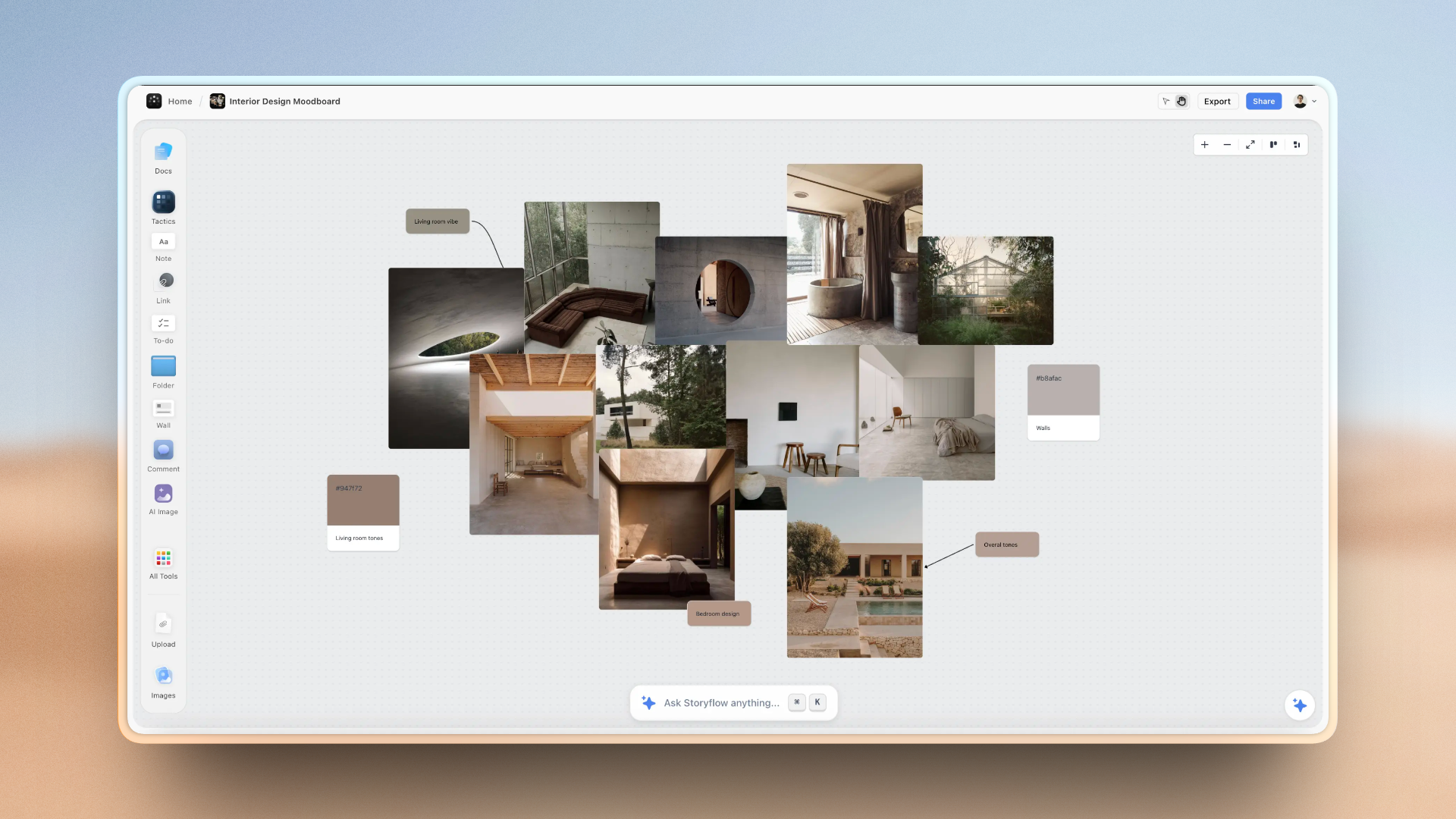
Honest limitation: a canvas tool is not a live-workshop facilitation platform. If you are running a large, high-energy session with twenty people and need timers, breakout rooms, and facilitation controls, a purpose-built workshop tool does that job better. The canvas earns its place for small distributed teams doing the actual creative work, not for facilitating a crowd.
The failure modes that kill a sprint
A sprint fails in predictable ways, and knowing them in advance is most of the defense.
- No decider in the room. The most common killer. The team produces and then waits days for approval, which means there was never a real deadline. Name and schedule the decider before anything else.
- A fuzzy problem statement. If the room cannot write the goal in one sentence, the sprint generates output aimed at nothing. Fix it in the frame phase, or do not start.
- A soft deadline. "By end of week, roughly" is not a deadline. The mechanism depends on a hard, public stop.
- Too many people. Past seven or eight, the sprint becomes a meeting about the sprint. Keep the maker group small.
- Skipping the produce phase. A sprint that ends at "we picked a direction" and never makes the thing has not delivered a decision-ready output.
- Endless diverge. Teams that love the idea-generation phase will stay in it forever. Time-box diverge tightly and force the move to converge even when it feels early. It always feels early.
Where a creative sprint is the wrong tool
A sprint is a specific instrument. Pretending it fits every creative problem is how teams learn to distrust it. It is the wrong tool in four clear cases.
First, deep-research problems that need incubation. Some creative work genuinely improves with time: a positioning that needs weeks of customer interviews, a concept that only clicks after the subconscious has chewed on it. If the honest bottleneck is understanding, not deciding, do the research first and sprint later.
Second, solo work. The sprint's machinery (the roles, the facilitation, the group converge) is overhead when it is just you. Time-boxing still helps, but the ceremony does not.
Third, problems that are not actually urgent. The deadline only works because it is real. If everyone knows the "deadline" is invented and nothing bad happens if it slips, the mechanism is hollow and people behave accordingly. Save the sprint for work that genuinely needs to resolve.
Fourth, using a sprint to avoid a strategy you have not done. This is the subtle one. A sprint is superb at answering "which execution wins" and useless at answering "what are we even trying to do." If you do not know your audience, positioning, or goal, a sprint produces polished output pointed in the wrong direction. Fix the strategy first, then sprint the execution.
The bottom line
A creative sprint is not a smaller design sprint, and it is not a synonym for brainstorming. It is a short, time-boxed process that takes a named creative problem to a decision-ready output, and the reason it works is not the ideation. It is the deadline. The hard stop forces the commitment that open-ended creative work never reaches on its own.
Run it with a clear problem statement, a decider in the room, a small group of makers, and a facilitator who guards the clock. Move through frame, diverge, converge, produce, and review, match the length to the problem, and lean toward the 1-day format more often than you think. Know the four cases where a sprint is the wrong tool, because using it well means also knowing when not to.
If your team is distributed, run the next sprint on one shared board: everyone diverges into cards, clusters together, and the decider approves where the work happened.
FAQ: Creative Sprints
What is a creative sprint?
A creative sprint is a short, time-boxed burst of focused work that moves a creative problem from a blank page to a concrete, decision-ready output, such as campaign directions, a batch of content, or a chosen concept with a rationale. The output must be something a stakeholder can approve or reject, not a loose pile of ideas.
How is a creative sprint different from a design sprint?
The Design Sprint is a specific five-day process from Google Ventures that builds and tests a product prototype with real users. A creative sprint is lighter and output-oriented, aimed at content and campaigns rather than product design, and usually runs in one or two days. Use a design sprint to validate a product idea, and a creative sprint to produce and choose creative work.
How long should a creative sprint be?
Match the length to the problem. A single deliverable with a known audience fits a 1-day sprint, a campaign with a few moving parts fits a 2-day sprint, and a large, ambiguous problem like a full brand campaign can justify a 5-day sprint. Most content and marketing work resolves in one or two days.
What are the phases of a creative sprint?
Five phases in sequence: frame the problem, diverge to generate widely, converge to cluster and cut, produce the actual deliverable, and review it with a decision-maker. The lengths change with the format, but the sequence stays the same.
Who should be in a creative sprint?
Four roles: a facilitator who owns the clock and stays neutral, a decider with authority to approve the output, a small group of makers who generate and produce, and a subject expert who knows the constraints. Keep the maker group to four to seven people, and make sure the decider is present for the converge and review phases.
What is the difference between a creative sprint and brainstorming?
Brainstorming generates ideas and often ends there. A creative sprint generates ideas and then forces them into a decision and a produced deliverable within a fixed deadline. The sprint's defining feature is the hard stop that turns ideas into a choice, which a brainstorm does not require.
Why does a creative sprint use a deadline?
Because the deadline is the actual mechanism. Teams rarely fail creative work for lack of ideas; they fail because the ideas never resolve into a choice. A hard, public deadline forces the commitment that open-ended deliberation avoids, which is why a sprint with a real deadline beats a longer process with a soft one.
Can a creative sprint be run remotely?
Yes, and most now are, since teams are distributed. The key is a shared surface where everyone can diverge into cards at once, cluster together, and let the decider approve in the same place. A shared canvas handles the small-team version well, though a large facilitated workshop with twenty people is better served by a dedicated workshop platform.
How many people should be in a creative sprint?
Keep the maker group small, roughly four to seven people. Past seven or eight, coordination cost eats the time you gained, and the sprint turns into a meeting about the sprint. Pull in subject experts on demand rather than seating everyone for the whole session.
When is a creative sprint the wrong tool?
Four cases: deep-research problems that need incubation rather than a fast decision, solo work where the group machinery is overhead, problems that are not genuinely urgent so the deadline is hollow, and any situation where the real gap is strategy. A sprint answers "which execution wins," not "what are we trying to do," so fix the strategy first.
Can AI help run a creative sprint?
Yes, mostly in the converge and review phases. If the sprint runs on a shared board, an AI that reads the whole board can summarize the strongest directions, flag which clusters are thin, and compress the write-up. The creative judgment and the decision stay with the team.
Table of Contents
- What a creative sprint actually is
- Creative sprint vs design sprint
- Why the deadline is the real mechanism
- The five phases of a creative sprint
- Roles: who does what in the room
- Pick your format: 1-day, 2-day, or 5-day
- Running a creative sprint on a shared canvas
- The failure modes that kill a sprint
- Where a creative sprint is the wrong tool
- The bottom line
- FAQ: Creative Sprints
- Related Reading
Templates to check out for this topic


Templates you can use in Storyflow
Every Storyflow board starts from real structure and an AI that reads the whole canvas. Open one of these templates and make it yours.


See Storyflow in Action
A visual AI workspace where every feature lives inside one canvas. No tab-switching, no context lost.
Build your entire board from a single message
Type what you need in the AI chat at the bottom of your canvas. The AI adds cards, headings, and structure directly onto your board.
Use expert frameworks as AI context
Type @ in the AI chat and choose any Tactic. The AI tailors every response to that framework instead of giving generic advice.
Turn your board into a mind map in seconds
Ask the AI to restructure your canvas as a mindmap. It connects your ideas into a visual hierarchy so you can see how everything relates.
Why Storyflow Exists
Storyflow actually began as a personal tool while working on creative and research projects.
We kept running into the same problem: ideas were scattered everywhere: notes, documents, and whiteboards.
Nothing helped us see how everything connected.
So we started building a workspace designed around how ideas actually grow.
→ Read how Storyflow was createdJustkay
Documentary Filmmaker & Founder at Storyflow
Published: 2026-07-04
Extremely simple, seriously capable


See how easy it is to get started
Watch a real project come together, from a blank board to a finished plan, clicked through step by step.
Start creating with AI and become more productive
Transform your creative workflow with AI-powered tools. Generate ideas, create content, and boost your productivity in minutes instead of hours.