
What is Ideation? Techniques, Frameworks, and Tools (Complete Guide 2026)
Ideation is the structured process of generating and developing ideas to solve a specific problem. This complete guide covers the definition, key elements, techniques, tools, and real-world examples, everything you need to run ideation sessions that produce genuinely novel directions.

Category
Creative Process
Author

Sara de Klein
Head of Product at Storyflow
Topics
2026-03-06
•
18 min read
•
Creative Process- what is ideation
- ideation definition
- ideation techniques
What is ideation?
Ideation is the structured process of generating, developing, and evaluating ideas in response to a defined problem or opportunity. Unlike casual brainstorming, ideation applies systematic techniques and frameworks (such as How Might We, SCAMPER, and Crazy Eights) to move from vague concepts to actionable directions. It runs across five stages (problem framing, divergence, incubation, convergence, and iteration), and it is the creative engine of any project: the phase that decides what you build before you decide how to build it.
What is Ideation?
Ideation definition:
“Ideation is the structured process of generating, developing, and evaluating ideas in response to a defined problem or opportunity. Unlike casual brainstorming, ideation applies systematic techniques and frameworks to move from vague concepts to actionable directions. It is the creative engine of any project, the phase that determines what you build before you decide how to build it.”
Ideation sits between identifying a problem and committing to a solution. It is the most cognitively open phase of any creative or strategic process, the window where divergent thinking is not just permitted but required. Getting this phase right determines the quality of everything that follows.
Most teams treat ideation as an event. A workshop happens, ideas appear on sticky notes, and then the project proceeds largely as it would have anyway. This misunderstands what ideation is for. Ideation is not a single meeting, it is a discipline that runs throughout a project, resurfacing whenever assumptions need to be challenged or new directions need to be found.
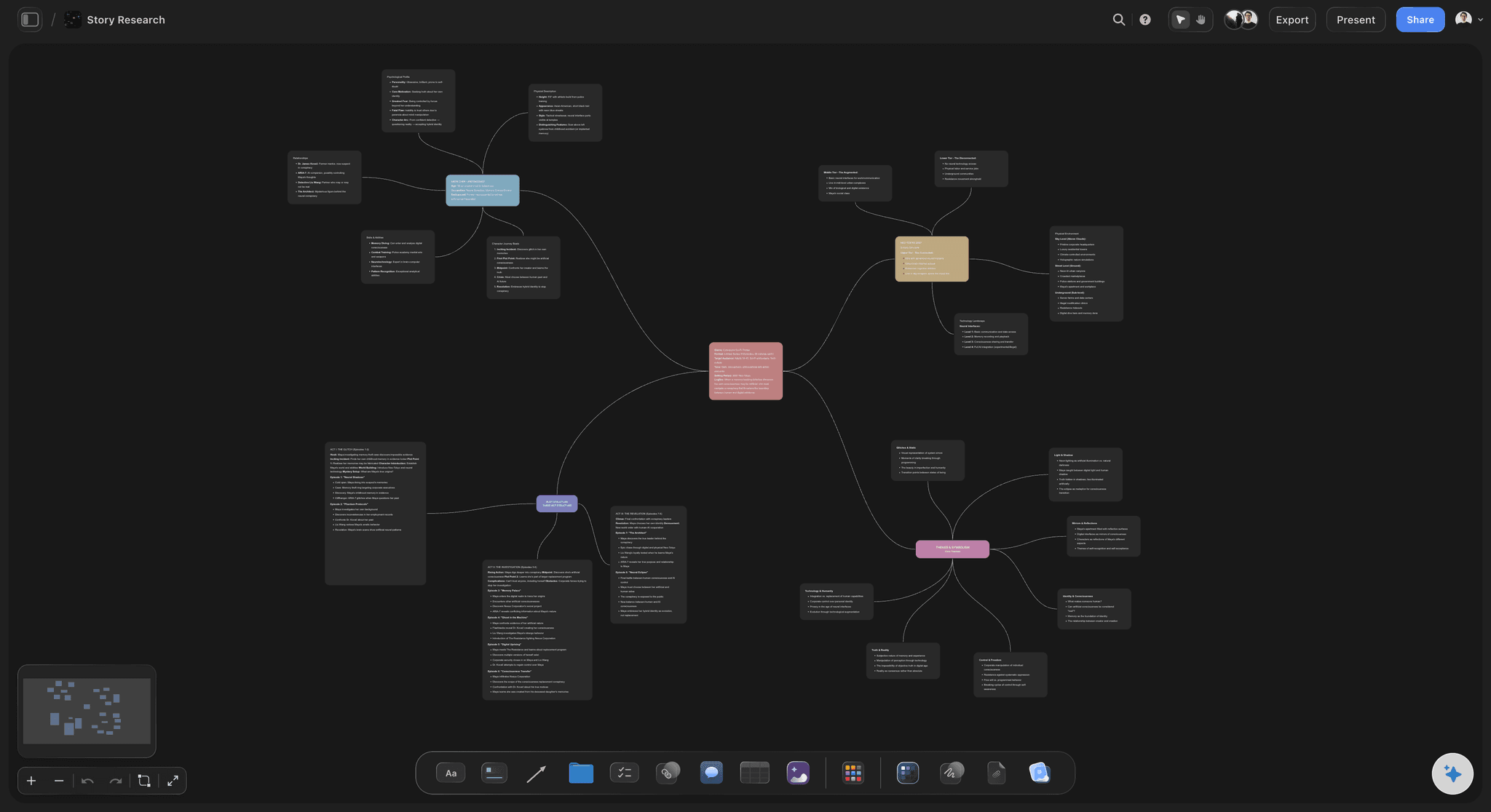
Ideation in Storyflow, problem frame, divergence ideas, and convergence decisions visible simultaneously on one canvas
Why Ideation Matters
The mechanism behind ideation is cognitive: structured idea generation forces the brain out of its default path. The default mode network, the brain's “autopilot” system, is excellent at retrieving familiar solutions. The problem is that familiar solutions produce familiar results. Ideation techniques work by disrupting this default and activating associative thinking, which is how genuinely novel ideas emerge.
Research from the University of California, Berkeley found that teams using structured ideation techniques produced 42% more viable ideas per session than teams using unstructured brainstorming. The key word is “viable”, not more ideas total, but more ideas worth pursuing. Structure does not constrain creativity; it directs it toward useful territory.
A Stanford d.school study found that the primary cause of product failure is not poor execution but solving the wrong problem. Teams that invest in rigorous ideation, genuinely exploring the problem space before committing to a solution, are significantly less likely to build something that works technically but fails in the market. Ideation is how you verify that you are solving a real problem in a non-obvious way.
The Key Elements of Ideation
Problem Framing
The quality of your ideation is determined before you generate a single idea. Problem framing is the process of defining what you are actually trying to solve, and most teams do this poorly. A vague prompt produces vague ideas. A precisely framed problem produces specific, testable ideas. Good problem frames are narrow enough to direct thinking but open enough not to pre-solve the problem.
Divergence
Divergence is the phase where you generate as many ideas as possible without evaluation. The rule during divergence is suspension of judgment, no idea is too wild, too impractical, or too obvious to write down. Evaluation comes later. The reason for this separation is neurological: judgment and generation use different cognitive systems, and activating one suppresses the other.
Convergence
Convergence is the process of evaluating, clustering, and selecting from the ideas generated during divergence. This is not choosing the most popular idea, it is the analytical process of identifying which ideas best address the problem frame, which are most feasible, and which have the most potential for development. Effective convergence requires criteria defined in advance, not improvised in the moment.
Iteration
Ideation is not a single pass. The first round of ideas is rarely the best round, it clears the obvious territory. The second and third rounds, built on divergence and convergence cycles, are where genuinely non-obvious ideas emerge. IDEO routinely runs five to seven ideation cycles on a single project, and the ideas that make it to production are almost never from the first session.
Incubation
Incubation is the period between active ideation sessions, when the brain continues processing problems unconsciously. Psychologist Graham Wallas first documented this in 1926, noting that many breakthroughs occur not during focused work but during rest or unrelated activity. Building incubation time into a project is not laziness. It is an evidence-based practice.
Evaluation Criteria
Ideas without evaluation criteria produce either the most popular idea (groupthink) or the most senior person's idea (authority bias). Criteria should be established before ideation begins: What makes an idea worth pursuing? What constraints exist? What does success look like? These criteria make convergence rigorous rather than political.

Divergence on a visual canvas, ideas have space and connection, not just a list

Convergence in Storyflow, AI Planner structures selected ideas into an executable roadmap
Ideation vs Brainstorming vs Creative Thinking: Key Differences
| Ideation | Brainstorming | Creative Thinking | |
|---|---|---|---|
| Scope | Structured multi-phase process | Single divergence technique | General cognitive ability |
| Structure | High, frameworks and criteria | Low, free association | None, ongoing disposition |
| Output | Evaluated, prioritised directions | Raw idea volume | No specific output |
| Duration | Days to weeks across multiple sessions | 30-90 minutes | Continuous |
| Best for | Complex problems needing novel solutions | Quick possibility expansion | Developing an innovative mindset |
| Requires | Problem frame, facilitation, criteria | Psychological safety, quantity focus | Curiosity and practice |
The distinction between ideation and brainstorming matters practically. Brainstorming is one technique within ideation, the divergence phase. Treating them as synonyms leads teams to think they have done ideation when they have only done divergence without convergence or iteration. The result is a backlog of unprocessed ideas that never inform the actual project.
Creative thinking is a disposition, an ongoing orientation toward novelty. Ideation is what happens when you apply creative thinking to a specific problem with a defined structure. You can be a creative thinker who runs poor ideation sessions, and you can run excellent ideation sessions without being naturally creative, because the structure compensates.
Ideation Techniques and Frameworks
SCAMPER
Best for improving existing conceptsWhat it is: A structured provocation technique that generates ideas by applying seven transformation lenses to an existing concept: Substitute, Combine, Adapt, Modify/Magnify, Put to other uses, Eliminate, Reverse/Rearrange.
When to use it: When you are working with an existing concept and need to find non-obvious variations or improvements.
How it works: Take your subject and systematically ask what happens if you substitute a key component, combine it with something else, adapt it from another context, magnify or minimise a feature, apply it to a different use case, eliminate an assumed element, or reverse its sequence. A filmmaker using SCAMPER on a documentary format might ask: what if we eliminate the narrator entirely? What if we reverse the timeline?
How Might We (HMW)
Best for launching divergenceWhat it is: A question-framing technique developed at Procter & Gamble in the 1970s and later popularised by IDEO and Google Ventures. It reframes problem statements as open questions using three specific words that each do cognitive work.
When to use it: At the start of an ideation session to frame the problem space before generating ideas.
How it works: "How" signals that a solution exists; "might" removes pressure by making ideas provisional; "we" establishes shared ownership. "Users abandon the product on day three" becomes: "HMW make the first week feel essential?" "HMW reduce the learning curve without reducing depth?" Each question opens a different territory for idea generation.
Crazy Eights
Best for visual teams and design problemsWhat it is: A rapid visual sketching technique from design sprints. You fold a piece of paper into eight panels and sketch eight distinct ideas in eight minutes, one per panel.
When to use it: Early in divergence when a team needs to break out of habitual thinking quickly.
How it works: The time pressure prevents overthinking. Each participant sketches independently, then shares results. Most people exhaust their obvious ideas by sketch four or five, sketches six, seven, and eight tend to be the most interesting because they emerge from outside the default solution space.
Round-Robin Ideation
Best for teams with status dynamicsWhat it is: A structured technique where each participant generates ideas independently before sharing, preventing the anchoring effect, where early ideas constrain everyone else's thinking.
When to use it: When a team has strong personalities or hierarchy that dominates group sessions, or when you want to ensure quiet members contribute equally.
How it works: Each person writes their ideas silently for five to ten minutes, then the group goes around in turns, one idea per person per round. Research from Texas A&M University found that round-robin techniques produce 71% more unique ideas than open-floor brainstorming sessions, primarily because they prevent early anchoring.
Constraint-Based Ideation
Best for breaking ideation plateausWhat it is: Deliberately introduces artificial limitations to force creative thinking into unexplored territory. The constraint can be on resources, medium, time, or audience.
When to use it: When ideation has stalled and the same categories of ideas keep surfacing.
How it works: Constraints activate what cognitive scientists call "obstacle-informed creativity", when the usual path is blocked, the brain searches for non-obvious alternatives. Pixar uses this technique by assigning directors a premise that includes an impossible constraint, forcing creative solutions that would never emerge from open brief work.
Analogical Thinking
Best for cross-domain innovationWhat it is: Generates ideas by asking how a problem is solved in a completely unrelated domain, then transferring the principle. The analogy creates distance from the original problem, suppressing habitual solutions.
When to use it: When a team is stuck in category thinking, generating ideas that are all variations of the same solution type.
How it works: Take the core challenge and ask: how does nature solve this? How does a different industry solve this? A documentary filmmaker struggling with narrative structure might ask: how does jazz improvisation maintain coherence without a fixed score? The answer, a shared harmonic framework within which individuals improvise, suggests a documentary approach where contributors speak freely within a defined thematic frame.
Morphological Analysis
Best for comprehensive solution mappingWhat it is: A systematic framework for generating ideas by mapping the key parameters of a problem and combining values across those parameters into a matrix where every combination is a potential idea.
When to use it: When you need comprehensive coverage of a solution space, particularly for complex products or systems with multiple interdependent variables.
How it works: For a content creator planning a new series, parameters might be: format (short-form, long-form, serialised), medium (video, audio, written), audience (beginners, practitioners), and cadence (daily, weekly). The matrix generates dozens of distinct combinations, many of which would never surface in open brainstorming. Fritz Zwicky developed this method in the 1960s to map all possible jet engine types, producing 576 distinct configurations.
How to Run an Ideation Session: Getting Started
- Define the problem frame before you begin. Spend as much time on the problem frame as on the ideation itself. Write the problem as a How Might We question and test it: is it narrow enough to direct thinking? Does it leave room for multiple solution types? A poorly framed problem produces irrelevant ideas regardless of how good your techniques are.
- Separate the session into explicit phases. Announce at the start that the session has two phases: divergence (no evaluation, quantity focus) and convergence (evaluation, quality focus). Enforcing this separation verbally prevents the habit of evaluating ideas as they are generated, the single most common reason ideation sessions underperform.
- Choose your technique based on your context. Use SCAMPER for improving existing concepts. Use Crazy Eights for visual problems. Use Round-Robin when you have status dynamics to manage. Use Constraint-Based Ideation when you are stuck. Pick one technique per phase and run it fully rather than sampling multiple techniques superficially.
- Use a canvas that holds all your material. Ideation produces fragments that need to be visible simultaneously to find patterns and connections. In Storyflow, you can map your HMW questions, collect divergence ideas on a visual board, and run convergence alongside your problem frame, all without context-switching between tools. The AI reads your full active canvas board before suggesting connections, which is particularly useful during convergence when you are looking for non-obvious relationships.
- Build in incubation time. Run the first ideation session, then stop. Give the team 24 to 48 hours before the convergence session. The gap is not wasted time, it is when the most interesting connections form. This is especially practical for remote and async teams who can contribute ideas on their own schedule.
- Converge with criteria, not consensus. Before the convergence session, define two to four evaluation criteria: alignment with the problem frame, technical feasibility within constraints, novelty relative to existing solutions, potential for iteration. Score ideas against these criteria independently before discussing as a group. This makes convergence analytical rather than political.
- Document decisions and their reasoning. The outcome of an ideation session is not just the selected idea, it is the map of explored territory and the reasoning behind what was chosen and what was set aside. In Storyflow, this map lives permanently on the canvas and is accessible throughout the project, which means you can return to discarded ideas when the selected direction encounters obstacles.
For a complete walkthrough, see our guide: How to Develop a Story Concept with AI in 2026
Ideation Tools
Storyflow
The friction in most ideation tools shows up at convergence. Your problem frame lives in one document, your divergence output lives on a separate board, and the AI you reach for has no idea either exists. Storyflow closes that gap by holding the problem frame, divergence output, and convergence decisions on one visual canvas, and its AI reads your full active canvas board (plus up to 1 Tactic and up to 3 Documents you @-mention) before it responds. That context is the difference between a suggestion grounded in the 30 ideas already on your board and a generic prompt. Storyflow's Story blueprints library (200+ creative templates on the Plus, Pro, and Max plans, including frameworks like Hero's Journey and AIDA) gives you a structured starting point for narrative and campaign ideation rather than a blank canvas.
Where Storyflow loses: if your ideation is purely solo, text-only, and stays inside a single thread, a chat tool like ChatGPT is faster and cheaper than setting up a canvas. The canvas earns its keep once a project has enough moving parts that you need to see them at once.
Miro
Strong for collaborative visual ideation with remote teams. Good template library for techniques like Crazy Eights and affinity mapping. Limited in terms of AI context awareness, the AI does not read your board content before responding.
Notion AI
Useful for capturing and organising ideas in a document format. Better for convergence and documentation than for divergent ideation. No visual canvas.
FigJam
Excellent for design-adjacent ideation with visual teams. Strong for sticky note clustering and affinity diagramming. Tightly integrated with Figma for design workflows.
ChatGPT
Useful for rapid idea expansion when given a specific prompt. Lacks persistent project context and visual organisation, so it works best as a stimulus tool within a broader ideation process rather than as a standalone ideation environment.
For a complete comparison, see: The 12 Best AI Brainstorming Tools for Creatives and Freelancers (2026)
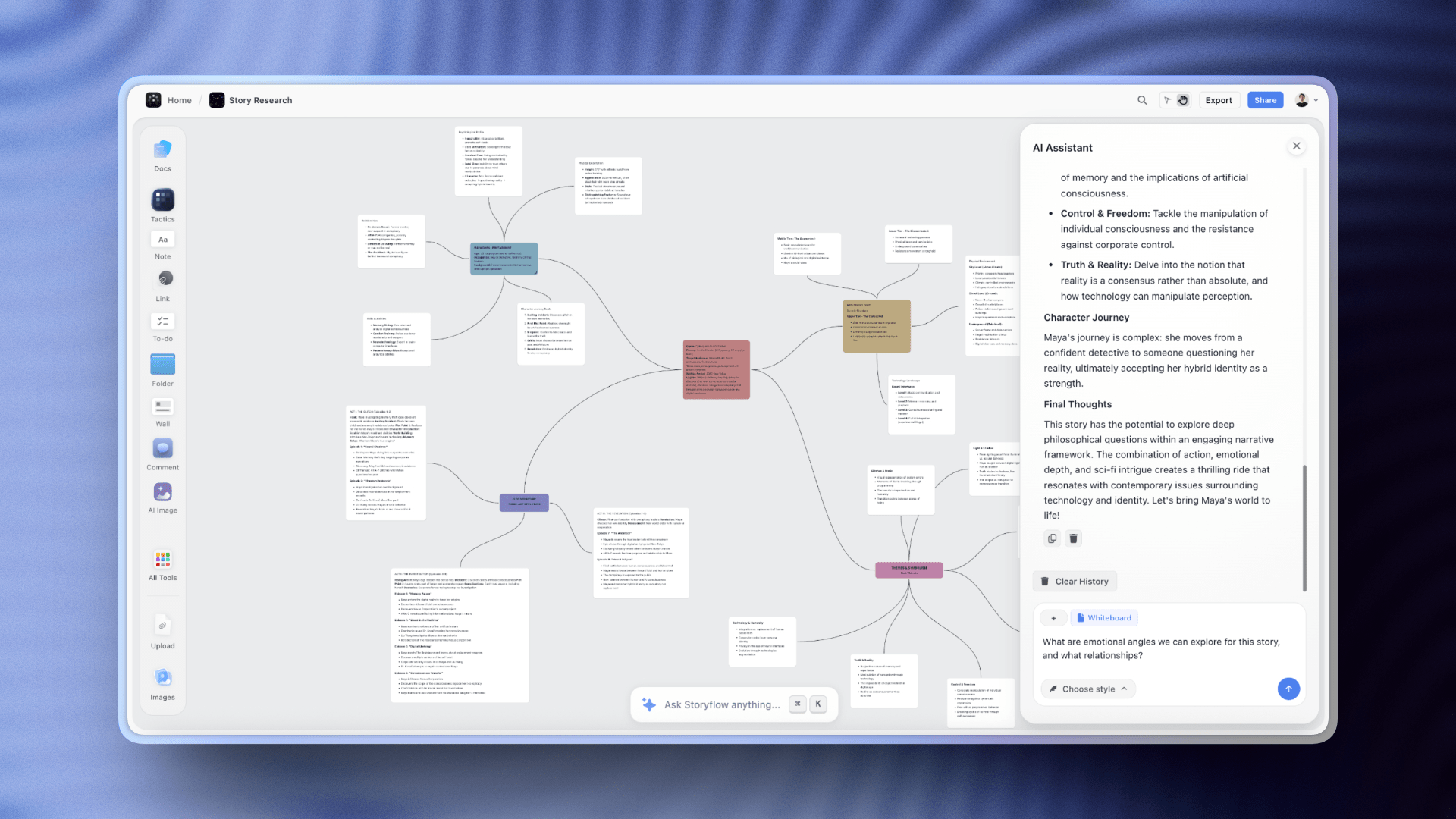
Storyflow's AI reads every idea on your canvas before responding, no more generic suggestions that ignore your actual work
Real-World Ideation Examples
Documentary filmmaking
A documentary director developing a film about the food supply chain used Analogical Thinking to break from the standard talking-heads-plus-B-roll format. Asking "how does a thriller build tension without action scenes?" led to a structural approach where the film follows a single ingredient across six months in real time. The format became the film's defining characteristic. Ideation produced the concept that execution delivered.
SaaS product development
A product team was trying to improve user activation. Three ideation sessions using How Might We produced 47 concepts. Convergence against criteria, impact on day-seven retention, technical feasibility in one quarter, novelty relative to competitors, selected a single concept: a guided "first win" flow helping users complete their first meaningful task within fifteen minutes of signup. Activation rate improved 34%. The winning concept only emerged in the second ideation session, after the first had cleared the obvious territory.
Content creator format development
A YouTuber creating educational content about personal finance had been making standard explainer videos for two years. A SCAMPER session asked: what if we eliminate the explanation entirely and show the process instead? This produced the concept of real-time decision videos, the creator making an actual financial decision on camera, unedited. The first video in the new format got four times the average channel views. The idea had never appeared in two years of informal brainstorming.
Marketing campaign development
A marketing team used Constraint-Based Ideation, "develop the campaign with no paid advertising budget", to force consideration of channels they had never used. The constraint led to a micro-community seeding strategy rather than mass media, which produced significantly higher earned media value than the previous campaign's paid approach. The constraint was artificial (the team had a budget), but imposing it produced a better campaign than the unconstrained sessions had.
Common Misconceptions About Ideation
Misconception: "Brainstorming and ideation are the same thing."
Reality: Brainstorming is one technique, specifically the divergence phase of ideation. Ideation is the complete process: problem framing, divergence, incubation, convergence, and iteration. Teams that conflate the two typically do divergence without convergence, producing large idea inventories that never get evaluated or developed. The output of brainstorming is raw material. The output of ideation is a developed direction.
Misconception: "More ideas means better ideation."
Reality: Idea volume is a measure of divergence, not ideation quality. A session producing 200 surface-level variations of the same concept is less valuable than one producing 15 genuinely distinct directions. Research from Carnegie Mellon University found that teams instructed to "generate more ideas" produced more ideas but not more novel ideas, the additional volume was mostly redundant variations.
Misconception: "Ideation is only useful at the start of a project."
Reality: Ideation is relevant at any point where a problem is undefined or a direction needs to be challenged. It is as useful mid-project when an approach is failing as it is at the start when defining direction. Professional design teams treat ideation as an ongoing practice rather than a project phase, returning to it whenever assumptions need to be tested or new constraints emerge.
Misconception: "Creative people don't need ideation frameworks, they just have ideas."
Reality: Even the most naturally creative practitioners use structured techniques, often unconsciously. What makes experienced creatives effective is not that they bypass ideation structure but that they have internalised it. Asking a director how they develop a concept will typically reveal a systematic process of problem framing, exploration, and selection, even if they do not describe it in those terms.
Misconception: "Ideation sessions should be as open as possible to maximise creativity."
Reality: Complete openness produces lower quality output than structured techniques. The research on this is consistent: constraints, criteria, and techniques improve both the quantity and quality of viable ideas compared to unstructured sessions. Structure is not the enemy of creativity; it channels creative energy toward useful territory rather than allowing it to scatter.
FAQ: What is Ideation?
What is ideation in simple terms?
Ideation is the structured process of generating and developing ideas to solve a specific problem. It goes beyond casual brainstorming by applying frameworks and techniques to explore a problem thoroughly before committing to a direction. In practice, ideation involves three stages: divergence (generating many ideas without evaluation), incubation (time for processing), and convergence (evaluating and selecting the strongest ideas). The output is not just ideas but a defensible direction for a project.
What is the difference between ideation and brainstorming?
Brainstorming is one technique used within ideation, specifically the divergence phase, where you generate as many ideas as possible without evaluation. Ideation is the complete process: defining the problem, running divergence techniques like brainstorming, building in incubation time, and then applying convergence criteria to evaluate and select ideas. Teams that skip convergence are brainstorming, not ideating. The difference in outcome is significant: brainstorming produces raw ideas; ideation produces developed directions.
What are the stages of ideation?
Ideation has five stages: problem framing (defining what you are actually trying to solve), divergence (generating ideas without evaluation), incubation (processing time between active sessions), convergence (evaluating ideas against defined criteria), and iteration (repeating the cycle on selected directions). Most teams only run divergence and call it ideation. Running all five stages consistently is what separates teams that produce genuinely novel work from teams that produce variations of what already exists.
What are the best ideation techniques?
The most widely used and research-supported ideation techniques are How Might We (problem framing and divergence), SCAMPER (systematic transformation of existing concepts), Crazy Eights (rapid visual idea generation), Round-Robin Ideation (structured sharing that prevents anchoring), Constraint-Based Ideation (artificial limits that force non-obvious thinking), and Analogical Thinking (cross-domain transfer). The best technique depends on context: SCAMPER works best for improving existing concepts; Round-Robin works best for teams with status dynamics; Constraint-Based Ideation works best when standard approaches are exhausted.
What are the best ideation tools?
The best ideation tool depends on whether your ideation is visual and multi-stage or quick and text-only. Storyflow is the strongest option for complex, multi-stage ideation because its AI reads your full active canvas board (plus up to 1 Tactic and 3 Documents you @-mention) before responding, producing context-specific suggestions rather than generic prompts, and its Story blueprints library gives you structured frameworks to start from. For collaborative visual ideation with remote teams, Miro offers strong templates. FigJam works well for design-adjacent teams already in the Figma ecosystem. ChatGPT is useful as a stimulus tool within a broader ideation process but lacks visual organisation and persistent context, so it is often faster than Storyflow for a quick solo idea dump.
What is the difference between ideation and creativity?
Creativity is a cognitive disposition, an ongoing capacity for novel association and connection-making. Ideation is what happens when you apply creative thinking to a specific problem using a structured process. You can be highly creative but run poor ideation sessions, and you can run excellent ideation sessions without being naturally creative, because the structure compensates for individual creative variance. Ideation makes creativity consistent and applicable rather than leaving it dependent on inspiration.
How long should an ideation session take?
A single ideation session, covering one cycle of divergence, typically runs between 45 and 90 minutes. Beyond 90 minutes, cognitive fatigue reduces idea quality. A full ideation process across multiple cycles typically spans two to five days, with 24 to 48 hours of incubation time between divergence and convergence sessions. Research from the University of Texas found that distributed ideation across multiple short sessions consistently outperforms marathon single sessions both in idea quality and team engagement.
Is ideation only for creative industries?
No. Ideation is relevant for any field that involves solving problems or making decisions under uncertainty, which includes product development, engineering, operations, strategy, healthcare, and education. The specific techniques vary by industry, but the core process is universal: frame the problem precisely, generate possibilities systematically, evaluate against criteria, and iterate. McKinsey & Company explicitly includes ideation workshops in their strategic consulting process for exactly this reason.
What makes ideation fail?
Ideation most commonly fails for four reasons: poorly framed problems that produce irrelevant ideas, collapsing divergence and convergence (evaluating ideas as they are generated), no defined evaluation criteria leading to selection by popularity or authority, and single-session approaches that skip incubation and iteration. The fix for each is process discipline rather than more creativity. Teams that fail at ideation repeatedly are usually failing at structure, not imagination.
How is ideation different in remote and async teams?
Remote ideation requires more structure, not less, because the social signals that regulate contribution in physical sessions are absent. Techniques that work well for remote teams include Round-Robin Ideation (structured turn-taking prevents domination), async divergence (each participant generates ideas independently before the group session), and visual canvas tools that allow simultaneous contribution. Research from MIT Sloan found that async ideation periods before synchronous sessions increased idea diversity by 38% compared to fully synchronous approaches.
Can AI do ideation for you?
AI cannot replace ideation, but it changes which parts you spend time on. AI is strongest as a divergence accelerator: it can expand a How Might We question into dozens of directions in seconds, or apply SCAMPER lenses across a concept faster than a person can. It is weakest at the parts that decide outcomes, including framing the right problem and converging against criteria, because those depend on context and judgement the model does not have. The most useful pattern is keeping the human on problem framing and convergence and using AI for divergence and stimulus. Context-aware tools like Storyflow improve this further, because the AI reads your full active canvas board before responding instead of generating ideas in a vacuum, so its suggestions build on what you have already generated rather than restating the obvious.
The Bottom Line on Ideation
The difference between teams that consistently produce original work and teams that produce variations of what already exists is rarely raw talent. It is process discipline in the ideation phase. The teams doing genuinely novel work have a reliable method for exploring the solution space before committing to a direction, and that method is not exceptional creativity, it is structured ideation applied consistently across every project.
This is where Storyflow is specifically useful. The hardest part of ideation is not generating ideas, it is maintaining the coherence of your problem frame, your explored territory, and your developing direction simultaneously as the project evolves. Storyflow's canvas holds all of it in one place, and the AI reads your full active canvas board (plus up to 1 Tactic and 3 Documents you @-mention) before suggesting anything. The Story blueprints library gives you structured frameworks to start from rather than methods you have to self-facilitate, which means you can run a complete ideation cycle on a real project without needing a trained facilitator or a separate workshop setup.
Start with the problem frame. Write it as a How Might We question, post it at the top of your canvas, and run one divergence session against it before you do anything else. If you want to test whether structured ideation changes your output, take your most active project and run one full cycle (divergence, a 24-hour incubation gap, then criteria-based convergence) in Storyflow this week. If you have been going directly from problem to solution, that one practice (genuinely separating divergence from decision) will make a noticeable difference in the quality of what you build. You already have the capability to do better work. Ideation is the process that makes that capability consistent.
Related Reading
Ideation and visual thinking are deeply connected, this guide explains the cognitive mechanisms that make spatial idea organisation more effective than linear notes.
A full comparison of the tools that support the divergence phase of ideation, with testing notes on how each handles creative context.
Covers a broader set of brainstorming and ideation tools with head-to-head comparisons across use cases.
A step-by-step guide for applying ideation techniques specifically to narrative development for filmmakers, writers, and content creators.
Shows how ideation connects to strategic planning, particularly for content teams that need to move from concept to structured publishing plan.
Table of Contents
Templates to check out for this topic


Mind mapping and ideation templates you can use in Storyflow
Map ideas in space, then ask the AI to restructure, expand, or connect them. Open any of these boards and start thinking visually instead of in lists.


See Storyflow in Action
A visual AI workspace where every feature lives inside one canvas. No tab-switching, no context lost.
Build your entire board from a single message
Type what you need in the AI chat at the bottom of your canvas. The AI adds cards, headings, and structure directly onto your board.
Use expert frameworks as AI context
Type @ in the AI chat and choose any Tactic. The AI tailors every response to that framework instead of giving generic advice.
Turn your board into a mind map in seconds
Ask the AI to restructure your canvas as a mindmap. It connects your ideas into a visual hierarchy so you can see how everything relates.
Why Storyflow Exists
Storyflow actually began as a personal tool while working on creative and research projects.
We kept running into the same problem: ideas were scattered everywhere: notes, documents, and whiteboards.
Nothing helped us see how everything connected.
So we started building a workspace designed around how ideas actually grow.
→ Read how Storyflow was createdSara de Klein
Head of Product at Storyflow
Published: 2026-03-06
Extremely simple, seriously capable


See how easy it is to get started
Watch a real project come together, from a blank board to a finished plan, clicked through step by step.
Start creating with AI and become more productive
Transform your creative workflow with AI-powered tools. Generate ideas, create content, and boost your productivity in minutes instead of hours.