
How to Plot a Novel Visually (Without Killing the Draft)
A novel is a sequence you read in order and a structure you can only judge all at once. An outline shows the first. Pacing, thread coverage and character presence live in the second, and a document cannot display them.

Category
Writing
Author

Justkay
Documentary Filmmaker & Founder at Storyflow
Topics
2026-08-26
•
16 min read
•
Writing- how to plot a novel visually
- app to visually plot a novel
- novel plotting grid
- novel structure diagnosis
- why does my novel sag in the middle
- index cards novel plotting
How do you plot a novel visually?
A novel is a sequence you read in order and a structure you can only judge all at once. An outline shows the first. Pacing, thread coverage and character presence live in the second, and a document cannot display them.
Key Takeaways
- A novel has two shapes and writers keep trying to hold both in one document. It is a sequence you read in order, and a structure you can only judge by seeing all of it at once.
- An outline is the sequence. A visual plot is the structure. They answer different questions, and the questions structure answers are the ones that make a draft fail in month four.
- The four things you can only see spatially: pacing (where the flat stretch is), thread coverage (which subplot vanishes for eleven chapters), character presence, and the shape of change.
- Plot visually with cards you can move, one row per thread, and time running left to right. Everything else is a variation on that.
- The real risk is over-plotting: a structure so complete that writing becomes transcription, and transcription is where prose goes flat. Plot the shape, not the sentences.
The Two Shapes of a Novel
Every novel exists in two forms at once, and confusing them is the most common structural mistake writers make.
The sequence. What a reader experiences: one thing, then the next thing, in order, at a specific pace. This is what an outline captures and what a manuscript is. It is linear because reading is linear.
The structure. The book as an object, seen from above: three subplots weaving, a character who disappears for a third of the middle, the two chapters that do the same work, the fact that everything interesting happens in the first quarter and the last, and nothing in between.
A document can hold the sequence perfectly and cannot show you the structure. Scroll through forty chapter summaries and you are experiencing them one at a time, which is exactly the condition that makes structural problems invisible. You cannot notice that the subplot vanishes for eleven chapters when you can only see two chapters at once, because noticing that requires comparison, and comparison requires simultaneity.
This is why writers get to draft two, sense that something is wrong in the middle, and cannot locate it. The middle is not wrong at the sentence level. It is wrong at a level the document cannot display.
Four problems are structural, and all four are close to invisible in an outline:
Pacing. Where the flat stretch is. Almost always somewhere in the second act, and almost always caused by several chapters in a row where the protagonist is reacting rather than choosing.
Thread coverage. Which subplot goes quiet, for how long, and whether the reader will have forgotten it by the time it returns.
Character presence. Who is on the page, how often, and the gap where a major character silently disappears for eight chapters.
The shape of change. Whether the protagonist's arc actually moves, or whether they have the same realisation three times in slightly different words.
None of those are visible in a list. All of them are obvious in about ninety seconds on a wall.
The Grid
The method is one idea and everything else is a variation on it.
Time runs left to right. Threads run top to bottom.
- One column per chapter or scene, in order.
- One row per thread: the main plot, each subplot, each major character's arc, and optionally one for the emotional register.
- A card sits at the intersection when that thread is active in that chapter.
That is the whole thing. Build it and step back, and the four problems above become visible immediately.
Gaps in a row are a thread going quiet. A four-chapter gap is usually fine. An eleven-chapter gap means the reader has forgotten it, and its return will feel arbitrary rather than satisfying.
Columns with only one card are thin chapters. One thread, no weave, and they are frequently the chapters readers describe as slow without being able to say why.
Columns with six cards are overloaded, and this is where a chapter should probably become two.
A row that is dense at the start and end and empty in the middle is a subplot you introduced, abandoned, and resolved, which readers experience as a cheat.
A row with even spacing and no escalation is a thread that is present but not developing, which is worse than absent because it takes up space.
You can build this on a wall with index cards, in a spreadsheet, or on any canvas. The tool matters far less than the two axes.
Building It, Step by Step
Step 1: Get the chapters onto cards
One card per chapter or scene. On each: what happens, who is present, and what changes by the end. Three lines maximum, because a card you have to read defeats the purpose.
The "what changes" line is the one to insist on. A chapter where nothing changes is a chapter where nothing happens, however good the prose is, and writing that line forces the admission.
If you are plotting before drafting, these are intentions. If you are diagnosing an existing draft, they are what is actually on the page, which is frequently not what you intended, and the discrepancy is itself the finding.
Step 2: Lay them out in reading order
Left to right, one row, in the order a reader meets them. This alone is useful: seeing forty chapters at once is a different experience from scrolling them, and problems start surfacing before you have added a single thread.
Step 3: Add the thread rows
Now go back through and mark which threads are live in each chapter. Main plot, romantic subplot, the mystery, the sibling relationship, the protagonist's arc.
Use whatever visual distinction the surface allows: colour, a row position, a symbol. On a wall, coloured cards. On a canvas, a row per thread. In a spreadsheet, a filled cell.
Resist adding more than five or six rows. More threads than that is usually a book with a structure problem you are about to document in detail rather than fix.
Step 4: Mark the turns
The points where the direction changes. The protagonist chooses instead of reacts. The reversal, the point of no return, the moment the reader's understanding is corrected.
Whatever structural model you use (three acts, the hero's journey, save the cat, or nothing at all) the turns are the load-bearing points, and their spacing is the single most reliable predictor of pacing. Clustered turns produce a rushed section. A long gap between turns is the flat stretch you already suspected.
Step 5: Step back and read the shape
This is the step and it takes five minutes.
Do not read the cards. Look at the pattern. Where are the gaps, the thin columns, the dense ones, the rows that flatline. Take a photograph if it is physical, because you will want the before.
Almost everybody finds the same three things on a first pass: a subplot that disappears longer than they realised, a stretch of consecutive chapters where the protagonist only reacts, and two chapters doing the same work.
Step 6: Move things, then stop
Fix what the shape showed you. Move a chapter, split an overloaded one, cut one of the two duplicates, introduce a thread earlier so its return lands.
Then stop, and this is the part that matters more than anything else on this page. The structure is a diagnostic, not a script. Once it tells you what is wrong, go back to writing. The temptation is to keep refining until every chapter is specified, and that is where drafts die.
Where to Build It
| Where | Moving cards | Sees everything at once | Persists | Free |
|---|---|---|---|---|
Index cards on a wall or floor | Best | Yes, if the room is big enough | No, photograph it | Cost of cards |
Scrivener corkboard | Good | Partially, scrolls | Yes, with the manuscript | ~$59 one-off |
Milanote | Good | Yes | Yes, nested boards | Free to 100 notes |
Storyflow | Good | Yes | Yes, and the AI reads it | Paid, early access |
Miro or FigJam | Good | Yes | Yes | Free tiers with caps |
Spreadsheet | Poor | Yes, and it is legible | Yes | Free |
Plottr | Purpose-built timeline | Yes | Yes | From ~$25 yr |
Obsidian Canvas | Good | Yes | Yes, files are yours | Free personal |
Two honest notes. Index cards still win for the first pass if you have the floor space, because physical arrangement is faster than any interface and the constraint of a finite room forces editing. And Scrivener is the right long-term home, because the corkboard sits on top of the actual manuscript, so moving a card moves the chapter rather than moving a picture of it.
For the diagnostic pass specifically, a canvas helps because you can hold forty cards and five thread rows in view. Storyflow, which we make, adds that the AI can read the whole grid, so questions like which threads go quiet longest, which chapters do the same work, and where the protagonist stops choosing are answerable from the board rather than by squinting at it. It is paid-only during early access from $7.99 a month annual, with the Free plan landing before the end of 2026. Milanote's free tier does the canvas half for nothing, and a spreadsheet does the grid half for nothing.
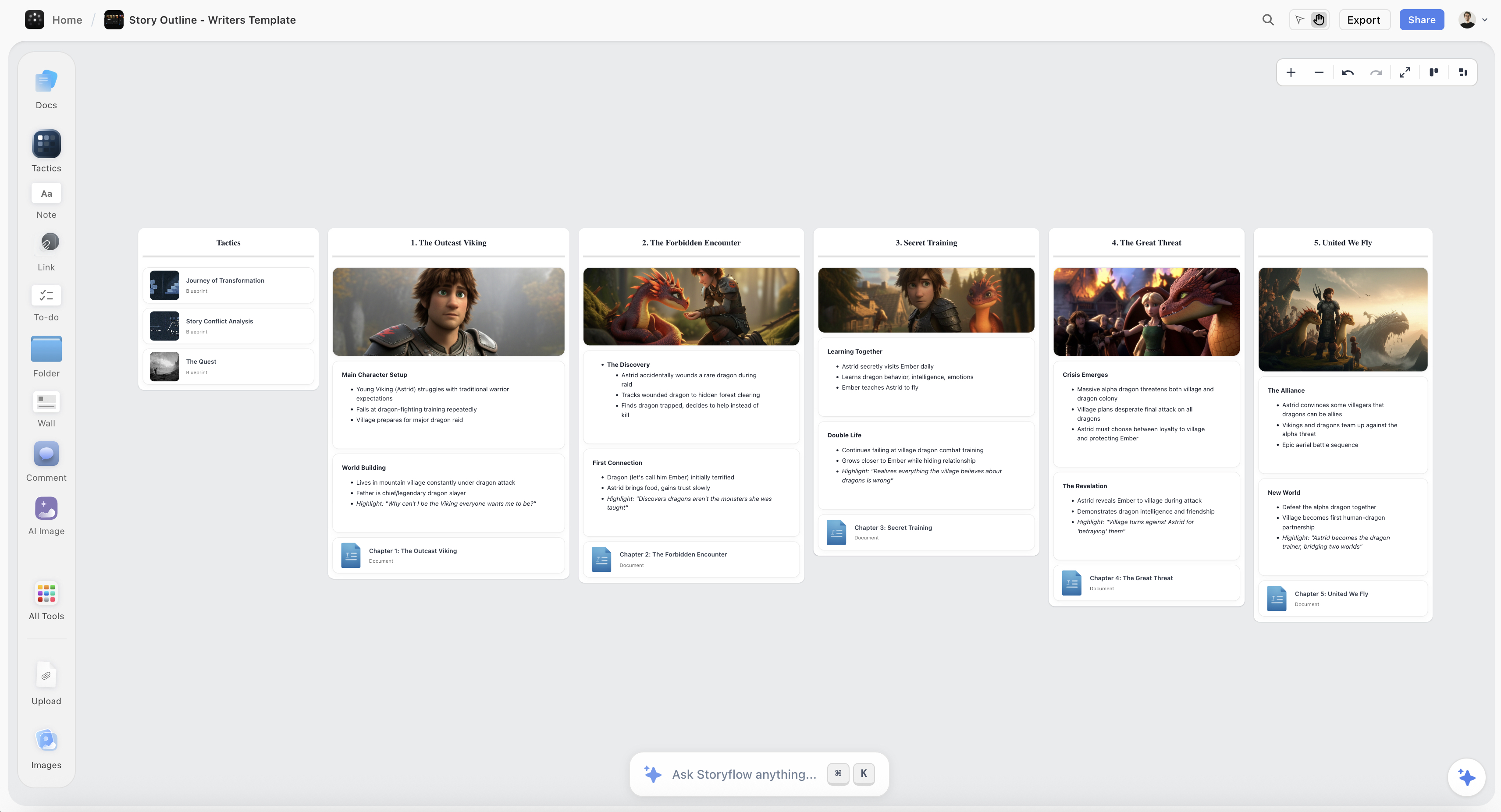
A novel plotted as a grid on a Storyflow canvas, chapters left to right and plot threads top to bottom
Look at the pattern, not the cards
Gaps in a thread row, thin columns, a protagonist who stops choosing for six chapters: all obvious in a grid and invisible in a document. Storyflow holds the whole grid on one canvas and its AI reads it, so which threads go quiet longest becomes a question. Index cards on a wall work too, and cost less.

The Over-Plotting Risk
Worth stating plainly, because visual plotting makes this failure much easier to reach.
A structure that is too complete kills the draft. When every chapter is specified, every beat assigned, and every thread mapped, writing becomes transcription. And transcription produces flat prose, because the discoveries that make a scene alive are made while writing it, not while planning it.
The signs you have gone too far: your cards contain dialogue, you have specified chapters you have no feeling for, the plan is more interesting to work on than the draft, or you have been plotting for three weeks.
The correct amount is the amount that answers a structural question you actually have. If you are pre-draft, that is usually the turns and the rough thread map, and nothing else. If you are diagnosing draft two, it is the full grid, once, and then back to the manuscript.
A useful rule: plot until you can see the shape, then stop before you can see the sentences.
What Goes Wrong
Plotting instead of writing. The most common and the most comfortable failure, because a plot always feels like progress and a bad first draft does not.
Too many thread rows. Nine rows is documenting a mess rather than diagnosing one. If you genuinely have nine threads, that is the finding.
Cards with too much on them. A card you have to read is a card you cannot scan, and scanning is the whole technique.
Plotting a first draft in detail. For a first novel especially, the structure you would plan is usually the structure you have read elsewhere. Draft, then diagnose, produces something more yours.
No "what changes" line. Without it, a card can describe a chapter where nothing happens, and it will look identical to one where something does.
Confusing structure with a template. A three-act grid can be filled in correctly and still be dead. The structure shows you shape; whether the shape is any good is a separate judgment.
Never photographing the wall. Physical plotting is the best method and its output is ephemeral. Photograph it before you take it down, every time.
The Bottom Line
The reason writers get to draft two and cannot locate what is wrong is not a failure of attention. It is that they are looking at the book in the only form a document can show them, which is one chapter at a time, and the problems they are hunting are only visible when the whole book is in view.
Pacing, thread coverage, character presence, and the shape of change are structural. They live in the relationship between chapter four and chapter twenty-six, and no amount of careful rereading surfaces them, because rereading is sequential and the problem is not.
The grid fixes that, and it is almost embarrassingly simple. Chapters left to right, threads top to bottom, a card where they meet. Build it, step back, and look at the pattern rather than the cards. Most writers find three real problems in the first five minutes.
Then fix those three things and close the board. The structure is there to tell you what is wrong, not to tell you what to write, and a plot detailed enough to write from is a plot detailed enough to make the writing dead.
FAQ: Plotting a Novel Visually
How do you plot a novel visually?
Time runs left to right, threads run top to bottom. One column per chapter, one row per plot thread or character arc, a card at each intersection where that thread is live. Build it, step back, and look at the pattern rather than reading the cards. Gaps, thin columns, and flatlining rows are the structural problems that an outline cannot show you.
What is the best app to plot a novel visually?
Index cards on a wall for the first pass, if you have the floor space, because physical arrangement beats any interface. Scrivener's corkboard as the long-term home, because the cards sit on the actual manuscript. Milanote or Storyflow if you want a persistent canvas that holds the whole grid, and Plottr if a purpose-built timeline suits how you think.
What is the difference between an outline and a visual plot?
An outline is the sequence: what happens in order, which is what a reader experiences. A visual plot is the structure: the book seen from above, all at once. They answer different questions, and pacing, thread coverage, and character presence are only visible in the second, because noticing them requires comparing parts of the book that are far apart.
Why does the middle of my novel sag?
Usually because several consecutive chapters have the protagonist reacting rather than choosing, and often because a subplot went quiet at the same time. Both are invisible in a document and obvious in a grid: a long gap between turns, and a row with an eleven-chapter hole in it. That is the diagnosis this method exists for.
How many plot threads should a novel have?
Three to five for most novels, including the main plot. More than six becomes hard for a reader to hold and hard for you to keep live. If your grid has nine rows, that is a finding rather than a documentation task, and the fix is usually merging two threads that are doing the same emotional work.
Should you plot before writing or after?
Both work and they answer different questions. Plotting before is useful for the turns and a rough thread map, and dangerous beyond that, because a fully specified plan turns writing into transcription. Plotting after draft one is a diagnostic, and it is where visual plotting earns the most, because you are looking at what is actually on the page rather than what you intended.
What should go on a chapter card?
Three lines: what happens, who is present, and what changes by the end. The last one is the important one, because a chapter where nothing changes is a chapter where nothing happens regardless of how good the prose is, and writing that line forces the admission. Anything longer stops being scannable, which defeats the purpose.
Can you plot a novel in Scrivener?
Yes, and it is the strongest option for the long term because the corkboard sits directly on the manuscript, so moving a card moves the chapter. Its limitation for the diagnostic pass is that the corkboard scrolls, so seeing forty cards plus several thread rows at once is harder than on a wall or a wide canvas.
Is Storyflow good for plotting a novel?
For the diagnostic pass, yes: the whole grid sits on one canvas and the AI reads it, so which threads go quiet longest, which chapters do the same work, and where the protagonist stops choosing can be asked rather than squinted at. It is not a writing tool and the manuscript belongs in Scrivener or a document. It is paid-only during early access, from $7.99/month annual.
How detailed should a novel plot be?
Detailed enough to answer the structural question you actually have, and no further. Pre-draft, that is usually the turns and a rough thread map. Post-draft, it is the full grid, once. The signal you have overdone it is that your cards contain dialogue, or that the plan has become more interesting to work on than the draft.
Does visual plotting work for pantsers?
Better than outlining does, because it can be done after the fact. A writer who discovers the story by writing can draft freely and then build the grid from what exists, which is a diagnostic rather than a plan. Many writers who dislike outlining find they have no objection to this, because it does not require deciding anything in advance.
What do you do after you see the structural problem?
Fix that specific thing and go back to writing. Move a chapter, split an overloaded one, cut one of two chapters doing the same work, introduce a thread earlier so its return lands. Then stop. The structure is a diagnostic, and continuing to refine it past the point where it answered your question is the most reliable way to stop making progress on the actual book.
Table of Contents
Templates to check out for this topic


Story and writing templates you can use in Storyflow
Start your next script, novel, or world from a ready-made Storyflow board instead of an empty page. The AI reads the whole canvas, so every suggestion is grounded in your story.


See Storyflow in Action
A visual AI workspace where every feature lives inside one canvas. No tab-switching, no context lost.
Build your entire board from a single message
Type what you need in the AI chat at the bottom of your canvas. The AI adds cards, headings, and structure directly onto your board.
Use expert frameworks as AI context
Type @ in the AI chat and choose any Tactic. The AI tailors every response to that framework instead of giving generic advice.
Turn your board into a mind map in seconds
Ask the AI to restructure your canvas as a mindmap. It connects your ideas into a visual hierarchy so you can see how everything relates.
Why Storyflow Exists
Storyflow actually began as a personal tool while working on creative and research projects.
We kept running into the same problem: ideas were scattered everywhere: notes, documents, and whiteboards.
Nothing helped us see how everything connected.
So we started building a workspace designed around how ideas actually grow.
→ Read how Storyflow was createdJustkay
Documentary Filmmaker & Founder at Storyflow
Published: 2026-08-26
Extremely simple, seriously capable


See how easy it is to get started
Watch a real project come together, from a blank board to a finished plan, clicked through step by step.
Start creating with AI and become more productive
Transform your creative workflow with AI-powered tools. Generate ideas, create content, and boost your productivity in minutes instead of hours.