
What Is a Story Arc? The Complete Guide (2026)
A story arc is the shape of change a story makes from beginning to resolution. This guide defines it, separates it from plot and character arc, and shows how to build one that holds.

Category
Storytelling
Author

Justkay
Documentary Filmmaker & Founder at Storyflow
Topics
2026-07-15
•
12 min read
•
Storytelling- what is a story arc
- story arc definition
- story arc vs plot
- types of story arcs
What is a story arc?
A story arc is the trajectory a story follows from beginning to resolution: the through-line of change that connects where a character or situation starts to where it ends. It is the shape of the whole, not the list of events (that is plot) and not the internal change inside one person (that is character arc). The most influential arc models are Freytag's Pyramid (1863), the three-act structure, and Kurt Vonnegut's shapes of stories. Every strong arc answers three questions: what changes, what the change costs, and how you prove the change is real. An arc is a change with a cost.
The Short Version
- A story arc is the overall shape of change across a story, from the opening state to the resolved state.
- Story arc, plot, character arc, and narrative arc are four different things people blur. Plot is the events. Character arc is the internal change. Story arc and narrative arc both name the shape of the whole.
- The classic shapes are Freytag's Pyramid (five stages), the three-act structure, and Vonnegut's shapes of stories. The Hero's Journey is a specialized long-form arc.
- A strong arc passes the Change-Cost-Proof test: something changes, the change is paid for, and a final beat proves it stuck.
- Arcs sag in the middle because the cost stops rising. Fix the sag by escalating what the change costs, not by adding more events.
What Is a Story Arc, Exactly?
Watch a reader close a book and say "that went somewhere." What they felt was not the plot, which they usually cannot recite an hour later. It was the arc: the sense that the story moved from one state to a genuinely different one, and that the distance between them was earned.
A story arc is that movement, the through-line running from the beginning, through the complication and the peak of tension, to the resolution. Aristotle named the crudest version in the Poetics (around 335 BCE): a whole has a beginning, a middle, and an end, and they are not interchangeable. The beginning sets a state, the middle disturbs it, the end settles it into something new.
I am a documentary filmmaker, and I built Storyflow because arc is the part of the work that broke most often in my own projects. In documentary you do not invent the events. You shoot dozens of hours of footage, then find the arc hiding inside it, the line of change that turns raw material into a story someone will sit through. A sequence of events where nothing changes is a list. A change that costs nothing is a coincidence.
Story Arc vs Plot vs Character Arc vs Narrative Arc
These four terms get used as if they are synonyms. They are not, and the confusion is the single biggest reason writing feedback goes in circles. Someone says "the arc is weak" when they mean the plot has a hole, or "fix the plot" when the real problem is that the protagonist never changes.
| Term | What it tracks | The line you follow | One-line example |
|---|---|---|---|
Story arc | The overall trajectory of change across the whole story | Opening state to resolved state | A guarded widow reopens to love, loses it, then chooses connection anyway |
Plot | The sequence of events, what actually happens | Cause to effect, event to event | She rents the cottage, meets the neighbor, hides the diagnosis, is found out |
Character arc | The internal change inside one person | A flawed belief to a transformed belief | "Needing people is weakness" becomes "needing people is the point" |
Narrative arc | The structural shape of the telling itself | The rise and fall of tension across the structure | Calm, rising complication, climax, release, new normal |
Read it as two pairs. Plot and character arc are the raw ingredients: plot is the outside (events), character arc is the inside (change in a person). Story arc and narrative arc are the shape they make together, close to interchangeable in everyday use. The practical test: if you can describe what happens but not what changes, you have a plot and no arc. If the hero changes but the events feel arbitrary, you have a character arc with no plot to carry it. An arc needs both.
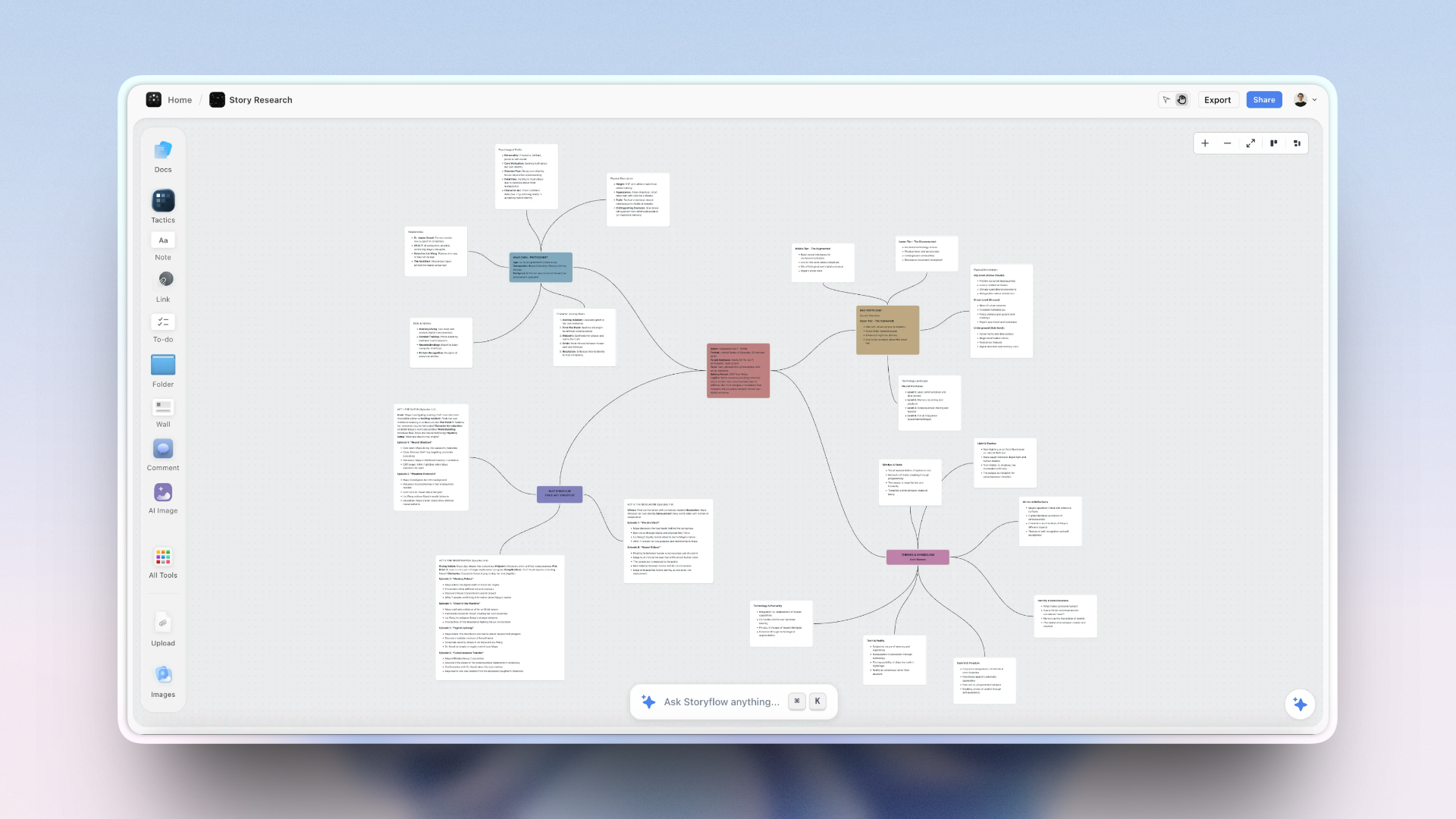
a Storyflow canvas mapping a story arc's rise and fall across beats
The Change-Cost-Proof Test
Every model below tells you what shape to draw. None tells you whether your arc is any good. For that I use a three-question diagnostic, the Change-Cost-Proof test, which works on any story shape, medium, and length.
- Change. Is the ending state genuinely different from the opening state? Name the before and the after in one sentence each. If they are the same sentence, you have an episode, not an arc.
- Cost. What did the change cost? A change handed over for free reads as luck. The audience believes transformation in proportion to the price paid for it: a relationship, a belief, a limb, an illusion, a life.
- Proof. Is there a final beat where the change is tested and holds? Telling us the character grew is assertion. Showing them make the new choice under the old pressure is proof.
In a redemption arc, a hardened character changes (Change), loses the thing that let them stay hard (Cost), and in the climax chooses the generous action when the selfish one is right there (Proof). Skip Change and it is a plot with no point, skip Cost and it is wish fulfillment, skip Proof and the audience does not believe the ending.
Structure diagrams are descriptive; this is prescriptive. Freytag can tell you where the climax sits. Only the Cost question tells you whether it will land. An arc is a change with a cost, and the Change-Cost-Proof test is that sentence turned into something you can check.
The Classic Arc Shapes
If the Change-Cost-Proof test is the quality check, the classic shapes are the templates you start from. Four have earned their place, and one is a specialized case.
| Shape | Origin | Structure | Best fit |
|---|---|---|---|
Freytag's Pyramid | Gustav Freytag, 1863 | Exposition, rising action, climax, falling action, resolution | Tragedy and five-act drama |
Three-act structure | Aristotle, formalized by Syd Field, 1979 | Setup, confrontation, resolution | Screenplays and most feature films |
The Hero's Journey | Joseph Campbell, 1949 | Departure, initiation, return | Myth, adventure, and epic |
Man in a Hole | Kurt Vonnegut | Fall, then rise to a higher point | Comedy and redemption stories |
Rags to Riches | Folk tradition | A steady emotional rise | Underdog and aspirational stories |
Freytag's Pyramid and the Five Stages
Gustav Freytag, a German novelist and playwright, analyzed the structure of classical and Shakespearean tragedy in Die Technik des Dramas (1863) and drew it as a pyramid. His five stages are exposition, rising action, climax, falling action, and a final stage Freytag called the catastrophe, which modern usage relabels resolution.
The thing everyone gets wrong: he was describing tragedy, not stories in general. The symmetrical pyramid, climax dead center, fits Oedipus far better than a modern thriller, where the climax sits near the very end. Use the five stages as vocabulary for naming where you are ("this is falling action and it is running too long"), not as a mold to force every story into.
The Three-Act Structure
The three-act structure is the working default of screen storytelling. Act one is setup: establish the world, the character, and the want, then break the normal with an inciting incident. Act two is confrontation: escalating obstacles, a midpoint that raises the stakes, a low point where the goal looks lost. Act three is resolution: the climax and the new normal. Aristotle supplied the beginning-middle-end skeleton; screenwriter Syd Field, in Screenplay (1979), gave it the modern shape with plot points at the act breaks.
Its strength is proportion: act two runs roughly half the length, which correctly warns you that the middle is where most of the failure lives. Its weakness is that "confrontation" is not a plan. A lot of sagging second acts are technically correct structures where the confrontation is just events, not rising cost.
Vonnegut's Shapes of Stories
Kurt Vonnegut proposed the most useful idea in this field, and he proposed it as a joke. Stories, he argued, have shapes you can draw on graph paper, plotting a character's fortune (good to ill) against time. He submitted a version as his master's thesis in anthropology at the University of Chicago; it was rejected, he later said with delight, for being too simple and looking like too much fun.
His shapes are unforgettable because they are drawn, not defined. "Man in a Hole" is the famous one: a character is doing fine, gets into trouble (the line drops), and gets out, ending higher than they started. Vonnegut's real insight is that the shape is a promise: once the audience senses it, they lean into the fall because they trust the rise is coming.
In 2016 a research team led by Andrew Reagan tested him empirically. In "The emotional arcs of stories are dominated by six basic shapes" (EPJ Data Science, 2016), they ran sentiment analysis across more than 1,300 works of fiction from Project Gutenberg and found six recurring shapes: Rags to Riches (rise), Tragedy (fall), Man in a Hole (fall then rise), Icarus (rise then fall), Cinderella (rise, fall, rise), and Oedipus (fall, rise, fall). Vonnegut's napkin sketch held up against a machine reading thousands of books.
The Hero's Journey
Joseph Campbell, in The Hero with a Thousand Faces (1949), identified a pattern across world myth he called the monomyth: a hero leaves the ordinary world, crosses a threshold into trial and transformation, and returns changed. It is the most detailed arc template in circulation, later simplified into the twelve-step version screenwriters use. It fits myth, adventure, and epic beautifully, and a quiet two-hander about a marriage barely at all. Forcing a "supreme ordeal" onto a story that does not want it is how earnest writers strangle good material. Treat it as one shape among several, not the secret structure of all stories.
How to Build a Strong Story Arc
Knowing the shapes does not build the arc. Here is the sequence I use, built around the Change-Cost-Proof test so the diagnostic and the construction are the same tool.
- Write the before and after in two sentences. State the opening and resolved states plainly. "A workaholic who believes love is a distraction" becomes "a man who reorders his life around a person." That is your Change. If you cannot write both sentences, no amount of plotting will hide it.
- Name the price. Decide what the change will cost, and make it something the protagonist would not pay lightly. This is the Cost, and it is the step amateurs skip. A character who becomes brave should lose the safety that cowardice bought them.
- Pick a shape that fits the change. A redemption fits Man in a Hole, an underdog fits Rags to Riches, a cautionary tale fits Icarus. Do not reverse-engineer a story into a shape. Start from your Change and Cost, then choose the shape they already imply.
- Escalate the cost through the middle. The second act is not "more obstacles." It is a ratchet where each beat costs more than the last. If beat four could swap places with beat seven without anyone noticing, your middle is a list, not a rise.
- Build the proof beat. Design one late scene where the character faces a version of the original pressure and chooses differently. This is your Proof, usually the climax. The audience believes the arc because they watched the new choice cost something and get made anyway.
Do this and the arc is load-bearing before you write a single polished scene. An arc is a change with a cost, so build the change and the cost first, and let the prose hang off that frame.
Where Story Arcs Sag
Arcs fail in a small number of recognizable ways. Learn the failure modes and you can diagnose a limp draft fast.
The sagging middle. The setup lands, the ending is planned, and the middle is a swamp. The cause is almost always that the cost stops rising: events keep happening but cost the same, so tension flatlines. The fix is not more plot but escalation, where each beat takes more from the protagonist than the last.
Change without cost. The protagonist ends up transformed, wiser, in love, victorious, but nothing was paid for it. This reads as wish fulfillment even when every scene is competent, because the ending was given, not earned. Find the price and charge it on the page.
The false peak. The climax is an event, not a proof. A big set piece that does not test the character's specific change is spectacle without an arc. The explosion is loud, but nobody was changed by it.
Two arcs fighting. A plot arc and a character arc that never intersect: the external goal resolves in one scene, the internal change in another. Strong stories fuse them, so the climactic choice satisfies both at once: the case is won precisely by the act of trusting.
Plotting Your Arc on a Canvas
Here is a friction every writer knows and few name. A document forces you to commit to a linear order before you can see the shape. You draft your arc as pages, top to bottom, and the sag is invisible until you have written thirty of them and something feels wrong. You cannot see the rise and fall of a story while it is trapped in a column of paragraphs, because the shape is spatial and the page is a line.
The familiar workaround is index cards on a corkboard, which works because it makes the arc spatial: you stand back, see the whole shape, and move the peak. But a corkboard is dumb: it holds cards and knows nothing about what is on them.
This is the gap Storyflow closes. Storyflow is an infinite canvas where each beat is a card you place in space, so you lay the arc out left to right and see the rise, the peak, and the fall. When the middle sags, the flat run of same-height beats shows in seconds, not thirty pages. Unlike a corkboard, Storyflow's AI reads your full active board (every beat card, note, and image on it) plus up to 1 blueprint and up to 3 Documents you @-mention in the chat, so you can ask where the cost stops rising and it reasons over the actual arc. Story blueprints (200+ on the Plus, Pro, and Max plans) include structures like the Hero's Journey and AIDA, so you start from a shape and fill it with your Change, Cost, and Proof. Plus is $7.99 per month billed annually ($9.99 monthly), and the free plan gives unlimited boards to lay out a full arc first.
Being honest about where Storyflow is the wrong tool matters more than the pitch. First, it is not a dedicated screenwriting app: there is no Final Draft-style script formatting or automated beat-sheet software, so if you need industry-standard pages, you draft the arc in Storyflow and format elsewhere. Second, it is cloud-only with no offline mode, which rules it out for off-grid or strictly local-first writing. Third, it is canvas-card-shaped rather than document-shaped, and a newer product with fewer templates than Notion, so long prose lives better in a real document editor. Storyflow is where you find and fix the arc, not where you write the final draft.
Which Arc Shape Should You Use?
Skip the theory and match your material to a shape.
- Redemption or comeback story: use Man in a Hole. Fall, then rise to a point higher than the start.
- Feature screenplay: use the three-act structure. It is the industry's shared language, and the long, escalating act two keeps you honest about where the work is.
- Myth, adventure, or epic fantasy: use the Hero's Journey. It fits the departure-and-return pattern those genres want. Do not force it onto intimate stories.
- Cautionary tale: use Icarus. A rise that becomes a fall, with the pleasure in the audience seeing it coming before the character does.
- Tragedy or literary drama: use Freytag's five stages. The symmetrical pyramid was built for exactly this.
Whatever shape you pick, run it through the Change-Cost-Proof test before you trust it. The shape tells you the silhouette. The test tells you whether it is alive.
The Bottom Line
A story arc is the shape of change a story makes from beginning to resolution, distinct from plot (the events), character arc (the interior shift), and, splitting hairs, narrative arc (the shape of the telling). The classic shapes, from Freytag's Pyramid to the three-act structure to Vonnegut's six, are templates for that shape. But no template guarantees a good arc. Only the Change-Cost-Proof test does, because it checks the one thing the diagrams cannot: whether the change was worth following.
If you take one idea from this guide, take the sentence it all hangs on. An arc is a change with a cost. Build the change, charge the cost, prove it in a final beat, and you have a story that goes somewhere. If your arc is one piece of a larger project, put every beat on a canvas and stand back: the sag, if there is one, will be obvious in ten seconds. Map your story arc on a Storyflow canvas.
FAQ: Story Arcs
What is a story arc in simple terms?
A story arc is the path a story travels from beginning to ending: the overall shape of change. It is the difference between where a character or situation starts and where it finishes. If nothing is meaningfully different at the end, the story has events but no arc.
What are the 5 stages of a story arc?
The five stages come from Freytag's Pyramid (1863): exposition, rising action, climax, falling action, and resolution. They move a story from its setup, up through peak tension, and down into its new normal. Freytag built them for tragedy, so use them as vocabulary rather than a rigid mold.
What is the difference between a story arc and a plot?
A plot is what happens (the sequence of events); a story arc is the shape of change those events produce. You can summarize a plot without ever naming what changed. "Strong plot, weak arc" means things happen but nothing meaningful shifts.
Is a story arc the same as a character arc?
No. A character arc is the internal change inside one person; a story arc is the trajectory of the whole story, including the external events and the overall shape of tension. The best stories fuse them so the climax resolves both at once.
What is a narrative arc?
A narrative arc is another name for the structural shape of a story, the rise and fall of tension from setup to resolution. In most usage it is interchangeable with story arc, leaning slightly toward the shape of the telling rather than the change in the material. For practical purposes, treat them as the same idea.
What are Kurt Vonnegut's shapes of stories?
Vonnegut argued that stories have simple shapes you can graph by plotting a character's fortune against time, such as "Man in a Hole" (trouble then recovery) and "Cinderella" (rise, catastrophe, happiness). In 2016, a team led by Andrew Reagan confirmed the idea empirically, finding six dominant emotional shapes across more than 1,300 novels.
How do you build a strong story arc?
Write the opening and resolved states in one sentence each to define your change, then decide what that change costs the protagonist. Pick a shape that fits, escalate the cost through the middle so tension keeps rising, and design a late beat that proves the change under pressure. That final proof is usually your climax.
Why does the middle of my story feel boring?
The middle sags because the cost stops rising, not because you need more events. When each scene costs the protagonist the same amount, tension flatlines even if plenty is happening. The fix is escalation: every beat should take more from the character than the one before.
Does a story arc have to end happily?
No. An arc requires meaningful change, not a positive one. A tragedy is a complete arc where the change is a fall, and Vonnegut's own shapes include Tragedy and Icarus. What makes an arc satisfying is not a happy ending but an earned one, where the ending state was paid for by the events that led to it.
What tools help you plan a story arc?
Index cards, corkboards, and whiteboards help because they make the arc spatial, letting you see the rise and fall at a glance instead of buried in pages. Canvas tools like Storyflow extend this by keeping the beat cards next to research, with AI that reads the board to flag where tension flattens. Dedicated screenwriting apps handle formatting but are weaker at showing the overall shape.
Table of Contents
- The Short Version
- What Is a Story Arc, Exactly?
- Story Arc vs Plot vs Character Arc vs Narrative Arc
- The Change-Cost-Proof Test
- The Classic Arc Shapes
- How to Build a Strong Story Arc
- Where Story Arcs Sag
- Plotting Your Arc on a Canvas
- Which Arc Shape Should You Use?
- The Bottom Line
- FAQ: Story Arcs
- Related Reading
Templates to check out for this topic


Templates you can use in Storyflow
Every Storyflow board starts from real structure and an AI that reads the whole canvas. Open one of these templates and make it yours.


See Storyflow in Action
A visual AI workspace where every feature lives inside one canvas. No tab-switching, no context lost.
Build your entire board from a single message
Type what you need in the AI chat at the bottom of your canvas. The AI adds cards, headings, and structure directly onto your board.
Use expert frameworks as AI context
Type @ in the AI chat and choose any Tactic. The AI tailors every response to that framework instead of giving generic advice.
Turn your board into a mind map in seconds
Ask the AI to restructure your canvas as a mindmap. It connects your ideas into a visual hierarchy so you can see how everything relates.
Why Storyflow Exists
Storyflow actually began as a personal tool while working on creative and research projects.
We kept running into the same problem: ideas were scattered everywhere: notes, documents, and whiteboards.
Nothing helped us see how everything connected.
So we started building a workspace designed around how ideas actually grow.
→ Read how Storyflow was createdJustkay
Documentary Filmmaker & Founder at Storyflow
Published: 2026-07-15
Extremely simple, seriously capable


See how easy it is to get started
Watch a real project come together, from a blank board to a finished plan, clicked through step by step.
Start creating with AI and become more productive
Transform your creative workflow with AI-powered tools. Generate ideas, create content, and boost your productivity in minutes instead of hours.